Subscription Lifecycle Management: A Practical Guide
- subscription lifecycle management
- ecommerce retention
- Shopify subscriptions
- churn reduction
- LTV optimisation
Launched
August, 2026
The UK has approximately 155 million active subscriptions, representing around £26 billion in annual consumer spend. Yet about 5.8% are unwanted, equivalent to roughly 9.7 million subscription contracts and £1.6 billion wasted each year, according to the UK government's subscription contracts data. That gap isn't a niche billing issue. It's the operational challenge at the centre of subscription lifecycle management.
A subscription programme can acquire customers efficiently and still lose money through failed payments, forgotten renewals, unclear trial terms, rigid delivery schedules and cancellation journeys designed to obstruct rather than help. I've seen Shopify merchants treat these problems as separate marketing, finance and support tasks. They're not. They're connected stages in one revenue system, and each hand-off needs reliable data, clear ownership and a customer experience that earns the next renewal.
What Subscription Lifecycle Management Really Means
Subscription lifecycle management is the operating system behind recurring revenue. It coordinates the subscriber relationship from the first offer through onboarding, ongoing use, renewal, cancellation and possible reactivation. Billing is part of that system, but it isn't the whole system. A payment platform can authorise charges and retry failures, while the merchant still sends poor renewal communications, hides pause controls or fails to understand why customers leave.
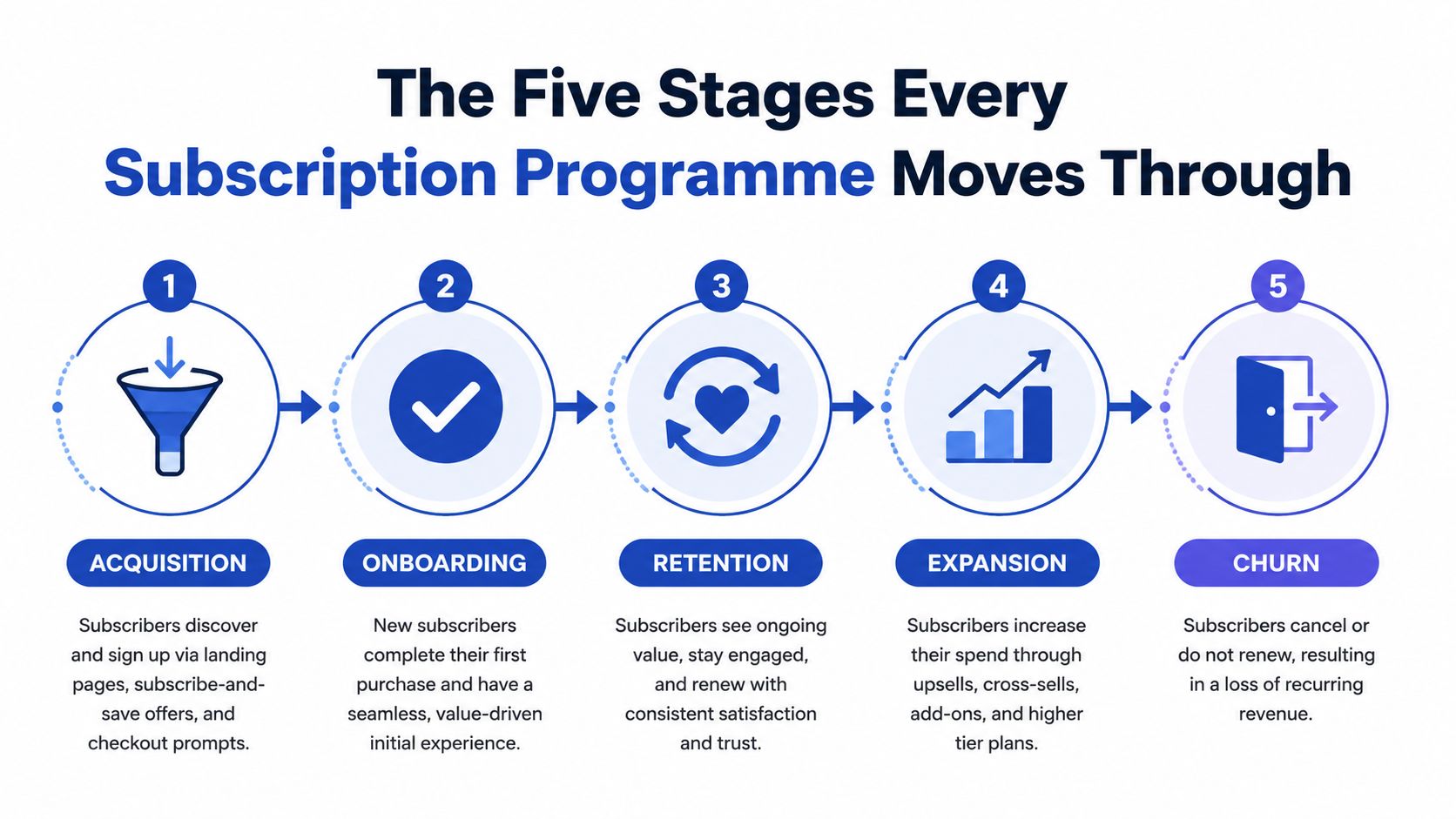
A practical model has five stages:
- Acquisition, where the customer discovers the offer and starts a subscription.
- Onboarding, where the merchant confirms expectations and gets the first order or first product experience right.
- Engagement, where the business creates reasons to use, reorder or explore more.
- Retention, where renewal value, flexibility and payment continuity are managed.
- Churn and recovery, where the merchant handles cancellation, failed payments and win-back.
The UK market shows why every stage deserves operational attention. Almost half of UK adults, 49%, regularly pay for entertainment and book platforms such as Spotify, Netflix and Amazon Prime, according to the Department for Business and Trade evidence review. At the same time, Citizens Advice reported that over 13 million people, or 26% of UK adults, accidentally took out a subscription during the previous year, with £688 million in unused subscription costs. A mature market still leaks revenue when the journey lacks clarity.
The three numbers that connect the stages
Retention rate tells you whether subscribers continue. Involuntary churn separates payment failure from a deliberate cancellation. Lifetime value, or LTV, shows whether the full relationship produces enough value to justify acquisition, service and recovery costs.
These metrics only help when the underlying events are classified correctly. A customer whose card expires hasn't necessarily rejected your product. A customer who cancels because a delivery arrived too frequently needs a different intervention from one who never understood the renewal terms.
Practical rule: Fix the path from charge attempt to payment recovery before spending more on discounts.
Merchants commonly lose money through forgotten renewals, hard-to-find cancellation controls and incomplete dunning. For teams serving values-led customers, resources such as Loyaltie for conscious shoppers can also help frame loyalty around trust and long-term customer value rather than indiscriminate promotional pressure. The implementation principle remains the same: give customers accurate information, useful controls and a reliable reason to continue.
The Five Stages Every Subscription Programme Moves Through
The five-stage model becomes useful when each stage has a Shopify implementation and an owner. The labels are familiar. The failure points are operational: unclear selling plans, missing account controls, inaccurate billing, weak renewal reminders and cancellation flows that create support work.
Acquisition
Configure the product template and selling plan selector so recurring and one-off purchases are visibly different. Show frequency, price and renewal terms before add-to-cart. In Shopify, selling plan data should carry into the cart line item, while checkout messaging confirms what will renew and when.
A coffee merchant might place one-off bags beside weekly or monthly plans. The trade-off is clarity versus visual simplicity. Hiding frequency may shorten the page, but it increases unsuitable sign-ups and later cancellations.
Onboarding
After subscription creation, pass order and subscription details into the confirmation page, transactional email and customer account. State the first delivery expectation, the next charge and the available account actions. Shopify customer accounts can expose subscription management through the subscription app's customer portal, rather than sending every change request to support.
Check the first order against the promise made on the product page. A late shipment or missing account instruction creates cancellation pressure before the second charge.
Engagement
Use the subscription status and selling plan as customer data that email and CRM workflows can read. A pet food merchant could send a consumption-based reminder, allow quantity changes through the portal and present an add-on after a successful delivery. The useful integration is the event handoff, not a larger campaign calendar.
Retention
Wire renewal reminders to the next billing date and make pause, skip, swap and quantity changes available before the charge. Shopify Flow can route relevant events to support or CRM systems, while the subscription app handles plan changes and billing actions. Flexibility can reduce short-term order volume, but it often costs less than losing a customer who temporarily has too much stock.
Billing accuracy matters here. Reconcile subscription orders, selling plan allocations, discounts and fulfilment status so a customer is not charged for an incorrect frequency or shipment.
Churn and recovery
Separate deliberate cancellation from payment failure in the subscription platform and downstream CRM. A Flow workflow can detect a status change, tag the customer and start the appropriate sequence. An active cancellation should open a reason-based flow with pause or swap options. A failed payment needs a payment-update path, retry handling and clear account instructions.
The cancellation screen should confirm the effective date and stop future charges. A confusing exit may delay churn briefly, but it also increases disputes and support contacts. The operational test is simple: trace one subscription from selling plan selection through renewal, cancellation and recovery, then verify every system records the same state.
Metrics That Drive Each Stage of the Lifecycle
Metrics should lead to a decision. If a dashboard only reports what happened, it's a history lesson rather than a management tool.
| Stage | Key Metric | Decision It Drives |
|---|---|---|
| Acquisition | Subscribe conversion rate and cost per subscriber | Shift spend towards offers and channels that attract viable recurring customers |
| Onboarding | First-order delivery success and confirmation email engagement | Repair fulfilment, messaging or expectation gaps before early cancellation |
| Engagement | Reorder rate, portal login frequency and upsell attach rate | Choose whether to improve product usage, account controls or merchandising |
| Retention | Voluntary churn, pause usage and renewal reminder click-through | Improve plan flexibility and renewal communications |
| Recovery | Involuntary churn, dunning recovery and win-back conversion | Adjust retry logic, payment messaging and reactivation timing |
Acquisition and onboarding signals
A falling subscribe conversion rate can indicate weak offer presentation, but it can also indicate that the recurring commitment isn't clear enough. Compare conversion by product, device, traffic source and selling plan, then inspect the checkout experience rather than immediately adding a discount.
For onboarding, first-order delivery success is more actionable than a broad customer satisfaction score. If orders arrive late or confirmation emails lack useful account instructions, fix those operational defects before increasing acquisition spend.
Engagement and retention signals
Portal login frequency is a directional signal, not a universal measure of value. A customer may rarely log in because the subscription works perfectly. Pair portal activity with reorder behaviour, support contacts, product consumption and skip events so you don't classify a quiet but healthy subscriber as at risk.
For retention, separate voluntary churn from involuntary churn. FT Strategies' subscription economy barometer specifically highlights the need for accurate system reporting and multi-point feedback because payment failures can look like customer rejection when the customer never intended to cancel.
Recovery and cohort economics
Track dunning recovery by failure reason, payment method, plan type and retry step. A recovery percentage without those dimensions can hide a broken card-update experience behind an apparently acceptable average.
LTV should be reported by acquisition cohort and subscription plan. If a campaign produces many sign-ups but those customers cancel before a second shipment, the acquisition metric is flattering a weak lifecycle. The useful question isn't whether the customer converted. It's whether the offer attracts customers who receive value and remain profitable.
Mapping the Lifecycle Onto Shopify and Shopify Plus
Shopify gives merchants the storefront and commerce foundation, but subscription lifecycle management depends on how the surfaces connect. A subscription app may manage contracts and recurring orders, while Shopify Flow, customer accounts, email tools and payment webhooks handle the surrounding experience.
| Stage | Shopify Surface | Key APIs / Apps | Notes |
|---|---|---|---|
| Acquisition | Theme, product pages, landing pages and checkout | Selling plans, subscription app and checkout extensibility | Make recurring terms visible before purchase |
| Onboarding | Order status page, customer accounts and email | Customer Account API, post-purchase extensions and email platform | Confirm delivery, access and account controls |
| Engagement | Customer account portal and lifecycle messaging | Subscription APIs, Klaviyo or Omnisend | Segment by active, paused, skipped and cancelled status |
| Retention | Subscription management and payment recovery | Subscription Contract API, payment webhooks and dunning tools | Support swaps, skips, pauses and payment updates |
| Churn and recovery | Flow, CRM and reactivation messaging | Shopify Flow, webhooks and CRM integration | Distinguish cancellation intent from payment loss |
Storefront and checkout
At acquisition, the critical choice is whether to use an established subscription app or build more of the experience yourself. An app usually reduces implementation time and covers common contract operations. Custom work gives greater control over plan presentation, portal behaviour and integrations, but it creates responsibility for edge cases, testing and ongoing API changes.
Merchants planning the setup should map product, selling plan, fulfilment and tax behaviour together. This Shopify subscription store setup guide is useful as a practical reference, particularly when the recurring offer affects product data and checkout presentation.
Accounts, messaging and automation
The Customer Account API can support a more coherent self-service experience, while the subscription platform remains responsible for contract operations. Klaviyo and Omnisend can manage behavioural messages, but only if events are reliable and suppression rules prevent cancelled subscribers receiving active-customer promotions. Shopify Audiences can support acquisition analysis and suppression, although merchants should avoid treating it as a substitute for lifecycle reporting.
Shopify Flow is well suited to operational routing. A status change can add a customer tag, create a task, notify support or send data to a CRM. The Flow trigger should not be the only source of truth. Use webhooks for systems that need reliable event delivery, idempotency and auditability.
Shopify Plus considerations
Shopify Plus adds more room for customized checkout experiences through checkout extensibility. B2B merchants also need to consider company locations, purchasing permissions and subscription contracts rather than assuming a consumer flow will transfer cleanly. Shopify Functions can support custom pricing and discount logic, but every pricing rule should be tested against renewal, cancellation, refund and partial fulfilment scenarios.
Two Merchants, Two Lifecycle Outcomes
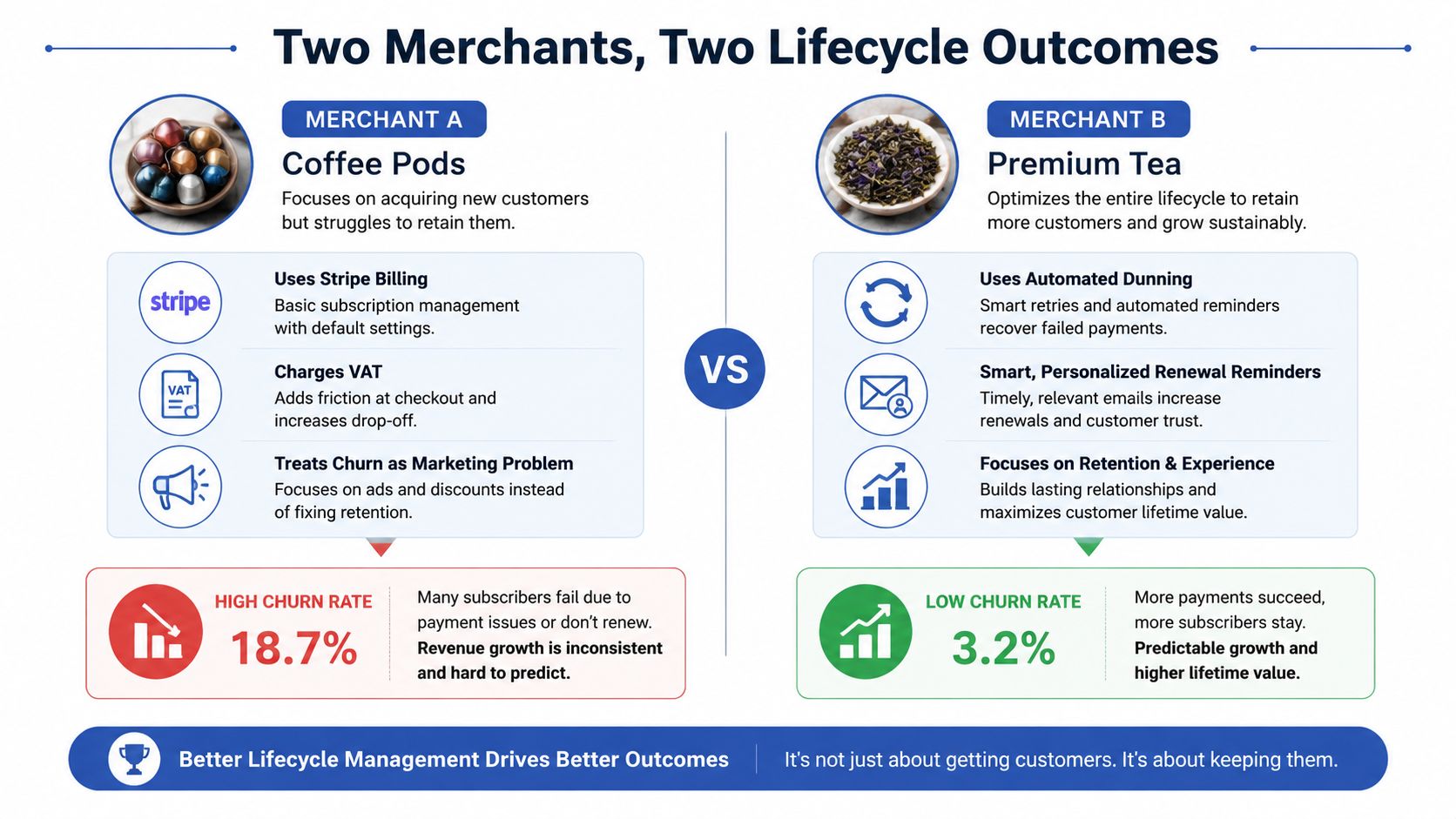
Consider two Shopify Plus merchants with similar acquisition economics and recurring product models. The difference isn't a new traffic channel. It's what happens after the first successful charge.
Merchant A sells coffee pods and uses Stripe Billing alongside a Shopify storefront. The team treats churn as a marketing problem, so it keeps refining acquisition creative while leaving the cancellation path as a single exit button. Dunning is generic, payment failures aren't classified by cause, and annual customers receive no reminder before rebilling.
That configuration creates several blind spots. A customer with an expired card is counted alongside a customer who actively dislikes the product. A customer who has too much stock sees no skip option. An annual subscriber can be surprised by a renewal they no longer remember authorising. The result is a programme that may convert well but provides little evidence about why revenue disappears.
Merchant B sells pet supplements through Recharge. The team connects card-update webhooks to its recovery flow, separates payment failures from deliberate cancellations, and gives customers a portal where they can adjust products and timing. Its cancellation journey asks for a reason, offers relevant alternatives and sends a renewal reminder for annual plans.
The important difference is not the vendor name. It's the operating design. Merchant B can see whether the customer needs a payment update, a pause, a smaller quantity or a genuine exit, then route that event to the right experience.
What the comparison teaches
The scenarios point to three practical conclusions:
- Acquisition doesn't compensate for operational leakage. More sign-ups won't repair failed renewals or confusing cancellation.
- Tools don't create the lifecycle by themselves. Recharge, Stripe Billing or another platform still needs deliberate event design, messaging and ownership.
- The same status needs different treatment. “Cancelled” may mean a deliberate decision, an expired payment method, a temporary pause or a customer who wants a different product.
Treat these as operating scenarios, not published case studies. The useful lesson is that lifecycle outcomes are engineered through contracts, events, account controls and recovery logic. A merchant can choose different platforms and still achieve the same discipline if the underlying workflow is designed properly.
Why Cancellation UX and Renewal Reminders Matter More Than Discounts
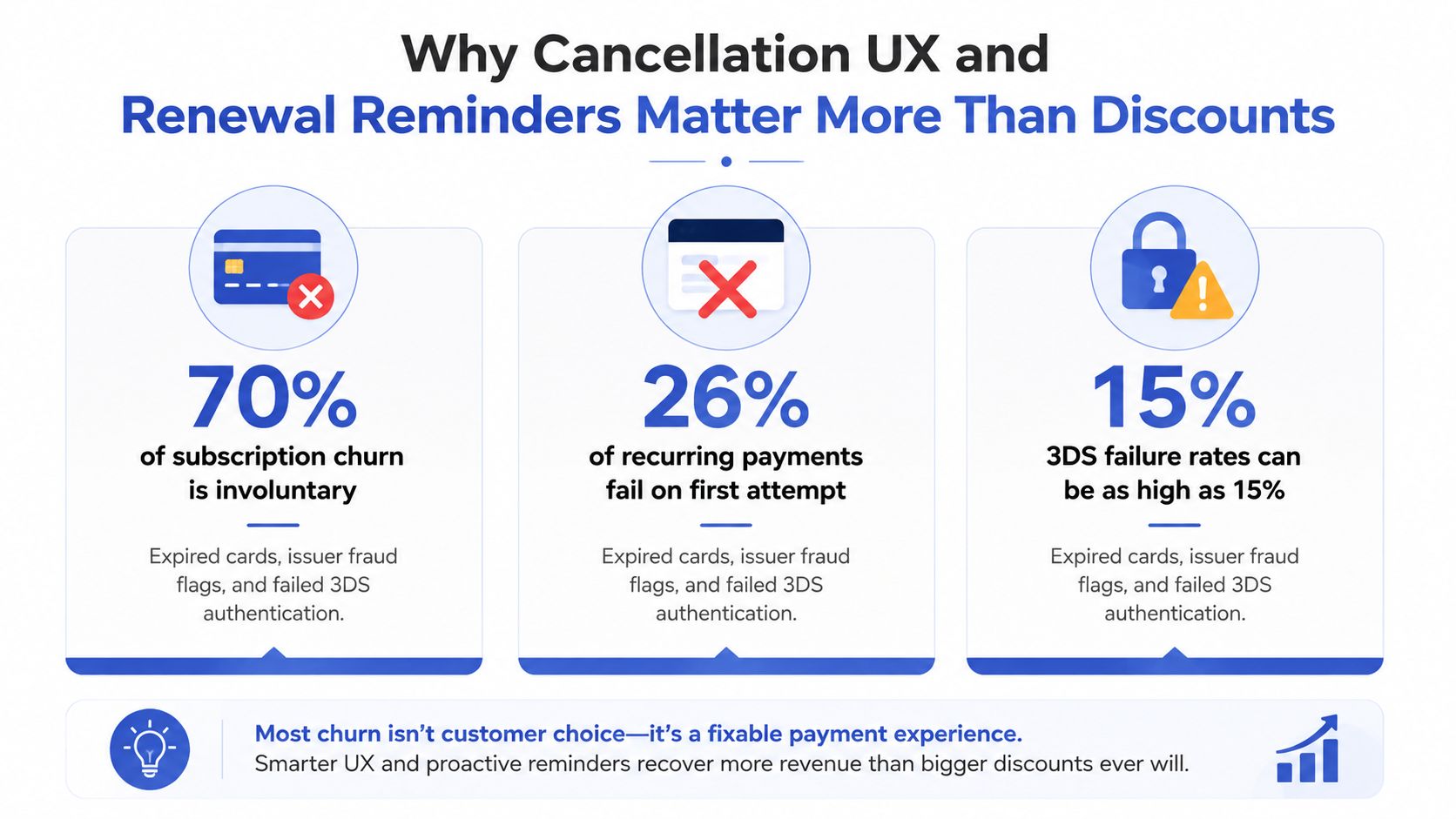
Retention teams often reach for a discount because it's easy to measure and easy to deploy. That can be the wrong first response. A discount may preserve a customer who wants less value, but it won't fix an expired card, an unclear renewal condition or a delivery schedule that no longer fits.
UK consumers themselves describe a market with substantial friction. Citizens Advice reported that 23% of UK adults failed to cancel a subscription during the previous year, losing an average of £123.40 each, as covered by the BBC's reporting on unwanted subscriptions. The same reporting cites government estimates of about 10 million unwanted active subscriptions, including 3.5 million people moved from free or discounted trials into full-price contracts and 1.3 million people affected by unexpected auto-renewals.
Build the exit customers can understand
A good cancellation flow makes the decision clear and preserves future trust. Put the cancellation control where customers expect it, explain the effective date, show what happens to pending orders and offer pause, skip or downgrade options before the final confirmation. Don't make the customer contact support to stop a recurring charge.
The alternative should match the reason. A price concern may justify a lower quantity. Excess stock calls for a skip. A temporary absence may justify a pause. A product complaint needs service recovery, not an automatic percentage off.
Treat annual renewals as explicit moments
Annual subscribers need advance notice that states the renewal date, amount, plan and cancellation route. Email reminders should be coordinated with account access and consented SMS where appropriate. The point isn't to pressure customers into staying. It's to ensure the renewal is informed rather than accidental.
Payment recovery belongs beside this work. Shopify Payments, a subscription app and a CRM can share payment failure events through webhooks, but the merchant must define the retry schedule, message sequence and stopping conditions. The workflow should avoid charging indefinitely, sending contradictory messages or marking a customer as voluntarily churned before recovery has finished.
Merchants that need human ownership for renewal conversations can also consider customer success recruitment services, particularly when subscription value depends on proactive support rather than automated messages alone. For the messaging layer, lifecycle email marketing guidance can help organise triggers around status, behaviour and renewal timing instead of relying on a generic campaign calendar.
Your 90-Day Subscription Lifecycle Playbook
A merchant doesn't need to replatform to improve subscription lifecycle management. Start with the revenue leaks that can be diagnosed and corrected quickly, then build the data habits that prevent the same issues returning.
| Window | Action | Shopify Surface | Lifecycle Impact |
|---|---|---|---|
| First two weeks | Activate card updates, map failed-payment triggers and write recovery emails | Payment settings, webhooks and email platform | Reduces avoidable payment loss |
| First two weeks | Publish self-service pause, skip, swap and cancellation controls | Customer Account API and subscription portal | Makes changes clear and reduces support friction |
| First two weeks | Audit recurring terms and renewal visibility | Theme, product pages and checkout extensibility | Improves informed acquisition and renewal |
| Days 30 to 60 | Implement reason-based dunning and retry handling | Subscription Contract API, webhooks and Flow | Separates recovery from deliberate churn |
| Days 30 to 60 | Build onboarding and pre-renewal sequences | Order status page, customer accounts and CRM | Reinforces value before the next charge |
| By day 90 | Create cohort LTV and churn-reason reporting | Shopify data, subscription platform and warehouse | Connects acquisition quality to retention |
| By day 90 | Review cancellation, pause and win-back outcomes | Flow, CRM and analytics | Shows which interventions preserve future value |
Quick wins
In the first two weeks, audit the full customer path as a subscriber, not as an administrator. Place a test order, update the payment method, skip a delivery, change a product and cancel. Record every screen, email and status transition. Activate available account updater functionality, ensure failed payments create a recoverable event and replace generic cancellation messaging with a self-service page.
Structural fixes
During days 30 to 60, formalise retry logic and contract events. Use webhooks for payment and subscription status changes, Flow for internal routing, and the Subscription Contract API where the portal or connected systems need contract-level operations. Add onboarding messages that explain delivery and account controls, then create renewal reminders tied to the actual contract date rather than a broad customer segment.
Measurement habits
By day 90, report voluntary and involuntary churn separately, group cancellation reasons into a usable taxonomy and review LTV by acquisition cohort. Churn reduction strategies for Shopify merchants can provide additional prompts for deciding which intervention to test first.
Fix billing accuracy before chasing discount-led retention. Recovered recurring revenue compounds through the existing customer base, while a new acquisition programme still has to pay for traffic, conversion and onboarding.
Grumspot helps Shopify merchants design and implement subscription experiences, including customer portals for pausing, skipping, changing products, updating payment details and cancelling, alongside welcome sequences, renewal reminders and cancellation interruption logic. Visit Grumspot to discuss a subscription audit, portal build or Shopify Plus integration plan grounded in the workflows your store needs.
Let's build something together
If you like what you saw, let's jump on a quick call and discuss your project

Related posts
Check out some similar posts.
- subscription examples
Explore 7 subscription examples across Shopify, pricing and retention models, with practical lessons...
Read more
- ecommerce subscription platform
Learn how an ecommerce subscription platform works, which models drive retention, and how to choose,...
Read more
- subscription service
Learn how to set up a subscription service with proven pricing, billing, churn and compliance strate...
Read more
- lifecycle email marketing
Master lifecycle email marketing for ecommerce. Our guide covers customer stages, automated flows, S...
Read more