Ecommerce Subscription Platform Guide for Shopify Brands
- ecommerce subscription platform
- Shopify subscriptions
- subscription ecommerce
- DTC retention
- Shopify Plus
Launched
September, 2026
Your acquisition team has had a strong month, yet the revenue forecast still feels fragile. Customers arrive through paid social, buy once, and disappear into a spreadsheet while finance tries to predict which orders will return. You may have a healthy product and a capable Shopify store, but one-off transactions make every month start from zero.
An ecommerce subscription platform changes the operating model. Instead of treating each purchase as an isolated event, it connects the offer, recurring payment, customer account, fulfilment trigger and retention journey. The result isn't guaranteed growth, but it gives your team a system for building an ongoing customer relationship rather than repeatedly reacquiring the same buyer.
The opportunity is particularly relevant in the UK. The subscription box market rose from £332 million in 2020 to £395 million in 2021, an 18.9% year-on-year increase, and was projected to reach £1.8 billion by 2025, according to Whistl's UK subscription box research. The same research indicated that 81% of UK households had signed up for at least one subscription service in 2021, compared with 65% the year before.
That adoption also creates a harder problem. Customers already understand subscriptions, so adding a “subscribe and save” button won't make your brand distinctive. Your platform needs to support a useful product model, transparent payment choices, easy account control and thoughtful retention work without making customers feel trapped.
Introduction to Recurring Revenue for Shopify Brands
A DTC founder often sees the subscription opportunity in a familiar way. A customer buys a cleanser, coffee blend or supplement, and the brand knows that the product will probably be needed again. The commercial question becomes whether the next purchase happens through a convenient recurring plan or through another expensive acquisition campaign.
That distinction matters because subscriptions move the relationship beyond the checkout. A buyer chooses a product once. A subscriber makes an ongoing commitment, and the brand takes responsibility for delivering value at every renewal. The storefront, billing provider, customer service team and warehouse all become part of the same experience.
UK demand is broad, but it isn't uniform. Research from Whistl Parcels on consumer subscription behaviour found that 38% of the UK population had used a subscription box service. Usage was highest among 18 to 31-year-olds at 58%, compared with 17% among people over 65. Monthly delivery was the dominant cadence at 58%, while 23% received weekly deliveries, and food or recipe boxes led categories at 53%.
These figures suggest two practical conclusions. First, subscription commerce is familiar enough that customers don't need a basic explanation of the concept. Second, the offer has to match product frequency and audience expectations. A monthly food box solves a different problem from a quarterly discovery box or a membership that provides digital access.
This guide helps you make five connected decisions:
- Commercial model: Should you offer replenishment, curation, membership or a configurable bundle?
- Platform depth: Do you need a lightweight Shopify app, a broader subscription system or custom architecture?
- Payment design: Which billing method and recovery process will protect the customer experience?
- Migration path: How can you move existing subscribers without missed renewals or duplicate charges?
- Growth system: How will you improve conversion, retention and customer value after launch?
The central idea is simple. A subscription platform isn't just a recurring checkout feature. It's the operating layer that helps your brand earn the next renewal.
What an Ecommerce Subscription Platform Actually Does
Think of a subscription as a membership club. The customer joins, selects their benefits, pays according to an agreed schedule and expects the club to remember their preferences. The club also needs to know when payment fails, what access remains active and how a member can change or leave.
An ecommerce subscription platform coordinates those responsibilities for a product business. It connects the catalogue and subscription rules to checkout, payment processing, order creation, fulfilment and the customer account area.
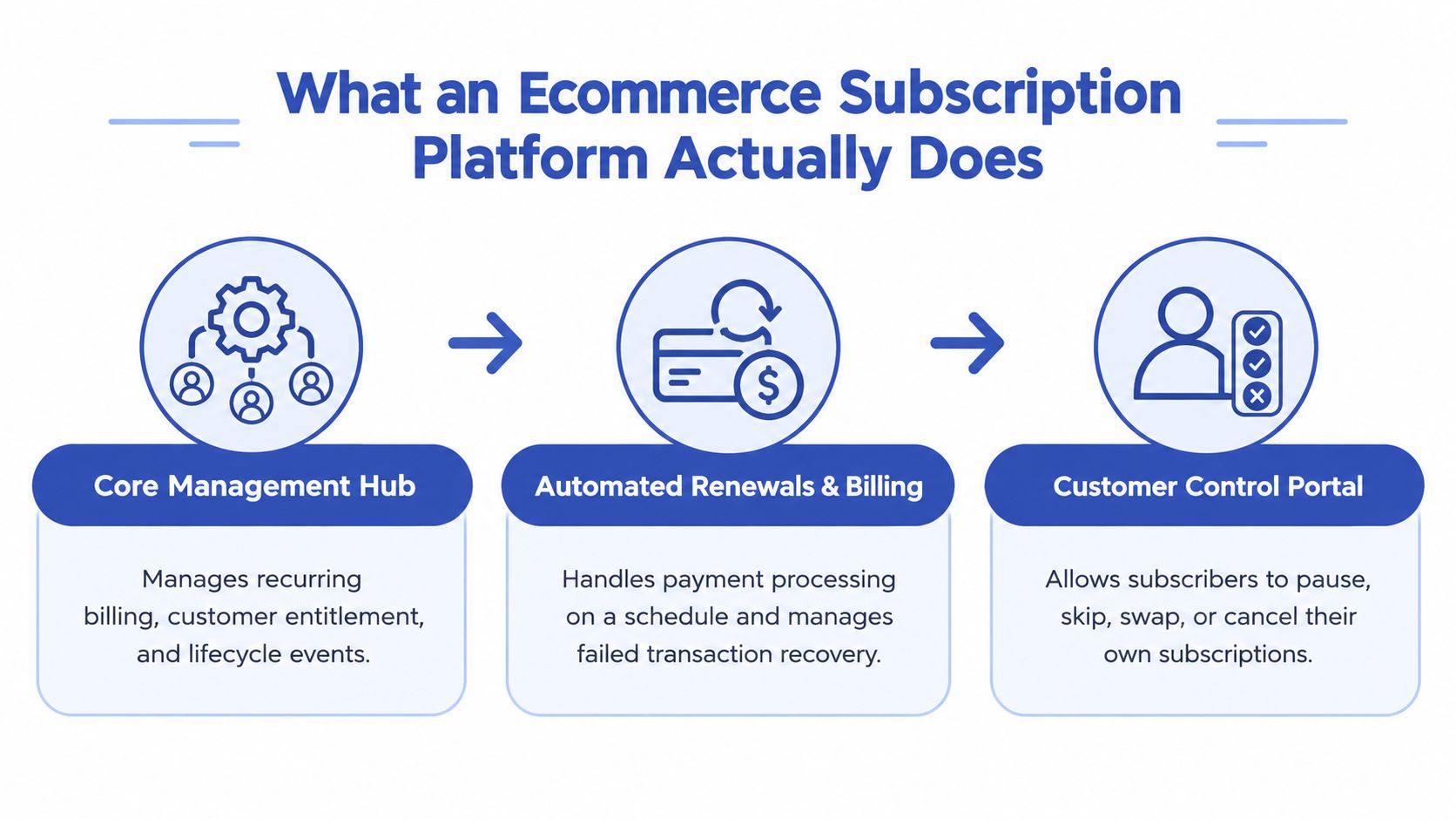
Core concept: Recurring billing charges the customer. Subscription commerce manages the relationship around that charge.
The five working parts
Product catalogue and rules define what can recur. You might allow a single coffee product every month, a curated box with changing contents or a bundle where the subscriber selects individual items. The platform must connect each choice to price, stock, delivery timing and eligibility.
Checkout presents the recurring offer clearly. Customers should understand the amount, billing interval, delivery terms and cancellation options before they pay. On Shopify, subscription selling plans and subscription contracts provide the underlying structure that apps and custom experiences can use.
Billing and renewal orchestration schedules charges and creates the events that follow them. A successful payment may trigger an order and fulfilment request. A failed payment should trigger a recovery journey rather than an unexplained cancellation.
Entitlement and lifecycle management records what the subscriber is owed. For physical goods, that may mean the next shipment. For a membership or digital product, it may mean continued access to a benefit. Pauses, skips, swaps, upgrades, downgrades and cancellations all change that state.
Customer control gives subscribers a branded portal where they can manage the relationship themselves. Self-service reduces avoidable support requests, but it also gives customers a safer alternative to cancelling when they need a temporary change.
App, platform or native API
A subscription app adds recurring capability to an existing Shopify store. It can be the fastest route for a straightforward replenishment offer, particularly when the standard checkout and customer portal meet your needs.
A full subscription platform usually provides deeper lifecycle logic, payment recovery, reporting and integrations. It becomes more valuable when subscriptions are central to operations rather than a small addition to the catalogue.
Shopify's native Subscription APIs sit lower in the stack. They provide the commerce primitives, while an app or custom development team builds the particular experience, workflows and integrations. That approach offers more control, but it also transfers more responsibility to your technical team.
The right choice depends on how much of the membership club you need to operate. If you only need scheduled repeat orders, an app may be enough. If you need complex product selection, regional payment logic, fulfilment coordination and a distinctive portal, evaluate the full system rather than the recurring button.
Subscription Business Models That Drive Retention
The product determines the subscription model more than the platform does. A replenishment plan works because the customer consumes a familiar product. A discovery box works because variety creates anticipation. A membership succeeds when the continuing benefits are more valuable than the effort of staying enrolled.
Four models to compare
Replenishment subscriptions suit products customers use at a predictable rate, such as coffee, skincare, pet food or household consumables. The retention driver is convenience. The platform should make the next delivery reliable while allowing the customer to adjust timing when their actual usage changes.
Curation and discovery boxes combine products into a changing experience. Beauty samples, food selections and lifestyle boxes can create excitement, but customers may cancel if the contents feel repetitive or poorly matched. Retention depends on personalisation, clear previews and enough flexibility to manage preferences.
Access and membership subscriptions sell benefits rather than a physical shipment. Examples include exclusive products, premium support, gated content or a community experience. The platform needs to connect payment status to entitlements, so access changes correctly when a customer upgrades, pauses or cancels.
Build-a-box and bundle subscriptions let customers assemble a recurring selection. This model can fit food, supplements, beauty and lifestyle catalogues with complementary products. It increases choice and can make the plan feel more relevant, but the platform must handle inventory, pricing and substitutions without creating operational confusion.
| Model | Best For | Billing Cadence | Retention Driver |
|---|---|---|---|
| Replenishment | Consumables and repeat-use products | Matched to product consumption | Convenience and continuity |
| Curation | Food, beauty and lifestyle discovery boxes | Usually a regular delivery schedule | Surprise, relevance and anticipation |
| Access or membership | Clubs, benefits and gated experiences | Ongoing access period | Exclusive value and belonging |
| Build-a-box | Mixed catalogues and configurable bundles | Customer-selected recurring interval | Control, relevance and bundle value |
Retention also depends on lifecycle design. A customer who can skip a shipment during a holiday may remain valuable, while a customer forced to cancel may be lost entirely. Subscription lifecycle management guidance is useful when you map these moments from sign-up through renewal, pause, reactivation and cancellation.
Don't assume one model must serve the whole catalogue. A food brand might offer a simple replenishment plan for a core product and a curated seasonal box for customers who want discovery. A beauty brand could combine replenishment for essentials with membership access to early product launches.
The commercial test is whether the recurring promise remains useful after the first delivery. If the customer has to keep receiving more product than they can use, convenience becomes waste. If the box lacks freshness, discovery becomes disappointment. If membership benefits are hard to access, exclusivity becomes friction.
How to Evaluate an Ecommerce Subscription Platform for Shopify
A feature list won't tell you whether a platform fits your store. Ask what happens during the customer's full lifecycle, from selecting a plan to changing a delivery, recovering a failed payment and reconciling the resulting order in your operational systems.
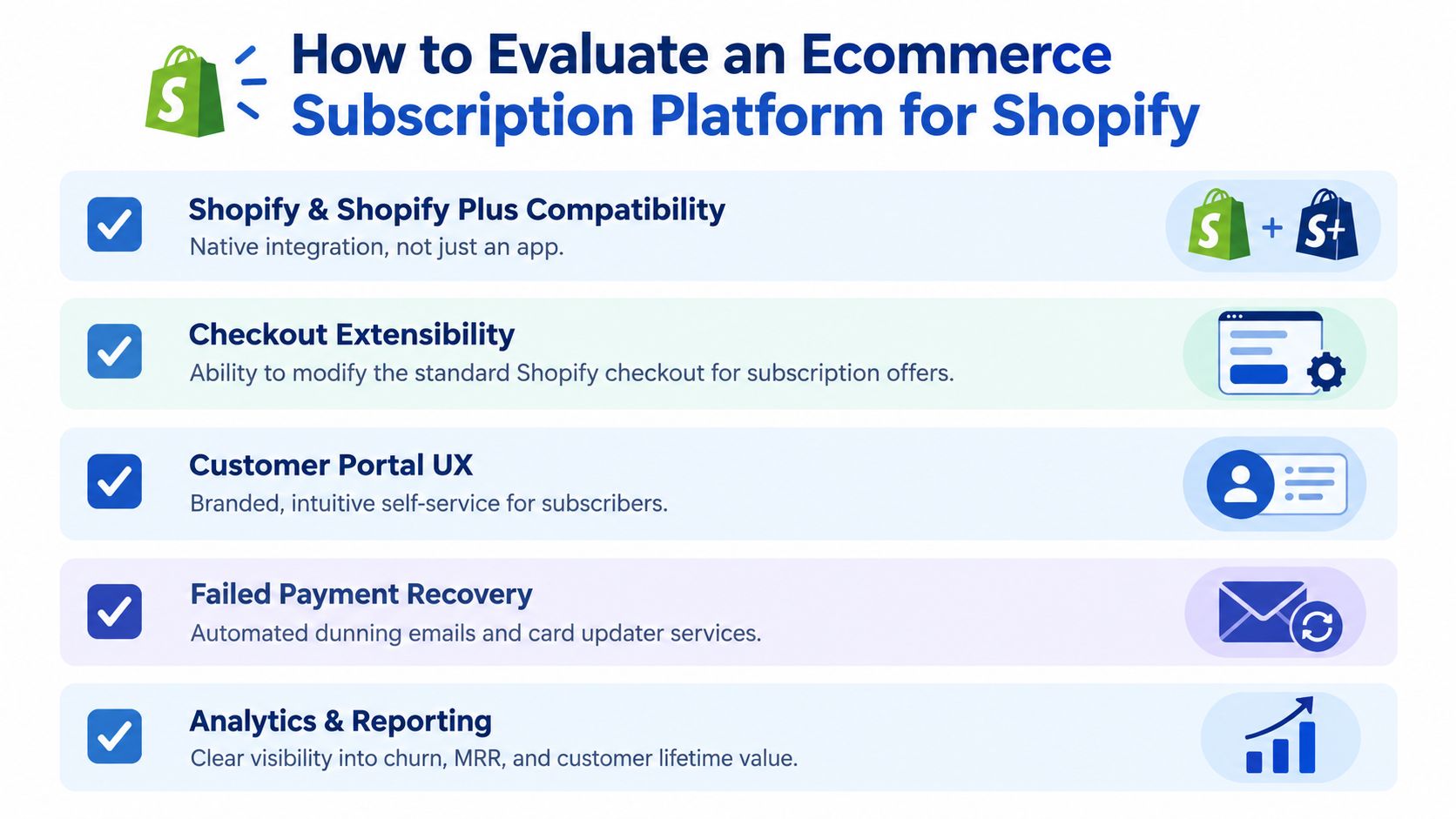
Start with Shopify compatibility, then test the areas where subscription projects usually become fragile.
Shopify fit and checkout control
A platform should work cleanly with your Shopify or Shopify Plus setup rather than placing a second storefront beside it. Review how it uses Shopify 2.0 themes, subscription selling plans, Functions and checkout extensibility. “Compatible with Shopify” can mean a native integration, an embedded app, a custom checkout flow or a series of workarounds. Those options have different implications for maintenance and performance.
Check the subscription offer on mobile as well as desktop. The customer should see the recurring price, delivery interval and commitment terms without navigating a confusing sequence of widgets. On Shopify Plus, ask which checkout changes are supported through current extensibility patterns and which require an external experience.
Customer control and payment recovery
The portal deserves the same design attention as the product page. Test whether subscribers can pause, skip, swap products, update delivery details and cancel without contacting support. A portal that hides cancellation may reduce immediate churn, but it can damage trust and increase payment disputes.
Failed payments need a defined workflow. Ask whether the system supports automated customer notifications, retry logic, card updater services and clear status information for your operations team. Revenue leakage can also originate in process gaps beyond payment failure, so this overview of revenue loss in SaaS platforms offers useful context for auditing recurring revenue controls.
Data, integrations and ownership
Your platform should expose usable data for finance, marketing and customer support. Look for visibility into active subscriptions, renewals, cancellations, pauses, reactivations, recurring revenue and cohort behaviour. Don't accept a dashboard that shows total sales but can't explain why customers leave.
Map integrations with your ERP, CRM, warehouse, fulfilment partner, tax tools and analytics stack. Confirm which system owns the product, customer, subscription contract, payment status and order record. If two systems can edit the same field, document the source of truth before launch.
Use a decision matrix rather than choosing the tool with the longest feature page:
| Decision filter | Lightweight app | Subscription platform | Custom or composable build |
|---|---|---|---|
| Launch speed | Usually fast | Moderate | Slower |
| Experience control | Limited to configurable patterns | Broader | Highest |
| Operational complexity | Best for simple flows | Handles more lifecycle cases | Depends on architecture |
| Developer ownership | Lower initially | Shared | High |
| Long-term flexibility | May reach limits | Stronger | Strongest, with higher upkeep |
The detailed Shopify subscription plans guide can help your team separate the commercial plan from the implementation decision. Keep total cost of ownership in view. App fees, payment costs, development work, support tickets, reconciliation effort and future migration risk all belong in the comparison.
Migrating and Implementing Your Subscription Setup
Migration is not a catalogue import. It's a controlled transfer of customer relationships, billing permissions, renewal dates, product rules and fulfilment instructions.
Begin by documenting the existing store. Record products, variants, active subscribers, delivery intervals, discounts, payment provider, next-charge dates and cancellation states. Include the exceptions, such as paused accounts, customers with multiple subscriptions and orders that are already in fulfilment.
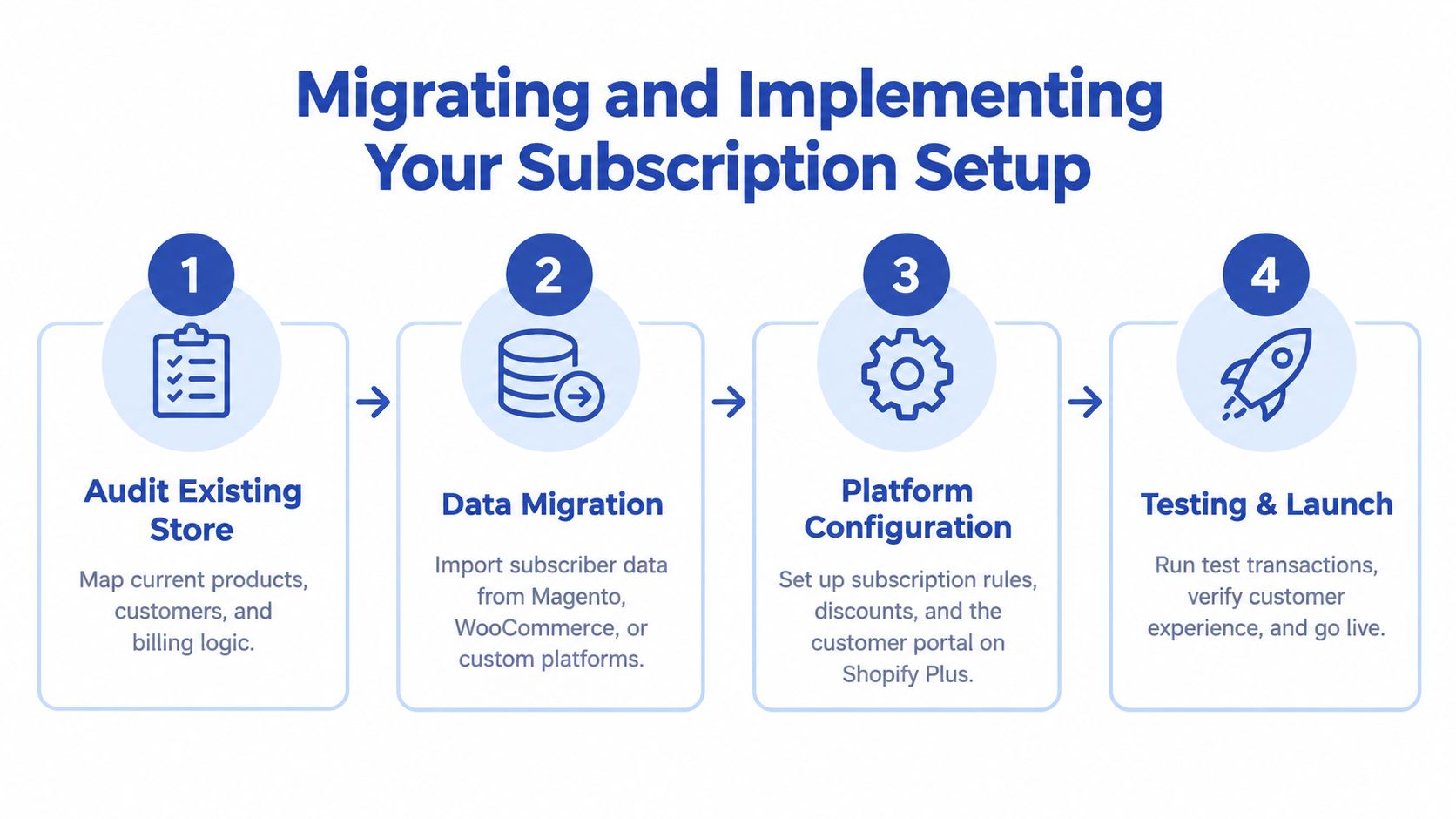
Step one, audit before you build
Your audit should answer one operational question: what must remain true after migration? The answer may include renewal timing, customer pricing, shipping rules, accumulated loyalty benefits or access to a particular portal.
Create a field-level migration map. For every source field, identify the Shopify destination, transformation rule, validation method and owner. Don't move ambiguous data just because it exists. A clean, documented subset is safer than importing unreliable statuses that later trigger incorrect charges.
Step two, plan the billing transition
Payment credentials require special care. In many migrations, the new system can't read stored payment details from the old platform. Confirm token portability with the payment provider and subscription vendor, and establish how customers will be asked to update payment information if tokens can't move.
Use a sandbox to test successful renewals, failed payments, changes to addresses, skipped orders, cancellations and refunds. Test operational notifications too, because a technically successful charge is still a failure if the warehouse doesn't receive the correct order.
Teams that need to understand acquisition sources across recurring journeys can use this practical guide to marketing attribution for SaaS, adapting the principles to ecommerce subscription events.
Step three, configure in phases
Choose the simplest viable implementation. Shopify's native subscription capabilities may suit a focused product range. A third-party app can provide a quicker route to customer portals and common lifecycle controls. Custom development makes sense when the brand needs bespoke bundles, unusual entitlements, complex fulfilment rules or a public app that must meet Built for Shopify expectations.
Configure products and selling plans first, then checkout presentation, customer portal, payment recovery and downstream integrations. The Shopify subscription theme resource is relevant when the storefront needs subscription-aware product templates and account experiences.
Step four, launch with observation
Start with a controlled product set or customer cohort where practical. Monitor renewals, order creation, fulfilment hand-off, customer support contacts and payment failures immediately after release. Keep a rollback plan for storefront changes and a clear process for resolving duplicate or missing records.
After launch, run a regular strategy cadence. Review cancellation reasons, skipped deliveries, portal usage, failed-payment recovery and product-level retention. The first release is the beginning of lifecycle optimisation, not the end of implementation.
How Subscription Setups Impact Conversion and Revenue Growth
Subscription growth comes from a chain of decisions, not one promotional badge. The customer must understand the value, select a plan that fits their routine, complete payment without uncertainty and retain enough control to keep the relationship useful.
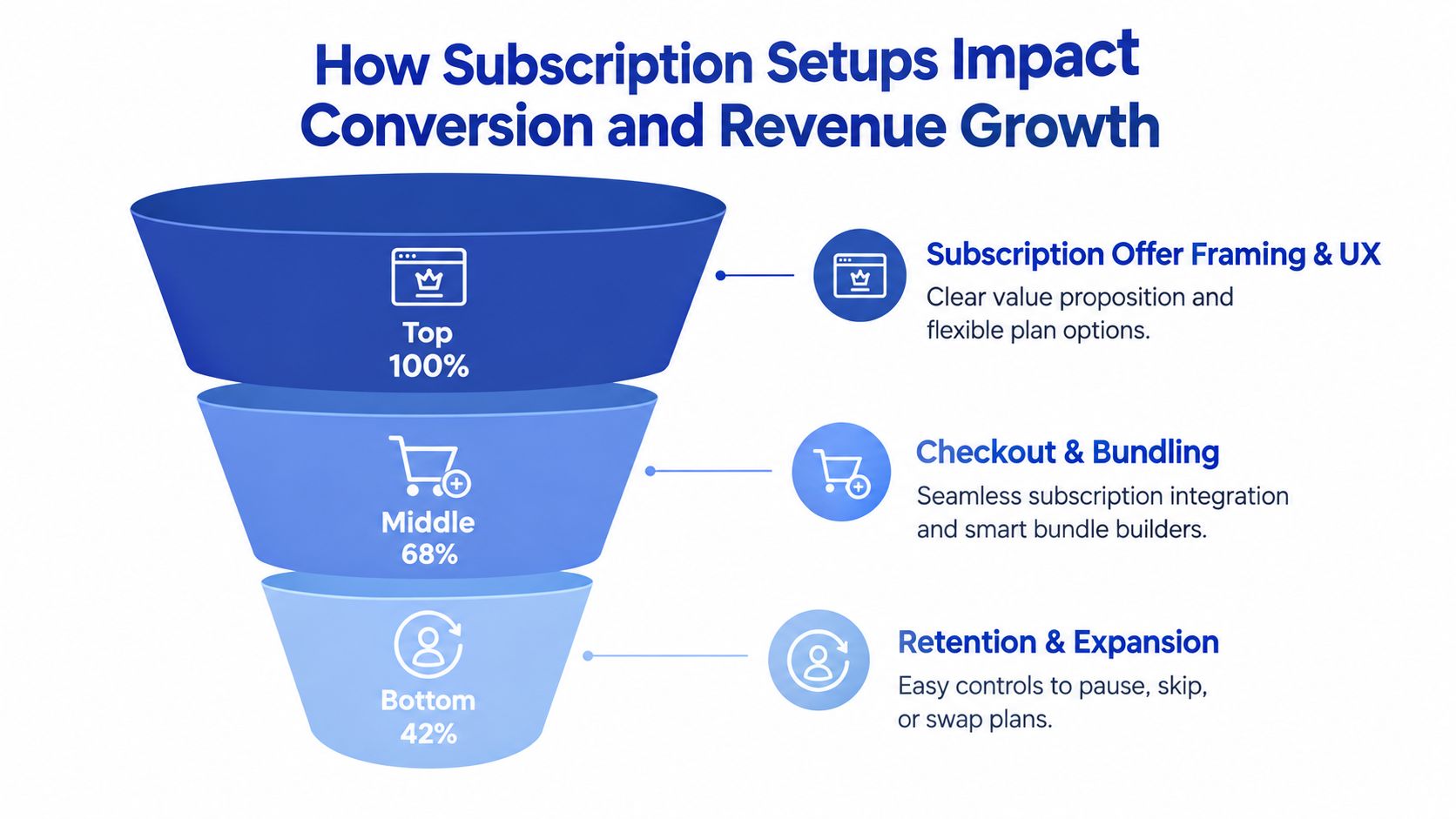
Offer framing sets the first expectation
Start with the customer problem. “Never run out” may suit a frequently used product, while “choose a new seasonal selection” better explains a discovery box. Show the recurring price, delivery timing, flexibility and cancellation terms near the decision point. Avoid making customers hunt through the FAQ to understand the commitment.
Offer design can use an incentive, a prepaid option or a pay-as-you-go plan, but each changes cash flow and perceived risk. Prepaid plans may suit customers who want a defined commitment. Pay-as-you-go plans reduce the initial barrier for customers who are still evaluating fit.
Bundles can increase relevance
A bundle builder gives customers a reason to subscribe to a broader basket rather than a single item. It works when products complement one another and the selection process remains quick. Too much choice creates work, while too little choice makes the bundle feel generic.
The same principle applies to delivery controls. Pause, skip and swap options aren't decorative account features. They let customers adapt the subscription to real life, which can preserve the relationship when a fixed schedule no longer fits.
Payment architecture affects retention
UK payment design deserves a strategic decision rather than a checkout setting. A UK ecommerce trends report notes that monthly billing accounts for about 74% of standard subscription plans in one UK survey, while 3% offered a one-off yearly payment and none used daily or weekly billing.
That pattern supports monthly plans as a familiar default, but it doesn't settle the architecture question. TrueLayer's discussion of Variable Recurring Payments describes their re-emergence in 2025, with FCA support and a major implementation wave expected. UK merchants should assess whether open banking payment options could complement cards, especially where failed renewals and cash-flow timing affect the customer relationship.
Use analytics to connect the funnel to the lifecycle. Review offer selection, checkout completion, first renewal, skips, cancellations, reactivations and payment recovery by product and acquisition source. A conversion improvement that produces more low-fit subscribers may increase support and cancellations, while a slightly harder offer that attracts better-fit customers may create healthier recurring revenue.
Choosing the Right Ecommerce Subscription Platform for Long Term Scale
Choose the smallest system that can support the customer relationship you intend to build, not merely the first recurring product you want to launch.
An app is a sensible starting point when your catalogue is simple, delivery rules are predictable and the standard Shopify experience meets your needs. A deeper platform becomes appropriate when you need multiple models, stronger payment recovery, complex fulfilment, richer reporting or a more capable customer portal. Custom development earns its place when those requirements create a genuine competitive experience rather than a preference for technical complexity.
Use this final comparison checklist:
- Model fit: Does the system support your actual replenishment, curation, membership or bundle model?
- Customer control: Can subscribers pause, skip, swap, update details and cancel clearly?
- Payment resilience: Can it recover failed payments and support your preferred UK payment architecture?
- Operational ownership: Do Shopify, the billing provider, ERP and fulfilment systems have clear responsibilities?
- Growth readiness: Can your team analyse lifecycle behaviour and improve the experience without rebuilding the stack?
Shopify Plus brands often need specialist help when migration, custom subscription flows, ERP integration and CRO intersect. Grumspot offers audits, Shopify 2.0 and Shopify Plus development, subscription app and native API integration, custom portals, migrations and ongoing conversion optimisation.
If your Shopify store is losing repeat revenue to rigid plans, payment failures or an awkward subscriber experience, start with a subscription audit from Grumspot. The team can map your current lifecycle, recommend a practical platform path and build the subscription experience your customers can manage with confidence.
Let's build something together
If you like what you saw, let's jump on a quick call and discuss your project

Related posts
Check out some similar posts.
- subscription examples
Explore 7 subscription examples across Shopify, pricing and retention models, with practical lessons...
Read more
- shopify website examples
Explore 7 Shopify website examples and learn the UX, conversion features, and practical lessons merc...
Read more
- cro best practices
Apply cro best practices to Shopify stores with 10 actionable tactics for testing, product pages, ch...
Read more
- ecommerce replatforming agency
Choosing an ecommerce replatforming agency? Learn what they do, replatforming signs, costs, timeline...
Read more