Churn Prediction Models Explained for E-Commerce
- churn prediction
- machine learning
- ecommerce analytics
- customer retention
- feature engineering
Launched
August, 2026
You're watching orders come in, subscription renewals slow down, and a few customers disappear from your Shopify dashboard. Nothing looks broken at first, but the same store that felt steady last month now has a leaking bucket problem, because every lost customer means more acquisition spend just to stand still. For a UK ecommerce team, churn prediction models stop being abstract machine learning and become a practical retention tool.
The UK market makes this more relevant. The Office for National Statistics reported that the business population reached 5.6 million at the start of 2024, and 4.95 million of those businesses were microbusinesses, so models often have to lean on behaviour rather than rich firmographic history (ONS-based summary). That matters for Shopify stores, subscription brands, and small ecommerce teams because the people buying from you often look like many other small firms on paper, yet their actual engagement patterns tell the complete story.
If you already use analytics, this is the next step. Instead of asking only who bought, you start asking who's drifting, who's frustrated, and who's likely to cancel before they tell you outright. For a practical ecommerce lens on that shift, predictive analytics for ecommerce is a useful companion.
Introduction to Churn Prediction Models
A UK Shopify merchant can see the warning signs before a customer leaves. Orders still arrive, but repeat purchases thin out, subscription pauses start to appear, and support tickets sound more frustrated than before. By the time someone clicks cancel, the pattern has usually been building in the background for days or weeks.
Churn prediction models turn those scattered signals into a risk score. They help you spot who is likely to drift away and act before the loss becomes permanent. The model focuses less on who a customer is on paper and more on what they have done recently, because recent behaviour usually says more than a static profile.
For Shopify stores and subscription brands, that matters because useful warning signs are often buried in ordinary activity. A drop in session frequency, a rise in failed payments, a slower response to emails, or a sudden shift in support tone can all point to churn risk. A practical guide to predictive analytics for ecommerce helps show how those signals move from raw data into decisions a merchant can act on.
Why this matters in UK ecommerce
UK ecommerce teams often work with thin customer records. That is especially true for microbusiness contexts, where firmographic detail is limited and the model has to rely more heavily on behaviour than on broad company background. In practice, that means looking at session frequency, support activity, payment failures, delivery issues, and engagement changes to spot patterns that a small store would otherwise miss.
The tighter the customer base, the more each retained account matters. Saving one subscription or repeat buyer protects revenue, reduces pressure on acquisition, and gives a small team more breathing room. A churn model does not replace retention work, but it helps decide where that work should go first.
Early warning signals are often the most useful ones. A customer who suddenly stops opening emails, delays their next purchase, or begins to contact support more often may be telling you more than a customer profile ever could.
Practical rule: if your store cannot describe a customer's last few interactions, it probably cannot predict churn well either.
Understanding Key Concepts
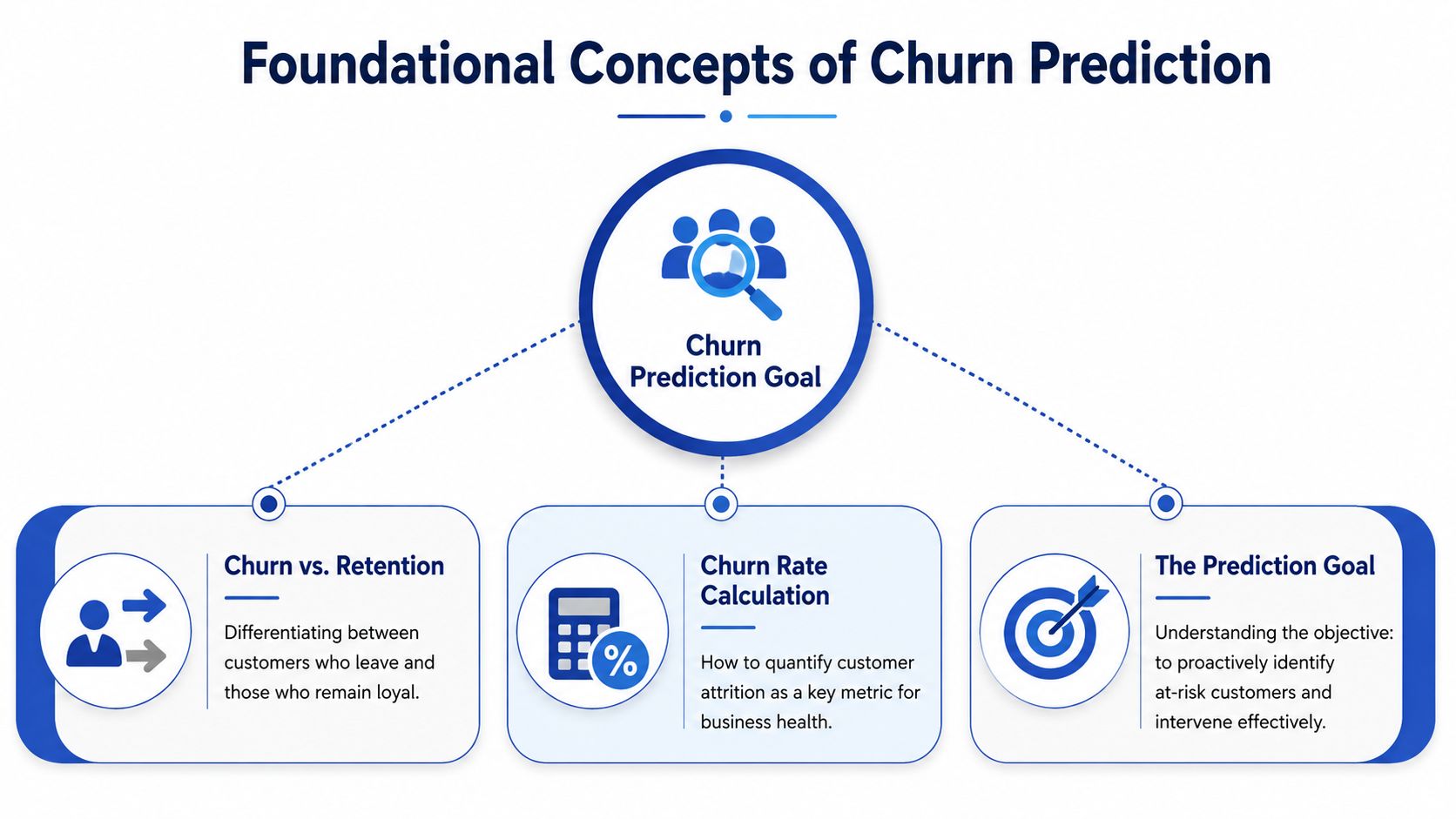
Before the algorithms enter the picture, the language needs to be clear. Churn means a customer leaves or stops engaging, while retention means they stay active and keep buying or renewing. In subscription ecommerce, churn might mean a cancellation or non-renewal, while in a store without subscriptions it can show up as a long silence after a pattern of regular orders.
A useful analogy is machine maintenance. If a factory team watches vibration and heat patterns, it can often spot a machine that's about to fail long before the breakdown. Customer behaviour works the same way. Purchase gaps, login gaps, support spikes, and payment failures are the warning lights.
The three pieces that matter most
First is the label, which is the outcome you want to predict. For churn, that's usually whether a customer leaves within a defined window. Second is the target variable, the thing the model learns to forecast. Third is the prediction horizon, the time window you're trying to look ahead, such as predicting whether a customer will churn in the next period you care about.
If you get those wrong, the model can look clever and still be useless. A score only matters if your team knows what event it refers to and when to act on it. That's why churn prediction is really an early-warning system, not just a dashboard metric.
Customer lifetime value adds another layer of meaning. If a customer is expensive to acquire and likely to buy again, early intervention becomes more valuable, which is why a good churn score should connect to action, not sit in a report. For a deeper business framing, see customer lifetime value explained.
A churn score is only useful when someone knows what to do with it.
Model Families in Churn Prediction
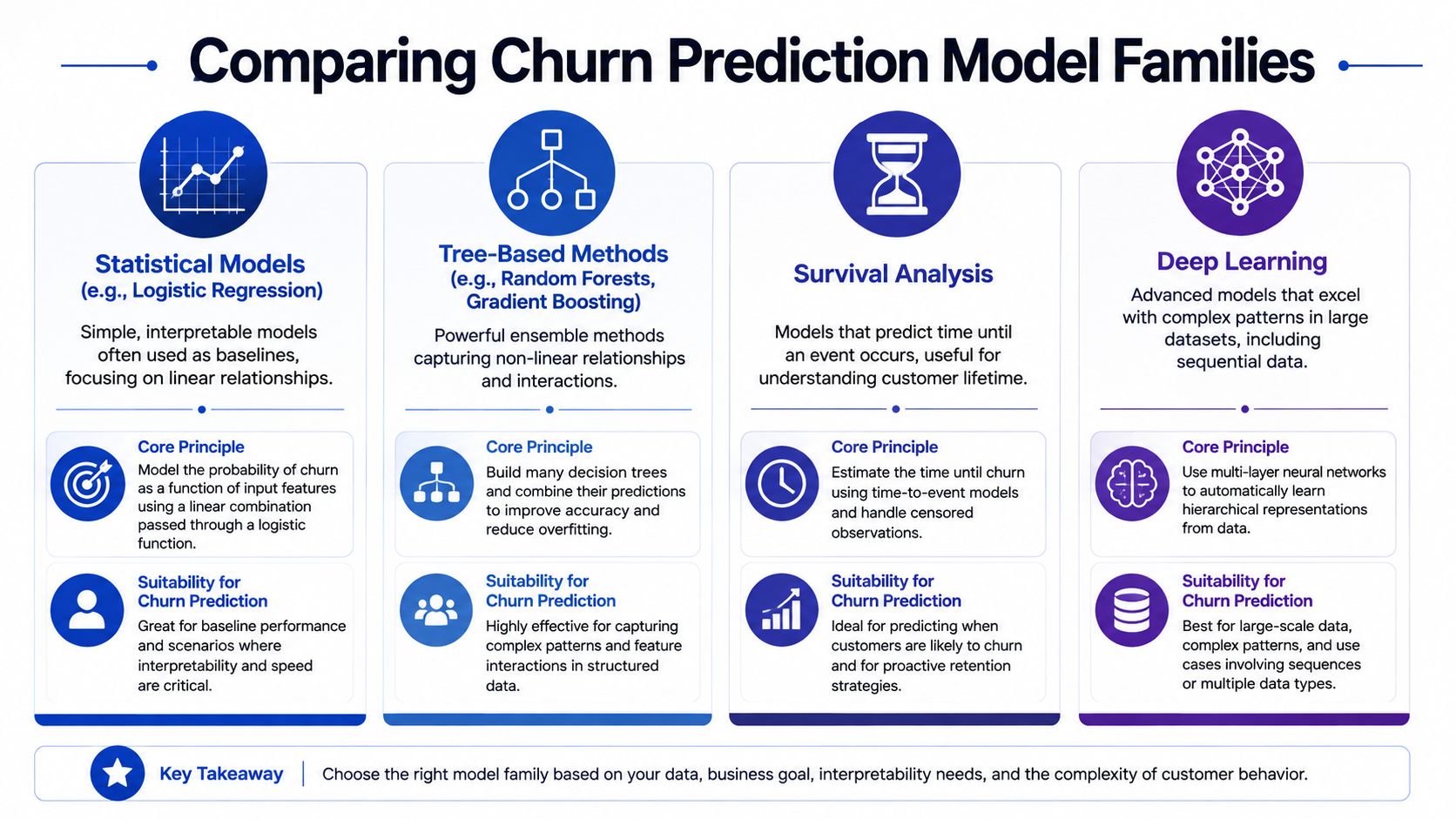
Different churn prediction models solve different problems. Some are easy to explain, some are stronger on accuracy, and some are better when timing matters. The right choice depends on how much data you have, how messy that data is, and whether your team needs a model it can trust at a glance or a model that squeezes more signal out of a complex pattern.
Simple models versus complex models
Logistic regression is often the cleanest starting point. It works well when you want interpretability, because you can see which variables push risk up or down. For smaller ecommerce teams, that transparency can matter more than squeezing out every last bit of performance.
Tree-based methods such as random forests and gradient boosting are usually stronger when relationships aren't neat and linear. They can capture interactions, such as a recent complaint plus a failed payment, that simple models may miss. In a 2026 multi-model study, gradient boosting reached 0.84 accuracy and an AUC-ROC of 0.932, and threshold tuning reduced false negatives by 15% (study).
Survival analysis is different again. It focuses on time to churn, which makes it useful when the business question is not just whether someone will leave, but when the risk becomes urgent. That can be helpful for renewals and lifecycle planning.
Deep learning can uncover complex patterns in large, detailed datasets, especially sequential behaviour. It's the most demanding option, though, because it usually needs more data, more tuning, and more operational maturity to justify the extra complexity.
| Model family | Best fit | Main strength | Main limitation |
|---|---|---|---|
| Logistic regression | Smaller teams, explainability | Easy to interpret | Can miss non-linear patterns |
| Tree-based methods | Rich behavioural data | Strong pattern capture | Harder to explain |
| Survival analysis | Timing-focused prediction | Estimates time until churn | Less intuitive for some teams |
| Deep learning | Large behavioural datasets | Handles complex sequences | Data-hungry and harder to operate |
If you're trying to choose, start with the question your business needs answered. A retailer with limited history may prefer a simple baseline. A larger Shopify Plus operation with many event streams may benefit more from boosted trees or sequence-based models. For broader ecommerce strategy context, Grumspot's demand forecasting guide sits in the same operational world, because both problems depend on recognising patterns early.
Feature Engineering and Evaluation Metrics
A churn model is only as good as the features you feed it. For UK telecom churn work, behavioural recency and service-quality features often matter more than tenure or plan type, especially when you're tracking 7/30/90-day usage decay and complaint frequency (Nature study). The same logic carries into ecommerce, where a recent drop in repeat visits can matter more than a customer's static profile.
Features that usually carry the most signal
Think in short windows first. Recent order cadence, time since last purchase, abandoned checkout activity, refund requests, payment failures, and support contacts often say more than long-term demographics. If a customer used to engage every week and then went quiet, that shift is often more informative than the fact that they signed up two years ago.
Behavioural features can also be operational. Failed logins, abandoned forms, repeated coupon attempts, and changes in campaign response tell you how friction is building. The model doesn't need to understand the emotion behind the behaviour, only the pattern.
Picking metrics that match the business goal
| Metric | Focus | Strength |
|---|---|---|
| Accuracy | Overall correctness | Easy to understand, but can hide weak churn detection |
| Precision | How many flagged customers truly churn | Useful when false alarms are costly |
| Recall | How many churners the model catches | Useful when missing at-risk customers is expensive |
| F1-score | Balance between precision and recall | Helpful when you need both at once |
| AUC-ROC | Ranking ability across thresholds | Good for comparing models across risk levels |
The metric you choose should match the action. If your team can only call a small list of customers, precision matters. If your main worry is missing people who are about to leave, recall matters more. If leadership wants a broad risk ranking, AUC-ROC can help compare models before you decide where to intervene.
Practical rule: don't celebrate a high score unless it changes who your team contacts next.
Data Challenges in Churn Prediction
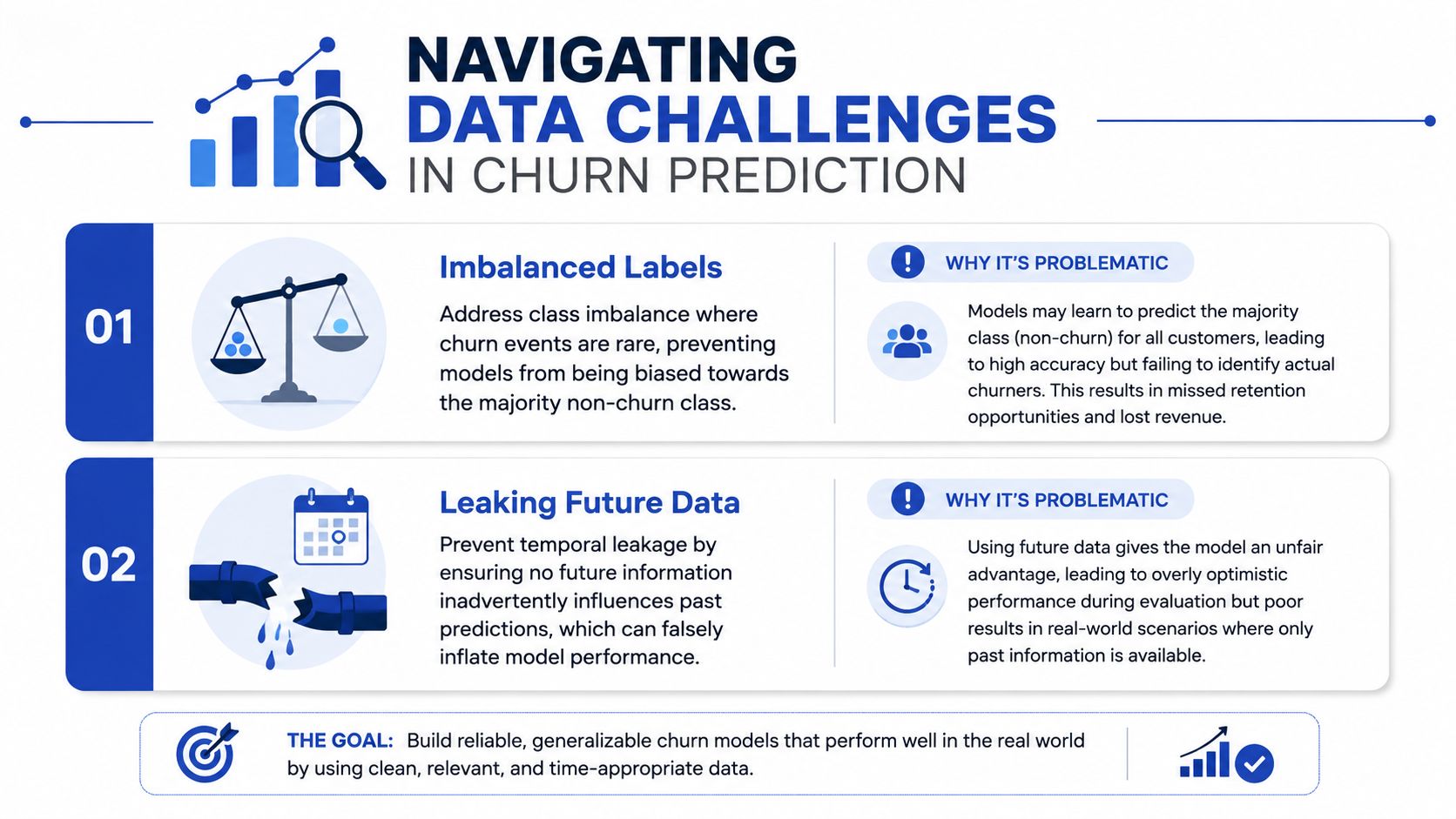
The hardest part of churn prediction models isn't always the algorithm. It's the data. Two problems show up again and again, class imbalance and leaking future data, and both can make a model look much better than it really is.
Why rare churn events distort training
In many ecommerce datasets, most customers don't churn in the immediate window you care about. That means the model can get lazy and keep predicting the majority class. It looks accurate on paper, but it fails the business test because it misses the people you most need to catch.
The usual fixes are familiar: resampling, cost-sensitive learning, and threshold tuning. The point is not to make the classes artificially equal, it's to stop the model from treating churn as a background noise event.
Why future data is poison
Temporal leakage happens when the model learns from information that wouldn't have been available at prediction time. A classic mistake is including a future refund, a later complaint, or a cancellation-related event in training data for a score that was supposed to be created earlier. That can produce excellent offline results and terrible live performance.
A literature review found that churn models also often fail to generalise across domains and rarely use interaction content like emails or chat logs, which makes cross-domain transfer an underserved challenge (review). That matters for UK teams because a model built for SaaS won't automatically behave well in retail, and a model trained on one product line may not travel cleanly to another.
A good habit is to split data by date, audit every feature for timing, and ask one blunt question before deployment, “Would I have this information available at the moment I want to score?” If the answer is no, the feature doesn't belong there.
Ecommerce Implementation Tips and Examples
On Shopify, churn prediction gets practical fast. You don't need a perfect lab setup to start, you need a clean way to connect store events to a feature pipeline. That usually means order history, customer tags, subscription app events, checkout behaviour, and support data all feeding the same scoring process.
What a useful Shopify setup looks like
A subscription brand can treat webhook events as the raw material for churn features. Order created, order refunded, payment failed, checkout abandoned, and customer updated are all signals that can be turned into recent-behaviour indicators. When those events are stored consistently, the model can score risk at the account level and hand that score back to the marketing or support team.
Micro-behaviour matters here too. Emerging research shows that signals like rage clicks and abandoned flows can surface churn risk earlier than login gaps or support tickets, which is especially useful in UK ecommerce where friction often appears first in the browser (behavioural signals research). If a customer repeatedly struggles with a discount code, a form field, or a checkout step, the churn story may already be unfolding.
A simple operating pattern
A practical workflow might look like this. First, the store collects events from Shopify and related apps. Next, those events become features such as short-term activity decay, payment retries, and support frequency. Then the model assigns risk bands, and the retention team uses them to decide which customers get a message, an offer, or human follow-up.
That's also where tooling choices matter. A Shopify Plus team might use a warehouse, a customer data platform, or a custom app to move scores back into daily operations. Grumspot can help with Shopify build and integration work when a store needs those systems connected, but the important part is the logic, not the tool brand. The model should make action easier, not create another dashboard nobody checks.
Deployment and Monitoring Strategies
A churn model that sits in a notebook isn't a production system. Once it starts informing real retention decisions, it needs a clear runbook, steady monitoring, and a way to adapt when customer behaviour changes.
A straightforward deployment path
Start by packaging the model so it can be called consistently, either in batches or in real time. Batch scoring works well when daily or weekly retention lists are enough. Real-time scoring makes more sense when a failed payment, abandoned checkout, or support escalation should trigger immediate action.
Then connect the output to the places your team already works. That might be a CRM, a helpdesk, a marketing platform, or a warehouse dashboard. The score should land where a human can act on it quickly.
What to watch after launch
Monitor whether the model's risk ranking still makes sense over time. If customer behaviour shifts, the model can drift while looking fine on the surface. Retraining on a sensible schedule helps, but only if the new data reflects current behaviour rather than stale patterns.
Dashboards should tell stakeholders three things, which accounts are at risk, what features are driving the score, and whether the model still catches the right people. Keep the feedback loop tight by checking whether retention actions change customer behaviour, not just whether the model looked accurate in a test set.
If the retention team can't tell why a customer was flagged, the score will lose trust fast.
Conclusion and Best Practices
Good churn prediction models start with a simple idea, recent customer behaviour tells you more than static labels do. In the UK, that matters even more because the market is crowded with microbusinesses, mobile engagement is high, and ecommerce teams often have to work with sparse but valuable data. The best systems don't chase complexity first, they build around usable signals, clear labels, and a scoring process that leads to action.
Keep the model tied to one question, who is at risk, and when should we intervene. Use behavioural recency, service-quality signals, and micro-interactions before you overcomplicate the stack. Then monitor drift, retrain thoughtfully, and keep marketing, support, and operations aligned so the score turns into a customer-saving workflow.
If you want help turning churn signals into something your Shopify team can use, Grumspot builds and integrates ecommerce systems with a conversion-first mindset. Visit Grumspot to explore how its Shopify design, development, and integration services can support retention-focused analytics and workflow improvements.
Let's build something together
If you like what you saw, let's jump on a quick call and discuss your project
Related posts
Check out some similar posts.
- subscription examples
Explore 7 subscription examples across Shopify, pricing and retention models, with practical lessons...
Read more
- customer lifetime value
Learn how to calculate customer lifetime value with proven formulas, worked examples, and practical ...
Read more
- predictive analytics
Discover what is predictive analytics, how it works, top tools, ecommerce use cases, and a step-by-s...
Read more
- retention marketing strategies
Boost ecommerce repeat purchases with 10 actionable retention marketing strategies. Implement on Sho...
Read more