How to Set Up a Subscription Service the Right Way
- subscription service
- Shopify subscriptions
- recurring billing
- subscription churn
- ecommerce retention
Launched
September, 2026
An hour before launch, a founder opens Shopify Admin and finds three subscription apps installed, two incomplete checkout flows, a warehouse spreadsheet nobody trusts, and a churn forecast that assumes customers will renew forever. The product may be excellent, but the service is still one failed payment, unclear cancellation path, or missed renewal notice away from an expensive rebuild.
How to set up a subscription service in the UK requires more than adding a recurring purchase option to an existing store. You're engineering a system that connects pricing, payment collection, fulfilment, customer self-service, retention, analytics, and consumer protection. The UK government has estimated non-regulated subscriptions at about £25 billion per year, with around three quarters of UK adults holding at least one subscription contract and average annual spending of £660 on those contracts. The government impact assessment makes the commercial opportunity clear, but it also explains why transparency and cancellation handling matter.
The Subscription Setup Mindset Before You Touch the Dashboard
Treat the launch as architecture, not a checkbox. Before installing Recharge, Bold, Skio, Appstle, or a custom Shopify Plus solution, settle the decisions that will determine how every downstream component behaves.
The first is billing cadence. Decide whether customers should pay monthly, quarterly, annually, or according to a product-specific schedule. Then decide how cards and Direct Debit through BACS fit together. Pay.UK data reported by Business Expert recorded 5.03 billion Direct Debit payments in 2025, including 563 million subscription payments, or 11% of the total. That behaviour gives UK customers a familiar route for recurring collections, particularly when a subscription has a higher value or a longer commitment.
The second is fulfilment. A monthly replenishment product has different requirements from a curated box, a digital membership, or a perishable product. You need to know whether stock is reserved at subscription creation, at renewal, or when the warehouse receives a fulfilment webhook. If the answer changes by SKU, your system needs to represent that difference rather than forcing every product through one cadence.
Practical rule: If the payment, fulfilment, and cancellation rules aren't written down before the build starts, the app configuration will make those decisions for you.
The third decision is retention control. Pause, downgrade, skip, and self-serve cancellation should exist before you spend on acquisition. A cancellation flow that only offers customer support contact creates avoidable labour and gives you no reliable reason code. A pause flow can preserve the relationship when the customer has too much stock, is travelling, or needs temporary budget relief.
The fourth is UK regulatory exposure. The Digital Markets, Competition and Consumers Act 2024 regime requires clearer pre-contract information, renewal notices, cooling-off rights, and easier cancellation flows. The legislation also requires reminder notices for each renewal payment connected to the end of a relevant six-month period where a consumer subscription contract has no concessionary period. The Act's subscription provisions should be translated into checkout fields, event triggers, email templates, and account controls.
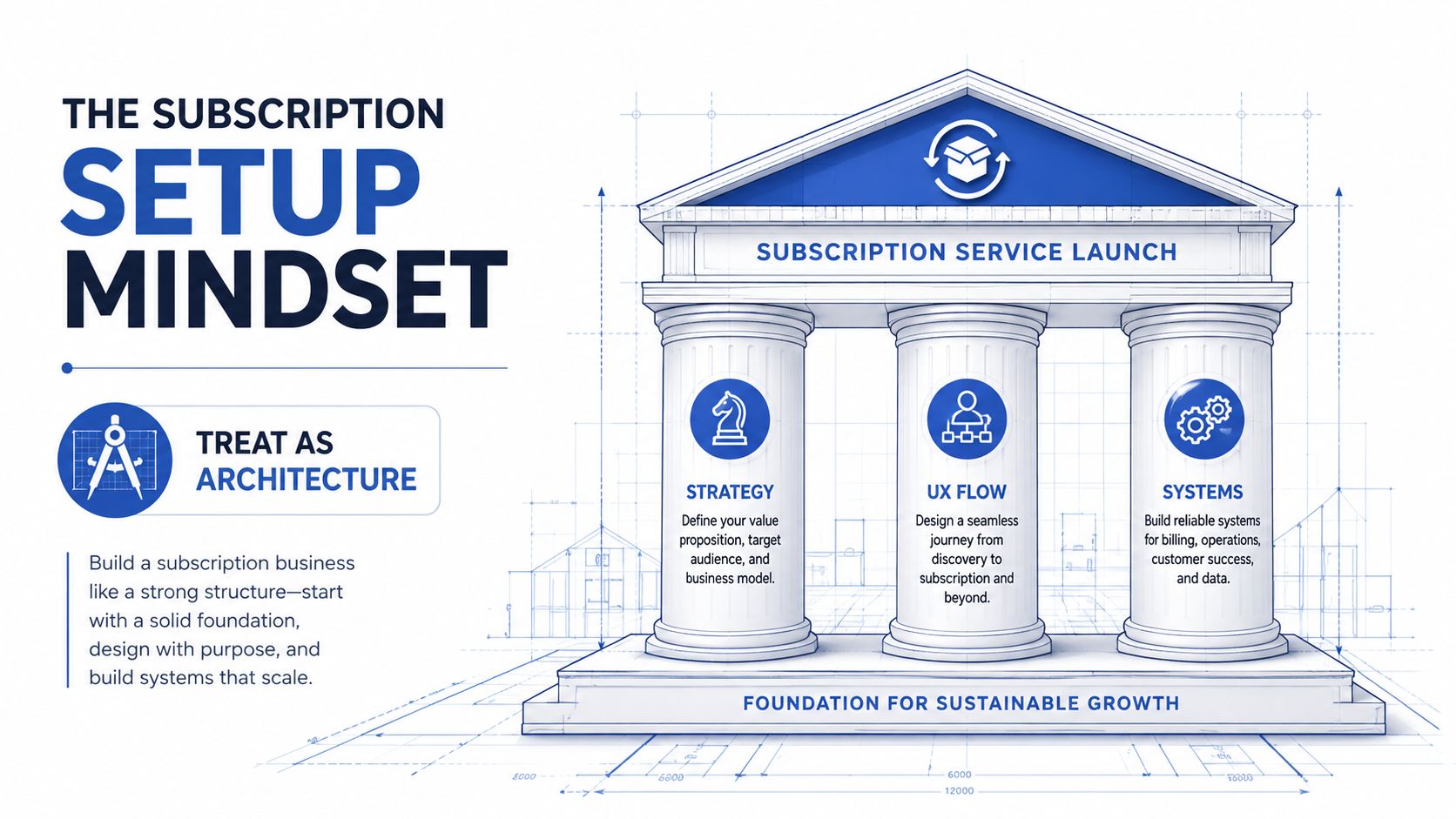
For a broader planning reference, the subscription website guide 2026 is useful when you're mapping the storefront, account area, and recurring service experience. The key principle remains simple: design the commercial and operational model first, then choose the technology that can support it.
Sizing the UK Opportunity and Choosing Your Pricing Model
A subscription price can look healthy at checkout and fail after the first few renewals. Calculate gross margin after fulfilment, payment costs, packaging, support, refunds, discounts, failed collections, and expected reactivation. That calculation should include the cost of customers who cycle between active, paused, and cancelled states, because retention patterns affect both stock planning and cash flow.
The UK government assessment estimated annual subscription spending at £21 billion to £33 billion, with average subscriber spending of £660 a year across subscription contracts. Treat those figures as market context, not as a reason to copy a competitor's price. Your addressable opportunity depends on repeat demand, household budget pressure, delivery economics, and how often customers can pause without leaving permanently.
Three structures usually suit UK merchants:
- Flat-rate box: Customers receive a defined product or selection at a fixed cadence. It is easy to explain and forecast, but margin suffers when box contents or shipping costs vary.
- Usage or top-up credits: Customers pay for an allowance and consume it over time. This suits services, repeat purchases, and variable usage, but the account needs visible balances, clear expiry rules, and a sensible pause path.
- Tiered access: Customers choose a level of benefits, product access, service, or quantity. Tiering can capture different willingness to pay, although every tier adds support, fulfilment, cancellation, and renewal-notice logic.
| Pricing Model | Typical Gross Margin | Churn Risk | Cash Flow Impact | Operational Complexity |
|---|---|---|---|---|
| Flat-rate box | Predictable if contents are standardised | Can rise when contents feel repetitive | Regular recurring receipts | Moderate, especially for variable stock |
| Usage or top-up credits | Depends on redemption and fulfilment cost | Customers may pause when balances build up | Can bring forward cash collection | High, because balances and entitlements need tracking |
| Tiered access | Stronger if premium benefits cost little to serve | Customers may downgrade instead of cancel | Annual or premium plans can improve cash timing | High, because each tier needs distinct rules |
For consumables, quarterly billing can be more practical than monthly when the product lasts longer, shipping is costly, or warehouse handling makes small orders inefficient. Annual prepay can improve working capital, but it creates a larger customer obligation and can make cancellation expectations more sensitive. Show the saving and cancellation terms clearly, account for Direct Debit preferences in the payment mix, and confirm that finance can recognise revenue correctly.
Subscription cycling changes the test plan. A customer who pauses, downgrades, or skips a delivery may still be valuable, so measure conversion, contribution margin, cancellation reasons, pause rate, and reactivation rather than treating every interruption as churn. Start with existing customers, organic demand, or a controlled audience before increasing paid traffic. A tiered test can compare packaging and value communication, while this guide to tiered pricing models offers a practical framework for structuring those options.
App Stack Versus Custom Build on Shopify and Shopify Plus
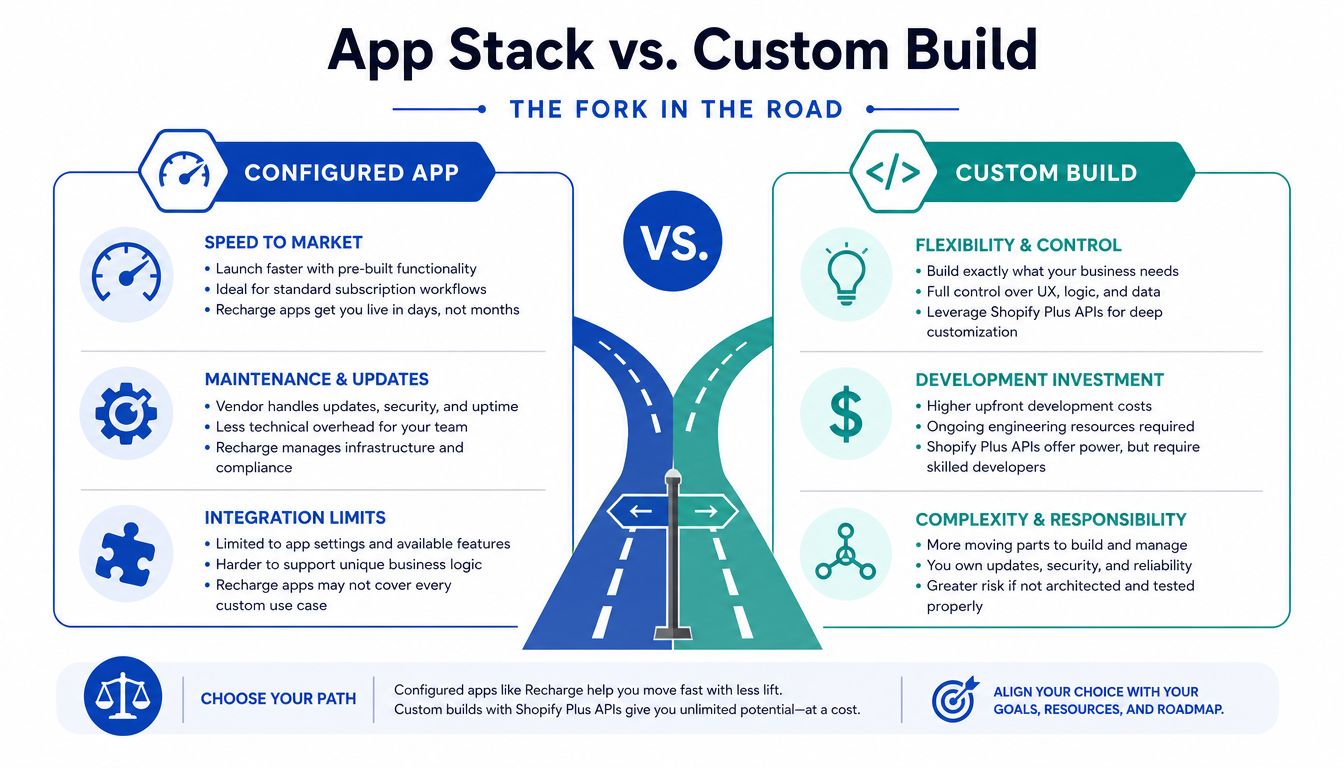
The app-versus-custom decision comes down to how much variation your business needs and how much operational ownership your team can sustain.
A configured app usually wins when you need to launch quickly, have a small technical team, and can accept the provider's customer portal, billing model, and fulfilment assumptions. Recharge, Bold, Skio, and Appstle can reduce initial development effort, but they still require careful theme integration, webhook monitoring, support procedures, and testing across discounts, refunds, shipping, and customer account changes.
A custom build becomes more compelling when your subscription rules are part of the product itself. Examples include mixed cadences in one basket, complex entitlement logic, unusual fulfilment windows, account-specific pricing, advanced experimentation, or a need to keep subscription data in a tightly controlled architecture. Shopify Plus APIs, Checkout Extensibility, Shopify Functions, and a purpose-built account experience can provide control, but they don't remove the need for payment, tax, dunning, and operational maintenance.
The criteria that decide the fork
Assess both routes against the same questions:
- Time to revenue: How quickly can the team launch a tested offer, not merely install an app?
- Internal ownership: Who maintains webhooks, retries, customer data, and future platform changes?
- Fulfilment uniqueness: Can the system handle your actual warehouse rules without manual workarounds?
- Experimentation: Can the team test cadence, packaging, upgrade paths, and cancellation interventions without rebuilding checkout?
- Long-term cost: Include implementation, app charges, support, seats, refund-related transaction costs, integration work, and maintenance across the planned operating horizon.
The cheapest launch is not automatically the cheapest operating model. Merchants often miss webhook maintenance, app seat charges, refund transaction fees, data synchronisation work, and the support cost of conflicting account portals. Direct Debit adds another decision. GoCardless may suit a BACS-led collection model, while Stripe Billing can simplify card billing and broader payment orchestration. Either route needs a clear owner for mandates, failed collections, refunds, and reconciliation.
Grumspot can fit into this decision as an implementation partner, with subscription app integration, custom subscription flows, and subscriber account portal work for Shopify stores. The same evaluation discipline applies to adjacent commerce tools. For example, a merchant assessing pricing for restaurants should still examine the underlying billing rules, customer entitlements, integrations, and support workload rather than judging a platform by its pricing page alone.
Recurring Billing, Fulfilment and the Back-Office Plumbing
A renewal is operationally complete only when it produces the correct order, stock movement, customer message, accounting entry, and fulfilment instruction. The storefront purchase starts that chain. It does not finish it.
Choose one primary billing authority before configuring the rest of the stack. Shopify Subscription APIs support a Shopify-centred architecture, Recharge supplies subscription management and billing workflows, and Stripe Billing can handle recurring card billing. If Direct Debit matters, add GoCardless or another suitable BACS arrangement deliberately. Two systems must not independently decide whether a customer is active, overdue, paused, or cancelled, especially when UK customers expect Direct Debit collections to follow clear mandate and notification rules.
| Gateway | Best fit | Card fees | Direct Debit support |
|---|---|---|---|
| Stripe Billing | Card-led recurring billing with developer control | Confirm current commercial terms with Stripe | Available through supported payment methods and configuration |
| Recharge native billing | Merchants prioritising a subscription platform workflow | Confirm current commercial terms with Recharge | Assess the supported UK configuration before committing |
| Shopify Subscription APIs | Teams building a Shopify-centred custom architecture | Determined by the selected Shopify payment setup | Requires a deliberate compatible Direct Debit design |
The table supports a decision, not a fee quote. Payment pricing changes by plan, method, contract, and transaction conditions. Confirm current fee structures directly with each provider before modelling margin, and use this payment processor integration guide to check the integration work behind the headline rate.
Build the renewal chain
Set the billing rule first. Charges can land on a fixed calendar day, such as the first or fifteenth, or on a rolling anniversary of the original order. Fixed dates help warehouses batch work and forecast capacity. Rolling dates feel more natural for customers, but create a less predictable schedule. For Direct Debit, align collection timing, mandate handling, customer notices, and fulfilment release so a payment status is not treated as final before the relevant banking event.
Failed payments need a dunning sequence. Tell the customer what failed, provide a secure payment-update route, explain when another attempt will occur, and stop fulfilment when the account reaches the correct state. Keep payment-failure messages separate from marketing content. The customer should be able to resolve the issue without searching through promotions.
Your day-one webhook checklist should include:
- Subscription created: Store the subscription identifier, cadence, product, price, customer, and consent record.
- Renewal scheduled: Prepare inventory and fulfilment capacity without treating a forecast as a completed order.
- Payment succeeded: Confirm the order and send the correct receipt or renewal message.
- Payment failed: Start dunning, update the account state, and notify the relevant operational queue.
- Subscription paused or skipped: Update fulfilment so stock is not picked unnecessarily.
- Subscription changed: Recalculate price, tax, items, cadence, and entitlements.
- Subscription cancelled: Stop future billing and record the reason.
- Refund issued: Sync financial and customer-facing status across systems.
Warehouse systems such as Linnworks may need webhook-driven stock decrements and cycle-day batching. Finance teams should define how Xero or Quickline receives deferred revenue and prepaid annual subscription information, and how VAT treatment fits the merchant's UK tax process and Making Tax Digital obligations. For recurring operations with many exceptions, AI in transport billing provides an adjacent reference for event-driven billing and exception handling. Grumspot can support subscription app integration, custom subscription flows, and subscriber account portal work for Shopify stores, with clear ownership still required across mandates, failed collections, refunds, and reconciliation.
Retention Engineering as a Setup Task, Not an Afterthought
The default subscription journey still assumes that a customer either renews or churns. UK customers don't always behave that way. Recent research reported that 63% of UK streaming subscribers are open to cycling subscriptions month to month, while other UK coverage found that 32% sign up for specific content and then cancel. Advanced Television's coverage shows why a cancellation event can represent a change in timing or priority, not permanent rejection.
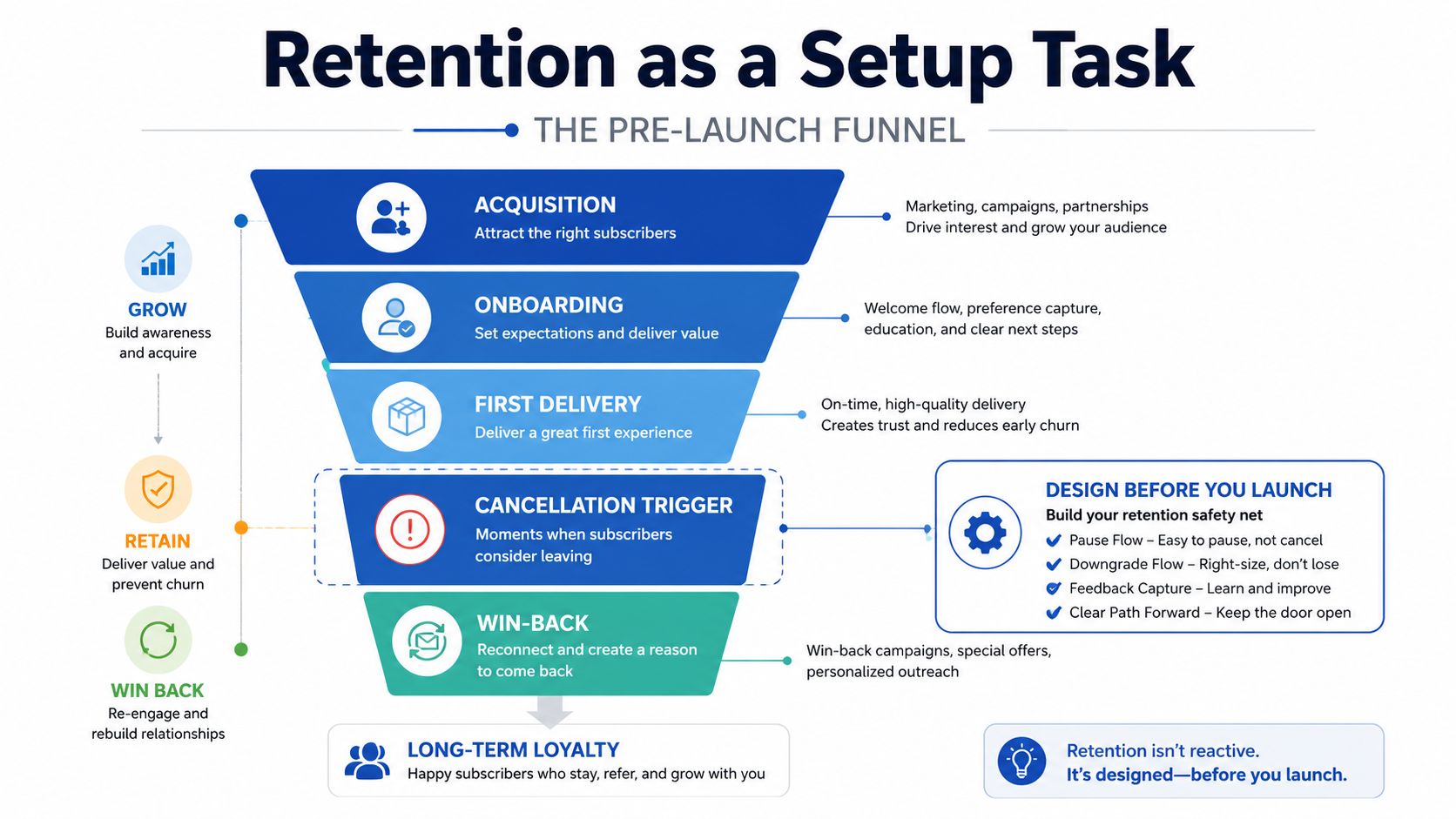
Build the account area around that behaviour. A subscriber who has too much stock should be able to pause or skip. Someone who finds the premium tier too expensive should be able to downgrade. A customer leaving because the delivery timing is wrong should be offered a cadence change, not forced to contact support.
Design the save path without trapping customers
A healthy cancellation flow is easy to complete and useful to the business. Ask for a reason code, present relevant alternatives, and keep the final cancellation action clear. Don't hide the cancellation link, add unnecessary support steps, or make a customer repeat information already held in the account.
Instrument the experience from the first release:
- cancel_started: The customer opens the cancellation journey.
- cancel_completed: The subscription reaches a confirmed cancelled state.
- pause_selected: The customer chooses a pause duration or pause option.
- downgrade_selected: The customer moves to a lower tier.
- skip_selected: The customer skips an upcoming charge or delivery.
- cadence_changed: The customer changes the renewal interval.
Use those events in Klaviyo or another lifecycle platform. A pause confirmation should state when the account will resume, and a reminder should arrive before that point. A downgrade can preserve the billing relationship while lowering the service level. A cancellation survey can distinguish price, product fit, timing, delivery, and payment issues.
The UK subscription-box research cited by Whistl reported that shoppers remain subscribed for around nine months on average, and 44% don't continue. Those findings reinforce a practical point: the first delivery, the second billing event, and the cancellation moment all need deliberate messaging. Retention isn't a campaign you add after launch. It's a set of product states, events, and customer choices that must exist before acquisition begins.
Compliance, Analytics and Migration Considerations Before Launch
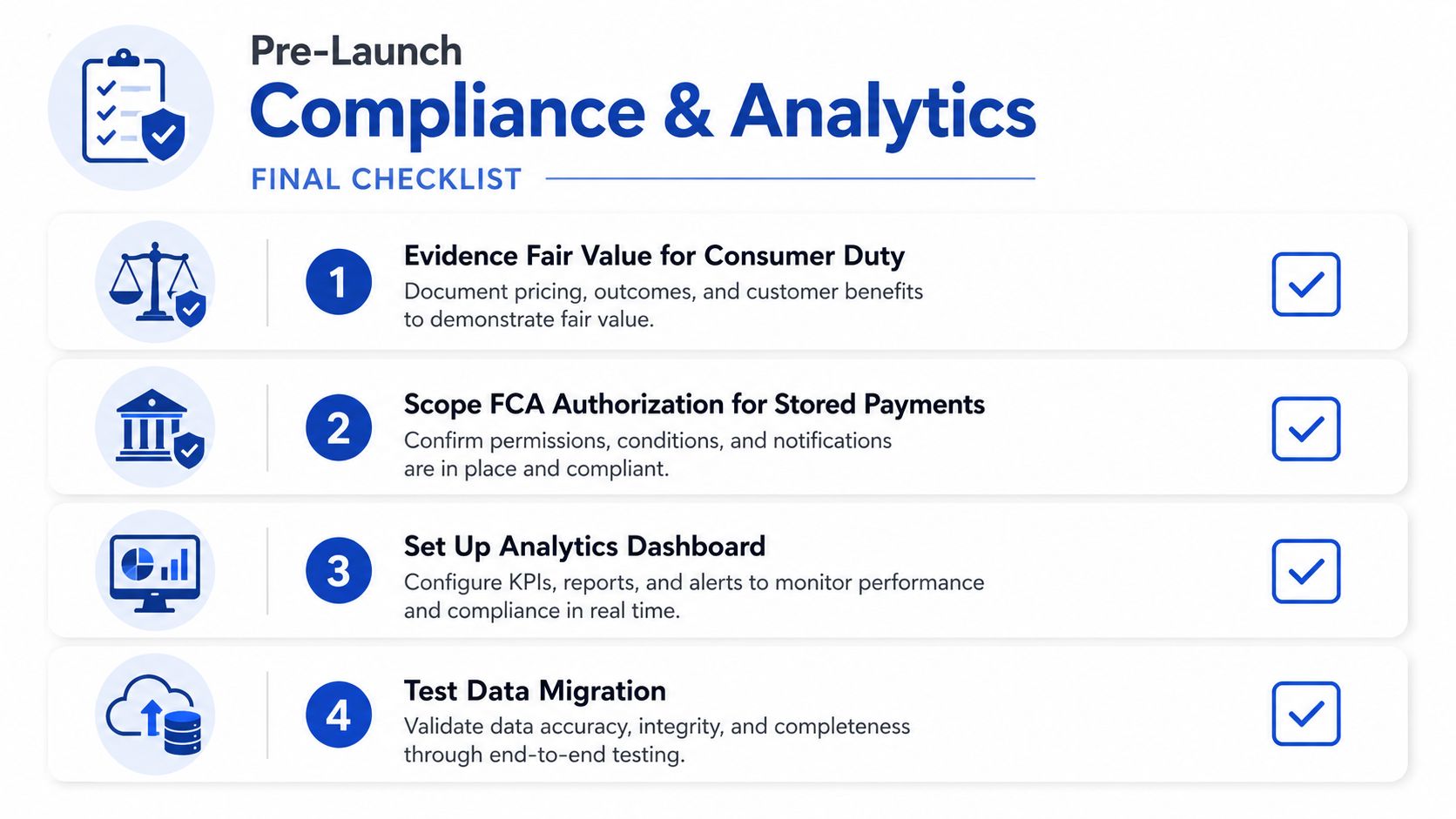
Compliance belongs in the build backlog. Start by documenting the offer, the customer outcome, the price, the renewal cadence, the cancellation rights, and the evidence supporting fair value. If the product involves regulated activity or stored payment credentials, scope whether FCA authorisation or an authorised payment partner is relevant to the model. Don't assume a platform's checkout removes that responsibility.
The UK subscription regime under the Digital Markets, Competition and Consumers Act has been reported as delayed to Autumn 2026, with planned requirements covering clearer pre-contract information, renewal and reminder notices, easier cancellation, and stronger enforcement. Reuters' coverage of the UK's payments and regulatory direction also describes a changing payments environment, including work around variable recurring payments and independent infrastructure. Treat the delay as build time, not permission to postpone the design.
Put the evidence and events in place
At checkout, capture the information a customer needs to understand what they're buying. Store the offer version, price, cadence, consent state, terms version, and timestamp. In the account area, provide a clear route to manage, pause, change, and cancel the subscription. Renewal reminders should be generated from billing events, not manually maintained calendars.
Analytics should answer operational questions, not just acquisition questions. Configure events for subscription start, first successful renewal, failed payment, pause, downgrade, cancellation start, cancellation completion, reactivation, refund, and delivery issue. Build cohort views in Shopify Analytics, Lifetimely, Peel, GA4, or Klaviyo so the team can compare renewal behaviour by product, cadence, acquisition source, and customer segment.
Migrate without breaking live billing
For a WooCommerce, Magento, or BigCommerce migration, separate customer identity from payment credentials. Map customer records, products, variants, prices, addresses, tax information, subscription status, next billing date, and historical orders. Payment tokens may not be portable between providers, so confirm the migration path before promising an uninterrupted renewal cycle.
Use a staged cutover. Freeze changes during the agreed migration window, export and reconcile records, test token or mandate handling, re-import history where appropriate, and monitor the first renewal events in both the old and new operational reports. Before launch, validate every import and reconciliation result with a documented process such as this guide to validating data after migration.
Your 30 60 90 Day Subscription Launch Plan
A useful roadmap gives each task an owner and a measurable exit condition. Put the following sequence into Asana, Monday, or Trello, then assign named people rather than leaving work with “the team”.
Days 1 to 30 build the foundation
The founder or commercial lead owns the offer, customer segment, price structure, and cadence decision. Finance validates margin after fulfilment, tax, refunds, and payment costs. Operations confirms stock, warehouse batching, packaging, and delivery capacity.
The technical lead should then compare a configured app against a Shopify Plus custom build. Shortlist Recharge, Bold, Skio, and Appstle only after documenting the required customer states and fulfilment rules. The exit criteria are a signed-off offer, a billing decision, a compliance risk register, a chosen architecture, and an event specification for subscription creation, renewal, failure, pause, downgrade, cancellation, and reactivation.
Days 31 to 60 configure and pressure-test
The implementation owner builds the subscription purchase flow, account portal, billing events, dunning, Direct Debit route where required, and UK tax configuration. Legal or compliance ownership reviews pre-contract information, renewal communications, cooling-off treatment, cancellation UX, consent capture, and the planned 2026 DMCC changes.
Operations runs test renewals against real warehouse scenarios. Include out-of-stock products, skipped deliveries, address changes, failed payments, refunds, tier changes, and cancellations close to fulfilment cut-off. The exit criteria are successful end-to-end test orders, reconciled finance entries, working customer self-service, signed-off email journeys, and a warehouse process that doesn't depend on manual spreadsheet edits.
Days 61 to 90 launch in controlled stages
The growth owner should begin with a small, controlled traffic cohort rather than exposing every visitor to an unproven recurring experience. The team should migrate legacy subscribers only after validating customer mapping, payment credentials or mandates, next billing dates, and historical order handling.
Review dashboards weekly:
- Renewal dashboard: Successful renewals, failed payments, dunning outcomes, and reactivations.
- Retention dashboard: Pause, downgrade, cancellation reasons, cadence changes, and cohort behaviour.
- Commercial dashboard: Revenue, contribution margin, refunds, fulfilment cost, and plan mix.
- Operations dashboard: Stock exceptions, delivery failures, support tickets, and webhook errors.
- Compliance dashboard: Renewal notices, consent records, cancellation completion, and unresolved customer complaints.
At the end of the period, ship one retention improvement based on observed behaviour. That might be a better pause option, clearer first-renewal messaging, a revised cadence, or a lower tier. Don't judge the service only by launch orders. Judge whether the architecture produces accurate billing, reliable fulfilment, clear customer control, and evidence you can use to improve the next cohort.
Grumspot helps Shopify merchants configure subscription apps, build custom subscription flows, connect recurring payment and notification logic, and create subscriber account portals for managing skips, pauses, changes, and cancellations. Visit Grumspot to discuss a UK-ready subscription setup that treats compliance, retention, and Shopify Plus implementation as one connected delivery project.
Let's build something together
If you like what you saw, let's jump on a quick call and discuss your project

Related posts
Check out some similar posts.
- subscription examples
Explore 7 subscription examples across Shopify, pricing and retention models, with practical lessons...
Read more
- ecommerce subscription platform
Learn how an ecommerce subscription platform works, which models drive retention, and how to choose,...
Read more
- shopify subscriptions
Discover how to use Shopify for subscription services in the UK. This practical guide covers setup, ...
Read more
- subscription lifecycle management
Master subscription lifecycle management with stages, metrics and best practices that lift retention...
Read more