Choose the Best Web Design Agency Derby
- web design agency derby
- hire web designer
- derby ecommerce
- local seo derby
- shopify agency uk
Launched
May, 2026

Your site probably isn't broken. It's just not doing enough.
That's where many Derby businesses get stuck. The website looks acceptable, loads well enough on office Wi-Fi, and says the right things about the business. But enquiries are inconsistent, organic visibility is weak, and nobody can clearly explain which pages are helping sales and which are wasting attention.
That's not really a design problem. It's a commercial problem.
A search for web design agency derby often starts with the wrong question. Most owners ask, “Who can build us a new site?” The better question is, “Who can help us turn the site into an asset that wins leads, supports sales, and doesn't damage search performance when it goes live?”
Your Derby Business Deserves More Than a Brochure Website
A brochure website can still look polished and still underperform. It may explain what you do, show a few service pages, and include a contact form. That's fine if your website exists only to validate your brand. It's not fine if you expect it to generate business.
That distinction matters because web design in the UK is a real professional-services market, not just a collection of freelancers making pretty homepages. The UK web design industry generated £621.3 million in revenue in 2023 and serves more than 2.7 million active websites, according to MadeByShape's industry summary. That scale tells you something important. Buyers expect outcomes, not decoration.
What a business site should actually do
A serious website should help your business in a few clear ways:
- Capture demand: Turn existing interest into phone calls, quote requests, bookings, or orders.
- Support discovery: Give Google enough crawlable, relevant, technically sound content to rank the right pages.
- Reduce friction: Make it easy for a buyer to understand your offer and take the next step.
- Create accountability: Show, through analytics and conversion tracking, whether the investment is paying off.
If an agency talks mostly about colours, layouts, and “refreshing the brand” before asking how leads are generated, they're solving the wrong problem.
Practical rule: If the website can't be tied to an enquiry, sale, or qualified lead path, it's a cost centre, not an asset.
For a Derby business owner planning a first major rebuild, that changes the brief. You're not buying pages. You're buying a system that should improve how people find you, trust you, and convert.
That also means the right partner might not be the nearest one. Postcode helps with convenience. It doesn't guarantee strategy, technical judgement, or commercial thinking.
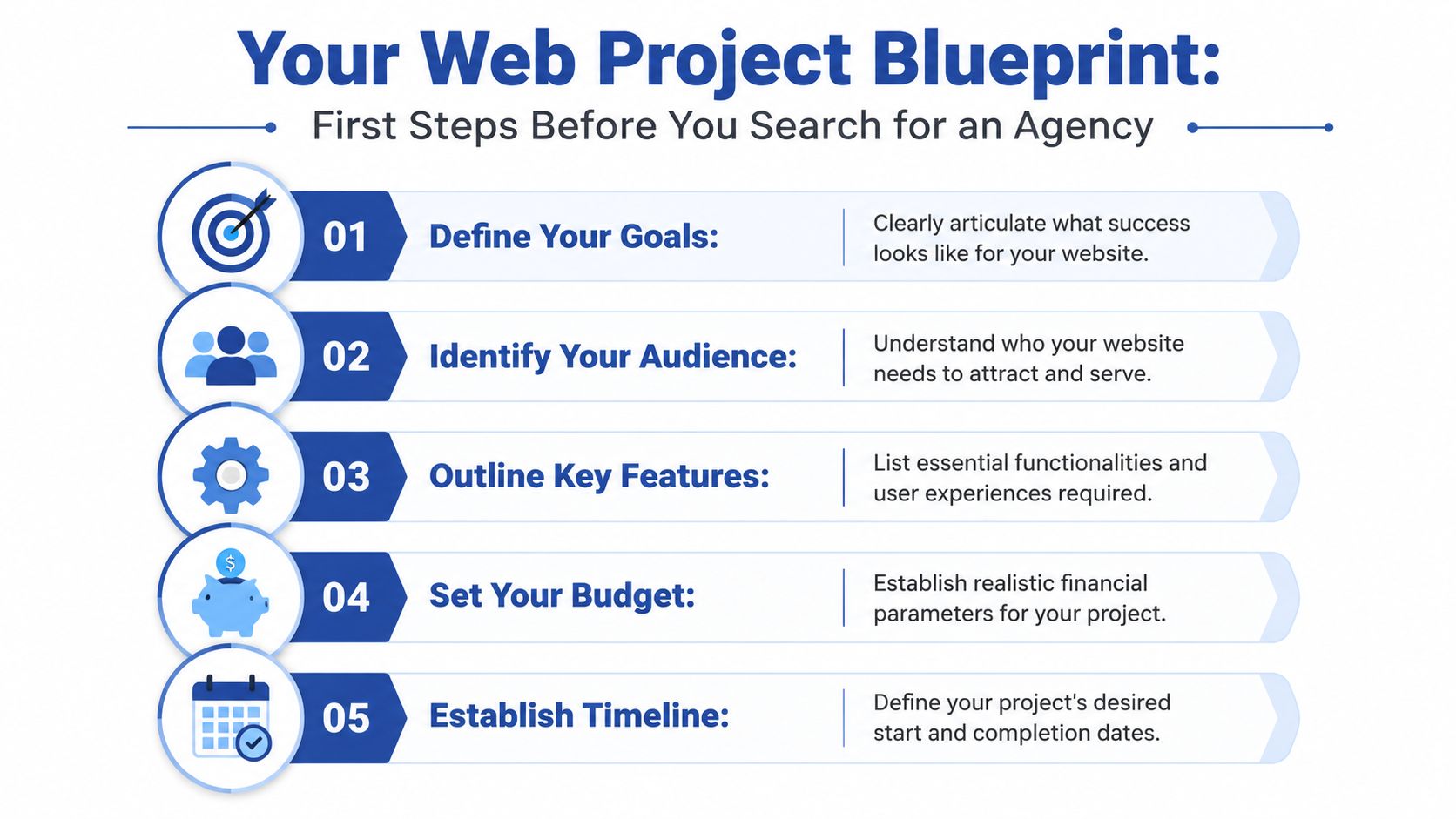
First Steps Before You Search for an Agency
Before you shortlist anyone, get your own brief into shape. Most poor web projects start with vague expectations. “We want something modern” sounds sensible, but it gives an agency too much room to fill the gaps with their assumptions.
A better starting point is to define what the site must change in the business. More quote requests from local service pages. Better quality leads. A smoother Shopify checkout. Fewer drop-offs on mobile. Clearer reporting after launch. Those are useful instructions because they affect structure, content, analytics, and design decisions.
Define success before design starts
Write down answers to these questions before any agency call:
What action matters most?
Is it a phone call, a completed enquiry form, an appointment booking, or a purchase?Which pages matter commercially?
Usually that means service pages, location pages, product pages, and contact or quote pages.What's failing today?
Low lead quality, poor mobile usability, thin content, slow pages, confusing navigation, or weak visibility.What must stay?
Existing rankings, specific URLs, brand assets, product data, integrations, or CRM connections.Who signs off decisions?
Many projects drift because too many stakeholders appear halfway through and rewrite the brief.
If you need a stronger framework for that prep work, this guide on how to hire the right Shopify agency is useful because it forces the commercial questions early rather than treating them as post-launch issues.
Technical basics aren't optional
Google's UK Search Central guidance puts page experience, mobile usability, and structured data at the centre of search visibility, as summarised in this UK-focused agency evaluation guide. For a Derby business, that means your new website can't just look good on a desktop monitor in a meeting room. It needs to work properly on a phone, load fast enough to keep users moving, and give search engines clean signals about what each page is for.
Here's the practical translation:
- Mobile-first design: Most prospects won't experience your site on a large screen first.
- Structured data: Helps search engines understand business details, services, and page context.
- Crawlable content: Fancy animations don't compensate for weak page structure or unclear headings.
- Page experience: Speed and stability affect whether users stay long enough to convert.
A good brief includes business goals, required functionality, technical constraints, and success measures. A bad brief says, “We want a nicer site.”
Set guardrails early
A project also needs boundaries. Decide your working budget range, rough timeline, and any absolute requirements such as platform choice, content migration, or integration requirements. If you don't define those up front, agencies will price wildly different scopes and you'll struggle to compare proposals fairly.
That early discipline saves time later. It also makes weak agencies easier to spot because they won't ask the questions a serious partner should ask.
Finding and Vetting Potential Derby Web Design Partners
Once your brief is clear, build a shortlist. Not a longlist of every agency with a polished homepage. A shortlist of firms that appear capable of delivering the result you need.
Derby has an established agency ecosystem. Some local firms have been around for a long time. For example, Website Design Derby states a founding date of 2002, which signals a stable local market, as reflected in its public company profile. Longevity is useful, but it shouldn't be mistaken for current capability. A firm can survive for years and still be weak on modern ecommerce, CRO, technical SEO, or platform-specific implementation.
Where to look beyond a simple Google search
Start with a mix of sources:
- Local search results: Useful for seeing who competes visibly in Derby and how they position themselves.
- Platform specialists: If you're on Shopify, Magento, or WordPress, look for firms with a clear specialism rather than generic “we do everything” messaging.
- Professional directories and review platforms: Helpful for cross-checking reputation, service focus, and project type.
- Industry referrals: Ask other business owners who've recently rebuilt or migrated a site what went well and what didn't.
That last point matters because good referrals often reveal operational truths you won't see on an agency homepage. Did they hit deadlines? Did they protect rankings? Did communication fall apart after kickoff?
How to read a portfolio properly
A portfolio is useful, but only if you read it with suspicion.
Don't just ask whether the sites look good. Ask whether the examples show evidence of commercial understanding. Is there a clear information hierarchy? Are service pages built for local search intent? Does the ecommerce flow reduce friction or add it? Is the content structured around buyer questions, or just brand language?
Look for signs of substance:
- Relevant project type: A hospitality brochure site doesn't prove ecommerce competence.
- Technical clarity: Agencies should explain what they changed, not just show screenshots.
- Business context: Better case studies describe the problem, constraints, and post-launch priorities.
- Measurement mindset: Even qualitative explanations of lead quality, conversion issues, or migration risk are more useful than design awards.
If you want a broader framework for vetting marketing agencies for new brands, that resource is worth reading because the same logic applies here. You're testing judgement, process, and fit, not just visual taste.
Agencies that only show finished visuals are selling appearance. Agencies that explain decisions are selling thinking.
Build a shortlist you can actually compare
Three to five agencies is usually enough. More than that, and comparisons become noisy.
Try to include a mix. One local Derby option with strong regional knowledge. One platform specialist. One agency that looks commercially sharp even if it's outside Derby. That gives you a better decision set than five similar generalists clustered in the same postcode.
Questions That Uncover an Agency's True Value
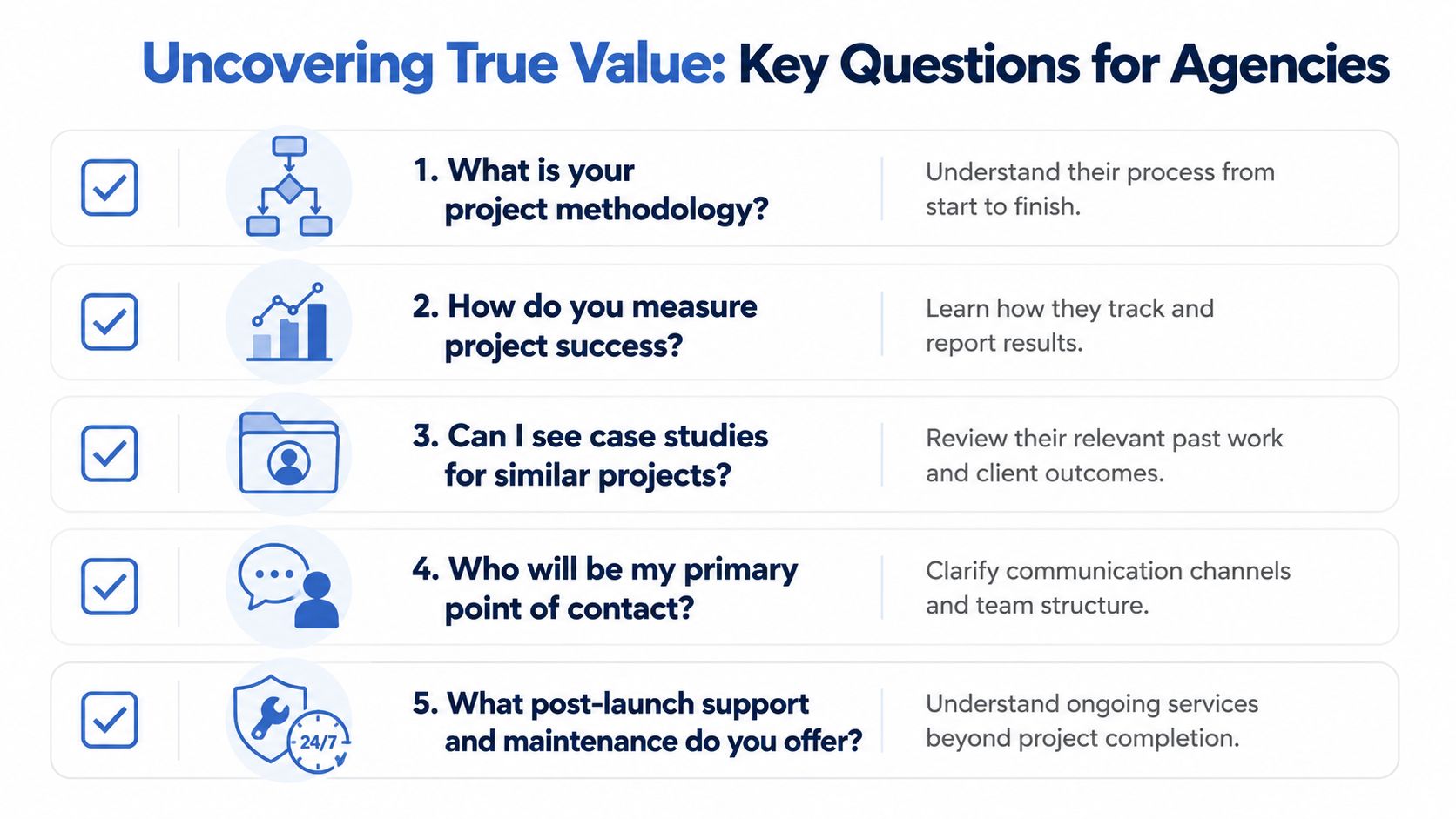
Early calls tell you far more than a proposal does, if you ask the right questions. Most buyers ask about price and timing first. Those matter, but they don't expose whether the agency knows how to protect search visibility, manage complexity, and tie the build to measurable outcomes.
Start by listening for how they think. Strong agencies usually answer in systems. Weak ones answer in slogans.
Ask about process, not just output
A dependable partner should be able to explain how the project will move from discovery to launch without sounding vague.
Ask questions like:
Who runs the project day to day?
You need to know whether you'll speak to a strategist, a project manager, or a salesperson who disappears after the contract is signed.How are decisions documented?
This exposes whether the team has a proper workflow or relies on scattered emails and memory.What do you need from us, and when?
Mature agencies know client delays often come from content, product data, approvals, and stakeholder conflict.What happens after launch?
If support is unclear, problems become your problem fast.
A useful supplement to these conversations is a review of proven local SEO strategies, especially if local service pages and map visibility matter to your revenue. It helps you judge whether the agency's local search advice is practical or just generic SEO language.
This short video is also a useful prompt for what good agency conversations should surface:
The migration question that exposes real technical competence
One of the clearest technical tests is how they handle redesign risk. A strong benchmark is whether the agency has a migration playbook covering URL redirects, metadata preservation, and post-launch crawl monitoring, as described in this Derby agency technical guide.
Ask directly:
| Question | What a strong answer includes | What a weak answer sounds like |
|---|---|---|
| How do you prevent traffic loss during a redesign? | Redirect mapping, metadata retention, crawl checks, launch monitoring | “We handle SEO too” |
| How do you test the site before launch? | Device testing, form testing, speed checks, structured data review | “We'll do QA” |
| How will success be measured after launch? | Defined KPIs, analytics setup, landing-page review, ongoing iteration | “You should see improvement” |
That one conversation often separates builders from partners.
If they can't explain what happens to your URLs, metadata, and indexed pages during launch, they shouldn't be trusted with a redesign.
Ask for relevant evidence, not generic confidence
You don't need inflated claims. You need relevance.
Ask to see work involving a similar catalogue size, service model, migration challenge, or conversion problem. If you're hiring for Shopify work, ask Shopify-specific questions. This is also where a specialist option such as hiring a Shopify expert becomes easier to evaluate because the conversation shifts from “Can you build websites?” to “How do you solve platform-specific revenue problems?”
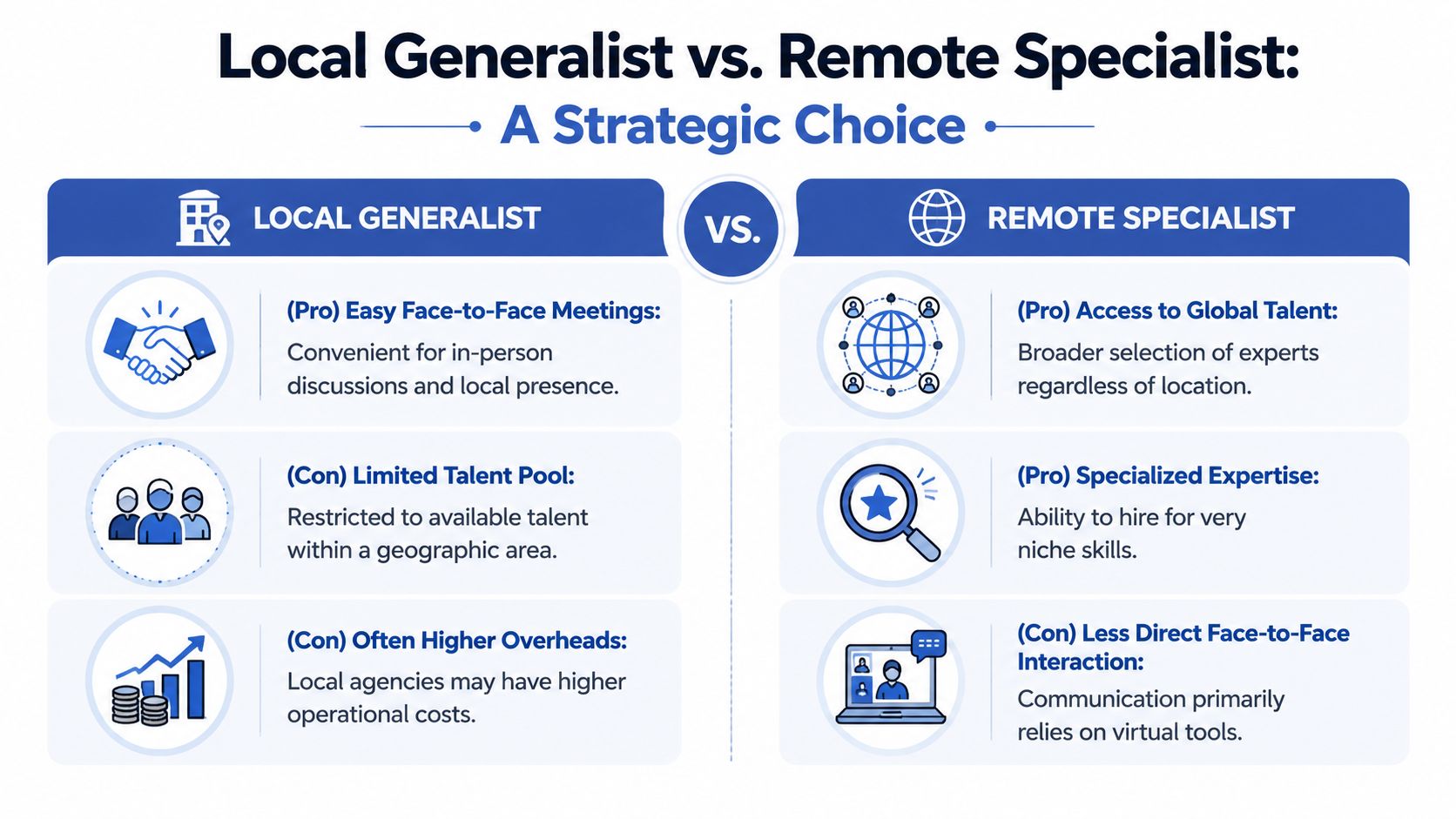
Considering a Remote Specialist Over a Local Generalist
Many Derby businesses assume local is automatically safer. Sometimes it is. If your team needs in-person workshops, fast office visits, or a local supplier network, proximity helps.
But location can also become a lazy filter. It narrows your options before you've tested the thing that matters most, which is whether the agency can solve your specific problem.
When local is helpful
A local generalist can be a good fit when:
- The project is straightforward: A basic service website with limited integrations and simple content needs.
- Face-to-face working matters: Some owners make decisions faster in a room than on video calls.
- Local market familiarity is valuable: Messaging, service areas, and buyer language can benefit from regional knowledge.
Those are real advantages. They just aren't universal advantages.
When a specialist is the better choice
For ecommerce, the balance often changes. Replatforming to Shopify 2.0 carries real risk because preserving SEO equity, handling structured data, and improving Core Web Vitals are specialist tasks where mistakes can cause visible traffic loss, as outlined in this Shopify migration and performance discussion.
That matters because many agencies can design a storefront. Fewer can manage the hidden engineering and SEO detail behind a safe migration.
A remote specialist is often stronger when the project involves:
- Platform complexity: Shopify theme architecture, app bloat reduction, ERP or CRM integrations, subscriptions, international storefronts.
- Commercial accountability: Ongoing CRO, landing-page testing, merchandising logic, checkout friction analysis.
- Technical launch risk: Redirect planning, schema validation, template preservation, structured content migration.
Compare the decision properly
Here's the trade-off in plain terms:
| Factor | Local generalist | Remote specialist |
|---|---|---|
| Communication | Easier in-person access | Usually stronger documented async updates if well run |
| Breadth | Broader service mix | Deeper capability in one platform or problem area |
| Convenience | Higher if you want meetings on site | Higher if you want fast execution without travel |
| Technical depth | Variable | Often stronger for migrations and ecommerce systems |
There's nothing wrong with choosing local. Just don't choose local by default.
One reason some businesses work with specialist partners outside Derby is that they want a narrower, more technical service model. For example, Grumspot focuses on Shopify design, development, migrations, and conversion-focused ecommerce work. That's not automatically the right fit for every business, but it's the kind of specialist model worth considering if your project is less about “a new website” and more about store performance, platform execution, and post-launch iteration.
The right partner matters more than their postcode. A poor local fit is still a poor fit.
Decoding Proposals and Making Your Final Decision
By the time proposals arrive, the decision usually feels like it's about price. It isn't. It's about clarity.
A strong proposal makes it obvious what the agency will do, how the project will run, what you're responsible for, and how success will be judged. A weak proposal hides behind broad phrases such as “complete redesign”, “SEO-ready build”, or “fully optimised experience” without spelling out deliverables.
What to look for in the document
Read proposals in layers.
First, check scope. Are sitemap planning, content migration, redirects, analytics, QA, and post-launch support included, or assumed? Next, inspect the workflow. Discovery, design, development, testing, launch, and support should be visible as real phases, not blended into one vague line item.
Then review assumptions. Good agencies state what they need from you. Copy, product data, imagery, approvals, access to systems, and stakeholder availability all affect delivery.
Red flags that usually create trouble later
Watch for these signs:
- Vague deliverables: You can't hold anyone accountable if the work isn't defined.
- No success criteria: If performance isn't discussed, the agency may see launch day as the finish line.
- Unclear ownership: You should know who handles content, redirects, testing, and support.
- Missing cost boundaries: Extra charges often appear where scope was never properly named.
A proposal should help you compare value, not just price. One way to sense whether an agency understands product presentation and buyer experience is to look at strong ecommerce examples outside the agency space. Brands such as WearView are useful reference points because they show how clear merchandising, product communication, and straightforward UX work together.
Make the choice with a long view
The best decision usually comes from three filters:
- Do they understand the business problem?
- Can they explain how they'll solve it without hand-waving?
- Do you trust how they work when things get messy?
If two proposals look similar, use total cost of ownership as the tiebreaker, not headline price. A cheaper build that creates SEO loss, poor data quality, or constant post-launch fixes often costs more in the end. If you need help framing those trade-offs, this breakdown of Shopify website design cost is a useful way to think about scope, complexity, and where budgets go.
If your Derby business is planning a serious ecommerce build, redesign, or Shopify migration, Grumspot is one option to review alongside local agencies. The team focuses on Shopify design, development, migrations, CRO, and technical audits, with support built around clear execution and ongoing iteration. If your priority is measurable performance rather than just a nicer-looking site, that's the kind of specialist capability worth comparing before you decide.
Let's build something together
If you like what you saw, let's jump on a quick call and discuss your project
Related posts
Check out some similar posts.

- web design agency southampton
Find the best web design agency Southampton. Our 2026 guide covers vetting, pricing, red flags & cho...
Read more
- web design agency sheffield
Find the best web design agency Sheffield. Our 2026 guide covers vetting portfolios, pricing, Shopif...
Read more
- web design agency leeds
Our 2026 guide helps you find & hire the best web design agency leeds. Get checklists, pricing bench...
Read more
- web design agency manchester
Find the best web design agency Manchester has to offer. Our 2026 guide covers services, pricing, qu...
Read more