Best Web Design Agency Leeds: Your 2026 Selection Guide
- web design agency leeds
- leeds web design
- hire web designer
- ecommerce agency leeds
- shopify agency leeds
Launched
June, 2026

You've probably done the same search a lot of Leeds businesses start with. You type in a few variants of web design agency Leeds, open five or six tabs, and quickly realise they all sound alike. Every agency says it builds beautiful websites, every portfolio has polished mock-ups, and every sales page promises strategy, SEO, development, and support.
That's where most buyers lose time.
The decision isn't which agency has the nicest homepage. It's which type of agency fits the job you need done. A brochure-site studio can be the right choice for one business and completely wrong for another. A technically strong development partner might be perfect for a complex integration project and a poor fit for a brand that mainly needs sharper messaging and stronger lead generation.
A smart hiring process starts by matching business need to agency model. Once you do that, the field gets much easier to read.
Starting Your Search for a Web Partner in Leeds
If your search feels messy, that's normal. Most agency websites are written to sound broad enough to appeal to everyone, which means they often hide the thing you most need to know. What are they best at?
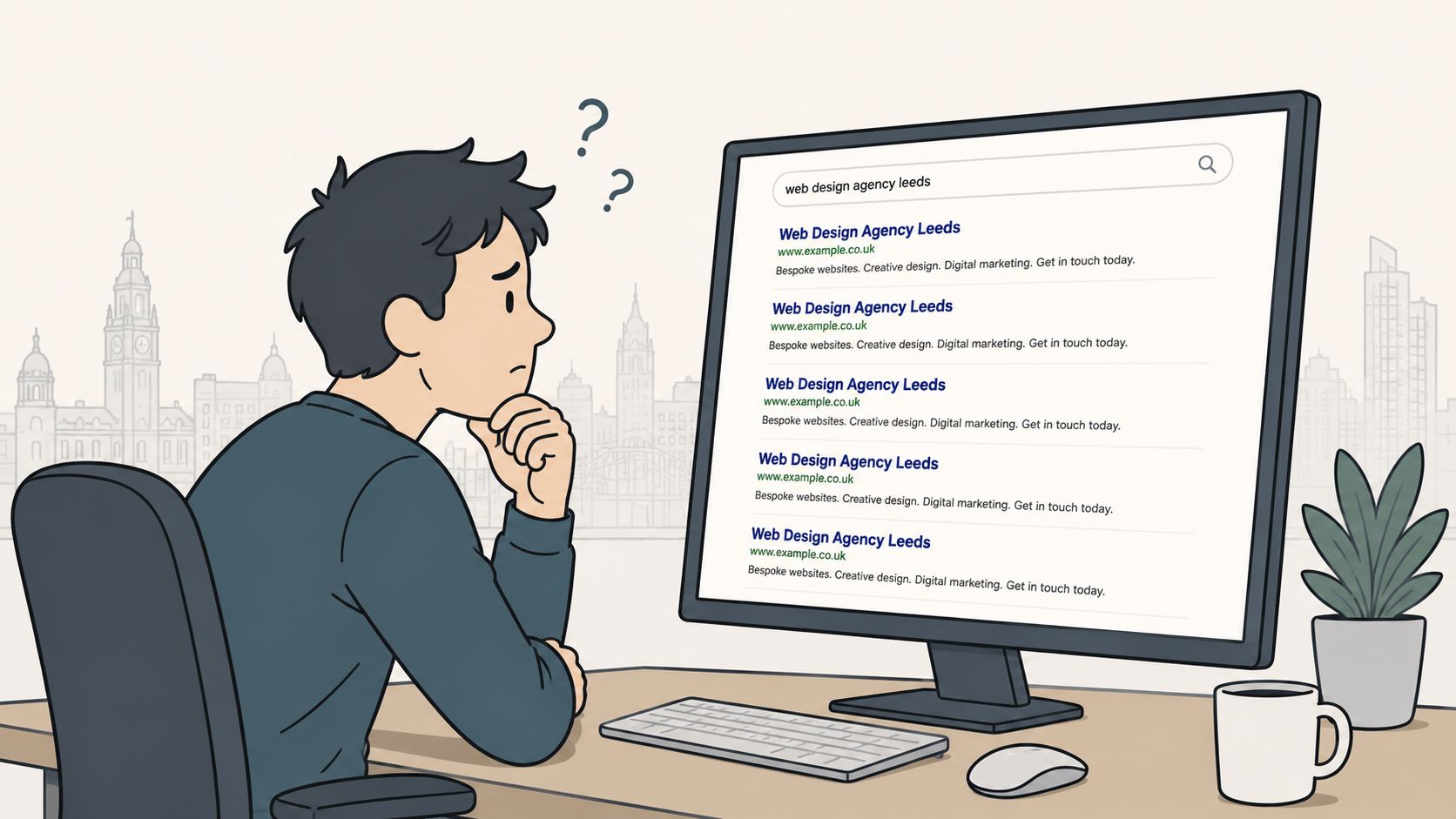
Comparative guidance on the Leeds market points to a gap buyers run into all the time. Different agencies vary materially in focus and capability, yet many present themselves as if they do everything equally well. That matters even more because the UK has roughly 5.5 million SMEs, which means many buyers aren't technical and need a clearer way to match project type to agency model rather than comparing generic portfolios (guidance on choosing a website design agency in Leeds).
The four agency types most buyers confuse
Most searches for a web design agency in Leeds collapse very different services into one bucket. In practice, you'll usually run into four broad models:
- Brochure-site studios build clean, credible marketing sites. They're often a sensible fit if you need a professional presence, straightforward content pages, and a manageable build.
- Conversion-led partners focus on enquiries, bookings, forms, user journeys, and landing page performance. They care less about decorative design and more about what gets users to act.
- Technical build shops are usually stronger when your project involves complex architecture, integrations, accessibility requirements, or long-term engineering support.
- Ecommerce specialists work best when the site is a sales engine, not a brochure. They understand merchandising, checkout friction, product structure, and platform-specific realities.
Practical rule: Don't ask whether an agency can build a website. Ask whether it regularly solves the same business problem you have.
What to decide before you compare agencies
A Leeds law firm replacing an outdated brochure site shouldn't shortlist agencies the same way as a retailer planning a Shopify migration. The first needs clarity, trust, and lead capture. The second needs technical execution, conversion thinking, and post-launch trading support.
That's why simple “top agencies in Leeds” lists rarely help much. They flatten all project types into one ranking.
If you want a broader UK comparison before narrowing locally, this guide to the best web design agency UK options is useful for seeing how different specialists position themselves. Then you can return to Leeds with better filters.
Define Your Project Before You Contact an Agency
Agencies write better proposals when the brief is sharp. Buyers also make better decisions when they know what they're asking for.
That sounds obvious, but many projects still start with a vague instruction such as “we need a better website”. That creates weak discovery calls, inconsistent quotes, and a shortlist built on presentation skills rather than fit.
The UK web design industry generated £621.3 million in revenue in 2023, with 2,041 active professional agencies operating nationwide. In that crowded market, specialist execution and sector knowledge matter, and a clear brief becomes your best tool for finding the right fit (UK web design industry statistics and trends).
Write the brief your agency actually needs
Keep it simple. A useful internal brief doesn't need to be long. It needs to remove ambiguity.
Include these basics:
The business goal
Say what the website has to do for the business. More qualified leads, more booked consultations, cleaner product discovery, smoother quote requests, stronger recruitment, easier content management. Pick the primary outcome.The audience
List who the site is for. Existing customers, procurement teams, local consumers, wholesale buyers, patients, members, distributors. If there are several audiences, rank them.The core journeys
Describe the actions that matter. Request a demo. Book an appointment. Browse categories. Add to basket. Download a brochure. Call the office. Good agencies build around journeys, not page counts.The must-haves
Name what the website cannot launch without. CMS access, booking tools, multilingual support, stock sync, CRM integration, gated resources, subscription functionality, location pages.The nice-to-haves
Put optional features in a separate list. That prevents every conversation from drifting into expensive extras too early.
The questions to answer internally first
Before you speak to any agency, get your team aligned on these points:
- What has to improve
Is the current issue weak lead quality, poor user flow, slow updates, limited ecommerce capability, or a site that no longer reflects the business? - Who signs off
If marketing wants one thing and directors want another, the project will stall. Define who owns the final call. - What content exists
Agencies can design around thin or disorganised content, but they can't make the problem disappear. - What success looks like
The sharper this is, the easier it is to compare proposals.
A vague brief invites vague pricing. A precise brief forces agencies to show how they think.
What works and what usually fails
A good brief gives an agency enough context to recommend the right scope. It doesn't dictate every visual detail from day one.
What doesn't work is asking three agencies to “quote for a redesign” while each is imagining a different project. One prices a brochure site, another assumes CRO and SEO input, another includes migration and training. The numbers look incomparable because the scopes are.
If you want useful proposals, make the brief tight enough that agencies respond to the same commercial problem.
Finding and Shortlisting Your Top Contenders
Once the brief is solid, your shortlist gets easier to build. This stage isn't about finding the most visible agencies. It's about eliminating the wrong ones quickly.
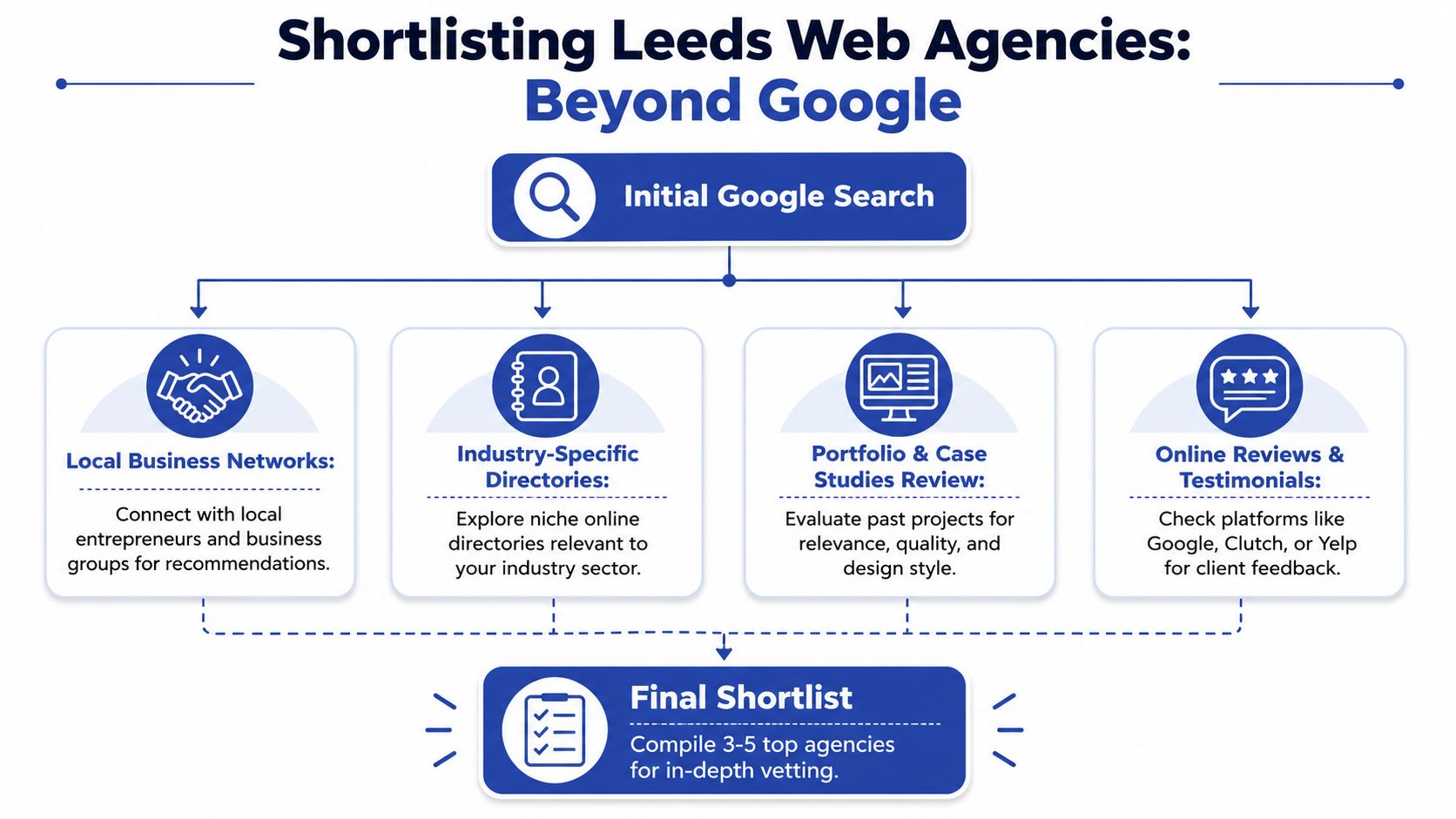
Build the shortlist from more than search rankings
Google is a starting point, not a verdict. Strong agencies can rank well, but so can agencies with better content marketing than delivery.
Use a mix of channels:
- Local recommendations from businesses outside your direct category. Ask who built the site, what communication was like, and whether support stayed strong after launch.
- Review platforms such as Google and Clutch. Look for patterns in feedback, especially around communication, timelines, and problem-solving.
- Design and industry directories when the project demands a particular specialism.
- Your own customer lens by browsing agency websites on mobile, checking clarity, speed, and whether the messaging is specific or generic.
Review portfolios for relevance, not taste
Most buyers still review portfolios the wrong way. They ask, “Do I like the design?” The better question is, “Have they solved the kind of problem I'm hiring for?”
A few examples make that easier:
| Your project | Strong portfolio sign | Weak portfolio sign |
|---|---|---|
| Lead generation site | Clear calls to action, trust elements, sensible page structure | Mostly visual concepts with no obvious conversion path |
| Ecommerce rebuild | Product hierarchy, filtering, merchandising logic, platform fluency | Stylish brand sites with little evidence of trading experience |
| Complex technical build | Multi-system integrations, robust content models, long-term support language | Mostly brochure sites with no sign of engineering depth |
| Accessibility-sensitive project | Discussion of auditing, remediation, testing, maintenance | Accessibility mentioned as a checkbox only |
A broad portfolio isn't always a strength. Sometimes it means the agency hasn't chosen a lane.
The shortlisting question most buyers forget
One of the biggest differentiators is what happens after launch. Guidance focused on Leeds agencies highlights post-launch performance and compliance as a major gap in agency marketing. It notes that accessibility is increasingly treated as risk management, and smart buyers should ask how an agency audits, fixes, and monitors accessibility, SEO, and conversion after launch (Leeds web design guidance on accessibility and post-launch support).
That single question filters out a lot of weak fits.
If an agency can only talk confidently about launch day, you still don't know how it performs in month three, month six, or during the first real business change.
A practical shortlisting method
Keep the final shortlist small enough to manage properly.
- Shortlist for fit first
Aim for agencies whose strongest work resembles your need, not just your sector. - Check how they describe support
Maintenance, optimisation, compliance, and technical ownership should be explained in plain terms. - Look for team clarity
You want to know who designs, who develops, who manages the build, and who handles post-launch issues. - Reduce to a workable group
Three to five serious contenders is usually enough for proper comparison.
A shortlist built this way gives you useful conversations. A random list of “top Leeds agencies” usually gives you polished sales calls and not much else.
Your Vetting Checklist Questions That Reveal True Value
A good agency call should leave you with a clearer view of your own project. A weak one usually leaves you with generic promises and a nice PDF.
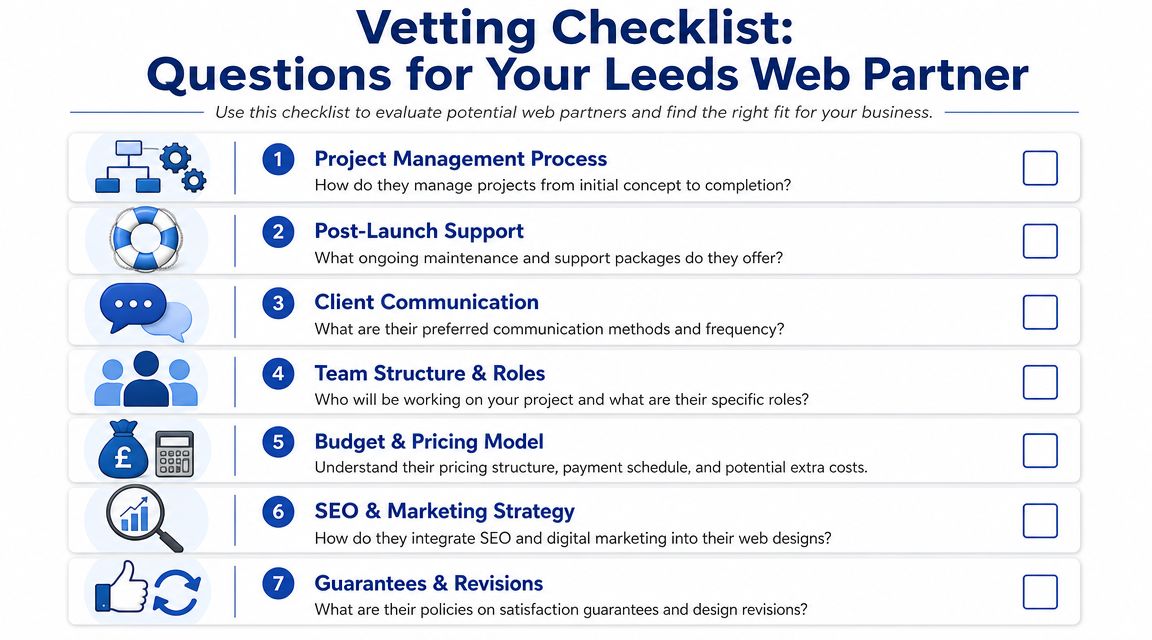
The most useful questions aren't “How long have you been doing this?” or “Can you handle SEO?” Every agency has a polished answer ready for those. Better questions force the team to show how it thinks.
Guidance on high-converting websites in Leeds recommends starting with an evidence-based conversion audit. The strongest agencies talk about mapping user journeys, identifying friction in the first 3 to 5 form fields, improving labels and autofill, and strengthening trust signals such as reviews, testimonials, and case studies (high-converting website guidance for Leeds businesses).
Questions that expose strategic depth
Ask these early:
How would you diagnose friction in our current user journey?
Serious teams will talk about page intent, user flow, forms, trust signals, and content hierarchy. Weak teams jump straight to redesign language.What would you want to audit before proposing a solution?
Look for mention of analytics, search intent, enquiry flow, content structure, and current technical constraints.How do you define success for a project like ours?
The answer should connect to enquiries, sales flow, content management, or operational efficiency. “A modern website” isn't a business outcome.
What you want to hear: a process that starts with user behaviour and business goals, not colour palettes.
Questions about delivery, not just ideas
The agency also needs to prove it can execute.
Consider asking:
- Who will work on the account?
- What does the handoff between design and development look like?
- How do revisions work?
- What slows projects down most often?
- What content, assets, or approvals do you need from us and when?
- How do you handle integrations with platforms such as Shopify, CRMs, ERPs, or booking systems?
For ecommerce projects, get more specific. Ask about catalogue structure, promotions, subscriptions, international considerations, app conflicts, and how they approach template customisation versus custom development.
If you're comparing service providers beyond web build alone, Surnex's SEM hiring tips are worth reading because they sharpen the same core skill. Evaluating whether a specialist can think commercially instead of just talking tactics.
Questions that test post-launch seriousness
At this point many pitches get thin.
Ask:
- What happens in the first months after launch?
- How do you prioritise fixes, improvements, and testing?
- Who owns accessibility, performance checks, and content issues once the site is live?
- What does support include, and what sits outside it?
A credible answer includes workflow, ownership, and cadence. It doesn't just say “we offer maintenance”.
For brands on Shopify, there are agencies that focus specifically on conversion-first store builds, audits, migrations, and ongoing CRO work. This guide on how to choose a web design agency is useful if you want another framework for comparing that kind of specialist.
Decoding Proposals and Making the Final Decision
Once proposals land, most buyers look at price first. That's understandable, but it's not enough. Price tells you what the agency charges. It doesn't tell you what the project includes, how the work will be run, or whether the team has understood the brief.
A stronger way to compare proposals is to read them like operating documents. If the agency can't explain scope clearly in writing, the project usually won't become clearer once work starts.
UK agency guidance warns against treating web design as a one-off deliverable. The better model is ongoing optimisation of site structure, load performance, accessibility, and content, with agencies acting as partners who can maintain and improve the site over time (website development guidance focused on long-term optimisation).
What a strong proposal usually includes
The best proposal isn't always the longest one. It's the one that removes uncertainty.
Look for:
- A clear statement of work with specific deliverables rather than broad wording such as “website redesign”
- Named phases and milestones so you know when discovery, design, build, content population, testing, and launch happen
- Assumptions and exclusions so both sides know what is and isn't included
- Team visibility showing who is responsible for strategy, UX, design, development, QA, and support
- Post-launch detail covering fixes, enhancements, training, monitoring, or retainer options
Compare value side by side
A simple comparison table helps stop the decision becoming emotional.
| Proposal area | Strong sign | Red flag |
|---|---|---|
| Scope | Itemised and unambiguous | Broad language with room for dispute |
| Timeline | Phased with dependencies | Loose promises with no structure |
| Pricing | Tied to scope and milestones | Cheap headline figure with unclear extras |
| Support | Defined post-launch model | “Support available” with no detail |
| Relevance | Tailored to your commercial goal | Recycled copy that could fit any client |
A cheap proposal can become expensive fast if every useful improvement sits outside scope.
Fixed project or ongoing retainer
Neither model is automatically better. It depends on the job.
A fixed project often suits a contained brief with a clear launch target. A retainer usually makes more sense when the website is expected to evolve through testing, content changes, platform work, and ongoing optimisation.
For ecommerce businesses, that distinction matters a lot because the site rarely stops changing. Theme updates, landing pages, campaign support, merchandising changes, app work, and conversion improvements all continue after launch. If you're budgeting that kind of work, this overview of Shopify website design cost helps frame the commercial trade-offs.
Final decision signals
Before signing, ask yourself three blunt questions:
- Did this agency understand the business problem or just repeat the brief?
- Can I see how the project will be run day to day?
- Do I trust them to improve the site after launch, not just deliver it?
If the answer to any of those is shaky, keep looking.
Your Next Step Towards a High-Performing Website
The right Leeds agency isn't the one with the loudest branding or the broadest claims. It's the one that fits the commercial job in front of you.
If you need a simple credibility site, hire for clarity and execution. If you need stronger lead generation, hire for conversion thinking. If your project depends on integrations, compliance, or robust maintenance, hire for technical depth. If your revenue depends on the website every day, hire an ecommerce specialist that understands trading realities after launch.
That distinction matters because websites rarely fail for one dramatic reason. They underperform through small misalignments. The wrong agency model. A weak brief. A portfolio that looked impressive but wasn't relevant. A proposal that covered launch and ignored everything after it.
What a smart decision looks like
A strong decision usually has these qualities:
- The brief is clear enough that proposals are comparable.
- The shortlist is focused on agencies whose specialism matches the work.
- The vetting questions test process rather than surface-level credibility.
- The final choice reflects long-term fit, not just launch cost.
That's the practical route to a website that performs like a business asset rather than a design exercise.
For ecommerce teams, it also helps to keep user behaviour at the centre of the decision. This practical piece on improving user engagement for e-commerce is useful because it reinforces a simple truth. Responsive design, page flow, and usability are not cosmetic decisions. They shape whether visitors stay, browse, and buy.
When specialist Shopify support makes sense
If your shortlist has led you to one conclusion, that the website needs to drive more from the same traffic, then a generalist agency may not be the right fit. That's especially true when the job includes platform migration, merchandising logic, app integration, subscription setup, international storefronts, or sustained CRO work.
In those cases, you want a partner that can handle both build quality and commercial iteration. Not just launch the storefront, then disappear.
If your project is Shopify-focused and you need help assessing whether you need a rebuild, a migration, a conversion audit, or ongoing store support, Grumspot is one option to consider. The team works on Shopify design, development, audits, migrations, and CRO retainers, so the conversation can stay focused on fit, scope, and what the site needs to do commercially rather than on generic agency promises.
Let's build something together
If you like what you saw, let's jump on a quick call and discuss your project
Related posts
Check out some similar posts.
- web design agency southampton
Find the best web design agency Southampton. Our 2026 guide covers vetting, pricing, red flags & cho...
Read more
- web design agency sheffield
Find the best web design agency Sheffield. Our 2026 guide covers vetting portfolios, pricing, Shopif...
Read more
- web design agency manchester
Find the best web design agency Manchester has to offer. Our 2026 guide covers services, pricing, qu...
Read more
- web design agency belfast
Find the best web design agency belfast for your project in 2026. Our expert guide helps you choose ...
Read more