Best Web Design Agency Belfast: Your 2026 Guide
- web design agency belfast
- ecommerce belfast
- shopify agency ni
- hire web designer
- belfast digital agency
Launched
May, 2026

Most advice about hiring a web design agency in Belfast is too shallow. It tells you to review portfolios, compare prices, and pick the team whose work looks polished. That's backwards.
If your site sells products, captures leads, supports bookings, or connects into your operations, you're not buying design. You're buying a commercial system. The right partner should understand conversion, platform constraints, integrations, migration risk, and what happens after launch when the significant work starts.
Why a Pretty Website Is Not Enough
A visually strong site can still underperform. It can load poorly, bury key actions, confuse mobile users, break tracking, create checkout friction, and leave your team dependent on developers for every change. That isn't a design win. It's an expensive liability.
Belfast businesses also aren't shopping in a cosy local niche. They're choosing inside a crowded national market. The UK has 2,041 professional web design agencies currently operating, and the sector's revenue reached £621.3 million in 2023 according to Made By Shape's review of UK web design agency statistics and trends. That tells you two things. First, plenty of agencies can make something look good. Second, aesthetics alone won't separate competent suppliers from commercially useful ones.
Design that performs beats design that flatters
A good homepage mock-up is easy to sell in a pitch. A site that supports search visibility, merchandising, retention, and operational efficiency is harder to fake. That's why business owners get misled. They buy what they can see, then discover later that nobody planned for filters, subscriptions, analytics, search pages, or customer account flows.
Practical rule: If an agency mostly talks about colours, layouts, and branding before it talks about goals, tracking, and user actions, you're speaking to a design studio, not a growth partner.
This matters beyond ecommerce too. A venue, clinic, manufacturer, or service business still needs pages to rank, convert, and move people towards enquiry. If you're reviewing how content and search work together in a niche market, Bare Digital's guide on how to optimise your wedding venue online is a useful example of thinking beyond visuals and into commercial intent.
The wrong hiring frame creates the wrong brief
Many buyers start with, “We need a new website.” That's too vague to produce a good outcome. A better brief sounds like this:
- We need to replace a slow platform that blocks content changes and complicates campaign launches.
- We need cleaner customer journeys from landing page to purchase or enquiry.
- We need better technical foundations for SEO, analytics, and future integrations.
- We need a team that stays involved after launch to improve what the data shows.
That shift matters. When you search for a web design agency Belfast, don't ask who makes the nicest sites. Ask who can build a site that earns its keep.
Define Your Project Goals Before You Search
A weak brief invites the wrong agency.
If you start with “we need a new website,” you hand control of the project to whoever tells the best story in the pitch. That usually leads to nice-looking concepts, vague scope, and expensive surprises once the technical work begins. Good agencies push back on fuzzy briefs because they know design decisions only matter after the business problem is clear.
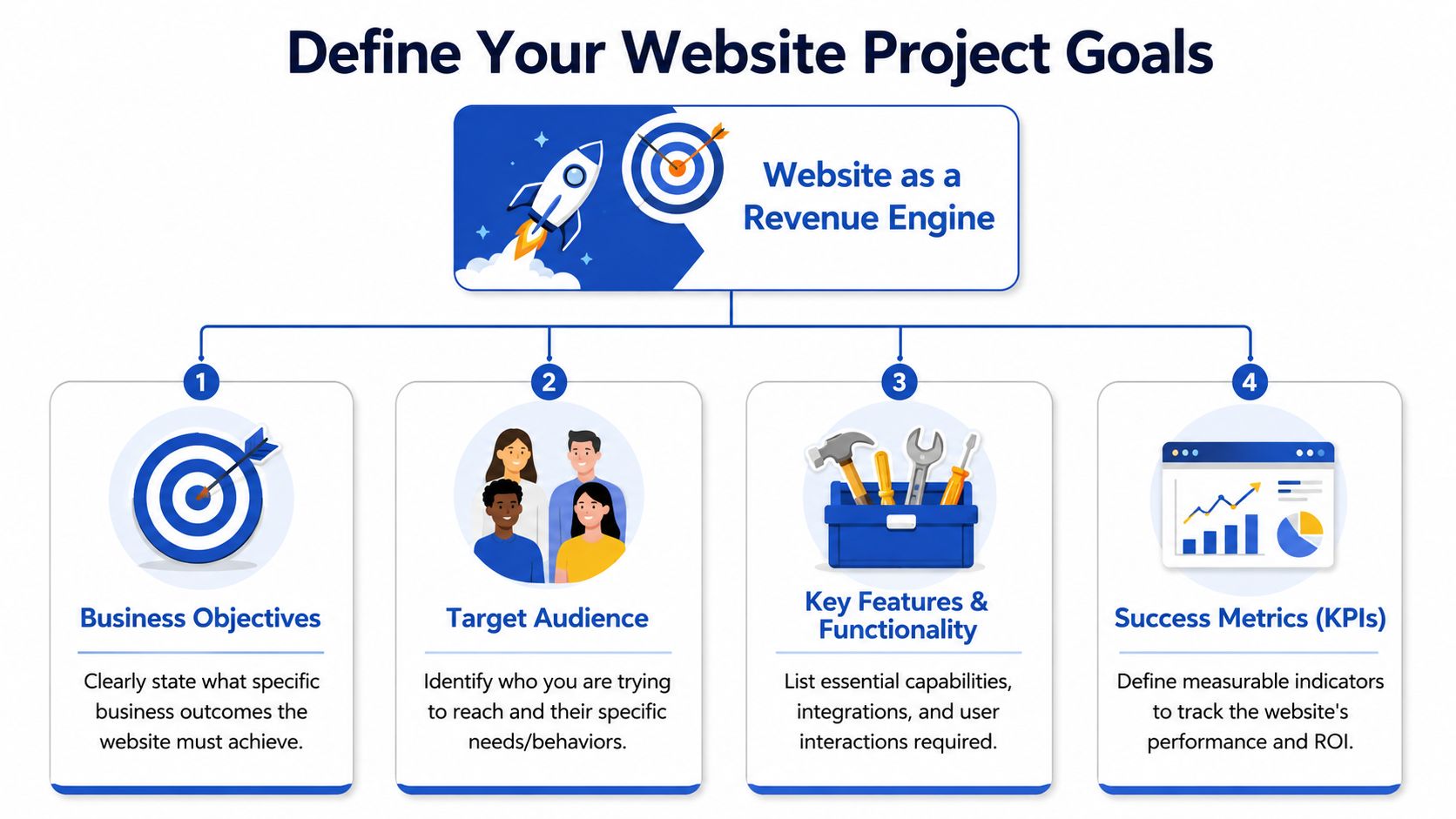
Start with the business problem
Write down what is blocking growth, margin, or efficiency.
For example:
- Sales are leaking because customers struggle to find products, compare options, or complete checkout.
- Your team is wasting time on manual updates, patchwork processes, or disconnected systems.
- The current platform limits growth because it cannot support subscriptions, international selling, bundles, or account-specific pricing.
- Marketing is underperforming because landing pages are slow to publish, tracking is unreliable, or campaign traffic hits weak entry points.
This changes the entire selection process. An agency that only knows how to redesign templates will struggle to answer a brief built around conversion, operations, and platform constraints. That is useful. It helps you rule them out early.
Define your core requirements
Projects go off course when owners leave the hard details for later. Agencies then scope against assumptions, and you pay for the gap.
List the requirements that affect platform choice, technical scope, and delivery risk:
- Platform direction such as staying on WordPress, leaving Magento, or migrating to Shopify or Shopify Plus
- Operational integrations with ERP, CRM, fulfilment tools, subscriptions, product feeds, or custom applications
- Content structure including landing pages, editorial content, location pages, or trade and retail journeys
- Commercial functions such as bundles, wholesale access, subscriptions, or multi-market storefronts
- Internal ownership covering who approves content, who owns product data, and who will run the site after launch
Hidden complexity is what wrecks budgets. If an agency learns halfway through that your store depends on stock sync, custom pricing rules, and subscription logic, the original proposal was never fit for purpose.
Decide how success will be judged
Agencies need decision criteria, not vague ambition.
Set the measures that matter before the first proposal lands. That gives you a way to compare agencies on commercial fit instead of presentation quality.
A practical framework usually looks like this:
| Goal area | Questions to answer internally |
|---|---|
| Revenue | What customer actions should the new site increase, shorten, or remove friction from? |
| Operations | Which manual jobs should the new setup reduce for your team? |
| Marketing | What campaigns, landing pages, or channels should become easier to launch and track? |
| Platform | What future requirements should the build support without another rebuild? |
Keep this grounded. If your real objective is to improve conversion rate, reduce admin time, or make migrations and integrations easier, say so. A serious agency can work with that. A design-led shop that sells aesthetics first will try to pull the conversation back to style.
Write the brief agencies can price properly
A useful brief is short, specific, and commercial. It should answer:
- What are we trying to fix?
- Who are the priority users or customer segments?
- What must the site do on day one?
- What systems must it connect to?
- What internal constraints could slow the project down?
- What does success look like after launch?
That level of clarity does two jobs. It helps strong agencies scope the project properly, and it exposes weak ones fast.
If an agency responds to a commercially specific brief with generic talk about modern design, fresh branding, and user-friendly layouts, keep looking. You are not hiring a team to decorate pages. You are choosing a partner to build a site that can support growth.
Separating Generalists from E-commerce Specialists
A generalist agency can be perfectly competent for a brochure site. That's not the same thing as being suitable for a trading business.
If you sell online, the commercial question is simple. Can this team build and improve the systems that influence revenue, or are they just packaging pages attractively? Many Belfast agency pages focus on design but rarely answer whether they handle ecommerce growth work like Shopify Plus migrations or CRO. That gap matters because a beautiful website is not the same as a revenue-ready platform, as discussed in Element Seven's perspective on the difference between design and ecommerce capability.
What a specialist talks about
An ecommerce specialist usually shifts the conversation away from “style” quickly. They ask about catalogue complexity, product data, fulfilment rules, merchandising logic, customer journeys, return visitors, subscriptions, and measurement.
That's the right instinct.
A specialist should be comfortable discussing:
- Migrations from legacy systems without breaking product data, redirects, or core trading flows
- Integrations between your storefront and the systems your team uses
- CRO work after launch, not just pre-launch design rationale
- Platform fit including when Shopify, Shopify Plus, WordPress, Craft CMS, or a custom stack makes sense
- Operational trade-offs such as app reliance versus custom development
What a generalist often misses
Generalist agencies tend to over-index on homepage design and underplay the mechanics that move money. They might show polished brand work, but stay vague on collection logic, on-site search behaviour, product page structure, checkout constraints, analytics setup, or content-to-commerce journeys.
That's risky if your business needs more than a digital brochure.
Look closely at what they don't say:
- Do they mention post-launch testing?
- Can they explain how they approach merchandising and conversion friction?
- Have they handled platform migrations before?
- Do they understand what happens when marketing, operations, and customer support all rely on the same site?
The wrong agency usually fails quietly. They deliver a decent-looking build, then leave your team with platform debt, weak reporting, and no roadmap for improvement.
Check whether they specialise by platform or by outcome
Platform expertise matters, but platform badges alone don't prove commercial depth. You want evidence that the team can connect design decisions to trading outcomes.
If your shortlist includes agencies for Shopify work, review resources that show how a dedicated partner approaches ecommerce design and build decisions, such as this guide on choosing a Shopify design agency. Use it as a benchmark. The point isn't to find one magic supplier. The point is to spot whether your shortlisted agencies speak the language of ecommerce operations and growth, or just the language of web projects.
A Belfast web design agency worth hiring for ecommerce should be able to explain not only what it will build, but how that build supports revenue, data, workflows, and iteration after launch.
Your Vetting Checklist for Finding the Right Partner
Once you have a shortlist, stop looking at visuals for a moment. Vet the agency like you would vet a senior hire. You want evidence, process, and commercial judgement.
Northern Ireland's online audience is overwhelmingly mobile. 98% of internet users in Northern Ireland access websites via mobile devices, according to Vudu Digital. That means mobile-first thinking isn't a nice extra for a Belfast agency. It's a basic competency. If their own site or client work feels awkward on a phone, remove them from the shortlist.
What to inspect before the first meeting
Open their site and client examples on your phone first, not your laptop. Check navigation, readability, tap targets, page speed feel, forms, and whether key actions are obvious without hunting.
Then review the commercial side:
- Service clarity. Do they clearly explain what happens before design starts?
- Technical depth. Can you see signs of platform, integration, or performance capability?
- Support model. Is there a defined plan for after launch, or do they disappear once the site is live?
- Relevant work. Are the examples similar to your business model, not just visually similar?
Agency vetting checklist
Use a simple scorecard. If an agency can't pass these basics, don't waste another call.
| Vetting Criterion | What to Look For | Pass/Fail |
|---|---|---|
| Mobile-first competence | Their own site and examples work cleanly on mobile, with clear navigation and usable forms | |
| Discovery process | They start with goals, UX, SEO, performance, and business requirements before showing design ideas | |
| Ecommerce capability | They talk confidently about migrations, integrations, CRO, subscriptions, or platform constraints where relevant | |
| Technical credibility | They can explain stack choices, performance considerations, and implementation trade-offs clearly | |
| Measurement mindset | They discuss analytics, testing, and post-launch improvement rather than treating launch as the finish line | |
| Support commitments | They define maintenance, optimisation, communication, and ownership after go-live | |
| Relevant references | They can point to clients with similar operational or commercial needs | |
| Proposal quality | The proposal is specific about scope, timelines, deliverables, risks, and assumptions |
How to verify what they claim
Ask for references, but don't ask lazy questions like “Were they good?” Ask what happened when the project hit friction. Did they communicate clearly? Did they push back on bad ideas? Did they solve commercial problems or just complete tickets?
For a stronger screening framework, compare your shortlist against a more detailed decision guide on how to choose a web design agency.
A serious agency should be able to explain why it made certain decisions, what trade-offs existed, and what it would improve next. If everything sounds effortless, you're hearing a sales version of the work.
Key Interview Questions and Obvious Red Flags
The interview is where weak agencies get exposed.
A polished sales call tells you very little about how an agency handles pressure, complexity, or commercial risk. Your job is to find out whether they can protect revenue during a rebuild, manage operational headaches, and improve performance after launch. If the conversation stays at the level of branding, moodboards, and generic process diagrams, you are speaking to the wrong firm.
Start with real situations, not abstract questions. Ask them to explain a project similar to yours from discovery through launch and into the first few months after go-live. Push for specifics. What went wrong? What changed mid-project? How did they handle tracking, SEO, integrations, approvals, and post-launch performance issues?
A quick visual prompt can help frame the conversation:
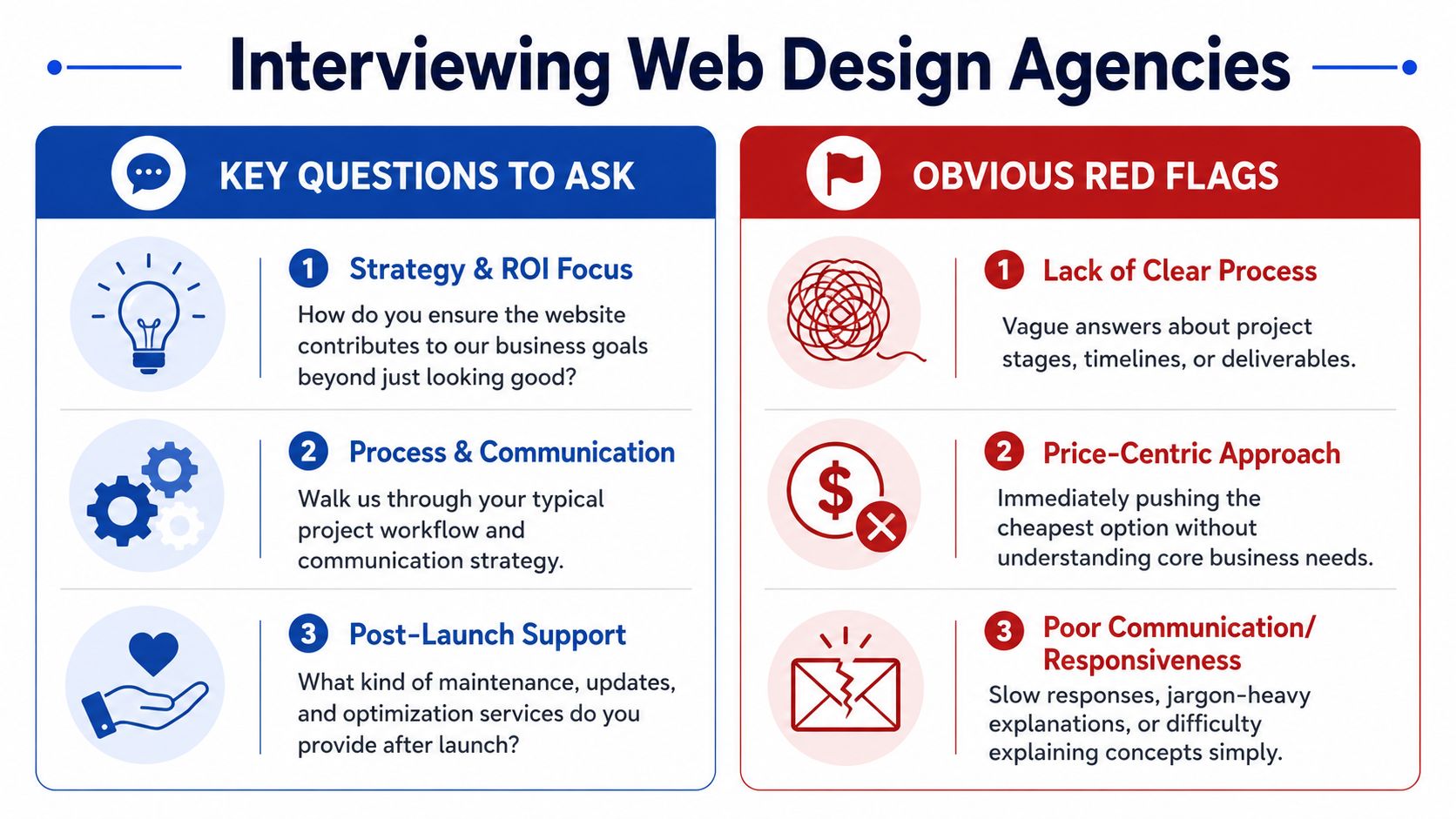
Questions that expose real capability
Use questions that force the agency to show its judgement:
- Walk us through a migration you handled. What were the main risks, and what did you do to reduce them?
- How do you decide what should be custom-built versus handled with apps or existing platform features?
- What happens between strategy approval and first design presentation?
- How do you improve conversion rate after launch? What do you review first?
- How do you protect SEO during a rebuild or platform move?
- Who will run our account day to day, and who makes the decisions?
- What assumptions are you making about our team, our content, and our approval speed?
- What would you challenge in our brief, and why?
Strong agencies answer these cleanly. They talk in decisions, trade-offs, and consequences. Weak agencies hide behind phrases like “a customized approach” and “we adapt to every client.”
Here's a useful companion video if you want a broader view of what to ask and how to assess agency answers.
Red flags that should end the conversation
Some warning signs should stop the process immediately.
- They sell taste instead of outcomes. A beautiful homepage means very little if they cannot talk about conversion paths, average order value, retention, or checkout friction.
- They cannot explain their methodology. If you hear vague claims about “our proven process” but get no clear explanation of discovery, prioritisation, testing, QA, or post-launch review, expect confusion once the work starts. As noted earlier, serious evaluation means looking past the portfolio and asking for a clear method, realistic timelines, and evidence of how they work.
- They dodge team questions. If you cannot identify who owns strategy, UX, development, QA, and support, handoff problems are already baked in.
- They treat launch as the finish line. Good e-commerce partners expect to monitor behaviour, fix friction, and improve conversion after the site goes live.
- They jump to price before diagnosis. That usually means they are selling a package, not solving a business problem.
One more red flag matters more than people admit. If the agency agrees with everything you say, be careful. You do not need a supplier who nods along. You need a partner willing to challenge poor assumptions before they become expensive mistakes.
Listen for judgement
The best answers are rarely the smoothest. They are the most honest.
An experienced agency will tell you where scope is risky, where your internal team could slow delivery, where a simpler build is the smarter commercial choice, and where custom work will create maintenance costs later. That is the level you should hire at.
A Belfast web design agency should be able to do more than design pages. It should be able to make sound business decisions under pressure. If it cannot talk confidently about migrations, integrations, CRO, and post-launch improvement, keep looking.
Decoding Pricing Timelines and Starting Your Project
Most pricing confusion comes from comparing unlike-for-like proposals. One agency prices design and development only. Another includes discovery, UX, QA, training, and support. A third keeps the upfront fee lower, then pushes important work into change requests.
Read proposals for what they assume, not just what they cost.
What usually shapes pricing
A straightforward brochure site and a revenue-focused ecommerce build are not the same purchase. Pricing moves when complexity moves.
Common cost drivers include:
- Platform and migration complexity
- Number of templates and unique user journeys
- Integration requirements
- Custom functionality
- Content population and SEO requirements
- Testing, training, and post-launch support
If you're trying to benchmark what different Shopify project scopes tend to include, this guide on Shopify website design cost is a useful reference point.
What shapes timelines
Timelines stretch for predictable reasons. The agency is rarely the only cause.
The biggest variables are usually:
| Timeline factor | Why it changes delivery |
|---|---|
| Scope clarity | Vague requirements create revisions and rework |
| Client feedback speed | Slow approvals delay every downstream task |
| Integration complexity | External systems introduce dependencies and testing rounds |
| Content readiness | Missing copy, images, and product data stalls launch preparation |
How to start properly
Your kickoff should not be a ceremonial call. It should confirm scope, decision-makers, timelines, risks, communication rhythm, and what “done” means at each stage.
If you run ecommerce on Shopify and need a specialist rather than a generalist web design supplier, Grumspot is one option for businesses that need bespoke storefronts, Shopify 2.0 migrations, CRO input, and integration work. That's relevant when your project goes beyond design into platform execution and ongoing improvement.
Before you sign, check the contract for ownership of code and assets, support terms, change-request handling, timelines, and assumptions around third-party tools. If any of that is fuzzy, fix it before work begins, not after.
If you're choosing a web design agency in Belfast and your site has real commercial weight, treat the decision like an investment in revenue infrastructure, not a branding exercise. Grumspot works with ecommerce brands that need design, development, CRO, migrations, and integrations aligned around performance, not just appearance.
Let's build something together
If you like what you saw, let's jump on a quick call and discuss your project
Related posts
Check out some similar posts.

- web design agency southampton
Find the best web design agency Southampton. Our 2026 guide covers vetting, pricing, red flags & cho...
Read more
- web design agency sheffield
Find the best web design agency Sheffield. Our 2026 guide covers vetting portfolios, pricing, Shopif...
Read more
- web design agency leeds
Our 2026 guide helps you find & hire the best web design agency leeds. Get checklists, pricing bench...
Read more
- web design agency manchester
Find the best web design agency Manchester has to offer. Our 2026 guide covers services, pricing, qu...
Read more