Web Design Agency Manchester: A Buyer's Guide for 2026
- web design agency manchester
- manchester web design
- ecommerce agency manchester
- shopify agency manchester
- hire web designer
Launched
June, 2026

You're probably in one of two situations right now. Your current site looks dated and doesn't reflect the business you've built, or it looks fine but isn't turning visitors into enquiries or sales. In both cases, the problem isn't design. It's performance.
That's why hiring a Web design agency in Manchester shouldn't be treated like buying a logo, a brochure, or a nicer homepage. You're choosing a team that will shape how customers judge your credibility, how easily they buy from you, and how well your site supports growth after launch.
Most business owners make the same mistake. They compare agencies on visuals first, price second, and process last. That's backwards. A polished portfolio doesn't tell you whether the agency can improve conversion, support ecommerce complexity, handle migrations properly, or keep improving the site once it's live.
Finding Your Digital Partner in a Crowded Market
Manchester gives you choice. Too much choice, frankly.
The wider UK market is crowded and mature, not a gold rush. One industry analysis says the UK web design sector generated £621.3 million in 2023, with only 0.2% CAGR over the previous five years, and counted 2,041 operating web design agencies across the UK, according to this web design industry analysis. That matters because it changes how you should buy.
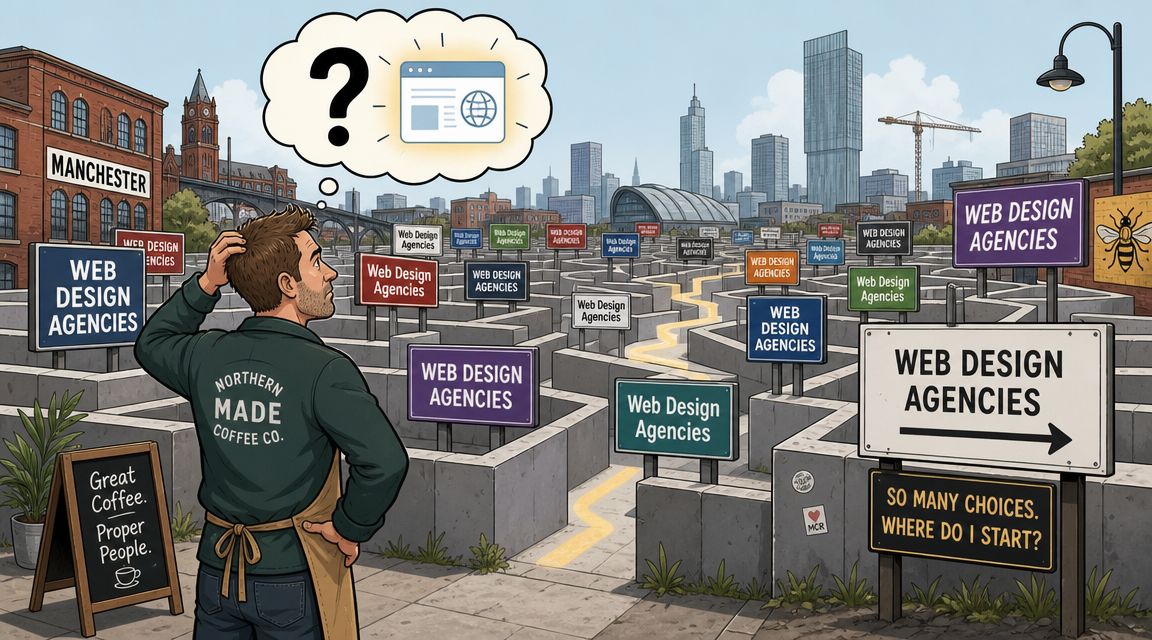
A mature market means there are plenty of suppliers. It doesn't mean they're interchangeable. In fact, the opposite is true. When there are lots of agencies competing for similar projects, the strongest signal isn't how slick their own website looks. It's whether they can connect design decisions to business outcomes.
Stop shopping for pages
If you search for a Web design agency in Manchester, you'll see the same promises repeated: bespoke websites, creative design, responsive development, digital growth. Those phrases tell you almost nothing.
You need to separate site builders from growth partners.
A site builder will deliver pages, content blocks, a CMS setup, and a launch date. A growth partner will ask harder questions: where leads drop off, which products need stronger merchandising, what your sales process looks like, how mobile users behave, and what happens after the redesign goes live.
Practical rule: If an agency spends more time discussing colours than conversion paths, keep looking.
That distinction matters even more for ecommerce businesses. A redesign that improves aesthetics but disrupts navigation, search visibility, or checkout flow can create expensive problems fast. If your business depends on online sales, the agency must understand revenue mechanics, not just design trends.
What a smart buyer does differently
Treat the agency search like a senior hire. You're not buying output. You're buying judgement.
A useful way to frame that is to look at how an agency boosts business growth through strategy, execution, and ongoing support rather than one-off deliverables. That's the standard to hold any Manchester agency against.
Use this filter early:
- Business alignment: Do they understand how your company makes money?
- Relevant specialism: Have they handled your type of site before, especially ecommerce, Shopify, or complex integrations?
- Operational clarity: Can they explain what happens before launch, at launch, and after launch?
- Performance mindset: Do they talk about user journeys, CRO, SEO, speed, and accessibility without waiting to be prompted?
Plenty of agencies can build a website. Far fewer can build one that earns its keep.
Decoding Modern Web Agency Services
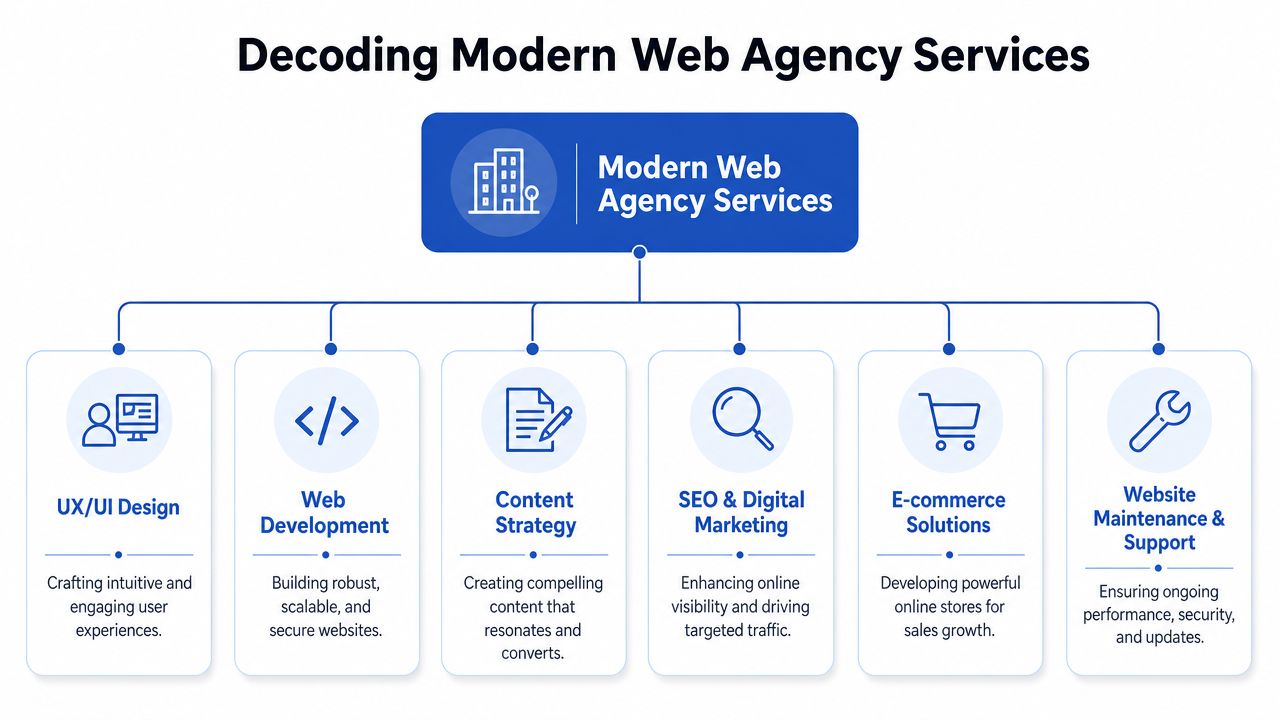
A modern agency should do more than make a site look current. Picture hiring a contractor. Some teams only decorate the rooms. Better teams can assess the structure, fix weak foundations, wire everything properly, and make the building work better day to day.
Here's the service map most buyers need to understand.
The core build work
At the base level, agencies typically handle UX, UI, web development, content structure, and responsive design. That covers how the site looks, how people move through it, and how it functions across devices.
That's necessary. It isn't enough.
A serious agency should also think about the hidden parts that affect results:
- Information architecture: Can users find the right product, service, or answer quickly?
- Content hierarchy: Does the page guide action, or just fill space?
- Technical setup: Is the CMS manageable for your team, or are you trapped relying on the agency?
- Search readiness: Are templates, page structures, and metadata built with SEO in mind?
For ecommerce, this goes deeper. Product filtering, collection structure, on-site search, cart behaviour, and merchandising logic matter as much as homepage design.
A practical example is the difference between a generic ecommerce build and a Shopify or Shopify Plus specialist. A generic team may create a good-looking store. A specialist should understand theme architecture, app impact, checkout constraints, international setups, subscriptions, and how to avoid bloated builds.
For a closer look at that side of the work, this guide to ecommerce website design services is useful because it frames design around commercial function rather than surface-level visuals.
The higher-value services
The agencies worth shortlisting usually offer work that goes beyond launch.
Those services often include:
- Platform migration: Moving from another platform to Shopify, Shopify 2.0, or a more suitable setup without breaking the customer experience.
- Systems integration: Connecting the site to ERP, CRM, fulfilment, subscriptions, reviews, or inventory tools.
- Technical audits: Reviewing speed, indexation, UX friction, accessibility issues, and template inefficiencies.
- CRO work: Testing and refining product pages, landing pages, collection pages, and checkout journeys.
- Ongoing SEO support: Improving site structure, template output, and content targeting over time.
A website launch isn't the finish line. It's the moment real performance work starts.
Many agencies often fall short. They can build. They can't iterate.
If you're running an online store, CRO should not be a bonus add-on buried in a proposal. It should be part of the commercial conversation from the start. If you want a straightforward explanation of that discipline, these Otter A/B conversion strategies give a solid overview of how structured testing improves site performance.
What service mix fits your business
Not every company needs the same level of agency support. A local service business may need clear lead paths, trust signals, and a CMS its team can update. A scaling ecommerce brand may need custom theme work, app rationalisation, ERP integration, and a retainer for continuous optimisation.
That's why the best agencies don't push a standard package. They match the service mix to your actual bottleneck. If they can't diagnose the bottleneck, they're guessing.
How to Evaluate a Manchester Agency
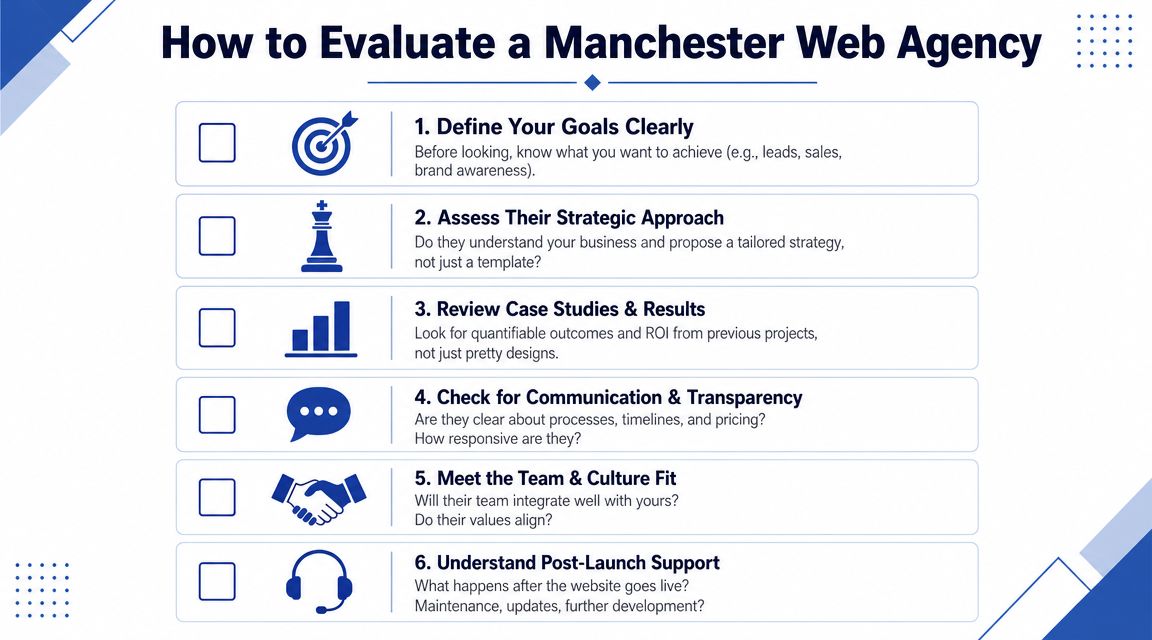
Most buyers evaluate agencies the wrong way. They browse portfolios, react to visual style, ask for a quote, then make a decision based on confidence and chemistry. That's understandable. It's also how businesses end up paying for redesigns that look better but perform worse.
You should evaluate an agency the way you'd evaluate a senior employee. Judge them on judgement, relevance, communication, and their ability to produce outcomes under real constraints.
Start with proof, not polish
A nice portfolio is table stakes. It proves the agency can present work attractively. It doesn't prove they can solve your problem.
Ask for case studies that show commercial thinking. If you're an ecommerce business, look for evidence that they understand product discovery, collection page logic, upsell flows, app complexity, and post-launch optimisation. If you generate leads, look for enquiry path design, trust-building content, and form strategy.
When case studies are vague, press harder. Ask what the business problem was, what changed, what the agency measured, and what happened after launch.
Use this lens:
| What to review | What matters |
|---|---|
| Portfolio | Relevance to your sector, platform, and business model |
| Case studies | Clear problem, solution, and outcome story |
| Proposal | Commercial logic, not just deliverables |
| Team | Who will actually do the work |
| Support | What happens after go-live |
If an agency can't explain its decisions in plain English, it probably doesn't understand them well enough.
Favour specialists when the project is complex
Generalists can be fine for simple brochure sites. They're a weak choice for ecommerce brands with platform issues, custom requirements, international storefronts, or a need for ongoing CRO.
This is especially true if you sell on Shopify. Shopify and Shopify Plus projects often involve theme performance, app sprawl, integrations, subscriptions, and merchandising issues that generic agencies don't handle particularly well. In those cases, a specialist agency is usually the safer commercial decision.
One example in this category is Grumspot, which focuses on Shopify design, development, migrations, audits, CRO, and deeper integrations. That type of specialist model makes sense when the site is a revenue engine rather than a static marketing asset.
For a broader decision framework, this guide on how to choose a web design agency covers the selection process in more operational detail.
Pay attention to what they avoid discussing
One of the biggest gaps in agency pitches is realism. As noted by Designers Up North on agency pricing and delivery realism, many agency conversations skip the hidden trade-off between low build costs and the ongoing work needed for CRO, accessibility, and page-speed optimisation. That's the issue behind the question many buyers should be asking: how do you avoid paying for a redesign that looks good yet underperforms after launch?
That's the right question because low headline pricing can hide expensive future problems.
If an agency never talks about performance after launch, they're telling you their responsibility ends at launch.
Judge the working relationship
You'll feel the quality of an agency long before you see the final site. It shows up in discovery calls, proposals, and follow-up.
Watch for these signals:
- Clear process: They can explain stages, decisions, dependencies, and approvals.
- Direct communication: They answer questions cleanly instead of hiding behind jargon.
- Senior involvement: You know who's leading strategy and who's executing.
- Commercial curiosity: They ask about margins, sales cycles, product priorities, and customer behaviour.
You don't need the friendliest agency. You need the one most likely to make sound decisions when the project gets messy, because every meaningful project does.
Budgeting and Timelines in the Manchester Market
Most businesses don't need perfect pricing certainty at the start. They need a reality check. That's where market benchmarks help.
According to DesignRush's Manchester agency listings, web design agencies in Manchester typically charge £50–£100 per hour and £1,000–£5,000 per project. Use that as a benchmarking tool, not a buying rule.
How to read those numbers properly
A quote at the low end doesn't automatically mean value. It can mean a narrow scope, junior delivery, reused templates, or weak post-launch support. A quote above that range doesn't automatically mean overpricing either. It may reflect strategy input, senior specialists, ecommerce complexity, integrations, or retention support.
The key is to compare scope, not just the headline fee.
Ask each agency to separate the proposal into parts such as:
- Discovery and strategy: Research, workshops, user journey planning
- Design: Wireframes, UI systems, page templates, revisions
- Development: Theme or CMS build, testing, integrations
- Migration and content: Data import, redirects, product setup, CMS population
- Post-launch work: Support, CRO, SEO, maintenance
That breakdown tells you where your money is going. If the proposal is a single line item with vague wording, you can't assess risk properly.
Project fee or retainer
Most agencies work in one of two ways.
A fixed project fee suits businesses with a defined scope, a clear launch requirement, and internal ownership once the site is live. It's cleaner for a rebuild, a migration, or a one-time redesign.
A monthly retainer suits businesses that treat the website as an ongoing sales asset. That model works better when you need continuous design updates, Shopify improvements, CRO testing, SEO support, or development time each month.
Neither is better by default. The wrong choice is building a site as a one-off project when the business clearly needs ongoing iteration.
If you're pricing a Shopify project specifically, this breakdown of Shopify website design cost is a practical companion because it helps frame platform-specific budget decisions.
Timelines depend on decisions, not just agency speed
Timelines often slip for predictable reasons: unclear approvals, late content, integration surprises, or internal indecision. Buyers often blame agencies for delays that start inside their own business.
A simple brochure site will move differently from a Shopify migration with product data cleanup, app selection, content restructuring, and ERP or CRM connections. That's obvious, but many proposals still hide behind generic timing language instead of identifying actual dependencies.
Buying advice: Ask what could delay the project before you ask how fast they can deliver it.
The strongest agencies are usually realistic about timing. They won't promise speed if your scope, data, or internal process doesn't support it.
Key Questions to Ask and Red Flags to Watch For
Discovery calls are not for being sold to. They're for pressure-testing the agency.
If you let the agency control the conversation, you'll get a polished pitch and very little clarity. Ask sharper questions. Push past the scripted answers. Good agencies won't mind. They'll welcome it.
Essential questions for vetting a Web design agency
| Category | Question to Ask |
|---|---|
| Goals | How will you define success for this project after launch? |
| Strategy | What do you think our current site is getting wrong commercially? |
| Process | What does your process look like from discovery to go-live? |
| Team | Who will be my day-to-day contact, and who will actually do the work? |
| Ecommerce | What experience do you have with Shopify or Shopify Plus if our store grows in complexity? |
| CRO | How do you approach conversion improvement after the redesign is live? |
| SEO | How do you protect search visibility during a rebuild or migration? |
| Integrations | How do you handle ERP, CRM, fulfilment, or subscription integrations? |
| Scope | How do you manage scope changes once the project is underway? |
| Communication | How often will we get updates, and in what format? |
| Support | What post-launch support do you offer, and what does it include? |
| Ownership | What will we fully own when the project is complete? |
These questions do two jobs. They reveal capability, and they reveal temperament. Some agencies get defensive when you ask direct commercial questions. That's useful information.
Red flags that should slow you down
Some warning signs are obvious. Others are easy to excuse because the agency seems nice or their work looks strong.
Watch for these:
- Vague proposals: If the scope is fuzzy, the disputes will be clear later.
- No post-launch plan: A redesign without a support model often leads to stagnation.
- High-pressure sales behaviour: Good agencies don't rush you into decisions.
- No access to delivery staff: If you can't meet the team doing the work, you're buying blind.
- Overemphasis on visuals: If every answer returns to aesthetics, strategy is probably thin.
- Platform agnosticism on complex builds: If they claim every platform is equally suitable, they're likely generalising instead of advising.
- Avoidance around measurement: If they won't discuss how success will be tracked, they're avoiding accountability.
The best agency conversations feel less like a pitch and more like a working session. You leave with clearer thinking, not just a stronger impression.
Use the call to test fit
A discovery call should help you answer one practical question. Can this team make good decisions with your money, your brand, and your growth goals?
Chemistry matters. It just shouldn't outrank competence.
The Local Advantage and Making Your Final Choice
There is a real benefit to hiring locally when the fit is right. A Manchester agency can offer face-to-face workshops, better context around the regional business environment, and a stronger sense of accountability when the relationship matters beyond launch.
That local advantage only matters if the fundamentals are right. Don't choose local over capable. Choose local when you also get strategic thinking, relevant platform experience, and a clear post-launch plan.
Make the decision like an investor
Your final choice should come down to a short list of business questions:
- Do they understand how our site contributes to revenue or lead generation?
- Do they have relevant experience for our model, especially ecommerce or Shopify if needed?
- Can they explain their decisions clearly and challenge weak assumptions?
- Do they have a credible plan for support after launch?
If the answer to any of those is no, keep looking.
The right Web design agency in Manchester won't just promise a better website. They'll help you build a stronger commercial asset, one that supports search visibility, improves user journeys, and keeps getting better after the relaunch. That's the standard worth paying for.
If you're reviewing agencies and need a team focused on Shopify design, development, migrations, CRO, and performance-led ecommerce work, take a look at Grumspot. It's a practical option for businesses that want a store built to sell, not just a site that looks new.
Let's build something together
If you like what you saw, let's jump on a quick call and discuss your project
Related posts
Check out some similar posts.

- web design agency southampton
Find the best web design agency Southampton. Our 2026 guide covers vetting, pricing, red flags & cho...
Read more
- web design agency sheffield
Find the best web design agency Sheffield. Our 2026 guide covers vetting portfolios, pricing, Shopif...
Read more
- web design agency leeds
Our 2026 guide helps you find & hire the best web design agency leeds. Get checklists, pricing bench...
Read more
- web design agency belfast
Find the best web design agency belfast for your project in 2026. Our expert guide helps you choose ...
Read more