Grumspot: Web Design Agency Hampshire for eCommerce Growth
- web design agency hampshire
- shopify plus agency
- ecommerce design hampshire
- cro hampshire
- local web design
Launched
June, 2026
Your website probably isn't broken. It's just doing the wrong job.
A lot of Hampshire business owners already have a site. It looks acceptable, loads well enough, and says the right things. But sales stay flat, enquiries are inconsistent, and nobody can tell whether the problem is the design, the product pages, the checkout, the tracking, or the agency that built it.
That's usually where the confusion starts. You search for a web design agency in Hampshire and get the same recycled promises from every direction. Nice visuals. Mobile friendly builds. SEO-ready pages. Ongoing support. None of that tells you whether the agency can grow an ecommerce business.
If you sell online, the key question isn't “Who can build us a website?” It's “Who can improve the numbers that matter?” That means conversion rate, average order value, retention, speed to test, and technical reliability. A brochure-site agency and an ecommerce growth partner are not the same thing.
Finding the Right Web Design Agency in Hampshire
If you're comparing Hampshire agencies, you're already seeing the problem. The phrase web design agency Hampshire covers wildly different needs. It lumps together basic brochure websites, nonprofit builds, lead generation sites, and full ecommerce platforms. That's a poor way to buy a revenue-driving asset.
The gap matters because most UK businesses already have some kind of web presence. The ONS reported that 82% of UK businesses had a website in 2024, but business needs still vary sharply by size and complexity, as noted in this analysis of Hampshire agency search intent. So the issue usually isn't whether you need a website. It's whether you need the right kind of partner.
Stop buying design when you need commercial performance
A general web agency often sells pages, templates, and launch dates. That works if your site's job is credibility. It fails if your site's job is sales.
An ecommerce business needs a different lens:
- Product discovery: Can customers find the right products quickly?
- Conversion flow: Do collection pages, PDPs, cart, and checkout reduce friction?
- Commercial UX: Does the design support bundles, subscriptions, upsells, and repeat purchase?
- Operational fit: Can the site connect cleanly to your CRM, ERP, fulfilment, and analytics stack?
A good-looking store that can't convert paid traffic is an expensive placeholder.
Choose the partner before you choose the platform
Too many businesses decide on Shopify, WooCommerce, or a redesign before they've defined what success looks like. That's backwards. Start with the commercial goal, then hire for that outcome.
If you need a sharper framework for the decision, this guide on how to choose a web design agency is a useful starting point. The core point is simple. Don't hire around aesthetics alone. Hire around the business model you're trying to grow.
Why a Local Ecommerce Specialist Outperforms a Generalist
Hiring local only matters if the agency can solve the problem you have.
Yes, proximity helps. A Hampshire-based team is easier to meet, easier to brief, and usually quicker to align with your commercial priorities. But locality by itself doesn't produce better ecommerce results. Specialisation does.
Local knowledge is useful, but commercial focus matters more
Top Hampshire agencies often support brands across Portsmouth, Southampton, and Winchester, showing that one regional partner can handle varied audiences and delivery needs. Providers such as Interpro Technology and Think Creative also describe broader capability across web development, UX, and integrations in their Hampshire service coverage, which sets the baseline for what a modern full-service agency should offer, as shown on Interpro Technology's web design page.
That regional spread is helpful. It means a local agency should already understand how to build for different customer contexts, devices, and operational setups. But that still doesn't separate a generalist from an ecommerce specialist.
A specialist thinks in terms of margin, merchandising, and funnel friction. A generalist often thinks in page layouts and brand presentation.
What the specialist sees that the generalist misses
When an ecommerce brand says, “We need a new site,” a specialist asks different questions:
- Where are users dropping off?
- Which devices convert worst?
- Which product templates suppress add-to-cart rate?
- How will migration affect rankings, feeds, and tracking?
- Can the CMS support testing without dev bottlenecks?
A generalist might still build something attractive. But attractive isn't enough if the store can't support subscriptions, localisation, bundling logic, or clean integrations.
If your stack includes Shopify, content operations need the same specialist mindset. For example, teams trying to optimize Shopify SEO content need workflows that respect collection architecture, internal linking, and merchandising priorities, not just generic blog publishing.
Hire the agency that talks about revenue leakage, not just visual polish.
For Hampshire businesses that rely on online sales, the safer bet is a local partner with deep ecommerce execution. You want a team that can sit in the room with marketing, operations, and finance, not just the brand manager.
Our Core Services That Drive Real Growth
Most service pages are laundry lists. That's not useful. What matters is the business problem each service fixes.
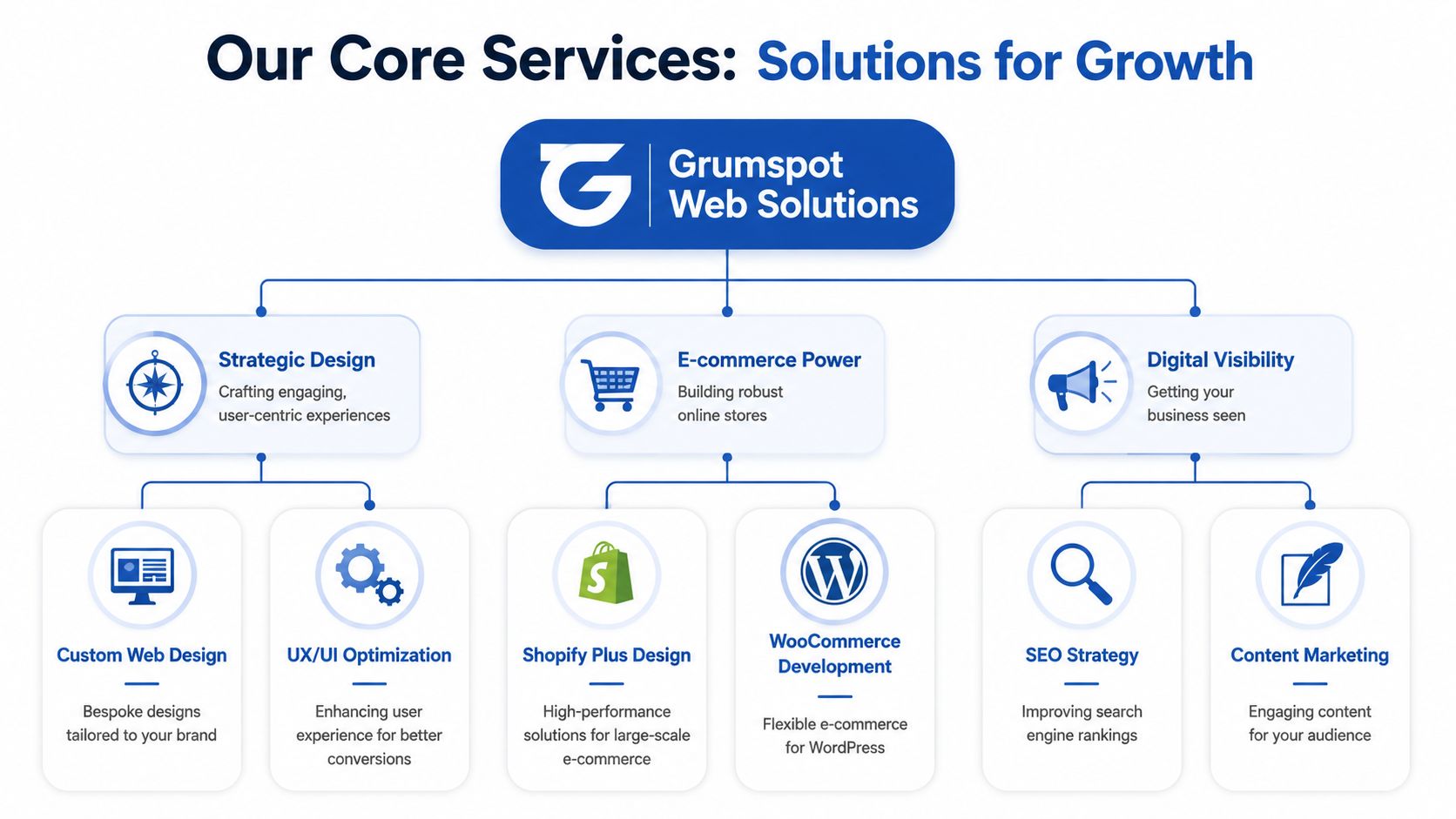
Shopify design and development for stores that need to scale
If your current store feels boxed in by theme limitations, slow change cycles, or clumsy merchandising, custom ecommerce design is the answer. Not because custom is fashionable. Because growing brands need storefronts that fit their catalogue, buying journey, and commercial model.
That can mean custom product page logic, cleaner navigation, stronger mobile UX, or templates built around bundles and repeat orders. For brands evaluating this route, these ecommerce website design services give a practical view of what a performance-led build should include.
Migration work that protects momentum
Platform migration is where many businesses lose traffic, data quality, and internal confidence. The risks are predictable. Broken redirects, missing metadata, poor content mapping, lost apps, messy product data, and reporting gaps after launch.
A proper migration plan should cover:
- SEO continuity: Redirect mapping, metadata handling, collection logic, and crawl protection
- Operational continuity: Orders, customers, catalogue data, fulfilment rules, and app dependencies
- Analytics continuity: Events, consent setup, channel attribution, and reporting validation
Specialist delivery proves its worth. You don't just need the new platform live. You need the business intact on day one.
CRO and UX improvements that turn traffic into orders
If traffic is coming in but sales aren't moving, redesign alone won't fix it. You need structured conversion work. That means reviewing collection pages, PDP hierarchy, mobile interactions, cart friction, trust signals, and checkout pathways.
The point of CRO isn't abstract “user experience”. It's finding where customers hesitate and removing the reason.
Practical rule: If your agency can't explain why users abandon key pages, they're guessing.
Integrations that remove manual work
Ecommerce brands outgrow manual operations quickly. Once order volume rises, disconnected systems create delays, stock issues, and reporting errors. Integrations solve that by connecting the store to the systems your team already relies on.
That includes ERPs, CRMs, subscription tools, shipping systems, returns platforms, and fulfilment workflows. It also includes custom app development where off-the-shelf tools can't handle your logic.
In this category, one option in the market is Grumspot, which focuses on Shopify Plus design, migrations to Shopify 2.0, CRO, and custom integrations for ecommerce teams that need faster iteration and more reliable execution.
How to Evaluate a Hampshire Web Design Agency
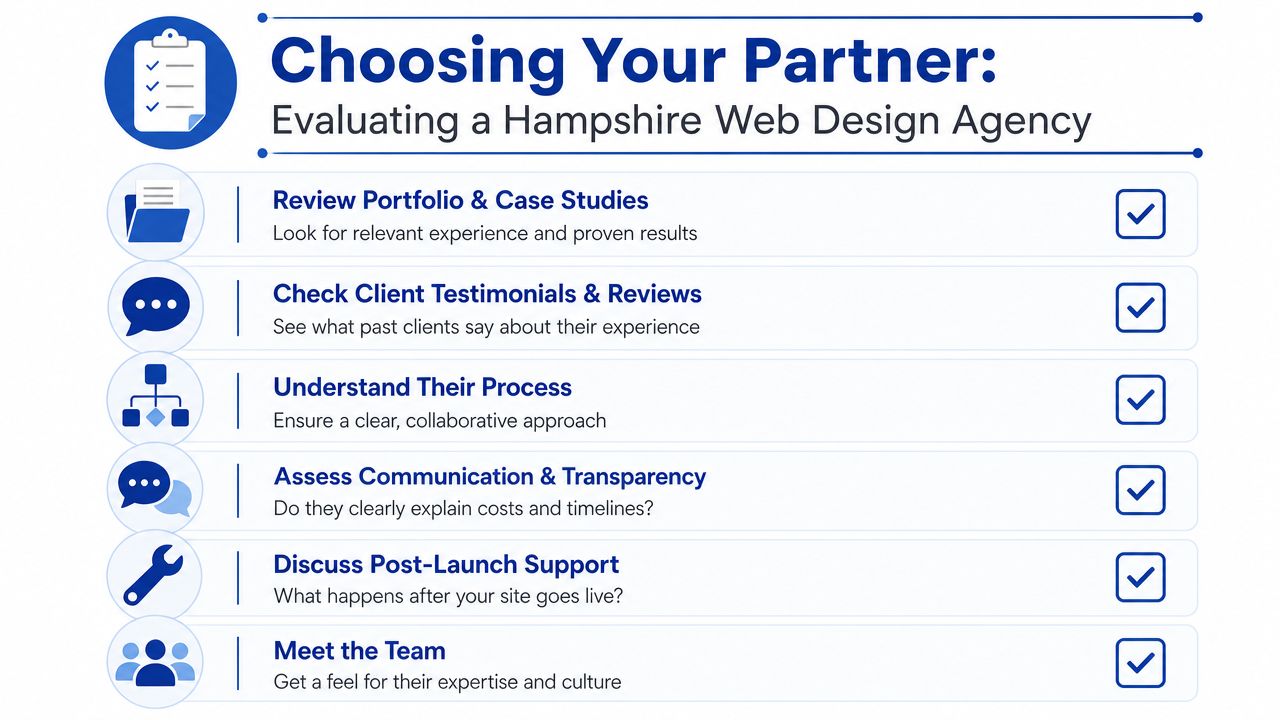
Most businesses evaluate agencies badly. They look at visuals, scan testimonials, ask for a quote, and compare price. That's how you end up buying a nice-looking problem.
A better filter is simple. Ask how the agency measures success, what they improve after launch, and how they protect revenue during technical work.
Ask for proof of commercial impact
A tangible Hampshire benchmark exists. MRS Digital reported that within the first 3 months of launching the Shuttercraft website, overall conversion rate increased by 88%, from 2.6% to 4.9%, according to its web design case material. That's the kind of outcome worth paying attention to.
Not every agency will have the same type of case study, but they should still be able to discuss business outcomes clearly. If they only show homepage screenshots, keep moving.
Ask these questions:
- What metrics define success? The right answer includes conversion, basket behaviour, lead quality, or revenue efficiency.
- How do you handle migrations or redesigns without damaging SEO? You want a process, not reassurance.
- What happens after launch? If support ends at go-live, you're taking on risk.
- Who will do the work? Senior strategy in the pitch means nothing if juniors execute unsupported.
Use a comparison table, not instinct
| Criteria | Generalist Web Agency | Specialist Ecommerce Partner (like Grumspot) |
|---|---|---|
| Primary focus | Brand presence and brochure-style delivery | Revenue performance, conversion flow, and store operations |
| Success metrics | Design approval, launch completion, page count | Conversion quality, merchandising effectiveness, operational fit |
| Platform depth | Broad but shallow across many CMS tools | Deep ecommerce capability with platform-specific execution |
| Migration handling | Often treated as a design project | Treated as a technical and commercial risk-management project |
| Integrations | Basic plugin setup | ERP, CRM, fulfilment, subscriptions, and custom logic |
| Post-launch work | Maintenance-led | Testing, optimisation, analytics, and iteration |
Look beyond web agencies if your channels are linked
If your ecommerce growth depends on marketplace sales as well as your own store, agency evaluation should get even stricter. The same issues apply on Amazon. Strategy, attribution, operations, and creative all need specialist handling. This roundup of MDS insights on Amazon agencies is worth reading if your channel mix goes beyond direct-to-consumer ecommerce.
The point is consistency. Don't hire broad generalists for specialist revenue problems.
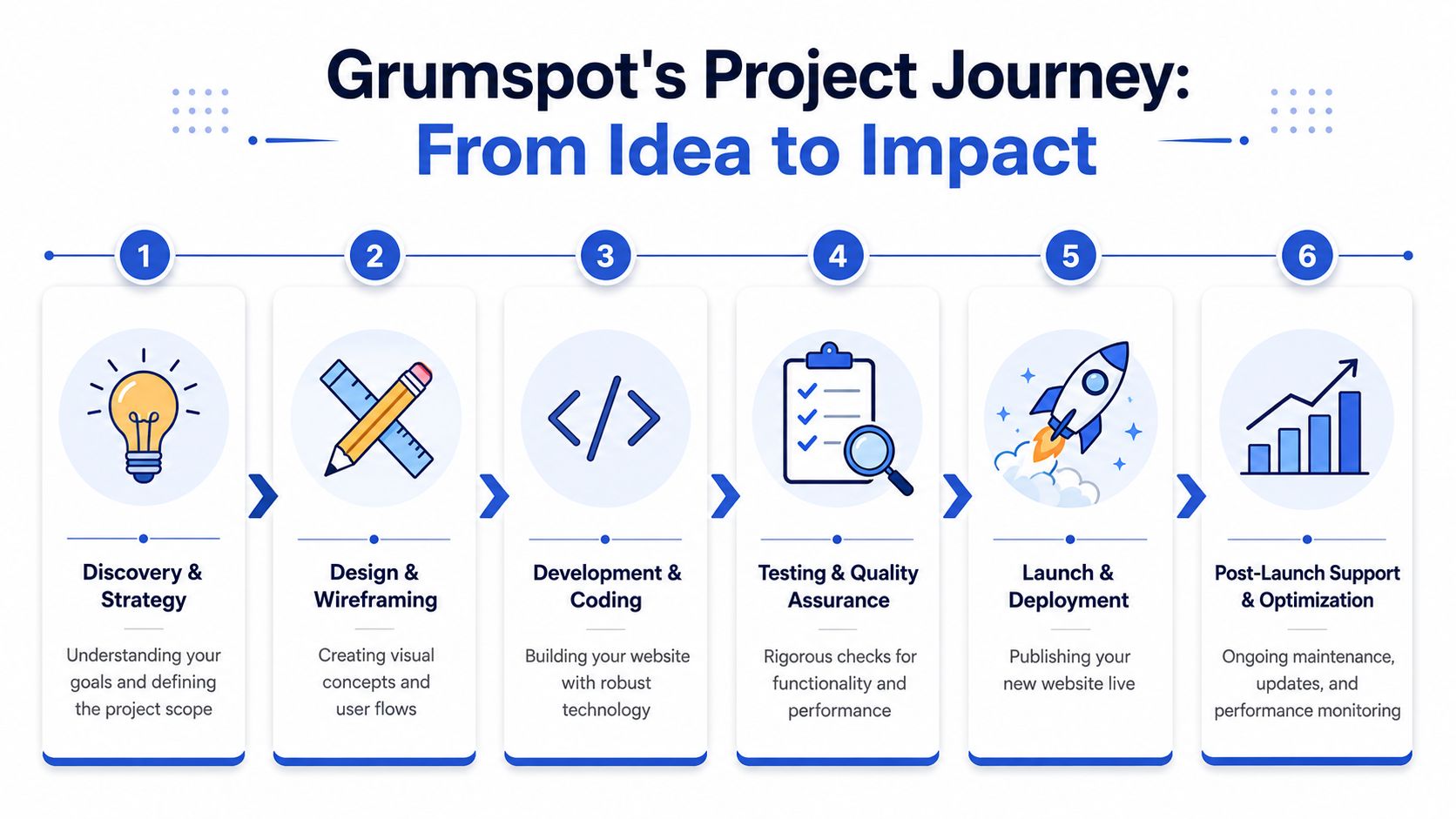
Our Process From Kick-off to Launch and Beyond
A good ecommerce project shouldn't feel chaotic. It should feel controlled. You need clarity on what's happening, what decisions matter, and what gets checked before revenue depends on it.
Discovery starts with the business, not the homepage
The first useful conversation isn't about colours or inspiration sites. It's about the numbers, the stack, and the constraints. What are you selling, who's buying, where are the drop-offs, what apps are critical, and what can't break during launch?
That audit phase usually covers current UX, analytics quality, product architecture, content gaps, and back-office dependencies. If an agency skips that and jumps straight into mock-ups, they're designing in the dark.
A sensible sequence looks like this:
- Commercial audit: Review performance bottlenecks, customer journeys, and platform limitations.
- Technical audit: Check theme architecture, app sprawl, integrations, tagging, and data quality.
- Priority setting: Decide what must be fixed now, what can wait, and what affects launch risk.
Design and development should reduce friction, not add theatre
Once priorities are clear, UX and design should focus on how customers buy. That includes navigation logic, collection structure, template hierarchy, mobile flow, and merchandising elements that support product discovery.
Development then turns those decisions into a stable storefront and connected backend. The quality marker here isn't how flashy the build looks in a presentation. It's whether your team can operate it efficiently after launch.
This walkthrough gives a decent sense of how modern ecommerce builds move from concept to execution:
Launch is the start of accountability, not the end of the project.
Post-launch is where weak agencies get exposed
This is the part many businesses underestimate. Plenty of agencies can get a site live. Far fewer can keep it commercially healthy.
That matters because the post-launch gap is real. The ICO's Data & Insights team reported 5,648 cookie complaints in 2024/25, and the ONS reported that online sales accounted for 27.8% of total retail sales in March 2025, both highlighted in this discussion of post-launch website performance issues. If consent setup, analytics, accessibility, or tracking are poorly handled, the business pays for it.
After launch, the work should include:
- Analytics validation: Make sure the data is usable before decisions rely on it
- Conversion review: Watch where sessions stall and identify quick wins
- Compliance checks: Keep consent and accessibility from becoming silent liabilities
- Ongoing iteration: Improve templates, content, and flows based on real behaviour
That's why a retainer often makes more sense than one-off maintenance. It gives your business access to continuous improvement, not just bug fixes.
Understanding Web Design Pricing and Value
Price shopping is understandable. It's also where many ecommerce projects go wrong.
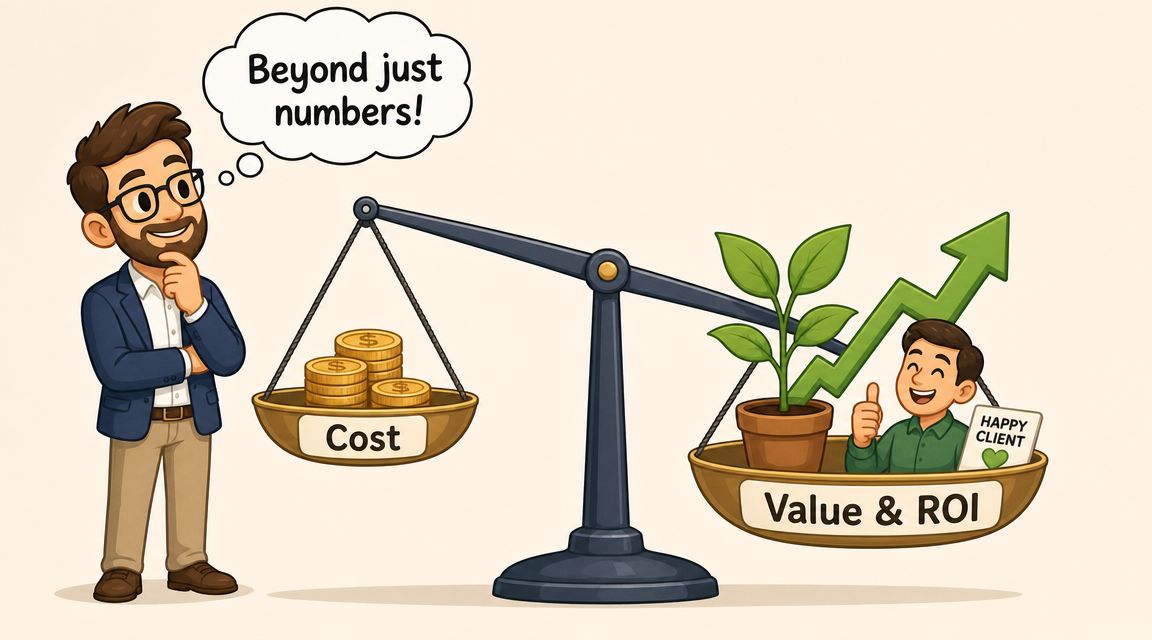
The UK web design services market is crowded. IBISWorld estimates industry revenue at £658.2 million in 2026 and notes 2,206 businesses in the sector in 2025, according to its UK web design services industry data. In a market with that many firms, buyers can compare agencies aggressively. That's why cheap proposals are common, and why they're often misleading.
What you're actually paying for
A serious ecommerce build isn't priced like a brochure site because the work isn't comparable. Cost depends on the level of custom design, platform complexity, migration scope, app ecosystem, integration depth, and the amount of post-launch support required.
A lower upfront quote usually means one of these things:
- Less strategic input: The agency is building pages, not solving commercial problems
- More template dependence: Faster to launch, harder to scale
- Thin technical planning: Migrations, tracking, and integrations become your problem later
- No optimisation layer: Once live, you're on your own
Project fee or retainer
For some brands, a one-off project makes sense. You need a rebuild, a migration, or a defined sprint of development work. For others, the smarter model is an ongoing retainer because ecommerce performance changes every month. Products change, campaigns change, and customer behaviour shifts.
If you want a grounded overview of how ecommerce builds are usually costed, this Cart Whisper ecommerce cost guide is a helpful reference point. For Shopify-specific planning, this breakdown of Shopify website design cost is also useful.
The right way to judge price is simple. Ask whether the agency is building a website or building a commercial asset.
Your Next Step Towards Ecommerce Growth
If you run an online store in Hampshire, don't hire a generic web agency and hope they can “do ecommerce too”. That's how businesses end up with polished sites that don't move revenue.
Choose the partner that understands merchandising, conversion, integrations, migration risk, and post-launch optimisation. That's the difference between a supplier and a growth partner.
If you're ready to move, take one of two paths:
- Book a discovery call if you already know the site needs a rebuild, migration, or performance work.
- Request a site audit if you're not sure where revenue is leaking and want an expert view before committing.
Both options are low friction. What matters is getting a clear diagnosis before spending more money on design that doesn't solve the underlying problem.
Frequently Asked Questions
Do I need a local Hampshire agency if my customers are nationwide
Not necessarily, but local access helps. If the agency is nearby, meetings are easier and collaboration is tighter. What matters more is whether they understand ecommerce, not just websites.
Is Shopify always the right choice for ecommerce
No. It's often the right choice for brands that want speed, stability, and a strong app ecosystem, but platform choice should follow business needs. Catalogue complexity, integrations, content model, and internal workflow all matter.
How long should a redesign take
It depends on complexity. A store with custom features, migration requirements, and integration work will take longer than a straightforward refresh. The better question is whether the agency has a clear process, clear milestones, and a proper launch checklist.
What should I ask on the first agency call
Ask how they define success, how they approach migrations, what happens after launch, and who will handle the work day to day. If the answers stay vague, that's a warning sign.
Can a redesign improve results without more traffic
Yes. If your current store leaks users through poor navigation, weak product pages, clumsy mobile UX, or checkout friction, improving the buying journey can make existing traffic more valuable. That's usually faster than trying to buy your way out with more ad spend.
Should I choose the agency with the cheapest quote
Usually not. Cheap web projects often create expensive follow-on problems. You save at the start, then pay later in lost sales, technical debt, and rework.
If your ecommerce site feels like a bottleneck instead of a sales channel, talk to Grumspot. They build, fix, and scale Shopify experiences for brands that need stronger conversion, cleaner execution, and a partner who understands the commercial side of web design.
Let's build something together
If you like what you saw, let's jump on a quick call and discuss your project
Related posts
Check out some similar posts.

- web design agency southampton
Find the best web design agency Southampton. Our 2026 guide covers vetting, pricing, red flags & cho...
Read more
- ecommerce development uk
Your complete guide to ecommerce development UK. Learn to plan, hire an agency, choose a tech stack ...
Read more
- shopify custom theme development
Unlock your brand's potential with Shopify custom theme development. This guide shows UK brands how ...
Read more
- shopify plus agency
What is a Shopify Plus agency? Learn what they do, the benefits of partnership, and how to choose th...
Read more