Web Design Agency Southampton: Your 2026 Growth Partner
- web design agency southampton
- hire web designer
- southampton web design
- ecommerce agency uk
- shopify plus agency
Launched
July, 2026

Your website probably isn't your biggest business problem in Southampton. But it may be the thing that complicates every other problem without overt notice.
A slow site wastes paid traffic. A clumsy checkout drags down ecommerce revenue. A brochure-style build that looked fine at launch can leave your team stuck every time you need a landing page, a product update, or a conversion fix. Most owners know something's off long before they start searching for a new agency. What they don't know is how to separate a decent design team from a partner who can actually help the business grow.
That matters because choice isn't the issue. Clarity is.
Your Starting Point Finding a Southampton Agency
A typical scenario goes like this. A Southampton business has outgrown its current website. The brand looks stronger than the site. Sales calls keep raising the same objections. Mobile pages feel awkward. The backend is messy. Every change takes too long, and nobody is fully sure whether the site is underperforming because of design, development, content, or all three.
Then the search starts. Local Google results. Agency directories. Recommendations from another business owner. A few polished portfolios. A few vague promises about bespoke builds and SEO-friendly design.
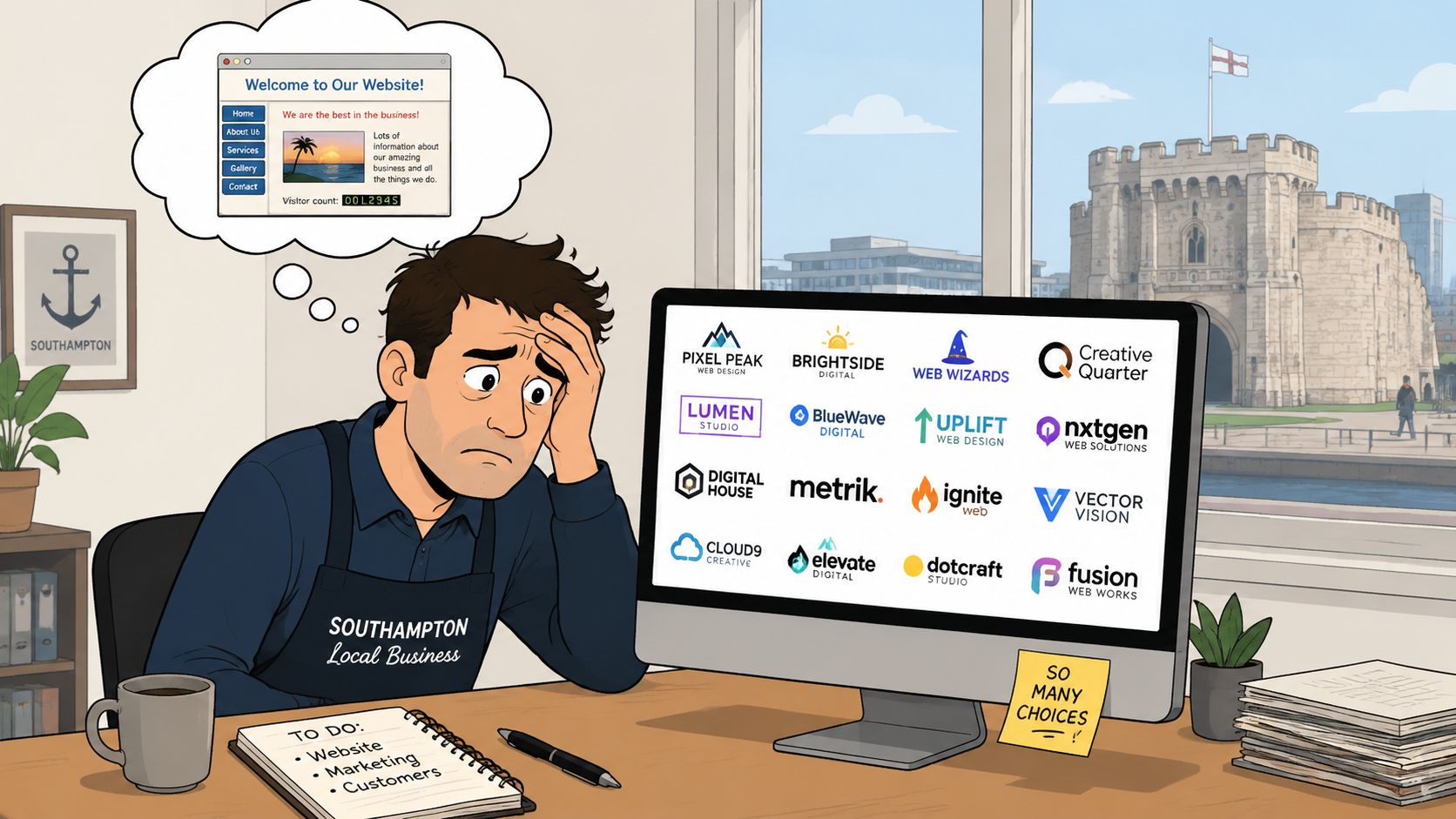
The market is big enough to create real noise. There are exactly 2,041 web design agencies operating across the UK, which makes selection difficult unless you know what you're screening for, according to UK web design agency market data. Southampton sits inside that wider market as a regional access point for businesses that want local support without defaulting to London pricing or London-style overhead.
What most business owners get wrong early
They look at aesthetics first.
Design matters, but design is only one layer. If you hire a web design agency in Southampton purely because the portfolio looks modern, you can still end up with a site that loads poorly, ranks weakly, converts badly, or becomes difficult to maintain once the project is handed over.
Practical rule: Don't start with “Who makes the nicest websites?” Start with “Who can build a site that supports the way we sell?”
That changes the shortlist fast.
A local manufacturer might need lead generation, quote requests, and CRM integration. A retailer may need Shopify expertise, merchandising logic, and checkout-focused UX. A service business may need booking flows, trust signals, and landing pages that support paid search. Those are different projects, even if all of them begin with “we need a new website”.
Why local still matters
A Southampton agency can be a strong fit when you want faster context on your market, easier collaboration, and a team that understands the commercial reality of local and regional firms. But local only helps if the agency also has the right technical depth.
If you're comparing nearby firms, it helps to widen the lens slightly and review the broader Hampshire web design agency landscape. Not to create more options, but to see which agencies behave like production vendors and which ones think like growth partners.
That distinction becomes the whole game in 2026. You're not just buying pages. You're choosing who gets trusted with conversion, visibility, and the pace of your next stage of growth.
Defining Your Project Before You Start Searching
Before you contact any agency, write down what the website is supposed to do for the business. Not what it should look like. What it should do.
That sounds obvious, but most weak briefs are full of visual references and missing the commercial brief. When that happens, agencies fill the gaps with assumptions, and assumptions are expensive.
Decide what type of website you actually need
These projects often get lumped together under “website redesign”, but they aren't the same:
- A brochure site suits businesses that need credibility, clear service pages, and straightforward contact journeys.
- A lead generation site needs strong landing page structure, enquiry flows, trust content, and a CMS your team will use.
- An ecommerce store needs a platform decision first. Product structure, catalogue logic, promotions, mobile UX, and operational integrations shape the build more than the homepage design does.
- A platform migration is different again. If you're moving from a legacy ecommerce setup or from WordPress into Shopify, the migration plan matters as much as the visual redesign.
If you sell online, don't let a generic agency steer you into a platform because it's what they're used to building.
Questions worth answering before the first call
Use this as a working brief:
What has to improve first?
More qualified leads, better ecommerce conversion, simpler content management, stronger mobile experience, faster page load, cleaner integrations.Who is the primary user?
New prospect, repeat buyer, procurement manager, wholesale account, local customer, mobile shopper.What actions matter most on the site?
Enquiry, purchase, booked consultation, account signup, sample request, phone call.What is blocking those actions now?
Slow pages, unclear navigation, weak product pages, dated design, poor trust signals, limited CMS control.What systems must connect?
ERP, CRM, subscriptions, fulfilment tools, email platforms, booking software, inventory systems.Who will maintain the site internally?
Founder, marketing manager, ecommerce team, external partner.
If you can't describe the business outcome in one sentence, the agency won't be able to scope the right solution.
Set a budget range before agencies do it for you
You don't need a perfect number. You do need a realistic bracket and a reason behind it.
A business with a basic information-led site has different needs from a retailer planning a custom storefront, subscription logic, or international selling. The budget should reflect operational complexity, not just page count.
That's also why comparing proposals line by line rarely works. One agency may be pricing templates and setup. Another may be pricing strategy, UX, technical discovery, custom development, QA, and post-launch support.
Where to find better candidates
Google is still useful, but it shouldn't be your only filter.
Look at:
- Competitor websites you respect. Check who built them.
- Local business networks. Ask who was still helpful after launch.
- Platform specialists. If you need Shopify or a complex ecommerce setup, search for platform-specific agencies before generic web designers.
- Your own stack. If your business relies on Klaviyo, Shopify, Recharge, a CRM, or custom integrations, ask agencies to show relevant work.
A good shortlist is short. Three to five agencies is enough if you've defined the project properly.
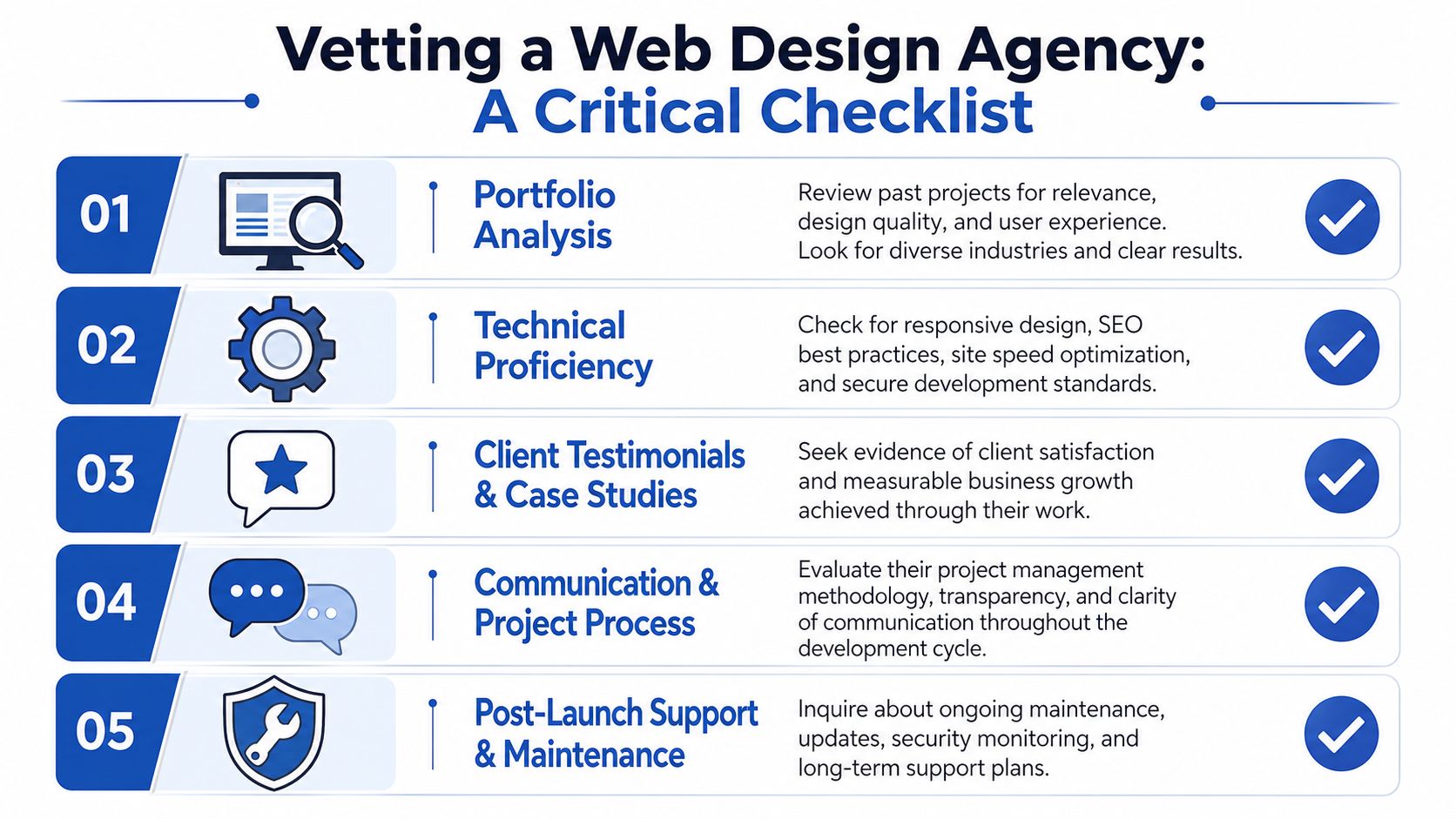
How to Vet an Agency's Portfolio and Technical Skill
An agency portfolio should answer one question quickly. Can this team solve problems like yours?
Too many portfolios are designed to impress at a glance and reveal very little once you look closer. You need to inspect them like an operator, not a fan.
Start with relevance, not polish
A sleek homepage mock-up doesn't tell you whether the agency understands your sales process, your product complexity, or your platform needs.
Look for portfolio examples that match at least one of these:
- Business model similarity such as B2B lead generation, DTC ecommerce, subscriptions, or catalogue-heavy retail
- Operational similarity such as content-heavy sites, app integrations, or multi-market setups
- Platform similarity such as Shopify, WordPress, or a headless stack if that matters to your team
If every example looks visually similar regardless of industry, that can be a warning sign. It may mean the agency is pushing the same design system onto every client rather than solving the actual brief.
Check the live site, not just the screenshots
Open the actual website from the portfolio if it's still live. Then test it like a buyer would.
Review:
- Mobile navigation: is it easy to move around one-handed?
- Page speed: does the site feel immediate or sluggish?
- Product and category pages: can users make decisions easily?
- CMS patterns: do template pages look consistent or stitched together?
- Trust signals: are reviews, policies, shipping details, or service proof easy to find?
For UK SMB-focused agencies in 2026, the technical baseline is clear. A site should achieve a Lighthouse Performance score above 90 with full Core Web Vitals compliance, based on agency selection guidance for UK SMBs. If an agency can't demonstrate that standard on its own work, be cautious about what it will deliver on yours.
A beautiful site that fails basic performance testing is usually an expensive redesign waiting to happen.
Ask for proof in ways that are hard to fake
The strongest agency conversations get specific fast.
Ask these questions:
- Which live URLs best represent the kind of project we're discussing?
- Who handled strategy, UX, development, and QA on those builds?
- What platform do you recommend for our use case, and what are the trade-offs?
- How do you handle revisions, testing, and launch checks?
- What happens after launch if conversion stalls or technical issues appear?
If answers stay high-level, keep pushing. Good teams can explain their process plainly. Weak teams hide behind buzzwords.
Named references matter more than testimonials
Website testimonials are easy to display and hard to evaluate.
What matters more is whether the agency will give you named references with live projects attached. Speak to someone who has already been through the handover, content population, revision rounds, launch pressure, and post-launch support period.
A short conversation can tell you more than a polished proposal.
Use a sharper hiring lens
Many Southampton businesses lose time. They compare a broad WordPress-focused design shop against a specialist ecommerce team as if both are interchangeable.
They aren't.
If your project involves Shopify, checkout thinking, subscriptions, merchandising, custom apps, or conversion testing, specialist capability matters. A generalist can produce a nice frontend. A specialist is more likely to understand how storefront UX, theme architecture, integrations, and optimisation work together.
For a stronger evaluation process, use a structured web design agency selection checklist before you decide who makes the shortlist. It helps prevent the common mistake of choosing based on style alone.
Understanding Agency Pricing and Engagement Models
Pricing gets confusing because agencies package work in very different ways. Two proposals can look miles apart even when the websites appear similar on paper.
That's why you need to separate price, scope, and engagement model. They're related, but they're not the same thing.
What Southampton pricing usually looks like
For Southampton agencies, top-ranked firms typically charge between £70 and £120 per hour, with basic small business websites ranging from £1,500 to £3,000 and advanced projects commonly landing between £5,000 and £15,000, according to Southampton web design pricing benchmarks.
Those figures are useful as orientation, not as a universal rate card. A site can sit at the lower end if the requirements are simple and content is ready. Costs move up when the build includes custom UX, ecommerce complexity, migrations, integrations, or a more demanding QA process.
Why the cheapest quote often causes the most friction
Low pricing can mean one of four things:
- Scope has been stripped back and important work is missing
- The delivery model is template-led rather than custom to your needs
- Post-launch support isn't included
- The agency is relying on change requests later
That doesn't mean high pricing is always justified. It means proposals should be read for what they include, not just what they cost.
Commercial check: If a proposal doesn't explain discovery, content handling, QA, launch support, and what happens after go-live, the real cost hasn't been shown yet.
Agency engagement models compared
| Model | Best For | Pros | Cons |
|---|---|---|---|
| Fixed-price project | Businesses with a clear scope and a defined launch target | Predictable budget, easy to compare at a high level, works well for contained builds | Less flexible once scope shifts, change requests can stack up, post-launch work is usually separate |
| Hourly billing | Smaller updates, audits, support work, or uncertain technical tasks | Flexible, useful for iterative problem-solving, good for short bursts of specialist help | Cost can become harder to forecast, weaker agencies may work slowly, priorities can drift |
| Monthly retainer | Brands treating the website as an ongoing sales asset | Supports continual optimisation, easier access to design and dev support, better fit for CRO and post-launch iteration | Feels like a bigger commitment, requires trust and clear accountability, not ideal if you only need a one-off launch |
Match the model to the business stage
A local service company replacing an outdated site may do well with a fixed-price project if the brief is clean and the post-launch needs are light.
A scaling ecommerce brand usually needs something else. Once you launch, the continuous effort often begins. Product page testing, merchandising updates, site speed improvements, content iteration, app changes, and checkout friction don't stop because the build is technically complete.
That's why businesses comparing platform-specific budgets often benefit from reading a more detailed breakdown of Shopify website design costs. The useful part isn't the headline number. It's understanding what complexity does to cost and where the return is supposed to come from.
What to look for in the proposal itself
A strong proposal should make these items easy to spot:
- Deliverables that are named clearly
- Assumptions about content, integrations, and internal approvals
- Timeline with realistic dependency points
- Revision process so nobody is guessing how feedback works
- Support terms after launch
If those aren't visible, the engagement model is likely doing more work than the website itself. And that usually leads to avoidable tension once the project starts.
Choosing a Growth Partner Not Just a Web Designer
A launch date feels like the finish line when you've spent weeks or months rebuilding a site. In practice, launch is where the commercial test starts.
That's the point many businesses discover they didn't hire a growth partner. They hired a delivery team.

Why one-off delivery often disappoints
Southampton business owners see the same pattern often enough. The agency produces the design, builds the pages, launches the site, fixes a few bugs, and fades out. What's left is a new website with no clear plan for testing, iteration, or conversion improvement.
That gap matters most in ecommerce. Recent UK industry data says 72% of Shopify merchants abandon agencies after launch because they don't get conversion growth support, according to industry commentary on post-launch agency gaps. The number matters less than the pattern itself. Businesses don't leave because launch happened. They leave because nothing meaningful happened after launch.
Post-launch support isn't a courtesy add-on. It's where commercial value is protected or lost.
What growth support actually looks like
A growth-focused agency relationship usually includes a mix of:
- Conversion rate optimisation through page testing, UX fixes, and funnel analysis
- Technical refinement such as speed improvements, bug reduction, and theme or component cleanup
- Merchandising and content iteration based on real customer behaviour
- Platform support when apps, integrations, or operational needs change
- Strategic reviews that link website changes to business goals
That's very different from a maintenance-only arrangement where the agency mainly handles plugin updates, minor edits, and security basics.
For ecommerce brands especially, CRO changes the hiring decision. If the team can't talk in detail about product page structure, collection logic, cart friction, upsells, subscriptions, or mobile checkout behaviour, they're likely still thinking like web designers rather than commercial operators.
A useful way to frame this is to compare agency selection outside web design too. The criteria businesses use when they compare Instagram growth agencies is similar in one important way. Retention and performance usually depend on whether the agency keeps improving the channel after the initial setup, not whether the first deliverable looked polished.
Ask this before you sign
When you speak to any web design agency in Southampton, ask one direct question:
What will you do in month two if the website launches cleanly but underperforms commercially?
If the answer is vague, generic, or limited to “we can discuss support later”, that tells you a lot.
This short overview helps frame what a more optimisation-led relationship looks like in practice:
A strong agency should already have a post-launch rhythm in mind. Reviews. Prioritisation. Testing. Technical follow-through. Clear ownership.
That's the difference between buying a site and investing in a digital asset that keeps getting better.
Your Questions About Southampton Agencies Answered
How much does a Shopify Plus store cost in Southampton compared with a WordPress site
The local content gap here is real. The question of Shopify Plus pricing versus generic WordPress agency pricing is underserved, because Southampton agency pages usually stay broad and talk about bespoke WordPress or cost-effective websites without breaking down Shopify Plus-specific cost layers, as noted in this discussion of Southampton agency content gaps.
In practice, the comparison shouldn't start with headline price alone. A WordPress build may look cheaper at proposal stage, especially if the agency is thinking in pages and templates. Shopify Plus projects usually carry different complexity. Catalogue structure, international selling, subscriptions, custom storefront behaviour, app ecosystems, and operational integrations all affect scope.
If you're a scaling ecommerce business, the better question is whether the platform and agency can support the way you sell now and the way you plan to sell next.
What red flags should I watch for on agency calls
A few warning signs show up repeatedly:
- They push one platform for every project. That often means they're selling their delivery comfort zone, not your business fit.
- They talk mostly about visuals. Strong agencies discuss user journeys, content, performance, maintenance, and commercial priorities.
- They avoid live examples. Screenshots are easy. Relevant live URLs are better.
- They can't explain post-launch support clearly. That usually means the relationship is built to end at handover.
- They price quickly without asking operational questions. Good scoping requires detail.
If the sales process feels rushed and imprecise, the project usually will too.
Should I choose a strictly local Southampton agency or a remote specialist
Local can help when you want face-to-face collaboration, easier stakeholder alignment, and an agency that understands the regional business environment.
A remote specialist can still be the better fit if your project needs deep ecommerce or platform expertise that a local generalist doesn't have. This is common with Shopify builds, migrations, CRO programmes, and technically demanding integrations.
The right decision usually comes down to this. Do you value proximity more than relevant skill, or can you get both?
Is maintenance enough after launch
Usually, no.
Maintenance keeps the site running. Growth work improves what the site does. Those are different jobs. If your site is important to lead generation or ecommerce revenue, maintenance alone won't answer conversion issues, UX friction, weak category pages, unclear messaging, or changing customer behaviour.
A website that's stable but stagnant can still be underperforming.
If you're choosing a web design agency in Southampton and you need more than a one-off build, Grumspot is worth a look. The team focuses on Shopify and Shopify Plus design, development, migrations, CRO, and retainer support for brands that want ongoing improvement after launch, not silence after handover.
Let's build something together
If you like what you saw, let's jump on a quick call and discuss your project
Related posts
Check out some similar posts.

- web design agency sheffield
Find the best web design agency Sheffield. Our 2026 guide covers vetting portfolios, pricing, Shopif...
Read more
- ecommerce development uk
Your complete guide to ecommerce development UK. Learn to plan, hire an agency, choose a tech stack ...
Read more
- web design agency hampshire
Grumspot is a leading web design agency hampshire specializing in Shopify Plus. We build high-conver...
Read more
- web design agency leeds
Our 2026 guide helps you find & hire the best web design agency leeds. Get checklists, pricing bench...
Read more