Ecommerce Development UK: Your 2026 Guide for Businesses
- ecommerce development uk
- shopify plus agency
- uk ecommerce
- build online store
- ecommerce strategy
Launched
July, 2026

Your current site probably isn't failing in an obvious way. It loads, takes orders, and gives the impression that ecommerce is “covered”. But behind that surface, stock updates are manual, marketing pages break when the theme changes, mobile journeys feel cramped, and every new feature request turns into a negotiation about time and cost.
That's the point where many UK businesses start looking seriously at ecommerce development. Not because they want a prettier storefront, but because the website has become an operational bottleneck.
A proper ecommerce build fixes more than design. It changes how your business sells, fulfils, reports, and scales. If you're planning your first serious rebuild, platform migration, or Shopify Plus project, the decisions you make early will shape budget, speed, and return long after launch.
Your Starting Point in the UK Ecommerce Market
A common pattern looks like this. A business launches on a starter theme or an older custom build, adds apps as new needs appear, and slowly ends up with a store that nobody fully understands. Marketing wants flexibility. Operations wants cleaner inventory flows. Customer service wants fewer delivery complaints. Finance wants reliable reporting. The site sits in the middle of all of it.
That pressure is happening inside a market with real upside. UK online retail sales reached £127.41 billion in 2024, and the market is projected to reach £286 billion by 2025, with Britain positioned as the third-largest ecommerce market globally, according to UK ecommerce market statistics. The same source notes that nearly one-third of all retail spending now occurs online.
That matters for one reason. If your ecommerce setup is weak, you're not just missing incremental gains. You're underperforming in a market where online buying is already normal behaviour.
A rebuild should start when the cost of keeping the current setup exceeds the discomfort of changing it.
In practice, that trigger usually comes from one of four places:
- Growth stalls: Traffic rises, but conversion and average order value don't move with it.
- Operations get messy: Orders, stock, customer data, and returns live in too many disconnected systems.
- Teams slow each other down: Marketing depends on developers for routine changes, and developers spend time patching old decisions.
- Expansion gets blocked: New regions, channels, subscriptions, bundles, or B2B requirements expose technical limits.
A strong ecommerce development project isn't a website redesign with a launch date. It's a business system upgrade. The build needs to support how you sell now and how you expect to sell next year, when catalogue size, traffic, and operational complexity have all increased.
Laying the Strategic Groundwork for Your Project
Most expensive ecommerce mistakes happen before design starts. They happen when a business approves a project without deciding what success looks like.
A useful brief doesn't begin with features. It begins with business priorities. If those priorities are unclear, your agency or developer will fill in the blanks with assumptions, and assumptions are where technical debt starts.
Start with commercial goals, not page templates
Different businesses need very different outcomes from the same platform.
A fashion brand might care most about stronger merchandising, better collection navigation, and reducing friction between product discovery and checkout. A B2B supplier may care less about homepage polish and more about account-specific pricing, repeat ordering, and integration with internal systems. Both are “ecommerce projects”, but they don't deserve the same roadmap.
Write down the problems in plain business language first:
- Revenue problems: Low conversion, weak average order value, poor repeat purchase behaviour
- Operational problems: Manual stock updates, duplicate data entry, fulfilment delays, reporting gaps
- Experience problems: Slow mobile journeys, hard-to-manage content, inconsistent product information
- Growth problems: Inability to expand internationally, support wholesale, or launch new product models
Once the business issue is clear, technology becomes easier to scope.
Define what the project must improve
Treat your project as an investment case. That means deciding which outcomes matter enough to justify budget and internal time.
A practical framework looks like this:
| Area | Good question to ask |
|---|---|
| Sales | What part of the buying journey is losing the most value today? |
| Operations | Which manual process consumes the most team time each week? |
| Customer experience | Where do customers get confused, drop out, or contact support unnecessarily? |
| Data | What can't you currently measure or trust? |
| Growth | What future business model or market expansion is blocked by the current setup? |
These answers shape the brief better than a generic feature wishlist ever will.
Practical rule: If a requested feature can't be tied to revenue, efficiency, customer experience, or risk reduction, it probably belongs in a later phase.
Budget for the whole system, not just the build
Founders often budget for design and development, then get caught by the surrounding costs. A typical project usually includes platform subscriptions, app licensing, migration work, ERP or CRM integration, QA, SEO migration checks, content entry, and post-launch support.
You also need to budget for internal decision-making. Slow approvals from merchandising, operations, finance, or legal will delay a project just as surely as slow development.
Before you speak to agencies, bring these decisions into one document:
- Primary business goal
- Secondary operational goal
- Must-have integrations
- Internal stakeholders and approvers
- Budget range
- Launch deadline and what drives it
- What cannot break during migration
That document is more valuable than a long list of “nice to haves”. It gives your development partner a basis for sensible trade-offs instead of reactive guesses.
How to Choose the Right Ecommerce Development Partner
The partner you choose will affect more than code quality. They'll shape scope, process, risk, and how much future flexibility you keep. That's why the wrong agency often costs less at the start and far more later.
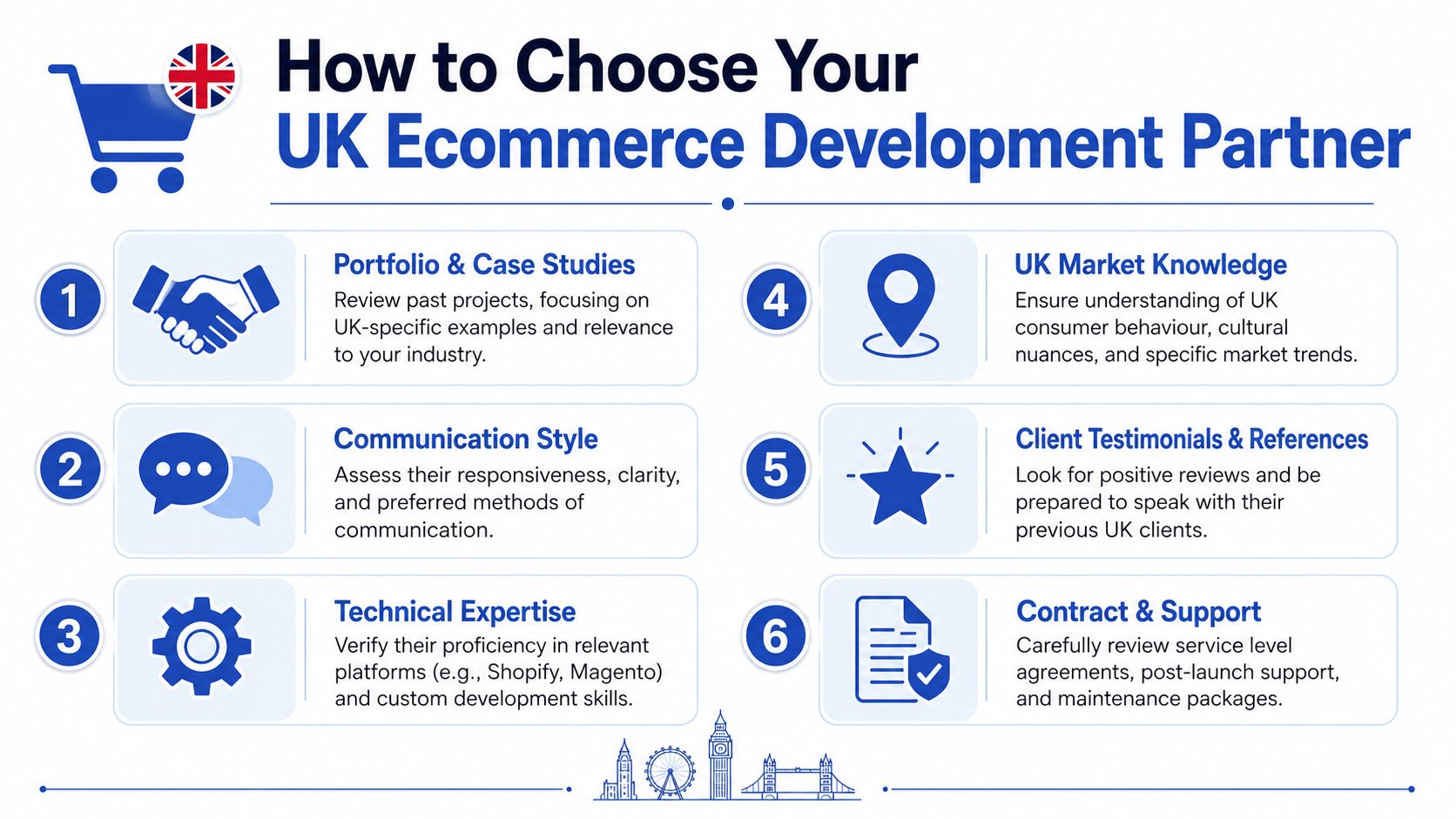
For a brochure site, a capable freelancer or generalist web studio can be enough. For a serious ecommerce project with platform migration, custom logic, multiple integrations, and post-launch iteration, specialist experience matters. Ecommerce has too many moving parts to treat as generic web design.
Understand the trade-offs before you shortlist
Here's the practical difference between common options:
| Partner type | Usually works well for | Usually struggles with |
|---|---|---|
| Freelancer | Small builds, minor fixes, focused implementation work | Capacity, multi-discipline delivery, long-term support |
| Generalist agency | Brand-led websites with light ecommerce needs | Deep platform knowledge, integration complexity, CRO discipline |
| Specialist ecommerce agency | Replatforming, Shopify Plus builds, integration-heavy projects, growth support | Overkill for very small stores |
This isn't about prestige. It's about fit. If your project includes ERP data, subscription logic, international shipping rules, custom storefront behaviour, or a demanding migration, you need a team that deals with those constraints regularly.
Ask harder questions than “Have you built stores before?”
Most selection processes are too polite. Businesses ask to see a portfolio and hear a process overview. That's not enough.
Ask questions that reveal how the partner thinks under pressure:
- How do you handle scope changes once design is signed off?
- Who writes the functional specification for integrations?
- How do you test inventory, payment, and fulfilment edge cases before launch?
- What happens if our internal feedback is delayed by a week?
- Which parts of the build will be theme customisation, app configuration, or custom code?
- How do you document the project so another team can maintain it later?
If you're hiring remotely, this guide on vetting development teams remotely is useful because it focuses on how to assess communication and delivery habits, not just sales calls and portfolios.
Ask to speak with a current client on a monthly retainer, not just one from a completed project.
That single conversation tells you more than a polished proposal. Retainer clients see how the agency behaves after launch, when deadlines move, bugs appear, and priorities compete.
What a strong partner should show you
Look for evidence in these areas:
- Live store relevance: Not just screenshots. You want examples that are live, active, and similar in complexity to your project.
- Platform depth: If Shopify Plus is under consideration, the team should speak clearly about Shopify 2.0 structure, app strategy, custom functions, and integration patterns.
- Commercial awareness: Good partners discuss margin, fulfilment, and team workflow, not only visuals.
- Process transparency: You should know who owns discovery, design sign-off, QA, launch, and support.
- Support model: Clarify whether they disappear after go-live or continue with optimisation.
For businesses evaluating Shopify-focused options, this guide on how to hire a Shopify development agency is a useful benchmark for what to ask and what to verify.
A final note on chemistry. You don't need an agency that flatters every idea. You need one that challenges weak assumptions early, before they become expensive build requirements.
Selecting Your UK Ecommerce Tech Stack
The tech stack decision isn't really about choosing a website platform. It's about deciding how your business data moves, who controls it, and how hard it will be to change direction later.
That distinction matters because many stores don't fail from lack of features. They fail because the stack is stitched together in a way that makes every new requirement slower, riskier, and more expensive.
Put the ecommerce platform at the centre, not in isolation
For many UK businesses, Shopify Plus is a strong fit because it gives a stable ecommerce core while reducing the burden of maintaining infrastructure. But Shopify Plus is only effective when it sits inside a well-planned system.
A practical stack usually includes:
- Ecommerce platform: Product catalogue, checkout, promotions, customer accounts
- CRM: Customer lifecycle, segmentation, retention flows, support context
- ERP or stock system: Inventory, purchasing, finance, order status, operational truth
- PIM or structured product data layer: Cleaner merchandising if the catalogue is large or complex
- 3PL and carrier integrations: Fulfilment data, tracking, dispatch rules
- Analytics and reporting tools: Commercial visibility without spreadsheet workarounds
When these parts are selected independently, the build becomes fragile. When they're planned together, the store supports the business instead of competing with it.
Mobile-first is not optional in the UK market
In the United Kingdom, smartphones commanded 54.12% of e-commerce transaction value in 2025 and are projected to expand at a 10.19% CAGR through 2031, according to Mordor Intelligence's UK ecommerce market analysis. That's the clearest reason to reject desktop-led design thinking.
A mobile-first build affects more than layout. It changes navigation depth, search behaviour, product page content order, media handling, and checkout expectations. If a partner treats mobile as a responsive adjustment made late in the process, that's a warning sign.
The mobile version isn't a smaller desktop site. It's the primary buying environment for a large share of customers.
Know when to keep it simple and when to go composable
Not every business needs headless commerce, custom middleware, or a heavily composable architecture. Those decisions are justified when they solve a real business problem, not when they sound advanced in a proposal.
Use this filter:
- Stay simpler if your catalogue is manageable, your content model is straightforward, and your growth plan depends more on execution than technical novelty.
- Consider a more API-led setup if you need richer content delivery, multiple front ends, unusual customer journeys, or deep integration logic across systems.
For teams weighing that architecture question, this explanation of API-first ecommerce architecture is helpful because it clarifies where flexibility pays off and where it just adds maintenance overhead.
Reduce future debt when choosing apps and integrations
The fastest stack isn't always the best stack. Adding five separate apps can look cheaper than commissioning one coherent solution, until they conflict, duplicate data, or slow the storefront.
A disciplined stack review should ask:
- Does this tool solve a core problem or a temporary convenience problem?
- Who owns the data this tool creates?
- What breaks if we replace it in a year?
- Will this app force workarounds in design or merchandising?
One practical option in the market is Grumspot, which handles bespoke storefront builds, Shopify 2.0 migrations, and deeper integrations for businesses that need more than off-the-shelf configuration. That kind of specialist support is relevant when your stack needs coordination across UX, development, and operational systems, not just theme edits.
The right stack should make the next two years easier, not get you to launch.
Mapping Your Project Timeline and Costs
Most ecommerce projects don't go over budget because developers work slowly. They go over budget because the scope was vague, the approval chain was unclear, or the business changed its mind after key decisions had already been built.
A clean project plan reduces all three risks.
What a typical project actually involves
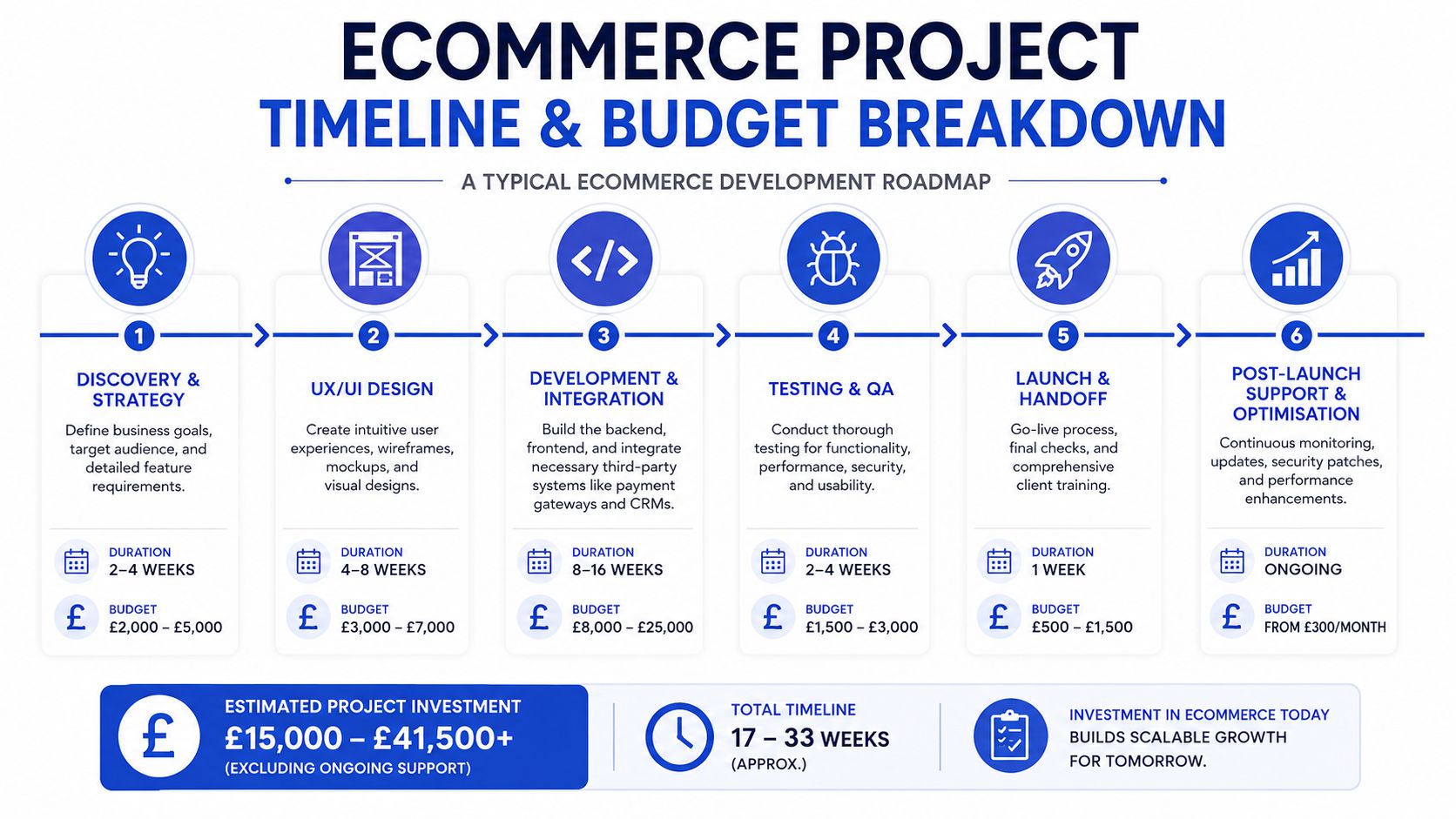
A serious ecommerce development UK project usually runs through these stages:
Discovery and strategy
This phase defines business requirements, user journeys, integration needs, content structure, and migration risk. If this part is rushed, every later phase becomes less predictable.
You want clear outputs here. Functional requirements, data mapping assumptions, stakeholder roles, and a prioritised feature list.
UX and UI design
Design should solve commercial and operational problems, not just produce polished mock-ups. Good design rounds answer questions about filtering, navigation, product detail structure, cart behaviour, account journeys, and content governance.
This stage also reveals if stakeholders agree on the customer journey. It's better to uncover disagreement in wireframes than in code.
Development and integration
Timelines often become distorted in a client's mind. The storefront build is only one layer. The harder work may sit behind it: ERP mapping, shipping logic, subscriptions, data migration, custom apps, or CRM sync.
Testing and UAT
Testing isn't just checking whether buttons work. It includes payments, promotions, stock edge cases, taxes, shipping rules, account logic, browser behaviour, mobile usability, and failure states.
Launch and handover
A launch plan should include redirects, content freezes, final data checks, rollback thinking, training, and ownership of the first support window.
Budget ranges are useful, but only if you understand what changes them
The infographic in this section includes indicative ranges for common phases. Those numbers are useful as planning guidance, but they don't tell the whole story because project cost is driven more by complexity than by page count.
These factors push cost upward fastest:
- Integration depth: ERP, CRM, 3PL, and custom product data logic
- Catalogue complexity: Variant structures, bundles, subscriptions, wholesale rules
- Content ambition: Bespoke landing pages, campaign flexibility, editorial experiences
- Migration risk: Legacy data cleanup, redirects, SEO preservation, order history requirements
- Approval friction: Slow stakeholder feedback and repeated design reversals
The real cost of technical debt
Businesses often compare proposals only on build price. That's a mistake. The more useful comparison is total cost over the next year.
A cheaper build can become expensive when:
- marketers need developer help for routine merchandising changes
- apps overlap and create storefront conflicts
- undocumented custom code makes future changes risky
- integrations fail without alerting and require manual reconciliation
- performance drops as more patches are added
Cheap projects often borrow money from the future. You pay the difference later in rework, support time, and missed trading opportunities.
Keep the timeline honest
If you need a seasonal launch, backward-plan from the commercial date and protect the final testing period. Don't let delays in content, approvals, or product data consume the QA window. That's how fragile launches happen.
Three habits keep projects on track:
- Freeze scope in phases: New ideas go into a later release unless they solve a critical issue.
- Nominate one decision-maker: Feedback by committee slows design and creates contradictory requests.
- Review dependencies weekly: Product data, imagery, legal copy, and shipping rules often delay launches more than code does.
A realistic plan is rarely the shortest one. It's the one that leaves room to test the parts that can break your business.
A UK-Specific Legal and Localisation Checklist
Many ecommerce builds look competent until they meet real-world UK trading conditions. That's where localisation stops being cosmetic and starts affecting conversion, compliance, and customer trust.
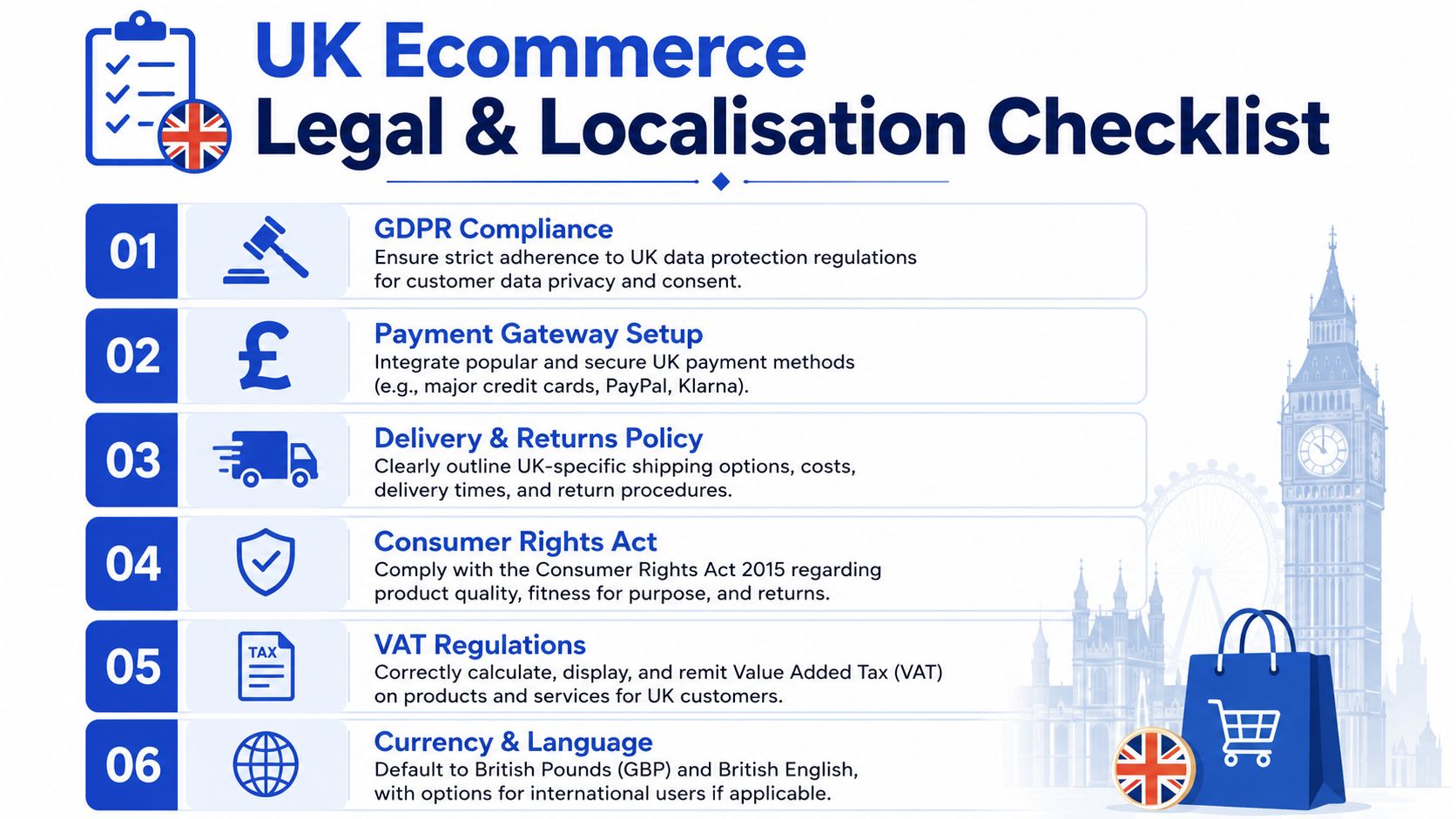
The details matter here. Currency, delivery messaging, returns language, tax handling, consent management, and payment options all influence whether the store feels native to the customer and workable for your team.
Get the legal foundations right early
These items shouldn't be left until the week before launch:
- GDPR and consent setup: Your data capture forms, account creation flows, and marketing opt-ins must align with UK data protection expectations.
- Cookie handling: Consent tools need to reflect the scripts running on the site, not a generic banner added after design sign-off.
- Accessibility considerations: Navigation, contrast, keyboard usability, form labels, and error states should be checked during QA, not treated as a legal afterthought.
- Payment security responsibilities: If your team is handling payments or adjacent customer data, review the operational implications alongside the storefront build. This overview of PCI compliance requirements is a useful starting point for understanding what needs formal attention.
Delivery transparency affects conversion directly
UK shoppers expect delivery information to be clear before they commit. That includes costs, lead times, dispatch expectations, and returns handling.
The commercial impact is not minor. A key technical specification for UK success is addressing delivery expectations; the 2026 Ecommerce Delivery Benchmark Report reveals that 34% of UK customers abandon carts due to poor delivery transparency or delayed shipping, as noted in the US Commercial Service guide to UK ecommerce.
That should change how you build the basket and checkout.
- Show delivery options early: Don't hide shipping clarity until the final step.
- Be precise about dispatch: “Fast delivery” is weaker than a clear operational promise.
- Make returns understandable: Customers shouldn't need to search policy pages to know what happens next.
If customers can't tell when an order will arrive, many of them won't place it.
Post-Brexit cross-border setup needs proper planning
Cross-border selling into the EU can be attractive, but the operational detail catches many businesses off guard. The challenge isn't just translation or local currency. It's tax handling, duties, customs data, and what the customer sees at checkout.
As noted in George Mudie's analysis of the future of UK ecommerce, UK merchants regularly need better guidance on cross-border VAT compliance, tariffs, and multi-country infrastructure after Brexit. In practice, that means deciding early how your store will calculate charges, communicate landed costs, and route fulfilment rules.
If your business is shipping internationally, practical customs preparation often starts with EORI guidance for UK businesses, especially before you configure cross-border shipping and documentation workflows.
Localise the store like a UK business, not a generic global template
A store built for UK customers should feel local in straightforward ways:
| Area | What to localise |
|---|---|
| Currency | Default to GBP where appropriate |
| Language | Use British English in product copy, delivery messaging, and support pages |
| Payments | Support the methods your customers already trust and use |
| Carriers | Integrate fulfilment and tracking options your operation can support reliably |
| Policies | Write returns, delivery, and customer rights information in plain language |
A polished storefront won't rescue weak localisation. Customers notice when the operational details feel imported from another market.
Optimising for Growth After Launch
Launch day matters, but it's not the point at which value is fully realised. It's the point at which your new platform finally starts generating usable signals.
What separates strong ecommerce teams from frustrated ones is what happens next. They don't treat the launch as a finish line. They treat it as the start of a more disciplined operating rhythm.
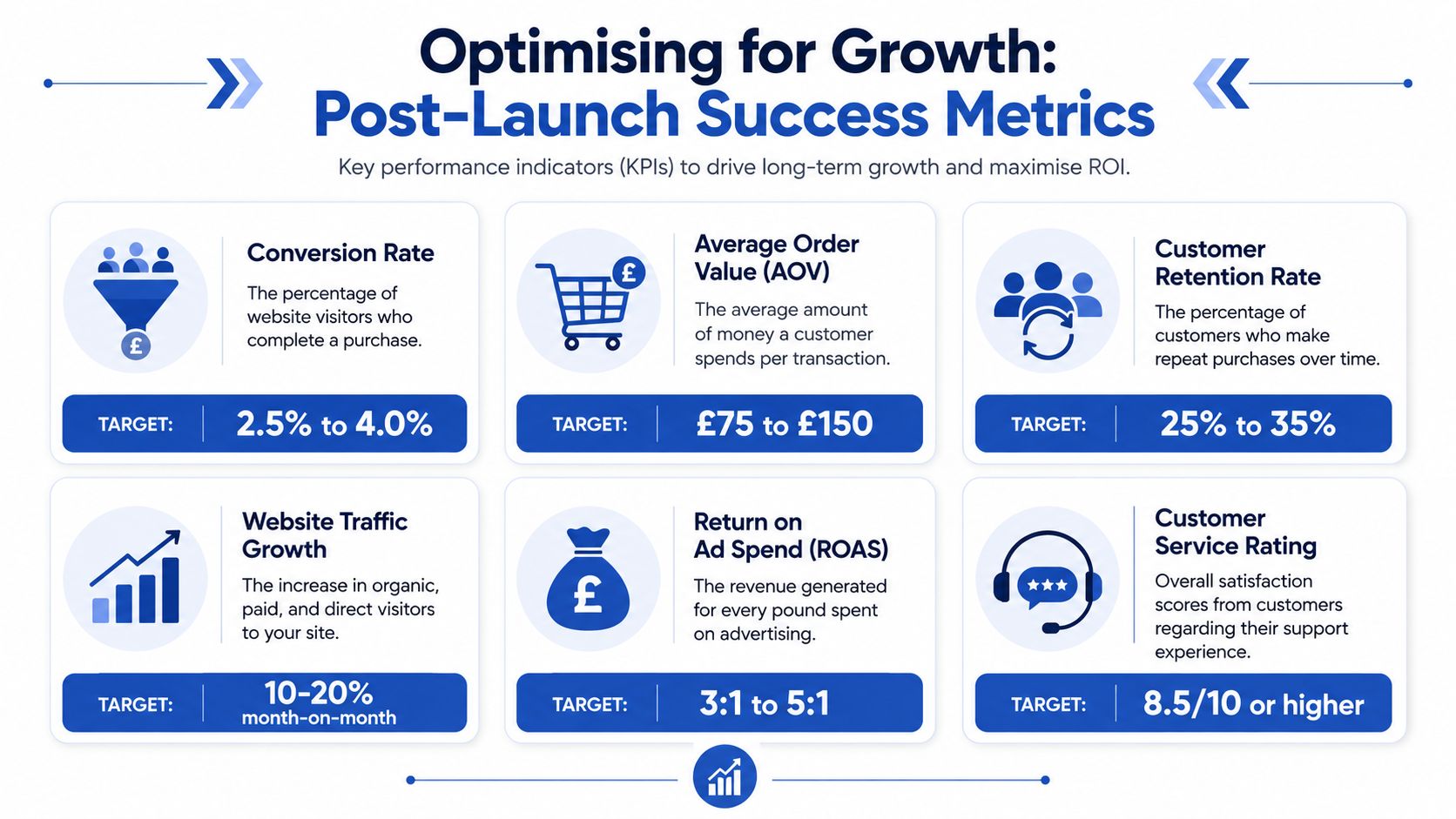
Use post-launch data to prioritise work
Most stores can produce a long list of improvements after go-live. That's normal. The mistake is treating all of them as equally urgent.
Start with three lenses:
Protect what you migrated
Check indexing, redirects, collection visibility, product data integrity, and tracking setup. If your migration affected URL structures or content architecture, technical SEO checks should happen immediately. Small migration issues can gradually damage visibility if nobody owns them in the first few weeks.
Improve conversion with method, not guesswork
In the UK, the average ecommerce conversion rate is 4.1%, and UK retailers who achieve this typically use A/B testing, personalisation, and mobile-first optimisation, according to Adobe's ecommerce conversion benchmark guidance. That benchmark is useful because it gives teams a reference point without encouraging random experimentation.
The key is sequence. Don't test everything at once. Focus first on pages and interactions closest to commercial value:
- Collection pages: Filtering, sorting, product-card clarity
- Product pages: Media order, trust signals, delivery messaging, upsell logic
- Cart and checkout path: Friction, distractions, validation issues, delivery confidence
- Mobile interactions: Thumb-friendly navigation, sticky actions, search behaviour
Choose a support model that matches how your business works
After launch, businesses usually default into one of three models:
| Model | Works best when | Risk to watch |
|---|---|---|
| Ad hoc fixes | You need occasional support only | Strategy gets replaced by reactive patching |
| Monthly retainer | You want continuous CRO, development, and prioritisation | Requires internal ownership and regular decision-making |
| In-house plus specialist support | You have day-to-day internal capacity but need expert help for larger changes | Responsibilities can blur without clear process |
For many scaling brands, a retainer works better because optimisation needs continuity. The same team sees your roadmap, understands earlier decisions, and can connect CRO, UX, SEO, and development instead of handling isolated tickets.
Tie development decisions to marketing performance
A storefront and a growth plan should inform each other. If paid traffic is rising but product pages don't support intent, ad efficiency suffers. If retention campaigns drive repeat visits but account experiences are weak, lifecycle marketing underdelivers.
That's why it's useful to review technical and commercial performance together. Teams planning their next stage of acquisition and retention work may find UFO Performance Marketing's ecommerce growth strategies helpful as a complementary marketing lens alongside platform optimisation.
The highest-return post-launch work usually happens where customer behaviour, storefront UX, and operational capability overlap.
That might mean changing how delivery promises appear on product pages. It might mean simplifying bundled product logic. It might mean cleaning up a search experience that is technically functional but commercially weak.
The point is simple. Don't let the new platform become static. Ecommerce development UK projects produce the best return when the site is treated as a living commercial asset, with a backlog shaped by evidence rather than opinion.
If you're planning a rebuild, migration, or Shopify Plus project and want a team that can handle strategy, UX, development, and ongoing optimisation in one workflow, Grumspot is one option to consider. They work on bespoke storefronts, Shopify 2.0 migrations, and integration-heavy ecommerce builds for businesses that need a store that can grow after launch, not just go live.
Let's build something together
If you like what you saw, let's jump on a quick call and discuss your project
Related posts
Check out some similar posts.

- ecommerce ab testing
Master ecommerce AB testing with a revenue-first playbook. Learn to build hypotheses, calculate samp...
Read more
- web design agency southampton
Find the best web design agency Southampton. Our 2026 guide covers vetting, pricing, red flags & cho...
Read more
- fraud prevention ecommerce
Secure your UK store with this fraud prevention ecommerce guide. Detect threats, manage chargebacks,...
Read more
- web design agency hampshire
Grumspot is a leading web design agency hampshire specializing in Shopify Plus. We build high-conver...
Read more