Conversion Optimization Agency: A 2026 Guide to Growth
- conversion optimization agency
- CRO agency
- CRO services
- increase conversion rate
- ecommerce optimization
Launched
June, 2026
You're probably in one of two situations right now. Traffic is healthy, the acquisition team is doing its job, but revenue hasn't moved in line with spend. Or the opposite. Sales are coming through, but every gain feels expensive because paid media has become the default answer to every growth problem.
That's usually when teams start looking at a conversion optimization agency. Not because they want prettier landing pages, but because they need the site to do more with the traffic they already have. In practice, that means fewer leaks between ad click and checkout, fewer abandoned forms, and fewer internal debates settled by opinion.
The best agency partnerships change more than pages. They change how the business makes decisions. Product starts validating ideas before shipping them widely. Marketing stops treating campaigns as isolated bursts. Engineering gets a clearer roadmap because experiments expose where technical debt is blocking growth. That's the difference between buying A/B tests and building an experimentation function.
What Is a Conversion Optimization Agency
A conversion optimization agency is a specialist team hired to turn more of your existing visitors into customers, leads, or qualified sign-ups. That sounds simple, but the actual work is more demanding. The agency has to diagnose why people hesitate, where they drop off, and what should change first.
A useful way to think about it is this. Your media team brings people to the door. Your product and brand get them interested. A CRO agency acts like a performance coach for the website itself, training the journey so more visitors complete the action that matters.
That matters more now because interest in CRO has grown sharply. Google Trends showed searches for “conversion rate optimization” reached an all-time high in September 2023, and the CRO software market was valued at $771.2 million in 2018 and is projected to reach $1.932 billion by 2026 according to Matomo's CRO statistics roundup. More teams are realising that buying more traffic isn't always the smartest next move.
A good agency doesn't start with “let's test button colour”. It starts with questions like these:
- Where is the biggest commercial friction: Product page, basket, checkout, lead form, pricing page, or post-click landing page.
- Which audience is underperforming: Mobile users, returning visitors, paid social traffic, high-intent search traffic, or a specific geography.
- What operational issue sits behind the conversion issue: Slow approvals, weak tracking, unclear offers, or product constraints.
If you need a clean primer before speaking to agencies, Grumspot's guide on what conversion rate optimization is is a useful starting point.
A CRO engagement is valuable when traffic exists, intent exists, and the site still loses too many people before the finish line.
The strongest agencies work across marketing, UX, analytics, and implementation. They don't just suggest changes. They create a disciplined system for deciding what gets changed, why it gets changed, and how success gets measured.
The Core Services of a CRO Agency
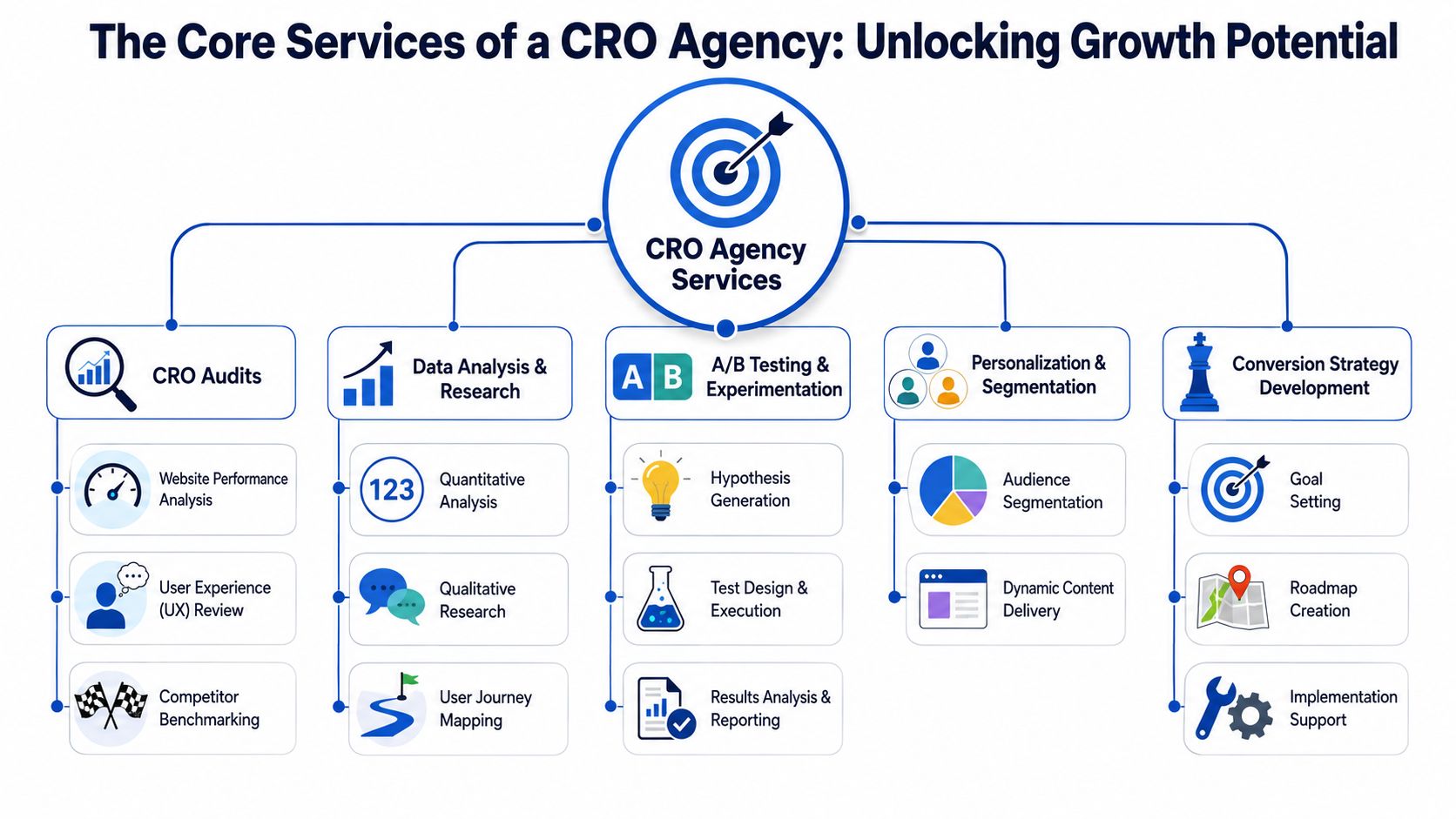
A CRO agency should help you decide what to fix, what to test, what to build, and what to leave alone. If the agency only produces test ideas, it will miss the operational causes behind poor conversion performance. Good CRO work connects research, design, analytics, development, and commercial priorities.
Audits and research
The first service is diagnosis. That usually includes funnel analysis, page reviews, event tracking checks, form analysis, device-level performance, and a close look at where intent breaks down.
A useful audit does more than list issues. It ranks them by commercial impact, implementation effort, and confidence level so your team knows what deserves attention first.
Research fills in the gaps analytics cannot cover on their own. Agencies use heatmaps, session recordings, user interviews, support logs, on-site polls, and survey responses to understand hesitation, confusion, and trust issues. Analytics shows where users drop. Research shows what likely caused the drop.
Experimentation, design, and implementation
Once the problem is clear, the agency turns evidence into a testing plan. Strong agencies write hypotheses tied to user behaviour and business outcomes, then work with designers and developers to produce variants that can be shipped cleanly and measured properly.
That service stack usually includes:
- Quantitative analysis: reviewing funnels, channel performance, landing pages, device splits, and drop-off patterns
- Qualitative research: examining recordings, polls, interviews, and support feedback for friction themes
- Experiment design: building hypotheses, prioritisation frameworks, targeting logic, and measurement plans
- UX and copy support: improving hierarchy, messaging, form structure, proof points, and page flow
- Technical implementation: launching tests, validating analytics, QA across devices, and monitoring test integrity
On Shopify, this often requires coordination between testing strategy and platform constraints. Grumspot's guide to Shopify A/B testing services is a useful reference for what that work looks like in practice.
Landing pages, segmentation, and business integration
Landing page optimisation is often the most visible agency output, but the page itself is only one part of the job. Conversion lift depends on whether the message matches the ad, whether the offer fits the audience, and whether the next step feels low-risk and clear. Teams reviewing campaign pages should study effective landing page strategies in that broader context.
The better agencies also shape decisions outside the test tool. If paid traffic from one audience segment keeps underperforming, that may point to a messaging issue in acquisition. If repeated tests show friction around plan selection or product configuration, the fix may belong in the product roadmap. If experiments are blocked by weak event tracking or release bottlenecks, the agency should push for analytics and development changes, not just report lower conversion rates.
This is the difference between a vendor that runs experiments and a partner that helps build an experimentation culture.
Practical rule: If an agency's work never changes your product backlog, campaign messaging, analytics setup, or release priorities, you are buying test execution, not integrated CRO.
The Conversion Optimization Process Explained
A weak CRO programme looks busy. The team is shipping page tweaks, running isolated tests, and reporting small lifts, yet revenue stays flat and the same friction points keep resurfacing. A strong agency process fixes that by tying experimentation to commercial priorities, product decisions, and delivery reality from the start.
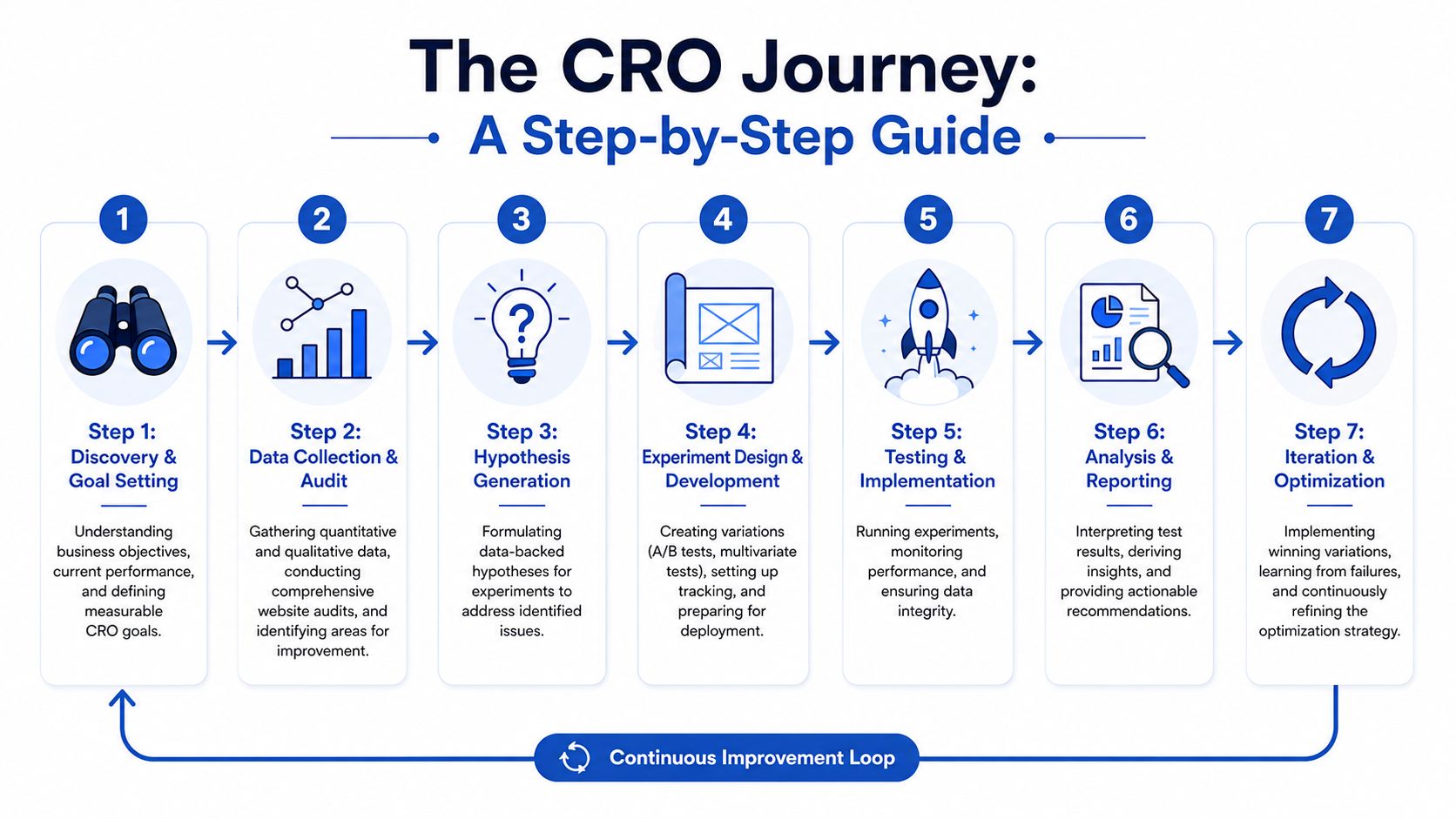
Start with the journey below. It shows the operating rhythm mature teams use to turn research into decisions the wider business can act on.
Discovery and diagnosis
The first job is alignment. An agency needs to know what the business is trying to improve, where margin sits, which channels drive demand, where seasonality affects behaviour, and what technical limits will shape implementation. Without that context, teams end up testing local page changes against the wrong commercial goal.
Then comes diagnosis. Good agencies combine analytics, session review, user research, funnel analysis, and technical checks to find where users hesitate, where tracking is weak, and where internal assumptions are unsupported. On Shopify, even test design can be shaped by theme structure, app conflicts, and release processes, which is why a practical reference like Grumspot's Shopify A/B testing services overview helps frame what is realistic to build and measure.
This stage should also expose problems outside the page itself. If paid traffic is converting poorly because the ad sets the wrong expectation, the fix belongs in campaign messaging. If users keep stalling around plan selection, pricing display, or onboarding steps, product and lifecycle teams need to be involved early.
Prioritisation and experiment design
Once the evidence is in, the agency has to make choices. At this stage, average operators lose control. They produce a long backlog, let internal opinion steer the roadmap, and treat every idea as equally urgent.
A stronger process ranks work against four filters: likely business impact, strength of evidence, implementation effort, and learning value. Some tests are worth shipping because they can raise revenue quickly. Others matter because they answer a strategic question that affects product, acquisition, or retention work across the quarter.
Typical priorities include:
- Checkout and form friction on high-intent journeys where small UX issues block completion.
- Message mismatch between ads, emails, social content, and landing pages.
- Mobile journey failures that break progression on the device where a large share of visits happen.
- Trust and clarity gaps around pricing, delivery, returns, or next steps.
That prioritisation should connect to the full funnel. If acquisition relies on creator content, paid social hooks, or humour-led campaigns, the on-site experience needs to continue the same promise and tone. FindClout's meme strategy insights are useful here because they show how awareness creative, retargeting, and conversion messaging need to work as one system.
Here's a short explainer if you want a visual walk-through of how experimentation fits together:
Build, launch, and learning transfer
Execution decides whether strategy survives contact with reality. Variants need proper QA across devices, analytics events need validation, audience allocation needs checking, and release timing has to fit the development calendar. Agencies that ignore these details often mistake tracking errors for experiment results.
After launch, the job is not just to call a winner. A mature CRO partner looks at what the test revealed about user motivation, segment differences, technical debt, and process bottlenecks. One losing test can still justify changes to analytics instrumentation, design patterns, merchandising logic, or sprint priorities.
That is the part many buyers miss. Its true value is not a string of isolated A/B tests. It is a repeatable operating model where research informs design, design informs development, and experiment outcomes reshape the product and marketing roadmap. Over time, that is how an agency helps build experimentation into the business instead of renting it in campaign by campaign.
Measuring Success with Key CRO Metrics
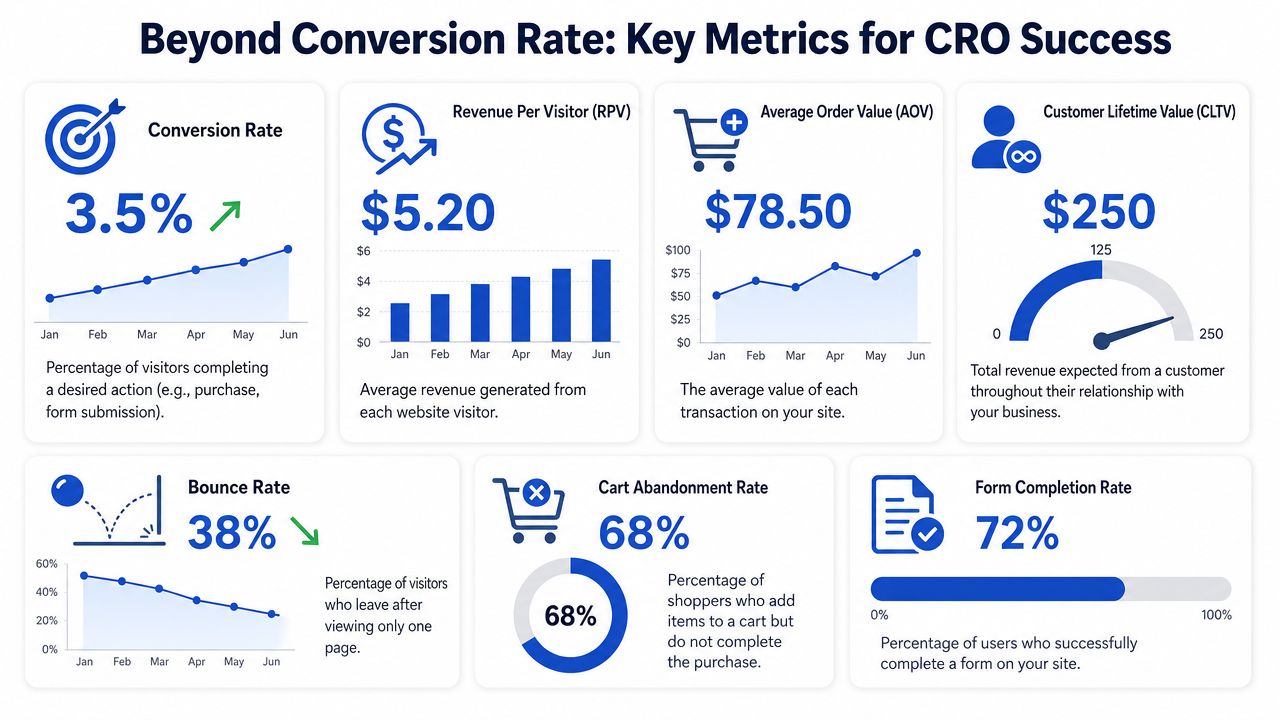
If an agency reports only on conversion rate, you're not getting enough information. Conversion rate matters, but it can hide as much as it reveals. You need a scorecard that ties page behaviour to commercial impact.
Benchmarks matter, but context matters more
For UK ecommerce, the average desktop conversion rate is about 3.2% and mobile is about 2.8%, while top-performing websites convert at 5.31% or higher, according to SQ Magazine's CRO statistics summary. Those figures are useful because they tell you whether the site is underperforming broadly or whether the issue sits deeper in your mix, offer, or audience quality.
But benchmarks shouldn't drive blind imitation. A low conversion rate with strong average order value can outperform a higher conversion rate with weak basket quality. A lead generation site may accept a lower front-end conversion rate if lead quality improves downstream.
What a useful KPI set looks like
A senior team should review a balanced set of metrics:
| Metric | Why it matters |
|---|---|
| Primary conversion rate | Shows whether more visitors complete the main action |
| Micro-conversions | Exposes movement earlier in the journey, such as add-to-cart or form starts |
| Average order value | Tells you whether conversion gains are strengthening or diluting basket value |
| Revenue per visitor | Connects traffic quality and on-site performance in one commercial view |
| Customer lifetime value | Helps assess whether acquisition and on-site changes are bringing in better customers |
| Bounce or exit patterns on key pages | Highlights where journeys break before intent develops |
Don't let an agency hide behind activity metrics. More tests run does not equal more value created.
What good reporting sounds like
Useful reporting answers business questions. It should tell you what changed, what was learned, which customer segments behaved differently, and what needs to happen next. It should also connect findings to actions outside the test itself.
For example, if mobile visitors engage with product content but abandon during checkout, that may indicate a UX issue, a payment trust issue, or a technical performance problem. The right response might sit with design, development, or operations. That's why mature CRO reporting should influence backlog decisions, not just celebrate winning variants.
Understanding Agency Pricing and Engagement Models
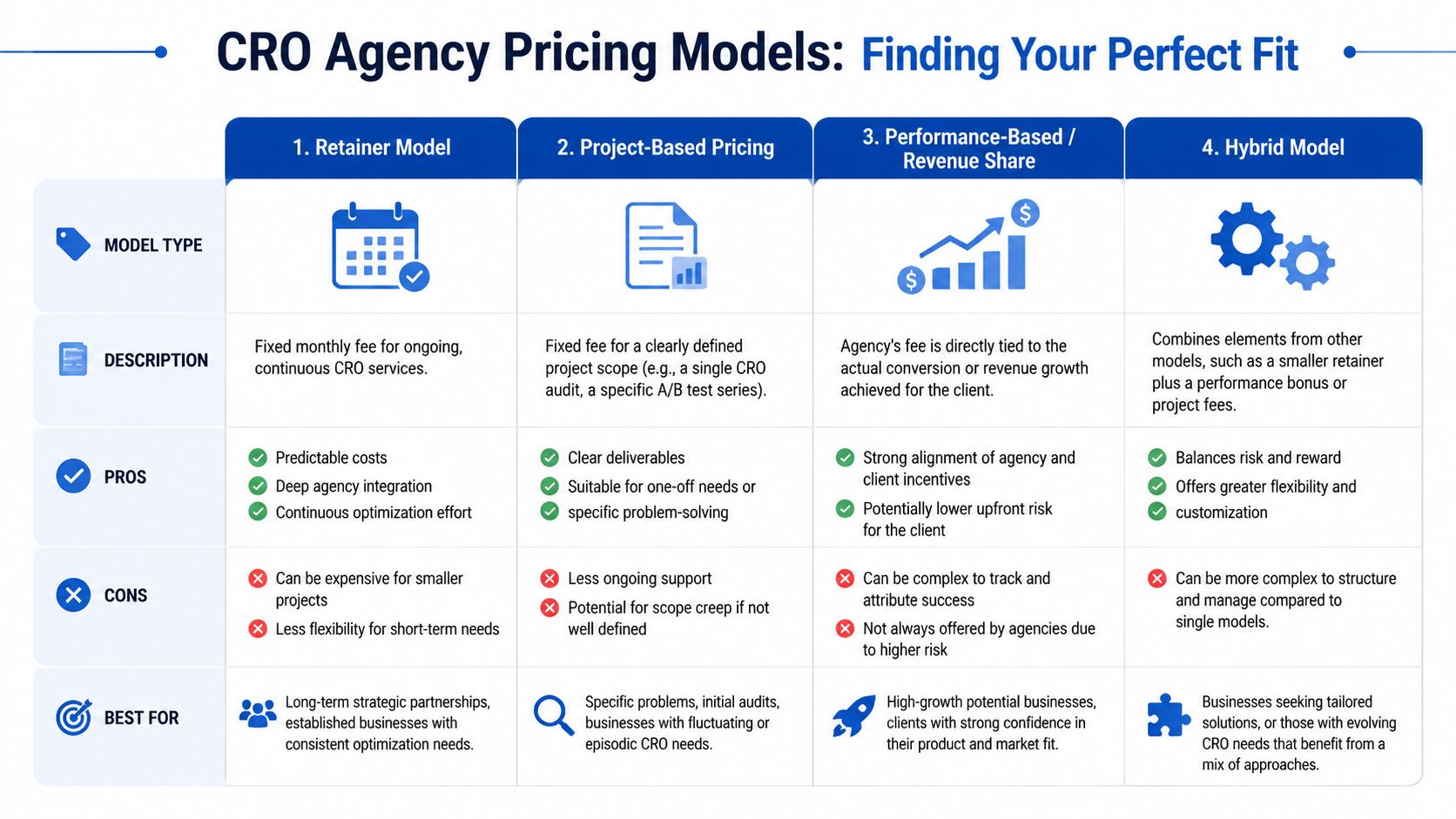
Pricing shapes behaviour. It determines how much context the agency learns, how aggressively it experiments, and whether the relationship feels transactional or embedded. The wrong model can create friction even when the team is capable.
The four models you'll see most often
| Model | Works well when | Main trade-off |
|---|---|---|
| Retainer | You want continuous testing, ongoing research, and integration with internal teams | Higher fixed commitment |
| Project-based | You need an audit, a landing page sprint, or a defined experiment series | Limited continuity once the scope ends |
| Performance-based | You want stronger incentive alignment around outcomes | Attribution and measurement can get messy |
| Hybrid | You need a base level of support plus upside incentives | More moving parts in contracts and reporting |
What each model changes operationally
Retainer models suit businesses that want CRO woven into weekly operations. The agency has time to understand your customers, platform constraints, promo calendar, and internal politics. That usually leads to better prioritisation. It also means the agency can influence product, design, and tech decisions rather than reacting to isolated requests.
Project pricing is useful when you need a specific deliverable. An audit. A landing page rebuild. A checkout review. It gives budget certainty, but the downside is obvious. CRO works best as a compounding process, and project work can stop just as the team starts learning what matters.
Performance-based models sound attractive because they promise shared risk. Sometimes they work. Sometimes they create arguments about attribution, external factors, and which revenue gains should count. They tend to work better when tracking is mature and the commercial baseline is already trusted.
Hybrid models often reflect reality best. A smaller fixed fee funds research, implementation, and planning. A variable component rewards outcomes. If you're evaluating hybrids, make sure the contract spells out baseline definitions, reporting windows, exclusion rules, and ownership of implementation work.
Commercial fit matters as much as technical fit. A brilliant agency on the wrong pricing model can still become a frustrating partner.
The key question isn't “which model is cheapest?”. It's “which model supports the operating rhythm we actually need?”.
How to Choose the Right Conversion Optimization Agency
Most agency selection processes are too polite. Buyers ask for case studies, hear a tidy process explanation, and compare proposals as if they're buying the same thing from different suppliers. They aren't. You're choosing who gets influence over revenue, customer experience, experimentation governance, and often your roadmap.
Look for integration, not just capability
A useful shortlist starts with one question. Can this agency work across teams, or will it stay trapped in marketing? A true CRO partner has to be credible with product managers, designers, developers, analysts, and channel owners. If they can't translate findings into backlog priorities and implementation briefs, they won't shift the business.
Many buyers miss a critical UK issue. Privacy and experimentation have to work together. Agencies often claim to be data-led, but fewer explain how they handle consent-aware analytics and testing. For UK businesses, that matters. Webeyez highlights that strong agencies should architect analytics and experimentation with UK GDPR consent requirements in mind, and that many agencies still don't make this capability clear in their positioning, as noted in Webeyez's guide to choosing a UK CRO agency.
Questions that reveal strategic depth
Ask questions that force the agency to show its operating model, not just its sales pitch.
- How do you decide what not to test? Good agencies are disciplined. Weak ones try to please everyone.
- What happens when a test is inconclusive? The answer should include learning, segmentation review, and next-step logic.
- How do you handle engineering dependency? If every test needs developer time, delivery speed becomes part of the strategy.
- How do you connect findings to product and lifecycle marketing? This shows whether they think beyond isolated pages.
- How do you manage analytics and consent in the UK context? This is a practical, not legalistic, question.
- Who does the work? Senior strategist, analyst, designer, developer, or outsourced contractor.
If your store runs on Shopify, it also helps to compare agencies that understand theme architecture, app interactions, and implementation realities. Grumspot's summary of what to look for in a Shopify CRO agency gives a platform-specific lens for that evaluation.
Signals that usually predict a better partnership
The strongest agencies tend to share a few traits:
- They challenge your assumptions: They won't validate every internal idea just to keep the account smooth.
- They talk about decision quality: Not just test volume.
- They care about instrumentation: Because bad tracking ruins good strategy.
- They can explain trade-offs clearly: Speed versus confidence, local lift versus global impact, design polish versus test velocity.
- They're comfortable influencing multiple functions: Marketing, product, and engineering.
A final point. Don't confuse niche expertise with narrow thinking. Industry experience helps, but the more important quality is whether the agency can adapt its process to your constraints without losing rigour.
Common Pitfalls to Avoid When Hiring an Agency
Most failed CRO engagements don't fail because nobody ran tests. They fail because the business hired for outputs and neglected operating conditions. The result is activity without traction.
Treating CRO as a silo
The fastest way to waste a good agency is to isolate it inside marketing. If product owns the template logic, engineering controls release cycles, analytics sits elsewhere, and legal signs off tracking, then CRO can't work as a closed department. It needs access and authority across functions.
When leaders treat the agency like a landing-page vendor, test ideas stay small. You get cosmetic changes when underlying issues sit in merchandising, pricing communication, site speed, checkout architecture, or lifecycle messaging.
Expecting instant wins from weak foundations
Some sites aren't ready for serious experimentation yet. Tracking is unreliable. Pages change constantly. Traffic is too fragmented. Internal approvals take weeks. In those cases, the first value from a CRO agency may be operational discipline, not immediate headline wins.
That's still useful. But it needs to be understood upfront, or the partnership gets judged unfairly.
Hiring teams with outdated decision methods
This one matters more than many buyers realise. Agencies still use simplistic decision rules that can slow testing and distort calls. Clutch notes that advanced UK CRO requires moving beyond rigid p-values to probabilistic decision-making and sequential testing with stopping rules, and that brands should ask agencies directly how they decide when a test has reached a conclusion, according to Clutch's UK conversion optimisation agency guidance.
If an agency can't explain its statistical logic in plain English, that's a warning sign. You don't need a lecture. You do need confidence that the team knows when evidence is strong, when it isn't, and how to avoid dragging weak tests on for too long.
Overvaluing local tweaks and undervaluing system fixes
Small changes have a place. Better copy, clearer hierarchy, sharper trust messaging. But if every recommendation stays at that level, the programme will plateau. The larger gains usually come from system-level fixes. Better product filtering. Cleaner mobile navigation. Stronger offer design. More coherent handoff from ad to landing page. Faster implementation pipelines.
The expensive mistake isn't running the wrong test. It's building a programme that can only test small things.
A good partnership gets more useful over time because it upgrades how the business learns, decides, and ships. That's what you should be buying.
If you need a partner that can connect CRO with Shopify design, development, audits, and implementation, Grumspot is one option to review. Their work sits closest to brands that need conversion improvements tied to real storefront changes, technical execution, and ongoing iteration rather than stand-alone advice.
Let's build something together
If you like what you saw, let's jump on a quick call and discuss your project
Related posts
Check out some similar posts.
- conversion rate optimisation australia
Boost sales in 2026 with our definitive guide to conversion rate optimisation australia. Learn local...
Read more
- Shopify optimization services
Unlock growth with Shopify store optimization services. Expert CRO, SEO, & speed tuning transform yo...
Read more
- ecommerce audit checklist
Discover the ecommerce audit checklist to fix issues, boost performance, and scale your online store...
Read more
- conversion rate optimization agency
Unlock growth with a trusted conversion rate optimization agency. Learn how data-driven testing and ...
Read more