Expert Shopify Store Optimization Services for Peak Performance
- Shopify optimization services
- Shopify CRO
- ecommerce optimization
- Shopify speed
- Shopify SEO services
Launched
March, 2026
Think of your Shopify store as a high-performance race car. Just getting a standard, out-of-the-box theme is like having a car that can get on the track. But to actually win the race? That requires a specialist pit crew, constantly tuning and refining every single part. That's exactly what Shopify store optimisation services do for your business.
This isn't about a one-off theme update or a quick fix. It's a continuous process of fine-tuning your store's design, speed, and technical guts to drive more sales and create a better customer experience. We’re talking about moving beyond a basic setup to build a high-performance selling machine.
What Are Shopify Store Optimisation Services?
At its core, optimisation is about making strategic, data-driven improvements across your entire customer journey. The goal is simple: remove any friction that stops a potential customer from buying, build their trust, and guide them smoothly from the moment they land on your site to the final checkout confirmation.
Simply having a store isn't enough anymore, especially in a competitive market. You need an expert-led strategy to find those small advantages that, when added up, put you leagues ahead of the competition.
The Core Concepts of Optimisation
True optimisation is built on a few key pillars that work together to lift your store's performance.
Conversion Rate Optimisation (CRO): This is the science and art of turning more of your visitors into paying customers. It involves digging into user behaviour, running A/B tests on everything from button colours to product descriptions, and refining each element to nudge people towards making a purchase.
User Experience (UX) Design: UX is all about how a person feels when they use your store. Is it a breeze to navigate? Can they find what they're looking for without getting frustrated? A great user experience builds confidence and dramatically lowers the chance of someone leaving your site empty-handed.
Technical SEO: This is all the crucial work that happens behind the scenes to help search engines like Google find, understand, and rank your store properly. It covers everything from optimising your site's structure and fixing broken links to ensuring it runs perfectly on mobile. A proper technical audit can uncover hidden problems that are quietly sabotaging your rankings. You can learn more about how a comprehensive page audit works in our detailed guide.
Why Optimisation Is Essential in the UK Market
The need for professional optimisation is especially acute in a packed marketplace. Take the UK, for example. There are an estimated 208,000 to 212,903 live Shopify stores, which gives Shopify a massive 23% market share.
For any merchant, that number means one thing: fierce competition. In this kind of environment, even tiny advantages in site speed or usability can be the deciding factor in whether a customer buys from you or from someone else.
In this environment, optimisation isn't just a "nice-to-have"—it's a critical strategy for survival and growth. It’s the mechanism that ensures your store doesn't just exist but actively performs, turning traffic into tangible revenue.
So, what do you actually get when you hire someone for Shopify store optimisation? It’s not some magic button or a single piece of software. It’s a whole suite of services, led by experts, all working together to boost your sales.
Think of it as a complete health check and performance tune-up for your online business, where every single part that influences a customer's decision to buy gets a thorough review.
Most professional services are built around a few core pillars. It usually all kicks off with a deep dive into your current store to see what’s working, what isn’t, and where the biggest opportunities for growth are hiding.
This diagram shows the main areas a solid optimisation strategy will focus on.
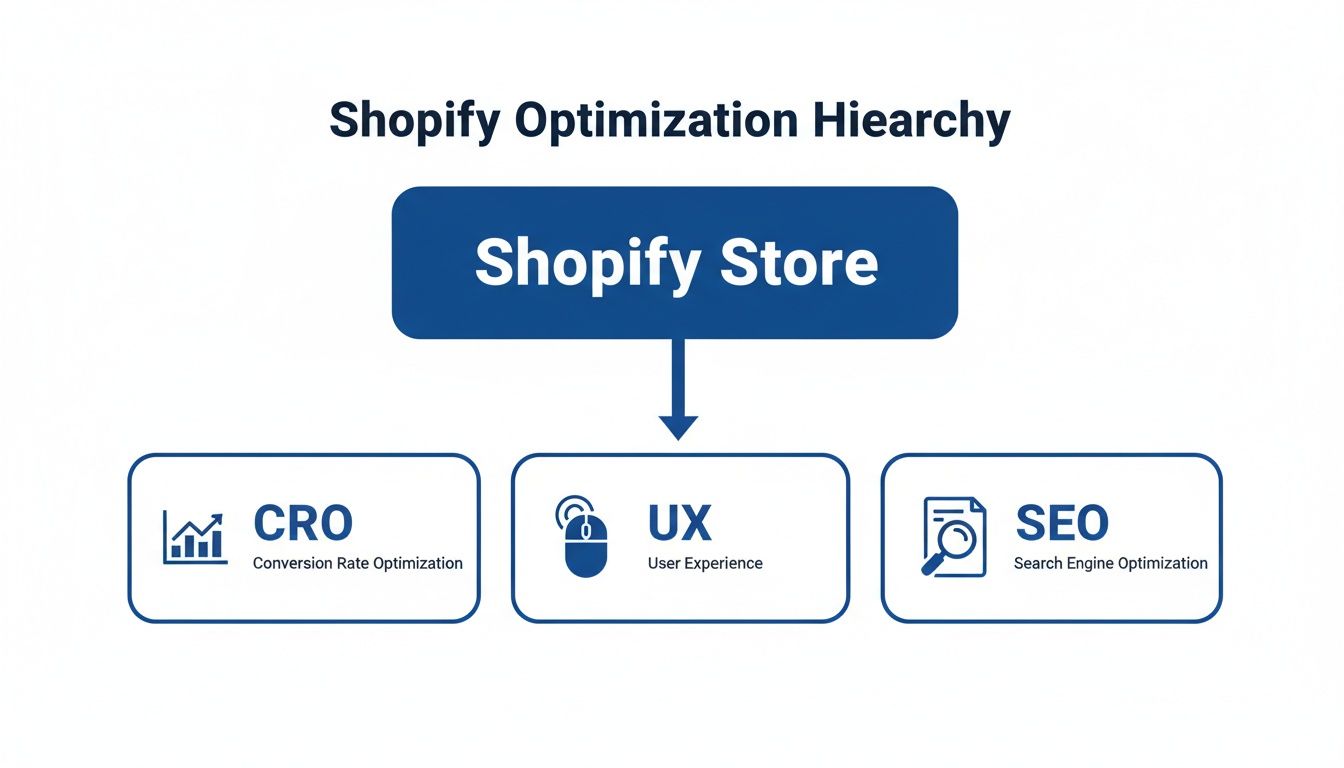
As you can see, a great Shopify store is a balancing act between making it easy to convert, pleasant to use, and simple for search engines to find.
To give you a clearer picture, this table breaks down the typical services you can expect and the main goal behind each one.
Shopify Optimization Services at a Glance
| Service Component | Primary Business Goal | Example Action |
|---|---|---|
| Design & CRO Audit | Increase Sales & Conversions | Analysing user heatmaps to find out why people abandon their carts. |
| Technical & SEO Audit | Improve Visibility & Performance | Fixing broken links and making sure your site structure is friendly to Google. |
| Speed Optimisation | Enhance User Experience & Reduce Bounce Rate | Compressing image files and cleaning up app code to make pages load faster. |
| Platform Migration | Future-Proof Your Business | Moving from an old ecommerce platform to Shopify 2.0 without losing SEO value. |
| System Integration | Streamline Operations | Connecting your store to your warehouse's inventory system to prevent overselling. |
| Subscription Setup | Create Recurring Revenue | Implementing a 'subscribe and save' model for your popular products. |
Each of these elements plays a vital role in turning your store into a well-oiled machine that doesn't just attract visitors, but consistently turns them into loyal customers. Let's look at what's involved in a bit more detail.
Design and Conversion Rate Audits
The first step is almost always a design and Conversion Rate Optimisation (CRO) audit. This is where specialists put on their detective hats. They'll dig into user behaviour data, look at heatmaps, and watch session recordings to figure out exactly where your potential customers are dropping off and why.
They look at everything – from how clear your navigation is to how persuasive your product pages are.
This part is crucial because the gap between an average store and a top-performing one is huge. In the UK, for instance, average Shopify conversion rates can be as low as 1.4% to 1.8%. But the top 10% of stores? They’re converting at over 4.7%. That’s the kind of potential that proper optimisation can unlock.
Technical and SEO Audits
Next up is the technical and SEO audit. This is like popping the bonnet on your car. An agency will look for all the hidden problems that are quietly killing your performance—things like broken links, clunky code, or a site structure that’s confusing search engines.
Think of a technical audit as a health check for your website’s foundations. If the foundation is shaky, it doesn't matter how great your design or marketing is; you'll never reach your full potential.
A proper SEO audit also makes sure your store is set up to rank well in search results. This drives valuable organic traffic your way, so you aren't paying for every single click.
Website Speed Optimisation
Nothing frustrates a potential customer more than a slow website. That's why website speed optimisation is a non-negotiable part of any decent service. Experts will do things like compress your images, minify your code, and review your third-party apps to shave every possible millisecond off your loading times.
Why is this so important? Well, research shows that a one-second delay in page load time can reduce conversions by up to 7%. On top of that, nearly 80% of shoppers who have a bad experience with site performance say they’re less likely to buy from that site again. If you want to get a head start, have a look at our complete Shopify store speed optimisation checklist.
Advanced Integrations and Migrations
For brands that are really starting to scale, optimisation can get more complex. This is where you get into the bigger projects that set you up for serious growth:
- Seamless Migrations: Moving your entire store to a more powerful platform like Shopify 2.0 without losing your hard-earned data or search rankings.
- System Integrations: This is about making your Shopify store talk to your other essential business tools, like your accounting software (ERP), customer database (CRM), or third-party logistics (3PL) provider.
- Customer Engagement Tools: A key part of modern ecommerce is keeping customers engaged. For example, embedding chatbots into your Shopify website can provide instant support and guide users to the right products.
These advanced projects are what turn your store into a truly unified ecommerce powerhouse. When all your systems are communicating perfectly, you cut down on manual admin, reduce costly errors, and build a scalable business that's ready for whatever comes next.
Measuring the Real-World Impact and ROI
When you bring in Shopify store optimisation services, you’re not just paying for a website facelift. You’re making a direct investment in your business's growth, and you should expect to see a clear return on that investment. It all comes down to tracking the right numbers to see what’s truly working.
The entire point is to move beyond vague improvements and witness concrete financial results. Proper optimisation turns your website from a simple digital brochure into your most powerful sales tool, where every pound spent is aimed at building sustainable profit.
Beyond the Conversion Rate
While the conversion rate is a crucial starting point, it only tells part of the story. A truly effective optimisation strategy casts a wider net, looking at data across the entire customer journey to gauge its full impact.
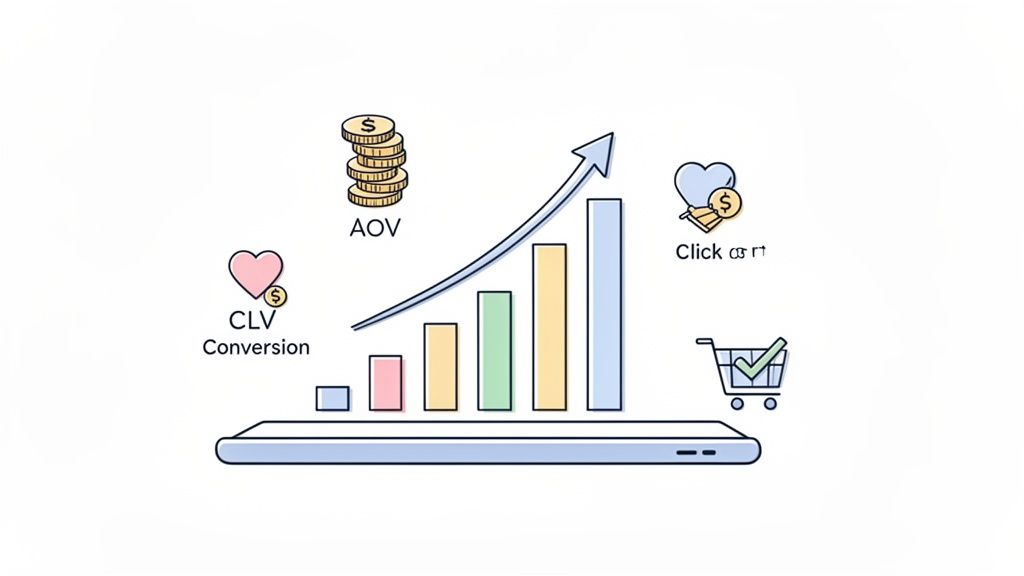
Here are the core metrics that reveal the true ROI of your optimisation efforts:
Average Order Value (AOV): This is simply the average amount a customer spends in a single transaction. Smart optimisation tactics, like offering product bundles or clever cross-sells at checkout, can give this figure a serious boost. For instance, a well-designed bundle offer can lift AOV by as much as 61% by making it easy for customers to buy more.
Customer Lifetime Value (CLV): This metric forecasts the total revenue you can realistically expect from one customer over their entire relationship with your brand. A fast, frustration-free user experience fosters loyalty, encouraging repeat business and dramatically increasing CLV.
Cart Abandonment Rate: This number tracks how many shoppers add items to their basket but leave before paying. A high rate is a huge red flag, usually pointing to friction in your checkout process. Optimisation tackles this head-on by simplifying steps, adding guest checkout options, and using trust badges.
According to Shopify's own research, accelerated checkouts like Shop Pay can increase conversions by up to 50% on mobile devices. This one change can recover thousands in lost sales by removing the final barrier to purchase.
The Compounding Effect of Small Wins
One of the most powerful things about continuous optimisation is how small, incremental improvements build on each other. A 1% bump in your conversion rate might not sound revolutionary on its own.
But, when you combine that with a 5% increase in AOV and a 10% drop in cart abandonment, the cumulative effect on your yearly revenue can be massive. Think of it like compound interest—each small, data-backed win creates a foundation for the next, leading to exponential growth over time. An expert agency is brilliant at finding and implementing these high-impact "small wins".
Linking Optimisation to Search Rankings
The benefits don't stop at your checkout. Technical optimisation has a direct and powerful influence on your search engine visibility. Google’s algorithm actively prioritises websites that deliver a fantastic user experience, which heavily relies on fast load times and mobile-friendly design—both cornerstones of good optimisation.
Key search-related outcomes include:
- Higher Organic Rankings: As your site’s Core Web Vitals score improves, Google is more likely to show your product and category pages higher in the search results, driving more free, high-intent traffic.
- Increased Click-Through Rates (CTR): An SEO audit often leads to better-optimised meta titles and descriptions. These small text snippets can be the difference that makes a user click your listing instead of a competitor's.
- Lower Bounce Rates: When your pages load in a snap and are easy to browse, visitors stick around longer. This behaviour sends strong positive signals to search engines that your site is a quality result.
Ultimately, measuring the impact of Shopify store optimisation services means connecting the dots between website tweaks and business outcomes. By keeping a close eye on these KPIs, you can draw a straight line from a faster site and smoother journey to more sales and a healthier bottom line. For those wanting to learn more, exploring what a top conversion rate optimisation agency prioritises can be incredibly insightful.
How to Choose the Right Optimisation Partner
Picking the right partner for your Shopify store optimisation services is one of the biggest calls you’ll make for your business. This isn't just about hiring a coder or a designer; you’re handing over the keys to your most important asset. The right agency becomes a genuine extension of your team, whereas the wrong one can lead to expensive mistakes and stalled growth.
So, how do you look past a slick portfolio and find a partner who will actually move the needle? It all starts with knowing what you need, whether that's fixing an urgent problem or building a long-term strategy for expansion.
Look for a Data-First Approach
The best optimisation partners are completely obsessed with data. They don't make decisions based on gut feelings or the latest design trends. Their entire process revolves around a simple, powerful loop: analyse user behaviour, form a hypothesis, test it, and measure the results.
When you're talking to a potential agency, ask them to walk you through their approach to Conversion Rate Optimisation (CRO). A good answer will involve tools like heatmaps, session recordings, and A/B testing platforms. If the conversation is all about aesthetics and they don't mention data, consider it a major red flag.
A partner with a data-driven mindset will:
- Dig into your analytics to find the pages that get lots of traffic but few conversions.
- Suggest specific, testable changes aimed squarely at improving your key metrics.
- Deliver clear reports that show you exactly how their work impacted your sales and AOV.
This analytical rigour is what turns your optimisation budget from a hopeful expense into a predictable investment. Every change has a purpose and a measurable outcome.
Vet Their Technical and Shopify Plus Expertise
Design is only one piece of the puzzle. Your partner absolutely must have deep technical knowledge of the Shopify platform, especially if you’re on or aiming for Shopify Plus. A beautiful website that’s slow, buggy, or built on flimsy code will actively drive customers away.
A great-looking store with poor technical foundations is like a race car with a beautiful paint job but a faulty engine. It might look impressive standing still, but it will fail you on the track where performance actually matters.
Ask potential partners about their hands-on experience with:
- Shopify 2.0 Architecture: Can they build flexible, fast sections that your own team can easily manage?
- Complex Migrations: Have they successfully moved stores from platforms like Magento or BigCommerce to Shopify without wrecking your SEO rankings?
- Custom App Development: Are they capable of building a bespoke solution when an off-the-shelf app just won’t cut it for your business?
This level of technical skill is non-negotiable for building a store that not only converts well but is also stable, secure, and ready to grow with you.
Demand Proof Through Case Studies and Testimonials
Talk is cheap. Any agency can promise the world, but a top-tier partner will have a portfolio of case studies to back it up. These shouldn’t be vague success stories; they need to be detailed accounts filled with real, hard numbers.
When you review their work, look for tangible business results. A case study that says "we improved the design" is meaningless. What you're looking for is something like, "we redesigned the product page and increased add-to-cart rates by 22%, which led to a 15% rise in overall revenue."
On a similar note, check for genuine client testimonials. Are their past clients willing to put their name on the line for them? Even better, are those clients from businesses of a similar size or in the same industry as yours? That kind of alignment is a strong signal they’ve tackled your specific challenges before.
Agency Selection Checklist
Choosing the right partner is critical, and this table breaks down the green flags to look for and the red flags to avoid.
| Evaluation Criteria | What to Look For (Green Flags) | What to Avoid (Red Flags) |
|---|---|---|
| Expertise & Proof | Data-driven case studies with specific KPIs (e.g., "+15% AOV"). | Vague claims of "improved sales" without any numbers to back it up. |
| Communication | Proactive updates, scheduled strategy calls, and a dedicated point of contact. | Slow response times, radio silence, and a general lack of transparency. |
| Technical Skill | Deep knowledge of Shopify Plus, custom development, and complex integrations. | A portfolio that only showcases basic theme setups and minor tweaks. |
| Engagement Model | Flexible options like retainers or projects with clear, flat-rate pricing. | Hidden fees, overly rigid contracts, and unpredictable hourly billing. |
Ultimately, finding the right Shopify store optimisation services provider is about more than just skills. It's about finding a partner who is genuinely invested in your success, communicates transparently, and has the proven experience to turn your ecommerce goals into reality.
Understanding Pricing and Engagement Models
Figuring out how much to pay for Shopify store optimisation services can feel a bit tricky. The price structures you’ll come across vary quite a bit, so getting to grips with the main ways agencies work is the first step to finding a partner that fits your budget and ambitions.
The way an agency charges isn't just about the money; it reveals a lot about their entire approach. It’s a window into how they manage their workflow, value their expertise, and what kind of partnership you can truly expect. Getting the model right is just as important as checking their technical skills.
When you're looking at potential partners, you'll want to dig into how they structure their fees. Many of the best agencies are transparent about this, and understanding the pricing models they use can give you a solid baseline for what's standard in the industry.
One-Off Projects for Specific Goals
The most direct way to engage an agency is with a one-off project. This approach is perfect when you have a single, clearly defined objective.
Think of it like hiring a skilled tradesperson. You need a specific job done—like fitting a new kitchen—so you agree on a price for that task, and the relationship ends once it’s finished.
A one-off project is a great fit for things like:
- A full store build or rebuild ahead of a big launch.
- Migrating your store to Shopify from another platform like Magento.
- A comprehensive speed optimisation audit and the subsequent fixes for a slow site.
This model gives you certainty. You get a fixed scope of work, a clear timeline, and a flat-rate price, which makes budgeting straightforward. The downside is that it’s purely transactional and isn't built for the kind of ongoing, iterative improvements that really drive long-term growth.
Monthly Retainers for Continuous Growth
For businesses that are serious about sustained improvement, the monthly retainer is the go-to model. This is less like hiring a contractor and more like having a dedicated pit crew for your race car, who are constantly tuning and tweaking everything for peak performance.
With a retainer, you pay a set monthly fee for ongoing access to a team of experts—senior developers, UX designers, and conversion specialists. They effectively become an extension of your own team, completely focused on continuous optimisation.
A retainer transforms your relationship with an agency from a simple vendor transaction into a true growth partnership. The focus shifts from completing a single project to achieving ongoing business objectives, month after month.
This model ensures your store never stagnates. The agency will work from a prioritised backlog of tasks, tackling everything from running A/B tests and fixing bugs to designing new features and refining the customer journey.
The real advantage here is proactive, consistent progress. Instead of just reacting when things go wrong, your optimisation partner is always on the lookout for new opportunities to lift your conversion rates, increase average order value, and improve performance across the board. These arrangements usually involve weekly strategy calls and regular updates, so you always know what’s happening. It’s this agility and deep expertise that helps you stay ahead of the competition.
What to Expect: From a Deep-Dive Audit to Scaling Your Growth
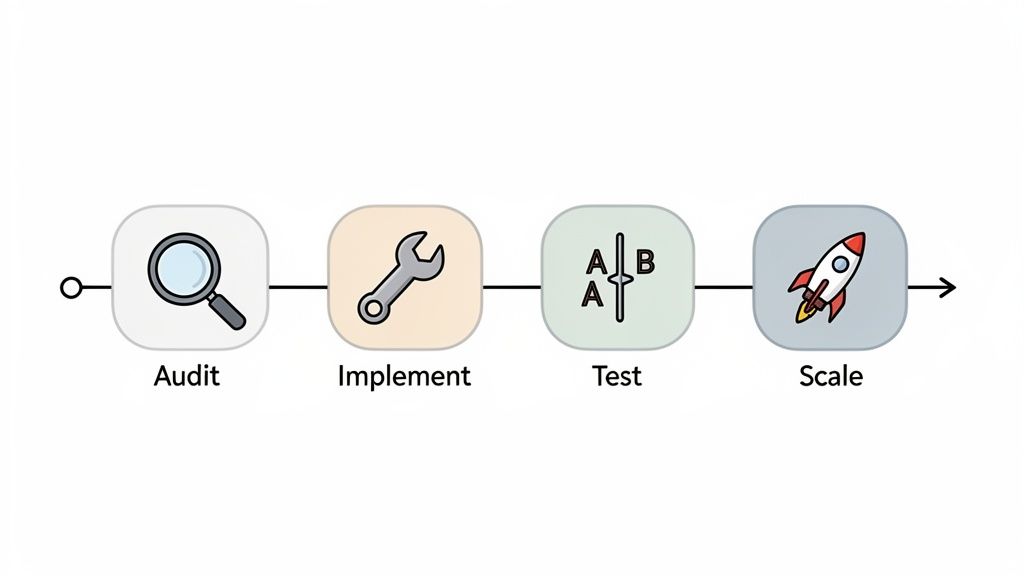
Bringing in a Shopify optimisation partner isn't about ticking off a few tasks on a to-do list. It's about kick-starting a continuous cycle of improvement that turns your store into a genuine sales machine. The entire process begins with a thorough audit, which is where we uncover all the hidden opportunities holding your store back.
Think of it as the blueprinting phase before a major renovation. We dive deep into your analytics, pore over user behaviour data, and scrutinise your site's technical foundations to get a complete, honest picture of your store’s performance. This initial deep dive is absolutely critical—it gives us the data-backed roadmap for everything that comes next.
Turning Insights into Action
With the audit complete, we move from discovery to doing. This is where the real work begins, turning those insights from the audit into tangible improvements on your store. We’ll always prioritise the work based on a simple formula: maximum impact for minimum effort, making sure you see the most significant wins first.
This phase is usually a blend of different activities:
- Quick Technical Fixes: We’ll start by tackling the low-hanging fruit. Things like squashing bugs, fixing broken links, or optimising slow scripts can deliver an immediate boost. When 83% of users expect a site to load in three seconds or less, speed is always a priority.
- CRO-Focused Design Tweaks: Using data from heatmaps and session recordings, we start refining key pages. This might involve rethinking a confusing navigation menu, A/B testing a new call-to-action on your product pages, or rewriting copy to be more persuasive.
- Major Development Projects: For ambitious brands ready to scale, this could mean bigger undertakings. We might manage a full migration to Shopify 2.0 to unlock new features or integrate a complex system like an ERP to get your inventory management under control.
This isn't a "set it and forget it" process. A good partner will keep you in the loop with daily updates and weekly strategy calls. The goal is to make sure the work we're doing is always perfectly aligned with where you want to take your business.
The Test, Learn, and Improve Cycle
Here’s the part that separates the stores that plateau from the ones that achieve lasting growth. Optimisation is never, ever a one-and-done project. The best results always come from a continuous cycle of testing ideas, learning from the data, and constantly improving.
Your website is never truly 'finished'. Think of it as a living asset that needs to constantly adapt to customer behaviour and market shifts to stay ahead of the competition.
Once we’ve rolled out a change, our job isn't over. We immediately start setting up A/B tests to prove that the new version is actually performing better than the old one. Every test, whether it wins or loses, gives us invaluable data and teaches us more about what makes your customers click.
By committing to this iterative process, your store starts to evolve in a smart, data-informed way. You're no longer making business-critical decisions based on a gut feeling. Instead, you're building a more resilient, high-growth business on a foundation of solid evidence. This is how you stop seeing optimisation as a cost and start treating it as your most powerful investment in growth.
Frequently Asked Questions
It's natural to have questions when you're thinking about investing in your store's performance. Here are some of the most common ones we hear from merchants, with straightforward answers to help you see things clearly.
How Long Until I See Results?
This is the big one, and the honest answer is: it depends. Some technical fixes, like a speed tune-up, can make your site feel snappier almost overnight. You’ll feel that improvement straight away.
But for the really meaningful gains from conversion rate optimisation (CRO) and SEO, you need a bit more patience. We typically see the needle start to move in a significant way within three to six months. Think of it as a long-term strategy, where small, continuous improvements build on each other to create powerful, compounding growth. This isn't about a single magic bullet; it's about building lasting momentum.
Can I Do Shopify Optimisation Myself?
Of course. Many store owners handle basic tasks themselves, and they should. Things like compressing images before you upload them or writing clear, SEO-friendly product descriptions are great habits to get into.
Where professional services come in is for the deeper, more complex work. We’re talking about advanced data analysis, obsessive user experience testing, and the kind of custom development needed to unlock serious, sustainable growth. It’s a different level of expertise.
Think of it this way: you can change your car's oil, but for a full engine rebuild, you bring in a specialist mechanic. Professional optimisation is the engine rebuild for your store.
Is Optimisation Only for Large Stores?
Not at all. While big brands on Shopify Plus certainly have complex needs, optimisation is for any store that’s serious about growth. In fact, getting the foundations right early on is one of the smartest things a new merchant can do.
By building good practices from the start, you create a strong, scalable base for future success. It prevents you from having to untangle major structural problems down the line and sets you on a path to profitability from day one.
What Is the Difference Between a Theme Update and Optimisation?
A theme update is essentially a fresh coat of paint. It changes your store's visual "skin" and can make your site look new and different, but it doesn't fundamentally change how it works or performs.
Store optimisation goes much, much deeper. It’s a data-driven process designed to improve every single aspect of your store that influences revenue—from page speed and checkout flows to the entire customer journey and search engine visibility. It’s strategic work that delivers results, no matter which theme you happen to be using.
Ready to unlock your store's true potential? Grumspot is a Shopify Plus agency that fixes, builds, and scales ecommerce experiences at speed. Book a call with us today and let's build your high-velocity revenue engine.
Let's build something together
If you like what you saw, let's jump on a quick call and discuss your project
Related posts
Check out some similar posts.
- black friday campaigns
Compare 7 tools for planning Black Friday campaigns on Shopify, covering email, SMS, personalisation...
Read more
- shopify website examples
Explore 7 Shopify website examples and learn the UX, conversion features, and practical lessons merc...
Read more
- zero party data
Learn what zero party data is, why it matters for ecommerce, and how to collect and use it for perso...
Read more
- cro best practices
Apply cro best practices to Shopify stores with 10 actionable tactics for testing, product pages, ch...
Read more