Ecommerce Replatforming Agency Guide for UK Brands
- ecommerce replatforming agency
- Shopify migration
- replatforming guide
- Shopify Plus
- UK ecommerce
Launched
September, 2026

A capable ecommerce replatforming agency delivers discovery, data and SEO migration, design and build, integrations, QA, and post-launch stabilisation across a typical 16 to 24 week engagement. The work is a controlled operational move, not a new coat of paint.
You're probably looking at replatforming because the current store has become expensive to operate and difficult to change. A founder can tolerate awkward admin screens or a slow release process for a while. The problem starts when every checkout change needs a developer, every integration has a hidden exception, and the team has to choose between fixing technical debt and launching the next commercial idea.
For UK brands, the decision carries real weight. Online retail sales reached £127.41 billion in 2024, up from £123.3 billion in 2023, with online sales representing about 30% of UK retail sales, according to Office for National Statistics-based UK ecommerce reporting. Your storefront is no longer a side channel. It's a core operating system for revenue, customer data, fulfilment, tax, marketing, and international trade.
Why Founders Start Searching for a Replatforming Agency
The familiar scenario is a UK DTC brand running on an ageing Magento installation or an over-customised WooCommerce build. Traffic remains dependable, but the team keeps postponing improvements because the checkout is fragile, the theme is difficult to edit, and the developer who understands the integrations has become a single point of failure.
The founder initially asks for a redesign. That's usually the wrong diagnosis. A visual refresh won't fix an order sync that fails, a product catalogue with inconsistent attributes, or a checkout that applies the wrong delivery rule to an EU customer.
The real trigger is operational drag
The search for an ecommerce replatforming agency normally begins when internal capability stops matching the company's ambition. Marketing wants faster landing-page releases. Operations needs accurate stock and fulfilment updates. Finance wants dependable tax treatment. The CTO wants to retire unsupported code without interrupting trading.
Those requests are connected. A new theme built on top of an unstable integration layer moves the problem into a more attractive interface. Likewise, a platform migration that preserves products but loses canonical logic, metadata, redirects, or transactional email flows can create a launch-day crisis.
The agency's job is to absorb complexity before it reaches customers.
A credible partner takes responsibility for the migration as a business transition. That includes documenting the current stack, deciding what should be preserved, challenging features that no longer earn their maintenance cost, and building a cutover plan that protects trading.
The UK market gives brands a strong reason to treat this work strategically. The online channel has moved beyond an emergency pandemic response into a more established commercial environment, so replatforming is increasingly about reducing technical debt, improving operational control, and preparing for growth. The agency should therefore be accountable for uptime, SEO equity, data integrity, checkout behaviour, and stabilisation after launch, not just the date the new theme is published.
What an Ecommerce Replatforming Agency Actually Does
An ecommerce replatforming agency owns the end-to-end move from one commerce platform to another. For many UK mid-market brands, that may mean moving from Magento, WooCommerce, or a custom system to Shopify or Shopify Plus, although the correct target depends on the operating model, catalogue, integrations, and international requirements.
A freelance developer can build a theme. A generalist agency can produce a polished storefront. A specialist migration team must preserve the business logic behind the storefront while rebuilding it on a platform the internal team can operate.
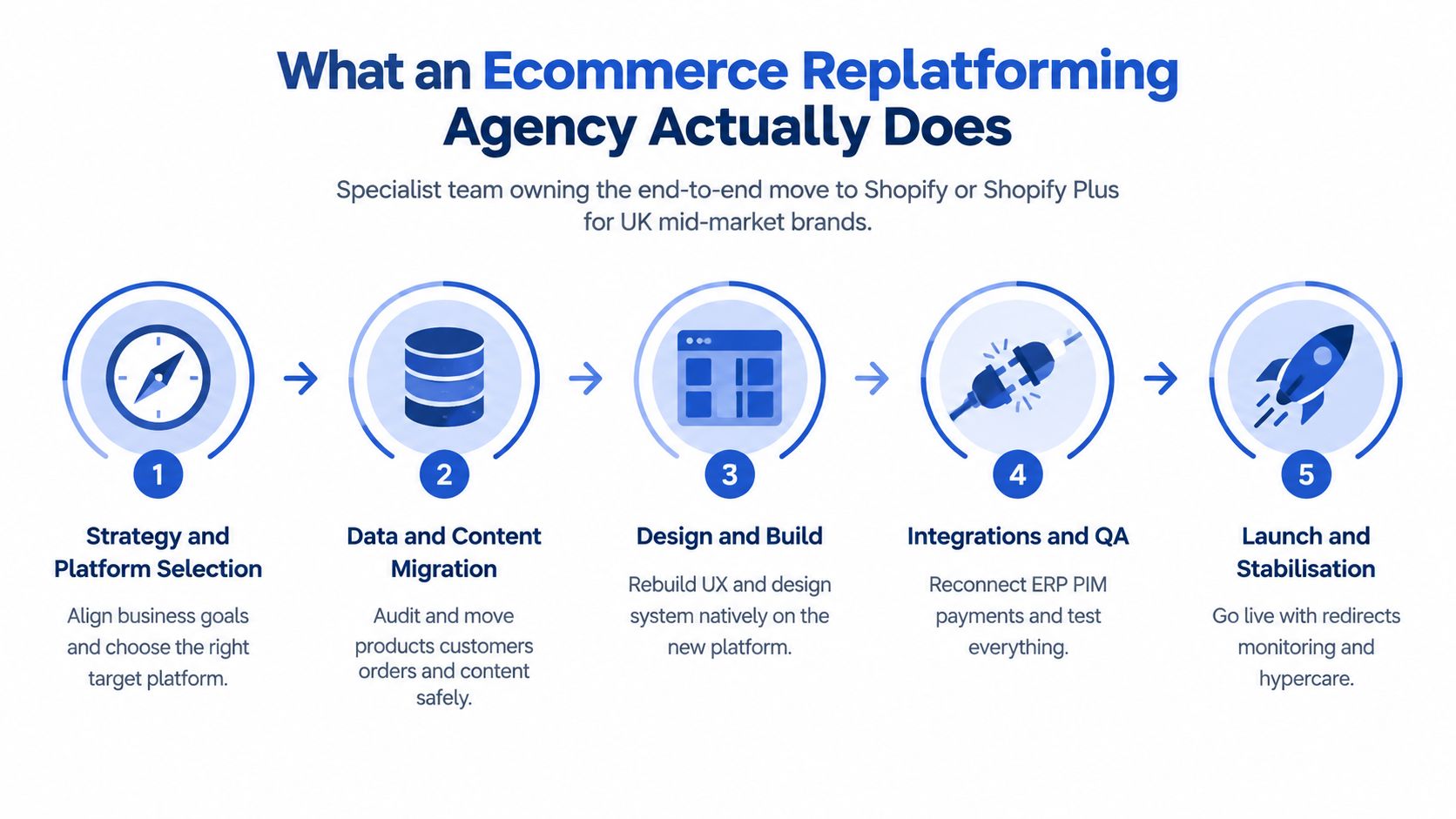
Six workstreams should be visible in the proposal
Discovery and platform fit: The team audits the existing platform, catalogue, customer model, order flows, analytics, content, integrations, and commercial requirements. The output should be a platform recommendation and a documented scope, not a generic Shopify pitch.
Technical architecture: Architects define the data model, app strategy, middleware, environments, permissions, deployment process, and integration boundaries. The team decides what Shopify can handle natively and what needs custom development.
Data and SEO migration: Specialists map products, variants, collections, customers, orders, pages, metadata, structured data, canonicals, analytics, feeds, and legacy URLs. The migration plan should include a complete crawl, 100% URL mapping, redirect validation, and post-launch monitoring, as outlined in this UK enterprise Shopify migration guide.
Design and theme build: Designers and frontend developers rebuild the experience using a maintainable design system. The aim isn't to copy every historical workaround. It's to preserve customer-critical journeys and improve the parts that create friction.
Integration delivery: The agency reconnects ERP, CRM, PIM, Klaviyo, payment providers, shipping systems, subscriptions, marketplaces, and reporting. UK-specific requirements can include tax configuration, customs and duty messaging, EPR workflows, and landed-cost calculations.
Launch and hypercare: The team runs UAT, monitors orders and integrations, checks redirects and analytics, and fixes defects quickly after cutover. A named project manager should coordinate the work rather than handing responsibility to whoever has capacity.
Ask whether the engagement is fixed-scope, time-and-materials, or a phased combination. Whichever model you choose, insist on named owners, acceptance criteria, change control, and a post-launch support window.
Signs Your Store Needs Replatforming
Replatforming is rarely triggered by one spectacular failure. More often, the store develops a collection of small constraints that consume margin and slow decisions. The right question isn't whether the site still functions. It's whether the current stack makes ordinary growth unnecessarily expensive.
Quiet signals that should concern you
An unsupported platform version or a patchwork of security fixes creates risk that the trading team can't easily see. Rising hosting costs, recurring emergency work, and fragile deployments indicate that the technical foundation is absorbing budget without creating customer value.
Performance problems deserve the same scrutiny. Slow templates, bloated apps, and checkout friction affect mobile shoppers first, but the commercial consequence often appears as a gradual decline in completed orders rather than a clear outage.
Other warning signs are more strategic:
- Feature bottlenecks: Subscriptions, B2B pricing, international storefronts, or merchandising rules require workarounds instead of supported workflows.
- Release dependency: Marketers wait for developers to change basic content, promotions, navigation, or landing pages.
- Maintenance-heavy engineering: Developers spend their working week keeping the store alive instead of improving the roadmap.
- Single-person knowledge: One freelancer or contractor understands the checkout, integrations, and deployment process.
- Peak-season avoidance: The team won't release necessary improvements before a trading period because nobody trusts the regression risk.
- Rising cost per order: Manual reconciliation, customer service intervention, and integration failures increase the operating cost attached to each sale.
| Common replatforming signals and what they cost | Where it shows up | Typical impact |
|---|---|---|
| Unsupported platform or ageing custom code | Security, hosting, deployment | More emergency work and less confidence in releases |
| Fragile integrations | Stock, orders, fulfilment, finance | Manual reconciliation and delayed operations |
| Slow or inflexible checkout | Mobile purchasing and promotions | Lost demand and weaker conversion efficiency |
| Hard-coded content workflow | Marketing and merchandising | Slower campaign launches and developer queues |
| Limited international capability | Currency, tax, shipping, and markets | Manual work and inconsistent customer promises |
| Single-person technical dependency | Support and incident response | High continuity risk when that person is unavailable |
A practical decision test
If the team can keep trading but can't change the business safely, replatforming deserves a formal assessment. Don't wait for a total outage. Commission discovery while the current store still works, because the strongest migration plans are built with access to reliable legacy data, known workflows, and enough time to test.
How a Replatforming Migration Actually Works
A competent migration has checkpoints, owners, and evidence. It shouldn't be described as “build the new site, import the products, and switch the domain”. UK migration guidance places a straightforward Magento or WooCommerce to Shopify move at 16 to 24 weeks, with complex enterprise programmes reaching £80,000 to £150,000 or more in delivery cost, depending on architecture, internationalisation, and ERP integrations. See the Shopify migration guide for a detailed planning reference.
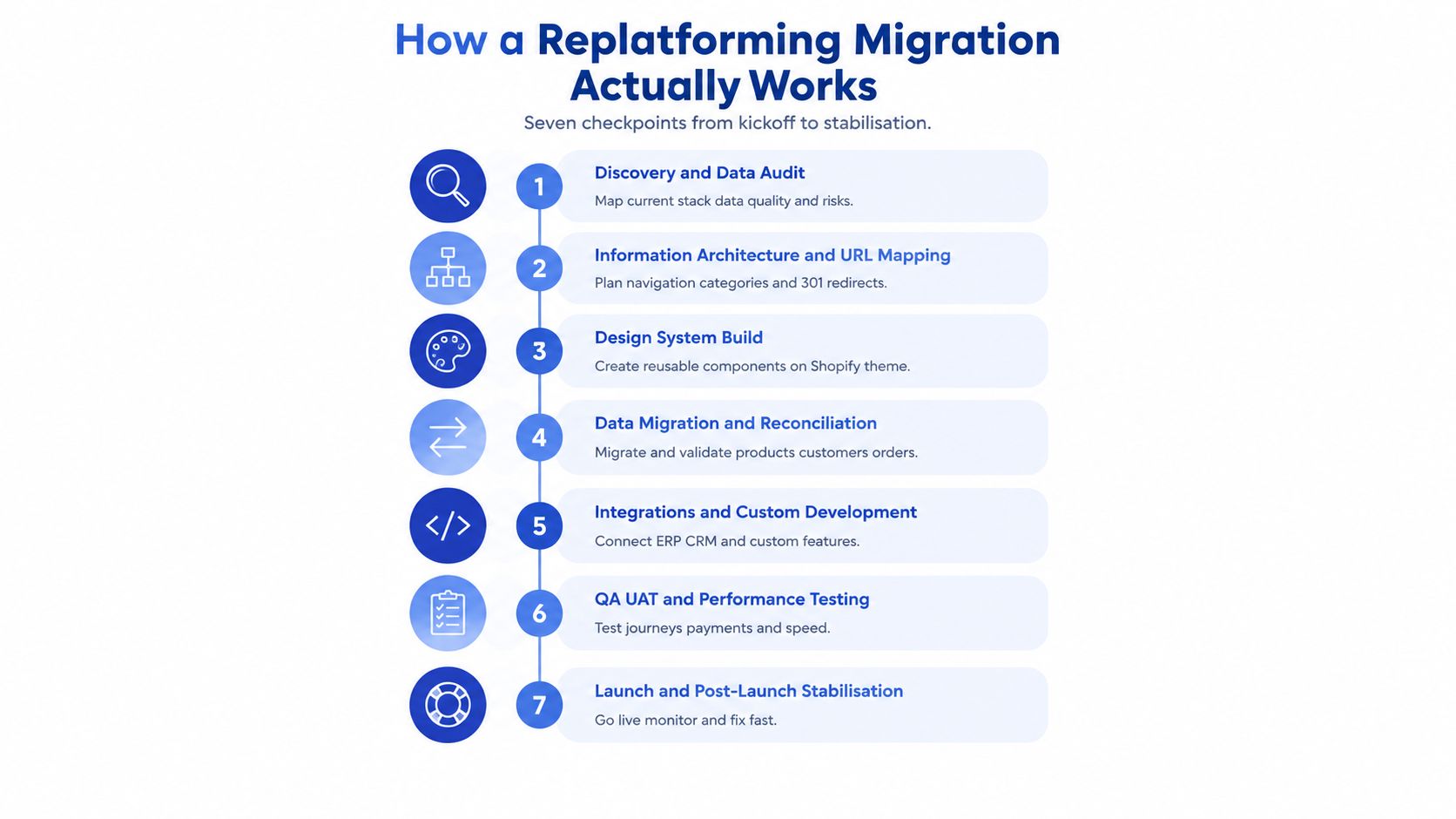
Seven checkpoints set the operational floor
Discovery and data audit: The agency maps the existing stack, data quality, custom logic, integrations, content, analytics, and known risks. The brand should provide a founder or commercial owner, technical lead, operations representative, and finance contact.
Information architecture and URL mapping: The team agrees navigation, collections, templates, internal linking, and destination URLs. It produces a redirect map, identifies duplicate or obsolete paths, and tests redirect behaviour before launch.
Design system and build: Designers define reusable components and page rules. Developers implement the new theme without carrying unnecessary legacy code into the target platform.
Data migration and reconciliation: Products, variants, customers, orders, content, and relevant configuration move through controlled imports. Reconciliation reports compare counts, identifiers, prices, inventory, customer fields, and order totals. Silent data loss is the failure to catch here.
Integration and custom development: The agency connects ERP, CRM, payments, tax, shipping, subscriptions, and marketing systems. Each interface needs success cases, failure handling, retry behaviour, and a named owner.
QA, UAT, and performance testing: Testers work from scripted journeys covering search, collection pages, discounts, checkout, payment, refunds, account access, emails, subscriptions, international orders, and fulfilment. A staging clone and realistic load testing expose failures that visual review won't find.
Cutover and stabilisation: The team freezes agreed data, runs the final migration, validates redirects and analytics, and monitors the store after launch. Plan for four to six weeks of stabilisation, with a prioritised defect queue and clear escalation routes.
Before signing a statement of work, request the artefacts, not just the activity list. You should see a redirect map, data reconciliation report, UAT scripts, integration sign-off, rollback triggers, and a monitoring plan. Check tax and currency calculations with real scenarios. A checkout can look correct while calculating the wrong amount.
The launch team should also inspect transactional email flows, abandoned checkout automation, feeds, canonical tags, structured data, search indexing, and analytics events. This data validation guide is useful when defining the reconciliation work.
A technical migration needs a controlled handover between teams. This video provides a visual explanation of the process:
Costs, Timelines, and ROI of a Replatforming Project
Don't build your business case around a platform licence alone. Investment includes discovery, data transformation, design, development, integrations, QA, launch support, training, and the internal time required to make decisions.
The verified UK benchmark supports a 16 to 24 week delivery window for a straightforward migration, while complex programmes can cost £80,000 to £150,000 or more. Treat those figures as planning anchors, not a quote. Catalogue complexity, data quality, custom logic, international markets, and ERP behaviour decide the final scope.
| Replatforming cost and timeline bands by brand tier | Platform | Typical investment | Timeline | Main ROI lever |
|---|---|---|---|---|
| Small or straightforward store | Shopify | Establish through discovery | Shorter than complex enterprise work | Faster content and merchandising changes |
| Mid-market migration | Shopify Plus | Often within the verified £80,000 to £150,000+ complex-project range | Commonly 16 to 24 weeks for a straightforward benchmark | Better checkout, integrations, and operational control |
| Enterprise or international programme | Shopify Plus or a more custom architecture | Can exceed the verified enterprise benchmark | Longer where bespoke systems and markets are involved | Scalable workflows, international operations, and reduced technical debt |
Separate the cost lines
Agency delivery covers strategy, project management, design, development, migration, QA, and launch. Platform and app costs are ongoing operating expenses. Integration work may be included in the agency scope or priced separately, especially where an ERP or middleware layer needs custom behaviour. Post-launch support should have its own allowance so the team isn't forced to choose between fixing defects and delivering optimisation.
The return usually comes from three sources. First, a more reliable checkout and faster storefront can improve commercial efficiency. Second, a simpler architecture can reduce maintenance and workaround costs. Third, the new platform may enable subscriptions, B2B workflows, international selling, or better operational automation that the old system blocked.
Don't promise a payback period before modelling current losses. Compare developer time, manual order handling, integration incidents, missed campaigns, and blocked revenue opportunities with the proposed investment. Most overruns come from expanding design and feature scope after development begins, not from importing a clean product catalogue.
How to Choose the Right Agency for the Job
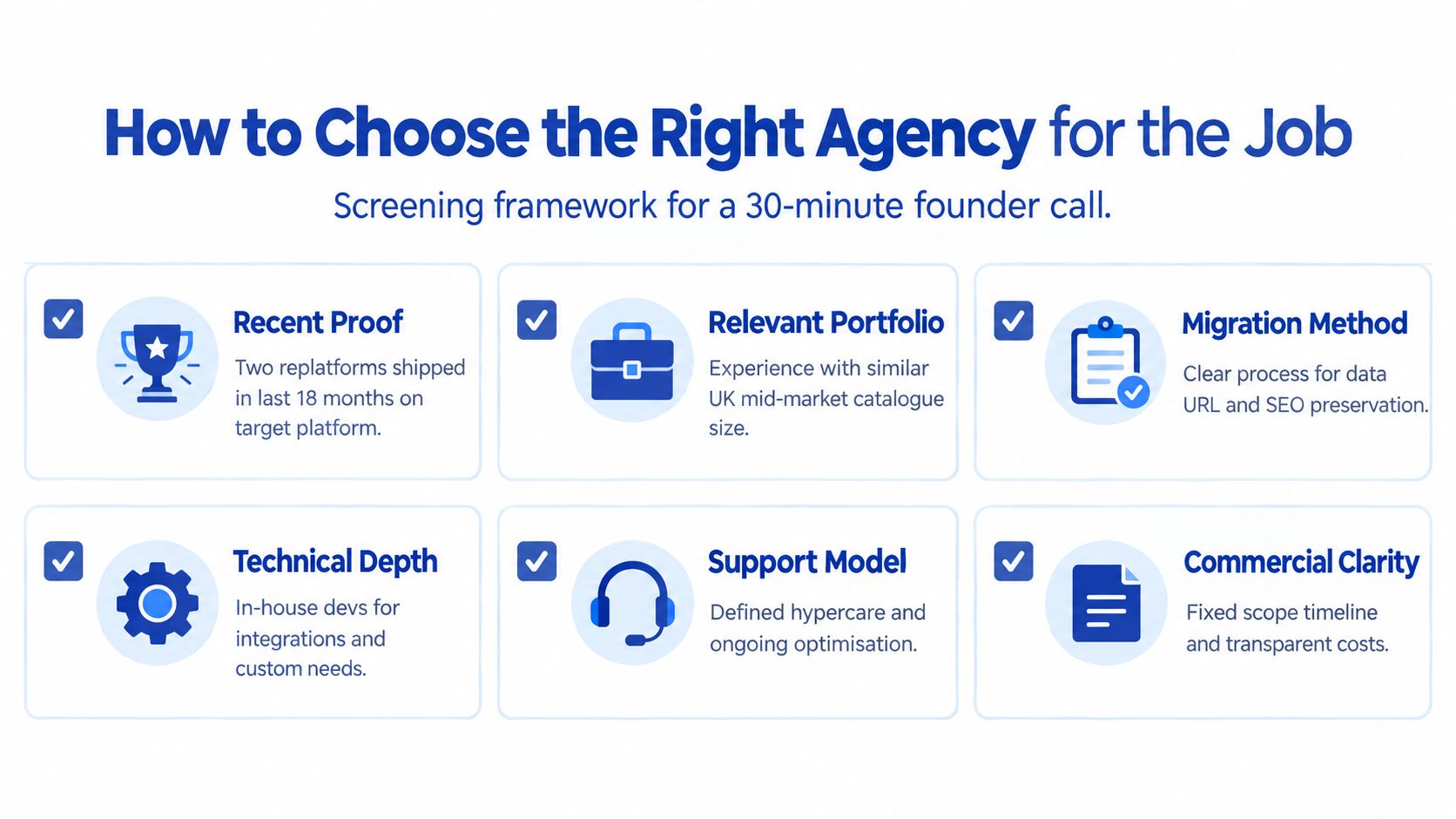
You can screen an agency effectively in one disciplined call. Don't ask only whether it has built Shopify stores. Ask whether it has migrated businesses where data, SEO, tax, fulfilment, and integration behaviour mattered.
Questions that expose delivery maturity
- Proof: Ask for two replatforms shipped recently on your exact target platform. Request reference contacts and inspect a sample of old URLs to confirm redirects still resolve cleanly.
- Team shape: Identify the dedicated project manager, backend lead, frontend lead, QA owner, and integration engineer. Three generalists may be excellent, but you need to know who owns each risk.
- Week-one audit: Ask what the team would inspect first, including data quality, URL patterns, order states, tax rules, app dependencies, and integration failures.
- Migration method: Find out which tools and scripts they use, how they reconcile records, and how they handle customer accounts, historical orders, variants, and content.
- SEO preservation: Ask who creates the redirect map, who validates it, and what happens if organic visibility changes after launch.
- Commercial control: Prefer fixed-fee phases with acceptance criteria and explicit change control over an open-ended day rate with an unclear finish line.
Use these vendor selection criteria to structure the call and compare agencies consistently.
Walk away from predictable red flags
No named project lead means nobody owns coordination. No migration plan until after contract means the agency is quoting before understanding the risk. No post-launch SLA leaves your team exposed when an order, redirect, tax rule, or integration fails in production.
Be cautious when the first meeting focuses on visual design. Design matters, but discovery should lead. A Shopify Plus Partner where relevant, evidence of rescuing messy migrations, a sample statement of work, and a clear hypercare model are stronger indicators than an impressive homepage.
Grumspot is one option for brands seeking Shopify migration, storefront rebuilds, SEO validation, and ERP or CRM integration support. Evaluate it against the same evidence standard as every other agency.
Post-Launch Checks and Your Next Move
Launch day is the beginning of verification. The new storefront can pass a design review and still fail in tax, customs, subscription billing, analytics, or fulfilment.
Check the operational layer first
Reconcile VAT through the new tax configuration and test the rates and exemptions that matter to the business. For EU orders, verify IOSS and CDS declaration workflows where applicable. If the brand has packaging or electrical obligations, confirm EPR registrations and fee routing are reflected in the operational process.
Then work through the commercial checks:
- SEO: Crawl the old URL set against the redirect map, check canonicals, structured data, indexability, XML feeds, and priority landing pages.
- Orders: Place test orders across payment methods, currencies, delivery destinations, discounts, refunds, and fulfilment routes.
- Subscriptions: Confirm billing cycles, renewals, failed payments, customer notifications, and cancellation behaviour.
- Integrations: Reconcile stock, orders, customers, fulfilment status, finance records, and marketing events across connected systems.
- Performance: Monitor realistic UK and EU traffic patterns, checkout response, error rates, and peak-period behaviour.
Run a 30, 60, and 90 day stabilisation plan with named owners. Review conversion rate, average order value, checkout completion, organic visibility, order accuracy, support tickets, and integration errors each week. Define rollback triggers before anyone needs to debate them under pressure.
The immediate next move is practical. Book a 30-minute scoping call, share the current platform, key integrations, catalogue structure, traffic profile, international markets, and known failures, then request a written migration plan with fixed milestones before signing a contract.
Grumspot provides Shopify migration, storefront rebuilding, SEO-focused launch validation, and integration work for brands moving from Magento, WooCommerce, or custom platforms. Visit Grumspot to discuss your current stack and request a migration scope built around data, operations, and post-launch control.
Let's build something together
If you like what you saw, let's jump on a quick call and discuss your project
Related posts
Check out some similar posts.

- ecommerce site search
Discover how ecommerce site search boosts conversion, UX, and SEO. Learn core features, implementati...
Read more
- Shopify Store Launch Checklist
Use this Shopify store launch checklist to cover design, payments, shipping, SEO, analytics, complia...
Read more
- shopify website examples
Explore 7 Shopify website examples and learn the UX, conversion features, and practical lessons merc...
Read more
- cro best practices
Apply cro best practices to Shopify stores with 10 actionable tactics for testing, product pages, ch...
Read more