10 CRO Best Practices for Shopify Stores
- cro best practices
- Shopify CRO
- ecommerce CRO
- conversion optimisation
- Shopify Plus
Launched
September, 2026

CRO starts before the first test. The popular advice focuses on button colours, urgency banners and shorter copy, but those tactics rarely solve a store's biggest commercial problem when the underlying journey is unclear or poorly measured. A Shopify store can have an attractive product page and still lose buyers because delivery costs appear too late, checkout errors go unnoticed, or mobile shoppers can't understand the offer quickly.
Effective cro best practices form a prioritised operating system. First establish a trustworthy baseline. Then identify the highest-value friction, form one testable hypothesis, implement the fix safely and measure the effect against business outcomes. Conversion rate matters, but it should sit alongside average order value, revenue per visitor, checkout completion, customer support contacts and lifetime value.
That distinction separates diagnosis, implementation and experimentation. An audit tells you what may be broken. Design and development make the experience clearer. Testing tells you whether a change improved the outcome for your audience. Shopify and Shopify Plus teams can use this discipline for incremental improvements, major migrations or a complete storefront rebuild. Grumspot is one relevant example of a conversion-first Shopify partner that combines design, audits and iterative delivery, but the operating rhythm matters more than the agency name.
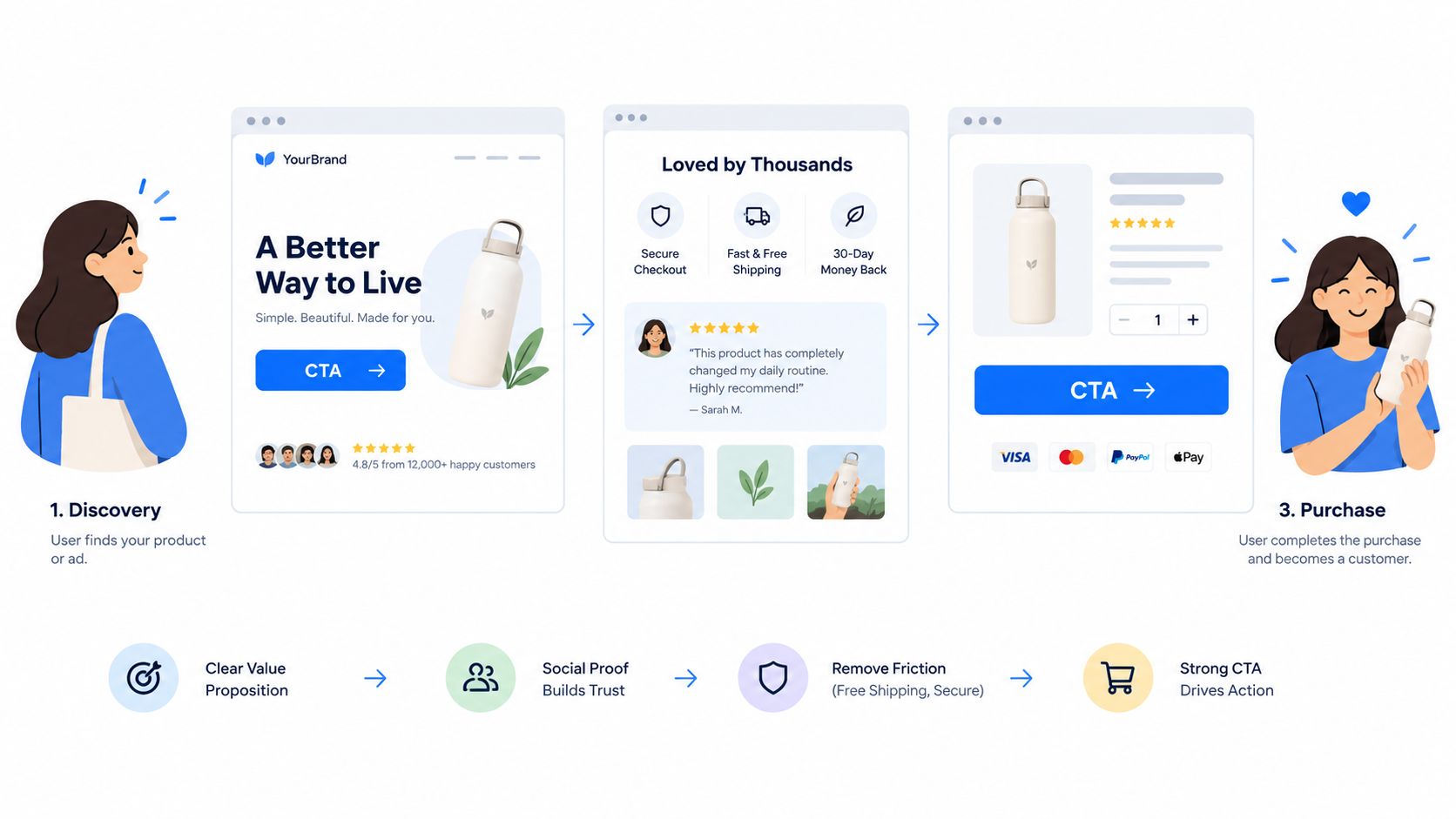
1. Conversion-First Design Framework
Conversion-first design begins with the customer's intent, not with a visual trend. A homepage visitor may still be learning about the brand, while someone on a product page is assessing fit, price, trust and delivery. A returning customer may need speed rather than more persuasion. Each page should make the next useful action obvious without forcing every visitor through the same message.
Start by mapping intent across the journey. Define what the visitor needs to know on a collection page, product page, cart and checkout, then connect the hierarchy, content and interface to that need. Set the success criteria before design work begins. A product-page redesign, for example, might test a clearer hierarchy against the existing version, with conversion rate as the primary KPI and add-to-cart rate, AOV and revenue per visitor as guardrails.
Practical rule: A design specification should state the customer problem, the intended behaviour and the metric that will confirm whether the change helped.
For Shopify, build this logic into a reusable theme system rather than a series of one-off templates. Mobile-first layouts, accessible contrast and keyboard navigation protect usability, while design tokens and component libraries keep promotional banners, product information and calls to action consistent. Review heatmaps and session recordings before approving a major redesign, then run a baseline period so the team can distinguish a genuine improvement from a seasonal change.
2. Testing And Experimentation
A testing programme earns its keep when observations become decisions. Random variants produced on a whim consume traffic and patience. Start with a measurable problem, confirm that tracking captures the relevant events, and prioritise pages where visitor intent and commercial value are already high.
Write the hypothesis in practical terms: “If we replace an ambiguous product-page CTA with language that describes the next action, more qualified visitors will add the item to their basket because they'll understand what happens next.” This gives the team a reason, a defined change and an outcome to measure.
Set one primary KPI, define the audience and record the test window before launch. Use power analysis to estimate the required sample size, then avoid stopping early because initial results look promising. UK research covering 2,408 A/B tests between January 2023 and March 2026 found that 17.4% produced a statistically significant winning variant, while 74.2% were inconclusive or showed no detectable difference. The dataset also reported a median requirement of 14,800 sessions per variation for a specified testing scenario at 95% confidence and 80% power. The UK CRO analysis shows why test quality and patience matter more than test volume.
A practical CTA brief should record:
- Observation: Visitors reach the CTA, hesitate or continue scrolling.
- Hypothesis: More explicit action language will reduce uncertainty.
- Primary KPI: Product-page conversion rate or add-to-cart rate.
- Guardrails: AOV, revenue per visitor and support contacts.
- Decision rule: Continue, implement, iterate or archive against the agreed evidence threshold.
For Shopify, begin with high-traffic templates, map tests to an impact-effort roadmap and log implementation details, audiences, results and learning in one repository. Record inconclusive outcomes too. The ecommerce A/B testing guide supports the operational side of this process. MVT suits stores with sufficient traffic and reliable instrumentation. A focused A/B test usually gives a cleaner answer. If you want to compare testing platforms and approaches before committing budget, browse Captiwate alternatives.
3. UX Audits And Heuristic Evaluation
An audit earns its cost when it produces a ranked set of decisions. A long list of subjective preferences fills a document without moving a metric. Start with funnel data, then use session recordings, heatmaps, mobile reviews, accessibility checks and think-aloud testing to explain where friction occurs. Heuristic evaluation can expose unclear system status, inconsistent labels, weak error recovery and unnecessary cognitive load before the team commits to a redesign.
The commercial case for clarity is strong. Independent UK research found that 51% of online shoppers had stopped using a website because it was too confusing. The Ipsos ecommerce experience research supports treating confusing navigation, ambiguous labels and poor hierarchy as conversion inputs, rather than purely aesthetic concerns.
Turn findings into a decision queue
Score each finding by impact, confidence and effort. A checkout issue affecting many mobile shoppers with repeated form errors should outrank a low-traffic footer adjustment. Customer service teams add context that analytics cannot provide, including whether shoppers understand delivery promises, return conditions or error messages.
Write each finding as an observable problem with an action, hypothesis and measurement plan. For example: “Visitors open the shipping accordion on product pages, leave before adding to cart and contact support about delivery timing.” The resulting action is specific: move delivery speed, cost and returns information closer to the buying decision. Track product conversion rate as the primary KPI, with support contacts and returns as guardrails.
Schedule audits before a migration, after a major theme release and at a regular review point. On Shopify, inspect theme behaviour, app interactions, search, filters, cart drawers and checkout hand-offs together. Compare mobile and desktop evidence, then place the highest-confidence issues into the CRO operating queue for testing or implementation.
4. Product Page Optimisation And Rich Content
Product pages should answer objections in the order shoppers experience them. Strong imagery demonstrates the product. Video shows use and scale. Specifications support comparison. Reviews address confidence. Delivery and returns information reduce perceived risk. Putting all of these elements on the page isn't automatically better, though. Content must be scannable, relevant and placed close to the decision it supports.
Map every content block to a question. A footwear store may need fit guidance and an on-foot video. A furniture retailer may need dimensions, material details and room photography. A skincare brand may need usage instructions, ingredients and suitability information. A generic description written for search engines won't resolve those practical concerns.
Test the current gallery against a richer, mobile-first media and review layout. Measure add-to-cart rate and product conversion rate, then monitor returns, refund reasons and customer support contacts. A richer page that lifts clicks but creates more unsuitable orders isn't a commercial win.
Build the page in Shopify
Use product metafields for structured specifications, fit guidance and care information, so content remains maintainable across variants. Compress images, provide meaningful alt text and keep video controls usable on small screens. Review widgets such as Judge.me or Yotpo can help collect and display evidence, but they shouldn't obscure the product details or slow the page.
Add product structured data carefully and validate the output. For apparel, connect size charts to the relevant product and variant rather than forcing shoppers to search elsewhere. Tools such as mobile body scans for ecommerce returns may be relevant where fit uncertainty drives avoidable returns, but the right solution depends on product category and customer expectations.
5. Checkout Optimisation And Friction Reduction
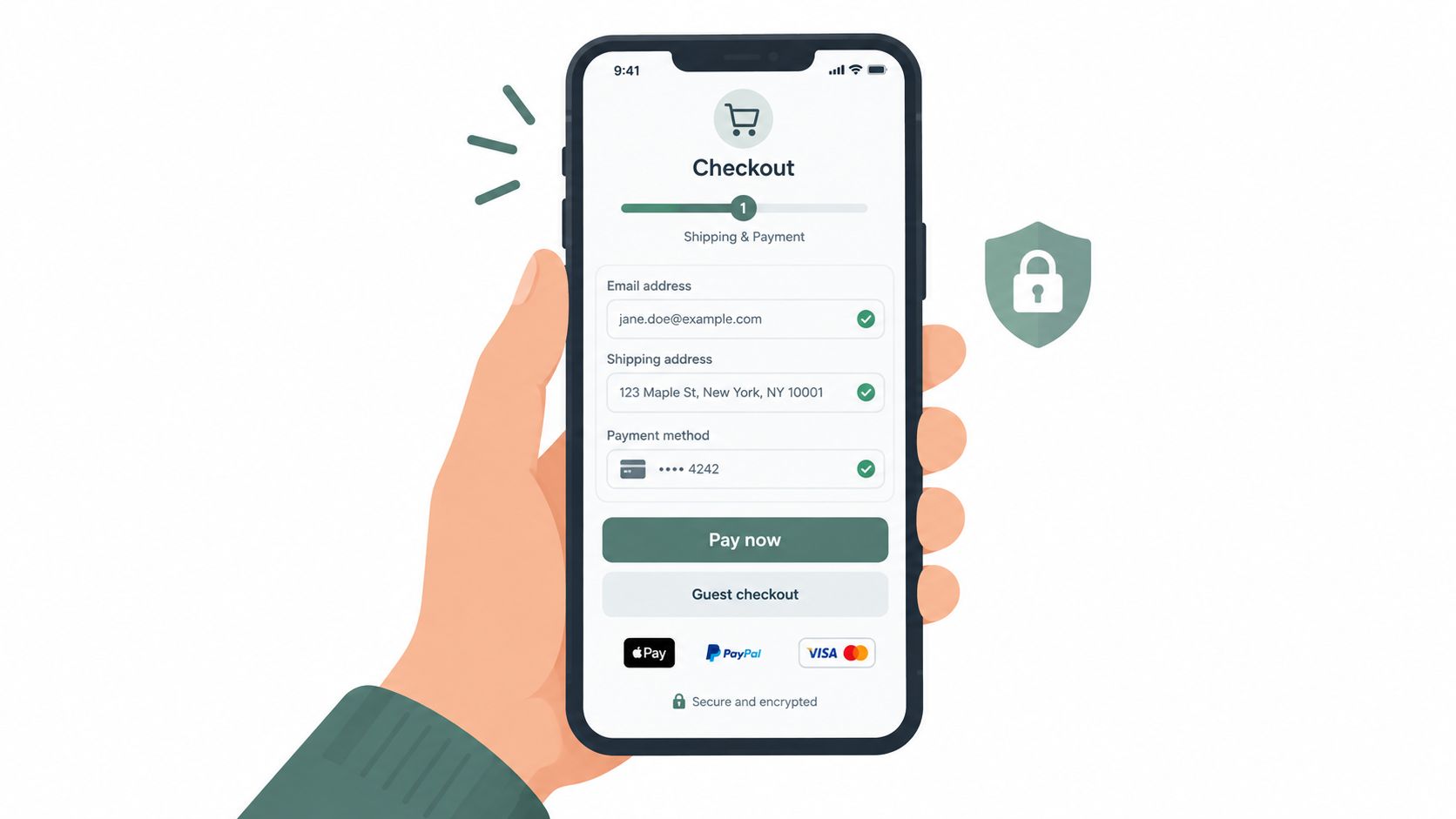
Checkout is where uncertainty becomes expensive. A shopper may accept a product price and still abandon when delivery cost, arrival timing, payment availability or returns conditions appear too late. DHL's UK report says 88% of UK shoppers browse more than they buy, and three in four abandon baskets when their preferred delivery option isn't available. The DHL UK shopper report makes delivery choice a core CRO concern, not a minor checkout detail.
Start with Shopify's native checkout and test before adding complexity. Review guest checkout, Shop Pay and other express options, address autocomplete, validation messages, payment errors, shipping methods and mobile tap targets. Customisation can be justified for a genuine operational or customer requirement, but custom code also introduces maintenance, compatibility and measurement risk.
A focused experiment could expose delivery cost and estimated arrival earlier on the product page or cart. Use checkout completion as the primary KPI, with payment errors, customer service contacts, AOV and margin as guardrails. If the change increases completed orders by steering customers towards a costly fulfilment option, finance needs to see that trade-off.
A Shopify checkout operating routine
- Reveal costs early: Show shipping conditions before the shopper reaches the final payment step.
- Keep forms purposeful: Remove fields that don't support fulfilment, compliance or customer communication.
- Handle errors clearly: Preserve entered information and explain exactly how to resolve the problem.
- Offer relevant payment choice: Review payment methods by device, market and order type rather than installing every option.
- Recover thoughtfully: Use cart recovery messages that remind customers of the product and clarify unresolved friction.
The Shopify checkout optimisation guidance is useful when reviewing native checkout configuration, extensions and the wider purchase flow.
6. Page Speed And Core Web Vitals
Real-user evidence should drive performance work. A single Lighthouse score can isolate a problem in controlled lab conditions, but field data shows how actual devices, networks and locations experience the store. Track LCP, INP and CLS alongside conversion rate, because speed matters commercially when it improves the customer experience without breaking merchandising or tracking.
Begin with product and collection templates carrying the strongest commercial intent. Review render-blocking scripts, oversized media, layout shifts, slow app requests and unnecessary third-party code. Prioritise the bottleneck with the clearest effect on a high-intent journey, then retest after each material release so the result remains attributable.
A suitable experiment can compare an optimised product template with the current version for a defined audience. The hypothesis is that reducing render delay will improve product engagement and conversion. Track Core Web Vitals, engagement signals, conversion rate and revenue per visitor. Use tracking health, traffic mix and recommendation widget presence as guardrails against false gains.
Shopify performance actions
- Optimise above-the-fold media: Serve appropriately sized WebP or AVIF images, and reserve layout space before they load.
- Defer non-critical work: Load chat, reviews and marketing scripts when needed rather than blocking the first interaction.
- Audit app impact: Remove duplicate functionality and test app scripts after theme updates.
- Protect merchandising: Lazy-load below-the-fold media without hiding important product information from customers or search engines.
- Measure in the field: Maintain a real-user monitoring view for device, template and release comparisons.
The image optimisation guide for the web provides a practical reference for reducing media weight without sacrificing product presentation.
7. High-Intent Traffic Capture And Optimisation
Not every visitor deserves the same intervention. A product viewer, comparison shopper and cart abandoner have different information needs, so an exit-intent pop-up shown to all three can create more irritation than value. Define the behavioural signal first, then choose the least intrusive response.
For a product viewer who pauses on delivery information, a compact reassurance message may help. For a returning visitor with items in the cart, a reminder may be more appropriate. For an anonymous visitor leaving a collection page, an incentive could damage margin without addressing the underlying issue. Measure incremental revenue and profit after incentives, not clicks or recovered orders in isolation.
A cart-abandonment experiment could compare message timing or offer structure. The hypothesis might be that clearer delivery information will recover more profitable orders than an automatic discount. Track recovered revenue, profit after incentives, checkout completion and unsubscribe or complaint signals. Keep frequency controls in place so a shopper doesn't receive overlapping email, SMS, on-site and paid retargeting messages.
A practical Shopify workflow
Use Shopify customer and cart events to create audiences, then coordinate email through Klaviyo or another approved platform. Keep product recommendations relevant to the abandoned basket, and make the message useful even when no incentive is offered. An exit-intent prompt should appear only after a meaningful interaction and should be easy to dismiss.
Retargeting can support the journey, but it shouldn't compensate for unclear delivery, weak product evidence or broken checkout. Fix the source of abandonment before increasing the number of reminders.
8. Behavioural Segmentation And Personalisation
Personalisation works when it reduces effort or improves relevance. It fails when it guesses too much, exposes sensitive assumptions or changes the page in ways the customer can't understand. Begin with transparent first-party segments, such as returning customers, previous purchasers, product-category browsers or shoppers who have explicitly selected a preference.
A returning customer might see recently purchased products, replenishment information or a faster route to support. A first-time visitor may need category education and delivery reassurance. Those are useful differences because they respond to observable needs rather than trying to create an artificial sense of recognition.
Test a returning-customer recommendation module against the standard merchandising block. Track segment conversion rate, recommendation click-through rate, AOV and repeat purchase behaviour. Include margin and product availability as operational guardrails, since an algorithm can promote products that are attractive but unavailable or commercially weak.
Roll out personalisation carefully
Start with Shopify analytics and a small number of dependable segments. Klaviyo, Privy and a customer data platform can extend the approach, but more tooling won't repair inconsistent identities, missing consent or unreliable events. Use preference centres to collect explicit interests, and give customers control over marketing choices.
For Shopify Plus, document which system owns customer attributes and how updates move between Shopify, email, service and fulfilment tools. Review data collection against UK GDPR requirements and internal retention policies. Personalisation should make the store easier to use, not make the customer wonder why the brand knows something they never shared.

9. SEO And Organic Traffic Quality Optimisation
Organic traffic is not a CRO success metric by itself. A store can attract more visitors while sending the wrong intent to the wrong landing page. Conversion work should therefore connect search demand to collection clarity, product relevance and the next commercial action.
Build pages around the questions shoppers ask. A collection page for a specific use case should help visitors compare products, understand availability and reach the right product detail quickly. Supporting editorial content can educate earlier-stage visitors, but it needs clear internal links into relevant collections and products. Product pages should target specific commercial intent without turning the copy into a list of repeated keywords.
A useful experiment compares the current collection page with a version that improves commercial relevance through clearer introductory copy, filters, comparison guidance and internal links. Track qualified organic sessions, search click-through rate, product engagement, organic conversion rate and revenue from organic traffic. Keep a close eye on product availability and landing-page alignment, because ranking for a query is not enough if the visitor can't find a suitable item.
Shopify SEO actions with conversion value
- Improve titles and snippets: Describe the product or collection clearly so searchers know what they'll find.
- Strengthen internal links: Connect guides, collections and products around a genuine customer journey.
- Use structured data carefully: Validate product, review and FAQ markup and keep it consistent with visible content.
- Protect technical health: Monitor indexing, canonicals, redirects and crawl issues in Google Search Console.
- Review landing intent: Compare organic behaviour by query group, landing template, device and product category.
SEO and CRO should share a backlog. The best page to optimise may be the one already receiving qualified demand but failing to answer the shopper's next question.
10. Customer Data Integration And Analytics Infrastructure
CRO decisions are only as reliable as the events behind them. Replatforming often leaves teams with duplicated transactions, broken attribution, missing consent states or different definitions of a purchase across Shopify Analytics and GA4. Before adding predictive models, fix the foundations that tell you whether a customer viewed a product, added it to cart, began checkout and completed payment.
Recent UK CRO guidance highlights consent-managed analytics, data governance and data quality checks as essential parts of modern optimisation. The UK CRO agency guidance is relevant to Shopify teams working with partial visibility and fragmented journeys. The practical response is to define trustworthy micro-conversions and decision thresholds, rather than pretending every session is fully observable.
Build the measurement layer in phases
Start with a documented event taxonomy, consistent UTM parameters and a reconciliation process between Shopify's native reporting and GA4. Assign an owner to each key event and record what consent is required before collection. Then connect email, service and advertising data through approved integrations. A CDP or warehouse can follow when the organisation can maintain identity resolution and governance.
For Shopify Plus, use Shopify Flow where it simplifies operational hand-offs, but don't let automation hide the underlying data logic. Server-side tracking can support resilience, yet it still needs consent controls and validation. Dashboard primary outcomes separately from diagnostic metrics, and label estimates, modelled data and observed data clearly.
Test the infrastructure itself. Compare order counts, revenue, device splits and checkout events across systems after releases. If the numbers don't reconcile, pause high-stakes experimentation until the team understands the discrepancy. Good CRO isn't more dashboards. It's a shared definition of what happened and enough confidence to act.
10 CRO Best Practices Comparison
| Item | Implementation Complexity (🔄) | Resource Requirements (⚡) | Expected Outcomes (📊) | Ideal Use Cases (💡) | Key Advantages (⭐) |
|---|---|---|---|---|---|
| Conversion-First Design Framework | High 🔄, multi-stage research & design | Medium–High ⚡, UX research, design system, dev | 📊 Measurable conversion & AOV lift; reduces rework | 💡 Major redesigns, Shopify Plus stores, high-AOV catalogs | ⭐ Direct revenue impact; consistent, scalable UX |
| Testing & Experimentation (A/B/MVT) | Medium–High 🔄, governance, stat. rigour | Medium ⚡, testing platform, analytics, dev/design time | 📊 Incremental validated gains; accumulates learnings | 💡 High-traffic pages, continuous optimization programs | ⭐ Data-driven decisions; risk reduction |
| UX Audits & Heuristic Evaluation | Medium 🔄, diagnostic sprint (1–2 weeks) | Medium ⚡, UX experts, recording/tools, test users | 📊 Prioritised fixes; fewer blind redesigns | 💡 Pre-redesign, checkout funnels, accessibility remediation | ⭐ Rapid identification of high-impact issues |
| Product Page Optimization & Rich Content | Medium 🔄, content mapping to objections | Medium–High ⚡, photography/video, content ops, UGC moderation | 📊 Higher product conversion, lower returns & support load | 💡 Product launches, high-consideration items, mobile shopping | ⭐ Builds trust, improves SEO and conversion at product level |
| Checkout Optimization & Friction Reduction | Medium 🔄, form, payment, compliance work | Medium ⚡, payments integration, dev, QA | 📊 Higher checkout conversions; high ROI (typ. 5:1) | 💡 Cart abandonment hotspots, mobile-heavy checkout flows | ⭐ Direct revenue lift; often fast, high-impact wins |
| Page Speed & Core Web Vitals Optimization | High 🔄, front-end & infra engineering | High ⚡, frontend engineers, CDN, RUM tools | 📊 Better SEO, UX, and conversions (5–15% typical) | 💡 Mobile-first audiences, slow templates, SEO-priority sites | ⭐ Improves rankings, engagement, and long-term UX |
| High-Intent Traffic Capture & Optimization | Low–Medium 🔄, messaging & timing rules | Low–Medium ⚡, marketing tools, automation, creatives | 📊 High conversion/recovery rates; quick revenue wins | 💡 Cart abandoners, returning visitors, browse abandoners | ⭐ Fastest path to recoverable revenue; efficient ROI |
| Behavioral Segmentation & Personalization | High 🔄, real-time rules and models | High ⚡, CDP, data engineering, ML, creatives | 📊 Increased relevance, CTR, AOV, LTV | 💡 Large catalogs, repeat customers, growth-stage brands | ⭐ Personalization at scale; retention and LTV gains |
| SEO & Organic Traffic Quality Optimization | Medium–High 🔄, content + technical roadmap | Medium ⚡, content teams, SEO tools, dev support | 📊 Compounding organic traffic and conversion over months | 💡 Long-term growth, content-driven brands, local presence | ⭐ Lowest long-term CAC; sustainable authority building |
| Customer Data Integration & Analytics Infrastructure | High 🔄, taxonomy, pipelines, governance | High ⚡, CDP/warehouse, data engineers, integrations | 📊 Reliable attribution, unified profiles, better activation | 💡 Enterprise/Plus merchants needing personalization & measurement | ⭐ Single source of truth; future-proofs personalization and privacy |
Turn Best Practices Into A CRO Operating Rhythm
The strongest CRO programmes don't begin with a list of design changes. They begin with measurement that the commercial, product and engineering teams trust. Establish the baseline for conversion rate, AOV, revenue per visitor, checkout completion and lifetime value, then document how each metric is calculated, which systems supply it and where consent limits visibility.
Next, run a focused funnel and UX audit. Review product discovery, collection filters, product pages, cart, checkout, delivery presentation and post-purchase signals. Combine analytics with recordings, heatmaps, customer service themes and accessibility checks. Rank findings by likely commercial impact, confidence in the diagnosis and implementation effort. A long backlog is easy to create. A short queue of defensible priorities is more useful.
Fix the clearest high-impact friction before chasing cosmetic improvements. If shoppers can't understand delivery options, make that information visible. If mobile visitors struggle with forms, reduce unnecessary input and improve error recovery. If product pages leave important objections unanswered, add evidence where the decision happens. The guide to turn visitors into paying customers is a useful reminder that conversion depends on the whole journey, not a single button.
Then create a testing backlog. Each item should contain the observation, hypothesis, audience, primary KPI, guardrails, estimated effort, sample-size requirement and decision rule. Review results by device, traffic source, customer type and product group. An aggregate win can hide a mobile loss, a new-customer problem or a margin issue. Protect against false positives by agreeing the test conditions before launch, checking tracking quality and avoiding premature decisions based on early movement.
Incentives require the same discipline. Free delivery or a discount may recover an order, but it can also reduce contribution margin, train customers to wait or conceal a delivery information problem. Measure profitable outcomes, not just conversion rate.
Shopify merchants can handle straightforward analysis and implementation internally when ownership, development capacity and analytics skills are available. Specialist tools are useful when the team needs behavioural evidence, experimentation infrastructure, performance monitoring or data integration. A conversion-first partner such as Grumspot becomes relevant when a store needs a deeper audit, custom Shopify Plus work, a migration from Magento, WooCommerce or a custom platform, or ongoing experimentation that internal teams can't resource. Grumspot's services include Shopify 2.0 migrations, bespoke storefronts, UX, technical and SEO audits, integrations and iterative CRO delivery.
The operating rhythm is simple to describe, but it requires consistency: measure, diagnose, prioritise, implement, test, learn and maintain. Treat every release as part of that system, and CRO becomes a practical way to improve customer experience and commercial performance without relying on fashionable tactics.
Grumspot can audit your Shopify or Shopify Plus store, identify high-value friction and translate the findings into conversion-focused design, development and experiments. Visit Grumspot to discuss a storefront rebuild, migration, technical audit or ongoing CRO support built around your commercial KPIs.
Let's build something together
If you like what you saw, let's jump on a quick call and discuss your project
Related posts
Check out some similar posts.
- black friday campaigns
Compare 7 tools for planning Black Friday campaigns on Shopify, covering email, SMS, personalisation...
Read more
- social proof examples
Examples of social proof for ecommerce brands: case studies, client testimonials, Shopify badges and...
Read more
- shopify website examples
Explore 7 Shopify website examples and learn the UX, conversion features, and practical lessons merc...
Read more
- zero party data
Learn what zero party data is, why it matters for ecommerce, and how to collect and use it for perso...
Read more