How to Choose the Right Ecommerce SEO Agency UK
- ecommerce seo agency uk
- uk seo services
- shopify seo
- hire seo agency
- ecommerce growth
Launched
July, 2026

You're staring at a retainer proposal, the agency has polished case studies, and the deck looks reassuring. Your store still gets traffic, but the revenue line isn't moving the way it should. That's the moment most founders start shopping for an ecommerce SEO agency UK and make the wrong decision for the wrong reason.
The right question isn't, “Who has the nicest pitch?” It's, “Who can prove commercial impact, and who can set up reporting so I can see it?” In the UK, that matters because online retail is already a huge market, with £127.41 billion in online retail sales in 2024 and online sales estimated at roughly 28% of all retail sales in one UK source, while another put the share at around 26% in 2025 (UK ecommerce SEO statistics). Organic search sits inside that reality, not outside it.
A serious agency doesn't sell vague visibility. It cleans up crawl waste, fixes indexation and canonical issues, builds transactional content that can rank, and ties the work back to revenue attribution. If you already want a broader practical checklist for store-level SEO hygiene, the ecommerce SEO best practices guide is useful, but keep your attention on the commercial plumbing first.
If your SEO is already “working” in traffic reports but you still can't explain what it adds to the business, you don't have a growth problem yet. You have a measurement problem.
What a UK Ecommerce SEO Agency Should Actually Do for You
A decent ecommerce SEO agency UK should start by treating your store like a system, not a set of keywords. That means looking for crawl traps, duplicated paths, weak category architecture, and pages that index but never earn money. It also means being honest about whether your current reporting can separate real SEO revenue from noise.
The work that matters
The first job is diagnosis. A credible agency should inspect how search engines crawl your store, where they waste time, and which pages deserve attention. On ecommerce sites, that usually means catalogue structure, filters, variants, thin category pages, and inconsistent canonicals. If the agency spends most of its opening call talking about “brand awareness” instead of indexation and commerce, walk away.
The second job is fixing pages that can sell. That means category pages, product pages, internal linking, and transactional copy around terms that buyers use when they're close to purchase. It also means building content that supports those pages, not random blog posts that make traffic graphs look prettier.
Practical rule: if the agency can't explain how organic visits turn into orders in your GA4 setup, it's not ready to manage a serious ecommerce account.
The third job is attribution. SEO work only matters if you can see its impact in revenue terms. That's why the stronger agencies push for access to Search Console, GA4 ecommerce events, and the store's own order data. They should be able to tell you which page types are earning revenue and which pages are just consuming crawl budget.
What to expect from the relationship
A founder choosing between agencies should think about fit by operating model, not presentation style. For example, if your team is also leaning on social commerce, a resource like the ecommerce social selling guide can help you see how SEO sits alongside other channels instead of pretending it owns all demand.
The agency's job is to create a cleaner path from search intent to checkout. If it can't show that path on paper, in your data, and in your contracts, it's not the right partner.
The First Six Weeks of a Creditable Audit-Led Programme
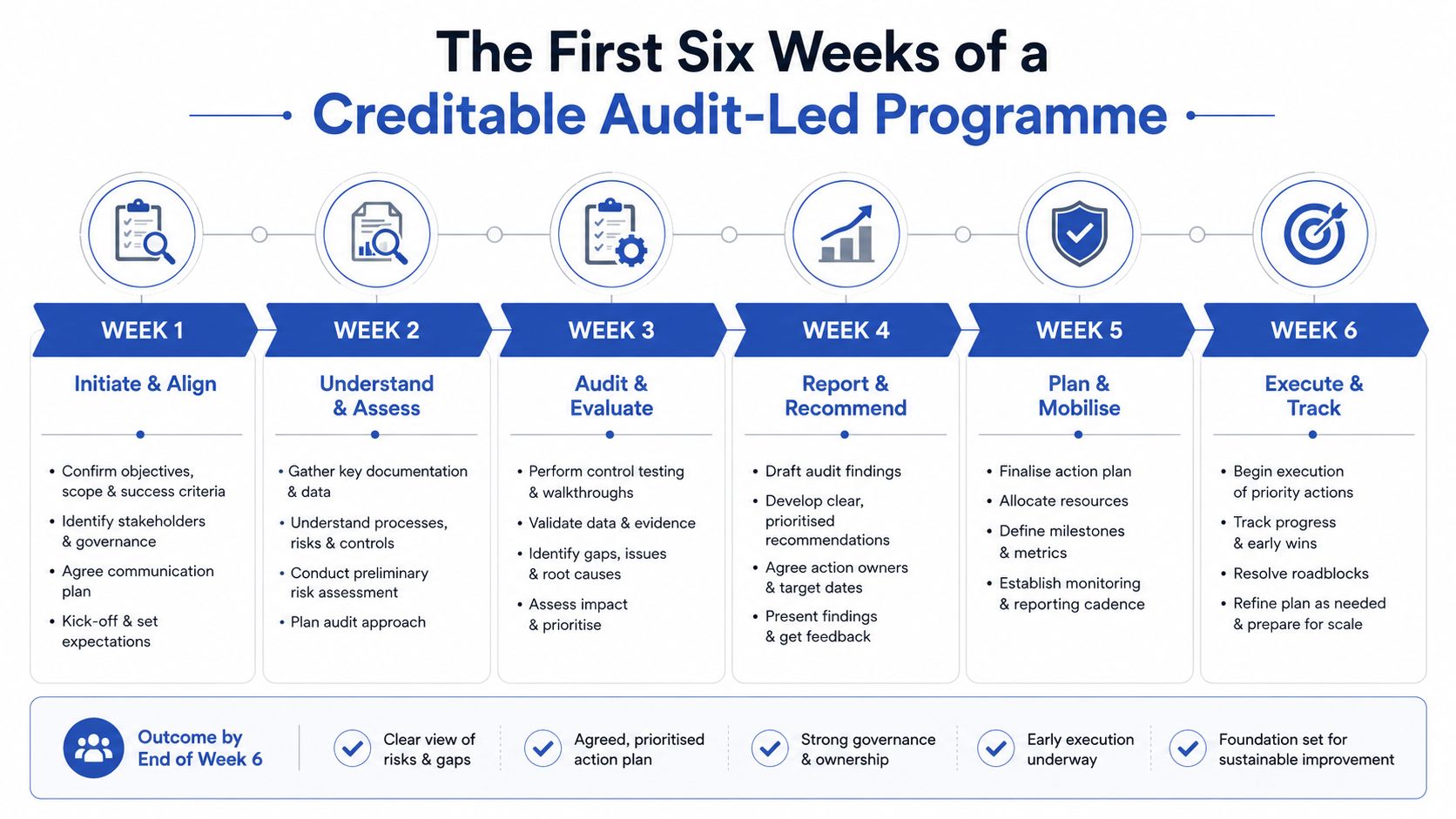
A serious agency doesn't start with content ideas. It starts by crawling the site properly and checking what search engines are seeing. UK practitioner guidance puts the opening window at Week 1 to 2 for a full crawl and log-file analysis, then Week 3 to 5 for remediation focused on indexation, canonicalisation, and faceted-navigation fixes (UK ecommerce SEO guide). That order matters because broken architecture will sabotage every later content effort.
What the early sequence should look like
In the first two weeks, the agency should map the catalogue, identify orphaned pages, inspect crawl depth, and review server logs if they're competent. They should also decide which URLs deserve indexation and which ones are junk. If they're talking about rewriting product descriptions before they understand crawl behaviour, they're skipping the step that protects the rest of the programme.
Weeks three to five should be remediation, not brainstorming. That's where canonical fixes, filter handling, pagination logic, internal linking changes, and page templates come in. The point is to reduce waste and make the best commercial pages easier for Google to trust.
By the time that work lands, you should expect the first ranking movement to show up in about 6 to 8 weeks, while meaningful commercial traction on competitive UK catalogues usually takes 6 to 9 months to emerge (UK ecommerce SEO guide). If an agency promises fast revenue on a big catalogue without first touching technical debt, it's guessing.
Here's the thing most founders miss. A technical fix can move rankings before it changes revenue. That's normal. Revenue lags because commercial pages need time, internal links need to be recrawled, and the store needs enough clean data for the agency to know what worked.
For a deeper process view, the SEO audit walkthrough is a sensible reference point. Use it as a benchmark when an agency claims it has “audited” your site in a single call.
Clean architecture first. Content second. Anything else is upside down.
How UK Agencies Price Ecommerce SEO Work
Pricing in this market is a filter, not just a number. If you understand the model, you can tell whether a quote fits the stage your business is in. If you don't, you'll compare a migration project to a growth retainer and make a bad call.
The four common models
A monthly retainer is the most common structure for stores that want ongoing growth. Independent UK guidance says retainers for growing ecommerce brands often sit around £1,500 to £7,500 per month, while larger retailers can sit well above that depending on scope (UK agency guidance). This suits Shopify Plus brands, multistore setups, and retailers that need compounding work across content, technical fixes, and reporting.
A project or migration fee is for discrete work. If you're rebuilding a site, changing platforms, or cleaning up a broken structure after launch, project pricing is the sensible model. One-off technical audits in the UK are commonly estimated at £1,500 to £6,000 (UK agency guidance). That's the right model when the job has a clear beginning and end.
Performance or revenue-share deals look attractive because they sound aligned. In practice, they can get messy fast if attribution is weak, seasonality is strong, or the agency has to wait for a platform team it doesn't control. I'd only consider this if measurement is already clean and the legal terms are tight.
Hourly or day-rate consulting works when you mainly need senior oversight, not execution. It's useful for teams with in-house developers or marketers who can implement recommendations quickly. It's a weak choice if your store needs coordinated SEO, content, and technical delivery.
Match the model to the problem
A retailer recovering from migration damage needs project work. A steady growth brand with a healthy site needs a retainer and a reporting cadence that ties activity to organic revenue. Don't let an agency sell you the wrong shape of engagement because it's what they prefer operationally.
For a pricing benchmark and scoping logic, the SEO audit cost guide is useful. The quote should reflect the level of complexity, not just the number of meetings.
KPIs and Reporting That Actually Prove Commercial Impact
Rank reports are convenient because they're easy to produce and easy to misunderstand. Revenue reports are harder, which is exactly why they matter. A credible UK ecommerce programme should report organic revenue growth, organic conversion rate, average order value from search traffic, and assisted conversions, not just keyword movement.
Build the measurement stack first
Search Console tells you how search sees the site. GA4 ecommerce events tell you what users do after they arrive. If those two systems aren't connected properly, an agency can overstate SEO success by taking credit for sales that came from email, paid social, or branded repeat traffic.
The right setup is simple in principle and messy in execution. Search Console should feed query and landing-page insight. GA4 should capture product views, add-to-cart events, checkout steps, and purchases. The agency should be able to reconcile landing-page performance with revenue, not just show you an uplift in sessions.
Seasonality matters more than most decks admit
UK retail seasonality can distort month-to-month comparisons. January sales, Easter, bank holidays, Black Friday, and Christmas all change buying behaviour, so a raw traffic increase or decline can tell you very little. If the agency isn't controlling for seasonal effects, it can make a weak month look healthy or a strong month look flat.
A clean report answers one question, did SEO make the store more profitable, or just busier?
The UK reporting gap is sharper than most founders realise. Existing agency pages talk about KPI audits and organic revenue, but they often stop short of explaining how the reporting stack should be set up across Search Console, GA4, and revenue attribution (Found ecommerce SEO). If an agency dodges that conversation, it's protecting the illusion of progress.
Red Flags to Watch for in UK Ecommerce SEO Pitches
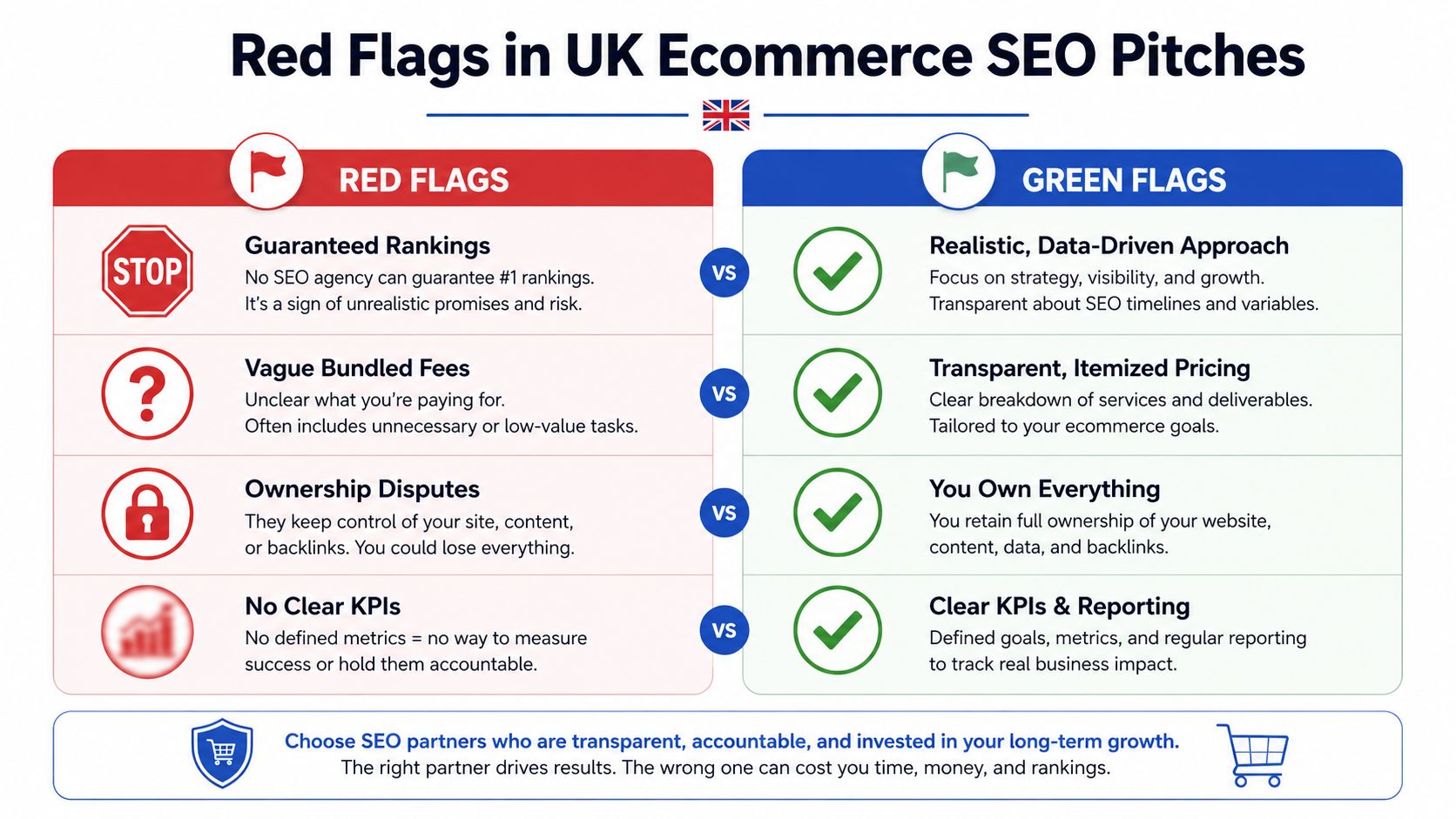
The easiest way to waste money is to buy certainty that no one can honestly deliver. That starts with guaranteed rankings. It continues with vague bundles, ownership confusion, and contracts that lock you in before you've seen the work quality.
What bad pitch language sounds like
If an agency promises first-page rankings, it's either being careless or dishonest. SEO is not a fixed-output service, especially on ecommerce sites where technical debt, catalogue complexity, and competition all shape the outcome. I'd treat that promise as a warning sign, not a comfort.
Watch for bundled monthly fees with no clear split between technical, content, and reporting work. That's how agencies hide underdelivery. If you can't tell what you're paying for, you can't challenge anything.
Ownership is another trap. Content, links, and account access should be contractually clear from day one. If the agency acts like your data or its output is something you borrow, not own, that tells you how the relationship will go later.
Good sign: the agency offers a scoped pilot and puts the first 90 days on paper before asking for a long commitment.
The signals that usually mean the opposite
Named specialists matter. You want to know who touches the account, not just who closed the sale. You also want transparent access to Search Console and GA4, because a partner that hides the data is asking you to trust the dashboard instead of the business.
Sample audits under NDA are useful too. They show how the agency thinks without forcing them to expose client data. A willingness to do a pilot is even better, because it puts the quality of the work ahead of the length of the contract.
The strongest filter is simple. If the pitch talks more about awards and less about commerce, the agency is selling confidence. If it talks about measurement quality, crawl issues, and revenue attribution, it's probably worth a second conversation.
Shopify Plus Specifics and International SEO Considerations
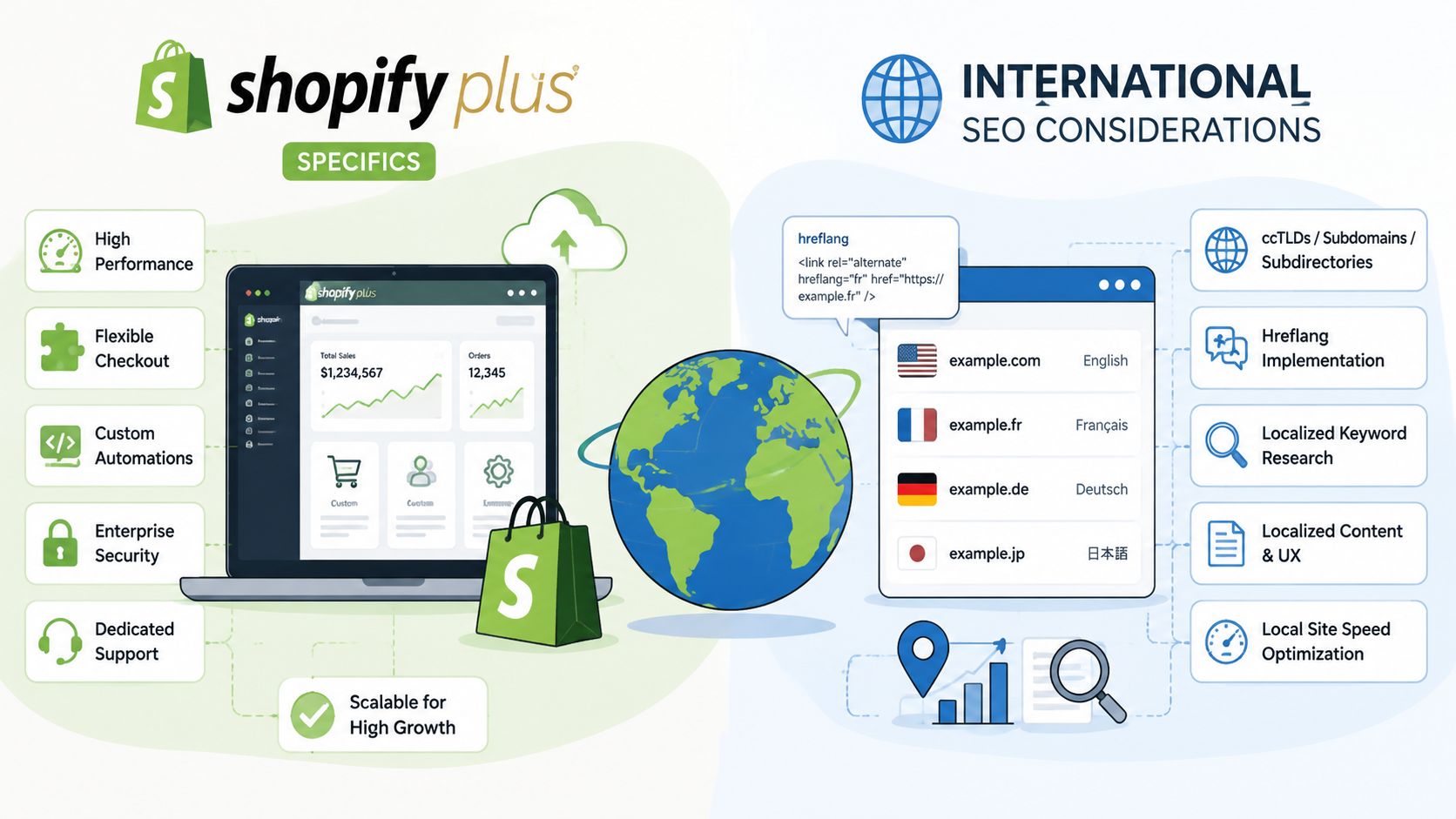
Shopify Plus stores have their own problems, and generic SEO agencies usually stumble on them. App bloat, theme code, render-blocking scripts, and variant handling can all drag performance down if the agency doesn't understand the platform. A proper audit should include the theme, app stack, template logic, and how product variants are exposed to crawlers.
Questions that matter on Shopify Plus
Ask whether the agency reviews theme weight and app duplication before recommending content work. Ask how it handles product variant canonicalisation, because variant sprawl can create duplicate signals that waste crawl budget. If the brand runs Hydrogen or another headless setup, the agency should be able to explain how rendered content, indexability, and structured data will be handled.
The same logic applies to migrations and rebuilds. Grumspot positions itself around Shopify Plus design and development, storefront migrations, and technical SEO audits, so it sits in the class of provider that should understand these platform issues in practice. That doesn't make any agency automatically right for your store, but it does show the type of technical depth you should expect.
International SEO needs discipline, not guesswork
If you sell into the US, EU, or Australia, the agency needs to manage hreflang, locale signals, and market-specific page intent. Currency alone doesn't solve international SEO. Search engines need clear signals about which version of a page belongs to which audience, and users need content that feels native to their market.
The agency should also have shipped multi-region Shopify Markets rollouts before. If it hasn't, you're taking on unnecessary risk. International SEO goes wrong when agencies confuse translation with localisation, or when they ignore how different markets search for the same products.
The right question is blunt. Can this team make one store behave like several markets without confusing search engines or customers? If the answer is fuzzy, keep looking.
Your Shortlist and Onboarding Checklist
Shortlisting should be boring and ruthless. Pick three agencies, not ten. Ask each one for a paid sample audit, then compare how they think, how they scope, and how they talk about measurement. You're not buying enthusiasm. You're buying a method.
A practical 30-60-90 day checklist
In the first 30 days, get shared access to Search Console and GA4, confirm ownership of content and links in the contract, and agree the pilot scope. Also verify that the agency understands which pages are commercial priorities, because not every indexed page deserves attention.
By 60 days, you should have seen technical remediation, a clearer keyword map, and reporting that uses revenue-based KPIs instead of rank noise. If the agency is still presenting pretty slides and no implementation record, that's a problem.
At 90 days, run a baseline revenue review. Compare organic revenue, conversion quality, and assisted conversions against the starting point, then decide whether to extend the relationship. If the agency can't connect work done to commercial movement, the contract should stop there.
The cheapest credible quote is rarely the right answer for a UK ecommerce brand that actually wants organic revenue, because cutting corners on measurement and technical depth costs more later.
If you want an agency that builds, fixes, and scales Shopify stores with technical SEO and conversion in mind, speak to Grumspot. They work on Shopify Plus builds, migrations, and audits, which makes them relevant if your search strategy needs to be tied to store performance rather than vanity reporting.
Let's build something together
If you like what you saw, let's jump on a quick call and discuss your project

Related posts
Check out some similar posts.
- seo and subdomains
Learn how SEO and subdomains interact, from indexing and authority to internationalisation. A practi...
Read more
- technical seo audit
What Is Technical SEO Audit. Learn what a technical SEO audit is, its core components, and how it dr...
Read more
- help center shopify
Learn how to build a help center Shopify merchants trust. Covers native pages vs apps, article struc...
Read more
- shopify seo
Choosing the right SEO app for Shopify means weighing features against speed, scripts, and plan limi...
Read more