SEO and Subdomains: A Practical Guide for Shopify Brands
- seo and subdomains
- subdomain seo
- shopify seo
- subdomain vs subdirectory
- international seo
Launched
October, 2026
Most advice about SEO and subdomains starts with the wrong question: “Which one ranks better, a subdomain or a subdirectory?” Google doesn't prescribe a ranking advantage for either structure. For Shopify and Shopify Plus brands, the harder issue is whether your team can govern, measure, connect and eventually migrate the property without losing control of its organic performance.
That distinction matters in the UK. The Competition and Markets Authority found that Google Search generated more than 90% of traditional-search queries in the UK between January 2018 and December 2024, while Bing accounted for approximately 5–10%. Google also handled roughly 10–25 billion queries per month in 2024, and mobile represented approximately 70–80% of Google searches by the end of 2024. (Competition and Markets Authority)
Your URL structure won't rescue a slow mobile template, an orphaned collection page or a broken canonical. It can, however, decide how many teams, properties, sitemaps and migration paths you need to manage. For most Shopify Plus merchants, a subdirectory is the sensible default. A subdomain earns its place only when the business, technology or governance model demands separation.
Why Subdomain SEO Is Mostly an Operations Problem
A subdomain isn't an SEO shortcut. It's an operating model.
Google's guidance is deliberately practical. Businesses should choose the structure that fits their organisation, with subdirectories often easier to manage and subdomains useful when different parts of a site need meaningful separation. (Google's SEO Starter Guide)
That means a UK retailer shouldn't choose blog.example.com because somebody claims subdomains rank better, or avoid it because somebody else claims they never pass value. The useful question is whether the blog needs a different CMS, release process, editorial owner, brand identity or reporting boundary. If it doesn't, example.com/blog usually gives the team fewer moving parts and a clearer route between educational content and commercial pages.
The UK context changes the cost of mistakes
Google dominates UK search discovery, so technical inconsistency on a live Shopify property has commercial consequences. Mobile performance matters just as much. A subdomain launched with a separate theme, tracking implementation or consent configuration can create a second place where the team needs to enforce responsive templates, crawlable navigation, structured metadata and indexable pages.
The URL itself isn't the advantage. Execution is the advantage.
A subdomain can work perfectly well when it has a clear purpose and strong connections to the main store. It can also sit online for months with incomplete internal links, conflicting canonical tags and no reliable reporting. Search engines may discover it, but your organisation still needs to know what exists, who owns it and how it contributes to revenue.
Practical rule: Choose the architecture your team can maintain after launch, not the architecture that sounds clever in a strategy presentation.
The right decision therefore has less to do with theoretical ranking power and more to do with governance, tracking, crawl coverage and future migration cost. Before approving uk.example.com, support.example.com or blog.example.com, ask who will maintain its templates, validate its sitemap, review its Search Console data and approve changes to its redirects.
If the answer is “the same team, using the same platform, with the same content model”, a subdirectory is probably the cleaner answer. If the answer involves a separate market team, technology stack or brand proposition, a subdomain may be justified.
What a Subdomain Actually Is in Technical SEO Terms
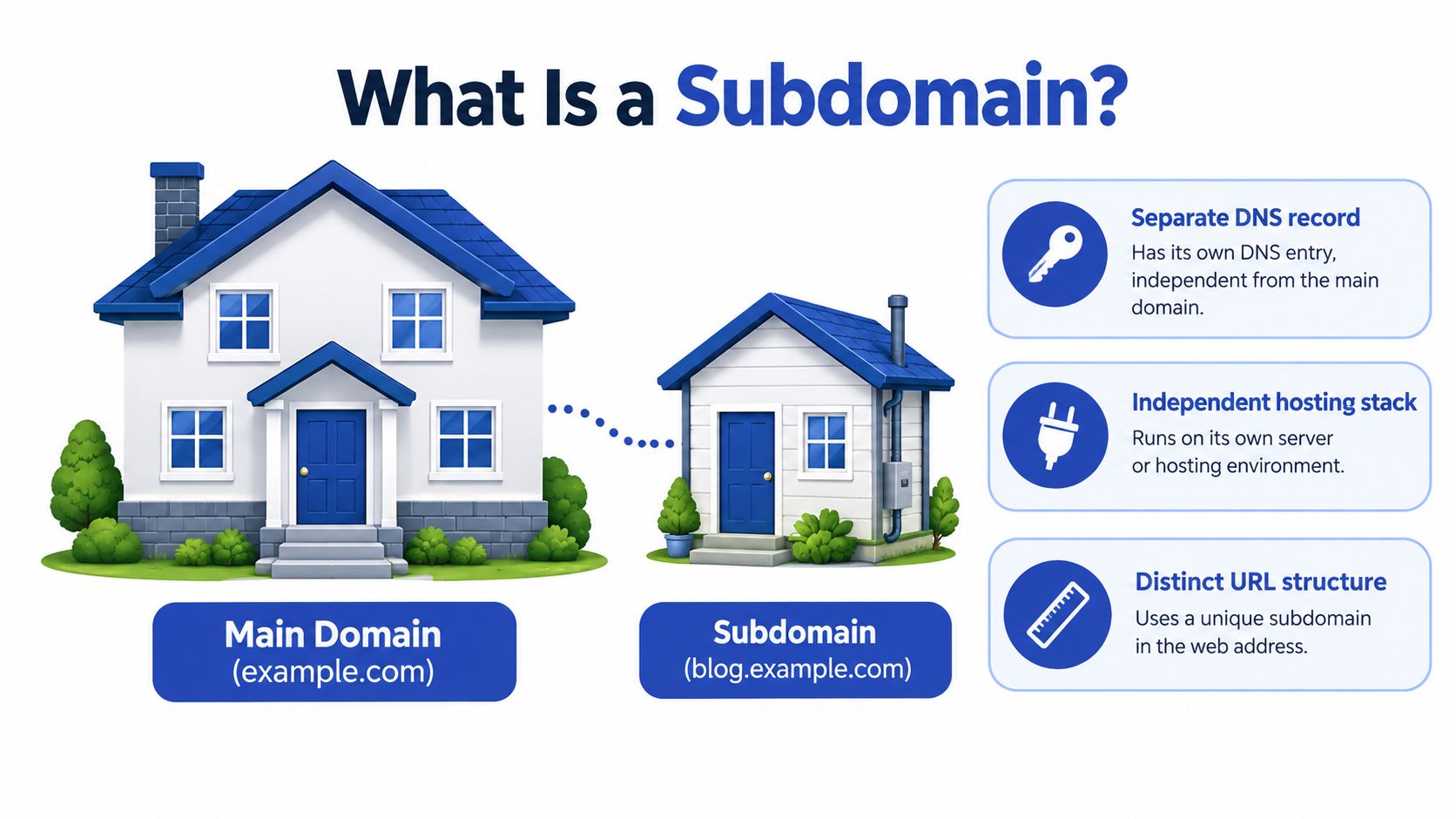
Think of your main domain as a house. A subdirectory is a new room inside that house, such as example.com/blog. It uses the same property address and usually shares the same infrastructure, navigation and governance.
A subdomain is more like a self-contained annex at blog.example.com. It remains visibly connected to the main brand, but it has its own address, entrance and operating requirements. The annex may share some services with the house, yet the people responsible for it still need to maintain its own rooms, utilities and access points.
What changes for search engines
A crawler sees blog.example.com as a separate host from example.com. That doesn't mean Google ignores the relationship, but it does mean your team must treat the subdomain as an independent technical SEO surface.
Set up and monitor the following:
- Search Console property: Verify the subdomain separately so the team can inspect its indexing, queries, pages and technical issues.
- XML sitemap: Publish a sitemap that contains the subdomain's own canonical URL set, then submit it in the relevant property.
- Robots controls: Review robots.txt and indexing directives for the host. A rule that works on the main store may not govern the subdomain.
- Canonical URLs: Make every page identify its preferred URL clearly. Don't allow staging, duplicate templates or market variants to create conflicting signals.
- Internal links: Link between the store and subdomain where users need to move between them. A subdomain that is technically live but poorly connected creates avoidable discovery problems.
- Structured data: Validate schema on the subdomain independently, especially if its homepage represents a distinct site identity.
A technical review should cover those controls alongside status codes, rendering and mobile templates. A useful primer on the wider process is this technical SEO audit guide, particularly when your subdomain uses a different CMS or hosting arrangement.
When separation is sensible
A subdomain earns consideration when the annex has a different function that affects delivery. A headless editorial platform, a separate support system, an independently operated regional storefront or a distinct brand can all justify a separate host.
A related blog for the same audience usually doesn't. Neither does a collection of Shopify landing pages that the ecommerce team could manage inside the main storefront. Separation adds value only when it solves a real organisational or technical problem.
Google's position is useful because it avoids a false universal rule. Use the structure that matches the organisation. The SEO outcome then depends on whether the people, systems and signals around that structure are complete.
Five Operational Dimensions of Subdomain SEO
Subdomain performance depends on five connected disciplines. A weakness in any one of them can make the property appear healthy while the commercial journey remains fragmented.
Indexation and crawl coverage
Start with the page set. Which URLs should Google index? Which should remain excluded? Does the sitemap contain only canonical, status-code-valid URLs? Are product, collection, editorial and support pages linked from useful navigation paths?
The UK web ecosystem is already substantial. Nominet recorded 8,790,349 registered .co.uk domains and 1,374,360 .uk domains in January 2024, alongside 417,283 .org.uk registrations. By March, the totals were 8,774,174 .co.uk, 1,362,238 .uk and 410,172 .org.uk domains. These figures count registered domains, not subdomains, but they show the scale of the namespace in which UK organisations build and migrate properties. (Nominet domain statistics)
Decision cue: If nobody owns the sitemap and indexation review, don't launch the subdomain yet.
Authority and link equity flow
Links pointing to the subdomain help search engines understand and evaluate that host. Links from the subdomain to the store help users and crawlers move between related areas, but you shouldn't assume every signal will consolidate exactly as it would inside one site structure.
Teams often overestimate the benefit of a content subdomain. If editorial pages support the same products and categories as the main shop, placing them apart can make your internal linking model less direct and your reporting harder to interpret. A specialised resource on how to improve your SaaS site's rankings can help teams think through technical authority and content architecture without reducing the decision to a URL preference.
Decision cue: If the subdomain's content is meant to strengthen the same commercial pages, default to keeping it close to those pages.
Tracking and analytics
Configure analytics before launch, not after the first campaign. Users moving between example.com and blog.example.com should remain part of one intelligible journey, with referrals, sessions and conversions attributed consistently.
Check the implementation on templates, consent states and checkout transitions. Shopify Plus brands often combine Shopify Analytics, GA4, advertising platforms and product feeds, so a second host can create gaps unless the measurement plan names every domain and event boundary.
Decision cue: If your reports can't distinguish a cross-subdomain visit from an external referral, the setup isn't ready.
Internationalisation and hreflang
Regional subdomains create a governance decision, not just a localisation decision. A UK store and an Ireland store may need separate canonicals, hreflang relationships, availability signals, delivery information and legal content. Those relationships must be reciprocal and maintained as templates change.
Don't copy the UK site onto ie.example.com and expect the market relationship to explain itself. Define which URLs represent equivalent regional pages, where products differ, and which team approves changes.
Decision cue: If nobody owns the market matrix, use a simpler structure until ownership is clear.
Governance across teams
A subdomain needs an accountable owner for content, development, SEO, analytics, DNS access, redirects and incident response. It also needs a documented exit plan. A property that belongs to “everyone” usually belongs to nobody.
Record the purpose of the host, its platform, its canonical rules, its sitemap location, its Search Console property and the conditions that would trigger consolidation. That document becomes valuable when an agency changes, a market team reorganises or Shopify Plus expansion introduces another storefront.
Decision cue: If you can't name the person responsible for a future migration, you're not ready to approve the first URL.
Subdomain vs Subdirectory for Shopify Plus Brands
For most Shopify Plus brands, the comparison is straightforward. A subdirectory wins when the content serves the same audience, supports the same commercial proposition and can run within the existing storefront. A subdomain wins when the surface needs meaningful separation.
| Criterion | Subdomain | Subdirectory |
|---|---|---|
| Search visibility | Creates a separate host that needs its own technical signals and authority plan | Keeps related content within the main site structure |
| Technical setup | Requires independent host verification, sitemap handling, canonical review and monitoring | Usually fits the existing storefront and deployment model |
| Brand identity | Can support a distinct site name, audience or regional proposition | Shares the parent site identity |
| Internal linking | Needs deliberate cross-host navigation and contextual links | Links remain within one primary architecture |
| Migration risk | May require a host-to-folder migration if the separation later becomes unnecessary | Usually avoids that additional consolidation project |
| Internationalisation | Can separate markets when teams, technology or legal requirements differ | Easier to operate when markets share governance and templates |
| Team ownership | Works when a separate team has genuine responsibility and capability | Works best when one ecommerce or content team owns the experience |
Google's site-diversity system generally treats a subdomain and its root domain as one site when limiting repeated results, although it can treat a subdomain separately when relevance warrants it. In practical terms, putting support or editorial content on support.example.co.uk doesn't reliably create an extra independent opportunity to fill the top results with your own pages.
That makes duplicate content across both structures a poor strategy. Pick one canonical home for each page, link to it consistently and avoid publishing near-identical UK content on the root domain and a subdomain.
My recommendation for Shopify Plus
Use a subdirectory by default for:
- Blogs related to the store's products and customers.
- Buying guides and editorial content supporting category demand.
- Product education, unless a separate technology platform is required.
- Regional content managed by the same team and storefront architecture.
- Campaign pages that don't need an independent brand or operational boundary.
Use a subdomain deliberately for:
- A separate regional operation with distinct governance.
- A headless or non-Shopify platform that must remain independent.
- A support, academy or community experience with its own product and ownership model.
- A sub-brand whose identity and customer journey differ from the main store.
Don't use a subdomain to make a routine content folder sound more strategic. It adds technical surfaces, reporting obligations and future migration risk without creating a guaranteed ranking advantage.
Pre-Launch Checklist for a Shopify Subdomain
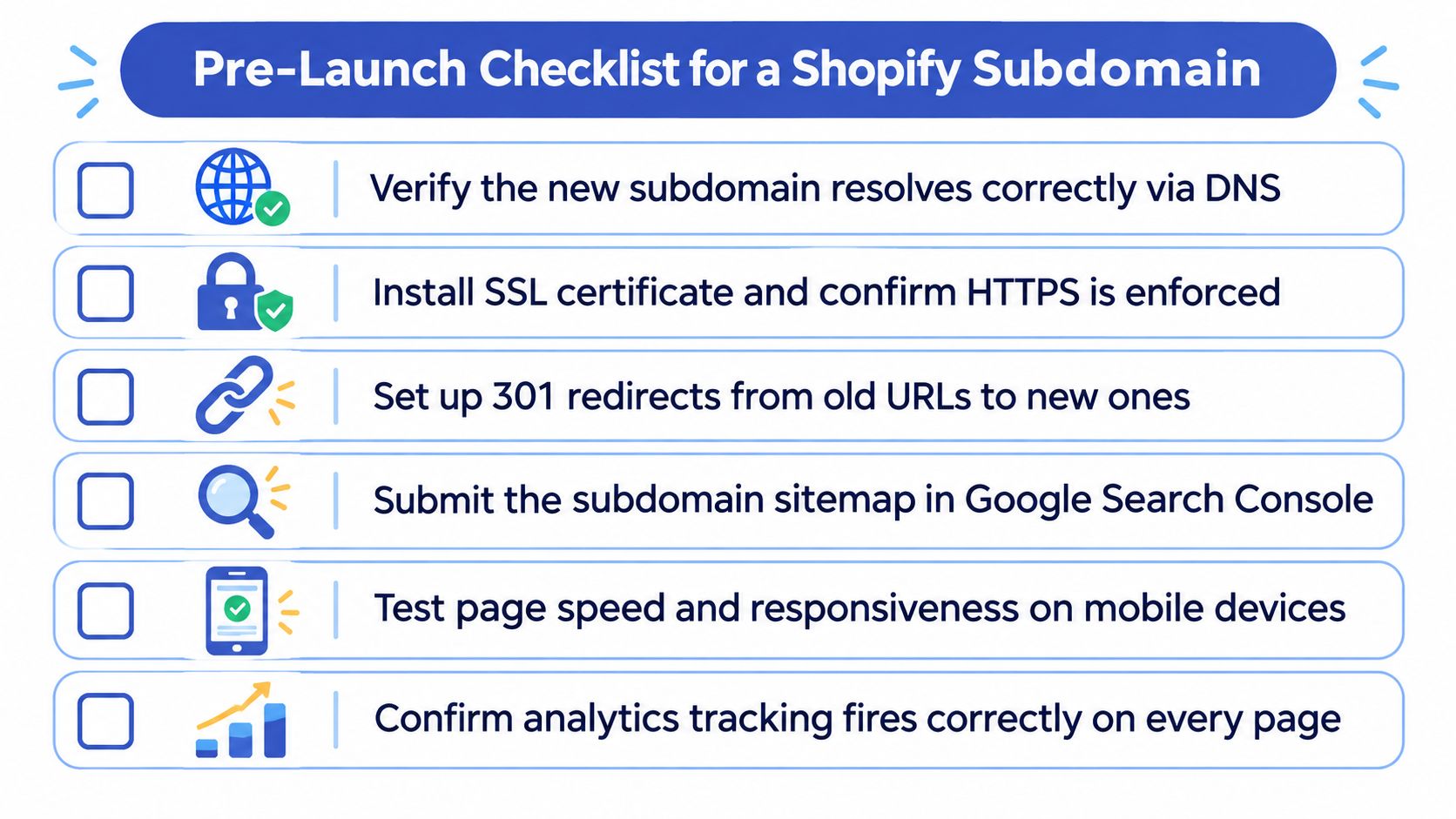
A subdomain launch should have an owner, a ticket list and a rollback plan. Treat it like a new SEO property, even when the brand, domain registrar and Shopify organisation are shared.
Build the technical foundation first
Verify the host in Google Search Console. Add the subdomain property before pages become public. This gives the SEO team a place to inspect coverage, indexing and sitemap processing from launch.
Publish a dedicated XML sitemap. Include the URLs intended for indexing, use their preferred canonical forms and submit the sitemap in the subdomain property. These XML sitemap best practices are particularly useful when a Shopify Plus implementation combines generated templates with manually managed content.
Test canonical and market signals. For international storefronts, validate canonical URLs, hreflang relationships, language content and regional availability together. A page can be crawlable yet still send contradictory market signals.
Confirm redirects before release. Map every old URL to its most relevant new destination. Avoid redirect chains, broad homepage redirects and temporary rules that nobody has agreed to retire.
Make ownership visible
Configure cross-domain measurement. Test navigation from the main store to the subdomain and back. Confirm that consent, campaign parameters, ecommerce events and checkout transitions behave as intended on real templates and mobile devices.
Assign responsibility for structured data. Decide who maintains product, organisation, breadcrumb and homepage markup. Google's site-name documentation defines a site at the domain or subdomain level and supports a distinct
WebSitestructured-data implementation on a subdomain homepage. Subdirectories don't receive separate site names, so don't create a second identity accidentally.Document the brand name. Decide whether
uk.example.comandie.example.comshould use the same site name or represent distinct regional properties. Align the visible homepage branding, title signals and structured data with that decision.Write the consolidation plan now. Record what would happen if the subdomain moved into the main Shopify storefront. Include URL mapping, redirect ownership, analytics changes, sitemap replacement and post-launch monitoring.
The final pre-launch review should include mobile rendering, navigation, indexability, structured data, analytics and market switching. A subdomain isn't finished when DNS resolves. It's finished when users, crawlers and internal teams can all understand its purpose.
A Realistic Migration Story From Subdomain to Subdirectory
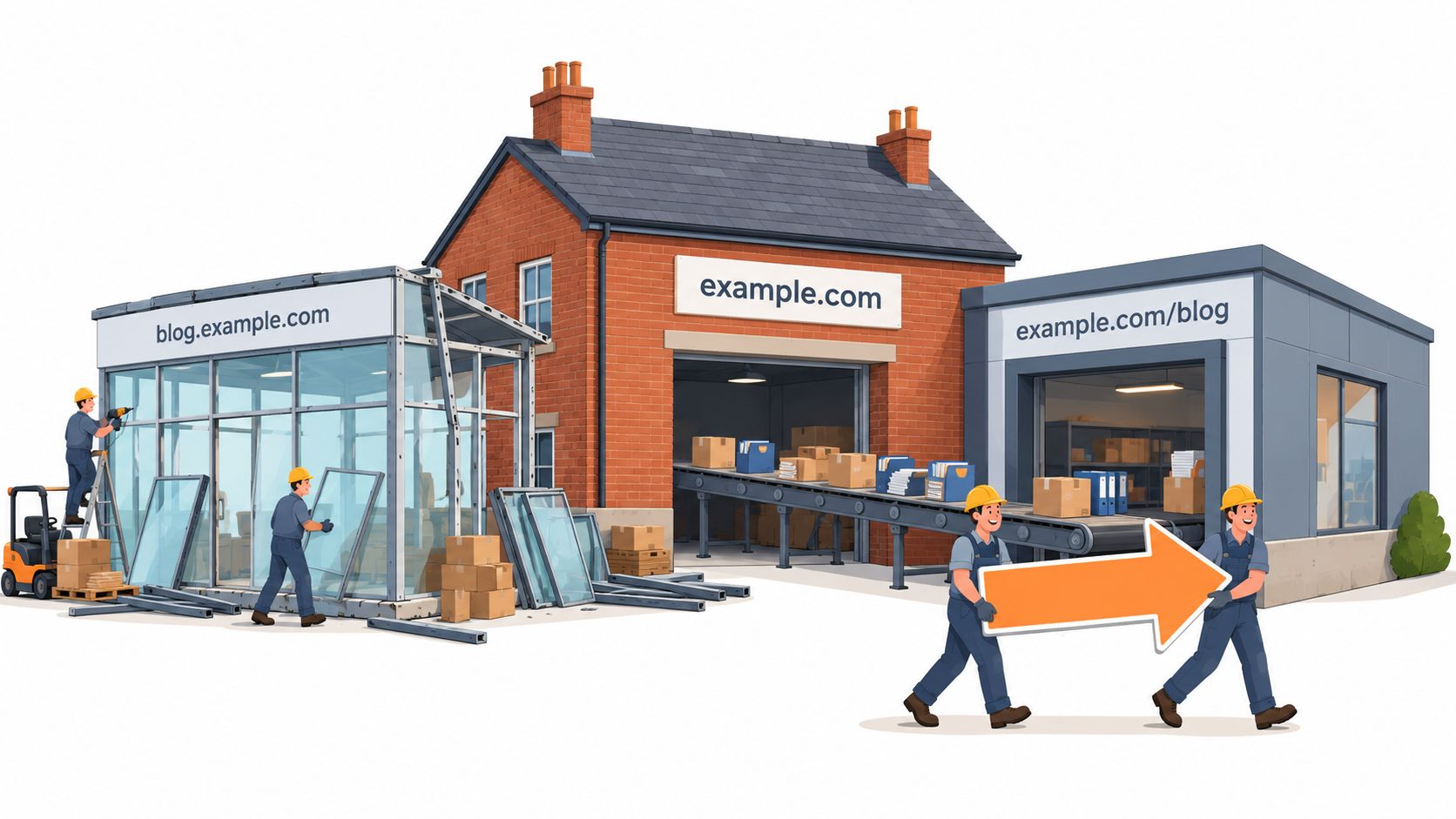
A UK Shopify Plus retailer launched its content hub at blog.example.com because the editorial team wanted a separate publishing stack. The arrangement made sense at first. The blog had its own release process, but product education and buying guides gradually became central to the store's category strategy.
The retailer later decided that example.com/blog would be easier for merchandising, analytics and internal linking. The migration was approved, but not treated as a simple folder move.
Phase one involved an inventory
The team exported every indexable blog URL, reviewed backlinks and grouped pages by topic, traffic intent and commercial relevance. They identified old articles with inconsistent canonicals, image paths that would change, and internal links pointing back to the subdomain.
They also created a complete redirect map before development began. That work followed the principles in this Shopify migration SEO preservation guide, with URL-level redirects, canonical checks, structured data validation and sitemap updates treated as one migration package.
Phase two exposed the weak points
The first staging review found redirect chains caused by an old campaign rule. Several articles retained canonical tags pointing to the subdomain, even though their new URLs lived in the folder. Analytics also counted some visits as new referral sessions because the cross-host configuration had never been standardised.
The team corrected the chains, changed canonicals, updated internal links and kept the old Search Console property active for monitoring. They didn't redirect every retired article to the homepage. Where an equivalent page existed, they mapped it directly. Where it didn't, they used a relevant alternative or retired the URL cleanly.
Phase three focused on verification
After launch, the retailer checked status codes, sitemap processing, canonical selection, internal links, analytics journeys and high-value landing pages. Recovery wasn't treated as an overnight event. A migration can take months to settle as crawlers revisit URLs, signals consolidate and teams correct defects.
The retailer eventually gained a simpler operating model, but the project consumed meaningful development, SEO, analytics and editorial effort. That cost wasn't an argument against the migration. It was evidence that the original subdomain decision should have been made with the same seriousness.
A Decision Framework and Direct Recommendation
Ask three questions before approving a Shopify subdomain.
- Is there a genuine reason to separate it? The reason should be technical, legal, regional, organisational or brand-related. “It looks cleaner” isn't enough.
- Can the team operate it independently? Confirm ownership for Search Console, sitemaps, canonicals, hreflang, structured data, analytics, redirects and incident response.
- Can the business afford future consolidation? Assume the property may one day move. If that prospect creates unacceptable migration work, choose the simpler architecture now.
My recommendation is direct: most UK Shopify and Shopify Plus brands should start with a subdirectory. Use a subdomain only when the separate host reflects a real operating boundary, such as a distinct market team, platform, brand or customer experience.
Keep the decision record current. It should name the purpose, owner, platform, URL rules, reporting setup and exit conditions. That documentation becomes essential as brands expand into Ireland, Europe or headless storefronts, where every additional property increases the number of relationships the team must maintain.
Don't debate subdomains as if they were ranking charms. Choose the structure your organisation can operate cleanly, measure and migrate safely.
Grumspot audits Shopify and Shopify Plus stores for crawlability, template behaviour, Core Web Vitals, app conflicts, internationalisation and SEO migration risks, then helps implement fixes such as redirects, canonical tags, structured data and sitemap updates. Visit Grumspot to plan a technically sound subdomain launch or consolidation with a team that understands ecommerce delivery.
Let's build something together
If you like what you saw, let's jump on a quick call and discuss your project
Related posts
Check out some similar posts.
- technical seo audit
What Is Technical SEO Audit. Learn what a technical SEO audit is, its core components, and how it dr...
Read more
- help center shopify
Learn how to build a help center Shopify merchants trust. Covers native pages vs apps, article struc...
Read more
- shopify seo
Choosing the right SEO app for Shopify means weighing features against speed, scripts, and plan limi...
Read more
- shopify plus seo agency
Learn how to choose the right Shopify Plus SEO agency for your store. Covers evaluation criteria, pr...
Read more