What Is Technical SEO Audit: The Complete Guide
- technical seo audit
- seo audit checklist
- shopify seo
- ecommerce seo
- seo best practices
Launched
October, 2026
A technical SEO audit is a structured examination of website infrastructure that determines whether search engines can discover, fetch, render, understand, and index a site's commercial URLs. For UK ecommerce, that matters in a market where online retail represented 27.1% of total retail sales in 2024, so technical visibility can affect a commercially significant source of revenue.
At 2 PM, a DTC brand manager opens the analytics dashboard and sees a familiar pattern. Organic traffic has flattened, conversion rate is slipping, and the paid team has already tested the obvious creative and audience changes. The product range is strong, but Google isn't consistently reaching the product and collection pages that should be attracting high-intent shoppers.
The cause may sit beneath the visible storefront: a robots.txt rule blocking an important directory, duplicate product URLs splitting signals, a canonical tag pointing to the wrong market, a redirect chain left over from a migration, or an app script slowing every product template. None of these problems necessarily looks dramatic in the Shopify admin. Together, they can prevent search engines from discovering, interpreting, or prioritising the pages that generate sales.

When Hidden Technical Problems Steal Your Revenue
A technical SEO audit turns a vague visibility problem into a commercial investigation. It examines whether search engines can reliably reach the URLs that drive revenue, and whether crawl budget is being spent on the right pages.
For a Shopify or Shopify Plus store, those pages usually include products, collections, editorial pages, and regional versions. The audit compares that commercial set with internal links, XML sitemaps, redirects, canonical tags, robots.txt rules, noindex directives, and rendered content. The practical question is simple, which technical issues stop Google from reaching or trusting profitable products?
That question changes prioritisation. A missing meta description may still deserve attention, but it should not outrank a collection blocked from crawling. A broken link on an old editorial page may create a warning, while an orphaned high-margin product can block discovery of a page that should be selling. Error counts alone do not show where developer time will protect revenue.
Why Shopify stores need a different lens
Shopify makes it easy to publish products and collections, but ecommerce architecture creates technical choices that a brochure site rarely faces. Faceted navigation can generate many filter combinations. Variant paths, app-generated links, internal search pages, parameter URLs, and international-market versions can all expand the set of URLs Google encounters.
A store manager may see a filter that helps shoppers narrow a collection. Google may see many similar URLs with limited independent value. The audit has to decide whether each URL should be crawlable, indexable, canonicalised, redirected, or excluded, based on search demand and commercial purpose.
The UK retail context makes this more than an administrative exercise. ONS recorded internet retail sales of £2.506 billion in October 2024 and £3.023 billion in November 2024 in its monthly internet retail sales series, which helps explain why a technical defect affecting product discovery can influence a meaningful sales channel. For a practical pre-launch baseline, the IndieTool checklist for first launches helps teams catch foundational omissions before a new storefront goes live.
Performance belongs in the same investigation. A Shopify theme can look polished while app embeds, tracking pixels, reviews, chat tools, and heavy media slow interaction on real mobile devices. Teams reviewing this layer can use a detailed guide to Shopify performance optimisation, then connect performance findings to the templates and journeys that support revenue.
The Five Pillars of a Technical SEO Audit
A useful audit follows the search engine journey rather than a random checklist. Google needs to find a URL, access it, render its meaningful content, understand its purpose, and decide whether it belongs in the index. The five pillars below overlap, so a change intended to solve one issue can create another if the relationships aren't tested.
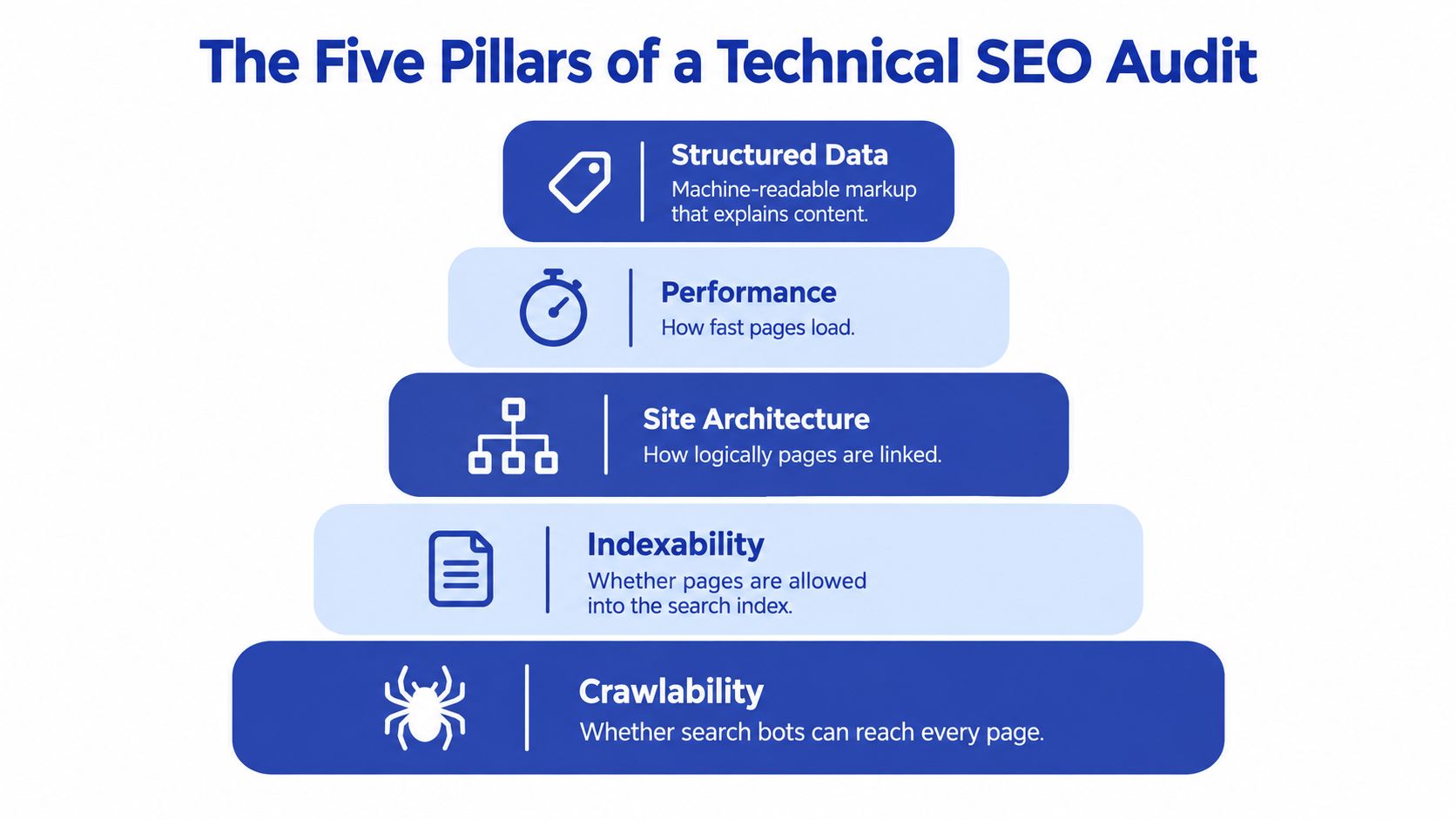
Crawlability comes first
Crawlability asks whether Googlebot can discover and fetch the intended URLs. The audit checks crawlable links, XML sitemaps, robots.txt rules, HTTP status codes, redirect chains, orphan pages, and parameter or faceted-navigation variants.
Google explains that robots.txt controls crawling, but it shouldn't be used as a method for preventing indexing. A blocked URL may remain known to Google without being crawled, while a noindex instruction can only be processed when Google can access the page. The distinction is central when cleaning up low-value Shopify URLs.
Indexability decides what can compete
Once Google reaches a page, indexability determines whether that page can enter the search index as the preferred version. Review noindex directives, canonical tags, duplicate product paths, pagination, and JavaScript-rendered content.
A canonical tag is a recommendation about the preferred version. It isn't a substitute for a coherent internal-link structure, consistent redirects, or an accurate sitemap. If those signals disagree, Google may choose a different URL than the one the merchandising team intended.
Architecture connects pages to value
Site architecture shows how products, collections, guides, and regional pages relate to one another. Internal links help search engines discover URLs and help users move from broader categories towards purchase decisions. The audit should identify valuable pages with weak or missing internal paths.
Performance affects access and use
Performance examines rendering cost, mobile behaviour, image delivery, JavaScript execution, and Core Web Vitals. Lab testing can identify likely causes, but UK-origin field data reveals what real users experience across devices, networks, consent tooling, and third-party applications.
Structured data and international signals add meaning
Structured data helps machines interpret products, prices, availability, breadcrumbs, and other page entities. It supports eligibility for enhanced search presentations when the implementation is valid, but it doesn't guarantee a rich result.
International stores add hreflang to this layer. The audit checks reciprocal references, UK-specific canonical targets, country or language URL consistency, and whether redirects send crawlers to an unintended market. Readers who want a deeper implementation reference can review this guide to structured data implementation.
For another perspective on the scope of a technical SEO audit, AY Rank provides a useful service-level reference. The important principle is that these pillars form one control system, not five unrelated tasks.
Why Site Speed Is a Revenue Problem Not a Technical One
A slow product page creates friction before a shopper can assess the item, compare variants, or move into checkout. On Shopify, that delay often comes from theme code, app embeds, image handling, or third-party scripts that compete for the same screen time and attention. Search engines also evaluate page experience signals, so performance affects both discoverability and the likelihood that visitors keep moving toward purchase.
Google's passing Core Web Vitals thresholds are LCP of 2.5 seconds or less, INP of 200 milliseconds or less, and CLS of 0.1 or less. These thresholds are documented in Google's Core Web Vitals guidance, which also reinforces the need to assess page behaviour rather than rely on a single synthetic score.
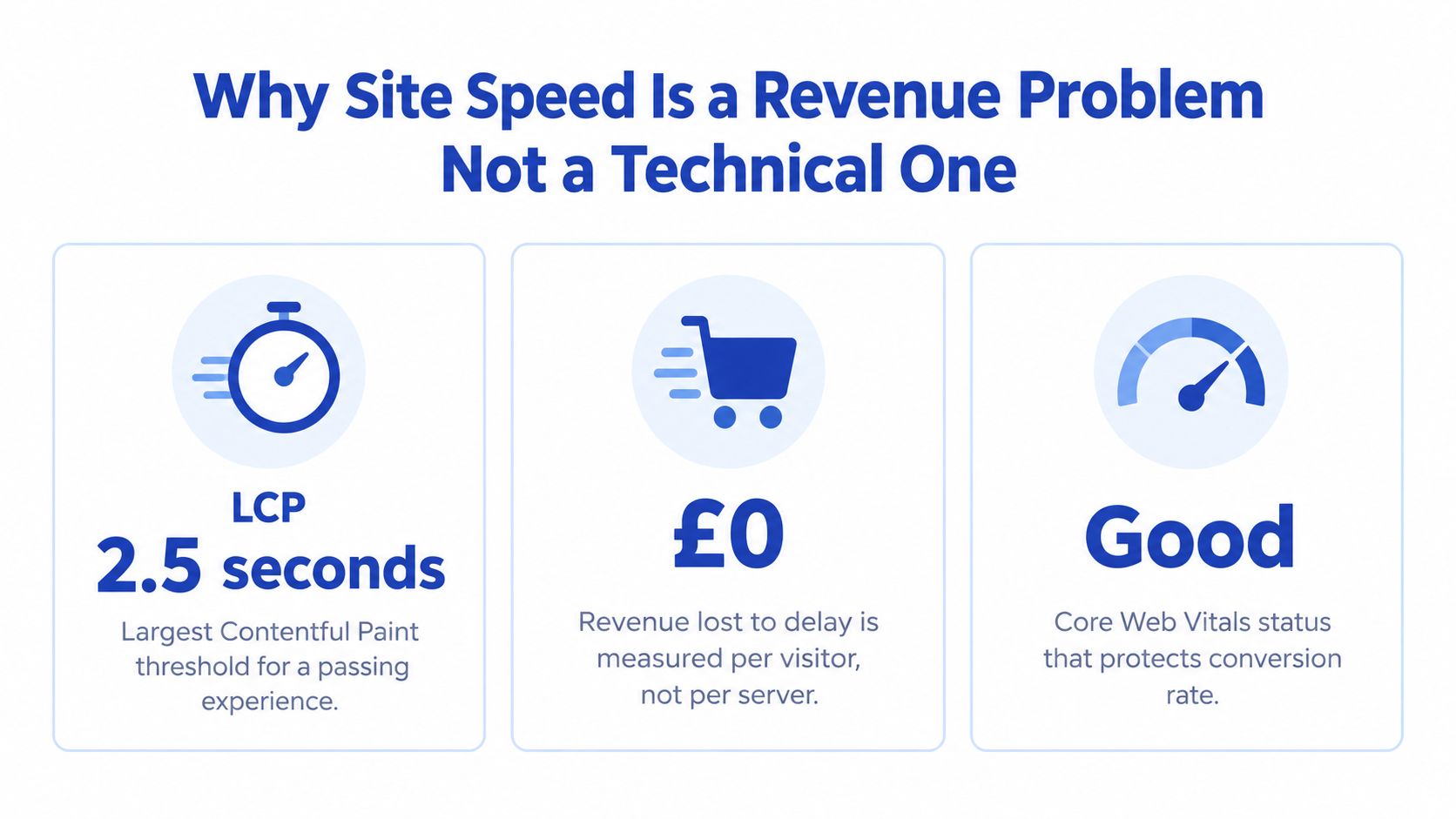
A UK ecommerce speed study covering approximately 150 retailers and 460 pages reported that 98 to 99% of tested pages missed the 2.5-second LCP threshold. It also reported average main-content loading of roughly 12 to 14 seconds and average performance scores near 43 out of 100. The study is a strong reason to treat performance triage as a commercial workstream, while still analysing each store's own field data rather than assuming the market average describes its experience.
Start with templates, not the homepage
The homepage rarely represents the whole store. A collection page may load a filter interface and product grid. A product page may load variant selectors, reviews, recommendation carousels, and subscription functionality. A checkout-adjacent journey may introduce different scripts and interaction demands.
Measure representative homepage, collection, product, and checkout-adjacent templates using UK-origin field data where available. Compare that evidence with lab tests to identify whether the cause is server response, image discovery, render-blocking CSS, JavaScript execution, layout movement, or a third-party application.
Fix the largest commercial constraint first
A practical sequence looks like this:
- Find the LCP element: Determine whether the main visual is an image, text block, or another component, then improve its delivery and priority.
- Reduce blocking work: Defer non-critical JavaScript and remove resources that delay the first meaningful render.
- Stabilise the layout: Reserve image dimensions and prevent late-loading components from shifting buttons, prices, or product information.
- Audit apps by contribution: Compare network requests and main-thread work before and after app embeds, pixels, reviews, chat, and consent tools load.
- Re-test real templates: Validate changes against field data, not only a favourable lab result.
For Shopify stores, theme section complexity, variant selectors, app embeds, image delivery, and tracking pixels deserve individual attention. The goal is a faster path from search result to useful product information and purchase action, not an abstract performance score.
Traditional Checklists versus Revenue-First Audit Methodology
A traditional audit often moves through a familiar sequence: inspect robots.txt, review the sitemap, check speed, validate schema, examine hreflang, and export the errors. That sequence can be useful for coverage, but it treats warnings as though they have equal commercial importance.
A revenue-first audit starts somewhere else. It defines the commercial URL set first, then asks whether search engines can discover, fetch, understand, and index those URLs. This approach connects the technical finding to a product, collection, market, or journey that the business values.
| Audit question | Traditional checklist | Revenue-first methodology |
|---|---|---|
| What gets reviewed first? | The site's technical components | Products, collections, editorial pages, and regional URLs that matter commercially |
| How are issues ranked? | By severity in a tool export | By effect on discovery, indexation, crawl efficiency, and conversion opportunity |
| How are duplicates handled? | Mark similar URLs as duplicate | Decide which versions should be crawlable, indexable, canonicalised, redirected, or excluded |
| How are internal links assessed? | Count broken or missing links | Find valuable products that are orphaned or difficult for crawlers to reach |
| How are filters judged? | Flag parameter variations | Separate useful search-demand landing pages from uncontrolled URL combinations |
| What is the final output? | A broad list of warnings | A prioritised implementation plan tied to commercial URLs |
The decision behind every URL
Suppose a filtered collection helps shoppers find a product type that has clear search demand. Blocking every filter URL might reduce crawl activity, but it could also remove a useful landing page. Conversely, allowing every combination to be crawled can consume attention on URLs with no independent commercial purpose.
The audit therefore maps URL behaviour to intent. It checks whether JavaScript-rendered links are discoverable, whether important products appear in the sitemap and internal-link graph, whether canonical targets remain within the UK market, and whether redirects preserve the intended destination after a migration.
Practical rule: Don't ask only whether a URL is technically valid. Ask whether it deserves search engine attention and whether its current signals help or hinder the product it represents.
Choosing the method for your situation
A small, stable catalogue may benefit from a focused checklist that confirms fundamentals and prevents regressions. A large Shopify Plus store, a complex international catalogue, or a migration from Magento, WooCommerce, or a custom build needs the revenue-first approach because URL volume and historical redirects make error counts particularly misleading.
The difference isn't whether the audit uses tools. Both approaches may use crawlers, Google Search Console, URL Inspection, sitemap exports, and template testing. The difference is the decision framework applied to the evidence.
What a Professional Technical SEO Audit Delivers
A professional audit should give a team a route from evidence to implementation. A spreadsheet containing hundreds of warnings doesn't tell a developer which fix to ship first, a merchandiser which products need attention, or a leadership team why the work matters.
The central deliverable is a prioritised defect register connected to the commercial URL set. Each issue should identify the affected template or URL pattern, explain the likely search and user impact, name the owner, and define the validation step after implementation.
Priority tier one, indexing blockers
Start with pages that should rank but can't enter the process reliably. Examples include important URLs blocked by robots.txt, accidental noindex directives, incorrect canonical targets, redirect chains, missing redirect coverage, and key content available only through JavaScript that hasn't been shown to render consistently.
The report should map these findings against products and collections, not just list URL strings. A blocked product template and an obsolete internal search page may both create crawl warnings, but they don't deserve the same response.
Priority tier two, crawl waste and duplication
Next, review faceted-navigation combinations, parameter URLs, internal search results, duplicate product paths, and collection filters that create low-value crawlable variants. The objective isn't to eliminate every variation automatically. It's to preserve useful discovery paths while reducing unnecessary duplication and competing signals.
For a Shopify Plus migration, this tier also includes old URL patterns and redirect coverage. The team should verify that legacy product and collection URLs resolve directly to the correct new destinations, without loops or chains that obscure the intended relationship.
Priority tier three, amplification
Once discovery and indexation are sound, address metadata, structured data, internal authority, and template-level enhancements. These changes can improve how eligible pages appear and how authority flows through the site, but they shouldn't distract from pages that search engines can't access or interpret correctly.
A useful handoff assigns work by role:
- SEO lead: Confirms the intended URL and indexation rules.
- Developer: Implements theme, redirect, rendering, and directive changes.
- Merchandiser: Verifies product, collection, and regional priorities.
- QA owner: Tests representative templates and validates the post-release crawl.
- Leadership: Approves sequencing based on commercial impact and delivery capacity.
This structure turns the audit from an observation into an operating plan. Every recommendation should answer three questions: what is wrong, why does it matter, and how will the team know it is fixed?
How Technical SEO Audits Drive CRO on Shopify Stores
Conversion-rate optimisation often starts with visible changes. Teams test button placement, revise hero copy, simplify navigation, or reorder product information. Those experiments matter, but they can't compensate for a store whose most valuable pages remain difficult for search engines to discover or slow for shoppers to use.

A technical audit gives CRO a sounder starting point. It confirms that the pages being optimised are indexable, connected through the internal-link graph, rendered with their essential product information, and available to the users search is meant to attract.
Where user experience and search usability collide
Shopify features often serve shoppers and crawlers differently. A filter may make a collection easier to browse but create uncontrolled parameter combinations. A variant selector may feel smooth in the browser while hiding important product details from a crawler if the information depends on client-side execution. An app embed may add reviews or recommendations while increasing the work required before interaction.
The right response isn't to remove useful functionality automatically. The audit identifies where a feature creates a technical trade-off, then looks for an implementation that preserves shopper utility without making search discovery unreliable.
That might mean exposing crawlable product links in the rendered HTML, controlling which filter combinations become indexable, clarifying canonical targets, simplifying a theme section, or removing an app that duplicates existing functionality. Each decision should be tested against both search access and the customer journey.
Read every finding as a conversion question
A CRO-minded review asks:
- Can the intended shopper reach the page from search?
- Does the page load the product information needed to make a decision?
- Can a mobile user interact with variants, filters, and add-to-cart controls without delay or layout movement?
- Do canonical and regional signals send the right market to the right URL?
- Does the internal architecture guide both crawlers and shoppers towards commercially important products?
A team working through broader CRO best practices should include these technical questions before interpreting an experiment's result. Otherwise, a weak acquisition path can make a strong product-page improvement appear ineffective.
Technical SEO and CRO aren't competing priorities. Search visibility brings qualified visitors to the right templates, while usability helps those visitors continue towards purchase. Fixing the infrastructure first gives front-end experiments a cleaner environment in which to perform.
Turning Audit Findings into Measurable Revenue Growth
The report is only the midpoint. Revenue impact appears when the team sequences implementation, validates each change, and connects technical outcomes to the commercial URL set.
Start with indexing blockers. Confirm that important pages are accessible, indexable, internally linked, and represented correctly in the sitemap. Then address crawl waste and duplication, including faceted variants, parameters, duplicate product paths, and migration redirects. Finish with metadata, structured data, and internal-authority improvements that help eligible pages earn stronger search presentation once the foundation is stable.
Build a before-and-after measurement layer
Record a baseline before releasing major fixes. Useful measures include:
- Indexed commercial URLs: Compare the product and collection set with the pages Google has indexed.
- Template-level LCP: Segment field performance by homepage, collection, product, and checkout-adjacent journeys.
- Crawl behaviour: Review whether crawlers spend attention on intended URLs or low-value variants.
- Rich-result eligibility: Track valid structured-data coverage for eligible product and content templates.
- Organic commercial journeys: Connect search landing pages with product engagement and conversion data in analytics.
These measures don't prove that one technical change caused every revenue movement. They do create a disciplined way to identify whether the intended pages became more discoverable, usable, and commercially active.
Sequence fixes by opportunity
An orphaned high-margin product needs internal links and a coherent canonical path before a new metadata test can help it. A regional page needs reciprocal hreflang and a stable market-specific destination before international reporting can be interpreted confidently. A product template needs usable performance before a richer visual redesign can improve the journey.
Teams considering automation can also review Yalc's perspective on AI SEO automation, while keeping human review in the loop for URL policy, market targeting, and commercial priorities. Automation can surface patterns, but the business still has to decide which pages deserve crawl and index attention.
The useful mental model is simple: technical SEO is infrastructure that controls the flow of opportunity. Crawlability determines whether search engines can reach a page. Indexability determines whether that page can compete. Architecture and structured data clarify its role. Performance determines whether users can use it comfortably. Together, these controls connect search visibility with conversion potential.
Grumspot provides Shopify and Shopify Plus design, migration, technical SEO, and CRO support, including audits that turn crawlability, indexation, performance, and template findings into an implementation plan. Visit Grumspot to discuss an audit for your storefront and identify the technical fixes most closely tied to lost discoverability and conversion opportunity.
Let's build something together
If you like what you saw, let's jump on a quick call and discuss your project
Related posts
Check out some similar posts.
- help center shopify
Learn how to build a help center Shopify merchants trust. Covers native pages vs apps, article struc...
Read more
- shopify seo
Choosing the right SEO app for Shopify means weighing features against speed, scripts, and plan limi...
Read more
- shopify plus seo agency
Learn how to choose the right Shopify Plus SEO agency for your store. Covers evaluation criteria, pr...
Read more
- ecommerce seo agency uk
Learn how to pick the right ecommerce SEO agency UK with our practical guide covering services, pric...
Read more