Shopify Design Agency: Scale Your Store with Expert Design-shopify design agency
- shopify design agency
- shopify plus partner
- ecommerce agency
- hire shopify expert
- uk ecommerce
Launched
March, 2026

At its core, a Shopify design agency is a team of specialists who build, refine, and grow e-commerce stores on the Shopify platform. They handle everything from bespoke theme design and conversion rate optimisation to tricky platform migrations, essentially becoming your strategic partner for boosting revenue.
When to Partner With a Shopify Design Agency
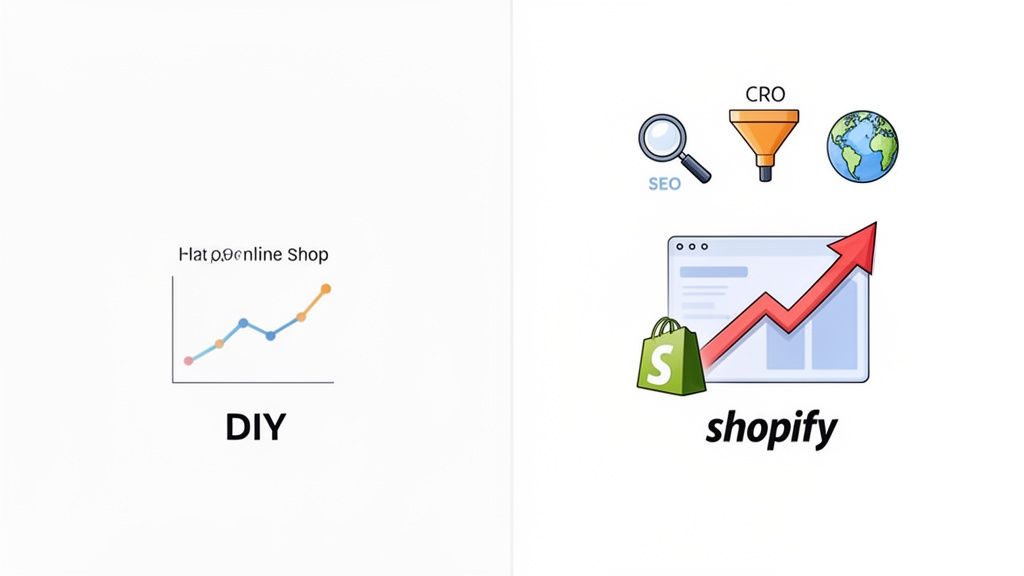
Knowing when to bring in a Shopify design agency is a defining moment for any online business. It's often the point where you decide to shift from simply having an online shop to building a high-performance sales machine. Many brands find themselves hitting a wall with a DIY approach or a standard theme, where flatlining conversion rates and technical glitches put a cap on their growth.
This is precisely when a partnership stops being a cost and becomes a crucial investment in your future.
From Aesthetics to Revenue Growth
The right agency does so much more than just make your website look good. Their real value is their deep, practical understanding of the entire e-commerce world. They bring a full suite of senior-level talent—developers, UX designers, CRO specialists, and SEO experts—who act as a natural extension of your own team.
To give you a better idea, here’s a quick comparison of the two paths.
DIY Management vs Agency Partnership At a Glance
The table below breaks down the key differences between managing your Shopify store yourself and bringing in a dedicated agency. It highlights the contrasts in approach, the resources you have at your disposal, and what you can realistically expect in terms of results.
| Aspect | DIY Approach | Agency Partnership |
|---|---|---|
| Strategy | Often reactive, fixing problems as they appear. | Proactive and data-driven, focused on long-term growth. |
| Expertise | Limited to the skills of your in-house team or founder. | Access to a full team of specialised experts (UX, dev, SEO, CRO). |
| Tools & Tech | Relies on standard apps and themes, often with conflicts. | Utilises premium tools and bespoke code for peak performance. |
| Pace of Growth | Typically slow and inconsistent, prone to plateaus. | Accelerated and strategic, designed for scalability. |
| Focus | Day-to-day operations and putting out fires. | Building a valuable, high-performing commercial asset. |
| Cost | Lower upfront cost but high opportunity cost (lost sales). | Higher initial investment with a clear focus on ROI. |
As you can see, an agency fundamentally shifts your focus from just keeping the lights on to actively building a more valuable and efficient business.
Common Growth Stalls an Agency Can Fix
Sound familiar? Many businesses turn to an agency when they face these common growth-stalling scenarios:
- Plateaued Sales: Your traffic is consistent, but revenue is stuck. This usually points to underlying user experience or conversion funnel issues.
- Technical Debt: The site has become slow, buggy, or weighed down by too many conflicting apps, which harms user trust and search rankings.
- Expansion Hurdles: You want to launch internationally, add a subscription model, or go headless, but you don’t have the technical expertise to get it right.
- Brand Misalignment: Your current design just doesn’t reflect the quality of your products or speak to your ideal customer anymore.
A professional Shopify design agency gets straight to work on these challenges. They start with a deep dive to find the root causes and then build a data-led strategy for a custom rebuild or an optimisation project.
The core difference is moving from a reactive "fix-it" mindset to a proactive "grow-it" strategy. An agency's job is to build a commercial asset designed for scalability and peak performance.
A Look at the UK Shopify Market
This need for expert help is especially true in the fiercely competitive UK market. The UK e-commerce scene is buzzing, with Shopify powering approximately 208,000 live stores, making it the second-largest market in the world after the US.
With UK e-commerce sales topping £120 billion a year and over 5,700 Shopify Plus stores leading the charge in Europe, you need more than a generic theme to make an impact. Success demands a bespoke, conversion-focused storefront, technical SEO mastery, and smart app integrations—all things a top-tier agency specialises in.
Ultimately, hiring an agency is an investment in senior talent that delivers measurable results, without the huge overheads and recruitment headaches of building that same team in-house.
Defining Your Project Needs and Goals
Hiring a Shopify design agency without a clear brief is a recipe for disaster. It’s like setting off on a road trip with no map – you’ll burn through your budget and end up somewhere you never wanted to be. Before you even start looking for a partner, you need to sit down and translate your business ambitions into a concrete project scope. This groundwork is what makes your first conversations with agencies productive, not just speculative.
A well-defined scope is your project's North Star. It gets your own team on the same page and gives potential agencies the clarity they need to give you an accurate proposal. Trust me, vague requests like "we need a new website" will only get you generic, overpriced quotes and a whole lot of frustration down the line.
From Business Goals to Agency Services
So, where do you start? Begin by connecting your high-level business objectives to the specific services an agency can provide. Your goals determine the work that actually needs to be done. Any top-tier Shopify agency will have a menu of solutions, and each one is designed to solve a particular commercial problem.
Think about these common scenarios I see all the time:
- Your Goal: Fix a leaky mobile conversion rate. If your analytics show tonnes of mobile traffic but pitiful sales, you should be focused on a UX/UI overhaul or a bespoke theme development project built on mobile-first principles. The agency's job is to iron out every bit of friction in that mobile buying journey.
- Your Goal: Get customers to spend more. To bump up your Average Order Value (AOV), you might be looking at custom app development for product bundles, a tiered discount engine, or a smarter cross-selling feature on your product pages.
- Your Goal: Launch a subscription service. This is rarely as simple as just installing an app. It often involves complex integrations with payment gateways, big changes to the customer account area, and a user experience designed from the ground up to manage recurring orders.
- Your Goal: Stop wasting time on manual tasks. If your team is drowning in admin, you're looking for a systems integration project. This could mean connecting Shopify to your ERP, CRM, or a third-party logistics (3PL) partner to automate the flow of information.
As you map this out, getting familiar with the latest principles of effective web design for ecommerce websites will pay dividends. It means you can have much more intelligent conversations with agencies and better judge the solutions they propose.
Case Study: A Brand Upgrading to Shopify Plus
Let's make this real. Imagine a successful skincare brand on a standard Shopify plan. They’ve just crossed the £2 million revenue mark and are starting to feel the platform creak under the strain. Their big goal is to scale aggressively over the next 18 months.
Here’s how they could turn those ambitions into a clear project scope for an agency:
- The Goal: Expand into the EU and US markets.
- The Need: A full Shopify Plus migration to take advantage of Shopify Markets Pro for localised pricing, languages, and separate domains.
- The Goal: Boost customer lifetime value.
- The Need: Launching a subscription service for their best-selling products, tied into a new loyalty programme to reward repeat purchases.
- The Goal: Look and feel like a premium brand.
- The Need: A full bespoke theme redesign. They need to move away from their off-the-shelf template and create a site that prioritises storytelling, high-quality visuals, and a much faster, more elegant user experience.
See the difference? This level of detail turns a vague "we want to grow" into an actionable brief. An agency can immediately see the project's complexity and its strategic importance. The conversation completely changes from "what can you do for us?" to "here's our plan, how would you execute it?" You can read more about what these kinds of projects involve in our guide to comprehensive Shopify store design services.
A detailed brief isn't just a shopping list of features. It’s a strategic document that connects every design and development decision back to a measurable business outcome.
How to Vet and Shortlist Potential Agencies
Alright, you've got your project needs mapped out. Now comes the crucial part: finding the right Shopify design agency to bring your vision to life. This isn't about casting a wide net with a generic Google search; it's about a focused, methodical hunt for the best fit.
A solid starting point is always the official Shopify Experts marketplace. These partners have already been given a stamp of approval by Shopify, which offers a decent baseline of quality. Your aim here is to build a tight shortlist of three to five genuine contenders, which means you need to look past the slick landing pages and really dig into their work.
This visual shows how your high-level goals should directly inform the specific services and scope you're looking for.
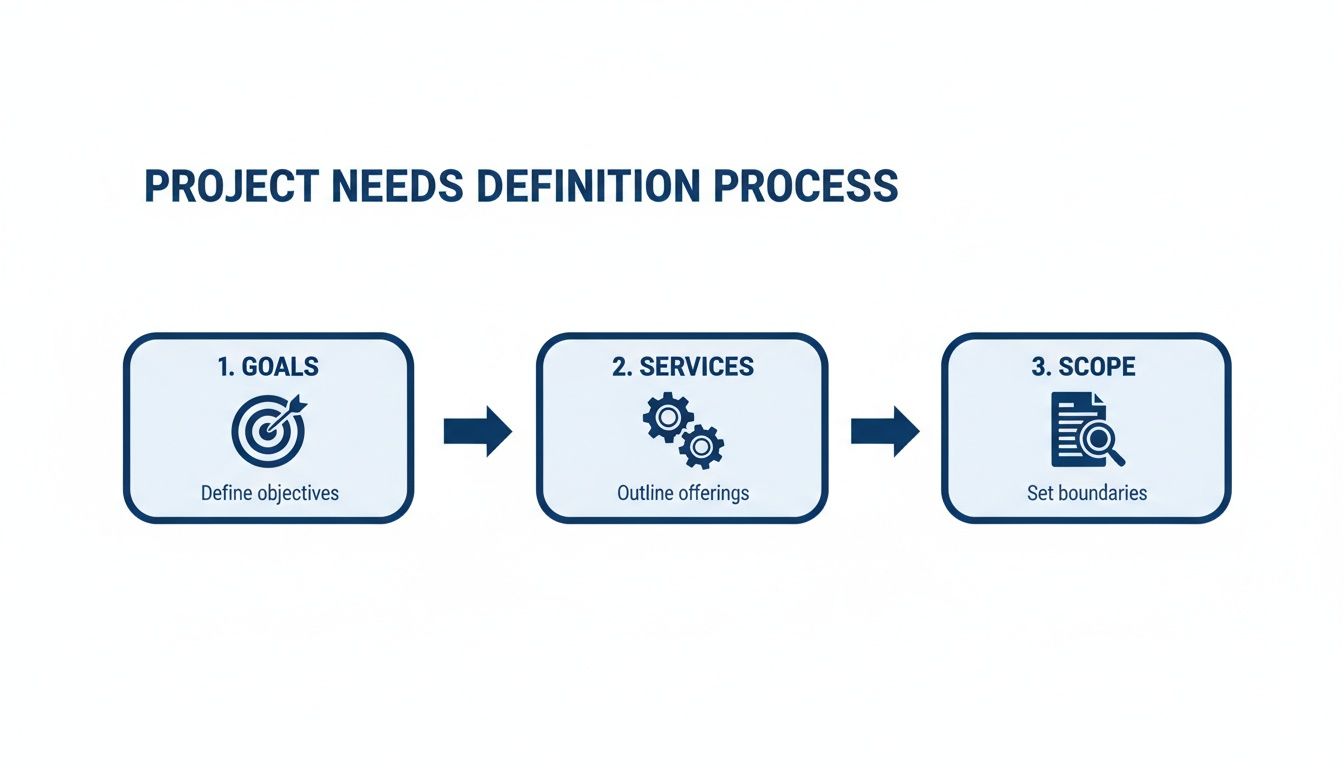
Having this clarity before you even start looking at agencies is essential. It means you’re judging them against your actual requirements, not just getting swayed by a flashy portfolio.
Analyse Portfolios for Technical Depth
A portfolio should be much more than a gallery of pretty designs. It needs to prove technical skill and sharp strategic thinking. Don't just admire the screenshots. Go to the live sites they've built and put them through their paces as if you were a customer.
As you click around, ask yourself some tough questions:
- Is the site fast? Seriously, run it through Google's PageSpeed Insights. A top-tier agency lives and breathes performance because they know slow sites sink sales.
- Is the mobile experience flawless? With over 70% of e-commerce traffic coming from mobile devices, a clunky mobile UX is an immediate deal-breaker.
- Can you spot complex features? Look for things that go beyond standard theme customisation. This could be sophisticated product customisers, unique subscription flows, or deep integrations with backend systems. This is how you spot an agency that can handle real complexity.
This hands-on approach helps you quickly filter out the agencies that are all style and no substance, especially if your project demands heavy lifting on the development side.
A portfolio isn’t just an art gallery; it's a collection of business solutions. Look for proof that the agency solved real commercial problems, not just that they made something look good.
Scrutinise Case Studies for Measurable Results
Case studies are where an agency has to show their receipts. Vague claims like "we improved their website" are completely worthless. You need to see cold, hard numbers that prove their work delivered a tangible return on investment.
A strong case study from a results-focused Shopify design agency will be packed with specific metrics.
Examples of Metrics That Matter:
- "Increased conversion rate from 1.2% to 2.1% post-launch."
- "Lifted average order value (AOV) by £15 with a new product bundling feature."
- "Reduced page load time by 45%, leading to a measurable drop in bounce rate."
- "Achieved a 30% rise in organic search traffic through technical SEO improvements made during the rebuild."
If you find a case study with no numbers, be wary. It could mean the project wasn't a success, or worse, that the agency doesn't even track its impact. Both are bad signs. Any good Shopify development agency will be shouting its successes from the rooftops, numbers and all. For more on this, check out our guide on what to expect from a leading Shopify development agency.
Common Red Flags to Watch For
As you do your initial research, keep an eye out for warning signs. Spotting these early can save you a world of pain down the line.
Tread carefully if you come across any of these:
- No Shopify Plus Experience: If you're a high-growth brand or already on Shopify Plus, an agency without specific Plus experience is a non-starter. The platform has unique complexities that require a specialist.
- An Outdated Portfolio: If their featured projects are all from a few years ago, it’s a sign they might not be current with Shopify’s modern architecture or today's design standards.
- Generic, Data-Free Case Studies: As we've covered, a lack of measurable results is a huge red flag. It suggests they either don't deliver or don't care about the commercial outcome.
- Poor Communication: How they treat you now is the best they ever will. If they’re slow to reply or give vague, unhelpful answers at this stage, just imagine the communication once a contract is signed.
By systematically digging into portfolios, demanding data-backed case studies, and keeping an eye out for these red flags, you can build a strong shortlist of agencies that are genuinely equipped to help you succeed.
Key Questions to Ask Your Top Agency Candidates
You've done the groundwork, pored over portfolios, and have a shortlist of agencies that look promising on paper. Now comes the most critical part: the interview. This is where you cut through the slick presentations and get a real feel for how they work.
Your goal isn't just to hear a sales pitch. It’s to find out if they're a true partner—technically, strategically, and culturally. The best way to do that is to ask questions that force them to show, not just tell.
Probing Their Process and Strategic Thinking
First things first, you need to get a handle on their workflow. Any experienced Shopify design agency will have a well-oiled process, but it should also be flexible enough to handle the curveballs that every project throws. Their answers should prove they’re thinking about your business results, not just their design process.
A vague answer is a major red flag. A confident agency, on the other hand, will be excited to show you how organised and effective they are.
Validating Their Technical Chops
Next, it’s time to dig into their technical skills, especially if you have complex needs like custom app development or large-scale integrations. Don't be shy about getting specific, even if you’re not a developer yourself. A good partner can explain complex topics clearly.
A great technical partner doesn't just write code; they build commercial solutions. Their technical decisions should always be justified by how they support your business objectives, such as improving performance or enabling a new sales channel.
Are they just theme tweakers, or can they handle the heavy lifting required to scale your business? Their responses to technical questions will tell you everything. A top-tier agency is obsessed with performance and thinks about how the tech serves the business, not the other way around.
Understanding Communication and Cultural Fit
Finally, don't forget you'll be working with these people closely, often daily. You're hiring a partner, not just a service provider. The chemistry has to be right, and their communication style needs to mesh with yours.
Make sure you bring your key people to these calls. Your e-commerce manager, a marketing lead, and maybe someone from operations should all be there. They’ll spot things you might miss and help you judge if the agency is a good fit for the whole team.
A great partner will have clear expectations for you, too. This shows they see the relationship as a genuine collaboration.
Essential Questions for Your Agency Shortlist
To help you get past the surface-level answers, we've put together a list of specific questions. Use this table during your interviews to dig into what really matters and compare agencies on a level playing field.
| Category | Question to Ask | What to Listen For |
|---|---|---|
| Process & Strategy | Can you walk me through your process for a recent project, from kickoff to post-launch support? | A clear, structured process with defined roles. They should talk about communication, milestones, and how they keep clients in the loop. |
| Process & Strategy | Show me a project where the client’s brief changed. How did you adapt and manage scope creep? | Honesty about challenges. Look for a fair and clear process for handling changes, not just a promise to "be flexible." |
| Process & Strategy | How do you measure a project's success? Share the KPIs you tracked for a recent client and the results. | Commercial metrics like conversion rate, average order value (AOV), and site speed. "The client was happy" is not a KPI. |
| Technical Skills | What's your approach to site speed optimisation? What tools and techniques do you use? | A proactive obsession with speed. They should mention image optimisation, code minification, and thoughtful app usage vs. custom code. |
| Technical Skills | Describe a complex integration you've built, like connecting Shopify Plus to an ERP or a 3PL. | Proof they can handle more than just the front-end. Their answer will show if they have the experience to support a scaling business. |
| Technical Skills | How do you approach technical SEO during a build or migration? | An understanding of URL structures, structured data, and managing 301 redirects. They should know that a beautiful site is useless if no one finds it. |
| Communication & Culture | Who would be our main point of contact? Will we have direct access to designers and developers? | A clear communication plan. Vague answers about "the team" are a warning sign. You want a dedicated project or account manager. |
| Communication & Culture | Can you give an example of when you had to push back on a client's request and explain why? | Confidence and a focus on partnership. They should be able to politely challenge ideas that aren't in your best interest, with solid reasoning. |
| Communication & Culture | What do you need from us to make this project a success? | This shows they see it as a two-way street. A great agency will have clear expectations for your team's involvement and feedback. |
By the time you've worked through these questions, you won't just know what each agency can do. You'll have a much clearer picture of what it would actually feel like to work with them day in and day out.
Getting Down to Brass Tacks: Contracts, Pricing, and Onboarding
So, you’ve found an agency that seems to click. The portfolio is sharp, the team gets your vision, and you’re ready to talk business. This next phase is all about the details—the money, the paperwork, and how you’ll actually start working together.
Getting this part right is crucial. A handshake and a good feeling are great, but a solid contract and a clear onboarding plan are what turn that initial excitement into a successful, long-term project.
Talking Money: Project vs. Retainer
When the proposal lands in your inbox, you’ll likely see one of two pricing structures. There’s no single "best" option; the right choice really boils down to what you’re trying to achieve.
Fixed-Price Projects: This is your go-to for a single, well-defined job, like a complete site redesign or migrating from another platform. You agree on one price for a specific list of deliverables. The beauty of this is predictability—you know the final bill before you even start. The trade-off? It’s not very flexible. If you want to add something new halfway through, that’s called ‘scope creep’, and it will mean a new quote and potentially a new timeline.
Monthly Retainers: If you’re looking for ongoing improvements—think conversion rate optimisation (CRO), SEO, or adding new features every month—a retainer is the way to go. You pay a set fee each month for an agreed amount of the agency's time. This model gives you incredible flexibility to shift priorities as your business evolves. The cost is ongoing, of course, but a good agency will make sure the value they deliver in sales and performance far outweighs their monthly fee.
Figuring out the true Shopify website design cost is less about the price tag and more about how that payment structure supports your goals. A fixed price is perfect for a big launch with a strict budget, while a retainer gives you the agility for continuous growth.
The Most Important Document: Your Statement of Work
Before you sign anything, you need to read the Statement of Work (SOW) from top to bottom. This isn't just a formality; it’s the legally binding blueprint for your entire project. Don't skim it—scrutinise every single clause.
A proper SOW leaves no room for confusion. Here’s what it absolutely must cover:
- Scope & Deliverables: What are you actually getting? This needs to be spelled out in detail. Look for specifics like "custom homepage and product page design," "Klaviyo integration for email flows," or "migration of 5,000 products with all variants." Ambiguity here is a red flag.
- Timelines & Milestones: A clear roadmap with dates. It should break the project into phases (e.g., discovery, design, development, launch) with deadlines for each.
- Payment Schedule: When do you pay? This is usually tied to milestones—for example, 30% up front, 40% after design approval, and the final 30% at launch.
- Intellectual Property (IP): This is non-negotiable. The contract must state that you own 100% of the final work once the final invoice is paid.
- Termination Clause: It’s always wise to have an exit strategy. This section explains how you or the agency can end the contract if things don't work out.
To make sure everyone is on the same page, a detailed contract is your best friend. Using a solid marketing agency contract template can be a good starting point to ensure nothing important gets missed.
Kicking Things Off the Right Way
A professional Shopify design agency will have a proper onboarding process. They don’t just cash your first cheque and vanish for a month. A smooth start is usually a sign of a well-organised team that respects your time and investment.
The first two weeks of any agency partnership set the tone for everything that follows. A chaotic beginning almost always leads to a chaotic project. You’re looking for structure, clarity, and proactive communication right out of the gate.
The first step should be a formal kick-off meeting with the entire team who’ll be working on your project—not just the sales rep who closed the deal. This is your chance to align on the goals one last time and set up your working rhythm.
Expect to be invited to a shared Slack channel for daily communication, a project management tool like Asana or Trello to track progress, and a recurring calendar invite for weekly check-in calls. This initial phase is all about building momentum and making sure everyone is on the exact same page before the real work begins.
Building a Long-Term Growth Partnership
A successful launch isn't the finish line; it’s the starting gun. I’ve seen far too many brilliant new sites lose momentum because there was no plan for what comes next. The real value of a great Shopify design agency partnership reveals itself in the months and years that follow, turning that initial project into a lasting competitive advantage.
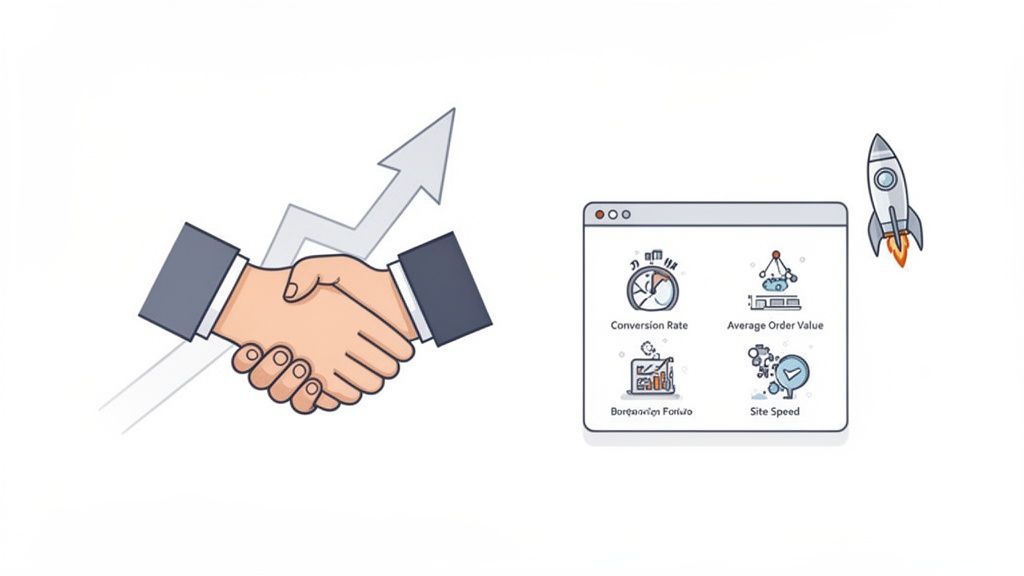
Think of the build as the foundation. Real growth comes from what you build on top of it, driven by continuous, data-backed improvements. It all starts with measuring the right things.
Measuring the Right Key Performance Indicators
So, how do you know if your investment is actually paying off? You have to connect the site’s performance back to the business goals you set at the start. It’s easy to get distracted by vanity metrics like social media likes, but you need to focus on the numbers that directly impact your bottom line.
A good agency will work with you to build and monitor a dashboard that zeroes in on the KPIs that truly matter. These almost always include:
- Conversion Rate: The percentage of visitors who buy something. This is the ultimate health check for your online store.
- Average Order Value (AOV): The average amount spent per order. Finding ways to increase this is often the fastest path to more revenue without needing more traffic.
- Site Speed & Core Web Vitals: How fast your pages load and become interactive. A slow site is a conversion killer and a red flag for Google.
- Customer Lifetime Value (CLV): The total revenue a single customer is likely to generate over time. This metric is a powerful indicator of customer loyalty and brand health.
These numbers tell the true story of your store's performance. They give you the hard data needed to make smart decisions about what to improve next.
The best agency partnerships are built on a shared obsession with results. Post-launch, the conversation should shift from "what are we building?" to "what did we learn from the data, and how can we use it to grow?"
Maintaining Momentum with Ongoing Optimisation
The most successful e-commerce brands are never really "finished" with their websites. They operate in a constant cycle of testing, learning, and improving. This is precisely where an ongoing retainer with your Shopify agency proves its worth.
This model transforms the agency from a one-time contractor into a proactive growth partner, allowing you to keep the momentum going long after launch.
What a growth retainer typically looks like:
- Conversion Rate Optimisation (CRO): Constantly A/B testing elements to see what works better. This could be anything from tweaking headlines and button colours to redesigning product pages or checkout flows. For instance, testing a new "quick add to cart" button could lift conversions by 5%.
- Iterative Feature Development: Strategically rolling out new functions based on customer feedback or changing business needs. This might mean adding a product bundling tool, a "shop the look" feature, or a more advanced search experience.
- Technical Maintenance & SEO: Keeping the site secure, fast, and aligned with the latest search engine best practices. This protects your rankings and helps you continue to grow organic traffic.
This continuous improvement loop ensures your store doesn't just launch well—it evolves. Your agency becomes an extension of your own team, constantly hunting for opportunities to unlock growth and make your customer experience better. That's how you build a powerful partnership that delivers value year after year.
Your Questions Answered
You’ve got questions, and that's a good thing. Choosing the right agency is a big decision, so let's get you some straight answers to the things we hear most often from merchants.
How Much Should I Budget for a Shopify Design Agency in the UK?
Honestly, this is the million-dollar question, and the answer really can be all over the map. It all comes down to what you actually need.
A simple theme customisation, maybe tweaking a few colours and layouts, could start from a few thousand pounds. But if you’re looking for a completely bespoke build for a high-turnover store, especially on Shopify Plus with a lot of complex integrations, you're looking at a different league. Those projects typically fall in the £25,000 to £100,000+ range.
And don't forget ongoing support. Most agencies offer retainer agreements for maintenance and conversion optimisation, which usually start around £2,000 to £5,000 a month.
What’s the Real Difference Between a Shopify Plus Agency and a Regular One?
Think of it like this: a regular Shopify agency is your trusted GP, but a Shopify Plus agency is the specialist consultant you see for a complex condition. They are officially certified by Shopify because they've proven they can handle the heavy lifting for enterprise-level brands.
Their expertise is centred on the unique challenges of the Plus platform, including:
- Large-scale data migrations from platforms like Magento or BigCommerce.
- Architecting sites to handle huge traffic spikes and thousands of checkouts.
- Building custom app integrations with your core business systems (think ERPs and CRMs).
- Setting up wholesale (B2B) channels and international expansion stores.
If you're a fast-growing brand or you're already on Shopify Plus, working with a designated Plus agency isn't just a nice-to-have—it's essential. Their experience is tailored to the demands of scale and can save you from incredibly costly mistakes down the line.
How Long Will a Shopify Redesign Actually Take?
The timeline is tied directly to the complexity of the job. A fairly straightforward theme setup and launch might be wrapped up in 4-8 weeks.
On the other hand, a full-blown bespoke design and build, starting from scratch with wireframes and user testing, is a much bigger undertaking. You should plan for a 3-6 month project.
The biggest variable we see? Data migration. Moving your products, customers, and order history from another platform like Magento can easily add weeks to the timeline. How clean and organised your data is will make all the difference. A clear brief from day one is the best way to get a timeline you can trust.
At Grumspot, we bring the specialised expertise needed to build a Shopify store that doesn’t just look good—it performs. From bespoke designs to relentless conversion rate optimisation, we deliver results. Get in touch and let's talk about your project.
Let's build something together
If you like what you saw, let's jump on a quick call and discuss your project
Related posts
Check out some similar posts.
- ecommerce ab testing
Master ecommerce AB testing with a revenue-first playbook. Learn to build hypotheses, calculate samp...
Read more
- web design agency sheffield
Find the best web design agency Sheffield. Our 2026 guide covers vetting portfolios, pricing, Shopif...
Read more
- ecommerce development uk
Your complete guide to ecommerce development UK. Learn to plan, hire an agency, choose a tech stack ...
Read more
- fraud prevention ecommerce
Secure your UK store with this fraud prevention ecommerce guide. Detect threats, manage chargebacks,...
Read more