Hire a Shopify Plus Migration Agency to Boost Growth
- Shopify Plus migration agency
- Shopify Plus migration
- ecommerce agency
- Shopify migration
- Shopify experts
Launched
April, 2026
So, what exactly is a Shopify Plus migration agency? Think of them as your specialist crew for a major e-commerce upgrade. They're not just moving data; they're managing the entire strategic and technical leap to Shopify Plus. From transferring your product catalogues to building a new theme and, crucially, protecting your SEO, they handle the heavy lifting so you can focus on running your business.
This isn't just a technical swap. It's a fundamental business move designed to give you the tools and power that enterprise-level commerce demands.
Knowing When to Hire a Shopify Plus Migration Agency
Is your current platform starting to feel less like a growth engine and more like you're trying to drive with the handbrake on? For many growing brands, that feeling is the first real sign it's time for a change. Recognising that you've outgrown your system is the first step. It’s not about just wanting shiny new features; it’s about hitting real, tangible walls that are actively holding back your revenue and efficiency.
When your team spends more time putting out technical fires than dreaming up new marketing campaigns, you've got a problem. These headaches often show up in small, frustrating ways that add up to a big cost.
The Strain of High Order Volume
Growth is great, right? Until your website can't keep up. As your order numbers climb, you might notice your site crawling during peak hours, especially during a big sale. Your team ends up patching things together with manual workarounds for order processing and inventory updates, which inevitably leads to mistakes and shipping delays.
It's a familiar story: a brand launches a flash sale, the site crashes, and they lose a mountain of revenue and customer goodwill in minutes. The cost of that single event—both in lost sales and brand damage—often makes the cost of a proper platform migration look like a bargain.
Here's the classic sign it's time to upgrade: your operational costs and manual effort are scaling at the same rate as your revenue. True scalability means your platform does more of the work for you, not the other way around.
When Limited Customisation Cripples Marketing
Your marketing team is brilliant. They have incredible ideas for promotions, personalised landing pages, and unique customer journeys, but they're constantly blocked by your platform's rigid templates. Want to launch a simple BOGO offer? You need a developer. A/B test a new checkout flow? Forget about it.
These limitations directly hamstring your ability to convert visitors and boost your average order value. A Shopify Plus migration agency helps you shatter those restrictions. They build a custom storefront that actually empowers your marketing team to execute their vision without needing a developer on speed dial.
Managing International Expansion Becomes a Nightmare
Expanding into new countries should be an exciting new chapter, not a logistical headache. If you're currently juggling multiple, separate websites for different regions—each with its own inventory, currency, and language settings—you're wasting a massive amount of time and money.
This fragmented approach makes global inventory management a guessing game and creates a confusing, disjointed experience for your customers. Shopify Plus was built to solve exactly this problem, with features like:
- Multiple Expansion Stores: Manage up to nine extra stores for different regions, all from a single, unified admin panel.
- Localised Experiences: Easily offer local currencies, languages, and payment methods that make international customers feel right at home.
- Centralised Management: Get a bird's-eye view of your entire global operation without the complexity of logging into ten different systems.
If any of this sounds painfully familiar, it’s time to start thinking of a migration as a necessary investment in your future. Partnering with the right experts ensures this transition isn't just a change, but a clear step forward with a positive return. To get a better sense of what's involved, you can learn more about what a top-tier Shopify Plus agency can do for you.
Your Complete Shopify Plus Migration Roadmap
Moving to Shopify Plus is a significant step up for any business, but it shouldn't be a leap into the unknown. When you partner with an experienced migration agency, the whole process is mapped out from start to finish. This isn't just a technical checklist; it’s a clear, phased journey that covers everything from data transfer to design choices, ensuring nothing gets missed.
Knowing what to expect from the outset is key. It helps you set realistic goals, understand your role in the project, and collaborate effectively with your agency. What feels like a huge, complicated task becomes a well-managed project with a clear end goal: a faster, more scalable, and ultimately more profitable e-commerce business.
This graphic really captures the essence of that journey—moving away from the headaches of your current platform towards the strategic growth that Plus unlocks.
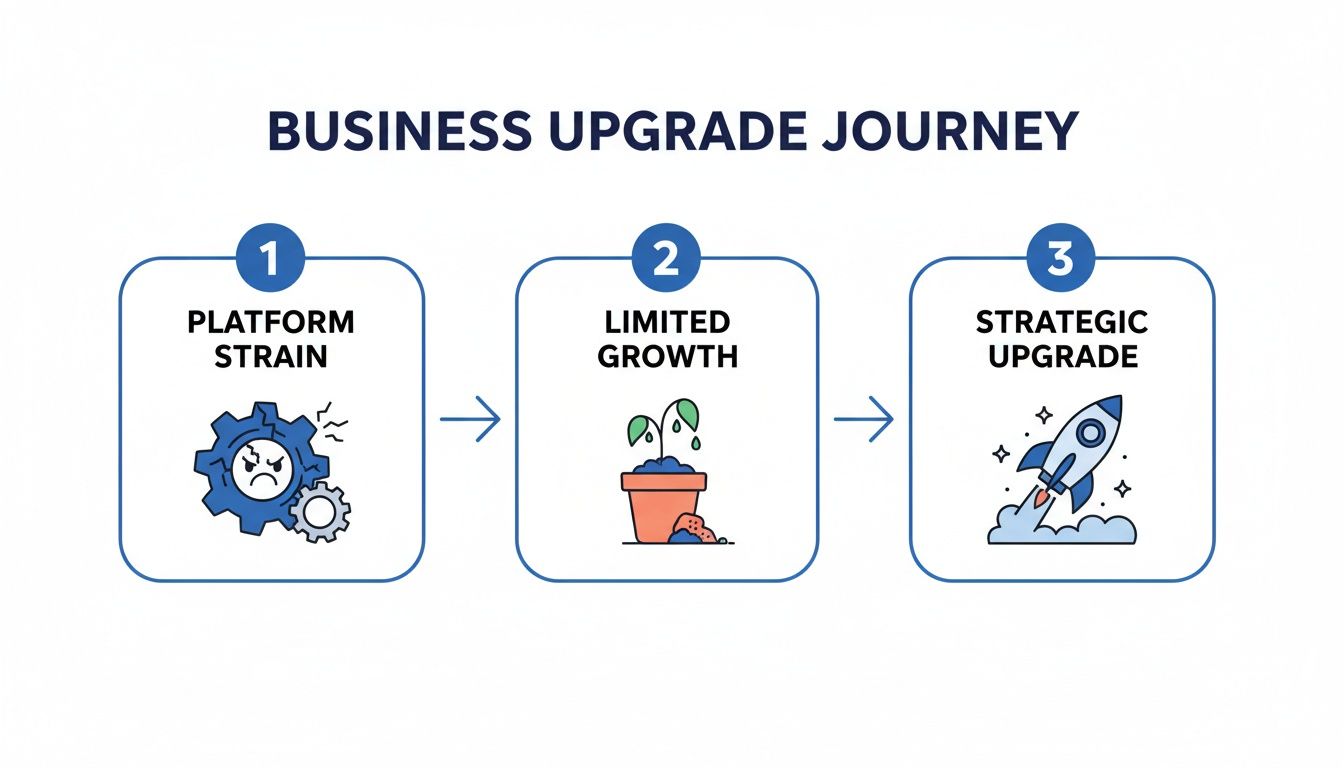
Each step is a deliberate move from being held back by operational limits to seizing new growth opportunities.
To give you a clearer picture of how this all comes together, here's a typical timeline. Keep in mind that every project is unique, but this gives a solid overview of what to expect.
Shopify Plus Migration Timeline and Key Activities
| Phase | Typical Duration | Key Agency Activities | Your Role |
|---|---|---|---|
| Audit & Discovery | 1-2 Weeks | Deep-dive audit of tech stack, SEO, and data. Requirement gathering workshops. | Provide access to current platform, analytics, and key team members for interviews. |
| Planning & Strategy | 1-2 Weeks | Project roadmap creation, solution architecture, design wireframing, and KPI definition. | Review and approve the project plan, wireframes, and strategy. Sign-off on the scope. |
| Design & Build | 4-8 Weeks | UI/UX design, custom theme development, app integration, and bespoke feature builds. | Provide feedback on designs at key milestones. Attend regular progress meetings. |
| Data & Testing | 2-3 Weeks | Data migration (products, customers, orders). Full QA and user acceptance testing (UAT). | Review migrated data samples. Perform your own UAT to confirm functionality meets needs. |
| Launch & Support | 1 Week (Launch) + 30-90 Days (Support) | Go-live execution, DNS changes, post-launch monitoring, bug fixes, and team training. | Give final launch approval. Learn the new platform and communicate any issues. |
This structured approach ensures that by the time you launch, you’re not just going live—you're going live with confidence.
The Groundwork: Pre-Migration Audit
Before a single line of code is written, any good agency starts with a deep dive into your current setup. This isn't a quick glance; it's a comprehensive pre-migration audit that becomes the blueprint for the entire project. The aim is to map out your entire e-commerce ecosystem.
During this discovery phase, the agency will:
- Analyse Your Tech Stack: They'll meticulously document every app, integration, and custom script you use. This helps decide what can be replaced with a native Shopify feature, what needs a new app, and what might require a custom build.
- Assess SEO Health: A full SEO audit is non-negotiable. We’re talking about mapping all your current URLs, cataloguing meta-data, and getting a baseline for your keyword rankings. This is all about protecting your hard-won search traffic.
- Review Data Structures: The team will examine how your product, customer, and order data is organised. This is where potential migration headaches are spotted early, like complex customer groups or unusual product variants.
This audit is all about identifying and solving problems before they happen. Catching roadblocks here means the migration plan can address them from day one, preventing nasty surprises down the line.
The Blueprint: Planning and Strategy
With the audit complete, the focus shifts to creating a solid plan. This is where your business goals are translated into a technical specification. A skilled agency will run strategy sessions to define exactly what success looks like for your business on the new platform.
Your objectives are clearly defined and documented. Are you aiming for a 15% lift in conversion rates? Do you need to offer a smoother checkout for international customers? Maybe the big win is simply giving your marketing team more control without needing a developer. These key performance indicators (KPIs) make sure everyone is working towards the same goals.
For many UK businesses, the financial case is a massive driver. We often see companies on platforms like Magento cut their annual running costs by 40-60% within a year of moving to Plus. When you consider that Magento's yearly upkeep can range from £40,000 to £120,000, the savings are substantial. Even with Shopify Plus starting at $2,300/month, most brands find they recoup their entire migration investment in just 12-18 months from these efficiencies alone.
The Build-Out: Design and Development
Now for the exciting part—where your new storefront starts to become a reality. Using the strategic plan as a guide, the agency’s designers and developers get to work creating a bespoke, high-converting experience on Shopify Plus. This is so much more than just customising a theme; it’s about building a digital asset that’s perfectly suited to your brand and your customers.
A huge focus here is Conversion Rate Optimisation (CRO). Every decision, from the layout of a product page to the design of a button, is made with one question in mind: "Does this make it easier for a customer to buy?"
The entire build happens in a private development store, so your current site continues to run without any interruption. You'll get to see the progress and give feedback at key stages, making sure the final result is exactly what you envisioned. This is where true collaboration in Shopify migration services really shines, ensuring a seamless and predictable outcome.
The Move: Data Migration and Testing
With the new store built, it's time to bring your data across. This is a careful, systematic process. Your agency will use specialist tools and custom scripts to transfer your products, customer accounts, and order history, making sure everything lands in the right place.
Once the data is in, the testing phase begins. This is where the Quality Assurance (QA) team puts the new site through its paces, checking everything from top to bottom:
- The functionality of all apps and integrations.
- The user experience across different devices (desktop, mobile, tablet).
- The entire purchase journey, from adding to cart to the final order confirmation.
- Crucial 301 redirects to ensure your SEO authority is passed to the new URLs.
Go-Live: Launch and Post-Launch Support
After all the building, testing, and your final approval, it's time to flick the switch. The agency will schedule the launch for a quiet time, usually overnight or on a weekend, to ensure a smooth transition. For your customers, the switch is instant—there’s virtually zero noticeable downtime.
But the job isn’t finished at launch. A top-tier agency provides dedicated post-launch support. They’ll monitor the site for any teething issues, keep a close eye on analytics to ensure KPIs are on track, and be available to help your team get up to speed. This ongoing partnership is what turns a one-off project into a long-term investment in your growth.
Moving your e-commerce store is much more than just a digital facelift. The real heart of the operation lies in a complex web of interconnected systems—the software that manages your inventory, talks to your customers, and gets parcels out the door. Get this wrong, and you don’t just have a buggy website; you have a business that’s ground to a halt.
This is where a seasoned Shopify Plus agency earns its keep. They’re the experts who can untangle this knot and ensure your business's core functions are seamlessly transplanted to the new platform.
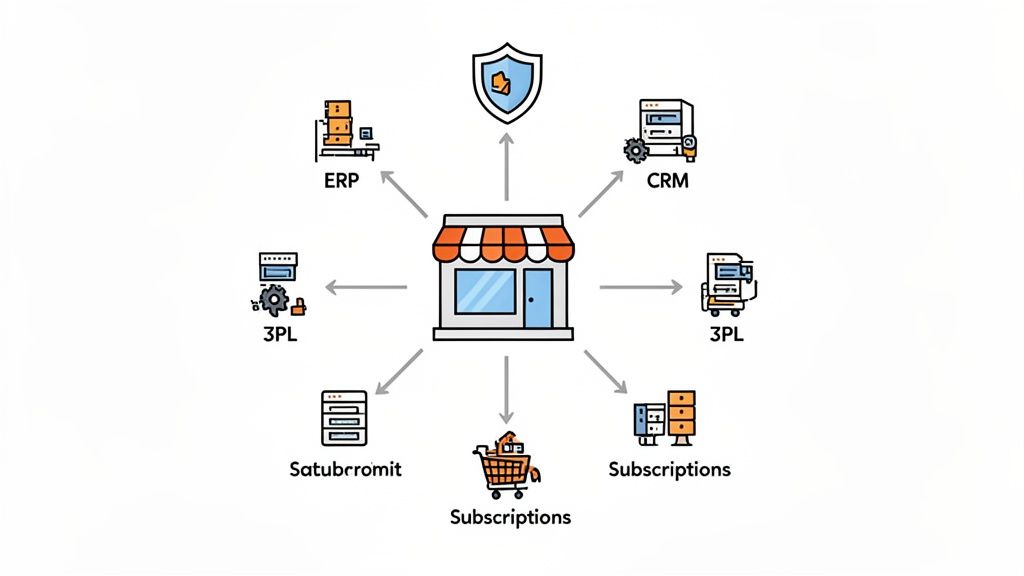
The trick isn’t just plugging the old systems into the new site. The true test is making sure the right data flows between them instantly and accurately from the moment you go live. A slip-up with your Enterprise Resource Planning (ERP), Customer Relationship Management (CRM), or third-party logistics (3PL) systems can cause a domino effect of lost orders, phantom stock, and some very unhappy customers.
Weaving in Your Core Business Systems
For any growing brand, the ERP is the master record for products and stock. Integrating it properly with Shopify Plus is absolutely fundamental. An agency won't just 'connect' it; they'll architect a solution, perhaps with custom middleware or a heavy-duty connector, to make the two systems speak the same language. The result? When stock levels change in your warehouse, your storefront knows about it in near real-time, putting an end to overselling.
Your CRM is just as vital, holding all that hard-won customer information. A proper migration ensures that when a new customer signs up or places an order on Shopify Plus, that activity is instantly logged in your CRM. This gives your marketing and service teams a single, complete picture of every customer's journey without having to jump between different dashboards.
Here’s what a good agency will focus on:
- ERP Integration: Syncing product data, inventory, complex pricing, and orders between your back-office system and Shopify Plus.
- CRM Integration: Making sure all customer details, their order history, and any marketing tags or segments flow seamlessly between platforms.
- 3PL & Fulfilment Integration: Setting up an automated workflow where orders are sent directly to your logistics partner, with tracking information then fed back into Shopify for the customer.
The real win isn't just connecting A to B. It’s about building an automated, two-way conversation between your systems. This cuts down on manual data entry, dramatically reduces human error, and makes your entire operation run more smoothly.
The Special Case of Subscriptions
Migrating subscribers is, without a doubt, one of the most high-stakes parts of any e-commerce migration. We're not just moving customer names; we're handling recurring billing schedules, sensitive payment tokens, and custom product bundles. A single mistake here doesn't just lose you a sale—it can sever an ongoing customer relationship and disrupt your predictable revenue stream.
An experienced agency knows the minefield they're navigating. They use proven, secure methods and often work directly with the teams behind subscription apps like ReCharge or Smartrr. Their job is to ensure every subscriber is transferred with their billing cycle, next order date, and payment method perfectly intact.
The process is incredibly detailed and typically involves:
- Secure Token Transfer: Working with payment gateways to safely move encrypted payment details without ever exposing the raw data.
- Precise Data Mapping: Painstakingly matching every customer's subscription plan, product choices, and delivery frequency to the new setup.
- Rigorous Validation: Running a small, controlled test batch of subscriptions to confirm recurring orders process flawlessly before migrating the entire customer base.
Protecting Your Data's Past and Future
Beyond the big system integrations, your agency's job is to protect the integrity of all your historical data—every last order and customer account. For security reasons, customer passwords can never be migrated. Instead, a good agency will set up a slick, user-friendly process that prompts customers to reactivate their accounts with a new password on their first visit.
They’ll use custom scripts and powerful data tools to extract, clean, and map years of order history and customer records into Shopify Plus. This preserves vital information, from order dates to specific product variants. After the transfer, they perform exhaustive checks to make sure everything lines up. It’s this meticulous work that ensures when you look up an order from three years ago in your new dashboard, it’s all there, just as it should be.
Protecting Your SEO and Driving Higher Conversions
Moving your store to a new platform can be nerve-wracking. The biggest fear I hear from merchants is watching years of hard-earned search rankings vanish after a migration. It's a valid concern. On one hand, you're excited about a faster, more capable site; on the other, you're terrified of losing the organic traffic you fought for.
This is exactly where an experienced Shopify Plus migration agency shows its worth. A properly handled migration isn't just about preventing a drop in traffic. It's a golden opportunity to build a stronger SEO foundation for future growth. It all comes down to having a meticulous plan from day one.
Securing Your Search Engine Rankings
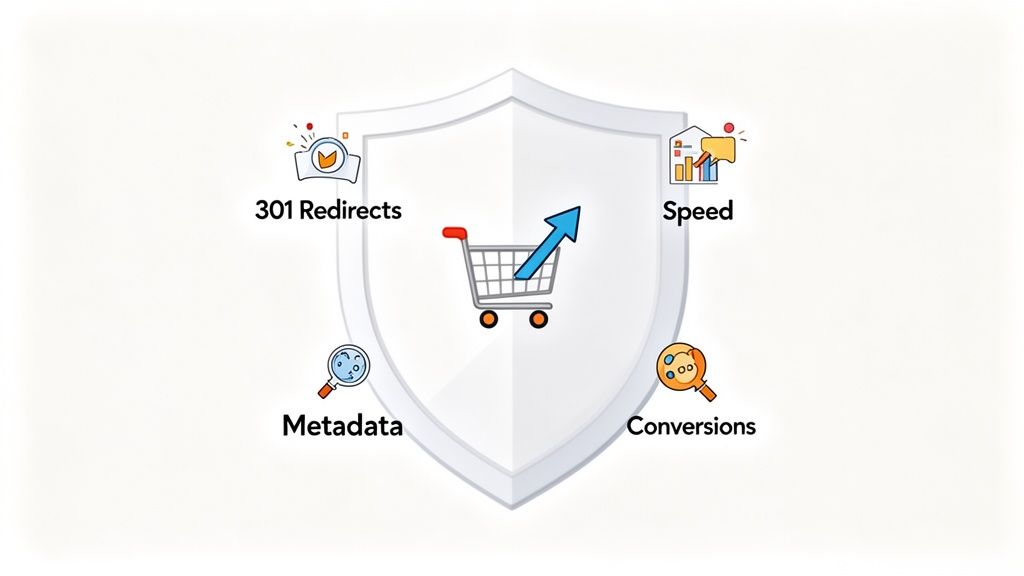
The single most critical task for protecting your SEO is creating a bulletproof 301 redirect map. This isn't just about pointing old links to your new homepage—that’s a recipe for disaster. We're talking about a granular, page-by-page map that tells search engines precisely where every single product, collection, and blog post has moved.
A good agency will start by crawling your entire existing site to capture every URL. From there, they'll painstakingly match each old link to its new home on Shopify Plus. When Google comes looking for an old page, this map guides it seamlessly to the new one, passing along all that valuable link equity and ranking power.
Of course, redirects are just one piece of the puzzle. Other essential tasks include:
- Metadata Migration: Systematically moving all your meta titles, descriptions, and H1 tags to the corresponding new pages. You don't want to lose that optimised copy.
- Canonical Tag Review: Double-checking that canonical tags are set up correctly, which is crucial for avoiding duplicate content issues, especially with product variants.
- Post-Launch SEO Audit: As soon as the new site is live, your agency should run a full technical audit. This helps catch any sneaky broken links, redirect chains, or crawl errors before they can do any real damage.
When these technical details are handled with precision, a migration can actually become a chance to fix old SEO problems. You can learn more about the specifics in our complete guide to Shopify migration SEO preservation.
A successful Shopify Plus migration goes beyond technical transfer; it's about optimising your online store to boost your ecommerce customer experience and ultimately drive higher conversions. This transition is the perfect moment to rethink every element of your site with performance in mind.
Turning Migration into a Conversion Machine
While protecting your existing assets is crucial, the real magic of a migration is in the opportunity to build something better. Think of it as your chance to design a store that’s laser-focused on conversions from the ground up, turning a technical project into a powerful revenue generator. A great agency doesn't just copy your old site; they completely rebuild it for peak performance.
This is particularly true for UK brands. The UK e-commerce scene has seen an explosion of Shopify Plus stores, with projections showing a massive jump from around 1,000 in 2023 to over 5,700 by 2026. This boom is driven by the platform's ability to deliver the fast checkouts and slick mobile experiences that customers now expect.
Optimising for Speed, Mobile, and Sales
A Conversion Rate Optimisation (CRO) mindset should be at the very heart of the new design. Your agency will use Shopify Plus’s robust infrastructure to make major improvements in the areas that matter most.
- Lightning-Fast Page Speed: Using modern, lightweight themes and smart image optimisation, your new site will be noticeably faster. A one-second delay can slice 7% off your conversion rate, so speed is pure profit.
- Superior Mobile UX: With most online sales happening on phones, a flawless mobile experience is no longer optional. The new design should be built mobile-first, not just as a shrunken-down version of the desktop site.
- A Smoother Checkout: Shopify Plus offers a highly refined and customisable checkout process designed to reduce cart abandonment. Features like Shopify Payments and Shop Pay create the kind of one-click buying that keeps customers coming back.
By focusing on these key areas, your agency ensures the migration doesn't just keep your business afloat—it gives it a powerful engine for growth. You end up with more than just a new website; you get a high-performance sales tool built to increase average order value and turn more visitors into loyal customers.
How to Choose the Right Shopify Plus Migration Agency
Picking the right partner for your move to Shopify Plus is, without a doubt, the single most critical decision you'll make. The experience, communication, and skill of your agency will make or break your migration. You're not just looking for a technical team to move data; you're looking for a strategic partner who genuinely gets your business goals.
Make the wrong choice, and you could be looking at blown budgets, missed deadlines, and a launch day plagued by technical fires. The right Shopify Plus migration agency, on the other hand, acts like an extension of your own team. They’ll navigate the complexities for you and set your brand up for real, long-term growth.
Vetting Criteria: Your Checklist for Potential Partners
Before you even think about getting on a call, you need a solid checklist to cut through the noise. Your first pass should be all about finding tangible proof that an agency has the right expertise and a history of successful projects like yours.
Here’s what to look for from the get-go:
Official Shopify Plus Partner Status: This is your first filter. It's non-negotiable. An official partner has been thoroughly vetted by Shopify itself for their technical skills, quality of work, and proven experience with enterprise-level merchants.
Relevant Case Studies: Don't get distracted by flashy portfolios. You need to see detailed case studies from migrations that mirror your own in complexity and scale. If you have complex integrations or need international storefronts, look for direct evidence that they've handled it before.
Technical and Design Capabilities: Take a hard look at their past work. Do their sites feel like they came from a template, or are they creating unique, high-performing experiences? A top-tier agency will have a strong portfolio that shows off both stunning design and serious technical chops, like custom app development or complex theme customisations.
This initial screening helps you build a strong shortlist, saving you a ton of time later on. For a deeper dive, you can explore some proven strategies for finding the right agency that aligns with your brand's vision.
Agency vs. In-House: Which Path to Take?
One of the first debates many businesses have is whether to use their internal team or hire a specialised agency. While going in-house might look like it saves money upfront, it’s a path loaded with hidden costs and significant risks.
When you're weighing your options, it helps to see a direct comparison of the risks and benefits involved.
Agency vs In-House Migration: A Risk and Benefit Comparison
| Factor | Specialised Agency | In-House Team |
|---|---|---|
| Speed | Significantly faster timeline due to established processes and a dedicated, experienced team. | Much slower, as your team is forced to learn on the job while juggling their normal duties. |
| Cost | A higher, but predictable, initial investment that delivers a stronger ROI. | Lower initial cost but a high risk of budget creep from unforeseen errors and delays. |
| Risk | Lower risk of critical mistakes like data loss, broken integrations, or damaging your SEO. | Higher risk of costly errors that can directly impact your revenue and search rankings. |
| Expertise | Deep experience from dozens of migrations means they can anticipate and avoid common pitfalls. | Limited migration experience almost guarantees you'll hit unforeseen technical roadblocks. |
The growth in Shopify Plus adoption in the UK really tells the story. We’ve seen a massive boom in brands upgrading, with 564 companies making the leap in the last year alone. That trend has helped the platform more than triple to over 5,700 UK stores by 2026. For ambitious UK brands needing a complete rebuild or international expansion, an expert agency is the default choice because it slashes the risks of a drawn-out, costly in-house project.
Essential Questions to Ask Potential Agencies
Once you have your shortlist, it’s time to start the interviews. The questions you ask now are what will truly reveal an agency’s process, culture, and expertise. You need to go deeper than just asking, "How much will it cost?"
Here are a few crucial questions to guide those conversations:
"Can you walk me through your project management and communication process?" You’re listening for specifics here. A great answer will mention a dedicated project manager, a regular schedule for meetings (like weekly syncs), and a shared workspace like Slack or Asana for day-to-day updates. Transparency is everything.
"How do you handle scope changes or unexpected problems during a project?" A professional agency won’t be fazed by this question. They should have a clear change request process, explaining how they document, estimate, and get your approval for any work that falls outside the original plan. This is how you avoid surprise bills.
"What does your post-launch support look like?" The work doesn't stop the day you go live. Ask about their warranty period for fixing bugs (usually 30–90 days) and what options they offer for ongoing retainers to handle continuous improvements and support.
A confident, experienced agency will welcome these tough questions. If you get vague answers or they seem reluctant to get into the details, consider it a major red flag. You're looking for clear, process-driven responses that give you total confidence in their ability to deliver.
Common Questions About Migrating to Shopify Plus with an Agency
Thinking about moving to Shopify Plus? You've probably got a lot of questions. That's a good thing. Going in with your eyes open helps you set a realistic budget, understand the timeline, and know exactly what to expect from an agency partnership.
We've handled countless migrations, and we find the same key questions come up time and again. Let's get them answered so you can move forward with confidence.
What’s the Realistic Cost of a Shopify Plus Migration with an Agency?
This is the big one, and the honest answer is: it varies. The investment really depends on the complexity of your business. For a relatively simple migration, you might be looking at a starting point around £8,000.
However, for larger stores with intricate customisations, bespoke theme work, and multiple system integrations, the budget can fall anywhere between £25,000 and £40,000, or even higher.
The main cost drivers we see are:
- Data Volume: How many products, customers, and orders need to be moved over?
- Integrations: The complexity of hooking up your ERP, CRM, 3PL, and other third-party systems is often the biggest variable.
- Custom Design: Are we adapting a premium theme, or are you looking for a completely bespoke design built from the ground up?
Any good agency will give you a detailed quote after a proper discovery call. While it's a significant investment, most of our clients see a clear return within 12-18 months from higher conversion rates and smoother operations.
How Long Does a Typical Shopify Plus Migration Take?
From our experience, a professionally managed migration usually takes between four and twelve weeks, from the initial kickoff meeting to the final launch. Trying to rush this is a classic mistake that leads to costly errors down the line. A structured timeline is non-negotiable.
The process isn't just a single event; it's a series of well-defined phases. We start with a week or two of discovery and planning to map everything out. Then comes the bulk of the work – design and development – which can take anywhere from two to six weeks. After that, we move into a critical data migration and testing phase for one to three weeks before a final week of checks and launch prep.
This phased approach ensures nothing is missed and everyone is on the same page before the big switch.
Will My Store Experience Downtime During the Migration?
No, there should be virtually zero downtime. This is a major point of concern for merchants, but a professional migration is designed to be seamless. Your new Shopify Plus store is built and tested in a separate, password-protected development environment. Your existing site just keeps running and taking orders as usual.
The "go-live" moment is really just a carefully planned switch. We point your domain to the new, fully-tested Shopify store. This is always scheduled for a low-traffic period—think overnight or on a quiet weekend—making the transition completely invisible to your customers.
What Happens to My Customer Data and Order History?
Protecting and moving your data is one of the most critical parts of the job. Your migration partner is responsible for transferring your entire customer database, complete order history, product catalogues, and all the little bits of data attached to them. It's a meticulous process that simply can't be rushed.
We use specialised scripts and tools to pull data from your old platform, clean it up, and map it perfectly to Shopify’s architecture to ensure total data integrity. One important thing to note: for security, customer passwords can't be migrated. Instead, your agency will set up a simple account reactivation flow, prompting customers to create a new password on their first visit.
After the migration, we always run a thorough validation to triple-check that every piece of information has landed correctly in its new home.
Ready to scale your e-commerce operations without the migration headaches? Grumspot is a Shopify Plus agency that specialises in seamless migrations, bespoke theme development, and conversion-focused design. We turn complex technical challenges into powerful growth opportunities. Book a call with us today to discuss your project.
Let's build something together
If you like what you saw, let's jump on a quick call and discuss your project
Related posts
Check out some similar posts.
- ecommerce replatforming agency
Choosing an ecommerce replatforming agency? Learn what they do, replatforming signs, costs, timeline...
Read more
- data migration
Learn how to validate data after migration with proven reconciliation methods, sample queries, autom...
Read more
- web design agency sheffield
Find the best web design agency Sheffield. Our 2026 guide covers vetting portfolios, pricing, Shopif...
Read more
- how to choose a web design agency
Learn how to choose a web design agency that drives real results. Our guide covers vetting portfolio...
Read more