Shopify Monthly Development Plan: Scale Your Store in 2026
- Shopify monthly development plan
- Shopify retainer
- ecommerce development
- Shopify agency
- Shopify support
Launched
May, 2026

You're probably in one of two situations right now. The first is familiar: the store is live, sales are coming through, and your team keeps adding requests to a growing list of “small” fixes that never stays small. A landing page tweak. A product template issue. An app conflict. A checkout edge case. Nothing feels catastrophic on its own, but together they keep pulling attention away from growth.
The second situation looks better on paper but feels just as frustrating. You've already invested in one-off Shopify projects. The site got redesigned, a feature launched, maybe a migration happened, and then momentum disappeared. A few months later, performance stalls, technical debt creeps in, and the next improvement turns into another big, expensive restart.
That's where a Shopify monthly development plan matters. Not as a helpdesk. Not as a bucket of hours. As an operating rhythm that keeps design, development, conversion work, and technical upkeep moving in the same direction every month.
When it's structured properly, a retainer gives a scaling ecommerce brand something project work rarely does: continuity. The agency learns your store, your catalogue, your stack, your margins, your bottlenecks, and your commercial priorities. Instead of asking, “What do you want built?” every few weeks, they help answer, “What should we improve next, and why?”
Beyond the Cycle of Fixes and Firefighting
Most Shopify teams don't struggle because they lack ideas. They struggle because execution arrives in bursts.
A campaign goes live, and the site needs landing page changes fast. Then a theme issue appears on mobile. Then someone notices the PDP isn't helping bundle uptake. Then a review app slows key pages. The team reacts, patches, moves on, and tells itself it'll get back to the bigger roadmap next month. Next month rarely arrives in a clean, organised way.
That reactive loop creates three problems at once:
- Priority drift: urgent tickets beat important work, so conversion improvements keep slipping.
- Technical drag: quick fixes pile up in the theme and app stack, which makes future changes slower.
- Commercial inconsistency: merchandising, UX, and development stop moving together.
The result isn't usually dramatic failure. It's slower growth than the brand should be capable of.
Practical rule: if your roadmap changes every week but your underlying problems stay the same every quarter, you don't have a capacity problem alone. You have a planning problem.
A monthly development plan changes the cadence. Instead of waiting for a major rebuild or raising tickets only when something breaks, the store gets a standing system for improvement. That system usually combines maintenance, prioritisation, experimentation, and implementation in one retained relationship.
For a scaling brand, that matters more than many teams realise. Competitors don't always win because they made one brilliant move. Often, they win because they kept making sensible moves without long gaps between them.
Why monthly rhythm matters
A store grows when the team can improve it while it's trading. That means balancing immediate needs with work that compounds over time.
A good monthly plan creates room for both. It keeps the storefront stable enough to sell, while reserving capacity for the work that increases average order value, improves user experience, removes friction, and supports new channels or markets.
What usually doesn't work
The weak version of a retainer is simple. You buy hours, send tasks, and hope the agency handles them.
The stronger version is operational. There's a backlog, a decision-maker, a sprint rhythm, recurring review points, and clear ownership of what gets done now, later, or not at all. That's the model that turns retained development into a growth engine rather than background support.
What is a Shopify Monthly Development Plan?
A Shopify monthly development plan is a retained partnership with a Shopify agency or specialist team that works on your store continuously rather than through isolated projects. The best way to think about it is as an on-demand extension of your in-house team. You're not hiring one freelancer for isolated tickets. You're getting access to a mix of capability, typically strategy, UX, front-end development, Shopify theme expertise, app integration support, and prioritisation.
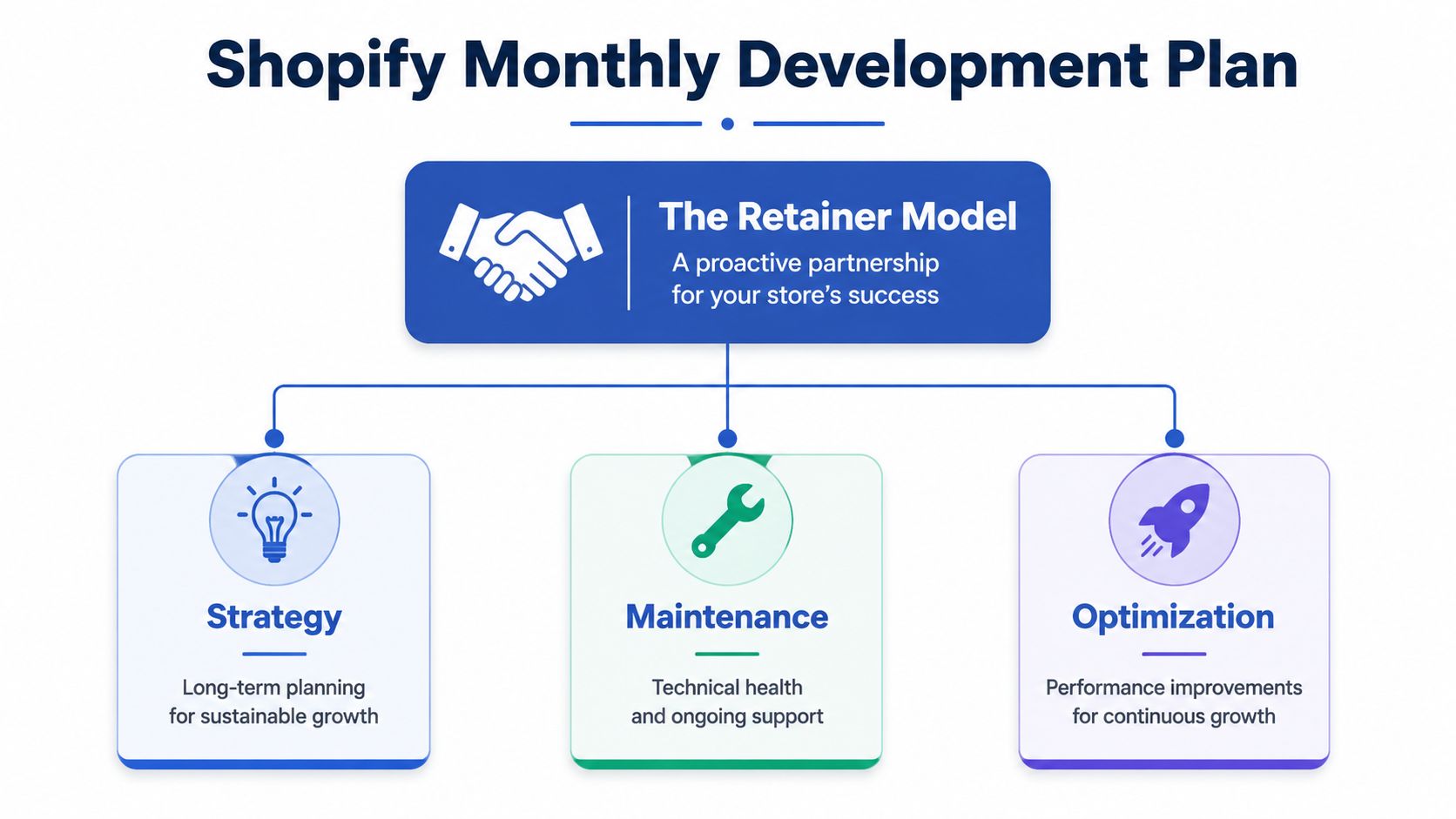
That matters because Shopify growth work is rarely one discipline. A conversion issue might begin with analytics, move into UX, touch Liquid or theme architecture, and end with QA across devices. If you treat each of those as separate purchases, you create delay and handoff risk. A monthly plan keeps those functions connected.
It's not a Shopify product
This point is easy to miss. Shopify itself does not offer a distinct monthly development plan. Agencies and developers typically build this service around Shopify's plan structure for live stores, and around free Shopify Partner development stores for safe build and test workflows. Those Partner stores provide unlimited stores without monthly fees but prohibit live transactions, which is useful for agencies handling GDPR-conscious testing and custom build work. Using Partner development stores can reduce overhead by 100% during development phases and has been linked to 68% faster go-to-market in Shopify Partner UK case studies from 2025, according to the Shopify Community discussion on plans for developing apps.
Retainer versus ticket queue
The simplest way to distinguish the model is this:
| Model | How it works | Typical outcome |
|---|---|---|
| Project work | defined scope, start date, end date | one major deliverable |
| Support plan | reactive fixes and incident handling | store stability |
| Monthly development plan | ongoing roadmap, delivery, testing, maintenance, optimisation | continuous store improvement |
A support plan keeps things running. A development plan keeps things moving.
That distinction affects how the agency thinks. In a support arrangement, the question is usually, “What broke?” In a development retainer, the question becomes, “What will open up the next layer of growth?”
What the relationship looks like in practice
A well-run retainer usually includes a blend of workstreams rather than one fixed category of task:
- Planned development: theme changes, landing pages, merchandising features, app integrations, content model improvements.
- Technical maintenance: bug fixing, compatibility issues, app conflicts, QA, speed-related clean-up.
- Optimisation work: PDP improvements, cart friction reduction, bundle logic, merchandising experiments, UX refinements.
- Strategic guidance: backlog grooming, sprint planning, roadmap decisions, trade-off calls.
A monthly plan works best when the agency understands not just your storefront, but your commercial model. Margin pressure, stock depth, repeat purchase patterns, promotional cadence, and channel mix all affect what should be built first.
Why scaling brands choose this model
Hiring internally can make sense, but many brands aren't ready to recruit a Shopify developer, a UX designer, and a CRO strategist at the same time. A monthly plan creates access to those capabilities without committing to a full internal team structure.
That's why the retainer model often fits brands that have moved beyond launch mode but don't yet want to build a large in-house ecommerce team. They need momentum, coverage, and decision support more than they need a single pair of hands.
Inside the Plan Key Components and Pricing Models
Retainers become easier to evaluate once you stop thinking in vague terms and start looking at the moving parts. The monthly fee usually sits on top of your Shopify subscription and app stack. For UK merchants, the live store foundation still starts with Shopify's plan tiers. The Basic plan costs £29 per month when billed annually, while Advanced costs £299 per month when billed annually. Agencies then layer in retained development, which often ranges from £500 to £10,000+ monthly, according to Elsner's breakdown of Shopify development cost. That same source notes this layered model sat within a period where Shopify saw 30% overall revenue growth in Q1 2025.
What you're actually buying
The strongest monthly plans aren't just “developer time”. They usually combine four operational components.
- Allocated execution capacity: a defined monthly block for design, development, QA, and implementation.
- Response expectations: agreed handling times for urgent issues, often documented as service levels.
- Communication rhythm: weekly calls, async updates, backlog reviews, and monthly planning.
- Commercial prioritisation: someone helps decide what deserves attention first.
Without that fourth piece, the retainer often degrades into task fulfilment.
Typical scope categories
Most retained Shopify work falls into a recurring mix:
- Storefront improvements: theme sections, navigation changes, collection logic, content blocks, campaign pages.
- Conversion work: PDP layout testing, cart and mini-cart tweaks, bundle UX, trust signals, upsell logic.
- Technical health: bug fixes, app cleanup, theme refactoring, regression QA, performance-related maintenance.
- Platform work: Shopify 2.0 updates, integration support, workflow setup, feed or data handling.
A mature agency will usually separate “must do now” work from “high-value next” work, because they're rarely the same thing.
Common pricing models
Not every agency prices retainers the same way, but most plans fall into one of these structures:
| Pricing model | How it works | Best fit |
|---|---|---|
| Fixed monthly hours | You buy a set block of execution time each month | brands with steady task volume |
| Tiered package | predefined service level with a broad scope and cadence | brands that want easier budgeting |
| Value-led retainer | pricing tied more closely to complexity, senior input, and business need | brands with strategic rather than purely production needs |
Fixed hours are easy to understand, but they can encourage shopping-list behaviour. Tiered retainers often work better because they package planning, communication, and execution together.
Example Shopify Monthly Development Tiers
| Tier | Ideal For | Monthly Hours | Typical Tasks |
|---|---|---|---|
| Foundation | recently launched stores that need steady upkeep | 10 to 20 | bug fixes, theme edits, app setup, small UX improvements |
| Growth | brands running active campaigns and frequent merchandising changes | 20 to 40 | landing pages, PDP updates, CRO tests, app rationalisation |
| Scale | established stores with multiple teams and a fuller roadmap | 40+ | sprint-based delivery, custom feature work, integration support, ongoing optimisation |
These are example structures, not market-wide standards. The point is to judge whether the plan matches your operating reality.
The hidden variable is process
Two agencies can quote the same monthly fee and deliver very different value.
One may spend most of the time waiting for tickets, clarifying scope, and moving tasks around. Another may run a clean process with a backlog, weekly priorities, QA discipline, and senior strategic oversight. From the client side, both look like “a retainer”. In practice, one buys motion and the other buys progress.
If the proposal only describes hours and not working method, reporting, prioritisation, and ownership, you're probably being sold labour rather than a development system.
The Business Case Retainer vs Project Work
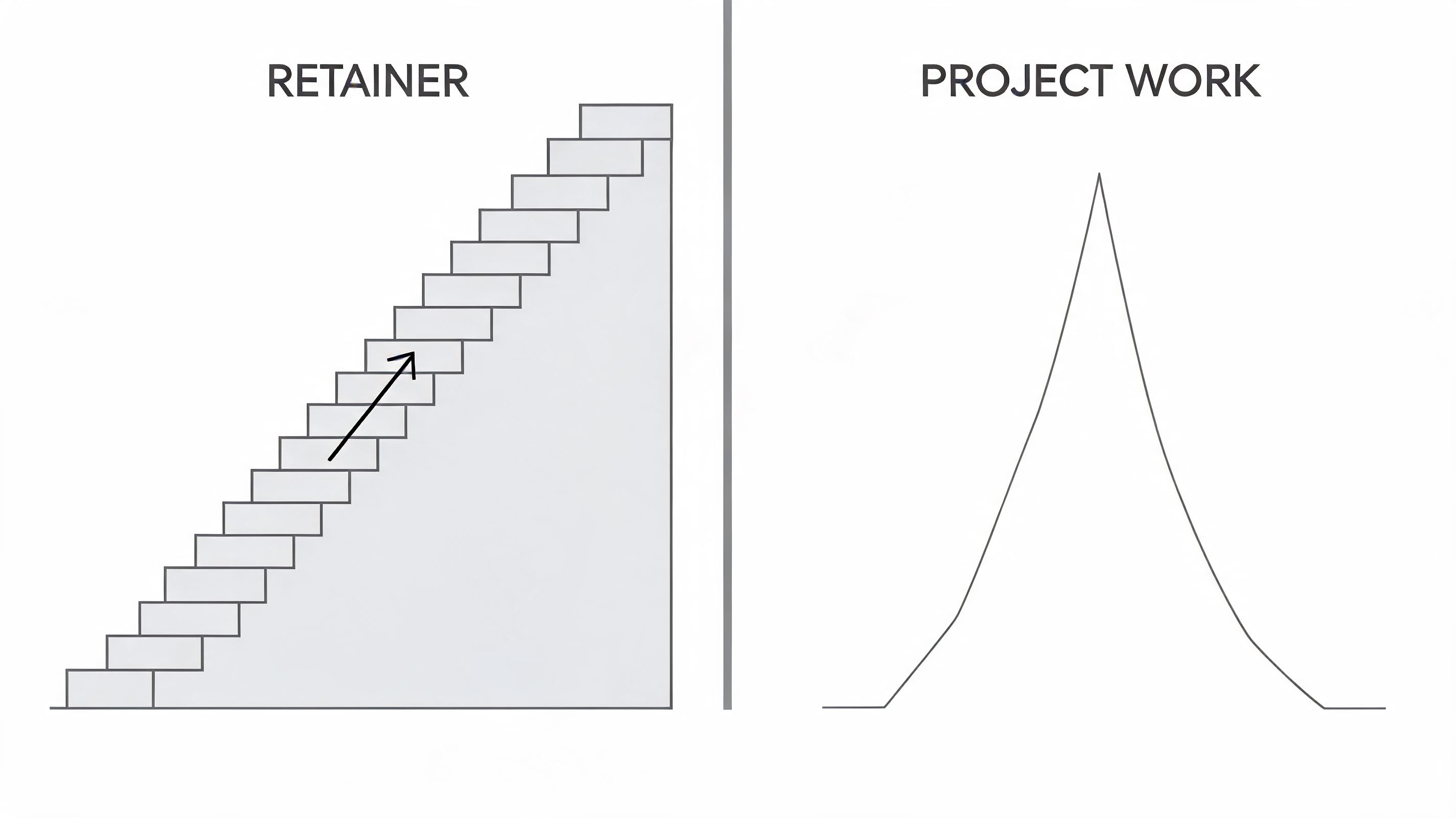
Project work still has a place. If you need a full store build, a replatform, or a defined migration, a project is often the right commercial shape. The problem starts when brands try to run an evolving ecommerce operation through a sequence of disconnected projects.
That approach looks efficient at first. You pay for a clear deliverable, launch it, and move on. But stores don't stand still after launch. Product ranges change, campaigns change, customer expectations change, app stacks change, and internal teams start spotting opportunities the original scope never covered.
Where project work wins
A project model is usually the right choice when:
- The scope is finite: store launch, redesign, migration, or a major rebuild.
- The business has a single urgent objective: for example, moving to Shopify 2.0 or replacing a core integration.
- Internal ownership is strong: someone in-house can carry momentum once the project ends.
For that kind of work, a project creates focus. It forces clarity, a deadline, and a defined output.
Where the retainer model wins
A monthly development plan becomes more valuable when the problem isn't one deliverable but an ongoing sequence of improvements.
According to Chargeflow's Shopify statistics overview, the shift from project-based work to a monthly retainer often happens as a UK store scales past £8,000 in monthly revenue. For stores reaching £30,000+ in sales, access to Shopify Flow automation and CRO becomes more critical. The same source notes Shopify's international GMV grew 24% year over year in 2024.
That fits what many agencies see in practice. Once a store has enough traffic and order volume, commercial gains often come from iteration, not reinvention.
The practical trade-off
Retainers give you four business advantages that project work usually can't.
- Continuity: the team already knows your theme, apps, workflows, and pain points.
- Predictable capacity: you don't restart procurement every time you need meaningful work done.
- Proactive optimisation: work can be planned around opportunity, not only around defects.
- Operational memory: lessons from previous tests and launches stay with the same delivery team.
That last point matters more than people expect. Every project handover loses context. Every new supplier has to relearn assumptions. Every fresh brief introduces interpretation risk.
A retainer reduces those resets. If you want a deeper breakdown of how that ongoing model works, this guide on a Shopify support retainer is a useful companion read.
The wrong way to compare costs
Many brands compare a retainer to a single project quote and decide the project is cheaper.
That's often the wrong comparison. The better comparison is this: what does it cost your team, commercially and operationally, to keep pausing work, rebuilding context, delaying improvements, and treating growth work as occasional rather than continuous?
Project work buys a result. A retainer buys a pace of execution. For a scaling store, pace is often the more valuable asset.
How to Choose and Evaluate a Development Agency
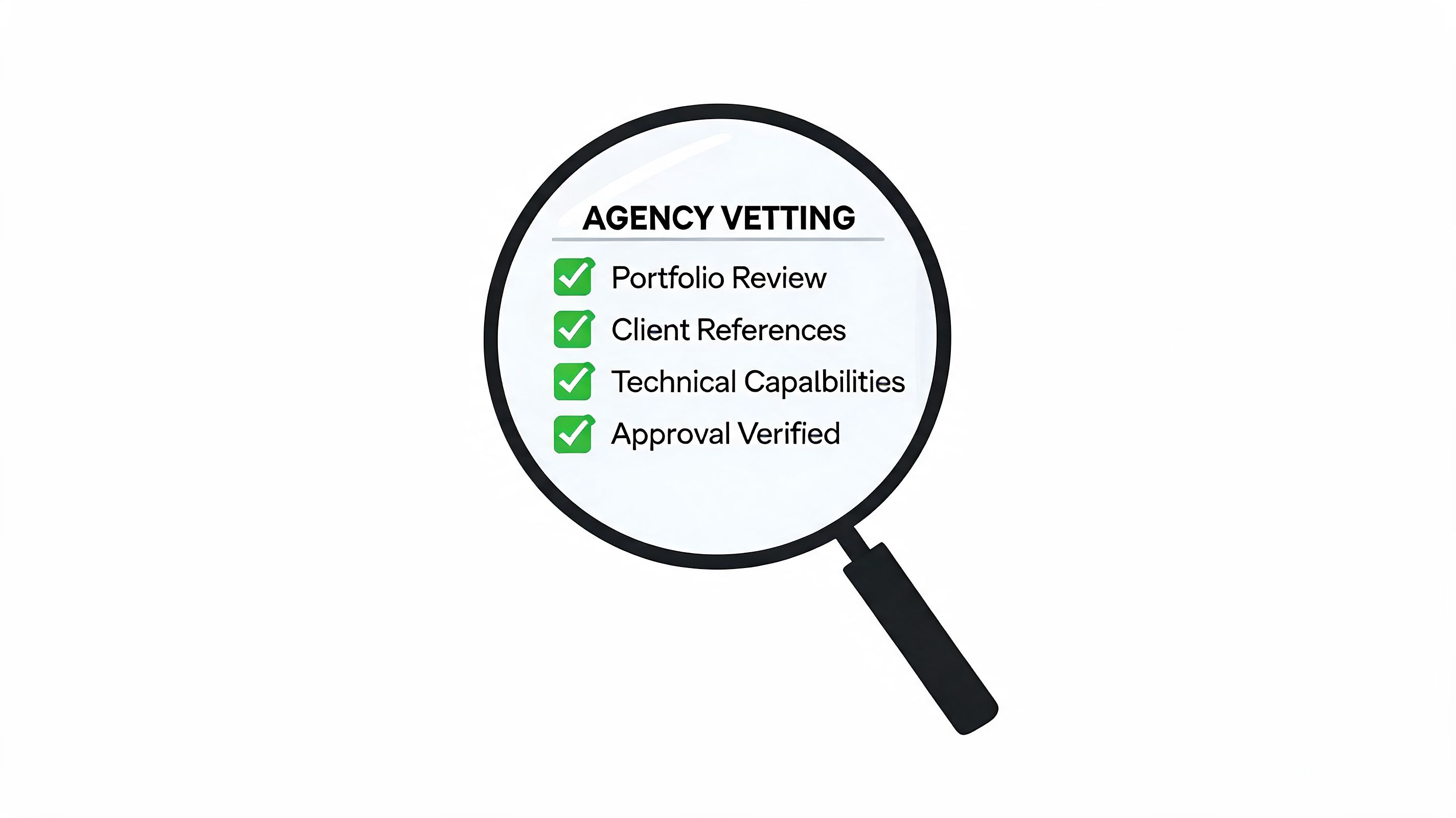
Agency selection gets easier when you stop asking who can do Shopify work and start asking who can run Shopify work in a way that fits your business. Plenty of teams can build features. Fewer can prioritise well, communicate cleanly, and stay commercially aligned month after month.
Start with capability, not pitch polish
The first filter is relevance. You want evidence that the agency has handled stores like yours in complexity, not just in aesthetic style.
Check for these signals:
- Platform depth: can they work confidently in Shopify 2.0, custom theme architecture, app ecosystems, and complex storefront changes?
- Commercial awareness: do they talk about conversion, merchandising, and customer flow, not only about code?
- Systems experience: have they handled ERP, CRM, subscription, or fulfilment integrations where needed?
- Operating maturity: can they explain how work is planned, reviewed, QA'd, and shipped each month?
For Shopify Plus specifically, ask how they use development environments. The Shopify Plus plan documentation states that savvy UK agencies use unlimited development stores to save clients £5k to £15k per month during audits or migrations by avoiding live plan fees. That same workflow is connected to advanced API use and the kind of conversion gains and AOV growth of over 60% that specialist agencies pursue.
Ask process questions that reveal how they really work
A good interview with an agency should feel less like a sales call and more like an operating review.
Use questions like these:
- How do you prioritise a monthly backlog when urgent requests arrive mid-cycle?
- Who owns strategy versus implementation on the account?
- How do you handle QA across devices, browsers, and live trading periods?
- What happens if a planned test or feature underperforms?
- How do you report completed work, open risks, and next priorities?
You can also compare agencies by reviewing a focused Shopify development agency checklist before you start calls.
A useful benchmark for operational expectations is this short video.
Red flags to watch for
Some warning signs appear early if you know where to look.
- They sell hours, not outcomes: the proposal is detailed on volume and vague on prioritisation.
- They can't explain cadence: no clear mention of weekly reviews, monthly planning, or accountability.
- They avoid technical specifics: broad claims about “full-service support” without discussing themes, apps, APIs, or testing methods.
- They don't ask commercial questions: if they never ask about margins, AOV, merchandising goals, traffic quality, or campaign calendar, they're likely treating your store as a design job.
- They promise everything: serious teams are usually clear about trade-offs and constraints.
The best agencies don't just say yes quickly. They tell you what should wait, what should be tested first, and what isn't worth building yet.
Align on KPIs before the first sprint
Not every retainer should optimise for the same metric. AOV may matter more than conversion rate in one business. Speed to campaign launch may matter more than aesthetic refinement in another.
Discuss the few numbers and signals that affect decisions. Common examples include conversion rate, average order value, merchandising uptake, landing page performance, site speed, and operational friction in content publishing. The goal isn't to create a giant dashboard. It's to make sure the agency knows what “better” means for your store.
A Monthly Plan in Action Workflows and Case Studies
The value of a retainer becomes obvious when you watch the monthly rhythm in motion. Most Shopify guidance focuses on annual goals and broader planning, but it often skips the practical mechanics of how work gets done every 30 days. The AWARE development planning article from Shopify Engineering highlights that gap, which is exactly where a structured monthly development plan becomes useful. It turns high-level intent into recurring sprints of A/B testing, feature prioritisation, and technical debt management.
Workflow one for a CRO sprint
A strong CRO month usually starts with a constrained problem, not a vague ambition to “improve conversion”.
Week one is diagnosis. The team reviews behaviour on a specific template or funnel step. That might be a product page where bundle adoption is weak, a cart drawer with poor attachment rates, or a landing page that's doing its job on desktop but not on mobile. The output isn't design yet. It's a prioritised hypothesis.
Week two is build. Design and development work together on the smallest credible implementation. That could be a revised information hierarchy on the PDP, a cleaner bundle selector, or a variant of trust content that's easier to scan. The aim is to launch a meaningful change without turning one experiment into a full redesign.
Week three is QA and release. Devices are checked, merchandising logic is verified, app interactions are tested, and the deployment is timed around the trading calendar.
Week four is review. The team looks at what changed, what didn't, and whether to iterate, roll back, or expand the winning direction.
A good monthly sprint doesn't try to answer every question. It isolates one worthwhile decision, ships it cleanly, and learns fast enough to inform the next month.
Workflow two for technical health
Not all retainer value comes from visible front-end changes. Some of the most profitable months are the ones where the team removes drag.
A common example is app sprawl. Stores often accumulate overlapping apps for reviews, upsells, filtering, subscriptions, pop-ups, or merchandising. Over time, the theme becomes harder to maintain, front-end logic gets messier, and every new change carries more regression risk.
A monthly plan lets that be handled as a managed programme rather than a disruptive overhaul:
- Month one: audit the installed stack, identify overlap, and map theme dependencies.
- Month two: remove or replace lower-value apps, refactor templates, and test user-critical flows.
- Month three: tidy residual code, stabilise the new setup, and document the new baseline.
That kind of work rarely creates a dramatic screenshot for a board deck. It does make every future sprint easier to ship.
What good case work tends to look like
The best retainer outcomes usually come from focused interventions tied to clear commercial intent. In practice, that might mean a custom bundle experience, a cleaner merchandising journey, a Shopify 2.0 migration, or a redesign of a store component that was blocking performance.
One example from agency work in this space is a custom bundle creator that lifted AOV by 61%, which shows how retained development can turn a specific merchandising hypothesis into measurable commercial impact. Another common retainer win is the ability to manage a Shopify 2.0 migration as a sequence of controlled changes rather than one high-risk event.
If you want to see how this kind of work is typically presented, reviewing detailed Shopify case studies is useful because it shows the link between issue, implementation, and result.
Why this rhythm compounds
Project work often produces a spike. Monthly development produces accumulation.
A store with a good retainer doesn't just launch improvements. It gets better at choosing them. The backlog sharpens, the agency learns what the team values, and fewer hours are wasted on re-explaining context or chasing low-impact ideas. That's why the retainer model is less about buying output and more about building a repeatable operating cadence.
Frequently Asked Questions About Shopify Retainers
Are retainers only for Shopify Plus brands
No. A monthly development plan can make sense well before Plus, especially once the store has regular trading volume, ongoing campaign demands, and a growing backlog of improvements. The key factor isn't prestige. It's whether the business benefits from continuous execution.
Smaller stores may only need a light monthly rhythm. Larger stores usually need stronger process, more senior oversight, and broader technical coverage.
What happens to unused hours
That depends entirely on the commercial model. Some agencies allow a limited rollover. Some work on a use-it-or-lose-it basis. Others avoid strict hourly accounting and frame the agreement around delivery capacity instead.
The important thing is to get the rule in writing before signing. If the agency is vague on this point, expect friction later.
Can the plan scale up or down with seasonality
It often should. Many ecommerce businesses don't need the same level of support in every month.
Peak trading periods, launches, migrations, and international expansion phases usually justify a heavier plan. Quieter trading windows may suit a leaner rhythm focused on maintenance, backlog clean-up, or test preparation. A flexible agency will usually discuss this openly rather than forcing a rigid year-round package.
What's the difference between support and development
Support is reactive. Development is proactive.
Support handles bugs, breakages, incidents, and small fixes. Development includes those needs where necessary, but it also covers roadmap execution, testing, UX refinement, feature delivery, and performance improvement. If your provider mainly waits for tickets, you're probably buying support, not a true Shopify monthly development plan.
How long should a retainer last before judging it
Long enough to complete more than one cycle of planning, implementation, and review.
A single month can prove responsiveness and technical competence. It's usually too short to judge strategic value. You need enough time to see whether the agency can learn your store, prioritise intelligently, ship consistently, and improve the quality of decisions over time.
What should be included in monthly reporting
The report doesn't need to be elaborate. It does need to be useful.
At minimum, you want:
- Completed work: what shipped and what changed
- Current risks: blockers, technical concerns, or dependency issues
- Open priorities: what's next and why
- Performance view: the commercial or operational impact of recent work, where measurable
The strongest reporting ties activity back to business outcomes, not just a list of tickets closed.
Is a retainer better than hiring in-house
Not always. If you have enough volume and leadership to support a specialist internal team, hiring in-house can be the right call.
But many scaling brands aren't choosing between a retainer and a full internal ecommerce pod. They're choosing between a retainer and fragmented execution. In that context, a monthly plan often gives faster access to senior Shopify capability, clearer delivery structure, and less management overhead.
How do you know the retainer is working
Look for signs beyond task completion.
The backlog should get sharper. Priorities should become easier to agree. Releases should feel less chaotic. The team should spend less time re-explaining context. The agency should start identifying worthwhile opportunities before you ask for them. That's usually the point where retained development stops feeling like outsourced production and starts acting like a growth partner.
If your store is stuck between reactive fixes and oversized project bursts, Grumspot offers Shopify design and development retainers that combine senior developers, UX design, CRO thinking, and recurring delivery cadence. The fit is strongest for brands that need ongoing momentum, not just occasional implementation.
Let's build something together
If you like what you saw, let's jump on a quick call and discuss your project
Related posts
Check out some similar posts.
- outsource Shopify development
Ready to outsource Shopify development? Our 2026 playbook covers finding partners, vetting, pricing,...
Read more
- Shopify maintenance agency
What is a Shopify maintenance agency and do you need one? Our 2026 guide covers services, pricing, h...
Read more
- Shopify performance optimization
Boost your Shopify store's speed & sales with our Shopify performance optimization guide. Audit, fix...
Read more
- Shopify Plus store build
Get expert guidance for your Shopify Plus store build. Master planning, migration, launch, and scali...
Read more