Increase Shopify Sales: A 2026 Playbook for UK Stores
- increase shopify sales
- shopify cro
- ecommerce growth
- shopify seo
- uk ecommerce
Launched
March, 2026

Sales stalls rarely because one thing is broken. More often, a Shopify store is leaking value in five or six places at once.
A UK merchant has traffic coming in, a few products that already sell, and a store that looks decent on the surface. Yet revenue plateaus. Paid traffic gets more expensive. Returning customer rate is inconsistent. Mobile visitors browse but do not finish checkout. The team responds by doing more activity instead of removing more friction.
That is the wrong order.
The way to increase Shopify sales is not to chase every tactic at once. It is to work through a prioritised sequence. Fix checkout friction first. Tighten product pages. Audit the funnel. Increase order value. Then build a testing programme. Only after that should you invest in more ambitious platform and market expansion work.
For UK stores, this order matters even more. Local payment expectations, shipping clarity, VAT presentation, and regional search habits all shape conversion. Post-Brexit selling friction has also made operational detail part of conversion work, not just back-office admin.
Introduction Why Your Sales Have Stalled and How to Fix It
A common pattern shows up after launch. The store gets through the first push, early customers buy, and then growth flattens. Traffic might still come in from search, social, email, or ads, but sales stop moving in line with effort.
That plateau usually comes from accumulated friction. Checkout asks for too much. Product pages answer the wrong questions. Merchandising is thin. Mobile journeys feel cramped. The team measures sessions and revenue, but not the specific points where people hesitate.
The fix is not another generic list of tips. It is a working order.
Start with the changes that affect the largest share of visitors and require the least development effort. Then move into diagnostic work, so every next change has a reason behind it. Then raise revenue per order. Then build repeatable conversion optimisation into your operating rhythm.
Key takeaway: If you are trying to increase Shopify sales, first improve how existing visitors buy. Only then should you spend harder on acquisition.
This is the playbook used by senior Shopify teams when a store has enough traction to prove demand, but not enough consistency to scale confidently. It is practical, UK-specific where it needs to be, and built around trade-offs.
Some improvements are quick and visible. Others take more discipline and less ego. The stores that scale usually choose discipline.
The Foundation Quick Wins for Immediate Sales Lifts
The fastest route to more revenue is usually already in your store. Before changing ad spend, change the buying path.

Fix checkout friction first
Payment setup is often the highest-impact low-effort fix. According to Cloudflight’s Shopify optimisation guidance, enabling advanced payment options such as Shop Pay, Apple Pay, and Google Pay can increase conversion rates by up to 50% compared with standard checkout, and 9% of UK cart abandonments stem from insufficient payment methods.
For a UK store, that means payment method coverage is not a feature request. It is conversion infrastructure.
Start with these checks:
- Enable Shop Pay: Turn on Shopify Payments and activate Shop Pay in Shopify admin. This removes repeat form filling for returning buyers.
- Add accelerated wallets: Apple Pay and Google Pay matter because they reduce typing, especially on mobile.
- Review local expectations: If your customer base expects Clearpay, Klarna, or other local options, assess whether your category and margin structure support them.
- Place buy buttons strategically: A direct buy path from the product page can remove an unnecessary detour through cart.
A useful rule is simple. If a customer has decided to buy, do not force them through extra fields, pages, or decisions.
Make mobile easier, not just responsive
A responsive theme is not the same thing as a mobile-optimised store. Many stores technically resize well but still create effort.
On mobile product pages, check the basics with a ruthless eye:
- Sticky add-to-cart: Keep the primary action visible as the user scrolls.
- Shorter opening copy: Lead with the decision-making details, not brand storytelling.
- Tap targets: Variant selectors, quantity controls, and accordions should be easy to use with a thumb.
- Visible delivery and returns messaging: Do not bury fulfilment information in policy pages.
- Compressed media: Product imagery should still feel premium, but heavy assets slow buying intent.
When a merchant asks why mobile sales lag, the answer is rarely “mobile users do not buy”. The answer is usually “the mobile path asks too much”.
A quick walkthrough helps expose that. Open your own store on a phone. Try buying one item with one hand. If the flow feels fiddly to you, it feels worse to a new customer.
Rebuild the product page around decisions
A product page has one job. Help the shopper decide.
Too many pages try to do five jobs at once. They tell a brand story, show oversized lifestyle media, load tabs with generic descriptions, and hide the details that matter at the point of purchase.
A stronger page usually includes:
- A clear first-screen value proposition: State what the product is, who it is for, and why it is different.
- Trust cues near the CTA: Reviews, delivery messaging, returns clarity, or payment reassurance close to the add-to-cart area.
- Scannable benefits before long descriptions: Most visitors do not read top to bottom.
- Variant clarity: If size, colour, compatibility, or finish matters, remove ambiguity.
- Reason to act now: Stock context, dispatch timing, or bundle prompts can help if they are truthful and relevant.
Here is a practical walkthrough of the kind of foundational changes worth reviewing before bigger CRO work:
Speed work that matters
Site speed advice often turns into a technical rabbit hole. Most stores do not need perfection first. They need obvious waste removed.
Prioritise these:
- Remove redundant apps that inject scripts across the storefront.
- Resize and compress oversized images on collection and product pages.
- Audit popups and third-party widgets that block interaction or shift layout.
- Use a cleaner theme structure if your current theme has been heavily patched over time.
- Review app overlap so one job is not handled by three separate tools.
Practical tip: If an app does not produce visible revenue, measurable retention value, or essential operational support, it should justify its performance cost.
Quick wins are not glamorous. They do, however, create the base layer every later strategy depends on.
Auditing Your Store for Hidden Revenue Blockers
The stores that keep growing tend to know exactly where money is being lost. They do not rely on gut feel once the easy fixes are done.
The most useful starting point is conversion rate. Shopify stores average 1.4% CVR, while the top 20% reach 3.2% and the top 10% exceed 4.7%, according to Wisepops’ Shopify onsite marketing statistics. That gap is large enough to change a store’s economics without touching traffic volume.
Track the metrics that explain revenue
A proper audit does not begin with sessions. It begins with the few numbers that determine sales quality.
Use this as a starter scorecard.
| Metric | Average Store | Top 20% Store | Where to Find It |
|---|---|---|---|
| Conversion rate | 1.4% | 3.2% | Shopify Analytics and GA4 purchase funnel reports |
| Top-tier conversion benchmark | 1.4% | 4.7% | Shopify Analytics, segmented by device, channel, and landing page |
| Average order value | Review your store baseline | Review your store baseline | Shopify sales reports |
| Customer lifetime value | Review your store baseline | Review your store baseline | Shopify customer reports and CRM data |
The point of this table is not to compare vanity metrics. It is to identify which lever matters most in your current stage.
If CVR is weak, focus on buying friction. If AOV is low, improve merchandising. If first orders happen but repeat orders do not, the issue shifts to retention, product fit, or post-purchase experience.
Audit the funnel by page type
Most underperforming stores do not have a site-wide problem. They have page-type problems.
Look at these separately:
Landing pages from paid traffic
Ad traffic often lands on pages built for broad messaging, not decisive buying. Check whether the landing page matches the ad promise, shows the product quickly, and presents a clear action without distractions.
Collection pages
Collection pages should filter choice, not create more of it. Weak sorting, poor thumbnail selection, and inconsistent product naming can lower product discovery before a customer even reaches the PDP.
Product pages
This is usually where the most valuable friction appears. Watch for variant confusion, thin trust cues, weak image sequencing, and buried shipping detail.
Cart and checkout
Look for coupon box fixation, delivery uncertainty, and anything that interrupts momentum after add to cart.
Audit habit: Review desktop and mobile separately. A store can look healthy in aggregate while mobile underperforms badly.
Use tools that show behaviour, not just totals
Analytics tells you what happened. Session recordings and heatmaps help explain why.
Use Shopify reports and GA4 to identify where drop-off clusters. Then use qualitative tools to inspect those pages. Look for repeated hesitation around size guides, shipping tabs, out-of-stock variants, awkward sticky bars, or promo messaging that distracts from purchase.
If you need a structured process, this ecommerce audit checklist is a useful framework for reviewing technical, UX, and conversion issues in one pass.
What often gets missed in UK stores
UK merchants often overlook market-specific friction because it feels operational rather than commercial.
The common examples are straightforward:
- VAT presentation confusion
- Delivery messaging that does not answer timing clearly
- Cross-border policies that are vague after Brexit
- Language or terminology that feels imported from another market
Those points do not always appear in a dashboard. They show up in hesitation, support queries, and abandoned carts.
A good audit turns hidden friction into a ranked task list. That ranked list becomes more valuable than any broad growth plan.
Boosting Average Order Value and Customer Loyalty
Once the funnel converts more cleanly, the next move is to make each order worth more. Many stores either leave money on the table at this stage or become too aggressive and hurt trust.
The best AOV work feels helpful. It improves the basket, not just the merchant’s margin.

According to Searchanise’s guide on increasing Shopify sales, AI-driven upsell and cross-sell widgets can boost AOV by 20-61% in UK Shopify stores. The same source notes a 61% AOV lift from a Grumspot bundle creator case study and 25% AOV growth from personalised upsells in UK benchmarks.
Bundle around use cases, not catalogue logic
Weak bundles are created from what the merchant wants to push. Strong bundles are built around what the shopper is already trying to achieve.
A skincare store should not bundle three random slow sellers. It should build routines. A homeware store should not only show “related products”. It should help complete a room or solve a hosting need. An apparel store should remove styling decisions by curating outfits or add-ons that make sense together.
Good bundles usually have three traits:
- They reduce decision effort
- They feel coherent from the customer’s point of view
- They are placed where buying intent is already strong
That usually means product pages, cart drawers, and post-purchase surfaces matter more than broad homepage promotion.
Use upsells in the right sequence
Many stores place every offer at once. That creates clutter.
A cleaner sequence works better:
| Offer type | Best placement | What it should do |
|---|---|---|
| Pre-purchase upsell | Product page or add-to-cart moment | Improve the core selection |
| Cross-sell | Cart or cart drawer | Add complementary items |
| Post-purchase offer | Thank-you page or post-checkout flow | Capture add-ons without disrupting the initial sale |
The order matters because customer intent changes as they move through the funnel.
Pre-purchase offers should help someone choose better. Post-purchase offers can be more opportunistic because the original transaction is already secured.
Loyalty starts with merchandising, not just points
A lot of loyalty programmes are deployed too early. If the product mix, replenishment rhythm, and post-purchase communication are weak, points alone will not create repeat buying.
Real loyalty usually grows from four operational choices:
Make the second purchase obvious
If a customer buys once, what should they buy next? Build that pathway with follow-up recommendations, replenishment prompts, or usage-based email sequences.
Support replenishment where it fits
For consumables or repeat-purchase categories, subscriptions can stabilise revenue and reduce the need to reacquire the same customer repeatedly. They work best when they offer convenience and flexibility, not lock-in.
Match offers to customer type
A new customer may need a lower-friction cross-sell. A repeat customer may respond better to routine-building bundles or early access to new products.
Keep post-purchase useful
Order confirmation and shipping updates are not just transactional messages. They are often the most opened emails in the journey, so they should reinforce confidence and guide the next purchase naturally.
If you want a deeper framework for structuring these levers, this guide on how to increase average order value covers practical approaches across bundles, thresholds, and post-purchase offers.
Merchandising rule: Do not ask every order to do the same job. Some baskets should increase AOV. Others should maximise first-purchase conversion. Know which one you are aiming for.
AOV and loyalty work best together. A smart basket strategy increases immediate revenue. A coherent follow-up path turns that first order into a repeatable relationship.
Implementing a Data-Driven Conversion Optimisation Programme
Quick wins create lift. Audits create clarity. AOV work raises order value. The next layer is what separates improving stores from durable ones. A repeatable CRO programme.
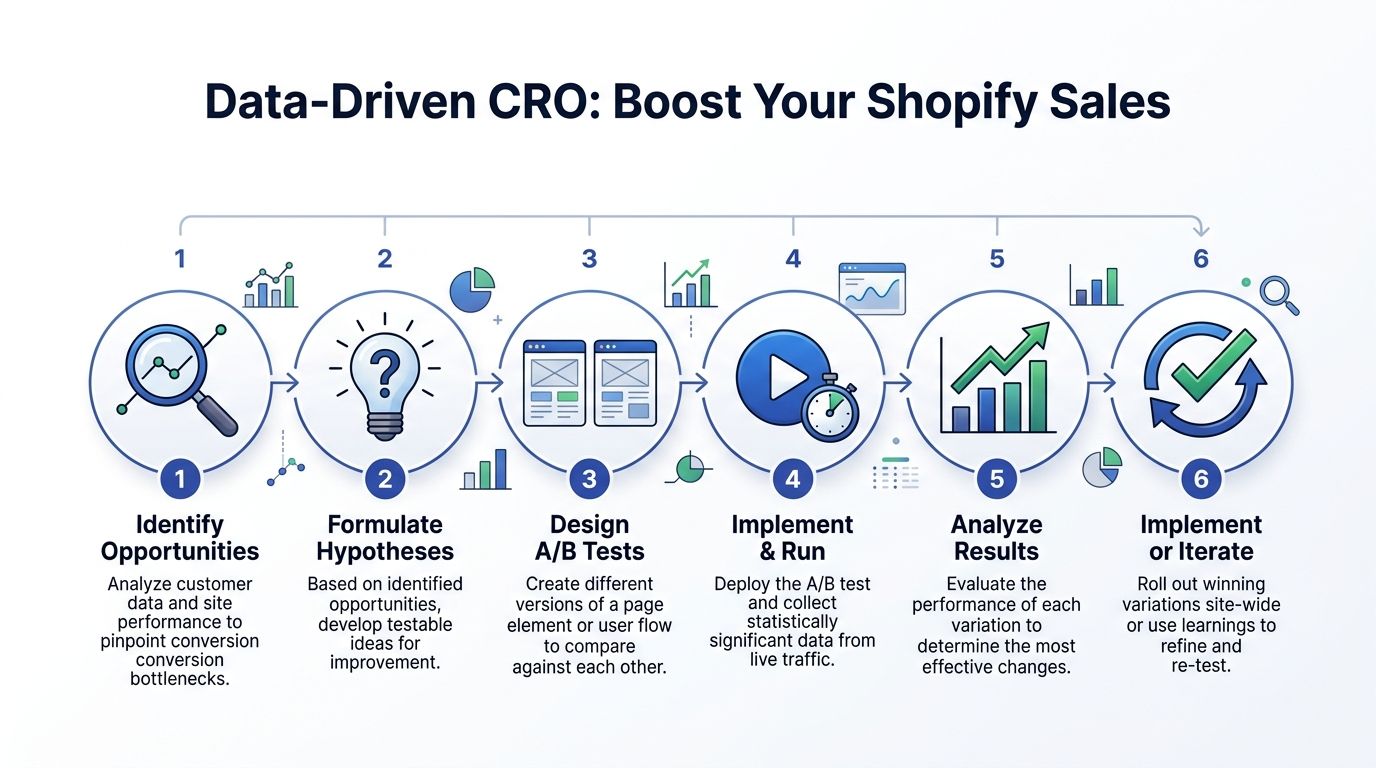
During the 2025 BFCM period covered in Brenton Way’s Shopify statistics roundup, Shopify merchants saw a 27% year-over-year sales increase, with average cart value at $114.70. The same source notes that Shop Pay delivers up to 50% higher conversion rates than guest checkout, while 79% of Shopify traffic originates from mobile devices. That mix tells you something important. Small checkout and device-focused improvements can compound quickly when demand spikes.
Use the hypothesis loop, not random testing
Most failed CRO efforts are not really testing programmes. They are redesign impulses with analytics attached.
A better process has five steps:
- Identify the friction
- Write a clear hypothesis
- Choose one variable to test
- Measure the result cleanly
- Roll out or learn and retest
An example of a usable hypothesis is this: “If we move delivery messaging above the add-to-cart button on mobile PDPs, more visitors will add to cart because shipping uncertainty is currently blocking the decision.”
That is testable. “Let’s freshen up the page design” is not.
Prioritise tests by likely impact
Not all experiments deserve equal attention. Start where intent is highest and traffic volume is sufficient.
A practical order looks like this:
Product page tests
These often produce the fastest learning because the page carries both discovery and decision-making load. Test media order, headline framing, CTA language, trust placement, and variant presentation.
Cart and cart drawer tests
These can reveal whether customers need reassurance, urgency, or simpler basket editing.
Checkout-adjacent messaging
Sometimes the biggest win is not a redesign. It is changing when and where you answer delivery, returns, or payment questions.
Collection page tests
These matter if users struggle to find the right products before they ever reach a PDP.
Combine quantitative and qualitative evidence
A strong test backlog pulls from both hard data and observed behaviour.
Use quantitative sources to find the page or step with the biggest drop-offs. Then use recordings, heatmaps, support transcripts, and on-site search patterns to understand the hesitation. That combination produces better hypotheses than dashboard review alone.
For stores formalising this process, Shopify conversion rate optimisation usually works best when ownership is clear. Someone needs to decide what gets tested, what counts as success, and when a result is strong enough to ship.
What not to test first
Some tests are easy to run and still poor uses of time.
Avoid starting with:
- Minor button colour debates without evidence of CTA visibility issues
- Homepage experiments when product pages drive most purchase decisions
- Full redesigns before simpler messaging or layout tests
- Too many simultaneous changes on the same page
CRO discipline: Test the smallest meaningful change that can prove or disprove your idea.
The stores that improve most consistently do not rely on occasional optimisation sprints. They build a habit of learning from customer behaviour, especially before peak trading periods when small gains scale into larger revenue effects.
Future-Proofing Your Store for Long-Term Scale
There is a point where conversion work alone is not enough. The store grows, operational complexity increases, and your tech stack starts to limit execution.
That is when future-proofing becomes commercial, not theoretical.

For UK merchants, one of the biggest missed opportunities is localisation. According to Smartling’s Shopify sales guide, UK online sales hit £221 billion in 2025, and hyper-localising a Shopify store for regional terms such as “trainers” instead of “sneakers”, alongside correct post-Brexit VAT presentation, can lift conversions by 25-30% from targeted traffic.
Know when your current setup is holding you back
Not every store needs Shopify Plus or a headless build. Many merchants jump too early because they want flexibility before they have operational clarity.
Upgrade pressure is usually real when one or more of these starts happening:
- Checkout customisation needs exceed what your current setup allows
- App workarounds are stacking up and slowing the storefront
- International selling requires more control over pricing, content, and regional logic
- ERP, CRM, or fulfilment workflows are being managed with manual fixes
- Your team cannot ship changes quickly because the theme has become fragile
The key question is not “what is the most advanced architecture?” It is “what setup lets us move faster without adding risk?”
Shopify 2.0, Plus, and headless are different decisions
These choices often get lumped together, but they solve different problems.
Shopify 2.0
For many stores, a cleaner Shopify 2.0 theme architecture is the right first step. It improves flexibility for sections, templates, and content management while reducing the need for brittle theme hacks.
Shopify Plus
Plus makes more sense when checkout control, automation, or scale-specific workflows become commercially important. It is useful when the business has already earned the complexity.
Headless with Hydrogen
Headless is a design and performance decision with operational consequences. It can be the right fit for brands that need highly customised frontends or unusual customer journeys. It is a poor fit for teams that still struggle to maintain a standard theme.
A blunt recommendation is often the right one. If your merchandising, analytics, and operational processes are still inconsistent, do not solve that with architecture first.
Treat integrations as growth infrastructure
Scaling stores usually break in operations before they break in design.
The important integration work includes:
| System area | Why it matters |
|---|---|
| ERP | Keeps inventory, fulfilment, and financial workflows aligned |
| CRM | Supports segmentation, lifecycle marketing, and repeat purchase flows |
| Fulfilment tools | Improves delivery communication and order confidence |
| Shopify Markets | Helps manage local pricing, messaging, and regional storefront logic |
For UK brands selling beyond domestic customers, this becomes even more important. Post-Brexit expectations around VAT clarity, shipping communication, and customs handling affect trust directly. If that logic is messy, marketing efficiency suffers because conversion suffers.
Local SEO should be engineered, not translated loosely
A lot of stores say they are “localised” when they have only changed currency and shipping copy.
Real UK localisation means checking product language, search terms, collection naming, metadata, structured content, and policy clarity. It also means aligning the storefront with how UK customers search and evaluate risk.
That includes regional vocabulary, sizing conventions, and legal display details. These are not cosmetic changes. They affect discoverability and confidence.
The long-term goal is simple. Build a Shopify setup that supports faster iteration, clearer localisation, and fewer manual interventions. Scale is rarely blocked by ambition. It is blocked by systems that cannot keep up.
Conclusion From Plateau to Playbook
If sales have stalled, more activity is rarely the answer. Better sequencing is.
Start by fixing what blocks the sale now. Payment friction, mobile usability, product-page clarity, and speed issues usually deserve attention before any growth campaign does. Then audit the funnel properly so decisions come from evidence, not guesswork. After that, raise basket value with better bundles, upsells, and post-purchase paths. Then build a real CRO rhythm that keeps improving the store over time. Finally, upgrade architecture and integrations when the business is ready to use that added flexibility well.
That order matters because each layer depends on the one below it.
The strongest Shopify growth work is rarely dramatic. It is disciplined. Teams that consistently increase Shopify sales tend to do the obvious things thoroughly, measure the right gaps, and keep refining the journey quarter after quarter.
Fix. Optimise. Then scale.
Frequently Asked Questions
| Question | Answer |
|---|---|
| What should I fix first if my Shopify sales are flat? | Start with checkout friction, mobile usability, and product-page clarity. These usually affect the largest share of shoppers and can produce faster gains than acquiring more traffic. |
| Should I focus on conversion rate or average order value first? | If your store struggles to turn visitors into buyers, fix conversion first. If conversion is stable but revenue per order is thin, move into bundles, upsells, and cart strategy. |
| How long does CRO usually take to show results? | Quick fixes can improve performance quickly, but a proper CRO programme should be treated as ongoing work. The goal is cumulative improvement, not one test that changes everything. |
| Do I need Shopify Plus to scale? | No. Many stores can grow well on a standard Shopify setup if theme architecture, analytics, merchandising, and operations are in good shape. Plus becomes more relevant when checkout control and deeper automation become important. |
| Should I handle this in-house or use a specialist partner? | In-house works when the team has time, analytical discipline, and development support. A specialist partner is useful when the backlog spans UX, technical fixes, CRO, and integrations, and the business needs faster execution. |
If you want help turning this into a working roadmap, Grumspot supports Shopify stores with audits, Shopify 2.0 builds, CRO, custom app work, and integration projects so teams can fix revenue blockers and scale with a clearer plan.
Let's build something together
If you like what you saw, let's jump on a quick call and discuss your project

Related posts
Check out some similar posts.
- seo and subdomains
Learn how SEO and subdomains interact, from indexing and authority to internationalisation. A practi...
Read more
- technical seo audit
What Is Technical SEO Audit. Learn what a technical SEO audit is, its core components, and how it dr...
Read more
- help center shopify
Learn how to build a help center Shopify merchants trust. Covers native pages vs apps, article struc...
Read more
- ecommerce ab testing
Master ecommerce AB testing with a revenue-first playbook. Learn to build hypotheses, calculate samp...
Read more