Unlock Revenue: Shopify AOV Optimization
- Shopify AOV optimization
- increase Shopify AOV
- Shopify Plus
- ecommerce CRO
- UK ecommerce
Launched
April, 2026
A lot of Shopify stores chase more traffic when easier money is on site. In the UK market, top-performing Shopify stores are already clearing more than £109 in AOV, while the median sits materially lower, which creates a 20 to 36% gap that can often be attacked faster than customer acquisition costs can be reduced (Red Stag Fulfillment UK Shopify AOV benchmarks).
That’s why Shopify AOV optimization matters. It changes the economics of the same traffic, the same product catalogue, and the same paid media budget. If a store can get existing buyers to add one more item, choose a stronger bundle, or accept a relevant post-purchase offer, revenue moves without forcing the team back onto the acquisition treadmill.
Why Shopify AOV is Your Most Powerful Growth Lever
AOV looks basic in Shopify Analytics. Revenue divided by orders. In practice, it is one of the fastest ways to change what each visit is worth, especially in a UK ecommerce market where paid acquisition costs rarely stay still for long.
A healthy AOV usually reflects good commercial structure. The product mix makes sense. Merchandising helps customers build a basket. Shipping thresholds are set from real order data, not instinct. Upsells are relevant to the SKU, margin profile, and fulfilment model. Checkout gives shoppers a reason to add one more item before they pay.
The UK performance gap
The benchmark that matters is headroom. Earlier UK benchmark data showed a clear gap between median Shopify performance and the strongest stores in the market. For operators, that gap is useful because it points to revenue already available inside existing demand, provided the store can raise basket size without hurting conversion.
The compounding effect of AOV is significant. A stronger basket raises revenue per session, gives paid media more room to work, and can improve customer lifetime value if the first order introduces the right products. We see this regularly on Plus accounts where CAC is under pressure. The teams that improve AOV often create breathing room faster than teams that only chase cheaper traffic.
Practical rule: If Meta, Google, or affiliate acquisition is getting more expensive, review AOV before increasing spend.
AOV usually improves efficiency faster than acquisition work
Acquisition still matters. But if basket economics are weak, new traffic only scales the problem.
A merchant can spend a quarter refining creatives, landing pages, and audience targeting, then watch the gain disappear because too many shoppers stop at a single hero SKU. AOV work addresses that earlier in the revenue chain. It affects merchandising, offers, checkout behaviour, retention, and contribution margin in the same programme of work.
Three reasons AOV projects often outperform broad acquisition projects on payback:
- They use existing buying intent. The customer is already on site and part way through the decision.
- They can improve order quality. Well-structured bundles, thresholds, and add-ons often produce better gross profit than a discount-led conversion push.
- They support product discovery. A broader first order can increase the chance of repeat purchase if the added items are useful.
AOV and profitability need to be managed together
Higher AOV is only valuable if margin, conversion rate, and operations hold up.
Operations hold up. Weaker advice often falls apart in this area. A bundle can increase order value and still reduce profit if it pulls customers away from better full-price combinations. A free shipping threshold can raise basket size and still lower total contribution if it is set below the true break-even point for UK delivery costs. A post-purchase upsell can create extra revenue and also create support issues if inventory, subscriptions, or fulfilment rules are not configured properly across Shopify, your 3PL, and any apps touching the order.
Effective Shopify AOV optimisation focuses on increasing basket size without adding friction or eroding margin.
That takes more than a cart drawer app. It requires diagnosis, offer design, technical implementation, and clean measurement. The stores that do this well treat AOV as an operating system for revenue, not a single tactic.
Finding Your Biggest AOV Opportunities
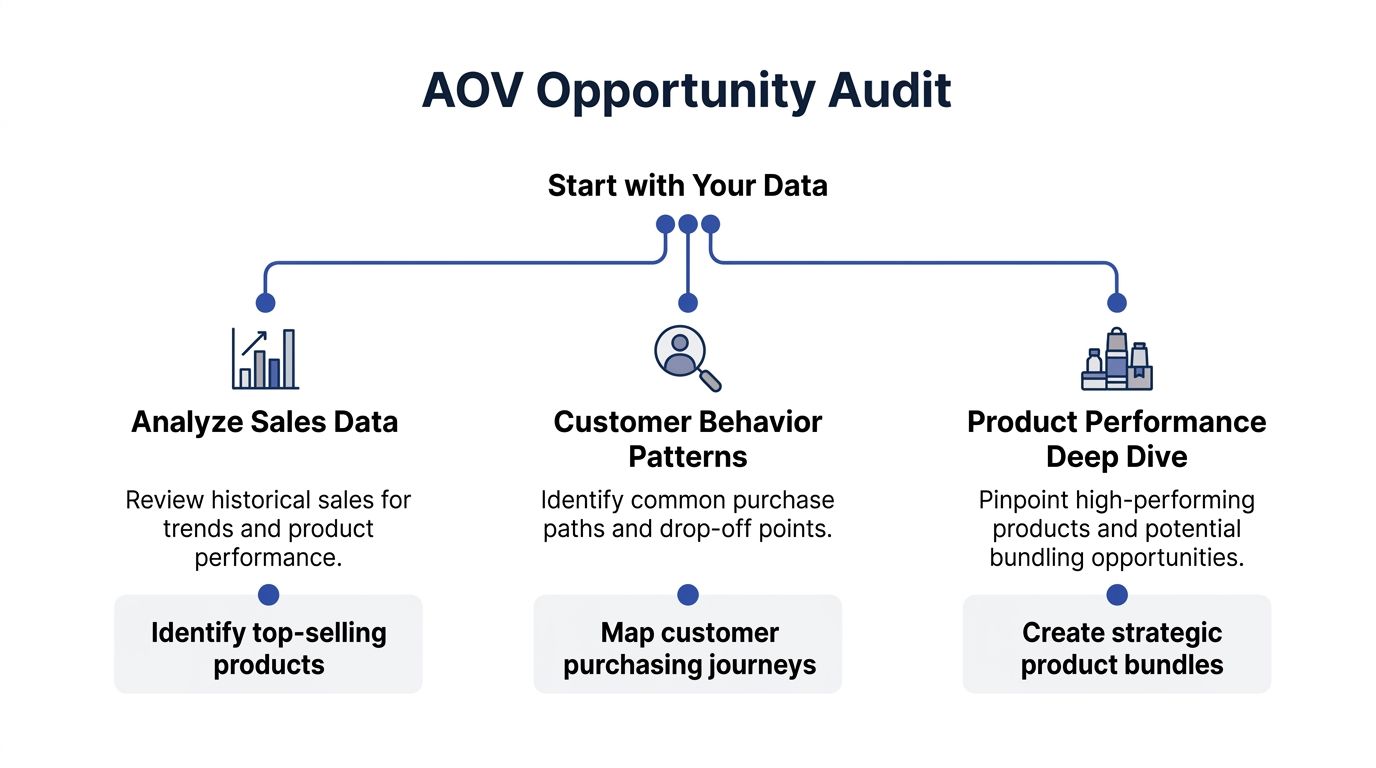
Before changing the cart, changing the checkout, or installing another app, you need a clean diagnosis. Most AOV projects fail because the team jumps to tactics first.
AOV work starts with pattern recognition. You’re looking for where customers signal willingness to spend more, and where the store gets in the way.
Start with baseline AOV and modal order value
In Shopify Analytics, pull your current AOV first. That gives you the broad picture. Then go one layer deeper and identify the modal order value, which is the order total that appears most often.
That distinction matters because the average can be distorted by a smaller number of large orders. The mode tells you what most customers do. For threshold planning, offer design, and bundle construction, that’s the more useful operational number.
A practical audit sequence looks like this:
- Pull AOV by a stable time window. Use a period long enough to smooth out campaign spikes.
- Find the modal basket value. This is what your most common customer behaviour looks like.
- Break out top products by attachment behaviour. Identify what gets bought alone versus what gets bought with other items.
- Review margin by product cluster. Some products are strong bundle anchors. Others should never be discounted.
- Check mobile and desktop cart paths separately. Friction can hide in mobile basket building.
Segment by traffic source before drawing conclusions
A common oversight in AOV reporting occurs if you only look at the store-wide average, which can lead to optimizing for the wrong customer.
For UK merchants, email traffic consistently yields a 25 to 30% higher AOV than social media ads. The same source also notes that failing to segment by source, such as Google or organic versus TikTok, creates skewed reporting and missed promotion opportunities (UK AOV source segmentation insight).
If email buyers spend more, they shouldn’t get the same merchandising treatment as colder paid social traffic. The threshold messaging, bundle selection, and cross-sell logic may need to differ by source.
Teams that treat all sessions as equal optimize for the average shopper, not the profitable one.
A useful reporting view includes:
- Email traffic with order composition and repeat-buyer behaviour
- Paid social traffic with first-order basket structure
- Organic and branded search with high-intent product combinations
- Returning customers versus first-time buyers
- Product-led landing pages versus collection-led landing pages
If your current reporting stack is thin, tools built for cohort and customer-value analysis can make this easier. A good starting point is this guide to e-commerce growth data analysis tools, especially if you need a cleaner way to connect AOV to LTV, CAC, and channel quality.
Audit products like a merchandiser, not just an analyst
AOV opportunities sit in a small part of the catalogue.
Look for these product types:
- Anchor products. Popular items that can carry accessories, refills, or companion items.
- Natural pairs. Products customers already buy together without being prompted.
- High-margin add-ons. Small items that raise basket value without adding much fulfilment complexity.
- Bundle-friendly sets. Products that solve a complete use case when grouped.
- Single-SKU traps. Items that convert well but repeatedly leave the basket underpowered.
AOV optimisation gets easier when you stop thinking in terms of “upsells everywhere” and start thinking in terms of “which combinations feel obvious to the buyer”.
That’s the key distinction. Customers don’t want aggressive selling. They want a better-configured purchase.
Core AOV Tactics for Every Shopify Store
The best foundational AOV tactics are the least glamorous. They are the ones that keep working after the launch week spike disappears.
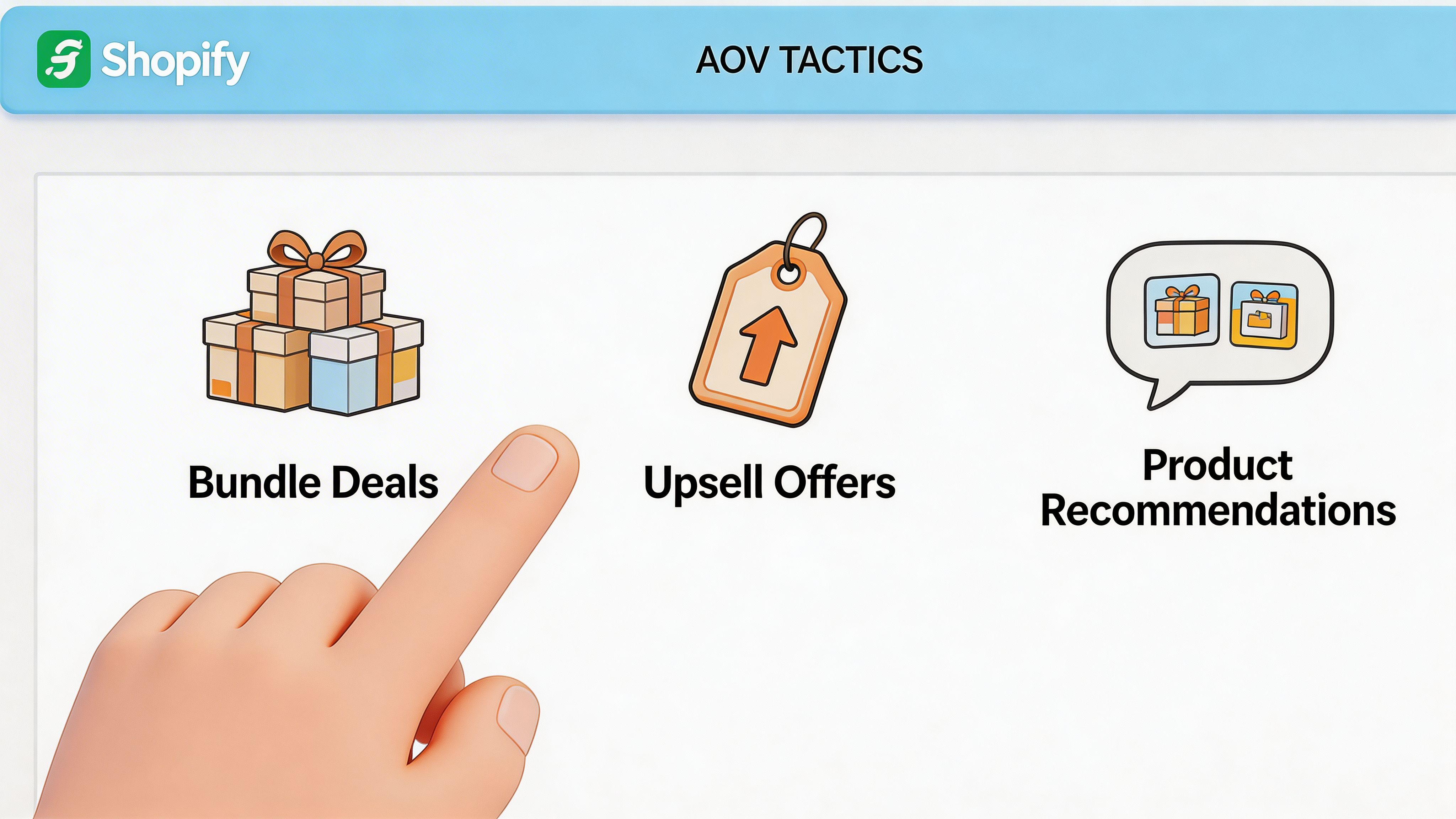
For most Shopify stores, the reliable base is this trio: bundles, in-cart cross-sells, and free shipping thresholds. If those three are poorly executed, advanced personalisation won’t save you.
Build bundles that solve a buying job
Most bundles fail because they’re assembled from the merchant’s inventory priorities, not the customer’s purchase logic.
A strong bundle does one of two things well:
- It completes a use case
- It increases quantity with a clear incentive
Those are different mechanisms and they should be treated differently.
Complete-the-job bundles
This works well when the customer needs a full setup. Think skincare routines, coffee kits, grooming systems, or “complete the look” fashion merchandising.
The best version keeps the decision load low. Don’t make buyers configure every variable if the products are already obvious companions. Show the value of buying the set together and make the savings or convenience clear.
Quantity bundles
These are straightforward and often effective for replenishable products. “Buy more, save more” structures can move the basket quickly if the unit economics hold.
Keep the rule simple. Customers should understand the offer in one glance. If the discount logic requires explanation, it’s already too complicated.
Margin check: AOV growth that comes from over-discounting isn’t growth. It’s merchandising drift.
Use free shipping thresholds with precision
A lot of stores set a free shipping threshold by instinct. That is a common mistake. Thresholds should be based on the most common order pattern, not a guess from the leadership team.
For UK stores, the more practical method is to set the threshold 25% above your modal order value, not your average. The Shopify example for a UK fashion store uses a £60 modal value and a £75 threshold, and notes that this change, combined with a visible cart progress bar, has increased AOV by up to 32% in UK case studies (Shopify guidance on AOV thresholds).
That one detail matters more than most merchants realise. A threshold that feels attainable nudges. A threshold that feels unrealistic repels.
A good implementation has three parts:
- The threshold is reachable
- The cart shows progress clearly
- The add-on suggestions help close the gap
If someone is only slightly below the threshold, don’t throw generic recommendations at them. Show products that fit the exact gap and make sense with what’s already in the basket.
Make the cart do actual selling
The cart drawer shouldn’t just summarise what’s been chosen. It should help the buyer improve the basket.
Useful in-cart cross-sells share a few traits:
- They’re complementary, not random
- They’re priced low enough to feel easy to add
- They don’t interrupt checkout intent
- They reflect cart contents, not bestsellers alone
For many stores, the quickest win is to map top-selling products to one or two hand-picked add-ons. That outperforms broad recommendation widgets because the relevance is tighter.
If you’re reviewing your stack, this rundown of https://grumspot.com/blog/10-essential-shopify-apps-for-higher-conversion-rates is useful for identifying the sort of apps that support cart UX, merchandising, and conversion without overloading the storefront.
Don’t let the offer presentation lag behind the tactic
Merchants implement a good tactic and present it badly.
Examples:
- The bundle exists, but only on a buried collection page.
- The cart progress bar exists, but the message is vague.
- The cross-sell exists, but the recommendation tile looks like an ad.
- The savings are present, but the buyer can’t instantly tell what they gain.
Presentation shapes uptake. Clear hierarchy, stronger product imagery, concise copy, and a visible value cue matter as much as the logic behind the offer.
If your team needs fast creative variations for bundle promos or paid tests around cart incentives, a tool like ShortGenius AI text-to-video generator can speed up ad production without waiting on a full creative cycle.
A short walkthrough helps when teams are aligning on these fundamentals:
What usually doesn’t work
Weak AOV programmes share the same flaws.
- Overstuffed bundles that mix too many low-intent products
- Cart upsells with no relevance to the selected item
- Thresholds set too high for the actual basket pattern
- Discounts applied without margin discipline
- Widgets competing for attention across product, cart, and checkout
The fix isn’t more apps. It’s better merchandising logic.
AOV rises when the store helps the customer make a better purchase. That’s the standard worth keeping.
Advanced AOV Strategies for Scaling Brands
Once the basics are working, the next gains come from better use of customer data and better timing. At this stage, scaling brands separate themselves from stores that are still relying on generic widgets.
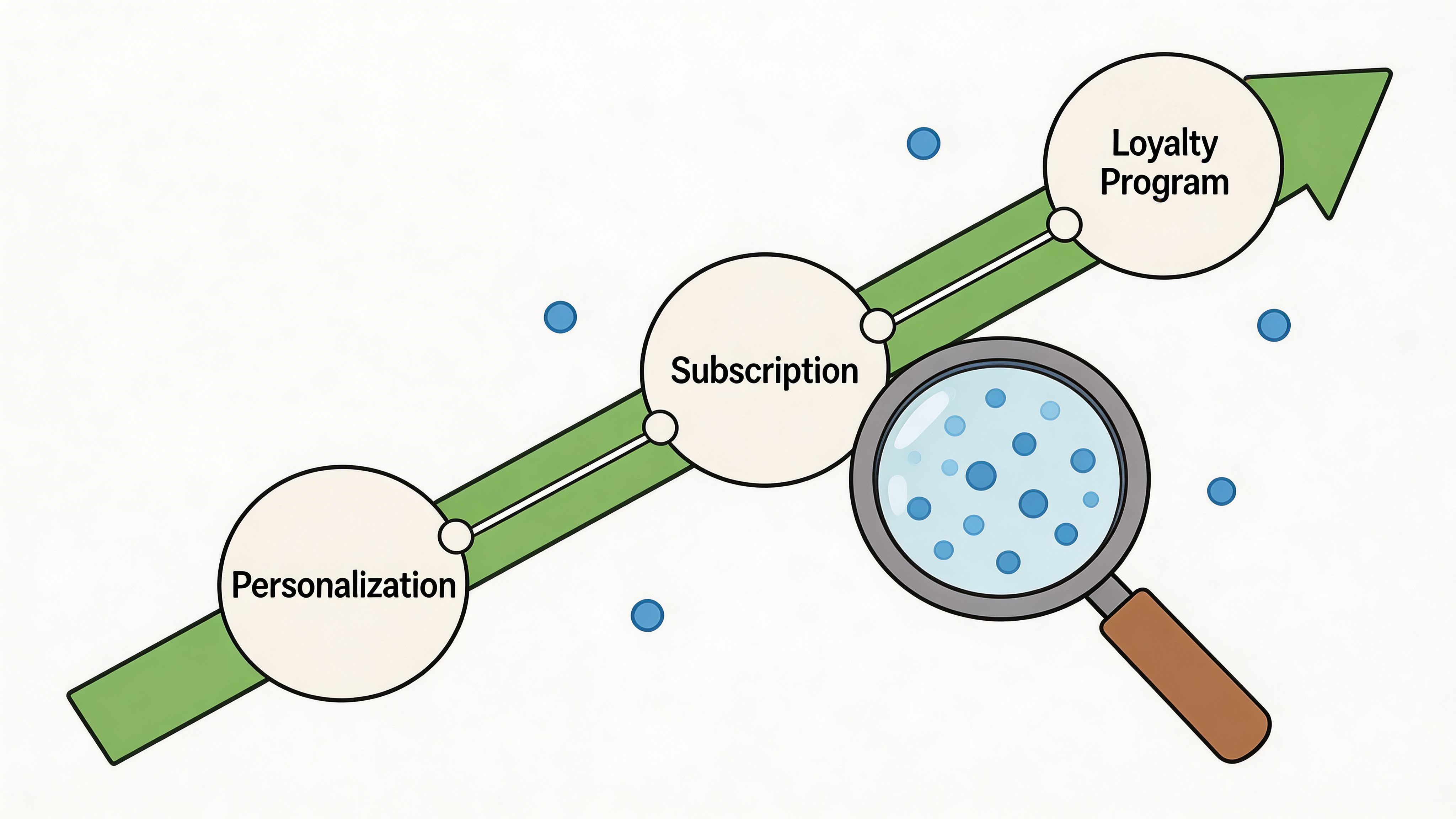
The three most useful advanced levers are AI recommendations, subscriptions, and post-purchase offers. They don’t solve the same problem, so the right choice depends on the catalogue, customer behaviour, and operational maturity.
AI recommendations work when the data is good enough
Personalisation can produce significant AOV gains, but only when the store has enough order history and the recommendation placements are sensible.
For UK stores, AI-driven recommendations can yield AOV gains of 20 to 32%, but the same guidance makes two limits clear. You need at least 100+ orders for the model to learn effectively, and the implementation must remain GDPR-compliant because poor data handling damages trust and creates legal risk (UK AI recommendation guidance for Shopify AOV).
That means a newer store shouldn’t expect magic from AI blocks alone. Hand-curated recommendations can outperform immature automation.
What tends to work best:
- Product page recommendations based on item compatibility
- Cart recommendations focused on useful add-ons
- Post-purchase recommendations for low-friction extras
- Returning-customer merchandising based on prior purchases
What usually underperforms:
- Generic “you may also like” carousels
- Recommendations pushed too high in the page hierarchy
- Personalisation driven by weak event tracking
- Data use that isn’t clearly disclosed or governed
AI is only as good as the behavioural signals feeding it. If tracking is patchy, the recommendations will be patchy too.
Subscriptions increase AOV differently
Subscriptions are less about squeezing more out of a one-off basket and more about restructuring how value is captured over time.
They fit best when the product replenishes, supports routine consumption, or can be grouped into repeatable deliveries. In those cases, “Subscribe & Save” can increase order commitment while also making repeat purchase behaviour more predictable.
The operational side matters. Subscription offers fail when replenishment timing is wrong, product swaps are painful, or cancellation feels adversarial. The strongest implementations reduce friction and let the customer control cadence.
Subscriptions tend to be strongest for:
- Consumables
- Refill-based products
- Repeat-use household goods
- Skincare and wellness routines
- Products that benefit from multi-unit ordering
Post-purchase offers capture intent after the first yes
Post-purchase is one of the cleanest advanced AOV plays because the customer has completed payment. That changes the psychology and lowers the risk of harming core conversion.
The offer still has to be relevant. The best post-purchase upsells feel like a useful extension of the original purchase, not an afterthought stuffed into the funnel.
Good examples include:
- Refill packs after a starter product
- Accessories after a hero item
- Travel sizes after a full-size purchase
- Extra quantities on replenishable lines
- Care or protection items after a premium purchase
AOV strategy comparison
| Strategy | Potential AOV Lift | Implementation Effort | Best For |
|---|---|---|---|
| AI recommendations | 20 to 32% for UK stores when data volume and compliance requirements are met | Medium to high | Stores with enough order history and clean tracking |
| Subscriptions | Qualitative upside, especially where repeat purchase behaviour is natural | Medium | Consumables and routine-purchase categories |
| Post-purchase offers | Qualitative upside with low risk to initial conversion when relevance is tight | Medium | Brands with clear product add-ons or replenishment logic |
Which one should you prioritise
The answer depends less on ambition and more on store readiness.
Choose AI recommendations if your catalogue has many complementary relationships and your store already generates enough order volume to train recommendation logic.
Choose subscriptions if customers predictably reorder and you can support the operational demands well.
Choose post-purchase offers if you want a lower-risk path to incremental revenue without cluttering the pre-purchase journey.
The common mistake is trying to launch all three together. That spreads testing effort too thin and makes attribution messy. Pick the one that best fits your product behaviour, then build the process around it properly.
Technical AOV Implementation on Shopify Plus
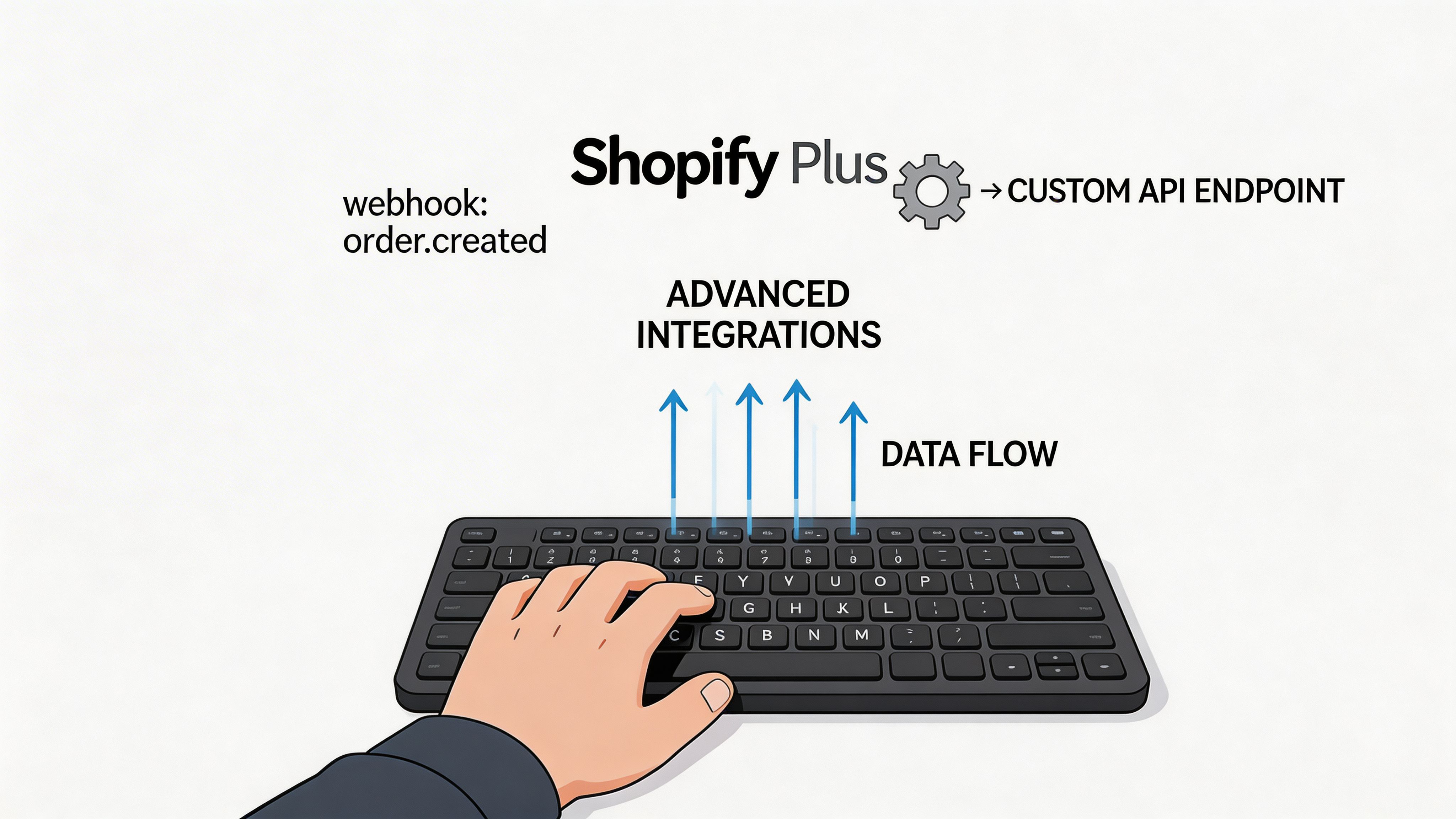
Shopify Plus gives teams more room to build AOV mechanics into the experience itself rather than layering everything through storefront apps. That matters when performance, UX consistency, and business logic start to compete with each other.
For scaling brands, the shift is from “which app can do this?” to “which parts should be custom because they’re commercially important?”
Build discount logic around your catalogue, not around app limits
Plus stores can outgrow generic bundle and discount tooling. The issue isn’t that apps can’t create offers. It’s that they force the catalogue into a rigid promotional model.
Custom implementation is useful when you need logic like:
- Gift-with-purchase based on product family
- Bundle qualification based on metafields
- Cart incentives that change by market or collection
- Eligibility rules based on customer tags
- Different upsell behaviour for wholesale and DTC customers
Here, Shopify Plus development becomes commercially meaningful, not technically interesting. If your team is planning bespoke checkout or cart logic, this overview of https://grumspot.com/blog/shopify-plus-development is a solid reference point for the broader development patterns involved.
Use cart-level engineering to reduce friction
AOV gains can die in the handoff between merchandising intent and user experience. The logic may be sound, but the implementation introduces lag, duplication, or confusion.
On Plus, custom cart work can improve that in a few ways:
Cart AJAX workflows
A dynamic cart can update thresholds, gifts, and recommended add-ons without forcing page reloads. That makes the nudge feel native rather than bolted on.
This matters most when the store relies on drawer carts, quick add interactions, or dynamic bundle composition.
Metafield-driven merchandising
Metafields are useful when recommendation logic needs structure. For example, products can carry data that identifies companion items, replenishment accessories, usage categories, or bundle families.
That gives the team more control than relying only on broad collections or sales history. It makes the merchandising logic easier to maintain.
Checkout extensions and in-flow offers
For Plus stores with more advanced checkout customisation, in-checkout upsells can be controlled more precisely than pre-purchase popups. The key is restraint. The checkout should still feel like the shortest path to completion.
The best technical AOV implementation is the one the customer barely notices. It feels fast, relevant, and obvious.
Keep systems aligned behind the storefront
The more advanced the offer, the more important the operational plumbing becomes.
AOV work on Plus touches:
- ERP inventory logic
- Fulfilment constraints
- Subscription systems
- CRM segmentation
- Customer event tracking
- Promotional exclusions by market
If those systems aren’t aligned, the front-end experience can look polished while the back office breaks. Common symptoms include misallocated inventory, discount conflicts, duplicate offers, and inaccurate reporting on bundle uptake.
That’s why custom AOV implementation should be scoped as a business process project, not only a theme task.
What bespoke execution is suitable for
Custom work isn’t always better. It’s better when the store has a repeatable revenue pattern worth protecting.
It makes sense when:
- Your top products need complex bundle rules
- Off-the-shelf apps create UX inconsistency
- You need multi-market or segmented offer logic
- Checkout merchandising is strategically important
- The store has enough scale to justify proprietary advantage
It makes less sense when the core offer itself still isn’t validated. In that case, use simpler tooling, prove the commercial case, then harden it with custom implementation later.
That order matters. Plus should help you operationalise what works, not distract the team with engineering for its own sake.
Measuring Success and Building Your Optimization Playbook
AOV work only becomes useful when the team can tell which change improved revenue quality and which change shifted numbers around. That means measurement has to go beyond a single headline metric.
The right dashboard should answer a simple question. Did the store make more money from the same buying intent without introducing damaging side effects?
Track the right metrics together
AOV on its own is incomplete. Pair it with the metrics that reveal whether the uplift is healthy.
The core reporting stack should include:
- AOV to track basket size
- Revenue per visitor to connect basket value with conversion performance
- Conversion rate to catch friction introduced by thresholds or offers
- Units per transaction to distinguish price effects from basket-building effects
- Gross margin by offer type to catch over-discounting
- Attachment rate by upsell or bundle to identify what gets adopted
A team that only watches AOV can misread performance badly. If basket value rises but conversion softens, the net result may still be weaker. Revenue per visitor helps expose that.
For broader CRO work tied to these patterns, https://grumspot.com/blog/ecommerce-conversion-optimization is a useful operational reference because AOV and conversion almost always need to be judged together.
Build a simple review cadence
The stores that improve AOV don’t treat it as a one-off campaign. They run it as a recurring optimisation rhythm.
A practical cadence looks like this:
| Review window | Focus | Typical question |
|---|---|---|
| Weekly | Offer adoption | Which bundles, cross-sells, or post-purchase offers are being accepted |
| Fortnightly | Funnel health | Did any AOV change create friction in cart or checkout |
| Monthly | Channel quality | Which sources produce the healthiest basket composition |
| Quarterly | Strategic resets | Which mechanics should be expanded, rebuilt, or removed |
Use controlled testing, not opinion battles
AOV projects attract a lot of subjective debate. Someone likes a bigger bundle card. Someone else wants a stronger discount. Someone else thinks the progress bar is distracting.
Testing resolves that faster than internal preference.
Good A/B testing rules for AOV work:
- Change one commercial variable at a time. Don’t alter threshold, copy, and offer design all in one test if you want clear learning.
- Keep the audience definition stable. Source mix changes can distort results.
- Measure secondary effects. Watch conversion, support issues, and margin.
- Test by device when relevant. Mobile cart behaviour can differ from desktop.
- Document what lost. Failed tests are useful if the team captures why.
Decision filter: If an AOV experiment increases basket size but makes checkout feel heavier, assume it needs refinement before rollout.
Build playbooks for common outcomes
Here, AOV optimisation becomes operational instead of theoretical.
If AOV rises and conversion stays stable
Expand the tactic. Add the winning logic to more products, collections, or customer segments. This indicates strong relevance and acceptable friction.
If AOV rises but conversion drops
The offer appears too aggressive, too visible, or too disruptive. Reduce complexity. Lower threshold pressure. Tighten product relevance.
If conversion rises but AOV stays flat
The merchandising may be cleaner, but the basket-building prompts are too weak. Improve add-on selection and gap-to-threshold messaging.
If upsell visibility is high but uptake is low
The issue lies beyond placement alone. It’s usually weak product pairing, poor pricing logic, or offer fatigue.
If bundles are adopted but margin falls
Rebuild the offer structure. Use fewer discounted items, switch to value-led grouping, or change which products anchor the bundle.
Don’t confuse activity with optimisation
Many stores install apps, switch on widgets, and call that an AOV strategy. It isn’t. It’s feature deployment.
Actual Shopify AOV optimization is disciplined. It starts with diagnosis, uses tactics that fit the catalogue, applies technical effort where it matters, and measures the commercial impact in context.
That’s what makes it sustainable. Not one promotion. Not one app. A repeatable system for turning intent into larger, healthier orders.
If your Shopify store has traffic but basket size isn’t where it should be, Grumspot helps fix the commercial and technical gaps that hold AOV back. From cart logic and merchandising UX to Shopify Plus builds, subscriptions, and deeper integrations, the team works like a senior ecommerce partner focused on conversion and revenue quality, not just feature delivery.
Let's build something together
If you like what you saw, let's jump on a quick call and discuss your project

Related posts
Check out some similar posts.

- shopify website examples
Explore 7 Shopify website examples and learn the UX, conversion features, and practical lessons merc...
Read more
- cro best practices
Apply cro best practices to Shopify stores with 10 actionable tactics for testing, product pages, ch...
Read more
- ecommerce subscription platform
Learn how an ecommerce subscription platform works, which models drive retention, and how to choose,...
Read more
- ecommerce replatforming agency
Choosing an ecommerce replatforming agency? Learn what they do, replatforming signs, costs, timeline...
Read more