API-First Ecommerce Architecture: A Merchant's Guide
- API-first ecommerce
- Headless Commerce
- Shopify Plus
- Composable Commerce
- Ecommerce Architecture
Launched
May, 2026
A lot of Shopify Plus merchants reach the same point without noticing it at first. Revenue is growing, the team is sharper, the product range is broader, and yet the store starts feeling harder to change, not easier. A landing page tweak turns into a sprint. A subscription flow needs three apps and a workaround. Peak trading days make everyone nervous. Marketing wants one experience, operations needs another, and development keeps saying, “We can do it, but not cleanly.”
That's usually the moment when the platform hasn't failed. It has become too tightly packed for what the business now needs.
Introduction When Your Store Outgrows Its Platform
In a standard ecommerce setup, the storefront, the business logic, and the integrations tend to live in one connected system. That's convenient when you're moving fast with a small team. It becomes restrictive when the brand needs custom buying journeys, international complexity, or deeper operational control.
One common pattern looks like this. The store works well enough day to day, but every strategic change has knock-on effects. Add a B2B pricing layer and search becomes awkward. Change the product page logic and the theme gets fragile. Launch a new channel and the backend starts carrying responsibilities it wasn't built to handle elegantly.
That's why more merchants are looking at API-first ecommerce architecture. Not because it's fashionable, but because it changes the shape of the system. Instead of forcing every experience through one frontend, it treats the backend as a set of services that can support many experiences cleanly.
The wider market is already moving in that direction. Globally, 80% of businesses are planning to adopt a headless architecture by 2024, with projections showing global eCommerce will reach $10 trillion by 2027, according to Swell's headless commerce statistics roundup. That doesn't mean every merchant should go headless tomorrow. It does mean rigid, all-in-one builds are losing ground.
If your current stack feels cramped, the right question isn't “Should we chase headless?” It's “Where is our present architecture slowing growth?” For some brands, the answer is better Shopify implementation. For others, it's a deeper structural change, often after a serious Shopify replatforming decision.
Practical rule: If your roadmap keeps getting blocked by the same technical constraints, the issue usually isn't the next app. It's the architecture.
What Is API-First Ecommerce Architecture
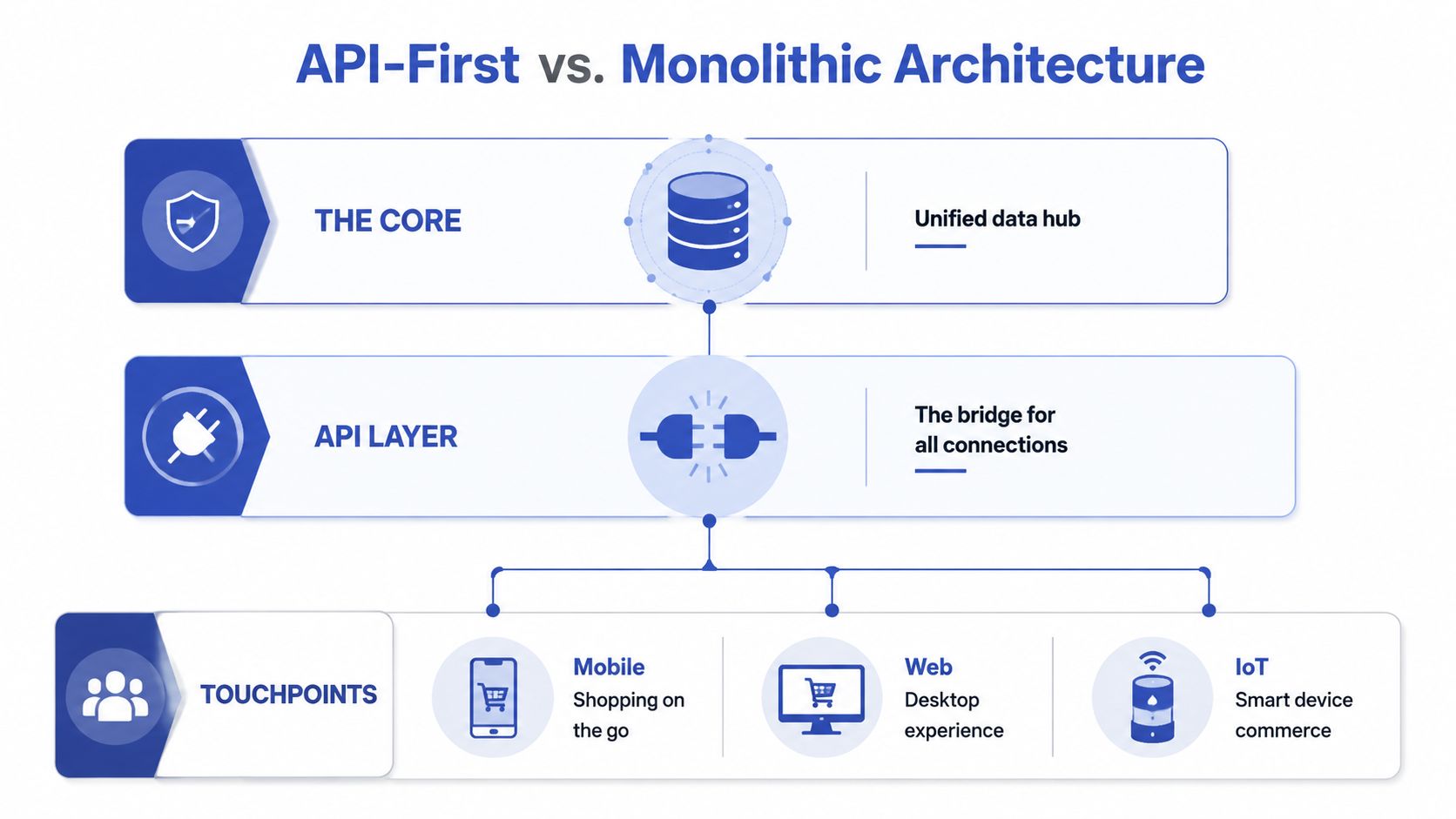
API-first ecommerce architecture means the system is designed around APIs as the primary way every part of the store communicates. Products, carts, customers, pricing, content, search, and orders are exposed through structured interfaces that other systems can use.
That sounds technical, but the business idea is simple. Your commerce platform stops being “the website” and becomes “the engine”. The website, mobile app, kiosk, portal, or campaign microsite can then sit on top of that engine.
The dollhouse and Lego version
A monolithic ecommerce platform is like a pre-built dollhouse. The walls, doors, and furniture are already connected. You can repaint it and swap a few accessories, but moving the staircase means sawing through the whole thing.
An API-first setup is more like Lego bricks. The catalogue is one brick. Checkout is another. Search, CMS, loyalty, ERP sync, reviews, and customer accounts are separate bricks too. APIs are the connectors that let those bricks work together.
That doesn't mean every brick must come from a different vendor. Shopify can still be the commercial core. The difference is that the architecture assumes components should be able to connect cleanly rather than live inside one rigid theme layer.
What the key terms actually mean
A lot of merchants hear four terms used almost interchangeably. They aren't identical.
- API means an application programming interface. In plain English, it's a controlled way for one system to request or send data to another.
- API-first means those interfaces are treated as the foundation, not bolted on later.
- Headless means the frontend presentation layer is separated from the backend commerce engine.
- Composable commerce means you assemble a stack from multiple specialised services instead of relying on one platform to do everything.
A headless store is often API-first. A composable stack is almost always API-first. But a merchant can adopt API-first thinking without replacing everything at once.
What decoupling changes in practice
The core shift is decoupling. Your frontend, what shoppers see, no longer has to be tightly tied to your backend operations. That separation has practical consequences.
For example, a marketing team might want richer landing pages, faster content experiments, and localised campaign experiences. Meanwhile, operations wants stable inventory rules, order flows, and ERP sync. In a monolith, those concerns often collide inside the same codebase. In API-first architecture, they can evolve more independently.
That's why the approach suits brands with more than one customer touchpoint. If you sell through a main storefront, a trade portal, in-store devices, paid campaign pages, or international storefront variants, decoupling becomes less of a luxury and more of a control mechanism.
The biggest misconception is that API-first means “custom everything”. It doesn't. It means “separate what should change quickly from what must stay reliable”.
How this fits Shopify Plus
For Shopify Plus merchants, API-first doesn't mean abandoning Shopify. It usually means using Shopify more intelligently.
Shopify can remain the system of record for products, cart logic, checkout, and order management, while the customer-facing layer is built with a more flexible frontend approach. That could involve Shopify's Storefront API, Hydrogen, Shopify Functions, a separate CMS, and selected third-party services for search or personalisation.
A useful plain-English explanation sits in this guide to headless ecommerce, especially if you're deciding whether this is a strategic shift or just a technical curiosity.
When API-first is the wrong lens
Not every merchant needs this.
If your catalogue is straightforward, your growth plan is channel-light, and your team mainly needs solid merchandising plus conversion improvements, a well-built Shopify theme may serve you better. API-first architecture adds moving parts. If those parts don't support a real business requirement, they become overhead.
That is where the distinction lies. API-first ecommerce architecture is powerful when complexity already exists in the business. It's wasteful when complexity is only being introduced by the tech team.
The Strategic Benefits of Going API-First
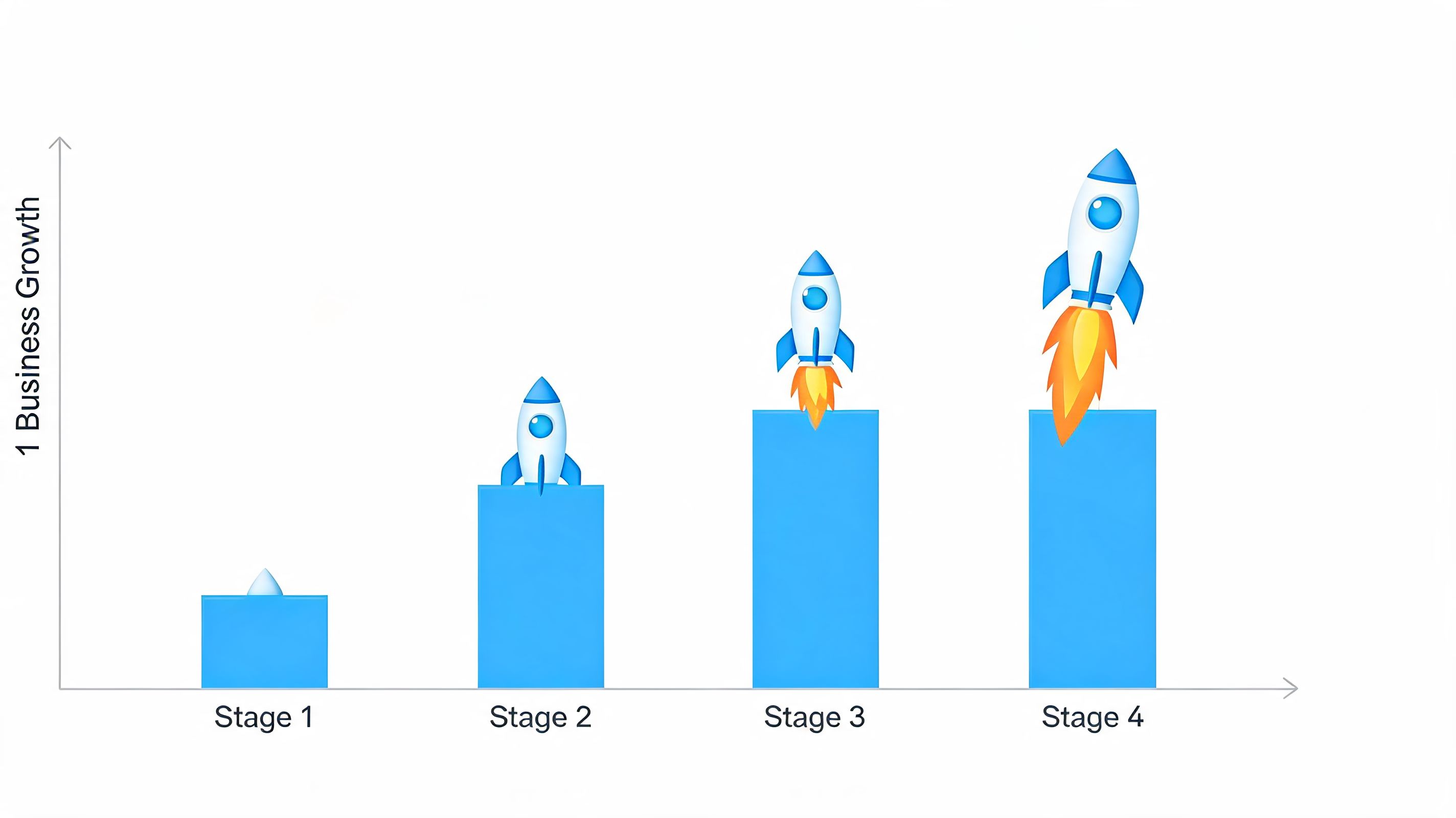
API-first architecture provides operational value rather than just a modern reputation. It transforms how quickly teams deploy updates, how extensively the customer experience expands, and how effectively the store performs during periods of high demand.
Faster delivery without waiting on one bottleneck
In monolithic builds, frontend and backend work often queue behind each other. The frontend needs data structures finalised before pages can be completed. Backend changes ripple into theme work. Small decisions create serial delays.
With API-first, teams can work in parallel. Standardised OpenAPI contracts enable parallel frontend-backend development, reducing time-to-market by up to 40%. UK data also shows 35% faster iterations and a 22% reduction in cart abandonment compared to legacy monolithic stores, according to Intexsoft's API-first ecommerce analysis.
For a merchant, that matters because roadmap speed is commercial speed. Faster iteration means quicker campaign launches, shorter waits for merchandising changes, and less time trapped in development dependency loops.
Better experiences across more touchpoints
An API-first store isn't built only for desktop theme rendering. It's built for reuse. The same product data and commerce logic can power different customer experiences without rebuilding the backend every time.
That gives merchants room to do things monolithic setups often make awkward:
- Run a richer content-led storefront while keeping commerce logic stable in Shopify.
- Support trade or wholesale portals without forcing B2B needs into the same frontend patterns as direct-to-consumer journeys.
- Test channel-specific experiences for mobile, campaigns, or emerging touchpoints without rewriting the business core.
This isn't just design freedom. It's a cleaner way to align the storefront with how the business operates its sales.
More resilient scaling during peak demand
Peak trading exposes architecture. A setup that feels acceptable in ordinary weeks can crack under pressure when traffic, cart activity, and third-party requests spike at the same time.
API-first architectures usually scale better because responsibilities are separated. Search, content, frontend rendering, and commerce logic don't all have to rise and fall together in one tightly coupled layer. That lowers the chance of one issue taking everything with it.
Merchant lens: The goal isn't novelty. The goal is fewer launch-day compromises and less dependence on one fragile layer.
Monolithic vs API-first architecture at a glance
| Aspect | Monolithic Architecture (e.g., Traditional Theme) | API-First Architecture (e.g., Headless/Composable) |
|---|---|---|
| Frontend changes | Tied closely to platform templates and theme logic | Can be developed separately from backend services |
| Channel flexibility | Best suited to a standard storefront | Supports web, mobile, portals, and other touchpoints more cleanly |
| Integration approach | Often grows through app layering and workarounds | Designed around structured connections between systems |
| Team workflow | Frontend and backend work often block each other | Parallel work is easier when contracts are defined clearly |
| Scaling behaviour | Failures can spread across the whole store experience | Separation of concerns can improve resilience |
| Merchant control | Faster to start, harder to customise deeply | More flexible, but requires stronger planning and governance |
Future-proofing without rebuilding constantly
A practical benefit that gets overlooked is optionality. When the store is tightly coupled, every major change feels like a partial rebuild. When APIs sit at the centre, it becomes easier to replace one layer without replacing all of them.
That might mean changing a CMS, introducing a new search provider, or creating a new frontend experience for a specific market. The point isn't to swap tools constantly. The point is not being boxed in.
What works well here is restraint. The strongest API-first setups still protect simplicity. They don't decompose every function for the sake of it. They separate only the parts that genuinely need independence.
The Real-World Trade-offs and Migration Costs
This is the part most glossy guides skip. API-first ecommerce architecture can create real commercial upside, but it also raises the price of getting things wrong.
A standard Shopify theme build hides a lot of complexity inside the platform. Once you decouple the frontend and start introducing multiple services, your team owns more architecture decisions, more testing responsibility, and more integration risk.
Migration usually costs more than expected
The hard truth for UK merchants is that migration rarely stays inside the clean technical scope imagined at kickoff. ERP behaviour, fulfilment rules, customer account quirks, subscription logic, promotion rules, and reporting dependencies all surface once work begins.
The clearest caution comes from UK-specific reporting. A 2025 UK Digital Commerce Report indicated that 68% of mid-sized UK retailers face 25-40% higher migration costs to API-first. A 2026 survey also found only 42% of Shopify Plus stores achieved positive ROI within 12 months, citing hidden API maintenance expenses averaging £15,000 per year, according to Statista reporting referenced in the provided data.
That doesn't mean the model fails. It means many merchants buy the promise and underestimate the implementation burden.
The hidden costs aren't usually glamorous
The expensive parts are often unexciting:
- Integration cleanup with systems like ERP, CRM, WMS, or carrier tools.
- Business rule reconstruction when old theme logic or app behaviour has to be replicated in a cleaner architecture.
- QA overhead because more services mean more edge cases.
- Ongoing maintenance for APIs, version changes, and service coordination.
A merchant often approves the visible spend, the new storefront build, and misses the recurring effort required to keep the whole machine stable.
ROI depends on the business model, not the architecture alone
Some brands should absolutely invest here. Others shouldn't. If your margin model is healthy, your roadmap depends on custom experiences, and your growth path includes multi-channel or operational complexity, API-first may justify itself.
If the business mainly needs better merchandising, sharper CRO, and tighter app governance, rebuilding around APIs can delay gains instead of accelerating them.
A costly migration isn't a failure if it unlocks a better operating model. It is a failure if it recreates the same store with more moving parts.
What tends to work and what tends not to
Usually works well
- Phased rollout where a merchant separates one area first, such as content or a custom landing experience
- Clear ownership of integrations, data contracts, and release responsibility
- A business case tied to concrete use cases, not broad ambition
Usually goes badly
- Full-stack reinvention with too many vendors introduced at once
- Headless for prestige, with no real customer or operational need
- Under-resourced support plans after launch
The trade-off is simple. Monolithic systems limit freedom but reduce decision load. API-first increases strategic freedom but demands operational maturity. Merchants who understand that trade-off tend to do well. Merchants who think it's only a frontend redesign often get an expensive lesson.
How to Build an API-First Strategy on Shopify Plus
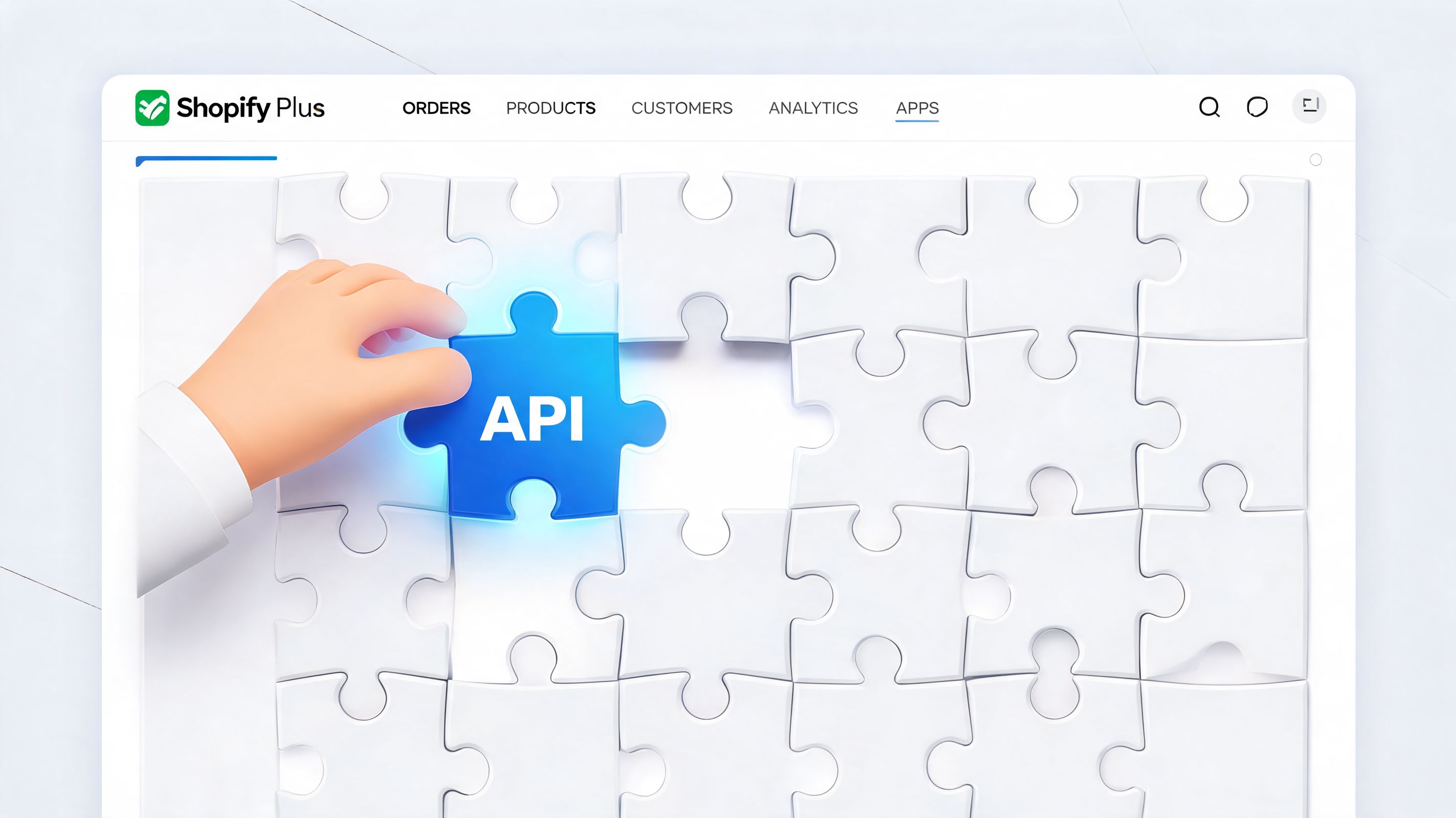
The useful thing about Shopify Plus is that you don't need to choose between “stay standard” and “rebuild everything.” There's a middle path. You can keep Shopify as the commercial backbone while introducing API-first layers where they create genuine value.
Start with Shopify as the engine
For most Shopify Plus brands, the safest architecture starts with a simple decision. Keep Shopify responsible for the commerce fundamentals it already handles well. That usually includes catalogue, pricing, cart behaviour, checkout, orders, and much of the app ecosystem.
Then decide what should sit outside the standard theme layer.
That could be:
- A custom storefront using Shopify's Storefront API
- A Hydrogen frontend for brands that want a Shopify-native headless path
- A separate CMS for content-rich publishing and campaign control
- Specialist services for search, personalisation, loyalty, or customer accounts
This isn't about using more tools for the sake of it. It's about giving each function a clear role.
Pick the pressure point first
The best Shopify Plus API-first projects usually begin with one dominant constraint. Not five.
If the current store struggles with performance and design flexibility, the pressure point is the storefront. If operational complexity is the issue, the pressure point may be integration architecture. If merchandising is held back by inflexible content structures, CMS and presentation may need to move first.
That matters because architecture should follow business friction. A lot of wasted spend comes from merchants adopting a composable stack before identifying which part of the current experience is blocking growth.
A practical Shopify Plus pattern
A common, sensible structure looks like this:
| Layer | Typical Shopify Plus choice | Purpose |
|---|---|---|
| Commerce core | Shopify Plus | Product, cart, checkout, orders |
| Frontend | Hydrogen or another custom frontend | Brand experience and presentation control |
| Content layer | CMS or Shopify content model | Editorial flexibility and campaign management |
| Business logic extensions | Shopify Functions and selected apps | Promotions, rules, and custom operational behaviour |
| Integrations | APIs to ERP, CRM, search, reviews | Data flow across systems |
A stronger technical walkthrough of that route appears in this headless Shopify Plus implementation guide.
Use Shopify's native tools where they reduce risk
Merchants sometimes assume “custom” automatically means “better.” It doesn't. In Shopify Plus, native tools often reduce long-term maintenance.
Storefront API gives the frontend structured access to catalogue and cart data. Hydrogen offers a framework designed for Shopify-driven experiences. Shopify Functions lets teams extend selected backend behaviour in a more controlled way than piling custom scripts on top of a theme.
That means a merchant can build a more customized storefront without taking full ownership of every commerce concern.
The healthiest API-first builds keep as much commodity commerce inside Shopify as possible and customise only the areas that create actual advantage.
Plan for demand before it arrives
Scalability isn't abstract for growing brands. Product drops, paid campaign bursts, seasonal spikes, and retail moments all put unusual stress on the system.
That's where architecture earns its keep. Shopify Plus stores using API-first architectures demonstrate the ability to handle 5x traffic spikes, from 10k to 50k concurrent users, without downtime, compared to a 28% failure rate in monolithic setups during peak seasons, according to UK-specific benchmarks cited by RTInsights.
For a merchant, the takeaway is practical. You don't build API-first only for daily average traffic. You build it for the day your campaign works better than expected.
A useful overview sits below if you want to see how Shopify frames the building blocks in a more visual format.
What to avoid on Shopify Plus
A few patterns create problems quickly:
- Replacing too much at once when the current store's main problem is isolated
- Pulling checkout logic outside Shopify unnecessarily, which often adds risk where reliability matters most
- Choosing tools before defining data ownership, especially across products, customers, and fulfilment states
- Ignoring content operations, then discovering the new setup is harder for internal teams to manage
A strong Shopify Plus API-first strategy isn't the most customised one. It's the one that keeps the commercial core stable while opening the exact points of flexibility the business needs.
Your Migration Checklist and Key Considerations
A successful migration starts long before any frontend build begins. Merchants who treat API-first ecommerce architecture as a business change rather than a design project make cleaner decisions and avoid most of the expensive surprises.
The migration checklist
Audit the current store List every integration, workflow, app dependency, redirect rule, and operational workaround. Include hidden logic in discounting, shipping, customer groups, bundles, subscriptions, and reporting. If something matters to finance, support, warehouse teams, or retention, it belongs in scope.
Define the business case in plain language
“We want headless” isn't a strategy. “We need separate B2B and DTC experiences without duplicating product operations” is. “We need a content-heavy storefront that marketing can run without development delays” is. Good architecture follows explicit commercial goals.Choose what stays in Shopify and what moves out Many migrations go off course at this stage. Keep the stable, commodity functions where they create the least operational burden. Move only the layers that need flexibility, independence, or stronger performance control.
Map data ownership before selecting tools
Who owns product truth? Inventory truth? Customer identity? Promotion logic? Content? Without these answers, APIs become pipes carrying confusion faster.Plan rollout in phases
Big-bang launches are tempting and often avoidable. A phased approach lowers risk, gives teams room to test assumptions, and makes it easier to isolate failures if something breaks.
Key decision: The architecture diagram matters less than the ownership model. If no one knows who owns the data or the release process, the stack will drift.
Four areas that decide whether the migration succeeds
Performance
Headless storefronts can be fast, but speed doesn't happen automatically. A merchant still needs disciplined caching, lean frontend decisions, sensible third-party script control, and a clear approach to how product and content data are fetched.
Common failure mode: the team leaves a slow theme and rebuilds the same bloat in React or another frontend framework.
Ask these questions early:
- What content must be fetched live, and what can be cached?
- Which third-party scripts contribute to revenue?
- How will collection pages, product pages, and search results behave under load?
SEO
Monolithic platforms give merchants a lot of technical SEO support by default. Once you decouple the frontend, that safety net becomes thinner. Canonicals, metadata, schema markup, redirects, internal linking, crawl behaviour, and indexable rendering all need direct attention.
That doesn't mean API-first is bad for SEO. It means SEO can't be treated as post-launch polishing.
Watch for these risks:
- Changed URLs without redirect discipline
- Thin or inconsistent metadata logic
- Client-side rendering choices that make content harder to index
- Disconnected content and product page governance
CRO
A custom storefront can improve conversion, but customisation alone doesn't guarantee commercial improvement. In fact, some merchants lose clarity because they mistake freedom for strategy.
A stronger approach is to define the conversion hypothesis before design work starts. If a headless rebuild is supposed to improve navigation, content relevance, product discovery, bundle logic, or mobile buying flow, those goals should shape the architecture and measurement plan.
The practical question is simple. What buying friction are you removing that the current setup can't solve cleanly?
Security and compliance
This is no longer a background concern. The EU-UK Data Act, effective January 2026, has become a major consideration. A UK ICO analysis found 55% of API-first platforms fail initial compliance audits due to non-standardised endpoints, and GDPR-aligned consent APIs can add up to 30% development time, according to Digital Applied's guide to headless commerce in 2026.
For UK merchants, that means compliance needs to be designed in from the start, not patched in after the frontend is complete.
Focus on:
- Consistent endpoint standards across services
- Consent handling that matches how customer data flows
- Access control for admin tools, portals, and integrations
- Documentation that lets legal, technical, and operational teams align
If your roadmap includes adjacent innovation around identity, contracts, or traceable digital processes, it can help to review how specialist partners outside ecommerce structure secure systems. A credible blockchain development company can be a useful reference point for thinking about data integrity and interoperable architectures, even if your stack has nothing to do with blockchain itself.
The practical questions to ask before signing off
Use this short review with your team and any agency partner:
- What exact business bottleneck are we solving?
- Which current apps or workflows are we replacing, not just recreating elsewhere?
- What does phase one include, and what is deliberately deferred?
- Who will maintain integrations after launch?
- How will we measure whether the migration is working commercially, not just technically?
- What happens if one service fails during a peak trading period?
- How are SEO and compliance signed off before go-live?
Merchants rarely regret asking harder questions before migration. They often regret assuming the architecture itself will answer them.
Conclusion Is API-First Right for Your Business
API-first isn't the right answer for every Shopify Plus merchant. It's the right answer when the current store structure is constraining growth in ways optimisation alone won't fix.
If your team needs deeper content control, cleaner system integrations, channel flexibility, stronger resilience under peak demand, or a more custom buying experience, API-first ecommerce architecture can be a strong strategic move. If your priorities are simpler, a well-executed Shopify setup may deliver better returns with less risk.
A useful decision test is to ask:
- Are we planning complex expansion across channels, markets, or customer types?
- Does our current storefront limit experiences we know would help conversion or retention?
- Are integrations and operational workarounds slowing the business down repeatedly?
- Can we support the added complexity that comes with a more flexible architecture?
If the answer to those questions is mostly no, keep things simpler. If the answer is yes, the conversation shifts from “Should we go headless?” to “How do we do it without overspending, overbuilding, or disrupting revenue?”
That's the authentic merchant mindset. Not hype, not fear. Fit.
If you're weighing whether API-first is worth the cost and complexity, Grumspot can help you assess it properly. Their team works with Shopify Plus merchants on audits, migrations, bespoke storefronts, ERP and CRM integrations, SEO risk reviews, and conversion-focused rebuilds, so you can decide what to change, what to keep, and how to scale without adding unnecessary overhead.
Let's build something together
If you like what you saw, let's jump on a quick call and discuss your project

Related posts
Check out some similar posts.

- shopify website examples
Explore 7 Shopify website examples and learn the UX, conversion features, and practical lessons merc...
Read more
- cro best practices
Apply cro best practices to Shopify stores with 10 actionable tactics for testing, product pages, ch...
Read more
- ecommerce subscription platform
Learn how an ecommerce subscription platform works, which models drive retention, and how to choose,...
Read more
- ecommerce replatforming agency
Choosing an ecommerce replatforming agency? Learn what they do, replatforming signs, costs, timeline...
Read more