Composable Commerce Shopify Plus: 2026 UK Merchant Guide
- composable commerce Shopify Plus
- Shopify Plus
- headless commerce
- ecommerce architecture
- Shopify agency UK
Launched
May, 2026

A lot of UK Shopify Plus merchants hit the same point at roughly the same stage of growth. The store is trading well. The team has a solid theme. Apps have filled the first round of gaps. Then the roadmap starts getting harder instead of easier.
Marketing wants richer landing pages without waiting on development every time. Operations needs tighter ERP or CRM flows. International teams want storefronts that feel local instead of duplicated. Product wants faster experimentation. The answer floating around every conference, partner call, and platform pitch is composable commerce Shopify Plus.
That answer is sometimes right. It's also often oversold.
Composable commerce can give you far more control over customer experience, content workflows, integrations, and frontend performance. It can also create a stack that costs more to run, takes longer to change, and depends on skills your team may not have in-house. For many scaling merchants, the smartest move isn't a full rebuild. It's choosing the exact point where Shopify's native stack stops helping and a more modular approach starts earning its keep.
Introduction Is Your Shopify Plus Store Hitting a Wall?
A familiar scenario looks like this. Your Shopify Plus store launched quickly, scaled well, and handled the first wave of growth without much drama. That was the right call. Shopify Plus is popular with enterprise and high-volume merchants for good reason, and the UK is a major part of that footprint.
According to BuiltWith data cited by EcommerceTrix, the UK hosts 5,804 live Shopify Plus stores as of 2026, making it the second-largest market globally after the United States. That matters because it tells you something practical. You're not on an odd platform with a thin ecosystem. You're on a platform that many serious UK merchants already use as the base for growth.
The friction usually shows up in layers rather than all at once.
The first signs are rarely dramatic
Your theme still works, but it's getting harder to bend. New landing page concepts need workarounds. Search doesn't behave the way your merchandising team wants. Personalisation ideas stall because the frontend is too tightly tied to theme logic. A rebrand gets scoped as a redesign, then quietly turns into an architectural debate.
On the backend, complexity also starts to surface. Finance wants cleaner system-to-system data. Operations needs more dependable inventory and order flows across channels. A B2B team asks for account-specific experiences that don't fit neatly into the existing setup.
Profitable stores rarely “break” first. They usually slow down first.
That's the point where composable commerce enters the conversation. Not because your current store has failed, but because the business has become more ambitious than the original setup.
This is a business decision before it's a technical one
The mistake is treating composable as an upgrade path everyone should eventually take. That's not how good architecture decisions work. The actual question is simpler. Where is your current Shopify Plus setup limiting revenue, speed, or operational control, and what is the lightest architectural change that removes that limit?
Sometimes the answer is “stay monolithic and tidy up the store properly.” Sometimes it's “go headless for the frontend.” Sometimes it's “replace only a few services.” And for a small number of very large retailers, it's a more modular enterprise setup.
What matters is making the decision with open eyes, especially if you're trading in the UK and balancing growth plans with team capacity, compliance, and cost discipline.
What Is Composable Commerce Really?
The easiest way to explain composable commerce is to stop treating it like a product name.
A standard Shopify Plus build is like buying a well-engineered car that already works as a complete system. You can customise it, upgrade parts, and tune it for your use case, but the major systems are designed to work together from the start. That's why Shopify Plus can launch quickly and stay operationally simple for many merchants.
Composable commerce is closer to building with advanced modular parts. You pick the pieces you want, connect them through APIs, and create a setup around your own priorities. That might mean one service for content, another for search, a custom frontend framework, and Shopify still handling core commerce functions such as product data, checkout, and order management.
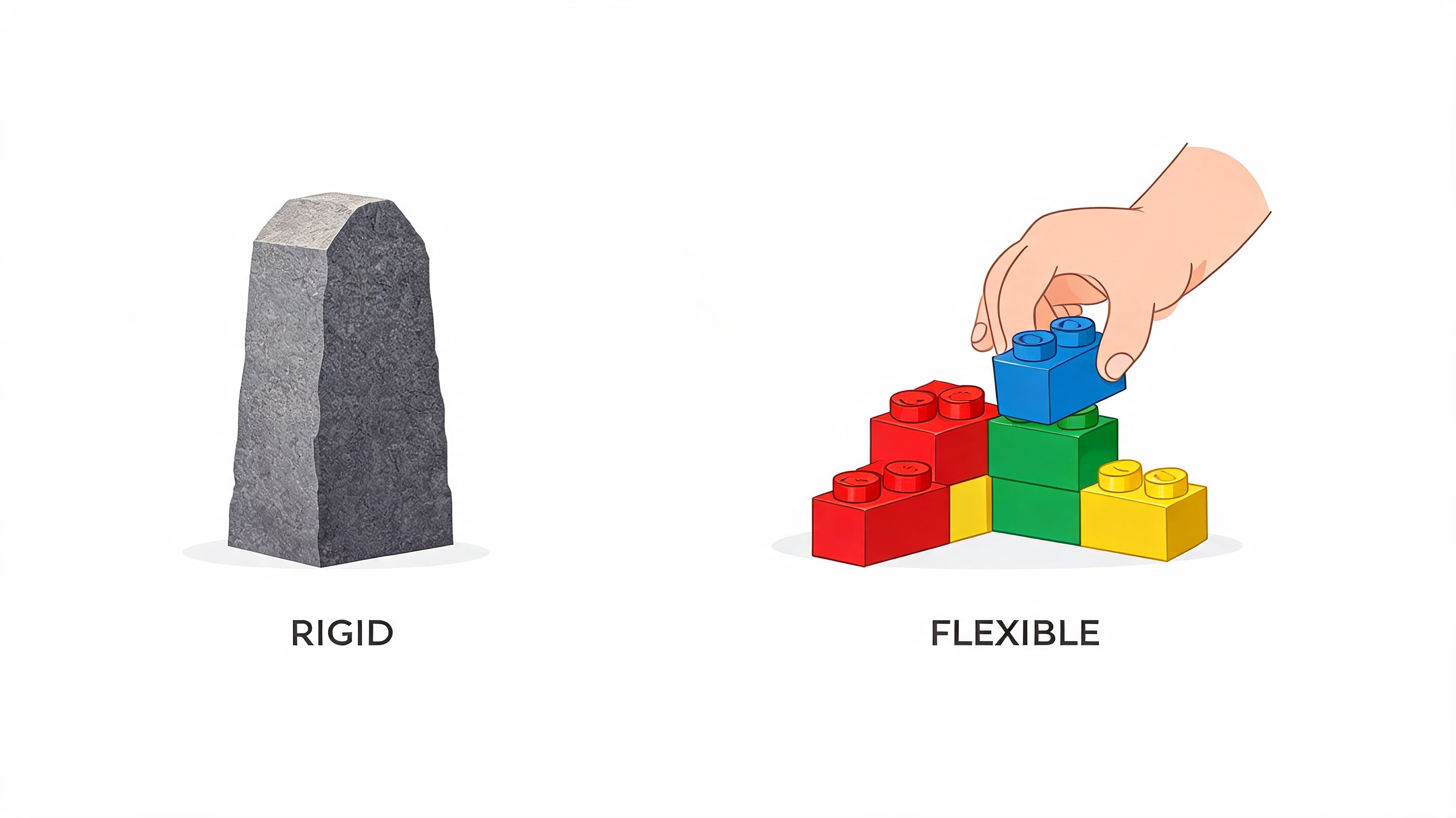
It's an architectural approach, not a shopping list
Merchants often get tripped up at this point. They hear “composable” and assume it automatically means better technology. It doesn't. It means more freedom to choose and assemble capabilities.
Those capabilities are often called packaged business capabilities, but you don't need the jargon to make a decision. In practice, think of them as separate parts of your commerce stack, such as:
- Search and merchandising: Algolia or Elasticsearch-driven experiences instead of native search behaviour
- Content management: A headless CMS for richer editorial control
- Frontend presentation: A custom storefront in React, Next.js, or Hydrogen
- Personalisation or experimentation: Tools that plug into a decoupled frontend more easily than a theme-led setup
- Backend integrations: ERP, CRM, subscriptions, fulfilment, and custom apps connected through APIs and webhooks
A useful primer on the frontend side of this is Grumspot's guide to what headless ecommerce means, because headless is often the first composable step merchants typically consider.
The API-first part is the bit that matters
In a composable setup, the systems don't live inside one tightly bundled interface. They communicate through APIs and event flows. That gives you room to create better customer journeys and more specialised internal workflows, but it also means someone has to own the connections between those systems.
That “someone” is where reality arrives.
A composable architecture only works well when your data structures, ownership model, release process, and support model are organised. If they aren't, you don't get elegant flexibility. You get a stack of tools that all need attention, all have contracts, and all can fail in different ways.
Practical rule: If your team can't clearly explain who owns search, content, frontend deployment, and integration monitoring, you're not ready for a fully composable stack.
For many Shopify Plus merchants, composable commerce is best understood as a spectrum. You do not have to jump from a standard theme build straight to a fully decoupled architecture. Most sensible decisions happen in the middle.
Key Composable Architecture Patterns for Shopify Plus
There are three patterns most merchants end up choosing from. They all sit under the broad umbrella of composable commerce Shopify Plus, but they solve different problems and come with very different levels of complexity.
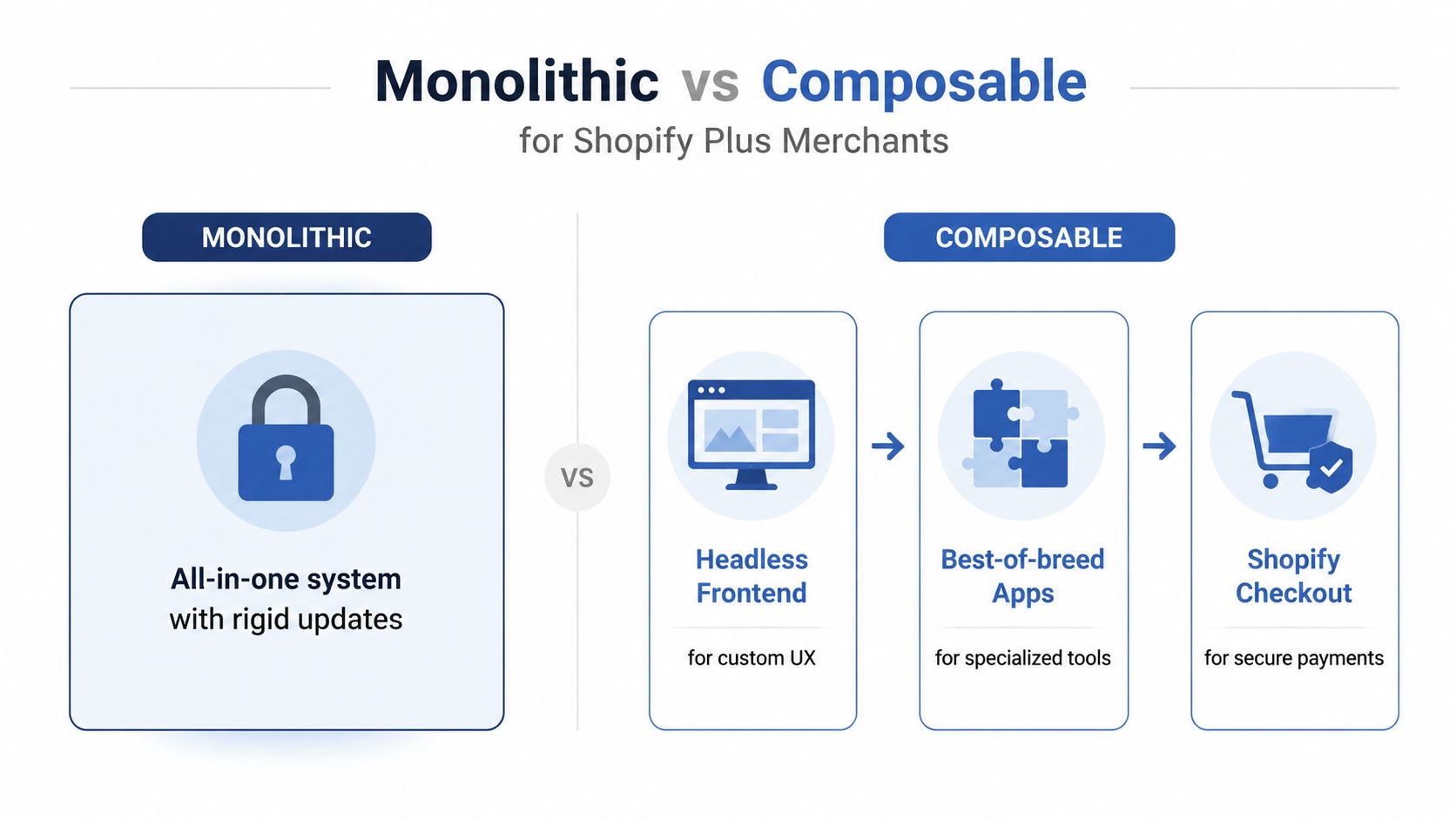
Standard Shopify Plus with selective enhancements
This is still the right answer more often than people admit. You keep Shopify's theme architecture and native operating model, then improve weak points with carefully chosen integrations or custom app work.
That could mean replacing native search with Algolia, using a stronger CMS workflow, building custom ERP connections, or adding specialised merchandising logic. The key point is that the storefront itself still behaves like a standard Shopify Plus build.
This model works well when:
- Your biggest constraints are feature-specific: Search, subscriptions, content operations, or back-office sync
- Your marketing team needs autonomy: Theme-based editing often stays easier for day-to-day trading
- You want lower operational overhead: Fewer moving parts means fewer release and monitoring concerns
- Your growth issues are real but not structural: The platform isn't the bottleneck. Specific functions are
This approach is often under-valued because it isn't flashy. But for many UK merchants, it gives the best balance of speed, control, and cost.
Headless Shopify Plus
Headless is the pattern people usually mean when they first say “composable”. The frontend is decoupled from Shopify's presentation layer, while Shopify continues to run the commerce engine behind the scenes.
That means your storefront can be built in frameworks such as React, Next.js, Vue, or Shopify's own Hydrogen stack. The frontend requests product, collection, cart, and customer data through APIs. The commercial logic remains anchored in Shopify.
For a good technical overview of that model, Grumspot's article on Shopify headless commerce is a useful reference point.
The value of headless is straightforward. You gain far more control over user experience, performance tuning, editorial structure, and frontend development workflows. If your brand experience is a competitive asset, that freedom can matter a lot.
According to Elogic's explanation of Shopify Plus headless architecture, headless commerce separates the frontend presentation layer from backend commerce operations and supports custom storefronts built with frameworks like React, Next.js, or Vue. That same source describes webhook-driven event systems that keep distributed components synchronised across orders, payments, and inventory.
Headless tends to fit merchants who need:
- Distinctive frontend experiences: Rich editorial storytelling, content-led navigation, unusual customer journeys
- Multi-brand storefront flexibility: Separate experiences with shared backend operations
- More control over deployment workflows: Frontend teams can ship outside theme constraints
- A cleaner path for advanced third-party tools: Search, CMS, and personalisation tools often fit more naturally
What doesn't work well is going headless just because the team is tired of the current theme. If your problem is weak UX, poor merchandising, or app sprawl, headless won't fix those by itself.
Fully composable with Commerce Components by Shopify
This is the enterprise pattern. It's not a default next step for ordinary scaling brands.
According to Swanky's breakdown of Commerce Components by Shopify, Shopify's 2023 release of Commerce Components by Shopify allows enterprises with GMV above $500 million to access more than 30 modular components, including checkout and Shop Pay, through flexible APIs. That changes the conversation because it gives very large retailers a way to adopt modularity across parts of Shopify that were previously much more bundled.
In practical terms, this means a retailer can decouple a custom React storefront from Shopify's core checkout and use an event-driven architecture around those components. That is a serious enterprise option. It is also overkill for most mid-market teams.
The presence of a modular enterprise offering doesn't mean your business should use it. It means Shopify now has a path for merchants whose scale justifies that level of architectural control.
Shopify architecture models compared
| Attribute | Standard Shopify Plus (Monolith) | Headless Shopify Plus | Fully Composable (with CCS) |
|---|---|---|---|
| Frontend control | Moderate within theme architecture | High | Very high |
| Operational complexity | Lower | Medium to high | High |
| Team requirements | Shopify theme and app expertise | Frontend engineering plus Shopify expertise | Enterprise engineering and architectural governance |
| Time to change | Fast for standard merchandising and content tasks | Fast for frontend teams, slower if governance is weak | Depends heavily on internal process maturity |
| Best fit | Merchants who need speed and simplicity | Brands needing custom UX and flexible frontend delivery | Very large enterprises with modular platform strategy |
| Checkout model | Native Shopify checkout | Native Shopify checkout connected to custom frontend | Modular component approach for qualifying enterprises |
| Cost control | More predictable | More moving parts | Highest architectural and vendor-management overhead |
Which pattern usually wins
Most successful merchants don't leap straight to full composability. They either improve a standard Shopify Plus build or move to headless for a specific commercial reason.
A hybrid stack often gives the best return. Keep Shopify where it's strong. Change the parts that are holding the business back. Ignore the hype that treats architectural complexity as a badge of maturity.
The Real Benefits and Trade-offs for Your Business
Composable commerce gets sold on freedom. That part is true. The part that's often missing is what freedom costs when a retail team has to operate it every day.

Where composable commerce earns its place
The strongest case for composable commerce Shopify Plus usually comes from one of three needs.
First, the brand needs a customer experience the theme layer can't sensibly support. That could be content-rich campaigns, highly customized product journeys, unusual merchandising logic, or region-specific storefronts that need more than theme duplication.
Second, the business needs better separation of concerns. Content teams want cleaner workflows. Frontend developers want modern deployment practices. Backend teams want integrations handled in a more deliberate way.
Third, the company wants architectural optionality. If you expect your CMS, search, personalisation, or frontend stack to evolve over time, composable makes swapping and extending parts more realistic than forcing everything through one layer.
A useful baseline for what merchants still get from the core platform is covered in Grumspot's overview of the benefits of Shopify Plus. That matters because many businesses still undervalue the operational simplicity they already have.
The hidden bill isn't just software
The most expensive part of composable isn't always the tools themselves. It's the coordination.
According to Shopify's enterprise discussion of composable commerce, 45% of enterprises run a composable front end with a full-stack back end. That matters because it reflects what many businesses discover in practice. They don't replace everything. They layer a modern frontend over a stable backend, then spend a lot of energy managing the seam between the two.
That seam creates work in places merchants often underestimate:
- Integration ownership: Someone has to manage APIs, webhooks, failure states, retries, and version changes
- Vendor management: More services mean more contracts, support tickets, roadmap conflicts, and renewal pressure
- Release discipline: A change in the CMS, frontend, search layer, or app logic can affect the same customer journey
- Monitoring and support: When checkout, content, and fulfilment touch different systems, diagnosing issues takes longer
- Hiring: Specialist engineering talent is harder to replace than a good Shopify theme team
Team readiness matters more than ambition
A mid-market merchant can absolutely outgrow a standard setup. But many don't fail because the architecture was too simple. They fail because the new stack assumed a team structure that didn't exist.
If your current store already struggles with ownership, documentation, and release control, composable will expose that weakness faster than it solves it.
The practical trade-off is this. You gain flexibility and control, but you also inherit more responsibility for keeping the system coherent. That's why the strongest composable builds usually come from businesses that already know exactly which bottleneck they're fixing.
If you can't name the bottleneck with precision, don't rebuild the architecture yet.
Real-World Examples and Performance Indicators
The best way to judge composable commerce Shopify Plus is to look at situations where the architecture changes the economics of the work, not just the aesthetics of the store.
A fashion brand expanding into multiple markets
Consider a UK fashion merchant with strong domestic performance and a plan to launch several localised storefronts. The issue isn't checkout. Shopify already handles that well. The issue is that content, campaign logic, and navigation need to feel distinct by market without creating duplicated backend administration.
A sensible answer might be a headless or hybrid setup. The brand could keep Shopify as the commercial engine, then use a more flexible frontend and structured content model to tailor experiences by region.
The indicators worth tracking here would include:
- Content publishing speed: Can regional teams launch campaigns faster without developer bottlenecks?
- Frontend iteration speed: Can the team test market-specific UX ideas without rebuilding the whole theme?
- Operational consistency: Are orders, inventory, and product data still managed cleanly from one core commerce system?
What would not justify the move is a vague desire to “feel more premium”. Architecture has to remove a real commercial or operational constraint.
A B2B supplier with awkward workflows
Now take a wholesaler on Shopify Plus selling to trade customers with negotiated pricing, account-level purchasing behaviour, and downstream ERP requirements. The default storefront may work for simple ordering, but account workflows and system integration become the primary issue.
In that case, composable doesn't have to mean a dramatic visual rebuild. It may mean creating modular services around account experiences, ERP connectivity, quoting logic, or custom portals while preserving the stable parts of Shopify.
The indicators here are different:
- Workflow completion: Are trade buyers able to complete the processes they need?
- Manual operations load: Has the team reduced repetitive admin work between Shopify and internal systems?
- Change velocity: Can the business adapt B2B processes without rewriting the whole storefront each time?
A content-led DTC brand with a crowded roadmap
A third pattern is the merchant whose theme has become a bottleneck for experimentation. The team wants richer campaigns, cleaner storytelling, stronger merchandising logic, and more design freedom, but every change has to fight against old theme assumptions and app conflicts.
A headless build can make sense in these cases, especially if the business treats the storefront as a product rather than a brochure. The KPIs aren't only customer-facing. Internal delivery matters too.
Good performance indicators for composable projects often include time-to-launch, testing velocity, editorial autonomy, and support burden. Not just conversion.
That distinction matters because some architectural wins show up first in team speed and operational clarity. The revenue outcome often follows, but only if the original business problem was diagnosed correctly.
Planning Your Move to Composable Commerce
The biggest mistake merchants make is treating composable as a single migration project. It almost never should be. It should be a phased business decision with technical implementation following behind it.
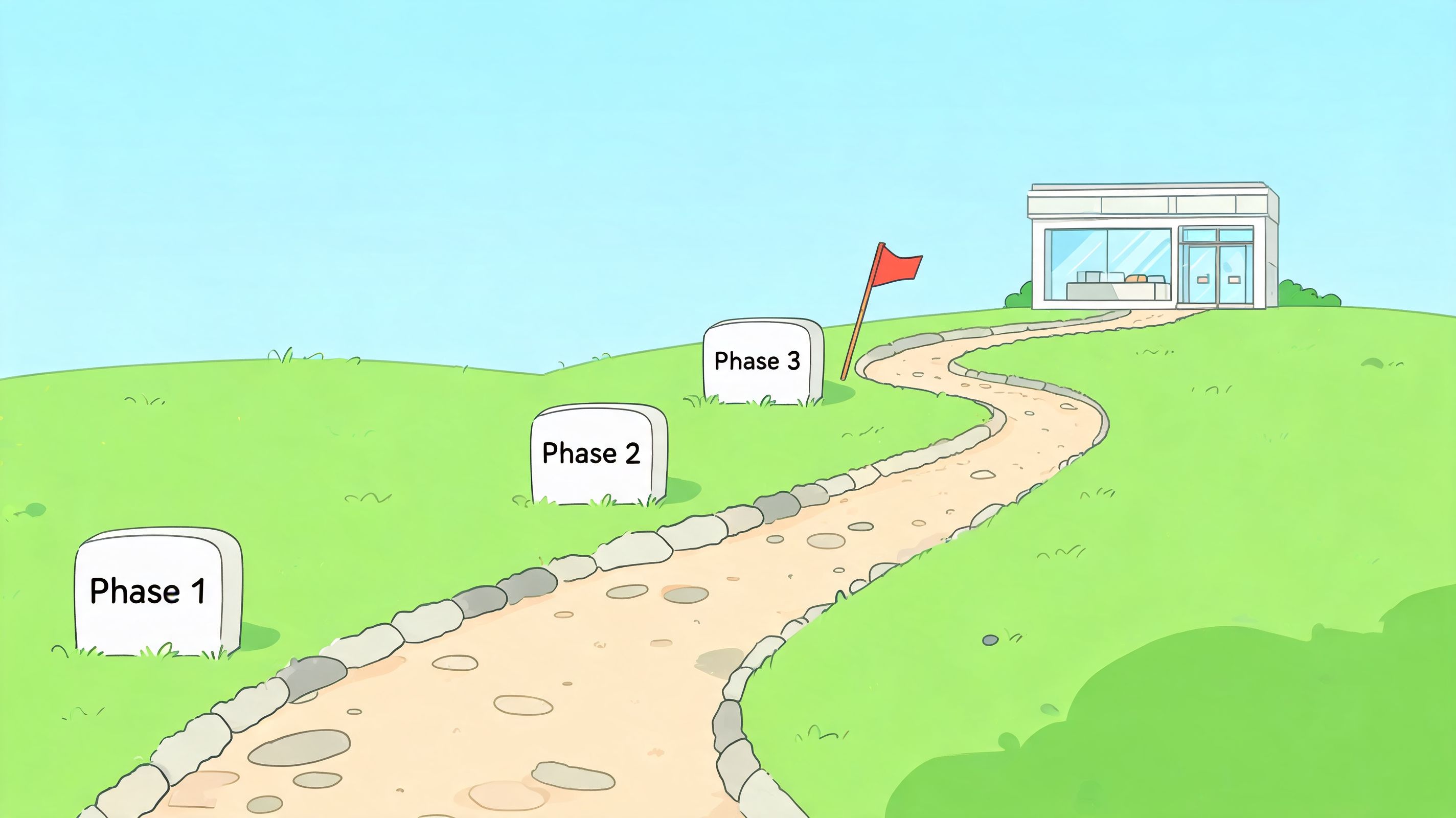
According to Digital Applied's discussion of headless commerce trends for Shopify Plus, a major barrier is the migration reality gap. Many guides don't explain whether profitable legacy Shopify Plus stores should migrate mid-scale, and they often skip over revenue risk and data-governance complexity for retailers handling GDPR-sensitive data across multiple vendors.
That's exactly the right warning. A profitable store should not go through architectural change just because the idea sounds modern.
Phase one starts with diagnosis
Before any stack decisions, get brutally specific about the current pain.
Ask questions like:
- What is slowing the business down? Theme limitations, content workflows, international rollout, search quality, ERP complexity, B2B logic, or all of the above?
- Which issue affects revenue or operating efficiency most directly?
- Which issue can't be solved cleanly inside standard Shopify Plus?
- Which requests are one-off edge cases and which are recurring structural needs?
If the answers are fuzzy, pause there. You probably need a technical and commercial audit before anything else. In that kind of assessment, agencies, internal teams, and specialist partners should all be looking for the same thing. The smallest intervention that removes the highest-friction constraint.
Choose the architecture that matches the team you actually have
A lot of expensive mistakes come from choosing for the future team instead of the current one. You might plan to build an internal frontend function later. You might hope operations will get more technical. You might expect vendor management to become easier. None of that helps today.
A realistic decision usually looks like one of these:
- Stay with the Shopify Plus monolith if your issues are mostly UX, CRO, theme quality, or app clutter.
- Go hybrid if a few specialised services would solve the underlying problem without rebuilding the storefront.
- Go headless if the frontend is a proven strategic bottleneck and you can support the new operating model.
- Consider deeper modularity only if the scale, governance, and engineering model justify it.
A planning partner can help with that evaluation. Grumspot, for example, handles Shopify Plus audits, migrations, bespoke storefront work, and ERP or CRM integrations, which is the type of scope merchants often need when the decision involves both customer experience and back-office architecture.
Build the roadmap in phases
A good roadmap rarely starts with “rebuild everything”.
It usually starts with one high-value change that reduces risk and teaches the team how the new model behaves. That might be replacing search, introducing a better content layer, rebuilding one customer journey, or moving the frontend while leaving the commercial core intact.
A short technical walkthrough can help frame the decisions before committing to scope:
After the first phase, review the operational effect as much as the customer effect. Did the team become faster? Did support become harder? Did deployment improve or get more fragile? Those answers should shape the next phase.
Avoid the big-bang rebuild unless there is a clear platform-level reason to replace the experience layer in one move. Most profitable merchants benefit more from staged change than dramatic reinvention.
For UK merchants, add one more filter. If customer data is moving across more systems, someone needs to own the data map, vendor boundaries, and compliance responsibilities early. That is not admin work to tidy up later. It is part of the architecture.
Conclusion Your Action Plan with Grumspot
Composable commerce Shopify Plus is not the finish line for ambitious merchants. It's one of several architectural tools available when the standard setup stops matching the business.
For some UK brands, the right move is to stay close to Shopify's monolithic strengths and improve the store properly. For others, a headless frontend or hybrid stack enables the next stage of growth without forcing a full platform rethink. A smaller group of very large retailers will need deeper modular control and have the team structure to support it.
The common failure isn't choosing monolith over composable, or composable over monolith. It's choosing an architecture that doesn't match the business problem, the internal team, or the operating discipline required to keep it healthy.
A practical decision checklist looks like this:
- Do we know exactly which business constraint we're trying to remove?
- Is that constraint structural, or can we solve it inside standard Shopify Plus?
- Will a more modular setup make our team faster, or spread responsibility across more vendors?
- Who will own frontend releases, integrations, data quality, and incident response after launch?
- Are we solving for real operational need, or reacting to industry hype?
If you can answer those questions clearly, the right path becomes much easier to see.
If you can't, that's usually the sign to pause major implementation and get the architecture assessed before anyone commits to a rebuild. The strongest outcomes come from diagnosing the bottleneck first, then choosing the lightest setup that removes it cleanly.
If you're weighing whether to stay with Shopify Plus, move headless, or take a hybrid composable route, Grumspot can help assess the fit, map the migration risk, and scope the storefront or integration work around your actual business constraints rather than a generic platform narrative.
Let's build something together
If you like what you saw, let's jump on a quick call and discuss your project

Related posts
Check out some similar posts.

- shopify website examples
Explore 7 Shopify website examples and learn the UX, conversion features, and practical lessons merc...
Read more
- headless commerce agency
Discover what a headless commerce agency does, when to choose headless over Shopify Plus themes, typ...
Read more
- cro best practices
Apply cro best practices to Shopify stores with 10 actionable tactics for testing, product pages, ch...
Read more
- composable commerce platform
Learn what a composable commerce platform is, how it differs from monoliths, and how UK Shopify Plus...
Read more