Shopify Developer on Demand: A 2026 UK Guide
- Shopify developer on demand
- Shopify development
- ecommerce developer
- hire shopify expert
- uk shopify agency
Launched
May, 2026

Sales are climbing. Your paid campaigns are finally efficient. Email is working. Returning customers are coming back.
Then the store starts fighting you.
A collection page loads awkwardly on mobile. A discount app conflicts with your bundle logic. The product template that felt fine six months ago now looks like a compromise. Your team has a list of “small fixes” that aren't small anymore, and every week one of them turns into a real trading problem.
That's the point where many ecommerce managers realise they don't just need development. They need reliable Shopify capability on tap.
Your Shopify Store is Growing Fast Now What
A common pattern looks like this. The brand launched on a solid theme, added a few apps, made some quick wins, and kept momentum going. Then growth changed the brief. The site now needs cleaner merchandising logic, faster templates, better integrations, and fewer workarounds.
The difficulty is timing. You may not have enough continuous demand to justify a permanent senior hire, but the store has already outgrown ad hoc fixes from whoever is available. That gap is where a Shopify developer on demand becomes useful.
This is particularly relevant in the UK. The UK was Europe's largest online retail market in 2024, with ecommerce accounting for 26.3% of total retail sales, according to the IMRG/Capgemini eRetail Sales Index coverage cited here. More than one in four pounds of retail spend was online. That changes the standard for execution. A slow storefront, brittle checkout customisation, or delayed integration fix isn't just a technical nuisance. It can affect revenue quickly.
The point where growth exposes technical debt
Most stores don't break all at once. They accumulate friction.
- Merchandising friction means your team can't launch landing pages or promotional layouts without editing theme code manually.
- Operational friction shows up when Shopify stops syncing cleanly with your ERP, CRM, shipping tool, or reporting workflow.
- Conversion friction appears when page speed drops, mobile interactions feel clumsy, or app conflicts create strange checkout behaviour.
Practical rule: if your roadmap includes more than design tweaks, and your team keeps postponing technical work because nobody owns it properly, you're already in on-demand territory.
The useful shift is to stop thinking about this as “hiring a developer” and start thinking about it as buying agility. You want someone who can step into a live trading environment, fix the right problems, and help your team ship meaningful improvements without the delay and overhead of a full recruitment cycle.
Defining the On-Demand Shopify Developer Model
A Shopify developer on demand is not just a person who edits theme sections when asked. The model works more like having a specialist consultant on call. You bring them in for high-value platform work, focused delivery windows, or recurring technical support that your internal team can't cover consistently.
That distinction matters. A lot of Shopify work looks simple from the outside because the admin is friendly. The harder work sits underneath: theme architecture, API behaviour, app conflicts, data flow, checkout logic, and release discipline.
What this model actually covers
In the UK, this model is most valuable when the task needs platform-specific engineering. Shopify developers commonly work with Liquid, HTML, CSS, JavaScript, the GraphQL Admin API, webhooks, Checkout UI extensions, and Shopify Functions, as described in this overview of Shopify developer capabilities.
That usually translates into work such as:
- Custom theme engineering for product pages, collection templates, landing pages, and reusable content blocks
- Integration work between Shopify and external systems like ERPs, CRMs, shipping platforms, and finance tools
- Checkout and cart customisation using approved extensibility tools rather than fragile hacks
- Automation and admin workflow improvements driven by webhooks and platform logic
- Migration support when moving to Shopify 2.0, restructuring a theme, or retiring app bloat
If your need is “change this banner” or “update a font”, you probably don't need senior on-demand development. If your need is “our subscriptions, bundles, fulfilment rules, and analytics stack keep colliding”, you probably do.
Why teams choose it over a permanent hire
The appeal is flexibility, but the primary advantage is concentration. Good on-demand engagements are narrow and commercially anchored. The developer isn't waiting around for work. They're there to move through a defined backlog, solve technical blockers, and reduce the drag that slows launches and optimisation.
That's why the model often works well as a retainer rather than a vague hourly arrangement. A structured monthly plan gives you room for urgent fixes, planned development, and iterative improvements without re-scoping every task. If you're comparing that format, this breakdown of a Shopify monthly development plan is useful because it shows how ongoing technical support can be packaged around delivery rather than random ticket handling.
The strongest on-demand setup feels less like outsourcing and more like extending your in-house team with platform-specific depth you don't currently have.
Where the boundaries should be
A good partner won't pretend they own everything.
They should own implementation, technical diagnosis, release quality, and advice on what's feasible inside Shopify. They shouldn't be inventing commercial priorities for you, rewriting your operations process without context, or unilaterally making compliance decisions that need legal sign-off.
That division of responsibility is healthy. It keeps the engagement fast, accountable, and useful.
Comparing Engagement Models Freelancer vs Agency vs Full-Time
Once you know you need more Shopify capability, the next question is structure. Many organizations are choosing between a freelancer, a full-time hire, or an on-demand agency arrangement.
The right answer depends less on budget alone than on how much risk, coordination, and complexity your store can tolerate.
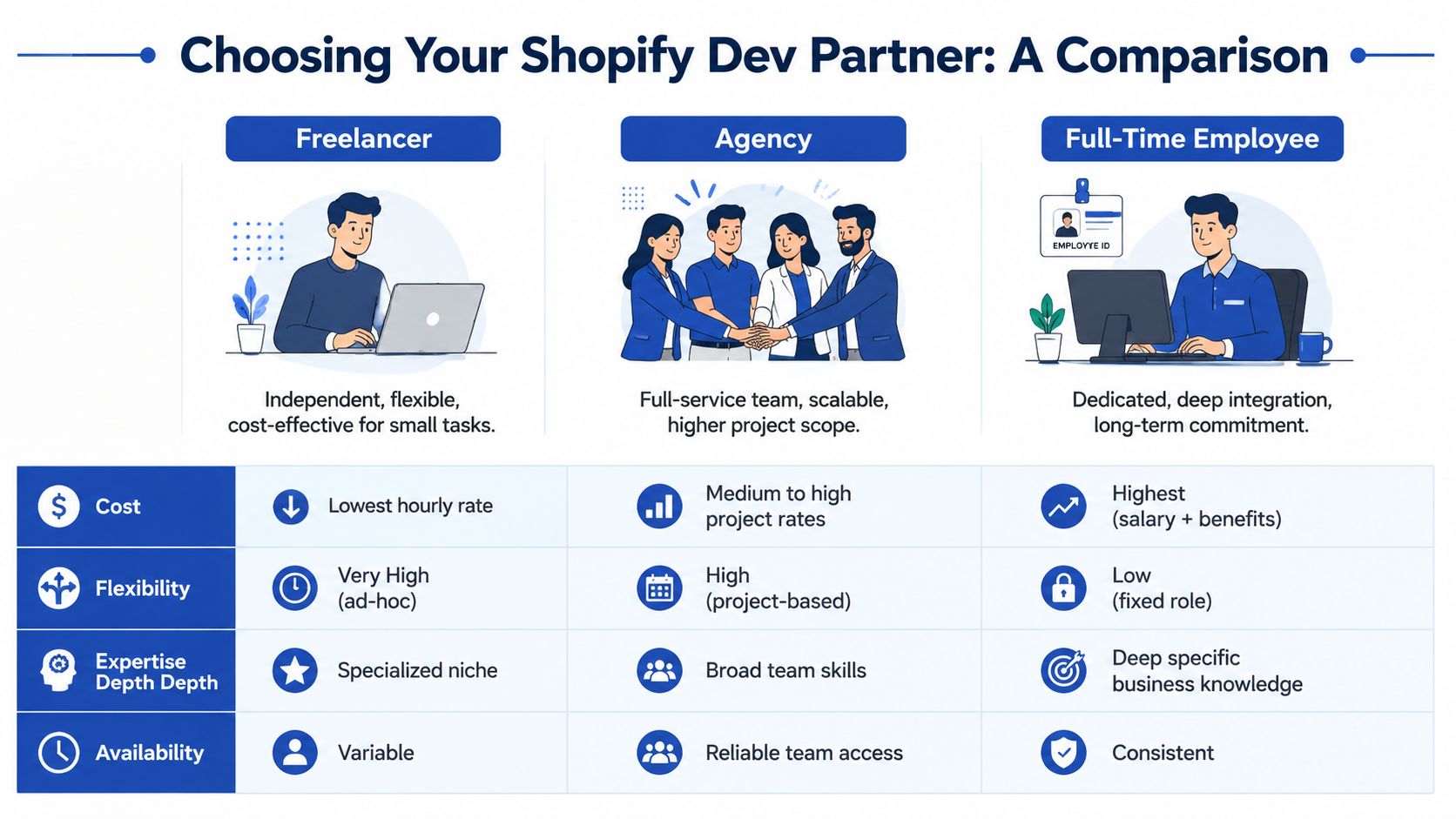
Shopify Developer Engagement Model Comparison
| Criteria | Freelancer | Full-Time Hire | On-Demand Agency (e.g. Grumspot) |
|---|---|---|---|
| Cost | Lower apparent entry cost for small jobs | Highest long-term overhead because salary, management, and utilisation all sit with you | Higher than a solo freelancer for simple tasks, often more efficient for mixed technical work |
| Speed to impact | Fast if the task is narrow and the freelancer is available | Slower at the start because hiring and onboarding take time | Fast once scoped, especially when the partner already has Shopify delivery process |
| Breadth of skills | Usually strong in one area, weaker outside it | Depends entirely on the individual you hire | Broader coverage across development, QA, UX, CRO, and integrations |
| Availability and responsiveness | Can vary with workload and timezone | Consistent if managed well | Usually structured around agreed response times and delivery capacity |
| Scalability | Harder to expand beyond one person's bandwidth | Limited by one employee unless you hire more people | Easier to add design, CRO, and senior technical input as priorities change |
| Management overhead | You manage tasks, QA, and prioritisation closely | You manage recruitment, line management, process, and retention | Lower day-to-day overhead if the agency has a clear operating model |
When a freelancer works well
Freelancers are useful when the work is clearly bounded. A theme tweak, a template issue, a specific app installation, or a short burst of bug-fixing can suit a strong specialist.
The trade-off is dependency. If your store needs frontend work, app troubleshooting, QA, and some conversion thinking at the same time, a solo operator can become a bottleneck. Some freelancers can handle broad scope, but many are strongest in one lane.
A freelancer also tends to work best when you already have someone in-house who can brief clearly, review work sensibly, and absorb platform decisions.
When full-time makes sense
A full-time Shopify hire becomes easier to justify when development is constant, your roadmap is deep, and the role extends beyond implementation into ownership. That could mean maintaining a custom theme architecture, supporting multiple trading teams, managing releases, and acting as the internal technical lead for ecommerce.
The problem is utilisation. Many brands don't need a senior Shopify engineer every hour of every week. They need one intensely during migrations, rebuilds, promotions, app rationalisation, or systems work. Outside those peaks, a permanent role can become expensive and oddly underused.
There's also a hiring challenge. Shopify isn't a generic web skill anymore. The platform keeps expanding, and the ecosystem keeps getting more specialised. By 2025, Shopify had captured 30% of US ecommerce businesses, Shopify Plus merchants generating $1m to $500m in revenue were growing an average of 126% year on year, and the Shopify App Store had expanded to 17,600+ apps by April 2026, according to Omnisend's Shopify statistics roundup. Even if you operate in the UK, that scale affects the talent market. You're hiring into a busy ecosystem.
Why agencies often win on mixed-scope work
An on-demand agency model tends to work best when the work is commercially important and technically uneven. One week you need a checkout issue fixed. Next week you need design support for a landing page. Then you need app review, speed work, and release support before a campaign goes live.
That's difficult to cover with one person unless they're unusually broad and consistently available.
If your roadmap mixes engineering, experimentation, and live trading support, the question isn't “who can code this?” It's “who can keep this moving without creating more management overhead for my team?”
This is similar to how growth teams build flexible support around other channels. For example, teams managing creator outreach often use scaling influencer campaigns with virtual marketing assistants as a way to add execution capacity without locking themselves into a fixed headcount decision. Shopify development often benefits from the same operating logic.
If you're actively weighing options, this guide on how to hire a Shopify developer is a practical companion because it helps separate project fit from CV polish.
A simple decision filter
Use this rough rule:
- Choose a freelancer when the brief is small, self-contained, and low risk.
- Choose full-time when Shopify development is a core internal function with sustained weekly demand.
- Choose on-demand agency support when the store needs specialist input, cross-functional delivery, and consistent momentum without the commitment of another permanent role.
Key Use Cases for an On-Demand Developer
The best use cases aren't “we need some dev help”. They're tied to moments where time, quality, and commercial impact matter at once.
A Shopify developer on demand is often at their most valuable when your team can already see the cost of delay. Sometimes that's an outage or urgent bug. Often it's slower, more expensive friction across launches, campaigns, or operational workflows.
Urgent trading issues
These jobs rarely arrive at a convenient time. A promotion clashes with discount logic. A new app disrupts product page behaviour. Checkout changes introduce edge-case issues that customer support notices before anyone else does.
In this situation speed matters, but so does diagnosis. The wrong fix can create a second problem somewhere else.
Typical urgent scenarios include:
- Broken cart or checkout behaviour after app installs, theme updates, or extensibility changes
- Inventory or fulfilment sync errors that expose inaccurate stock or order status data
- Theme regressions where a “small tweak” affects templates, metafields, or mobile layout across key pages
The advantage of on-demand support here is less about availability alone. It's about having someone who understands Shopify's architecture well enough to isolate the root cause quickly.
Planned growth work
Not all important work is urgent. A lot of value comes from the roadmap items that keep slipping because they're too technical for marketing and too commercially messy for a generic development queue.
Common examples include Shopify 2.0 migrations, full storefront rebuilds, custom subscription logic, and integration projects between Shopify and back-office systems. International growth work often sits in this category too. UK merchants expanding into the EU or Middle East often need cleaner handling of currencies, tax display, shipping logic, content localisation, and market-specific storefront behaviour. Those aren't one-click settings decisions. They usually involve implementation choices, operational ownership questions, and iterative testing.
A strong on-demand partner should be able to say, “this belongs in Shopify”, “this belongs in your ERP”, and “this needs an ops decision before we write code”.
That clarity saves time. It also stops development from becoming a dumping ground for unresolved business decisions.
Performance and conversion work
This is the use case many teams under-budget for.
For UK ecommerce teams, Shopify developers are expected to optimise page speed, time to interact, and bounce rate, while also building custom themes from the Liquid theme engine rather than relying on off-the-shelf templates. Better theme architecture and lighter custom code improve storefront responsiveness, as described in this summary of Shopify developer skills.
That matters because performance work usually sits between departments. Marketing sees weaker conversion. Design sees UX inconsistency. Development sees accumulated theme debt and app overhead. Nobody owns the whole chain unless a technical partner does.
The jobs that usually justify specialist input
Here's where on-demand support tends to outperform generic dev help:
Storefront rebuilds with live trading constraints
You need a better UX and cleaner code, but you can't afford a messy launch.Custom product or bundle logic
Standard apps don't fit the buying journey, or the app stack is becoming too rigid.ERP, CRM, or fulfilment integrations
Manual workarounds are consuming team time and increasing the risk of order or stock issues.Internationalisation projects
Your UK store is selling cross-border and needs more than simple currency switching.Audit-led optimisation
The store “works”, but page performance, template quality, and technical debt are suppressing growth.
What doesn't usually need this model
Not every task deserves a specialist retainer.
If your needs are mostly content updates, product uploads, homepage swaps, and basic merchandising changes, a capable ecommerce executive or theme support workflow may be enough. On-demand development pays off when the work is technical, revenue-adjacent, or risky to get wrong.
That's the key distinction. You're not buying code volume. You're buying the ability to remove blockers that ordinary execution can't resolve safely.
How to Vet and Choose the Right On-Demand Partner
A polished proposal doesn't tell you much. Plenty of partners can talk confidently about Shopify. Far fewer can work cleanly inside a live store, communicate trade-offs transparently, and handle the parts of the brief that aren't visible in a portfolio screenshot.
The fastest way to avoid a bad fit is to vet in three layers: technical depth, operating process, and UK-specific judgement.

Check technical depth, not just aesthetics
A nice homepage in their portfolio proves very little. Ask what they built.
Useful questions include:
What kind of Shopify work do you handle most often?
Listen for specifics like Liquid architecture, app integrations, theme rebuilds, Shopify Functions, checkout extensibility, or API work.How do you approach app bloat and theme performance?
Strong answers mention code restraint, dependency review, and release discipline.Can you explain a recent migration or integration project?
You want to hear about data flow, testing, rollback planning, and edge cases, not just visuals.
If the conversation stays vague, assume the delivery will be vague too.
Review how they run projects
Good technical work can still fail if the operating model is chaotic.
Ask who your day-to-day contact will be, how tickets are prioritised, how releases are tested, and what happens when something urgent lands mid-sprint. A decent partner should be able to describe their workflow in practical terms, not agency theatre.
Look for signs of operational maturity:
- Clear intake process for bugs, roadmap items, and urgent requests
- Defined communication rhythm such as Slack, ClickUp, Jira, Trello, or weekly calls
- Testing and QA discipline before anything touches the live theme
- Transparent ownership on who decides, who builds, and who signs off
If you want a benchmark for what outsourced Shopify support can look like structurally, this overview of outsource Shopify development is useful because it frames delivery around process, not just labour.
Test for UK compliance awareness
Many hiring conversations stay too shallow.
A real UK ecommerce brief often includes privacy, consent, trust signals, accessibility expectations, and checkout or analytics changes that can create compliance risk if handled badly. Generic hiring advice often misses that. One reason the gap matters is that many merchants are effectively asking whether an on-demand developer can handle legal and trust-related build requirements as part of delivery, a concern highlighted in this discussion of hiring a Shopify website developer.
Ask direct questions.
- How do you approach cookie consent changes when analytics or marketing tags need updating?
- What do you do when a requested UX pattern could create accessibility issues?
- Where do you stop and ask for legal or compliance input rather than making assumptions?
Don't hire a partner who treats compliance as somebody else's problem. They don't need to be your legal adviser, but they do need to build in a way that respects legal and trust constraints.
Look for commercial understanding
The strongest partners don't just take tickets. They can tell the difference between busywork and strategic advantage.
If you explain your goals, they should be able to help sort the backlog into three groups: urgent revenue protection, medium-term growth work, and low-value cosmetic noise. That prioritisation instinct is often more valuable than flashy pitch work.
Your Onboarding Playbook for Immediate Impact
The first week sets the tone. If access is messy, priorities are scattered, and nobody on your side owns decisions, even a strong Shopify developer on demand will spend too much time untangling basics.
A clean onboarding process doesn't need to be elaborate. It needs to remove ambiguity.
Prepare the backlog before kickoff
Don't start with “we have loads of things”. Start with a working list.
Use whatever your team already understands, whether that's Trello, Jira, ClickUp, Notion, or a shared spreadsheet. The format matters less than the order. Split tasks into urgent fixes, scheduled improvements, and later ideas. Add screenshots, page URLs, and a sentence on business impact for each item.
This helps your partner spot what should be batched, what needs investigation first, and what isn't worth doing yet.
Sort access and environments properly
Most delays happen here.
Before kickoff, prepare access to Shopify admin, theme code, analytics, tag management, app dashboards, design files, and any connected systems relevant to the brief. Use a password manager for secure sharing. Decide which theme is the staging theme, how approvals work, and who has authority to publish.
A simple checklist helps:
- Platform access for Shopify, apps, and connected tools
- Design and brand assets including Figma, imagery, and style references
- Tracking visibility so the developer can see how analytics and tags are currently configured
- Decision owners for commercial sign-off, technical sign-off, and legal review where needed
Define communication before work starts
Don't wait for the first urgent issue to decide where communication lives.
Pick one main channel such as Slack or Microsoft Teams. Set expectations for daily updates, weekly calls, and how urgent requests are escalated. Choose one internal point of contact who can answer questions quickly and stop conflicting instructions from multiple stakeholders.
The fastest projects usually have one client-side owner, one prioritised backlog, and one agreed place where decisions happen.
Give the first sprint a sharp brief
The first sprint shouldn't try to solve everything.
A better pattern is to combine one urgent issue, one meaningful improvement, and one diagnostic task. That gives the partner space to prove responsiveness, show technical judgement, and learn the store properly without disappearing into a giant undefined rebuild.
When onboarding is done well, value appears quickly. Not because the developer is rushing, but because your team has made it easy for good work to happen.
The Grumspot On-Demand Model in Action
A growing Shopify store rarely needs the same kind of technical support every month. One quarter is dominated by checkout issues, app conflicts, and performance fixes. The next is about preparing for a new market, tightening UK compliance details, or adapting the storefront for different currencies, languages, and fulfilment rules. An on-demand model works when it can absorb that change without forcing you into a permanent headcount decision too early.
Grumspot is one example of that approach. Its support spans monthly retainers and project work across bespoke storefront builds, Shopify 2.0 migrations, internationalisation, subscriptions, performance improvements, and integrations with systems such as ERPs and CRMs. The practical advantage is not extra hands alone. It is access to senior Shopify judgement that can shift between engineering, UX, CRO, and operational priorities as the store changes.
That matters for scaling teams with cross-border plans.
A retailer selling only in the UK may need careful handling of VAT presentation, shipping logic, app data flows, and consent tooling. A retailer expanding beyond the UK adds another layer. Market configuration, translated content, local payment methods, and region-specific customer journeys all start to affect development choices. The on-demand model is useful here because it gives ecommerce managers a way to bring in capability at the point complexity appears, rather than carrying the cost of a full-time specialist before the roadmap justifies it.
In practice, the work usually shifts over time. Early sprints often focus on stabilisation. Later work tends to move into conversion improvements, theme component updates, app rationalisation, and systems integration. A good partner handles those changes with discipline, not with vague promises of "flexibility".
Proof still matters more than pitch language. Published examples from Grumspot include a bundle creator tied to higher average order value and full store rebuilds for growing merchants. The point is not that every store needs custom bundling or a rebuild. The point is that useful on-demand support should show evidence of commercial thinking, technical depth, and the ability to work on revenue-affecting tasks, not only backlog cleanup.
If you are comparing partners, ask to see how they explain trade-offs. Ask how they would phase a UK-first store that expects international rollout in six months. Ask what they would standardise early to avoid expensive rework later. Reference materials such as Clickstera frequently asked questions can help frame those conversations, but the deciding factor is whether the partner can tie technical decisions to trading reality.
The model fits best when your roadmap is active, priorities change, and you need experienced Shopify capability without the management overhead of a full in-house hire. If your store needs daily embedded ownership across every planning cycle, a permanent internal role may still be the better choice.
Frequently Asked Questions
How is a Shopify developer on demand different from a one-off project developer
A one-off project developer is hired to deliver a defined outcome, then step away. A Shopify developer on demand usually supports an evolving backlog over time. That makes the model better suited to live trading environments where priorities change and technical work doesn't arrive in neat, isolated chunks.
Is a retainer always better than ad hoc support
Not always.
If you have one contained piece of work with clear acceptance criteria, a fixed project can be the cleaner option. A retainer works better when you expect a mix of bug fixes, improvements, and roadmap items across the month. It gives your team continuity and reduces the friction of repeated scoping.
How quickly can an on-demand engagement start
That depends on access, scope clarity, and the partner's availability. In practice, stores start faster when the client already has a prioritised backlog, approved stakeholders, and platform access prepared. If those basics aren't ready, kickoff drifts no matter who you hire.
Can the developer also advise on apps, UX, and conversion issues
A good on-demand partner should. They may not own your full ecommerce strategy, but they should be able to flag weak app choices, identify technical causes of UX friction, and explain where development can support conversion work. If they only wait for instructions, you're paying for hands, not judgement.
Do I need separate compliance support
Sometimes yes.
A capable developer should be able to implement consent tooling, privacy-conscious tracking changes, and accessibility-aware frontend work. But they shouldn't replace legal advice. The cleanest arrangement is usually shared responsibility: your internal team or adviser confirms the compliance position, and the developer implements it properly.
What should I prepare before the first call
Bring your current priorities, a list of systems connected to Shopify, known pain points, and any deadlines tied to campaigns or launches. If you already have questions about how other providers structure support resources, browsing a general resource like Clickstera frequently asked questions can help you shape clearer operational questions before speaking to a technical partner.
What's the biggest mistake teams make
They buy capacity before they define ownership.
If nobody internally can prioritise work, approve changes, and connect technical requests to business goals, the engagement gets noisy quickly. The stores that get the most from on-demand support usually have one person who owns outcomes, not just tickets.
If your Shopify roadmap is getting heavier and your team needs dependable senior support without the commitment of a permanent hire, Grumspot is worth a look. A short discovery call can help you decide whether you need a freelancer, a project team, or an on-demand retainer, and what the cleanest setup looks like for your store.
Let's build something together
If you like what you saw, let's jump on a quick call and discuss your project

Related posts
Check out some similar posts.
- project scope definition
Master project scope definition with clear deliverables, boundaries, and change control. Includes Sh...
Read more
- Shopify 2.0 theme development
Master Shopify 2.0 theme development. Learn to set up, build, migrate, & optimize themes with JSON t...
Read more
- Shopify Plus custom bundle app
Build a Shopify Plus custom bundle app that drives revenue. Our end-to-end guide covers technical ar...
Read more
- shopify design agency
Discover how a shopify design agency can transform your store with conversion-focused design, fast p...
Read more