Shopify Store Setup Services: A 2026 UK Guide
- shopify store setup services
- shopify agency uk
- ecommerce setup
- shopify expert
- shopify development
Launched
April, 2026

You’re probably in one of three situations right now. You’ve got a product and need a proper Shopify store, you’ve outgrown a scrappy first version that isn’t converting well, or you’re migrating from another platform and can’t afford a messy launch.
That’s where shopify store setup services either become a smart investment or an expensive disappointment.
A lot of businesses buy “setup” thinking they’re paying for a theme install, product uploads, and a payment gateway. In practice, the quality of the setup shapes revenue, margin, operational friction, compliance risk, and how much rework you’ll pay for later. In the UK, that gap is even wider because generic global setups often miss the parts that matter most locally, especially VAT handling, post-Brexit tax logic, checkout localisation, and the way UK customers expect to pay.
A professional setup should leave you with more than a live website. It should leave you with a store that’s ready to sell, track, scale, and survive audit pressure without constant patchwork.
What Are Shopify Store Setup Services Really?
A founder comes to us after three months of piecing a store together with tutorials, apps, and a premium theme. The site is live, but sales are patchy, reporting is unreliable, VAT settings are questionable, and every small change creates another problem. That is usually the point where “setup” stops meaning design work and starts meaning business infrastructure.
Professional shopify store setup services are the work of turning a Shopify account into a revenue-producing sales channel. The job is not to publish pages. The job is to build a store that supports acquisition, conversion, fulfilment, reporting, and compliance from day one.
That changes what a buyer should expect.
A serious setup covers store structure, theme configuration, product and collection logic, search and filtering, payments, shipping rules, tax settings, analytics, app selection, email capture, policy pages, and operational integrations. In the UK, it also needs proper attention on VAT handling, shipping disclosures, returns information, cookie consent, and the legal details generic international setups often miss.
These decisions affect revenue directly. Poor navigation lowers product discovery. Weak collection logic hurts SEO and merchandising. A cluttered product page reduces conversion. Bad app choices slow the site and add monthly cost. Incorrect tax setup creates margin problems and can leave a merchant cleaning up errors after launch.
At Grumspot, we treat setup work as commercial planning expressed through Shopify. If a brand needs higher average order value, the build should support bundles, cross-sells, and clearer product comparison. If paid traffic is the growth engine, landing page structure, mobile speed, and tracking accuracy matter more than visual extras. If the business wants stronger conversion performance over time, early decisions about template flexibility and testing matter, which is why work such as Shopify Conversion Rate Optimization should be considered during setup, not months later.
The same applies to SEO. A professional setup is not “SEO later.” It includes sensible URL structure, collection hierarchy, internal linking, metadata control, image handling, and indexation decisions that stop the store from fighting itself. If you want a practical view of how this fits into the build process, this guide on how to build a Shopify store for growth lays out the steps clearly.
What businesses are buying, if the service is any good, is judgment.
They are paying for someone to decide what needs custom work, what Shopify already handles well, which apps are worth the cost, where future scale will break the first version, and which shortcuts will cost more to fix later. A cheap setup can still become an expensive store if it creates friction at checkout, weak data, or compliance gaps that surface once orders start coming in.
A weak provider usually delivers a branded theme, loads too many apps, leaves defaults untouched, and calls it done. A strong provider builds around margin, conversion, and operational reality. That is the meaning of store setup services.
Core Deliverables That Drive E-commerce Growth
The line items in a proposal only matter if they connect to outcomes. Design, development, SEO, CRO, and integrations all sound useful. What matters is whether each one contributes to revenue, efficiency, or lower risk.
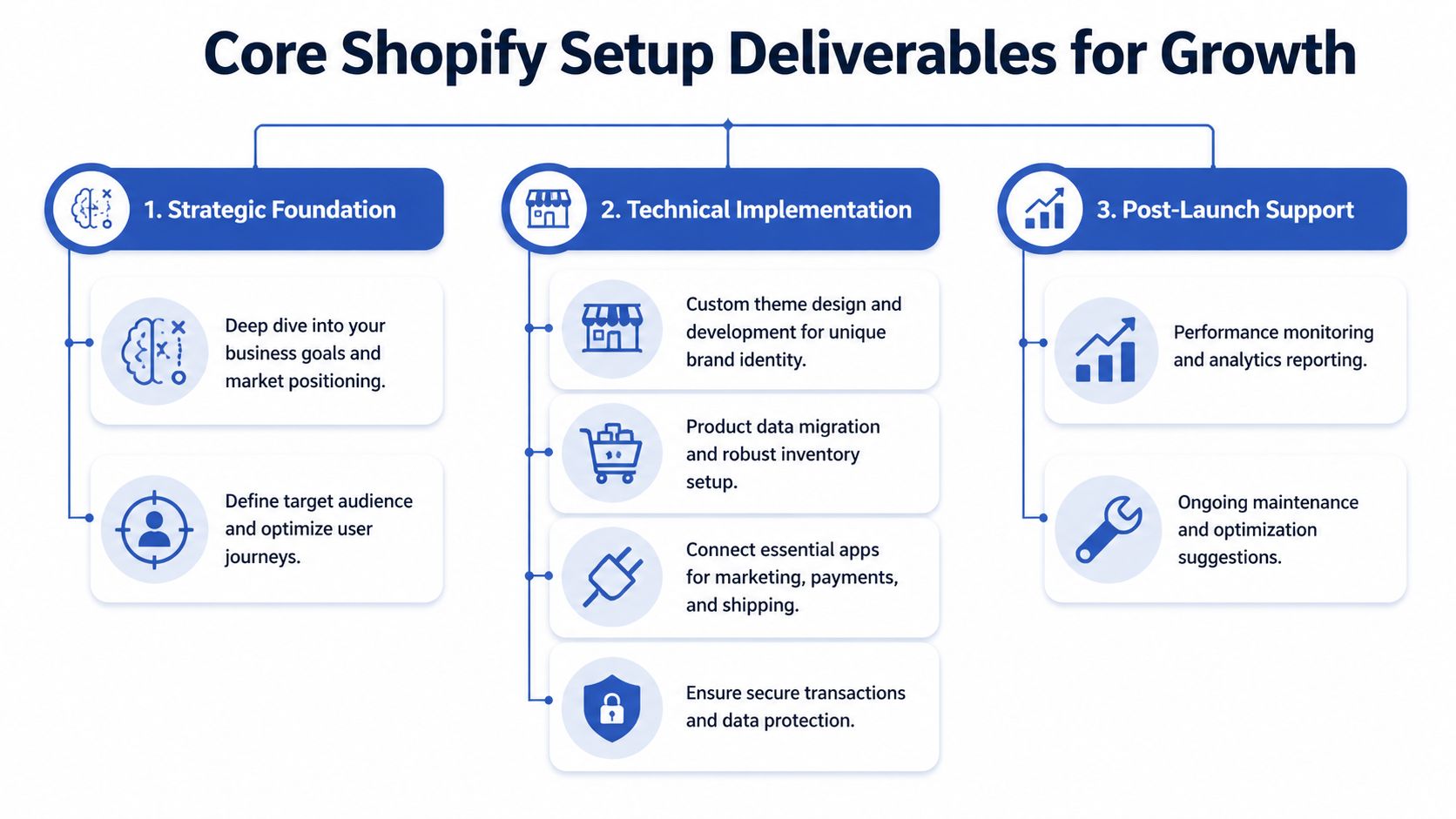
Strategic foundation before any build work
The strongest setups begin before anyone touches a theme.
That early work usually includes offer positioning, collection logic, navigation planning, device priorities, customer journey mapping, and a view on what the store needs to achieve in the first phase. A business selling a few hero products needs a very different structure from a catalogue-heavy brand with variants, bundles, subscriptions, and wholesale considerations.
A strong build feels simple to the customer because someone did the hard thinking upfront.
This phase also defines what not to build yet. That matters because many stores get over-engineered in week one. A leaner stack with clear priorities usually outperforms a bloated setup full of features nobody maintains.
If you want a plain-language walkthrough of how a build comes together, Grumspot’s guide on how to build a Shopify store is a useful reference point.
Theme design and development that affects trust
Design isn’t decoration. It shapes whether a shopper trusts the store enough to keep moving.
A bespoke or heavily customised theme can improve clarity around value proposition, product discovery, content hierarchy, and mobile usability. The development side matters just as much. Clean implementation avoids unnecessary app clutter, protects site speed, and creates a better base for future testing.
Here’s the direct commercial logic:
Design quality affects trust. Code quality affects speed. Trust and speed affect conversion.
That’s why “cheap setup” often becomes expensive later. Teams save money on launch, then pay again to fix speed, poor mobile layouts, and inflexible templates.
Checkout and CRO work that lifts sales
Setup services quickly prove their value. In UK Shopify setups, checkout optimisation is not optional. According to this checklist on professional Shopify setup expectations, enabling Apple Pay and Klarna drives a 27% reduction in cart abandonment. The same source notes that using Shopify 2.0 checkout extensibility for custom features such as urgency timers can lift AOV by 18%.
Those are setup decisions, not post-launch extras.
If you’re evaluating CRO priorities more broadly, this guide to Shopify Conversion Rate Optimization is worth reviewing because it frames optimisation around actual buying behaviour rather than surface-level design tweaks.
Data migration and catalogues that don’t create hidden mess
Migration work often gets underestimated because it sounds procedural. It isn’t. Product data quality directly affects filtering, search relevance, merchandising, feeds, reporting, and customer confidence.
A proper migration checks:
- Product structure: variants, options, tags, metafields, and collection logic
- Content continuity: URLs, media mapping, page structure, and brand copy
- Operational accuracy: inventory rules, shipping profiles, and fulfilment dependencies
Bad migrations don’t always fail on launch day. They fail later when merchandising is inconsistent, search behaves oddly, or teams realise product rules were imported without a usable structure.
Integrations that remove manual work
ERP, CRM, WMS, reviews, subscriptions, shipping, returns, and support tools all need to connect cleanly. The setup work involved can either streamline operations or lock a business into daily admin.
A good partner will challenge the stack, not just install whatever the client mentions. Some apps overlap. Some create performance drag. Some solve one problem while creating three new ones.
Foundational SEO that protects discoverability
SEO at setup stage isn’t about writing a few meta titles and calling it done. It’s about giving search engines and users a cleaner structure from day one. That includes collection architecture, internal linking, template hierarchy, indexation decisions, content migration handling, and redirect planning where needed.
The result isn’t instant rankings. It’s a stronger technical and content base that avoids avoidable losses later.
Typical Timelines and Investment Levels in 2026
A founder gets a quote for £6,000 and assumes launch is six weeks away. Three months later, the store is still in revision because product data is messy, shipping rules were never agreed, and nobody clarified how VAT should work for UK and EU orders. That pattern is common.
The two questions that matter early are still the same. How long will this take, and what will it cost? The useful answer starts with commercial scope, not page count. A 50-product store can be expensive if it needs subscription logic, custom bundles, B2B pricing, or back-office integration. A 500-product store can move faster if the catalogue is structured well, decisions are made quickly, and the build stays close to proven theme architecture.
A practical view of project bands
These are realistic planning ranges for the UK market in 2026.
| Project Tier | Best For | Typical Timeline | Investment Range (GBP) |
|---|---|---|---|
| Starter setup | New brands launching with a standard theme, light customisation, small catalogue | 4 to 6 weeks | £5k to £10k |
| Growth setup | Established stores needing stronger UX, app stack planning, CRO thinking, and moderate integrations | 8 to 12 weeks | £10k to £25k |
| Advanced build or migration | Complex catalogues, custom development, ERP or CRM integration, international setup, or Shopify Plus preparation | 3 to 6 months | £25k+ |
These numbers work as budget planning, not fixed-price promises. I’ve seen a modest-looking project jump a tier because approvals were slow and product data arrived in five different spreadsheets.
What actually changes the budget
The big cost drivers are usually operational, not cosmetic.
- Design depth: custom collection logic, bespoke PDP layouts, and content blocks built for merchandising and conversion take time to design, build, and test
- Systems work: ERP, CRM, subscriptions, search, returns, and fulfilment tools often create more effort than the storefront itself
- Catalogue condition: poor data structure increases migration clean-up, QA time, and post-launch admin
- Decision speed: delayed feedback, missing assets, and unclear ownership add weeks quickly
- Compliance scope: UK tax setup, invoicing requirements, cookie consent, privacy flows, and market configuration need to be right before launch
Compliance is where cheap builds often become expensive. UK merchants need VAT rules configured properly, but that is only part of the job. The setup may also need correct company details, returns information, privacy and cookie handling, checkout messaging, and payment settings that match the way the business trades. If any of that is wrong, the cost shows up later in finance queries, support volume, chargebacks, and rework.
That affects revenue more than people expect.
A store that launches with weak tax logic or unclear shipping charges does not just create admin problems. It creates abandoned checkouts, customer service friction, and lower trust at the point of purchase. Good setup work protects margin as much as it protects compliance.
Where false economy shows up
The highest ROI usually comes from avoiding a second build.
Low quotes often leave out the work that determines whether the store performs after launch. That includes discovery, data preparation, QA across devices and payment methods, redirect mapping, tracking validation, and post-launch support. Agencies can make a proposal look efficient by excluding these items, then charge later when the missing work becomes urgent.
For teams replatforming from WooCommerce, Magento, or another legacy setup, the risks sit inside the data and operational rules. This guide to Shopify migration services for replatforming projects explains where timelines stretch and why migration budgets can vary so much.
A better buying question is not “What is the cheapest way to get live?” It is “What setup gives us a store that converts, stays compliant, and does not need rebuilding in six months?”
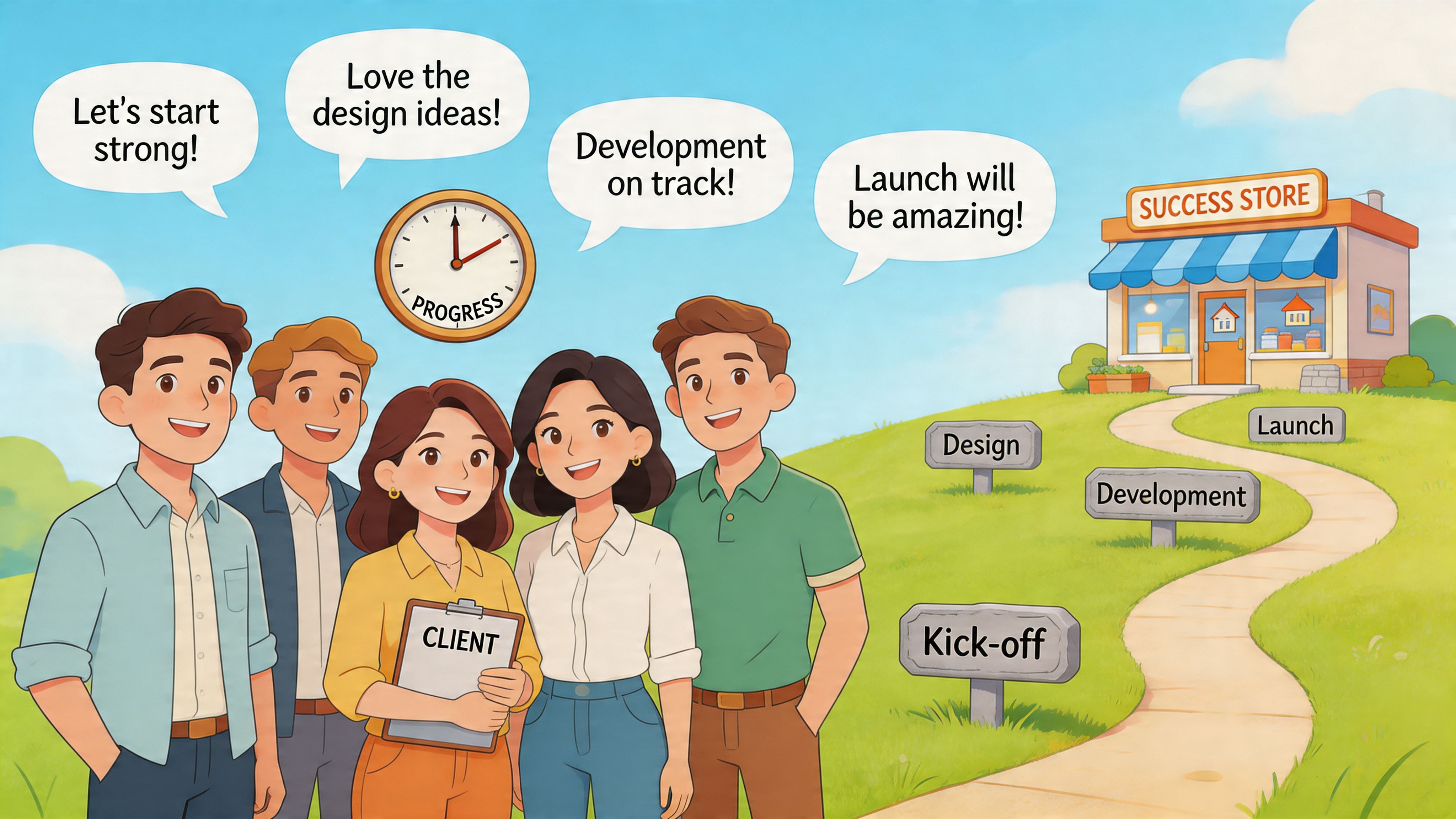
The Engagement Process From Kick-off to Launch
A good agency process should feel organised, collaborative, and unsurprising. Not silent for two weeks, then suddenly a staging link appears with major decisions already made.
The strongest store setups follow a clear sequence, and each stage exists for a reason.
Discovery that ties build decisions to commercial goals
The project starts with questions that sound less like web design and more like operations and sales. What’s the business trying to improve? What’s already broken? Where do customers drop off? Which internal workflows are slow? What must work on day one, and what can wait?
That’s where priorities get set. Not every feature deserves equal attention. Some stores need speed and simplicity. Others need migration stability, internationalisation, or subscription logic handled correctly from the start.
Design work that solves specific buying problems
Once the brief is clear, design should move beyond moodboards and homepage mock-ups. The useful questions are practical. How quickly does the store explain the offer? Can a mobile user compare variants easily? Is the collection layout helping discovery or slowing it down? Do PDPs answer the objections that block purchase?
This phase often includes:
- Wireframes for key templates such as homepage, collection, product page, cart, and content pages
- UI design aligned to brand identity without sacrificing clarity
- Feedback rounds that focus on user behaviour, not just subjective taste
The best reviews during this stage are specific. “This block should handle bundle education better” is productive. “Can we make it pop more?” usually isn’t.
Development and integration that turns designs into a working store
Once approved, the store gets built in a development environment. Within this environment, theme sections, metafields, app connections, data structures, and operational logic come together.
A capable team won’t just replicate the mock-up. They’ll also think about maintainability. Can the internal team edit content without developer help? Are sections reusable? Are third-party apps necessary? Are there performance trade-offs hidden in a feature request?
The cleanest builds are the ones that give the merchant control without handing them a fragile system.
QA that prevents embarrassing launch issues
Testing is where strong agencies separate themselves from fast ones. Every key flow should be checked on real devices and common browsers. Product variants, promotions, checkout behaviour, shipping methods, tax outputs, forms, transactional emails, analytics, redirects, and app interactions all need review.
Weak QA often leads to a launch that looks fine in a demo and fails under real customer behaviour.
Launch and handover that don’t feel chaotic
Launch day should be procedural, not dramatic. The team handles final checks, domain transition, payment verification, and basic post-launch monitoring. The client should also leave with documentation or training on the practical basics of running the store.
After that, the relationship usually goes one of two ways. Either the partner exits cleanly after handover, or they stay involved through a support or growth retainer. For brands actively testing, scaling, or integrating more systems, ongoing support usually delivers better long-term value than ad hoc fixes.
How to Choose the Right Shopify Partner in the UK
Choosing a Shopify partner isn’t mainly about finding the best portfolio. It’s about finding the team least likely to create expensive problems behind a polished front end.
That matters more in the UK because local setup details often get missed by agencies using a generic international process.

Green flags worth taking seriously
A good partner usually shows their quality in how they ask questions, not just in how they present answers.
Look for these signals:
- Commercial thinking: they ask about conversion, margins, operations, and growth plans, not only colours and layouts
- Clear scope boundaries: they explain what’s included, what requires custom work, and what could affect budget or timeline
- Real technical judgement: they can justify app choices, theme decisions, and integration methods in plain English
- UK market understanding: they know local payment preferences, VAT handling, Shopify Markets setup, and GDPR implications
- Post-launch thinking: they talk about maintenance, testing, training, and optimisation, not just delivery
One overlooked evaluation method is to ask how they compare service providers generally. Lists like this roundup of Top Digital Marketing Agencies aren’t a Shopify buying guide, but they’re useful for spotting broader agency vetting habits such as reviewing service fit, clarity, and evidence of execution.
Red flags that usually cost more later
The wrong partner often sounds confident, fast, and affordable. That combination can be genuine, but it often hides shortcuts.
Be careful if you see:
- Vague proposals: no detail on deliverables, rounds of revision, QA, or launch responsibilities
- Template-first selling: they push the same stack on every client regardless of model or complexity
- No compliance depth: they treat tax, customs, and regional setup as minor settings
- No discussion of CRO: they can build pages but don’t think seriously about how those pages sell
- Weak ownership after launch: no support path, no monitoring plan, no interest in iteration
UK-specific questions to ask before signing
For UK merchants, compliance and localisation aren’t side notes. According to this analysis of UK Shopify setup mistakes, 68% of small Shopify sellers report setup errors that cause transaction failures, and poor tax handling can contribute to 42% cart abandonment from unexpected tax charges. Those figures should change what you ask in a sales call.
Ask direct questions such as:
- How will you configure VAT and post-Brexit tax handling for our sales model?
- Which UK payment methods and gateways do you usually prioritise?
- How do you handle Shopify Markets for GB and NI differences where relevant?
- What’s your process for testing tax, shipping, and checkout edge cases before launch?
- What happens if we discover a compliance issue after go-live?
For a technical lens on what capable implementation should include, this breakdown of Shopify development services is a helpful benchmark.
A short video can also help you sharpen your evaluation criteria before committing to a partner:
The simplest buyer test
Ask every shortlisted agency the same question: “What are the biggest risks in our setup, specifically?”
The weak ones will answer with generalities. The strong ones will identify real constraints, explain trade-offs, and tell you where they’d advise restraint.
That’s usually the moment you find out whether you’re talking to order-takers or actual consultants.
Real Results A Look at Case Study Highlights
The value of setup work becomes clearer when you look at the underlying problem, not just the final number.
Case one, AOV was the bottleneck
One common pattern in underperforming stores is that traffic isn’t the main issue. Average basket size is. In that situation, redesigning the homepage won’t do much on its own. The setup has to create better buying mechanics inside the product journey.
A strong example is a bundle-focused implementation where the team built a custom bundle creator around how customers shopped, rather than forcing them through disconnected product pages. The result, according to Grumspot’s published case study summary, was a 61% AOV lift. That’s the difference between cosmetic setup work and conversion-led architecture.
Better revenue often comes from making purchase decisions easier, not from adding more visual flair.
Case two, migration work that protects what already performs
Another recurring scenario is the brand that needs a rebuild or platform move but can’t afford to damage existing traction. In those projects, success doesn’t just mean a better-looking front end. It means preserving useful content, maintaining key landing page value, and avoiding operational disruption while upgrading the experience.
The teams that handle this well usually focus on structure first. They map product data properly, make deliberate template choices, simplify the app stack, and treat launch risk as a core workstream rather than an afterthought.
Case three, design systems that support faster iteration
Sometimes the win isn’t a single headline metric. It’s the removal of friction for the internal team. A store with reusable sections, cleaner content management, and more flexible merchandising becomes easier to test and improve over time.
That kind of setup rarely feels flashy in a pitch meeting. It matters later when marketing teams can launch campaigns without developer bottlenecks, product teams can update collection experiences quickly, and the store stops feeling fragile.
The pattern across all three cases is consistent. The setup delivered value because it was tied to a commercial problem first. Not because someone completed a checklist of Shopify tasks.
Frequently Asked Questions About Professional Setups
Should we launch quickly on a standard theme or wait for a more custom build?
A founder usually asks this after getting two competing proposals. One promises a fast launch on a stock theme. The other recommends custom work, more planning, and a bigger budget. The right answer comes down to payback.
A standard-theme build is often the better commercial decision if the goal is to validate demand, get paid traffic live, or prove that a product line can convert. A custom build starts to make financial sense when the business model depends on things a generic setup handles badly, such as bundled products, subscriptions, complex filters, B2B pricing, or heavy CRM and ERP integration.
I usually advise clients to ask one question first. Will the first version support revenue properly for the next 6 to 12 months, or will it create expensive rework after launch?
Speed matters. So does avoiding a rebuild three months later because merchandising, checkout logic, or content structure was wrong from the start.
Is Shopify Plus worth considering during setup?
Sometimes. It is a scaling decision, not a badge.
Plus is usually worth serious consideration when checkout extensibility, automation, multi-store complexity, higher API limits, or more advanced international trading requirements are already part of the operating model. In the UK, that discussion also needs to include VAT handling, market configuration, privacy workflows, and whether the team is set up to manage a larger app and integration footprint without breaking reporting or customer experience.
The main risk is paying for Plus before the business is ready to use it properly. We see that in projects where a brand upgrades for perceived headroom, then discovers key apps conflict with the theme build or the migration plan has missed URL mapping, metadata, or feed dependencies. The platform itself is rarely the problem. Poor planning is.
What about subscriptions and recurring billing in the UK?
This is one of the easiest ways to lose margin after launch.
Subscriptions can increase customer lifetime value, but only when billing logic, customer communication, and account management are set up properly for the UK buyer. That includes clear recurring payment consent, cancellation flows that match consumer protection expectations, GDPR-aware data handling, VAT treatment, and app settings that are localised for the market rather than left on US defaults.
Poor setups usually fail in small places that affect retention. Delivery cadence is confusing. Renewal emails are generic. Customer portal options are weak. Payment failure recovery is left to the app's default settings. Those details shape churn and support cost, which means they shape ROI.
If subscriptions are part of the model, they need to be designed into the store setup, not added after the theme is signed off.
Can an in-house team maintain the store after launch?
Yes, if the build was scoped with handover in mind.
A professional setup should let the internal team update pages, run campaigns, manage collections, and change product information without touching fragile code or calling a developer for every merchandising request. That usually comes down to practical build choices. Clean section architecture, sensible metafield structure, restrained app use, clear naming conventions, and documentation that reflects how the team works.
I treat maintainability as a commercial issue, not a technical courtesy. If every landing page edit needs external support, operating costs rise and campaign speed drops. If the team can make controlled changes confidently, the store improves faster and gets more value from the original build.
What should we ask before hiring a Shopify setup partner?
Ask how they scope around revenue, not just deliverables.
A good partner should explain what they are prioritising first, where they expect commercial lift to come from, what they will leave out of phase one, and how they will handle UK requirements such as returns wording, privacy and cookie setup, VAT presentation, and subscription consent where relevant. They should also be candid about dependencies on your side, including product data quality, content readiness, photography, app decisions, and approval speed.
Ask who will do the work, how launch risk is handled, what happens after go-live, and how success will be measured in the first 30 to 90 days. If the answers stay abstract, the engagement usually will too.
If you need a partner to build, fix, or scale a Shopify store with a conversion-first approach, Grumspot is built for that work. The team handles bespoke storefronts, Shopify 2.0 migrations, CRO-led redesigns, deep integrations, subscription setups, and ongoing support with clear communication and flat pricing.
Let's build something together
If you like what you saw, let's jump on a quick call and discuss your project

Related posts
Check out some similar posts.
- recently viewed items
Build and optimise recently viewed items on Shopify with code patterns, localStorage, server-side tr...
Read more
- best web design agency uk
Looking for the best web design agency UK? We review the top 7 for 2026, comparing Shopify, WordPres...
Read more
- web design agency derby
Find the perfect web design agency Derby. Our 2026 guide helps you vet portfolios, ask the right que...
Read more
- shopify plus agency
What is a Shopify Plus agency? Learn what they do, the benefits of partnership, and how to choose th...
Read more