Supply Chain Visibility: A Practical Guide for Modern Brands
- supply chain visibility
- ecommerce logistics
- Shopify ERP integration
- RFID tracking
- TMS and WMS
Launched
August, 2026
A customer places an order for your best-selling product. Shopify shows 40 units available, but the warehouse has already picked the last one. Your 3PL missed an inventory update, the ERP still carries an older count, and the customer learns the truth from a cancellation email.
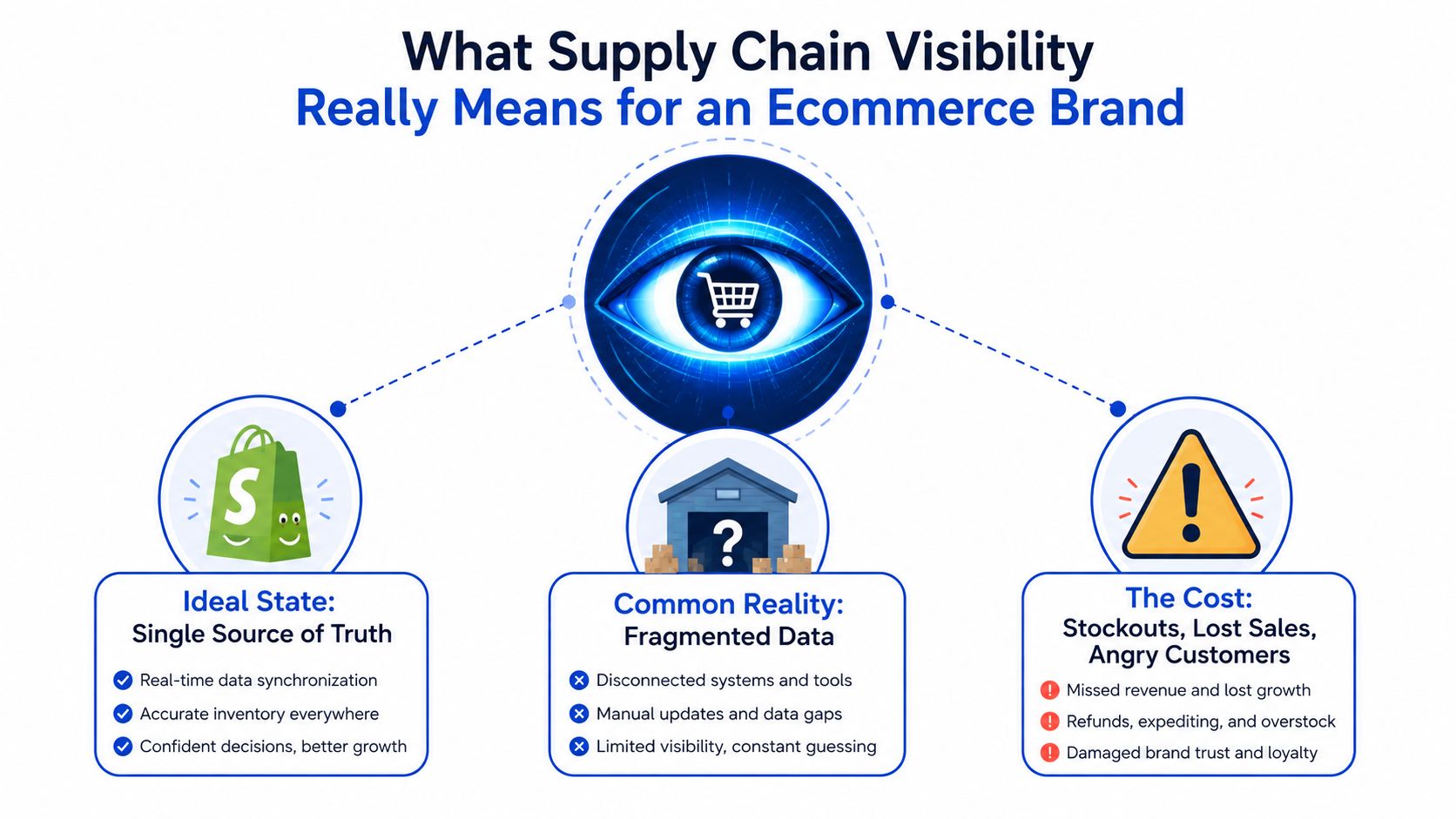
That gap between what your systems say and what is physically happening is the supply chain visibility problem. It affects stock, purchase orders, supplier capacity, inbound freight, fulfilment, cash and customer promises. A brand can have excellent sales data and still make poor decisions if its product and supplier data arrives late, sits in separate systems or stops at the first supplier.
What Supply Chain Visibility Really Means for an Ecommerce Brand
Supply chain visibility means knowing what is happening to goods, orders and money from supplier to customer. For an ecommerce brand, that includes available and allocated stock, purchase orders, inbound shipments, warehouse events, carrier progress, returns, and the financial effect of delays or shortages.
A Shopify inventory figure can be accurate and still be too old for a decision. The useful question is whether data from Shopify, the ERP, warehouse and 3PL arrives with shared definitions and enough freshness to protect the customer promise. A dashboard displays information. Visibility gives a team the context to act.
Three terms describe different capabilities:
- Visibility shows the current or recent state of an item, order, shipment or supplier relationship.
- Traceability follows a product, component or batch through its history, supporting quality, recall or compliance work.
- Transparency describes how openly partners share information, including supplier identities, practices and dependencies.
The three practical levels
At inside-the-four-walls visibility, the brand can see warehouse stock, reservations, pick and pack progress, returns and carrier hand-offs. Shopify, a warehouse management system and a 3PL integration usually supply this tier. Finance can connect it to stockout rate, fulfilment cost or inventory write-offs.
At tier 1 visibility, the view extends to direct suppliers. Purchase orders, promised dates, confirmed quantities and shipment milestones can flow through an ERP purchasing module, supplier portal or EDI connection. The finance question becomes whether supplier performance is affecting On-Time In-Full, or OTIF, purchase commitments and working capital.
At tier 2 and tier 3 visibility, the brand examines suppliers behind direct suppliers. This can expose shared factories, single-source materials and dependencies hidden by a tier 1 scorecard. A multi-tier assessment, supplier questionnaire or ERP supplier hierarchy can build the map, while item-level material records help connect a dependency to affected products. The international supply chain management guide provides broader context on procurement, logistics and supplier relationships.
The deeper the tier, the less frequently data may update and the more manual verification it may require. That trade-off matters. A brand selling a standard item may only need reliable tier 1 dates. A product dependent on one material source may need item-level tier 3 mapping.
Practical rule: define the visibility tier before buying a tool. A live warehouse feed cannot reveal a tier 3 material dependency, and a supplier map cannot replace accurate sellable-stock data. A finance-approved metric for each tier keeps visibility tied to a decision rather than a dashboard.
The Business Value and the KPIs That Prove It
Visibility earns budget when finance can connect it to a commercial outcome. A dashboard that looks impressive but can't explain missed deliveries, excess stock or lost sales is an operating expense without a clear decision attached.
Start with two KPIs rather than attempting to measure everything.
Choose the metric before the feed
On-Time In-Full, or OTIF, measures whether an order arrives by the promised date and with the promised quantity. It needs order dates, requested dates, confirmed quantities, dispatch events and proof of delivery. Tier 1 purchase-order visibility helps with supplier deliveries, while 3PL and carrier data supports the customer-order part of the measure.
Perfect order rate goes further. It combines the conditions that make an order successful, such as accurate picking, complete shipment, on-time delivery and correct documentation. It exposes failures that a simple delivery-date report can hide.
Stockout rate connects availability to lost selling opportunities. It depends on reliable item-level stock, reservations, returns, inbound purchase orders and a rule for distinguishing unavailable stock from stock that is physically present but not sellable.
Days of cover turns inventory into a planning measure. It needs an agreed demand input, clean available-to-sell stock and credible inbound dates. A forecast can be useful, but it won't rescue a business that counts quarantined or already allocated units as available.
For demand assumptions and ecommerce planning context, use this ecommerce demand forecasting guide alongside your inventory and purchasing reports.
Match each KPI to its visibility tier
| KPI | Most useful visibility | Finance question |
|---|---|---|
| OTIF | Supplier, warehouse and shipment events | Are service failures creating credits, refunds or lost repeat sales? |
| Perfect order rate | Item, order and fulfilment events | Where does the order process fail? |
| Stockout rate | Item-level stock and inbound supply | Which unavailable products are constraining revenue? |
| Days of cover | Inventory, demand and confirmed inbound data | Is working capital sitting in the right products? |
A weekly tier 2 supplier scorecard can be more valuable than another warehouse sensor when a material dependency drives the largest disruption risk. The UK manufacturing evidence supports this operational logic. Survey research covering 264 UK manufacturing plants found that supply chain connectivity and information-sharing resources contribute to visibility capability, which improves resilience and strength. The principle applies to brands too: better data matters when a named person uses it to change an order, allocation or supplier decision.
The Core Technologies Behind End-to-End Visibility
Technology should follow the visibility problem, not lead it. An API won't fix inconsistent SKU codes, and RFID won't tell a buyer that a supplier's raw-material source has changed unless the surrounding process captures that relationship.
Think of the stack as a set of communication methods and operational systems:
- APIs work like a live phone line between applications. Shopify can send order events, while a 3PL can return inventory, fulfilment and tracking updates.
- EDI resembles structured digital paperwork. Messages such as purchase orders, shipment notices and inventory reports follow agreed formats.
- RFID acts like a barcode that can be read without pointing a scanner directly at each item. It suits controlled locations where scan events justify the installation and process work.
- IoT sensors collect readings such as location, temperature or shock during a shipment. The value depends on a response rule, not on collecting readings alone.
- A WMS manages warehouse execution, including receiving, put-away, picking, packing and stock movements.
- A TMS manages transport planning and shipment execution, including carrier selection, routing and delivery events.
- An ERP connects purchasing, inventory valuation, orders, suppliers and finance. It often becomes the commercial record, while the WMS remains the operational record.
Core visibility technologies at a glance
| Technology | Visibility Tier | Typical Data Captured | Best Fit For |
|---|---|---|---|
| Shopify APIs and webhooks | Item and order | Orders, product changes, fulfilment events | Direct-to-consumer brands |
| EDI | Tier 1 and shipment | Purchase orders, acknowledgements, advance shipment notices, inventory reports | Brands with structured supplier or 3PL relationships |
| WMS | Warehouse and item | Receipts, locations, picks, packs and adjustments | Brands operating through a warehouse or 3PL |
| TMS | Shipment | Carrier bookings, milestones and delivery status | Brands with complex inbound or outbound transport |
| RFID | Item and warehouse | Reads at receiving, movement and dispatch points | High-volume operations with repeatable scanning points |
| IoT sensors | Shipment and condition | Location and environmental readings | Goods sensitive to handling or transit conditions |
| ERP integration | Commercial network | Purchasing, inventory, supplier and finance records | Brands needing one reconciled business view |
Your warehouse process should determine whether you need a WMS integration, rather than the acronym determining your process. A practical warehouse management systems guide can help teams compare operational requirements before selecting software.
Manufacturing teams may also evaluate distributed production as part of their resilience planning. For a focused explanation of FDM SLS printing for supply chains, look at how additive methods affect production choices, lead times and supply relationships.
Connecting Shopify, ERP and 3PLs in Practice
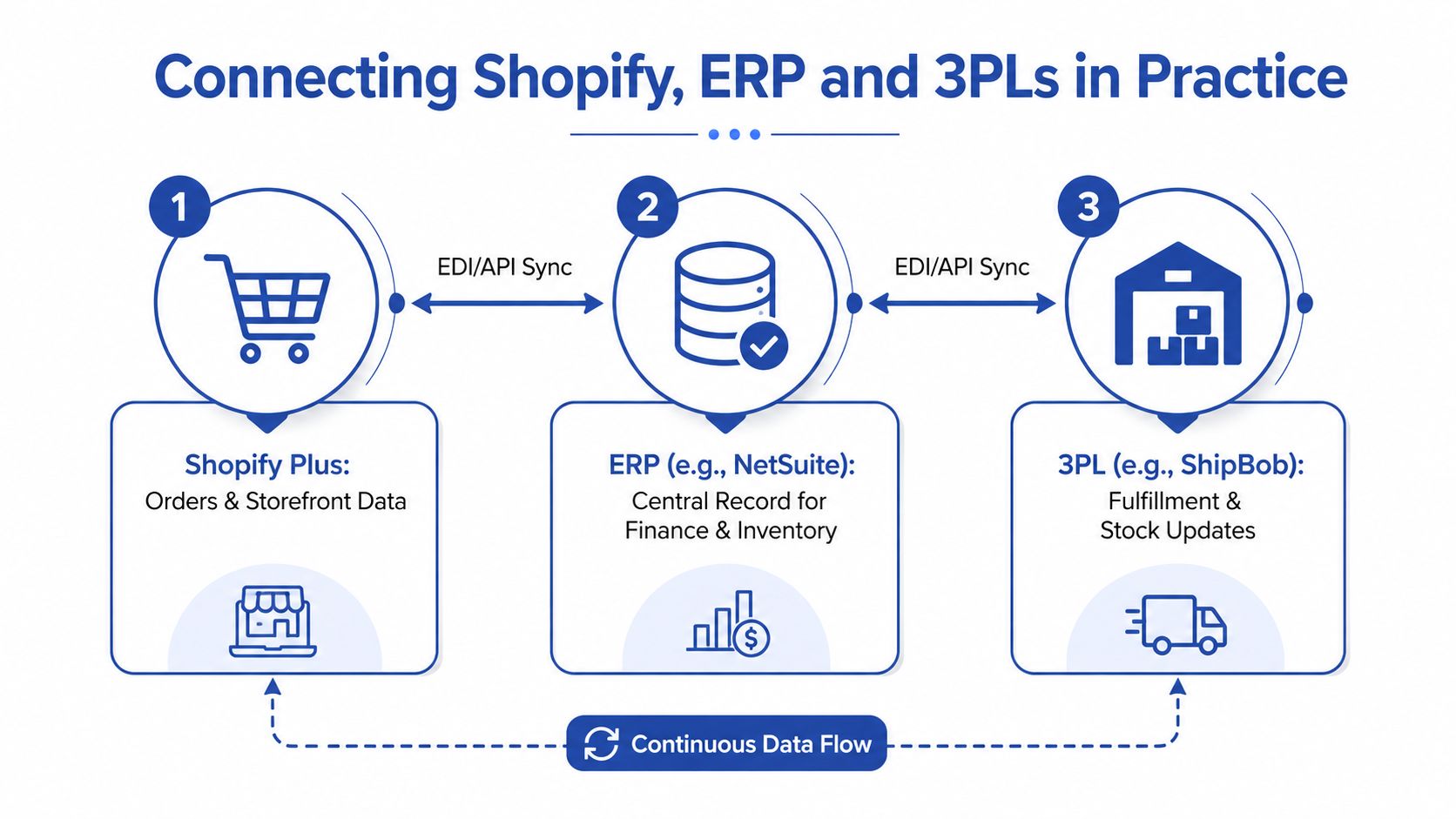
A workable architecture gives every system a defined job. Shopify owns the storefront experience and customer order capture. The ERP holds the commercial record for purchasing, inventory accounting and finance. The 3PL or WMS records what physically arrived, moved, was picked and shipped.
The integration should follow the transaction, not a vague promise of “real-time visibility”.
The order and fulfilment path
- Shopify captures the order. A webhook sends the order event to middleware or the ERP. The integration validates the SKU, address, payment status and fulfilment location.
- The ERP checks the commercial position. It applies allocation rules, records the sale and updates the relevant inventory or reservation state.
- The 3PL receives the fulfilment request. Its API or EDI connection accepts the order and returns acknowledgement, exception or rejection data.
- The warehouse executes the work. Pick, pack and dispatch events move back through the 3PL integration.
- Shopify receives the customer-facing update. The fulfilment status and tracking reference update the order, while the ERP reconciles shipment and financial records.
For supplier visibility, an EDI 850 can represent a purchase order, while an EDI 856 can provide an advance shipment notice. An EDI 846 can communicate inventory data where the trading relationship supports it. These messages don't replace an ERP or WMS. They create a structured exchange that reduces manual re-keying and gives teams a defined point at which to challenge missing or late information.
Shopify Flow can trigger internal actions for events that Shopify can see, such as tagging orders, notifying staff or escalating fulfilment conditions. Webhooks are more suitable when an external integration must receive an event and process it outside Shopify.
A specialist implementation partner may also help with non-standard ERP or workflow requirements. For example, teams comparing modular business software can review Odoo modules for tradies to understand how an ERP ecosystem can be organised around operational needs.
For the Shopify-to-ERP design itself, this Shopify ERP integration resource provides a useful reference point. Draw the process on a whiteboard as order, fulfil, ship, reconcile. If a team can't identify the system that owns each event, the integration isn't ready for production.
What Good Visibility Looks Like in Real Brands
A DTC apparel brand can have a Shopify Plus storefront and still run fulfilment from a spreadsheet. The commercial team sees orders in Shopify, the warehouse sees tasks in its own platform, and the finance team sees a different inventory figure in the ERP. Each team works hard, but nobody owns the reconciliation between promised stock and physical stock.
A sensible repair doesn't begin with RFID. The brand first maps the SKU identifiers shared by Shopify, the ERP and the 3PL, then schedules a daily reconciliation. It separates available, allocated, damaged and inbound units, gives exceptions an owner and reports OTIF by fulfilment path. The result is a more dependable operating rhythm because the team can explain discrepancies instead of arguing over which number is correct.
The useful outcome isn't more data. It's a trusted exception list that tells someone what to fix today.
A multichannel retailer faces a different problem. Its distribution centre handles stock for ecommerce, marketplaces and physical shops, so a delayed or missed scan can distort replenishment across several channels. In that setting, RFID can support receiving and movement events when the retailer has repeatable scan points, suitable item labelling and a process for investigating unreadable tags.
The integration choice matters more than the hardware label. RFID reads should flow into the warehouse system, where the retailer can compare expected and observed movement. Replenishment rules should use the resulting stock state, while finance receives controlled adjustments rather than every raw read.
Neither example starts with a universal visibility programme. The first brand fixes reconciliation around its highest-value customer promise. The second adds item-level sensing where the distribution centre has a repeatable operational use. Both define the decision that the data must support before expanding the technology.
A Pragmatic 90, 180 and 365-Day Implementation Roadmap
Visibility programmes lose momentum when teams try to map every supplier, instrument every shipment and replace every system at once. A staged plan creates proof, exposes data quality problems early and gives finance a clear decision at each point.
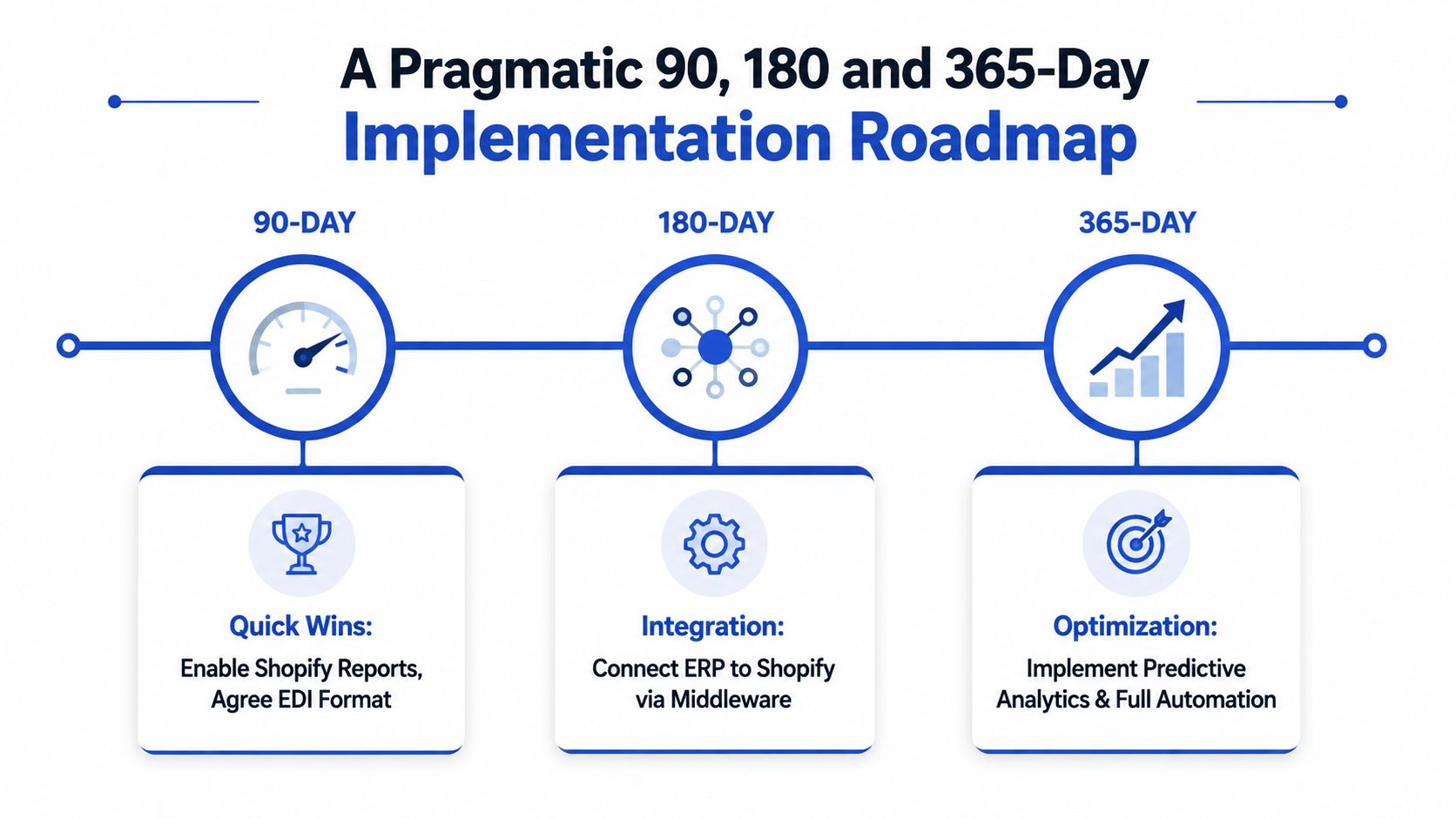
The first 90 days build control
Start with the systems you already use:
- Inventory baseline: Compare Shopify's available-to-sell quantities with the 3PL or WMS record for priority SKUs.
- Event ownership: Document who owns order acceptance, allocation, dispatch, cancellation and adjustment events.
- EDI agreement: Agree the message format and exception process for supplier or 3PL inventory reporting, including an EDI 846 where appropriate.
- Supplier scorecard: Track confirmed dates, received quantities, late orders and unresolved exceptions for direct suppliers.
The exit criterion is a signed-off reconciliation report and a named owner for each exception. Don't proceed because a connector is installed. Proceed when the commercial team trusts the report enough to change an allocation or supplier conversation.
Days 91 to 180 connect the records
Connect Shopify, the ERP and the 3PL through middleware or a suitable integration layer. Establish a shared SKU, location and supplier master, then test duplicate orders, partial fulfilments, cancellations, returns and late updates.
Run one tier 2 pilot for a product or material where an upstream dependency can affect availability. Ask the tier 1 supplier to provide the relationship and update process, but keep the scope narrow enough to validate data quality and response ownership.
The checkpoint is operational rather than technical. Finance should be able to reconcile stock movement and fulfilment activity, while operations should be able to identify the next action when a supplier or shipment misses its commitment.
Days 181 to 365 expand only where the case is clear
Consider RFID at a distribution centre when scan-level events will change receiving, replenishment or shrink investigations. Consider IoT on inbound containers when condition or location data will trigger a specific intervention. Build multi-tier mapping around critical products, materials and suppliers rather than collecting information without a decision attached.
At the year-end review, keep the tools that improve a chosen KPI and retire reports that nobody uses. A mature programme is not the one with the largest data estate. It's the one where teams can make faster, better-supported decisions at the right supply chain tier.
Common Pitfalls and the Counterintuitive Truths That Save Budget
A fulfilment feed can arrive seconds after an event and still mislead the team. Duplicate SKUs, stale allocations and unexplained adjustments turn speed into noise. A daily reconciliation with a named owner can support better decisions when the live feed lacks trust.
Match update frequency to the decision. A high-volume sales channel may need frequent fulfilment events, while a supplier scorecard can run weekly if purchase orders change slowly. Set the service level according to the cost of a late update, rather than the appeal of real-time data.
The blind spot sits beyond the direct supplier
Tier 1 visibility covers the contract, purchase order and direct relationship. It does not necessarily show the dependency that could prevent that supplier from delivering. For a critical product, map one level deeper first, then extend the map only when it changes an availability, fulfilment or cash decision.
Recent UK cyber-risk research found that 72% of organisations lack full visibility beyond direct third parties according to the 2025 UK supply-chain report. The practical response is a focused tier 2 or tier 3 pilot, not an attempt to document the entire network at once. Ask which upstream dependency could stop one critical product, who owns that relationship, and how updates will reach the ERP or planning process.
Four expensive failure modes
- Bad master data: Create one controlled SKU and location cross-reference before adding another connector.
- Alert fatigue: Send an alert only when a named person has a defined response.
- Scope creep: Pilot one product, supplier or warehouse process before expanding.
- Vanity dashboards: Tie every visual to OTIF, stockout rate, perfect order rate or days of cover.
The budget-saving rule is simple: one clean supplier relationship can be worth more than ten unused dashboards. At tier 1, that may mean a reliable ERP or 3PL status feed. At tier 2 or tier 3, it may mean a maintained dependency record and an owner for exceptions. Finance can then judge the investment through fewer stockouts, cleaner reconciliation or improved working-capital control, rather than dashboard count.
Pulling It Together and Answering the Questions You Still Have
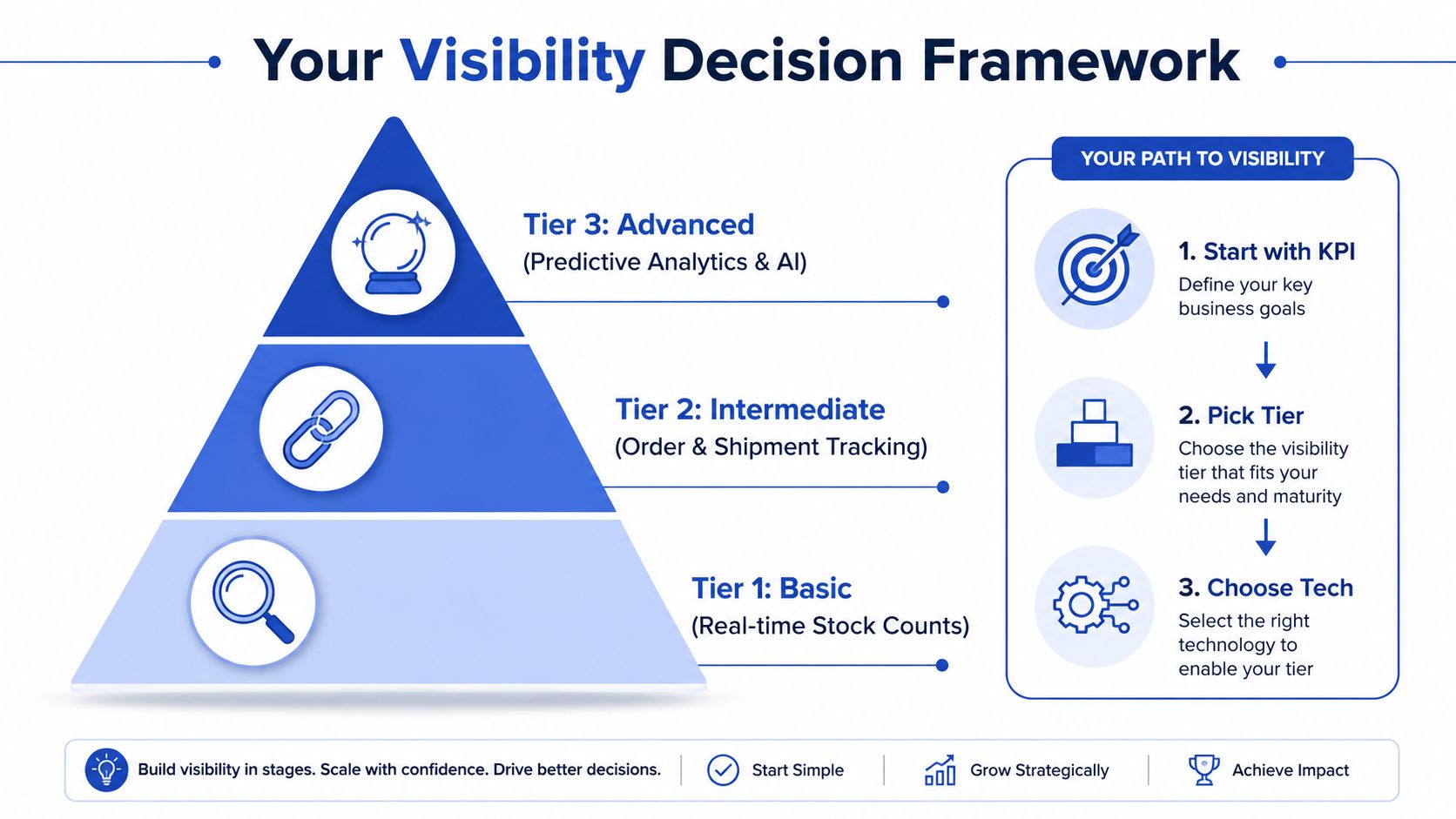
Use this sequence in your next planning meeting:
- Start with the KPI. Decide whether the immediate problem is stock availability, supplier delivery, fulfilment accuracy or working capital.
- Pick the tier. Choose inside-the-warehouse, tier 1, tier 2 or tier 3 visibility based on where that KPI is failing.
- Choose the technology. Select APIs, EDI, WMS, ERP, RFID or another tool only after defining the event and owner.
- Set the exit criterion. Agree the report, reconciliation or decision that proves the work is useful.
Questions brand teams often ask
How much visibility is enough? Enough to identify the dependency that can change your chosen KPI and act before the customer promise fails. You don't need every upstream record on day one.
Should we build or buy? Buy standard connectivity and warehouse or ERP capability where it fits. Build the specific rules, data model and exception workflows that make your operation different.
When should RFID enter the plan? Add it when item-level reads will change a warehouse decision and the process can handle exceptions. Don't use it to compensate for unclear ownership or poor SKU data.
What does EDI really cost? The cost isn't only message transmission. Allow for mapping, partner testing, error handling, monitoring and changes to your operating process.
What should you ask your brand director or CFO? Which KPI is losing money, which tier contains the cause, and what decision will the new data change?
Grumspot helps Shopify Plus brands connect storefronts with ERPs, 3PLs and fulfilment workflows so inventory and order events support practical supply chain visibility. Visit Grumspot to discuss an integration, audit or Shopify build centred on the operational data your team needs to act.
Let's build something together
If you like what you saw, let's jump on a quick call and discuss your project
Related posts
Check out some similar posts.
- ecommerce erp integration
Master ecommerce erp integration for Shopify and Shopify Plus. Plan, map data, choose middleware and...
Read more
- warehouse management systems
Discover warehouse management systems (WMS) in our 2026 guide. Learn features, benefits, and how to ...
Read more
- Shopify integration
Discover how Shopify third-party integration services connect your store to ERPs, CRMs, & more. Guid...
Read more