Warehouse Management Systems: 2026 Guide for Ecommerce
- warehouse management systems
- wms
- ecommerce logistics
- shopify wms
- inventory management
Launched
May, 2026
Your Shopify store is selling. That's the good news. The bad news is that your warehouse may already be falling behind.
Orders arrive faster than your team can pick them. One person knows where the awkward SKUs live, but only because they put them there. Stock says “available” online, yet the shelf is empty. Returns sit in tubs waiting for someone to inspect them. The packing bench becomes a triage station. At that point, you don't have a growth problem. You have an execution problem.
For scaling merchants, that's usually when the question changes from “Do we need better inventory tracking?” to “Do we need a system that runs the warehouse?”
When Warehouse Chaos Threatens Growth
A lot of ecommerce brands hit the same wall. The first phase works well enough with Shopify, a shipping app, and a sensible team. You can still solve most issues by shouting across the room, checking a spreadsheet, or walking to the shelf yourself.
Then complexity creeps in. More SKUs. More bundles. More channels. More returns. More staff touching the same stock.
The symptoms are familiar:
- Mis-picks keep happening because the pick path depends on habit rather than process.
- Overselling starts to hurt because stock updates lag behind what's on the shelf.
- Returns clog the operation because no one has a clean workflow for checking, quarantining, and restocking items.
- Training gets messy because new staff learn from whoever is nearby, not from a defined process.
That's when a warehouse stops behaving like a stockroom and starts behaving like a traffic junction with no signals. Everyone's moving, but not in a controlled way.
The UK context matters here. The logistics sector contributes about £127 billion in gross value added, employs around 2.7 million people, and supports roughly 5% of UK GDP, according to MarketsandMarkets coverage of the warehouse management system market. Operational efficiency isn't a niche concern. It sits inside a sector big enough to shape how businesses compete.
Growth breaks warehouses long before it breaks websites.
That's why warehouse management systems matter. They don't just count stock. They impose order on movement, decisions, and exceptions.
If you're also thinking beyond software into physical resilience, maintenance discipline, and optimizing distribution center uptime becomes relevant too. A warehouse can't scale well when either the systems or the floor equipment are unreliable.
What Is a Warehouse Management System
A warehouse management system, or WMS, is the operating system for the warehouse floor. If Shopify is the storefront and your ERP is the company ledger, the WMS is the air traffic controller telling each item, picker, and task where to go next.
An inventory app usually answers a basic question: what stock do we have?
A WMS answers harder questions:
- where should incoming stock go
- which order should be picked first
- what path should the picker take
- how should returns be handled
- what needs replenishing before a pick face runs dry
- which shipment is ready, packed, and verified
The simplest way to think about it
A good warehouse runs on location discipline. Every product has a place. Every move is recorded. Every handoff is checked.
A WMS creates a digital version of that reality. It knows the bin, shelf, pallet bay, or pick location. It records receipt, put-away, pick, pack, move, and dispatch. It reduces the amount of “someone will remember” in your operation.
Without that control, you're relying on memory and workarounds. That can hold for a while in a small operation. It fails fast once order volume rises.
Why ecommerce made WMS more important
The pressure didn't come from software vendors. It came from buying behaviour.
According to SAP's overview of WMS, UK online retail sales reached £137.4 billion in 2021, equal to 27.4% of all retail sales, after peaking at 36.8% in January 2021 during the pandemic surge. SAP also notes that this shift increased pressure on fulfilment networks to manage real-time stock control, returns, and omnichannel order routing, all central WMS jobs, in its guide to what a warehouse management system is.
For a Shopify merchant, that means the warehouse is no longer a back-room function. It's part of the customer experience.
If your storefront promises speed and accuracy, your warehouse has to keep that promise.
What a WMS is not
It's not just barcode scanning. It's not just a nicer stock screen. And it's not automatically an enterprise-only tool.
The practical difference is this. A stock app tells you what should be true. A WMS is designed to help your team make it true on the floor.
Core WMS Features and Business Benefits
When merchants evaluate warehouse management systems, they often get lost in feature lists. The better approach is to ask what each feature changes in day-to-day work.
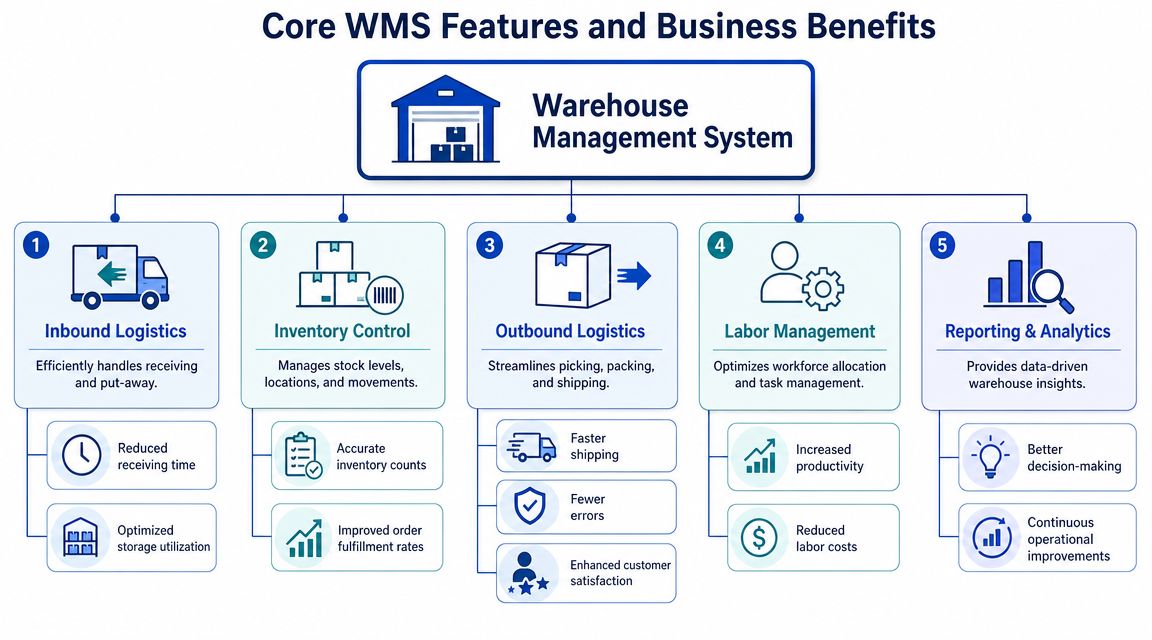
For UK warehousing operations, the practical technical value of a WMS is its ability to optimise labour and space utilization by coordinating resource usage and material flows, while integrating with ERP, e-commerce, and shipping systems to automate order routing, inventory balancing, and delivery tracking across multi-channel fulfillment. Oracle explains this in its overview of warehouse management systems.
Inbound control
Receiving is where inventory accuracy starts, or falls apart.
If staff receive stock loosely, leave pallets unlabelled, or put items away wherever there's room, every downstream task gets harder. A WMS improves this by directing receiving, validating what arrived, and assigning put-away locations.
That delivers two immediate gains:
- Cleaner stock availability because goods become available in a controlled way
- Better space use because product goes where it should, not wherever someone found a gap
Inventory control
Many merchants assume they already have enough. Sometimes they do. Sometimes they don't.
A proper WMS tracks stock by warehouse location and movement, not just by total quantity. That matters when one bin is empty, reserve stock is elsewhere, and your picker wastes time hunting.
Useful inventory-control functions often include:
- Cycle counting support so teams can verify high-risk locations without stopping the whole operation
- Location tracking so a SKU lives in a known bin, not in “one of those shelves near packing”
- Replenishment logic so pick faces are refilled before they create bottlenecks
Outbound execution
Merchants feel pain most directly because customers experience it too.
Picking, packing, and shipping are not just final steps. They are where warehouse errors become customer-facing problems. A WMS can direct pick tasks, support scan verification, and keep packing aligned with the order and carrier workflow.
The business benefits are obvious on the floor:
| Functional area | What it does | Business benefit |
|---|---|---|
| Inbound logistics | Manages receiving and put-away | Faster intake, better storage discipline |
| Inventory control | Tracks stock by location and movement | More reliable counts, fewer surprises |
| Outbound logistics | Directs picking, packing, and dispatch | Fewer errors, smoother fulfilment |
| Labour management | Assigns and sequences tasks | Better use of staff time |
| Reporting and analytics | Exposes bottlenecks and drift | Better operational decisions |
Labour and reporting
A warehouse often looks busy even when it's inefficient. That's why labour visibility matters.
The right WMS helps supervisors see where time is going, which tasks are stuck, and where congestion keeps appearing. That's useful whether you run one site or you're studying approaches to optimizing Australian supply chain and fulfillment in broader multi-node operations.
A busy warehouse is not the same thing as a controlled warehouse.
WMS vs ERP vs Inventory Management Systems
Many Shopify merchants get tripped up. They compare software categories that solve different problems, then wonder why the shortlist feels confusing.
The cleanest distinction is this:
- Inventory management systems track stock quantities and locations at a basic level.
- ERP systems connect inventory with finance, purchasing, planning, and wider business operations.
- Warehouse management systems control the physical execution of warehouse work.
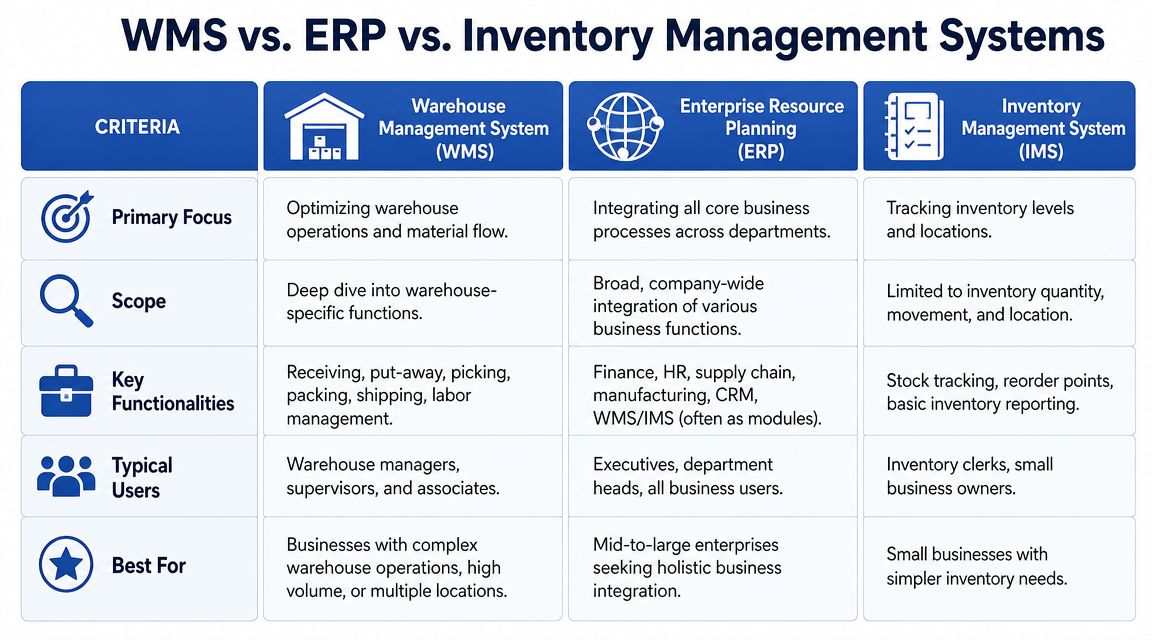
System Comparison WMS vs ERP vs Inventory Management
| System | Primary Focus | Key Functions | Best For |
|---|---|---|---|
| WMS | Optimising warehouse operations and material flow | Receiving, put-away, picking, packing, shipping, labour control | Businesses with growing warehouse complexity |
| ERP | Integrating company-wide processes | Finance, purchasing, planning, operations, sometimes warehouse modules | Businesses needing cross-department control |
| Inventory Management System | Tracking stock levels and locations | Stock counts, reorder logic, basic inventory reporting | Smaller businesses with simpler fulfilment needs |
What each system is really good at
An inventory management system is usually enough when the main issue is visibility. You need cleaner stock data, better purchase planning, and fewer spreadsheet reconciliations. You do not yet need directed work on the floor.
An ERP becomes valuable when inventory decisions affect purchasing, accounting, manufacturing, or multi-entity operations. ERPs are broad by design. They give management a joined-up view of the business.
A WMS matters when the physical warehouse itself is the bottleneck. Goods are in the building, but movement is messy. Staff spend too much time searching, correcting, or redoing. That's a warehouse execution issue, not a finance or planning issue.
Where overlap creates confusion
Some ERP platforms include warehouse modules. Some inventory tools add mobile scanning and location control. Some WMS vendors include light inventory planning. That overlap is real, but it doesn't erase the core distinction.
A practical test helps:
- If your pain is stock visibility, start by reviewing your inventory layer.
- If your pain is business-wide data flow, focus on ERP.
- If your pain is how orders move through the warehouse, you're in WMS territory.
For a deeper look at stock-control foundations in ecommerce, this guide to inventory management for ecommerce is a useful companion.
Don't buy a WMS to solve a planning problem. Don't expect an ERP module to solve a floor-discipline problem if it wasn't built for that depth.
Choosing the Right WMS for Your Business
Buying question isn't “Should I get a WMS?” It's “Do I need a full warehouse system now, or am I still at the stage where a better inventory layer is enough?”
That distinction matters because many growing brands jump too early and end up paying for complexity they won't use. Others wait too long and force staff to run a larger operation on habits and patched-together apps.
The gap in most guidance is exactly this practical threshold question. Made4net highlights that common content explains features like tracking, picking, packing, and integration, but rarely answers when a UK ecommerce brand needs a standalone WMS versus a lighter system in its article on top warehouse management system features.
Signs you probably need something lighter
If your team runs one location, has a manageable SKU range, and can still maintain reliable stock with disciplined processes, an inventory app or ERP module may be enough.
That's often true when:
- The main issue is stock visibility rather than warehouse flow
- Your staff can still train quickly without relying on tribal knowledge
- Returns are manageable with a simple inspection and restock routine
- Pick and pack is straightforward and doesn't require directed logic
In that stage, adding a WMS can feel like bringing a full traffic-control system to a quiet car park.
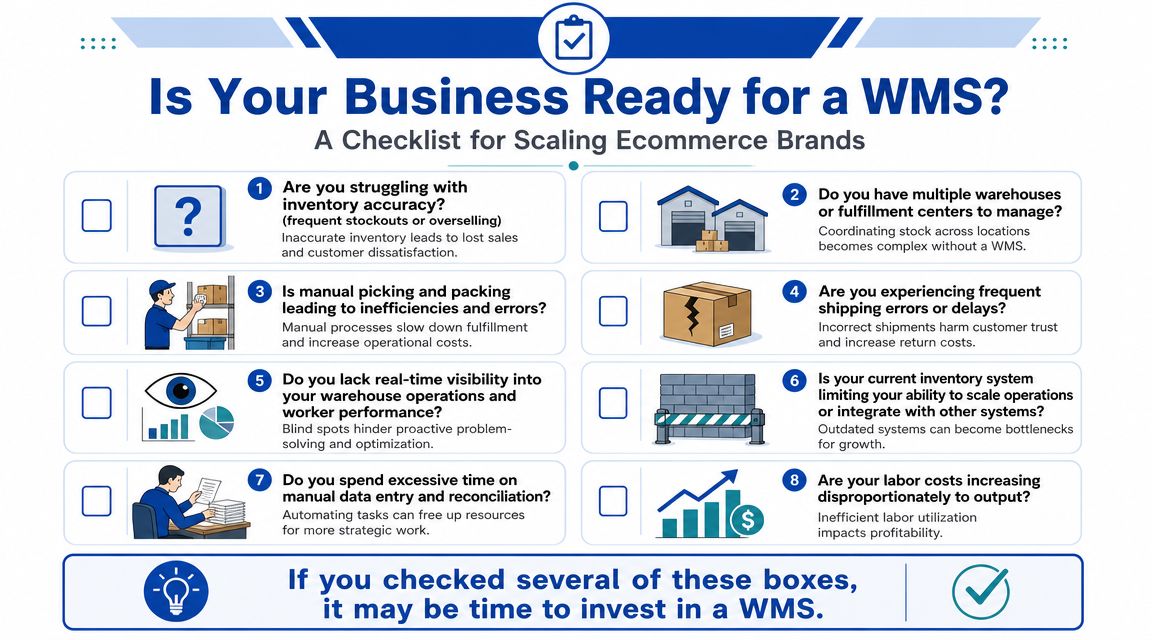
Signs you've crossed into WMS territory
The decision usually becomes clearer when complexity, not just volume, starts driving errors.
A standalone or more capable WMS deserves a close look when you recognise several of these:
- Multiple sales channels create stock tension between Shopify, marketplaces, wholesale orders, or retail replenishment.
- The warehouse depends on specific people who “just know” where things are or how exceptions get handled.
- Manual picking creates avoidable mistakes because there's no guided workflow or verification.
- You run more than one storage area or location and stock balancing is becoming a daily nuisance.
- Seasonal peaks expose process weakness and the operation becomes fragile as soon as demand spikes.
- Your current system can't support integrations cleanly with ecommerce, shipping, or finance tools.
The shortlist criteria that matter
A WMS for a scaling Shopify merchant should be judged less on glossy features and more on fit.
Ask vendors these questions:
- How well does it integrate with Shopify? Orders, cancellations, returns, bundles, and inventory events all need clean handling.
- Does it support your actual workflow? Not the demo warehouse. Yours.
- Can your team learn it quickly? If the interface is clumsy, adoption will stall.
- How does it handle exceptions? Damages, partial receipts, substitutions, returns, and transfers matter more than ideal-case flows.
- What happens as complexity grows? New channels, more users, more locations, more custom rules.
Standalone WMS or ERP module
An ERP warehouse module can be sensible if you already operate extensively within the ERP and your warehouse needs are moderate.
A standalone WMS is often the better choice when warehouse execution is strategically important and needs more depth than the ERP can provide. That's common in high-SKU ecommerce, multi-channel fulfilment, or operations with frequent returns and packaging variation.
If your stack decision also involves back-office data flow, this guide to mastering Shopify ERP integration helps frame where warehouse software fits.
One practical note. Grumspot works on Shopify ERP and fulfilment integrations, which is relevant when the challenge isn't just selecting a WMS but making sure order, SKU, bundle, and stock data stay aligned across systems.
WMS Implementation and Common Pitfalls
A WMS project fails less often because the software is bad and more often because the business treats implementation like a simple install.
It isn't. You're formalising warehouse behaviour.
A short walkthrough helps frame the work ahead:
A practical rollout path
Most solid implementations follow a phased pattern.
Discovery and process mapping
Document what happens now. Not what the SOP says. Look at receiving, put-away, picking, replenishment, packing, dispatch, and returns.Configuration and integration
Set rules, locations, user roles, workflows, and links to Shopify, shipping tools, and any ERP or finance platform.Data migration and testing
Clean your SKU, barcode, bundle, and location data before moving it. Then test normal flows and awkward scenarios.Training and change management
Teach staff how the process works, not just which screen to tap.Go-live and optimisation
Expect friction. Watch the floor closely. Tighten settings after real usage exposes edge cases.
Pitfalls that slow projects down
The most common mistakes are operational, not technical.
Bad master data
If SKUs, barcodes, units, or locations are messy, the WMS will reveal the mess fast. It won't fix it for you.Copying broken processes into new software
Some teams automate confusion. They move poor put-away rules or vague returns handling into a new system and call it implementation.Weak floor buy-in
If supervisors and pickers think the WMS is extra admin, they'll bypass it. Then the data degrades and trust disappears.Choosing for feature count instead of fit
A heavyweight system with poor usability often underperforms a simpler one that matches the operation.
The best implementation question isn't “What can the software do?” It's “What behaviour will this force us to standardise?”
How to avoid the usual mess
A few habits improve the odds significantly:
| Pitfall | Better move |
|---|---|
| Unclear current processes | Walk the floor and map real workflows before configuration |
| Dirty product and location data | Clean naming, barcodes, and bins before migration |
| Poor adoption | Involve warehouse supervisors early and train with live scenarios |
| Integration surprises | Test order edits, cancellations, returns, and edge cases |
| Rushed go-live | Use a controlled launch with close monitoring |
If implementation depends on connecting multiple systems, Shopify third-party integration services are often part of the actual project scope, even when the WMS vendor doesn't emphasise it.
Measuring ROI and Your Next Steps
WMS ROI is easiest to understand when you stop thinking about software and start thinking about friction.
Every warehouse loses time and margin in the same places. Staff search for stock. Orders get corrected. Returns wait too long. Data is keyed twice. New starters rely on verbal instructions instead of a guided workflow.
Where the return usually comes from
Look for gains in these areas:
- Labour productivity because staff spend less time walking, searching, and fixing
- Inventory accuracy because movements are recorded with more discipline
- Fulfilment quality because pick and pack verification catches problems earlier
- Space use because stock placement becomes intentional
- Management visibility because bottlenecks become easier to spot and fix
A simple decision framework
Before buying anything, audit your operation with blunt questions:
- Where do errors enter the process most often?
- Which tasks depend on memory rather than system control?
- What exceptions create the most rework?
- Is your current issue about stock visibility, business integration, or physical warehouse execution?
- Will process discipline improve with a lighter tool, or do you need true warehouse direction?
Start with the bottleneck, not the software category.
For many scaling Shopify brands, that's the key next step. Walk the warehouse. Follow one purchase order from receipt to shelf. Follow one customer order from release to dispatch. Follow one return back into stock. The point where the team starts improvising is usually the point where your current system has stopped being enough.
If your Shopify store is growing and you need help deciding whether the next step is a WMS, a stronger inventory layer, or a cleaner ERP and fulfilment integration, Grumspot works on the technical side of that decision. That includes Shopify integrations, ERP sync, and the operational plumbing that keeps stock and order data aligned across systems.
Let's build something together
If you like what you saw, let's jump on a quick call and discuss your project

Related posts
Check out some similar posts.

- supply chain visibility
Learn what supply chain visibility means, why it matters for ecommerce, and how to build it with API...
Read more
- warehouse management system integration
Optimize your Shopify operations with seamless warehouse management system integration. Learn to pla...
Read more
- demand forecasting ecommerce
Master demand forecasting ecommerce. Choose statistical & ML models, integrate with Shopify, & reduc...
Read more
- seasonal demand forecasting
Master seasonal demand forecasting with our guide. Source data, select models, & integrate with Shop...
Read more