Web Design Agency Sheffield: Your 2026 Selection Guide
- web design agency sheffield
- hire web designer
- sheffield web design
- ecommerce agency
- shopify agency sheffield
Launched
July, 2026

Your current site probably isn't failing in one dramatic way. It's leaking value in small, expensive ways. Paid traffic lands on pages that feel dated. Buyers can't find the right product path. Mobile pages hesitate before they load. Internal teams keep saying, “We'll fix it after launch,” and nothing improves.
That's usually when the search for a web design agency in Sheffield starts. Not because a business suddenly wants a prettier homepage, but because the website has become a commercial bottleneck.
The hard part is that most agencies present well. They all show polished mock-ups, talk about brand experience, and promise a smooth process. Very few make it easy to judge whether they can handle performance, platform constraints, SEO preservation, or the operational mess that comes with a serious ecommerce rebuild. If you're scaling, those details matter more than the hero banner.
Finding Your Partner in a Competitive Sheffield Market
A lot of Sheffield businesses start with a simple assumption: there are so many agencies around that finding one should be easy. In practice, the market is narrower than it looks.
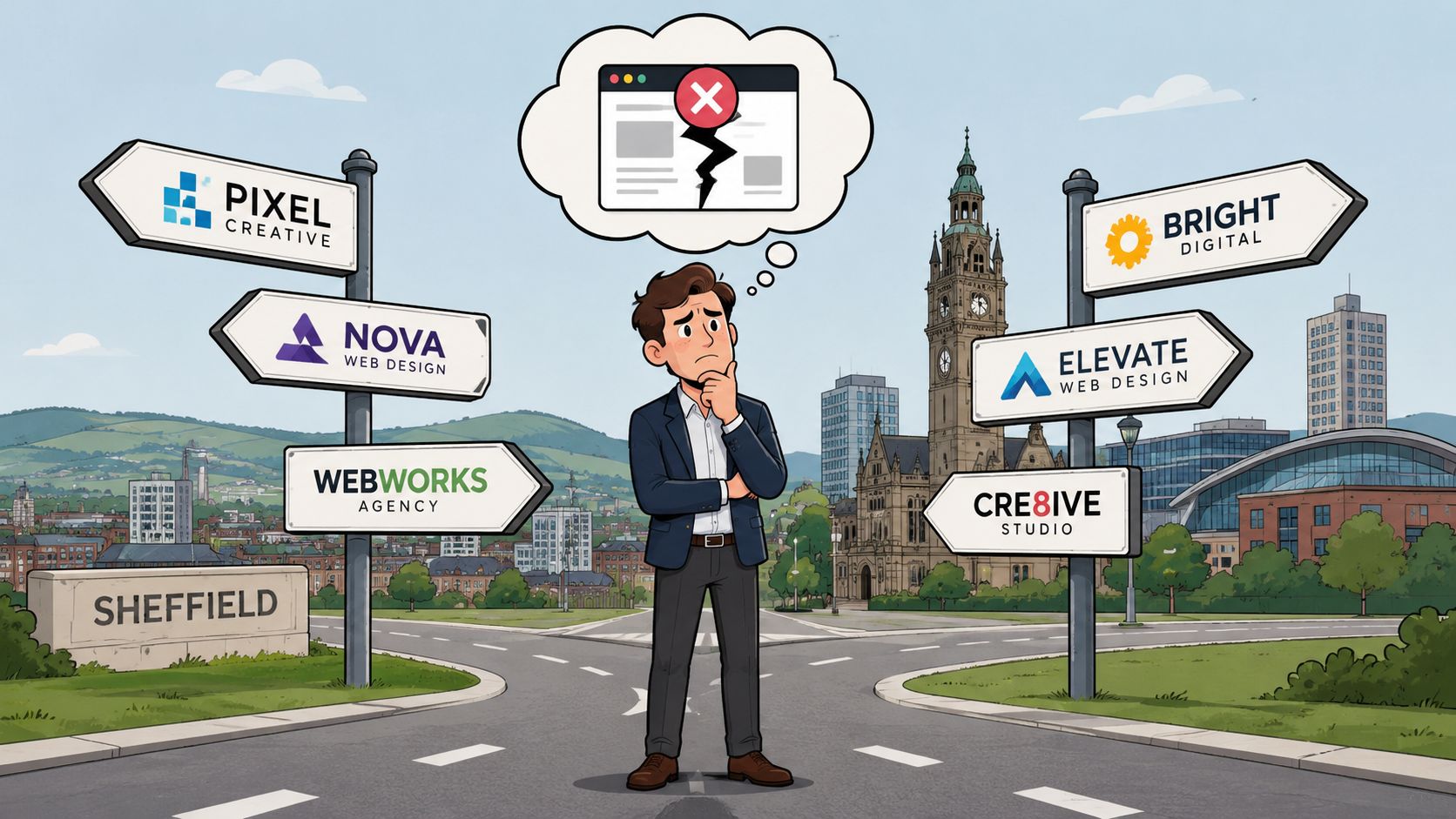
AgencyList's Sheffield directory shows exactly 9 approved website design agencies in Sheffield, South Yorkshire, while the wider Sheffield area contains 73 total web design companies as reported by TechBehemoths in 2026. That gap tells you something useful. There are plenty of providers, but a much smaller group that clears a more selective standard.
Why that matters in real buying decisions
That's good news if you're hiring carefully. Sheffield isn't an endless sea of interchangeable suppliers. It's a focused local market where you can compare a manageable number of serious contenders without defaulting to London.
That changes the mindset. You're not looking for someone to “do the website.” You're choosing a partner that will influence conversion, search visibility, platform fit, and the pace at which your internal team can execute after launch.
A brochure-style business can survive a weaker process for a while. An ecommerce brand usually can't. Product data, merchandising rules, checkout behaviour, app dependencies, customer journeys, and operational integrations all turn a redesign into a business systems project. If an agency treats it like a visual refresh, the problems move to a newer interface.
Practical rule: shortlist agencies as if you were hiring an external product team, not a creative vendor.
What a strong local partner looks like
The best Sheffield agencies tend to show three traits early.
- Commercial awareness. They ask what the site must change in the business, not just what pages you want.
- Technical confidence. They can explain performance, platform trade-offs, and post-launch responsibilities in plain English.
- Operational maturity. They have a delivery process that survives feedback loops, revisions, and stakeholder noise.
A weak fit usually reveals itself fast. The conversation stays at surface level. They talk about trends, aesthetics, and “engagement” but avoid questions about migration sequencing, analytics setup, or performance accountability.
When businesses choose well, the agency becomes an extension of the team. When they choose badly, they spend months managing avoidable ambiguity.
Defining Your Project Goals Beyond a Pretty Design
Before you speak to any agency, get your own brief into shape. Most disappointing projects don't start with bad design. They start with vague instructions.
If your brief says you want a site that feels modern, premium, and user-friendly, you'll get subjective proposals that are hard to compare. If your brief says the current site confuses first-time visitors, under-serves mobile users, and makes merchandising difficult, agencies have something concrete to solve.
Start with business outcomes
Write down what the website must do better than the current one. Keep it tied to business reality.
For example, an ecommerce brief often needs answers to questions like these:
- Which product categories matter most commercially?
- Where do customers hesitate before purchase?
- What does the site need to support operationally, such as subscriptions, bundles, stock messaging, or regional storefront complexity?
- What must stay intact during the rebuild, such as existing rankings, collection structures, or customer account behaviour?
That's a stronger starting point than a features wishlist.
Build a brief around four decisions
Use a practical framework which includes the essentials.
Audience and intent
Define who the site is for and what they're trying to achieve. A returning customer browsing collections behaves differently from a first-time visitor comparing products.Primary journeys
List the actions that matter most. That might be finding a product fast, understanding shipping, building trust, or completing checkout with minimal friction.Commercial measures
Decide how you'll judge success. Use your own internal KPIs, not agency jargon. Better conversion quality, stronger average order value, cleaner category discovery, lower support friction, and improved content management are all valid if they're real business priorities.Constraints
Include platform realities, internal approval bottlenecks, existing integrations, and any deadlines tied to trading periods.
One useful planning reference is Arlo Inc.'s 2026 growth framework. Not because you need to follow it rigidly, but because it's a sensible reminder that growth work usually breaks down into acquisition, conversion, retention, and operational execution. A redesign touches all four.
A good brief doesn't answer every question. It makes the right questions unavoidable.
Budget conversations get better when the brief is honest
Clients often worry that sharing budget too early weakens their position. Usually the opposite is true. A realistic budget range helps agencies shape the right solution.
If you hide the number, you tend to get proposals that are either bloated or stripped down beyond usefulness. If you're transparent about the commercial importance of the project, agencies can tell you whether the scope fits the investment.
A solid brief should include:
- Current pain points that are affecting sales, lead quality, or team efficiency
- Non-negotiables such as platform preference, SEO retention, accessibility requirements, or content migration
- Decision-makers so the agency knows who signs off
- Desired launch window with any seasonal constraints
- Examples you like, but only as reference points, not instructions to copy
This prep work saves time later. It also makes it much easier to spot which agency understands the problem and which one is just replying to keywords in your enquiry.
How to Vet Portfolios and Validate Client Results
An agency portfolio should answer one question: can this team solve the kind of problem you actually have?
Too many buyers stop at visual taste. They scroll through glossy screenshots, decide the work looks premium, and assume the underlying delivery is equally strong. That's a mistake. Static imagery hides a lot. It doesn't show mobile awkwardness, sluggish page rendering, clumsy collection logic, or weak content structure.
Start with the live work, not the agency's own commentary.
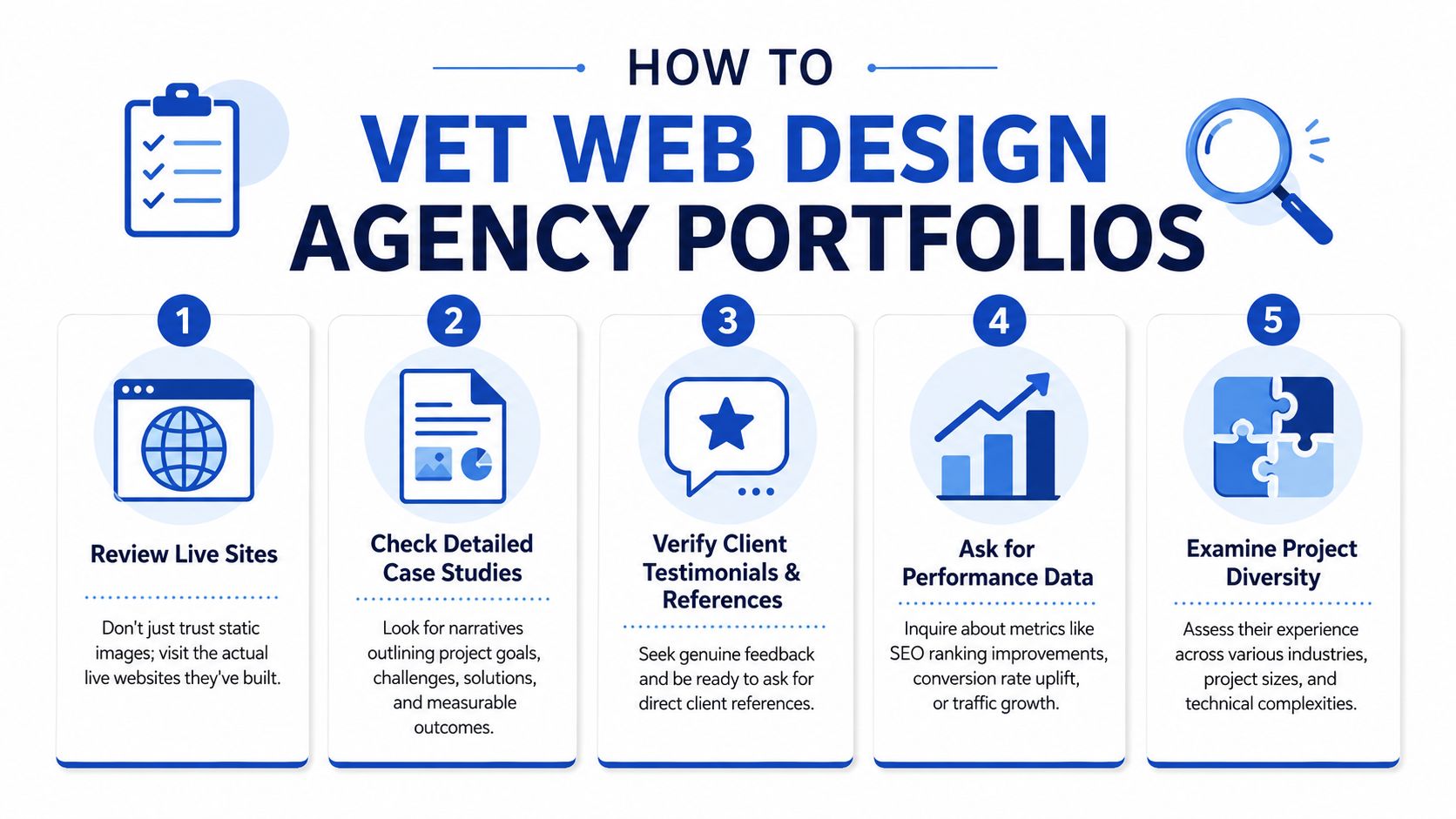
What to inspect beyond the screenshot
Open several recent sites on desktop and mobile. Click around like a customer, not a designer.
Look for signs that the agency can manage both polish and function:
- Navigation quality. Does the structure make sense fast, especially for a first-time visitor?
- Merchandising clarity. On ecommerce builds, can you understand category logic, filters, and product hierarchy without effort?
- Content discipline. Does the site communicate clearly, or is it over-designed and under-explained?
- Interaction consistency. Buttons, forms, product cards, and search behaviour should feel coherent across templates.
A useful companion checklist is this guide on how to choose a web design agency, especially if you want a second lens for reviewing live examples and separating aesthetics from delivery quality.
Social proof needs to be verifiable
Strong agencies don't rely on vague praise. They can point to review platforms, named clients, and repeatable delivery history.
A concrete benchmark comes from Clutch's Sheffield web design listings, where The SEO Works shows 103 verified client reviews, a 4.66 average rating, and 17 completed web design projects in 2026 alone. That doesn't mean they're automatically right for every brief. It does show what strong social proof looks like when an agency has real market presence.
If an agency claims strong results but offers no third-party review trail, no referenceable clients, and no detailed project history, treat that as a risk.
Here's a quick visual summary before you contact references:
Ask for the project story, not just the outcome claim
Case studies are useful when they explain the sequence. You want to know:
| What to check | What to look for |
|---|---|
| Original problem | A real business issue, not “the brand wanted a refresh” |
| Scope of work | Design, development, migration, CRO, content, integrations |
| Constraints | Legacy systems, internal complexity, SEO risk, stakeholder needs |
| Decision logic | Why the agency chose a specific platform or UX approach |
| Evidence of success | Verifiable proof, not empty adjectives |
If a case study can't explain the business problem, the design decisions, and the client outcome in one connected story, it's mostly a gallery piece.
One more practical filter helps: ask which portfolio examples most resemble your own level of complexity. Not your industry alone. Complexity. A small brochure site and a multi-market Shopify rebuild might both look clean in a screenshot, but they demand very different capabilities.
Assessing Crucial Technical and E-commerce Capabilities
Many selection processes go off track. Buyers spend weeks discussing branding, page layouts, and inspiration boards, then squeeze the technical conversation into the final call. For ecommerce, that order should be reversed.
Design matters. Performance matters more when the site has to acquire traffic, convert sessions, and support day-to-day trading.
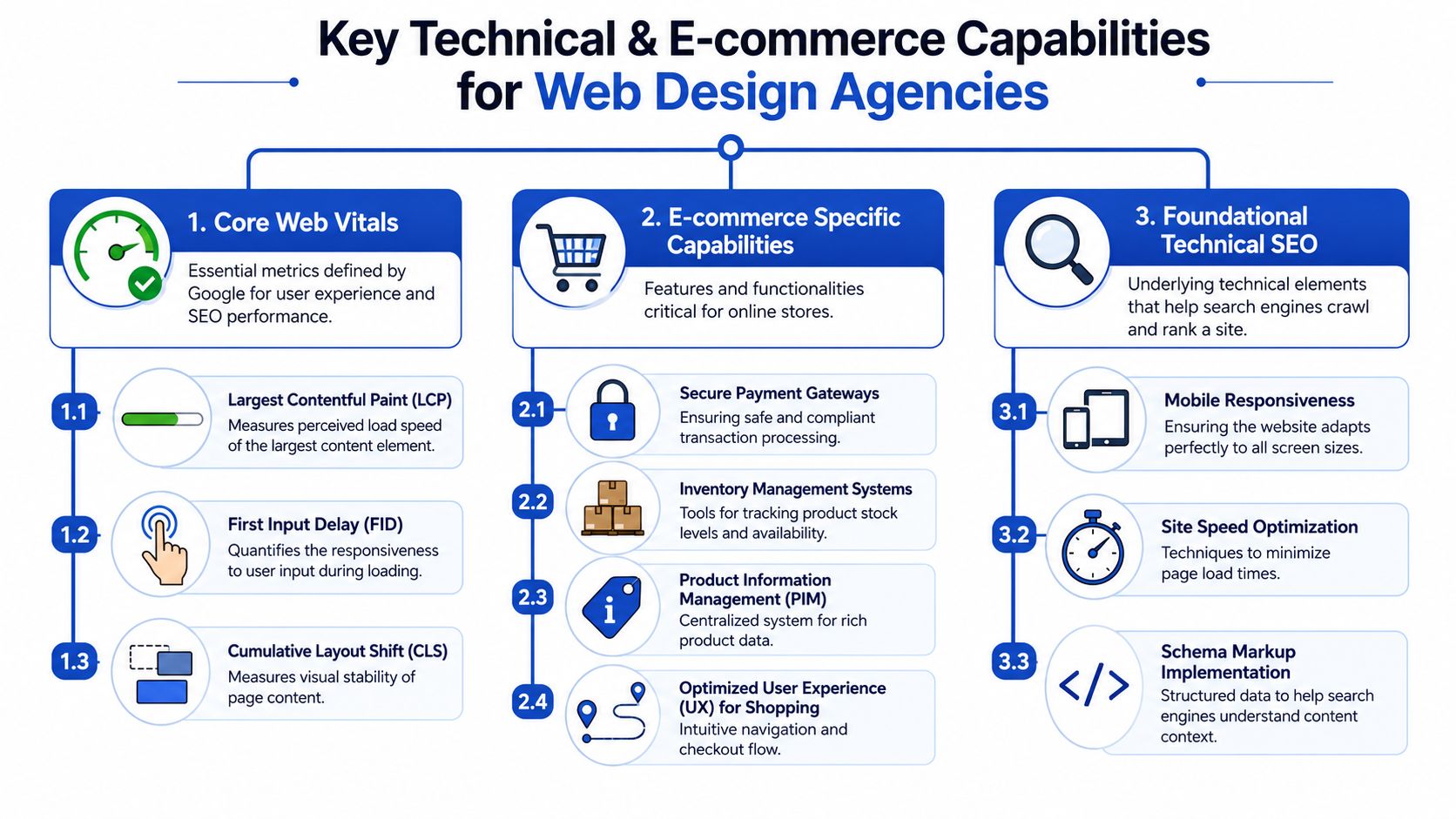
Use a hard performance standard
A credible agency should be comfortable being held to a measurable technical bar. According to Factory Jet's UK agency checklist, the baseline standard is a Lighthouse Performance score above 90 with full Core Web Vitals compliance. The same source states that agencies delivering below that threshold typically see a 15 to 20% reduction in search visibility and conversion rates, and that 30% of projects fail to maintain compliance when post-launch monitoring is neglected.
That gives you something specific to ask for. Not “Will the site be fast?” Ask:
- What performance score do you target before launch?
- How do you control JavaScript and CSS payload during build?
- How do you handle caching, rendering strategy, and mobile validation?
- What happens after launch if performance degrades?
Those questions quickly separate agencies with an engineering process from agencies that hope the finished site “should be fine”.
Ecommerce capability isn't one skill
A proper ecommerce partner needs range. On Shopify projects, for example, capability often spans theme architecture, app evaluation, custom app work, subscription logic, international setup, search and filter behaviour, product data modelling, and systems integration.
That's why a portfolio full of attractive brand sites doesn't prove ecommerce strength. You need to hear how they make platform decisions under pressure.
A useful reference point if you're vetting Shopify-specific delivery is this piece on Shopify ecommerce website design, which outlines the practical relationship between storefront UX, technical implementation, and growth requirements.
Migration planning is where weak agencies get exposed
The most expensive mistakes tend to happen during migrations. Data gets mishandled. Redirect planning is rushed. Collection logic changes without considering search equity. Product variants become messy. Third-party apps are added to patch issues that should have been solved in architecture.
For ecommerce brands moving from legacy systems, the right questions are blunt:
- How do you audit the current store before recommending Shopify or Shopify Plus?
- What's your process for preserving SEO-critical URLs and content value?
- How do you handle customer accounts, order history, and product data integrity?
- Which app decisions do you avoid because they create long-term complexity?
- What does post-migration QA look like on mobile, checkout, and merchandising flows?
A migration isn't a copy-and-paste exercise. It's a controlled rebuild with commercial risk attached.
What good technical answers sound like
A strong agency usually speaks plainly. They won't hide behind buzzwords like headless, composable, or scalable without explaining when those choices help.
Listen for practical maturity:
- They define trade-offs clearly. For example, when a simpler Shopify architecture is better than unnecessary complexity.
- They distinguish launch from maintenance. Performance work doesn't stop on go-live day.
- They think in systems. The site has to work with operations, content teams, and future campaigns.
- They test real behaviour. Mobile navigation, add-to-cart logic, and search experience matter as much as design fidelity.
If the technical lead can't explain these issues clearly in a discovery call, that usually shows up later as scope drift, platform workarounds, and unpleasant launch week surprises.
Creating Your Shortlist and Running Discovery Calls
Once your brief is clear and your vetting criteria are sharper, reduce the field aggressively. Most businesses don't need a longlist. They need a disciplined shortlist.
For a web design agency in Sheffield, I'd rather compare a few strong candidates in depth than skim a dozen websites and lose the thread. Aim for three or four agencies that fit your project type, budget range, and complexity level.
How to build the shortlist
Start by removing agencies that only show generic service pages and no meaningful proof of delivery. Then narrow based on fit.
Use these filters:
- Relevant project type. Ecommerce brands should prioritise agencies that can discuss stores, migrations, integrations, and platform constraints comfortably.
- Local communication fit. Geography isn't everything, but responsiveness and clarity matter. You want a team that communicates well under pressure.
- Evidence over style. Keep the agencies that can show live work, credible reviews, and thoughtful case narratives.
- Commercial understanding. If they ask better business questions in the first interaction, keep talking.
One issue deserves special attention. The Sheffield Site's review of the local market notes that most Sheffield web design agency content fails to explain the cost and technical complexity of legacy-store migration to Shopify 2.0, and cites UK government data showing 62% of small businesses use outdated ecommerce platforms while only 14% have a clear migration roadmap. That makes migration questioning a priority, not a niche concern.
Run discovery calls like working sessions
A good discovery call should feel diagnostic. If it feels like a one-way pitch, you aren't learning enough.
Ask questions that force specifics.
| Category | Question | What a Good Answer Looks Like |
|---|---|---|
| Strategy | How do you define success for a project like ours? | They connect design decisions to your business model, audience, and internal KPIs |
| Process | What happens before design starts? | They mention audit work, stakeholder discovery, technical review, and content or data planning |
| Ecommerce | How do you approach Shopify 2.0 migrations from legacy platforms? | They discuss architecture, data handling, SEO preservation, app rationalisation, and QA |
| Performance | What technical standard do you build to? | They can explain a clear benchmark and how they test against it |
| SEO | Who owns redirects, metadata, and crawl-risk decisions during migration? | They identify responsibility clearly and describe the workflow |
| Team | Who will actually work on our project? | You hear about named roles, not a vague “team” |
| Communication | How are decisions, blockers, and updates handled? | They describe a repeatable cadence and escalation path |
| Support | What happens after launch? | They explain monitoring, fixes, and ongoing improvement expectations |
What to notice during the call
Pay attention to how they answer, not just what they answer.
A strong agency will challenge weak assumptions politely. They'll ask follow-up questions that improve the brief. They'll tell you when a request creates complexity with little upside. That's useful.
A weaker agency usually does one of two things. It either agrees with everything to keep momentum, or it stays abstract because it hasn't thought enough about delivery.
The best discovery calls leave you with clearer thinking, even before you receive a proposal.
When proposals arrive, compare them on understanding first, scope second, and price third. Cheap ambiguity is expensive once the project starts.
Finalising Contracts Scope and Timelines
By the time you reach contract stage, the real selection work should already be done. The contract isn't where trust is created. It's where trust gets translated into deliverables, responsibilities, and timing.
The most useful document here is the Statement of Work. If it's vague, the project will become vague.
What the scope document must pin down
A proper scope should define what the agency is producing, what the client must provide, and where the boundary sits.
That usually includes:
- Deliverables such as UX, design systems, templates, development, migration work, QA, and launch support
- Rounds of revision so feedback doesn't become open-ended
- Content responsibilities including product data, copy, image prep, and approvals
- Technical responsibilities for integrations, analytics, redirects, and post-launch fixes
- Acceptance criteria so completion is based on agreed standards, not shifting interpretation
This is also the moment to confirm ownership. Make sure intellectual property, access rights, and licence responsibilities are written down clearly. Creative assets often create confusion later, especially typography. If your team needs a practical reference on that point, this guide to managing font licenses for clients is worth reviewing before sign-off.
Timelines should reflect decision reality
The timeline in a proposal often assumes prompt feedback, quick approvals, and clean asset handovers. Real projects rarely behave that neatly.
Get specific about:
- Dependencies. What can stall the schedule?
- Review windows. How long does each side have to approve work?
- Launch readiness. Who signs off content, QA, and commercial checks?
- Support period. What's covered immediately after launch?
If you need a clearer sense of how scope choices influence investment and complexity, this breakdown of Shopify website design cost is useful for framing discussions around deliverables rather than headline pricing.
A good contract doesn't feel defensive. It feels precise. Both sides know what's being built, how decisions get made, what happens if scope shifts, and who owns which risk. That clarity is what turns a promising agency relationship into a working one.
If you're looking for a team that specialises in Shopify design, development, migration planning, and conversion-focused ecommerce execution, Grumspot is worth a look. They help brands rebuild underperforming stores, handle complex Shopify 2.0 work, and scale with a senior team that moves quickly without adding agency drag.
Let's build something together
If you like what you saw, let's jump on a quick call and discuss your project
Related posts
Check out some similar posts.

- web design agency southampton
Find the best web design agency Southampton. Our 2026 guide covers vetting, pricing, red flags & cho...
Read more
- web design agency leeds
Our 2026 guide helps you find & hire the best web design agency leeds. Get checklists, pricing bench...
Read more
- web design agency manchester
Find the best web design agency Manchester has to offer. Our 2026 guide covers services, pricing, qu...
Read more
- web design agency belfast
Find the best web design agency belfast for your project in 2026. Our expert guide helps you choose ...
Read more