Hire the Best Conversion Rate Optimization Consultant
- conversion rate optimisation
- cro consultant
- hire cro specialist
- ecommerce conversion
- shopify plus optimisation
Launched
June, 2026
Traffic is steady. Orders aren't.
You open GA4, Shopify analytics, maybe a heatmap tool, and the pattern is always the same. People are landing on product pages, browsing collections, even starting checkout, yet revenue barely moves. The usual reaction is to buy more traffic, launch another campaign, or ask for a redesign. Sometimes that helps. Often it just sends more people into the same leaky funnel.
That's where a conversion rate optimisation consultant earns their keep. Not by guessing which button colour might work better, but by finding out where intent breaks down and fixing the parts of the journey that stop buyers from completing.
Your Website Gets Traffic But Sales Are Flat What Now
If you're in ecommerce, this problem is familiar. Sessions look healthy. Paid campaigns are still bringing people in. Organic traffic hasn't collapsed. But sales feel disconnected from attention.
The mistake is assuming the issue must be top-of-funnel. In many stores, the actual problem sits further down. Product pages don't answer objections. Cart pages create friction. Checkout asks for too much effort. Mobile users hit avoidable usability problems. None of that shows up in a channel report as clearly as it should.
Average website conversion rates typically sit between 2% and 5%, and a move from 2% to 3% is a 50% relative improvement in conversions according to Glassbox's CRO overview. That's why optimisation matters so much. You don't always need more visitors. You need more of your existing visitors to complete the action you already want.
A good consultant looks at this commercially, not cosmetically. They ask questions like:
- Where do high-intent users stall: On product pages, in the cart, or during checkout?
- Which segments underperform: Mobile, returning users, paid traffic, or first-time visitors?
- What friction is self-inflicted: Slow pages, cluttered templates, weak messaging, unclear delivery information, or unnecessary fields?
For ecommerce teams that want a grounded starting point, this ecommerce conversion optimisation guide is useful because it frames CRO around revenue mechanics rather than design trends.
Most stores don't have a traffic problem first. They have an efficiency problem.
That distinction matters. If your site already attracts the right audience, every improvement to conversion rate compounds the value of your existing spend. That's the business case for hiring a conversion rate optimization consultant. They help you stop paying to send demand into avoidable friction.
What a Conversion Rate Optimisation Consultant Actually Does
A serious CRO consultant works more like a revenue scientist than a designer with opinions. Their job is to identify where conversion loss happens, build a defensible hypothesis, run a controlled test, and learn something reliable from the outcome.
This visual sums up the role well:
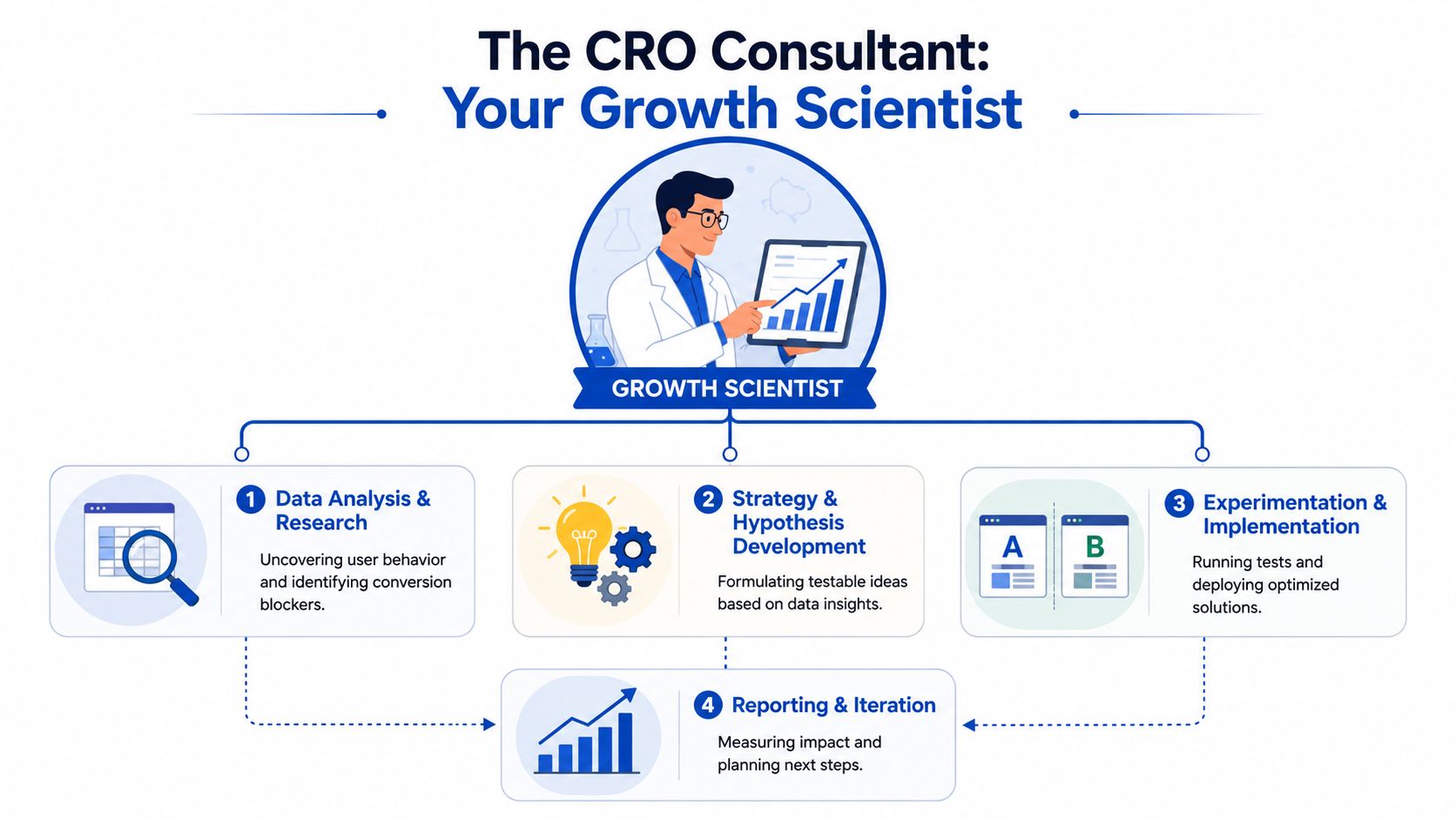
A lot of businesses hire the wrong person because they expect instant recommendations. That's backwards. If someone prescribes fixes before they've audited the funnel, reviewed behaviour data, and checked tracking quality, you're getting taste masquerading as strategy.
Research comes before recommendations
The first job is diagnosis. That usually means reviewing analytics, funnel paths, behaviour recordings, heatmaps, form interactions, device splits, and page-by-page drop-off patterns. For Shopify stores, this often reveals simple but expensive issues such as weak product page hierarchy, low-visibility shipping information, poor sticky CTA behaviour on mobile, or coupon distractions in cart.
A professional CRO consultant treats optimisation as a controlled measurement problem. Their frameworks emphasise that hypotheses must be built from observed user friction and then verified statistically with A/B tests, rather than gut feel, as outlined by ConversionRate.store's guide to hiring a CRO consultant.
If you want a service model built around that process, conversion rate optimisation services should include research, testing logic, implementation planning, and reporting, not just a list of design suggestions.
The workflow is usually four parts
Research
The consultant finds where users hesitate, loop, or leave.Hypothesis
They translate evidence into a testable statement. For example, if buyers keep abandoning at shipping selection, the hypothesis may involve clarity, trust, or effort reduction.Testing
They validate whether the change improves the target outcome.Analysis
They decide what was learned, what gets rolled out, and what should be tested next.
Later in the process, video can help teams understand the discipline from a broader angle:
What they do not do
They don't chase random “best practices” because another brand uses them. They don't redesign pages just to make them look cleaner. And they don't confuse movement with progress.
A consultant is there to reduce uncertainty. Not add more opinions to the room.
That's the practical difference between a real conversion rate optimization consultant and a generic ecommerce adviser. One works from evidence. The other works from preference.
The Core Services and Workflow of a CRO Engagement
Most strong CRO engagements follow a structured cycle. The exact tooling and pace vary, but the underlying workflow stays consistent because that's how you produce measurable outcomes instead of scattered improvements.
This is the typical shape of the work:
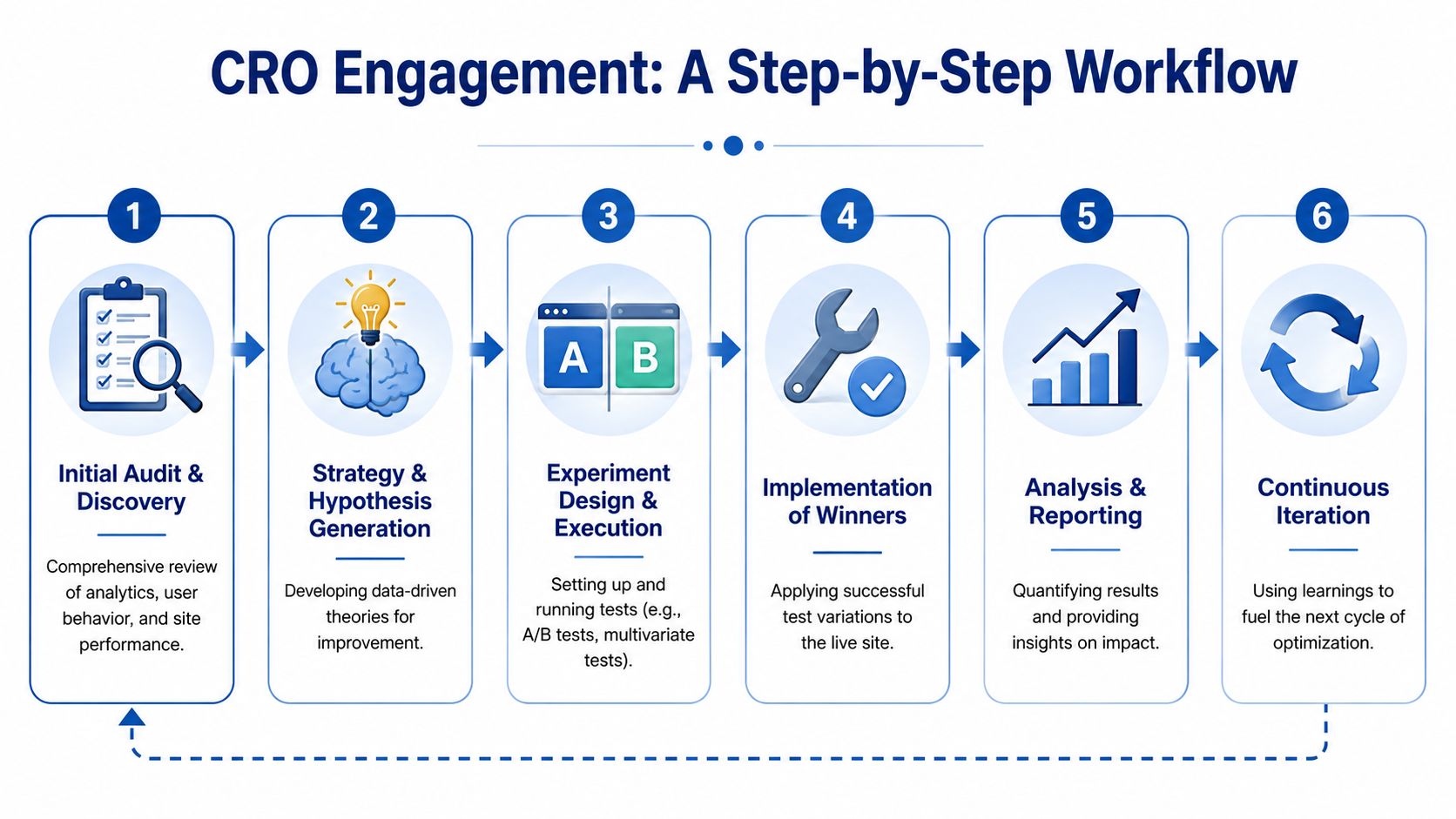
Audit and discovery
The engagement usually starts with a full review of your conversion environment. That includes analytics setup, funnel definitions, checkout flow, key templates, mobile usability, page speed issues, and traffic-source behaviour. In Shopify Plus, a competent consultant also looks at how theme logic, apps, and custom scripts may be affecting performance or introducing friction.
The output here shouldn't be vague. You want a prioritised view of where revenue is leaking, what can be fixed quickly, and what requires testing before rollout.
Research and hypothesis building
This phase turns raw observation into a test roadmap. A consultant reviews quantitative data alongside qualitative inputs such as session recordings, customer support themes, on-site survey feedback, and merchandising context. The goal is to isolate high-friction moments and assign likely causes.
Typical deliverables include:
- Funnel findings: Where users drop out by page type, step, device, or audience segment
- Research summaries: Key behavioural patterns and recurring friction points
- Hypothesis backlog: Test ideas tied to a specific problem and expected behavioural change
- Prioritisation logic: Which experiments should run first based on likely impact and implementation effort
Experimentation and implementation
The complexities involved expose weak operators. Anyone can suggest ideas. Fewer people can design a clean experiment, coordinate the build, QA the variation properly, and launch without polluting the result.
For Shopify Plus brands, implementation quality matters as much as the hypothesis. Theme changes, app conflicts, custom checkout logic, and localisation layers can all distort results if nobody manages them properly.
Practical rule: If the consultant can't explain how they protect data quality and QA test variants, they're not ready to run a serious programme.
Reporting and iteration
The best consultants don't report on “wins” only. They explain what happened, why it likely happened, and what the business should do next. Sometimes a test loses but still reveals valuable information about message sensitivity, checkout anxiety, or merchandising order.
Businesses that adopt CRO tools and methodologies see an average 223% ROI, according to Lead Forensics' CRO statistics round-up. That figure makes sense when the work is systematic. Revenue improves because teams stop making disconnected changes and start compounding validated ones.
A proper engagement isn't a one-off clean-up. It's an operating rhythm. Audit, learn, test, ship, and repeat.
Key KPIs and Essential Tools of the Trade
A weak CRO discussion collapses everything into one number. Conversion rate matters, but it rarely tells the whole commercial story on its own. Good consultants read performance through a set of connected metrics, then use tools that show both behaviour and outcome.
The KPIs that actually matter
For ecommerce, I pay close attention to where performance changes hands between intent and friction. That usually means looking at a mix like this:
- Conversion rate: Useful, but only when segmented properly by device, landing page type, traffic source, and customer cohort.
- Average order value: Important when testing bundles, upsells, cart design, shipping thresholds, or merchandising order.
- Cart abandonment patterns: Less about the headline and more about where abandonment clusters.
- Checkout completion rate: A core signal for stores with strong add-to-cart intent but weak finish rates.
- Revenue per visitor: Helpful when a test affects both conversion behaviour and basket composition.
- Task completion signals: For example, whether users can select a variant, apply filters, or understand delivery options without hesitation.
The right KPI depends on the page and the problem. Testing a PDP headline is not the same job as optimising checkout inputs or cart drawer behaviour.
The core tool categories
A capable consultant usually works across a stack, not a single platform.
| Tool category | What it's used for | Typical examples |
|---|---|---|
| Analytics | Funnel analysis, segment comparison, pathing | Google Analytics 4, Shopify analytics |
| Behaviour tools | Heatmaps, recordings, click and scroll behaviour | Hotjar, Microsoft Clarity |
| Experimentation tools | A/B testing and controlled rollout | VWO, Optimizely |
| Feedback tools | On-site surveys, form feedback, customer voice | Hotjar Surveys, post-purchase surveys |
| Reporting layers | Shared dashboards and stakeholder visibility | Looker Studio, internal reporting dashboards |
Some teams are also using automation and analysis support from broader AI stacks. If you're reviewing tools that support research, reporting, and experimentation workflows, this round-up of top marketing AI solutions is a useful reference because it shows where AI can assist without replacing actual CRO judgement.
What a proposal should sound like
If a consultant talks only about “improving UX”, ask them which KPI they expect to move and how they'll measure it. If they list tools without explaining the role each one plays, that's another warning sign.
A real operator can connect the metric, the tool, and the business effect in plain English. They should be able to tell you why a cart drop-off issue needs behaviour analysis, why a checkout test needs clean experiment design, and why a PDP issue may need message testing rather than visual redesign.
How to Hire the Right CRO Consultant for Your Business
Hiring a CRO consultant is mostly about filtering out people who sound data-driven from people who are. Plenty of candidates can talk about testing, user journeys, and optimisation. Fewer can show a clear process, explain trade-offs, and work within the constraints your business has.
For UK brands, there's a further complication. You don't just need someone who can analyse behaviour. You need someone who understands what becomes harder to measure under local privacy constraints.
A key evaluation point for UK businesses is how a consultant handles privacy constraints. With the ICO's cookie rules, a consultant's ability to maintain statistically usable measurement despite tracking loss is a practical differentiator, as noted by Consultport's overview of conversion optimisation consultants.
What to evaluate first
Don't start with portfolios. Start with process.
You want to know whether the consultant can:
- Diagnose before prescribing: They should ask about data quality, tracking gaps, and funnel structure before suggesting fixes.
- Work within UK consent realities: They should be able to discuss consent mode, signal loss, first-party data, and what this changes in reporting confidence.
- Prioritise commercially: Not every issue deserves a test. High-intent friction usually comes first.
- Communicate clearly: If they can't explain methodology without jargon, stakeholder alignment will be painful.
- Work with your implementation model: Some consultants only advise. Others can support design and development handoff.
CRO Consultant Evaluation Checklist
| Evaluation Area | What to Look For | Score (1-5) |
|---|---|---|
| Process quality | Clear workflow for research, hypothesis building, testing, and analysis | |
| Measurement discipline | Strong grasp of analytics quality, attribution limits, and experiment validity | |
| UK privacy awareness | Practical answers on consent, tracking loss, and first-party measurement | |
| Ecommerce relevance | Experience with product pages, cart flows, checkout friction, and merchandising decisions | |
| Shopify fit | Comfort working with theme constraints, app ecosystems, and implementation dependencies | |
| Communication | Explains findings in commercial language, not just tool output | |
| Prioritisation | Can justify why one test should run before another | |
| Collaboration | Works well with internal teams, agencies, or developers |
The questions worth asking in interview
At this stage, you separate rehearsed theory from practice.
Ask things like:
- How do you decide what to test first when a store has several obvious issues?
- What would make you avoid an A/B test and recommend a direct implementation instead?
- How do you handle reporting gaps when consent reduces trackable sessions?
- What does a good experiment brief include before design or development starts?
- Tell me about a hypothesis that was wrong. What changed after the result?
- How do you work with Shopify developers when a test touches theme logic or app behaviour?
- Which metrics do you trust most when checkout tracking is incomplete?
If a candidate gives polished answers but never mentions trade-offs, edge cases, or measurement limits, they probably haven't run enough live programmes.
What usually doesn't work
The wrong hire often looks impressive at first. They promise quick wins, recommend a full redesign too early, or flood you with generic “best practices”. Then the programme stalls because nobody solved the hard parts: weak instrumentation, unclear prioritisation, stakeholder drag, or implementation bottlenecks.
The right consultant doesn't try to sound clever. They make the work legible. They show you how decisions get made, what evidence matters, and how progress will be judged.
Real World CRO in Action for Shopify Plus Stores
Shopify Plus stores rarely need abstract CRO theory. They need someone to spot where demand is getting stuck and fix it without creating more technical debt.
That usually means working on pages with clear intent. Product detail pages. Cart. Checkout. Account flows. Subscription moments. Collection pages with heavy filtering. These are the parts of the storefront where small experience problems directly interrupt revenue.
Example one, checkout friction on a mature store
A common Shopify Plus pattern looks like this. Product engagement is decent. Add-to-cart activity is healthy. Checkout starts happen. Completion feels soft.
In that situation, a consultant won't start by redesigning the homepage. They'll inspect the high-intent path. Are there too many form fields? Are address and payment steps clear on mobile? Is inline validation helping or frustrating? Are payment options broad enough for the market? Is delivery information visible at the moment people need reassurance?
For UK ecommerce merchants, reducing friction on high-intent pages is a top priority. CRO guidance consistently links fewer form fields, inline validation, progress indicators, and multiple payment options to higher completion rates, according to this CRO guide from EZbot.
That's where a Shopify Plus-specific audit becomes valuable. A focused Shopify CRO audit can surface whether the problem is experience design, technical implementation, or a measurement blind spot.
Example two, increasing basket value without hurting conversion
Another frequent scenario is a store with stable conversion but weak order economics. Here the work shifts from “how do we get more people through checkout” to “how do we increase what a buying customer is willing to add”.
On Shopify Plus, that might mean testing:
- Cross-sells on PDPs: Relevance matters more than quantity
- Cart upsells: Placement and timing decide whether they help or distract
- Bundle logic: Especially where the offer reduces decision effort
- Merchandising order: The sequence of information can raise or lower confidence
CRO often overlaps with retention and lifecycle marketing. If a store is refining post-purchase journeys or campaign creative in parallel, even details like email subject line capitalization can matter because message clarity affects whether customers re-engage with upsell or replenishment campaigns.
Example three, international complexity
Shopify Plus brands selling into multiple markets often carry hidden conversion drag. Localised currency, shipping expectations, tax presentation, payment preferences, and translated content all affect buyer confidence. A generic consultant may miss that. A commerce-focused one won't.
Good CRO on Shopify Plus is rarely about one clever test. It's about tightening the buying journey where intent is already present.
That's why the best work tends to look operational rather than flashy. Better checkout logic. Cleaner variant selection. Smarter merchandising. Stronger mobile hierarchy. Fewer interruptions between interest and purchase.
Maximising ROI with a Conversion-First Agency
There's a practical limit to what a solo consultant can do, even if they're excellent. They can identify issues, shape the roadmap, and interpret results. But once testing starts touching theme code, UX revisions, app behaviour, or localisation layers, implementation speed becomes the bottleneck.
That's where a conversion-first agency model is often stronger. You're not relying on one person to think, spec, coordinate, QA, and report. You've got strategy, design, development, and analysis working in the same operating rhythm. For Shopify Plus brands, that usually means faster test deployment and fewer delays between insight and execution.
CRO ROI doesn't come from isolated ideas; it stems from throughput. Research has to become experiments. Experiments have to become shipped improvements. Shipped improvements have to inform the next round. If any of those steps stall, the programme becomes a slide deck instead of a growth system.
For businesses also trying to tighten marketing accountability beyond onsite conversion, this piece on Viral.new on boosting impact is a useful companion read because it looks at ROI discipline from another channel angle. The principle is the same. Performance work only earns trust when it ties activity back to commercial outcome.
A monthly retainer often suits brands that want continuous iteration. A one-off project can make sense if you need an audit, a test roadmap, or a specific funnel intervention. The better fit depends on how quickly your team can implement changes and how serious you are about ongoing optimisation.
If your store gets traffic but too much of that intent leaks away before purchase, hiring a conversion rate optimization consultant is usually a smart move. If you also need Shopify design, development, and deployment capacity around that strategy, an integrated agency setup is often the more effective model.
If you're ready to turn your Shopify store into a stronger revenue engine, Grumspot can support the work with Shopify Plus design, development, audits, and conversion-focused optimisation that connects strategy to implementation.
Let's build something together
If you like what you saw, let's jump on a quick call and discuss your project
Related posts
Check out some similar posts.
- ecommerce ab testing
Master ecommerce AB testing with a revenue-first playbook. Learn to build hypotheses, calculate samp...
Read more
- conversion rate optimisation
Benefits of conversion rate optimization. Discover the real benefits of conversion rate optimisation...
Read more
- ecommerce ui ux design
Learn ecommerce UI UX design principles that lift conversion, from information architecture to acces...
Read more
- reduce Shopify cart abandonment
Diagnose & reduce Shopify cart abandonment with our 2026 playbook. Get actionable strategies for UI,...
Read more