Ecommerce Growth Uk
- ecommerce growth uk
- uk ecommerce strategy
- shopify growth
- conversion optimisation
- uk retail trends
Launched
August, 2026

UK ecommerce reached 27.6% of total retail sales in May 2026, so growth now comes from better execution, not from waiting for the market to expand. The operators winning ecommerce growth in the UK are improving conversion, increasing basket value, retaining more customers, and making every channel contribute profitably.
That's the mental shift merchants need to make. The UK remains a powerful ecommerce market, but it's no longer in the easy phase where more online demand automatically lifts every competent retailer. A faster store, clearer delivery promise, stronger merchandising and tighter measurement now matter more than another broad acquisition campaign.
A Shopify Plus programme should therefore focus on CRO, AOV, retention, channel efficiency and disciplined international expansion. The brands that treat those levers as an integrated operating system will take more share from slower competitors without assuming that category-wide tailwinds will do the work for them.
The State of UK Ecommerce in 2026
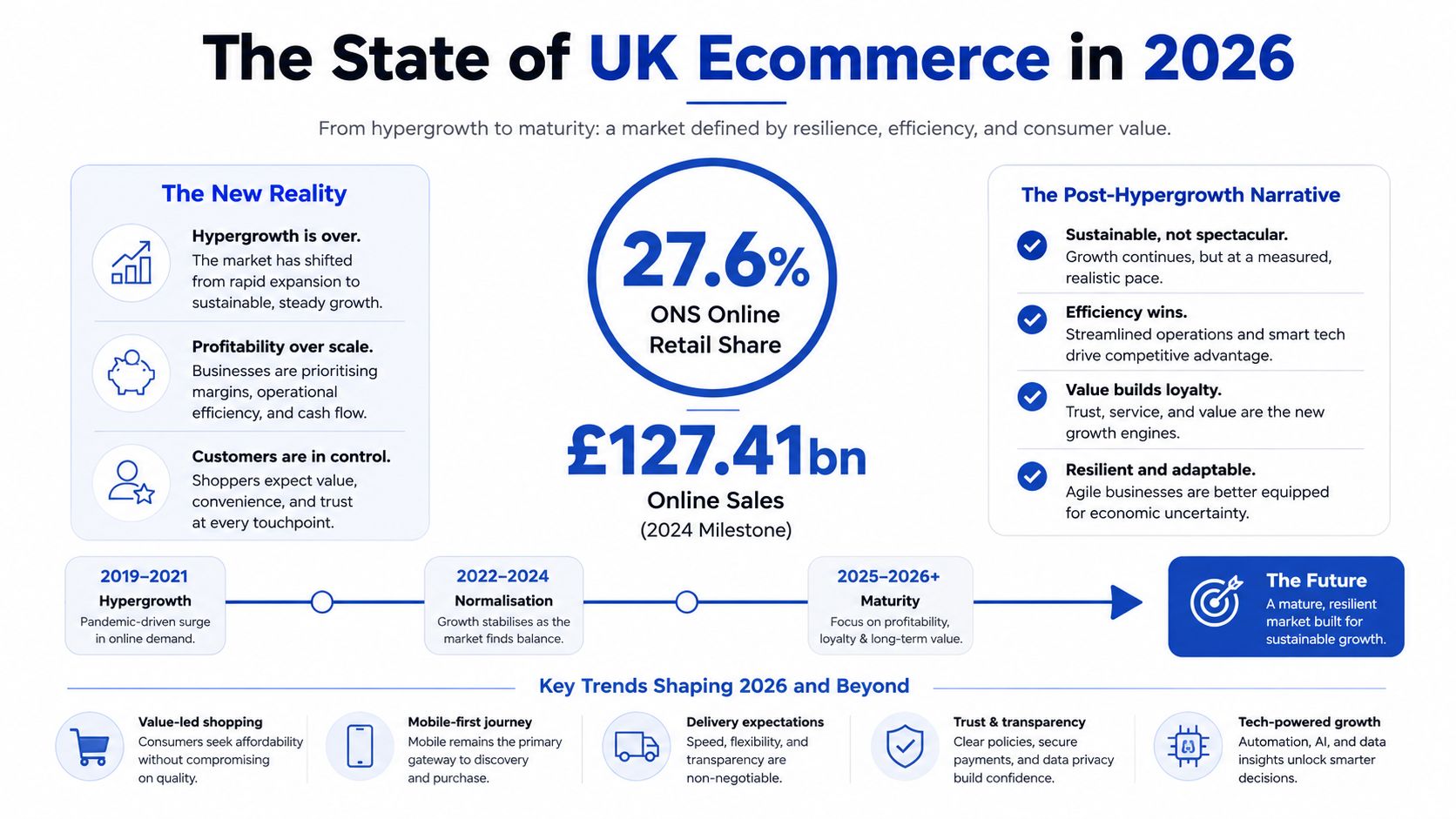
The UK online retail market has reached a mature operating stage. Online sales were valued at £127.41 billion in 2024, up from £123.3 billion in 2023, according to UK ecommerce market statistics. That annual total was widely reported as the highest recorded outside the lockdown spike, which makes it more useful than a temporary pandemic comparison. It shows that online retail has become a permanent part of national demand.
The latest share data reinforces the point. Online sales represented 27.6% of total retail sales in May 2026, compared with 27.4% across 2025, after the pandemic peak of 30.7% in 2021, as recorded in the Office for National Statistics retail sales time series. Ecommerce has settled at a structurally high level, even though the channel is no longer expanding at its extraordinary pandemic pace.
Why the old growth model breaks
Before 2021, many teams could justify aggressive traffic acquisition because the online channel itself was taking a larger role in retail. That assumption is weaker now. Saturated categories face tougher customer acquisition, shoppers compare more alternatives, and household budgets remain sensitive to price, delivery fees and returns.
A mature market changes the commercial question from “How do we grow the pie?” to “How do we take a larger slice?” That means improving the percentage of visitors who buy, increasing the value of each order, creating reasons to return and removing waste from paid, marketplace and fulfilment activity.
The ONS trend also needs careful interpretation. A stable online share doesn't mean ecommerce revenue is frozen. Online spending values still grew 9.8% year on year over the three months to May 2026, with 12.2% growth in May, while June online spending values were 14.4% higher than a year earlier, according to UK ecommerce spending analysis for 2026. Retailers can still grow quickly, but execution has to create that growth.
The practical implication: budget for fewer speculative experiments and more measured improvements to product discovery, checkout completion, basket composition and repeat purchase.
For Shopify operators, that changes roadmap priorities. Performance engineering comes before decorative redesign. Product data quality comes before publishing more low-intent content. Retention flows deserve the same commercial scrutiny as acquisition campaigns. International expansion should follow operational readiness, not vanity market count.
A strong UK ecommerce development approach should connect storefront performance, merchandising, fulfilment visibility and analytics from the start. In this market, small improvements compound because the channel already represents a substantial share of retail demand.
Channel Strategies That Drive UK Ecommerce Growth
A UK Shopify Plus brand needs a four-channel model, not a collection of disconnected campaigns. SEO captures durable intent, paid media creates controlled reach, marketplaces add demand access, and CRM turns completed orders into future revenue. The right allocation depends on category economics and repeat purchase behaviour, but a useful starting model is 35% SEO, 30% paid media, 20% lifecycle and CRM, and 15% marketplaces.
Those percentages are an operating hypothesis, not a universal rule. A low-repeat furniture brand may need more marketplace discipline and less lifecycle investment. A replenishment-led beauty business can justify heavier CRM. Review the weighting against contribution margin, not last-click revenue.
| Channel | Budget Weight | Primary KPI | Best Fit |
|---|---|---|---|
| SEO | 35% | Net contribution from organic visitors | Brands with searchable categories and strong product margins |
| Paid media | 30% | Blended contribution margin | Brands with creative testing capacity and clear demand signals |
| Lifecycle and CRM | 20% | Cohort revenue and repeat purchase rate | Replenishment, subscription and repeatable product categories |
| Marketplaces | 15% | Marketplace contribution after fees and returns | Products with proven demand and operational capacity |
SEO should build commercial assets
Invest in category architecture, product schema, internal linking and original buying guidance. UK spelling, delivery information, sizing context and regional intent belong in the experience where they help shoppers decide. Cut thin location pages, copied manufacturer descriptions and blog content that attracts readers without a plausible route to purchase.
Paid media needs faster creative iteration than is often the case. Google Shopping depends on clean feeds, accurate availability and useful titles. Meta and TikTok need a steady supply of differentiated creative, not endless audience segmentation. Server-side tracking can improve signal quality, but it won't rescue weak offers or slow landing pages.
Marketplaces are useful when they introduce incremental customers or clear surplus stock efficiently. They become expensive when the brand shifts existing demand from its own site while paying marketplace fees and losing customer ownership. Audit overlap before increasing spend.
Owned CRM should cover welcome, browse abandonment, post-purchase education, replenishment, win-back and service recovery. Use segmentation based on product, margin and purchase behaviour. For a broader acquisition and retention framework, the ecommerce customer acquisition framework from Next Point Digital provides a useful planning reference.
Shopify Plus brands should also document channel roles in an omnichannel ecommerce strategy. If every channel is judged by the same last-click metric, teams will overfund whichever channel claims the sale most aggressively.
Payments and Fulfilment for the UK Shopper
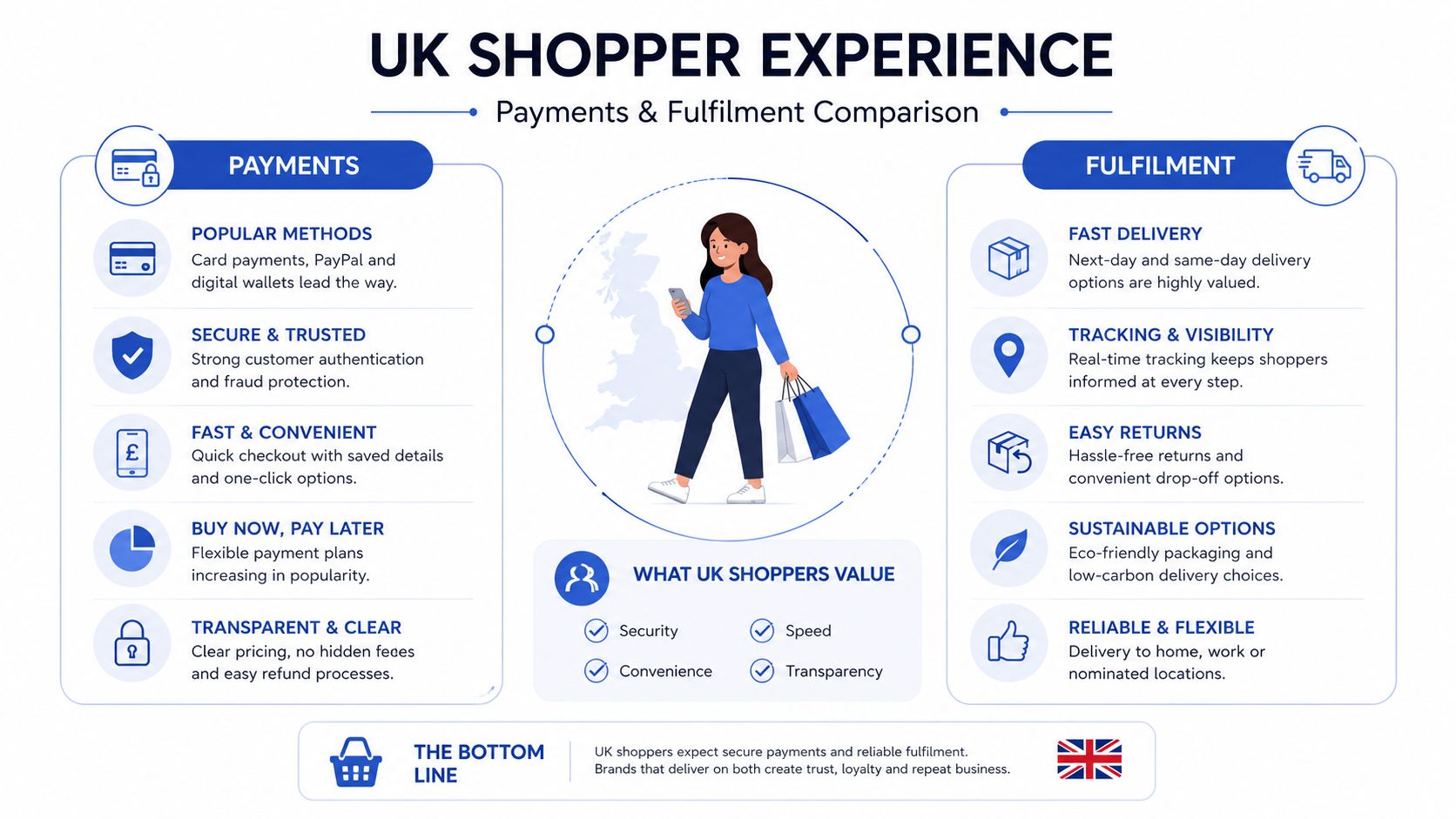
Payments and fulfilment should be designed together because customers experience them as one decision. A fast payment method won't compensate for an uncertain delivery date, and an excellent courier promise won't help if checkout rejects the shopper's preferred wallet.
On Shopify, place Apple Pay and Google Pay express buttons where they reduce effort without hiding important product choices. Keep PayPal visible because it carries recognition and reassurance for shoppers who don't want to enter card details. For higher-value baskets, test Klarna or Clearpay carefully, with eligibility, fees and returns made clear. Open Banking through providers such as TrueLayer can be worth testing for high-AOV orders or repeat customers, but it needs a clean fallback when bank authentication fails.
The payment stack should reflect margin, not fashion. Buy-now-pay-later can help remove an affordability objection, but indiscriminate promotion can add cost and complicate refunds. Measure completed payment, refund handling and contribution after payment fees.
Delivery promises belong on the product page
Royal Mail Tracked 24 and Tracked 48 can suit brands that need familiar coverage and clear tracking. Evri may work when cost is the priority and the merchant monitors exception rates closely. DPD Local is a stronger fit where tracking quality and delivery communication justify the higher cost. Yodel can be useful in a broader carrier mix, particularly when the business routes parcels according to postcode, service level and capacity.
Don't make the customer discover the delivery promise at the final step. Show dispatch cut-off, estimated arrival, delivery price and return conditions on the product page, then repeat the relevant information in the cart. Scottish Highlands, Channel Islands and BFPO addresses need explicit treatment rather than a generic “UK delivery” label.
Operational rule: choose the cheapest carrier that meets the promised customer outcome, not the cheapest label price.
Delivery copy, tracking messages and return instructions should stay consistent across email, customer service and the storefront. Merchants working on creative production can also use a comparison such as 10 fashion AI tools compared when evaluating ways to produce product and campaign assets efficiently.
For the technical side of wallets, alternative payments and checkout routing, document requirements before selecting an ecommerce payment processor integration. The integration should support reliable reconciliation, refunds and reporting, not just payment acceptance.
Shopify Store CRO and UX Best Practices
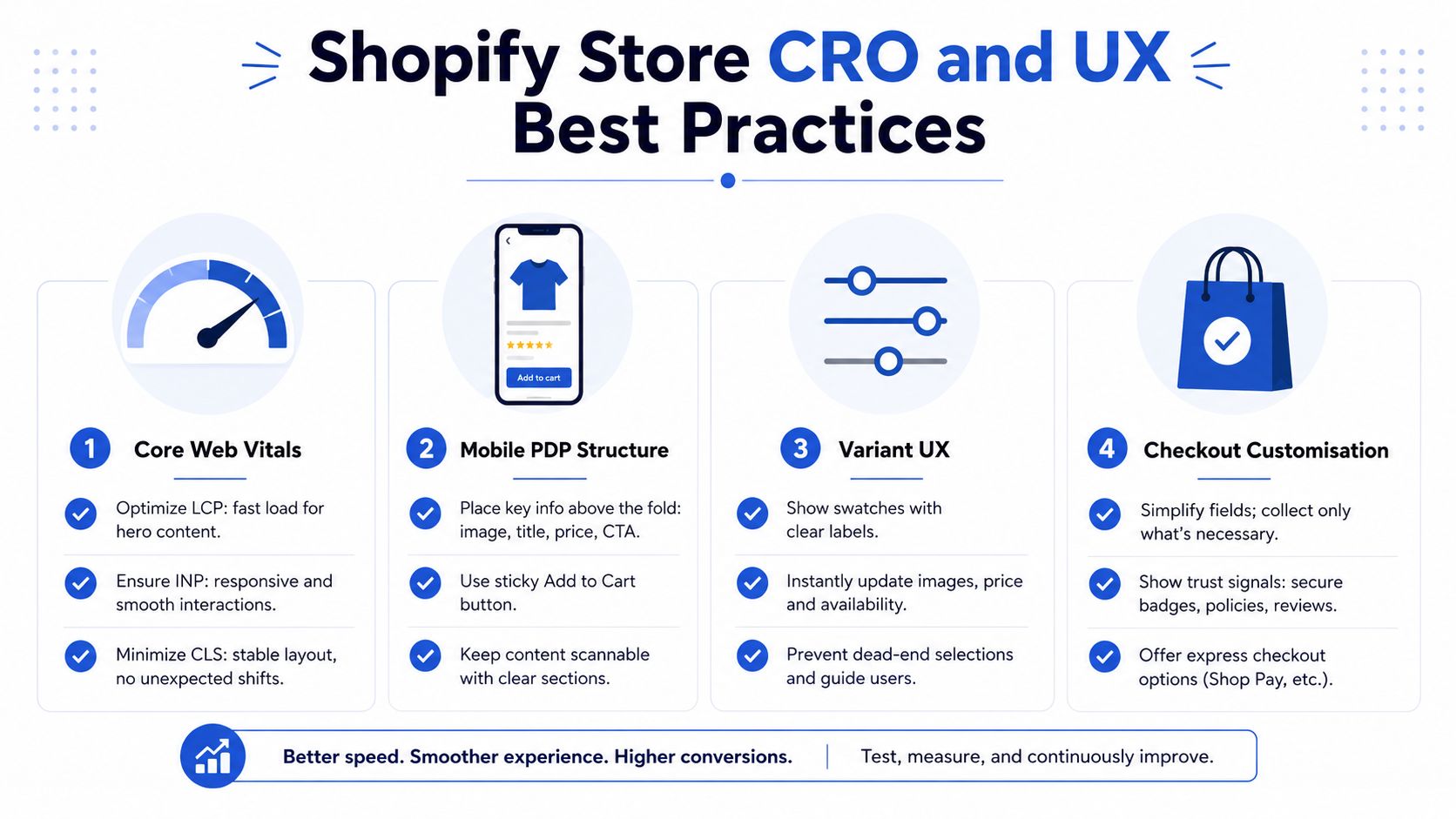
A Shopify CRO programme should start with the highest-value friction, in a fixed order. First fix performance. Then fix mobile product pages. Then improve variant selection and basket construction. Only after those foundations should the team spend serious time on checkout customisation.
Core Web Vitals matter because slow pages interrupt discovery before the shopper sees the offer. Compress images, remove redundant scripts, review app impact and load non-essential functionality after the primary content. A Shopify 2.0 theme should be modular without becoming a container for every app a team has ever installed.
Product pages do the commercial work
On mobile, put the product name, price, availability, primary image, variant controls, delivery promise and add-to-basket action in a clear hierarchy. Don't force shoppers to scroll through brand storytelling before they can answer basic purchase questions. Variant selectors should state what changes, show unavailable options clearly and preserve the selected choice when the shopper changes colour or size.
Bundles can increase basket value when they solve a real usage need. A Grumspot bundle creator deployment reportedly lifted average order value by 61%, according to the publisher's supplied case-study information. The useful pattern is not the number alone. It's the placement of a relevant bundle near the primary product decision, a transparent discount mechanic and a post-purchase upsell that doesn't interrupt the original checkout.
Subscription toggles suit products with predictable replenishment, but the default must be understandable and cancellable. Back-in-stock alerts recover demand from unavailable products. Exit-intent capture should offer a useful next step, such as a size guide or product reminder, rather than training visitors to wait for discounts.
Shopify Functions and Checkout Extensibility let Plus merchants customise validation, discounts and checkout logic without rebuilding the entire platform. Keep the checkout lean. Every added field, message or upsell needs a clear revenue or service justification.
A practical implementation order
- Measure the baseline: Segment revenue, conversion and AOV by device, landing page and product group.
- Remove heavy scripts: Identify apps and tags that slow the critical path.
- Restructure mobile PDPs: Put decision-making information above secondary content.
- Improve search: Add predictive results, useful synonyms and zero-result handling.
- Fix variants: Make size, colour, availability and pricing unambiguous.
- Clarify delivery: Display cut-offs, arrival estimates and returns before cart.
- Test bundles: Pair products by use case, not by arbitrary stock pressure.
- Add retention capture: Use subscriptions, back-in-stock and relevant email capture.
- Simplify checkout: Remove unnecessary fields and test wallet prominence.
- Review evidence: Promote changes only when segmented results support them.
UK Regulatory and Localisation Essentials
Compliance affects conversion because shoppers need to understand price, delivery, returns and data use before they commit. Treat legal requirements as storefront requirements, not documents that sit outside the trading experience.
For EU sales, VATMOSS has been replaced by the One Stop Shop, commonly abbreviated to OSS. The EU cross-border threshold is €10,000, so merchants need a clear process for identifying when their sales model and registration obligations require action. Domestic VAT reporting also needs to align with Making Tax Digital processes. Get tax advice for the merchant's exact structure, especially where inventory, fulfilment and entities cross borders.
Extended Producer Responsibility can affect packaging, electronics and textiles, with obligations that may differ across UK nations. Product data, packaging records and fulfilment workflows should capture the information finance and compliance teams need before reporting deadlines become urgent.
| Area | UK Rule | Storefront Impact |
|---|---|---|
| VAT and EU sales | Use OSS for relevant EU cross-border reporting | Show applicable tax treatment and keep country logic consistent |
| Domestic VAT | Follow Making Tax Digital requirements | Maintain reliable transaction and tax records |
| Packaging and products | EPR obligations can apply by material and category | Capture packaging, electronics and textile information operationally |
| Pricing | ASA expectations favour clear, VAT-inclusive consumer pricing | Display total product price and delivery charges plainly |
| Consumer rights | Consumer Rights Act protections apply to qualifying purchases | Publish accurate descriptions, returns and remedy information |
| Privacy | UK GDPR requires meaningful consent for non-essential cookies | Don't make analytics consent confusing or coercive |
| Regional delivery | Some UK destinations need special service and cost rules | Render accurate estimates for remote and BFPO addresses |
Pricing should include VAT where required for consumer presentation, and delivery fees shouldn't appear as a surprise at the last step. Returns content must match the actual process, including refund timing and exclusions. Cookie consent should respect UK GDPR while keeping essential checkout functions available.
Localisation extends beyond currency. Use UK sizing conventions, regional delivery rules and accurate language for England, Scotland, Wales and Northern Ireland. Northern Ireland may require separate stock and shipping logic when goods move between Great Britain, Northern Ireland and the EU customs environment. Build those rules into product, inventory and checkout data rather than relying on support agents to correct errors manually.
KPIs and Measurement That Actually Matter
Sessions and conversion rate are useful diagnostics, but they're weak executive metrics on their own. A mature UK ecommerce dashboard should show net revenue per visitor, blended MER, cohort LTV, repeat purchase rate and contribution margin after fulfilment and returns.
Net revenue per visitor connects traffic quality with commercial outcome. Blended MER, or total revenue divided by total marketing spend, prevents teams from celebrating one platform's reported efficiency while overall acquisition costs rise. Cohort LTV shows whether a first order creates durable value, while contribution margin reveals whether discounts, shipping and returns have consumed the apparent revenue.
Build three decision dashboards
Acquisition efficiency should combine spend, new customer revenue, blended MER, net revenue per visitor and contribution by channel. Compare Google, Meta, TikTok and Amazon using consistent cost definitions. Don't add platform-attributed revenue together without checking overlap.
Retention cohorts should track customers by first purchase period, product, acquisition source and margin group. Look for repeat purchase timing, product-led retention and the difference between discount-led and full-price cohorts.
Unit economics should show product margin, payment fees, fulfilment, returns, customer service cost and discounts. Shopify analytics can provide the commerce foundation, while GA4 supports behavioural analysis. Triple Whale or Northbeam can help consolidate marketing views, but neither removes the need for a clean product and finance data model.
The supplied brief requests benchmark ranges for apparel, beauty and home, but no verified benchmark values are available here. Don't fill that gap with invented ranges. Use your own historical cohorts, contribution targets and controlled tests to create internal benchmarks that reflect your assortment and returns profile.
Measurement discipline: a metric belongs on the main dashboard only if a trading team can make a budget, merchandising or product decision from it.
Raw follower count is rarely a useful growth KPI unless it connects to owned engagement or revenue. Branded search volume can rise while purchase intent falls. Even headline conversion rate can mislead when traffic mix, device mix, product availability or discounting changes.
A 90-Day Playbook for Scaling and Expansion
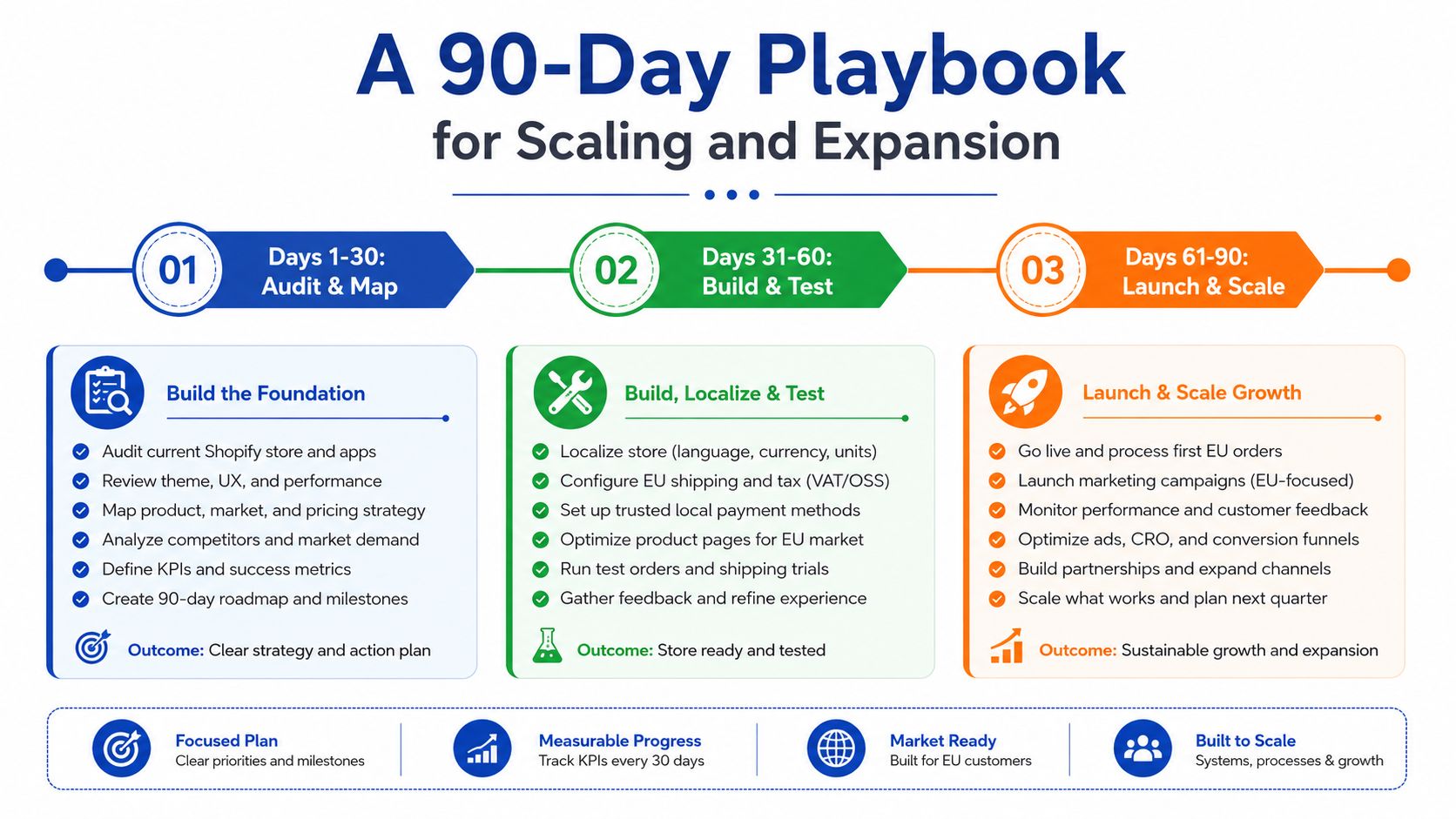
The cleanest Shopify Plus programmes sequence diagnosis before expansion. New markets and new apps amplify weak data, poor stock visibility and unclear margin logic, so the first phase should establish what the current business can support.
Days 1 to 30, audit and map
Start with the existing Shopify setup, theme performance, app inventory, checkout configuration, tracking and integration points. Map SKU cohorts by gross margin, return exposure, stock availability and repeat-purchase potential. Decide whether Shopify 2.0 already meets the requirement or whether Shopify Plus is justified by checkout complexity, expansion needs, automation and organisational scale.
Choose the EU scope deliberately. Republic of Ireland can be a focused first test, while full EU expansion requires broader tax, currency, language, returns and fulfilment preparation. Document decision gates before development begins.
Days 31 to 60, build and test
Ship the CRO fixes with the clearest commercial case first. Improve mobile PDP hierarchy, speed, search, delivery communication and payment choice. Launch a bundle or subscription test where the product economics support it, then configure multi-currency pricing and country-specific shipping logic.
Stand up inventory buffers with a 3PL such as Huboo or Ryder only after service levels, stock ownership and returns workflows are documented. Consolidate redundant apps. A replatform that preserves every legacy app without challenging its purpose is usually an expensive rebuild of old friction.
Days 61 to 90, launch and scale
Activate the chosen EU storefront or market configuration once tax, delivery, stock and returns tests pass. Run controlled paid media tests in Germany and the Netherlands rather than translating the entire catalogue and buying broad traffic immediately. Compare cohort LTV, contribution margin and service performance with the UK baseline.
Use a launch checklist that covers:
- Data integrity: Products, variants, prices, stock and customer consent pass end-to-end checks.
- Margin protection: Discounts, delivery costs, payment fees and returns appear in the market model.
- Operational readiness: The 3PL, carrier, support team and finance process share the same order status definitions.
- App governance: Every installed app has an owner, a measurable purpose and a tested fallback.
- Replatform safety: Redirects, canonical logic, structured data, analytics and feed connections are validated before cutover.
- Decision gates: Expansion continues only when service quality and contribution economics meet the agreed internal thresholds.
The programme should leave the UK store stronger even if the first EU test remains small. That's the right definition of ecommerce growth in the UK: more valuable orders, better retention, cleaner operations and expansion that the business can absorb.
Grumspot helps Shopify and Shopify Plus merchants improve conversion, rebuild storefronts, migrate to Shopify 2.0, integrate operational systems and develop custom apps for complex requirements. Visit Grumspot to discuss a focused CRO, replatforming or international expansion plan for your UK ecommerce business.
Let's build something together
If you like what you saw, let's jump on a quick call and discuss your project

Related posts
Check out some similar posts.

- cro best practices
Apply cro best practices to Shopify stores with 10 actionable tactics for testing, product pages, ch...
Read more
- shopify plus stores
Explore 7 Shopify Plus stores, from Gymshark to Huel, and uncover design, UX, conversion and integra...
Read more
- recently viewed items
Build and optimise recently viewed items on Shopify with code patterns, localStorage, server-side tr...
Read more
- social proof widgets
Learn how social proof widgets boost Shopify conversions. Discover types, placement strategies, perf...
Read more