Omnichannel Ecommerce Strategy: A Practical Guide
- omnichannel ecommerce strategy
- Shopify Plus
- ecommerce growth
- retention strategy
- cross-channel retail
Launched
July, 2026
You're probably already seeing it in the data and in the day-to-day mess: a customer spots a product on Instagram, checks the fit on mobile, asks a store associate about stock, then buys from an email link two days later. If those moments live in separate systems, the customer feels one journey and your team sees four disconnected transactions, which is where revenue leaks, stock errors, and support friction start to stack up.
An omnichannel ecommerce strategy fixes that by designing the business around one continuous customer experience, not a set of independent channels. For UK Shopify Plus merchants, the hard part isn't adding more touchpoints, it's building the operational backbone that keeps inventory, identity, pricing, returns, and reporting in sync when customers move between them. That's the difference between a brand that merely sells in multiple places and one that can serve a shopper wherever they choose to buy.
Why Omnichannel Ecommerce Strategy Matters for Modern Brands
A typical UK buying journey doesn't look tidy anymore. A shopper sees a jacket on Instagram, taps through to your Shopify store, checks delivery options on mobile, then visits a pop-up or a store to feel the fabric before finally converting from an email reminder. If your channels are siloed, each handoff introduces a new risk, the store can't see the cart, email pushes the wrong stock, and the customer gets asked to repeat themselves.
That's why omnichannel ecommerce strategy is really a decision about how your business recognises the same person across touchpoints. It's not a buzzword for “being everywhere”. It's the deliberate design of connected journeys where the store, app, email, POS, and fulfilment stack share context.
A customer doesn't think in channels. They think in steps, and every broken step costs you trust.
The distinction from multichannel retail is simple. Multichannel means the brand is present in several places. Omnichannel means those places operate from shared truth, so the customer can start in one place and finish in another without the journey resetting.
The practical implication for UK merchants is blunt. If you're still treating storefront, mobile, pop-up, and support as separate operating units, you're leaving basket value and repeat purchase on the table. Customer journey mapping only becomes useful when the journey is connected, because mapping disconnected touchpoints just documents the friction.
The strongest Shopify Plus teams I've worked with stop asking, “Which channel sold this?” They ask, “Where did the shopper need reassurance, and did we carry that context forward?” That shift changes how you design product discovery, stock visibility, service handoffs, and fulfilment promises.
The Business Case for Connected Customer Journeys
The numbers justify the operational pain. Industry benchmarks show 80% of consumers use multiple channels to complete a purchase, 73% use more than one channel during the buying journey, and omnichannel customers spend 30% more than single-channel shoppers, according to Firework's omnichannel statistics. For UK brands, that matters because the shopper is already behaving this way, whether your stack is ready or not.
The retention case is even harder to ignore. Research summarised in 2026 reports that brands with excellent omnichannel experiences retain customers at 89% versus 41% for poor integration, while 70% of DTC brands use omnichannel strategies to increase average order value and 55% report a 15 to 20% AOV lift, according to WorldMetrics' omnichannel data. Those are not vanity metrics. They're the difference between a growth model that relies entirely on acquisition and one that compounds value through repeat purchasing.
Why the economics are stronger than the surface metrics suggest
Acquisition costs keep rising, and logistics costs don't get easier just because a brand opens a second channel. When journeys are connected, the brand spends less to recover a hesitant shopper and gets more from each customer over time. That combination is what makes omnichannel attractive to UK DTC teams under margin pressure.
Practical rule: if your omnichannel plan only improves top-of-funnel traffic, it's not a business case. It's a campaign.
The same logic applies to service quality. If the customer support team can see what happened in-store, on-site, and after checkout, you reduce repeat contacts and awkward “we can't see that order” conversations. That's why connected journeys don't just improve sales, they improve the economics of the whole customer lifecycle.
The commercial trade-off merchants need to accept
The investment isn't free. You'll spend time on integration, data standards, and process redesign before the visible upside lands. But the brands that delay this work usually pay more later in manual fixes, stock drift, and inconsistent customer experience. The question is no longer whether omnichannel is fashionable. It's whether your current operating model can support the way people already shop.
Core Architecture of a True Omnichannel System
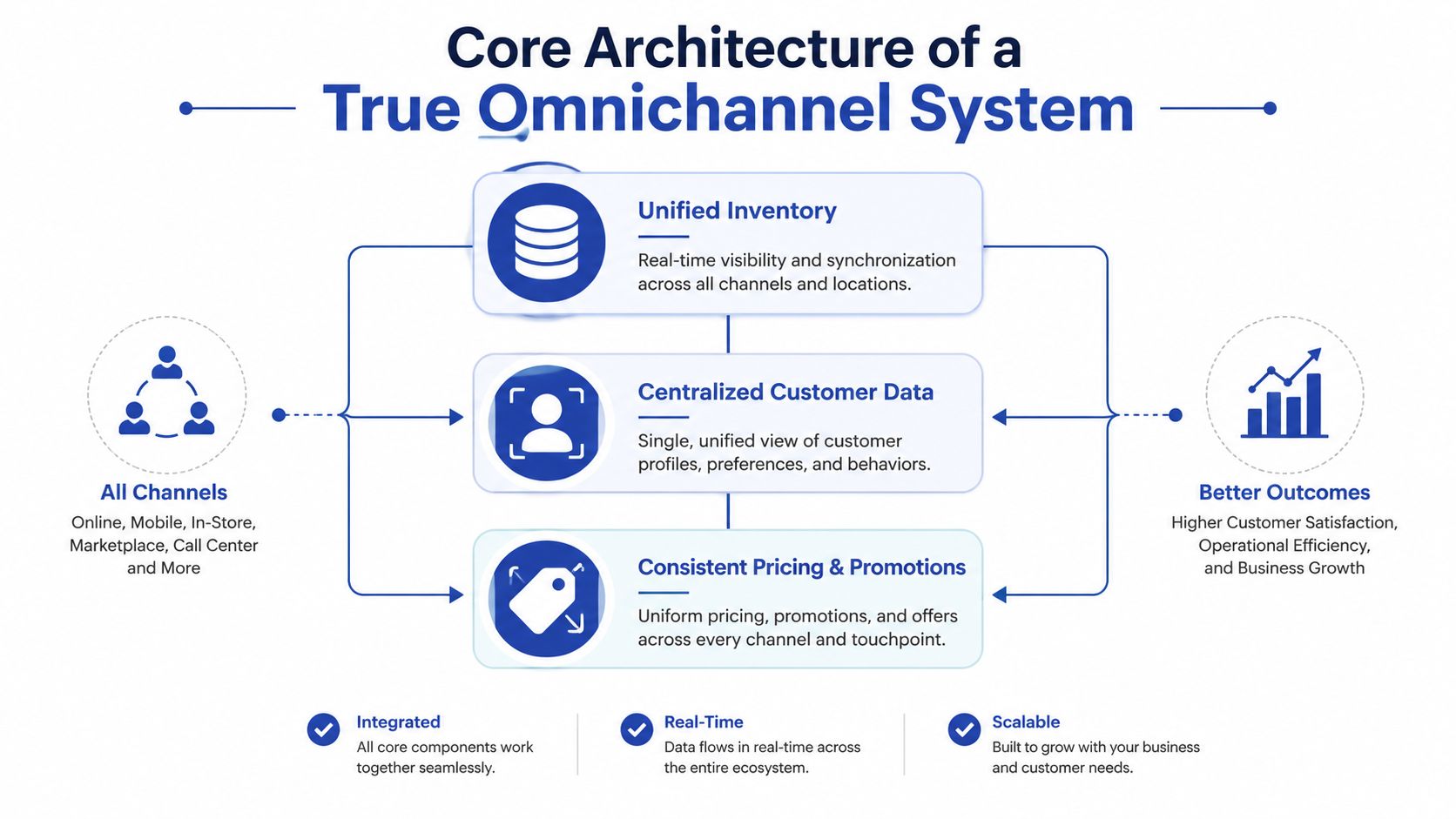
A true omnichannel system is a systems problem, not a marketing one. The channel mix matters, but the real work sits underneath it, in how fast data moves, how identities are resolved, and how consistently rules are applied across every touchpoint. If those foundations are weak, adding another channel just multiplies the inconsistency.
The three pillars that actually matter
The first pillar is real-time inventory visibility. Leading guidance on omnichannel retail defines this as a single inventory pool visible across channels in real time, not a separate stock count for each channel. That requires ecommerce, POS, ERP, and WMS to stay in sync, otherwise oversells and avoidable cart abandonment become normal.
The second pillar is unified customer identity. Store visits, web sessions, support tickets, loyalty activity, and purchases need to resolve to one customer record. Without that, the customer can buy online, return in-store, and still be treated like a stranger by the support team.
The third pillar is consistent pricing and promotions. If a customer sees one price on mobile and another at checkout or in-store, trust erodes fast. Omnichannel only feels cohesive when the rules travel with the customer, not with the channel.
What fails in production
Disconnected systems create predictable problems. A store shows stock that the web team already sold. A CRM contains duplicate profiles for the same person. A promotion works in one channel and breaks in another because the rule engine lives somewhere else. Those are not edge cases, they're the standard failure modes of a fragmented stack.
Prioritise data sync latency, inventory accuracy, and identity resolution before you add any new channel. Channel count doesn't save broken operations.
How to think about the architecture
The useful question isn't, “Which app should we add next?” It's, “Where is our source of truth?” Once that's clear, the architecture becomes easier to design. API-first ecommerce architecture is usually the cleanest route for Shopify Plus merchants because it lets you orchestrate data between systems without forcing every function into one monolith.
The YouTube walkthrough above is useful if your team needs a visual on how the stack hangs together, but the key test is boring and practical. Can a store associate see available stock, can support see the last order, and can the customer move channels without repeating the same information? If the answer is no, the architecture still isn't ready.
Building Your Shopify Plus Omnichannel Tech Stack
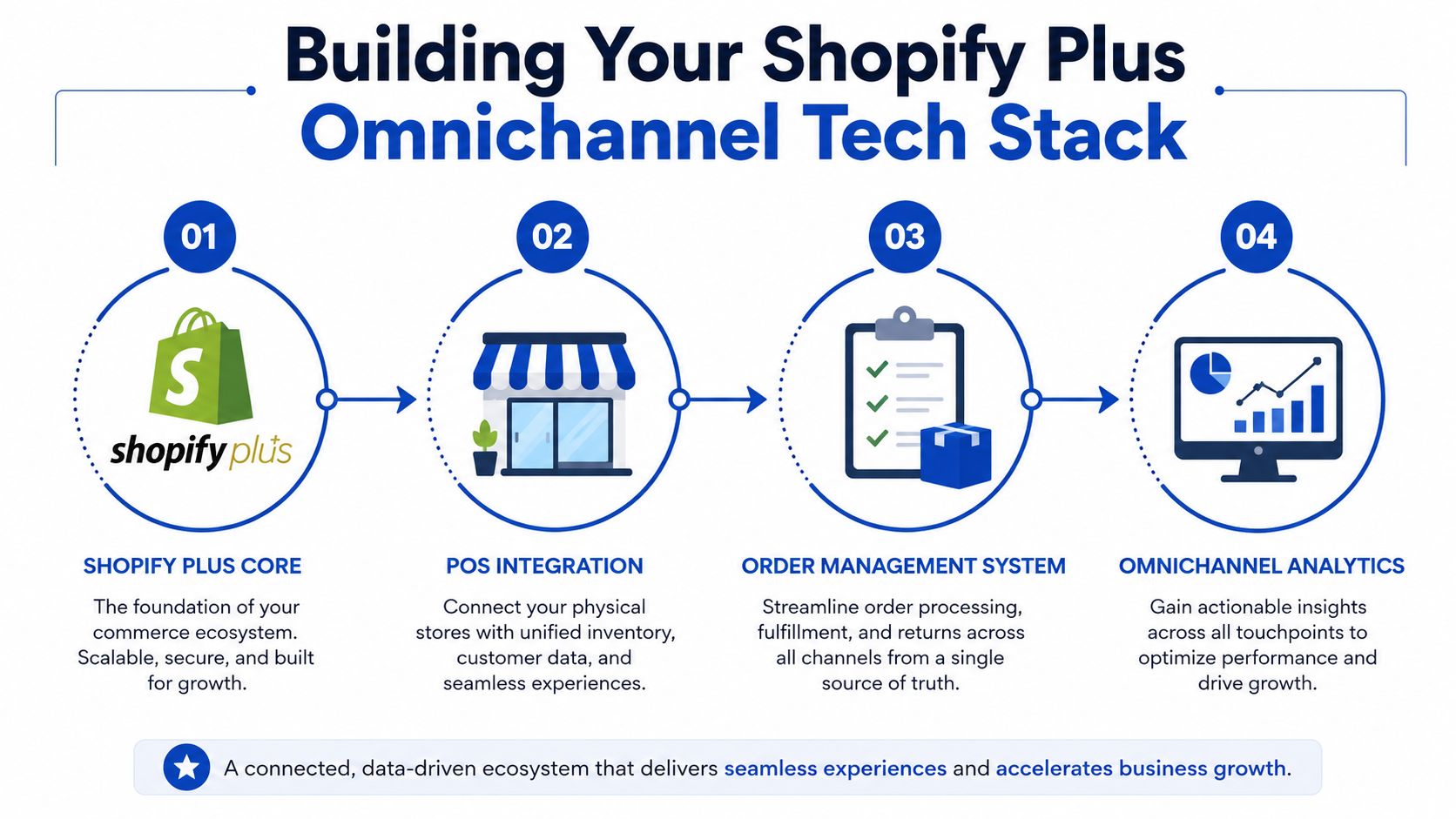
Shopify Plus gives you a strong commerce core, but omnichannel rarely works from the box alone. You need clear integration points, and you need to know which systems own which jobs. If you stack apps without a data model, you don't get agility, you get a new layer of silos.
Start with the systems that must talk both ways
POS integration is the first obvious one. Store staff need live stock, order lookup, and customer history, and online checkout needs store-side inventory availability to stay accurate. That's bidirectional data, not a daily export.
ERP and WMS connections come next because they control the operational truth of stock, replenishment, and fulfilment. If the warehouse says one thing and Shopify says another, your team ends up reconciling exceptions by hand. That's where margin leaks.
CRM and loyalty systems should collect interactions from every touchpoint and return audience context back into commerce and service workflows. A good CRM doesn't just store names and emails, it helps your team understand what the customer already bought, returned, or asked about.
Marketplace connectors can expand reach, but they need tight rules. If marketplaces operate on stale inventory or isolated customer records, they create more complexity than value. Use them only when the data flow is disciplined.
What to evaluate in each app category
Look for stable APIs, webhook support, and event-level syncing. Ask whether the tool can handle location-aware inventory, unified order status, and customer identity resolution without custom hacks. If the answer is vague, integration costs will show up later.
Integration rule: if a tool can't explain its data ownership clearly, assume it will create a new silo.
Bespoke work becomes necessary when the off-the-shelf app can't support your actual workflow. That's where custom app development and deeper middleware patterns earn their keep. Shopify third-party integration services are relevant here because the hard part is rarely “connecting” software, it's making the connection reliable under real trading conditions.
One option in the stack
Grumspot builds custom apps and deeper integrations where standard connectors stop short, especially when a merchant needs ERP, CRM, and fulfilment workflows to behave as one system. That kind of work only matters if the data model is clear, but when it is, it avoids the endless compromise of forcing critical processes into a generic app.
The goal is not to add more software. It's to make sure each layer has a defined purpose, clean data ownership, and a measurable dependency on the layers below it.
Designing Returns and Post Purchase Experiences Across Channels
Most omnichannel playbooks stop at checkout, and that's where they get shallow. The margin impact shows up after the order is placed, when a customer wants a return, an exchange, or a refund in a different channel from the one they used to buy. If that flow is clumsy, the promise of convenience starts costing more than it returns.
UK retailers feel this pressure hard because retail sales volumes were still weak in 2024, as noted by the British Retail Consortium in the source brief. That makes post-purchase orchestration more than an operations issue. It becomes part of margin protection.
Returns are a systems design problem
The first decision is where returned stock goes. Some items can safely go back to sellable inventory, some need inspection, and some should be routed to clearance or returns processing. If your rules aren't explicit, store teams and warehouse teams will make inconsistent calls.
Refund logic also needs one customer view. If the customer buys online and returns in-store, the support team should see the original order, the item status, and the refund path without switching systems. That reduces delays and stops the “we need to contact another department” loop that frustrates customers.
There's a useful operational analogy in logistics tooling. A guide on tracking for hauliers shows how visibility across handoffs reduces uncertainty, and the same principle applies to returns. If you can trace the movement and status of an order after checkout, you can design a cleaner refund or exchange path.
Customers don't separate buying from returning. They experience both as one service promise.
In-store exchange rules need to be explicit
Cross-channel exchanges are where many brands lose control. A return may be approved in-store, but if the replacement stock isn't available locally, staff need a clear path for ship-to-home or a different location. That decision should be system-led, not improvised by the store manager on a busy Saturday.
Support handoffs matter too. If a customer starts with live chat and finishes with a store visit, the notes, reason codes, and order status must travel with them. Otherwise, the service team repeats the same questions and the customer feels like they're starting from zero.
The big shift is mental as much as technical. Returns are not a penalty to be minimised by making the process difficult. They're a loyalty touchpoint. If you make the process clean, customers are more likely to trust future purchases.
Measuring Omnichannel Performance Under Privacy Constraints
The old habit of looking at channel-only ROAS is misleading once journeys span web, app, store, email, support, and fulfilment. A customer may discover in one channel, validate in another, and convert in a third. If you only credit the last touchpoint, you miss the actual behaviour that drove the sale.
That's why omnichannel measurement needs broader efficiency metrics. Industry guidance recommends moving beyond platform-siloed ROAS and tracking measures like Marketing Efficiency Ratio, assisted conversions, cross-channel conversion rate, inventory accuracy, order routing, split shipment percentage, and BOPIS or ship-from-store speed, as outlined in Improvado's omnichannel analytics guidance. Those metrics show both customer demand and operational drag.
First-party data has become the only reliable backbone
UK retail measurement is tighter now because broad browser tracking is less dependable and consent is inconsistent. The Office for National Statistics reported that online spending accounted for roughly a quarter of all retail sales in 2024, which makes first-party data quality more important than ever, as noted in ecorn's omnichannel retail strategy article. If the store, site, and service teams don't write to a shared customer model, your reporting will always be partial.
That model doesn't need to be complex to be useful. It does need to link identities, orders, returns, service contacts, and fulfilment events in a way that respects consent and access rules. The more complete the event trail, the easier it is to see which touchpoints move revenue and which ones only create activity.
If the data model can't connect a store visit to a later online order, the attribution model is already broken.
What to instrument first
Start with event-level data capture across web, app, email, POS, support, and fulfilment. Then decide which KPIs answer the business questions. Did the customer convert after a store handoff? Did the chosen fulfilment route create delays? Did stock inaccuracies cause avoidable cancellations?
The useful insight is not just “what converted”. It's “what created friction along the way”. Once you can measure that, omnichannel stops being a vague promise and becomes something you can improve.
Your Omnichannel Implementation Roadmap and Checklist
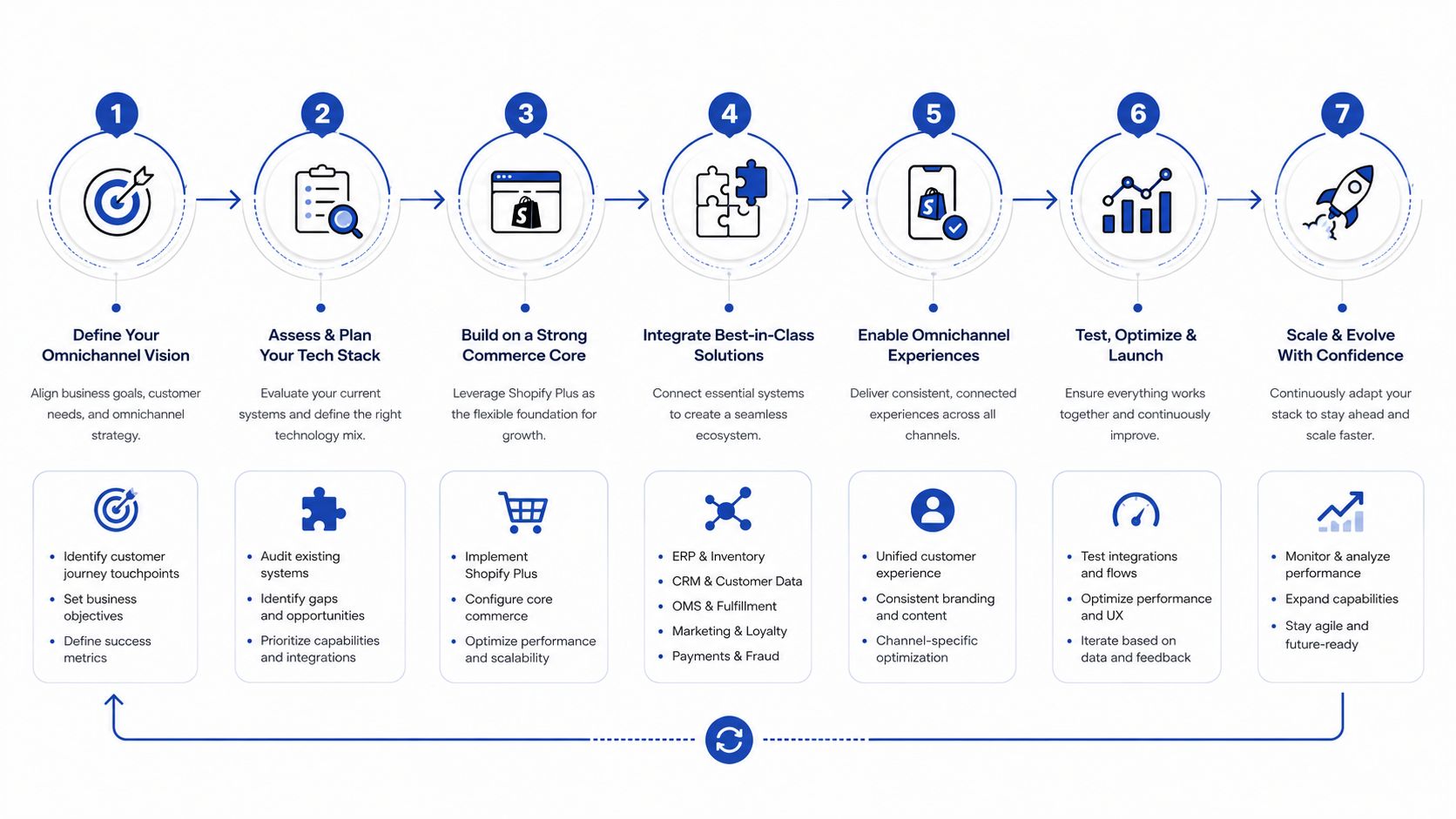
The cleanest rollout is phased. Teams that try to launch every touchpoint at once usually end up with broken inventory logic, incomplete customer records, and store staff who don't trust the new process. A better approach is to build the foundation, expand only when the data is stable, and then optimise the harder pieces.
Phase 1, foundation
Get inventory and identity under control first. That means one customer record, one view of stock, and one rule set for pricing and promotions across the channels you already run. If you skip this, every later channel just inherits the same inconsistency.
Common pitfall. Adding a marketplace, loyalty app, or new POS flow before fixing data sync. That looks like progress in a board deck and pain in production.
Checklist:
- Inventory truth: confirm stock updates propagate reliably between Shopify, POS, ERP, and WMS.
- Identity match: reduce duplicate customer records and define a single customer key.
- Offer consistency: make pricing and promotions behave the same way in-store and online.
Phase 2, expansion
Once the core data is stable, add or deepen channel experiences. That usually means click-and-collect, ship-from-store, return-in-store, and more personalised messaging based on actual behaviour. At this stage, the customer should feel the benefits of connected systems without you adding complexity to the team's daily work.
Common pitfall. Underestimating POS integration complexity. Store processes often have edge cases that don't appear in ecommerce-only testing, especially around exchanges and partial returns.
Checklist:
- Channel handoffs: test online-to-store and store-to-online journeys end to end.
- Support visibility: make order history and fulfilment status available to the service team.
- Staff training: align store incentives so omnichannel orders aren't treated as someone else's problem.
Phase 3, optimisation
Measurement and post-purchase orchestration mature here. Improve attribution, refine fulfilment routing, and make returns and exchanges easier to process without manual intervention. The brands that do this well tend to spend less time arguing about data and more time fixing the actual friction points.
Common pitfall. Treating returns as a back-office issue instead of a customer experience and margin issue.
Final checklist:
- Cross-channel reporting: track assisted conversions and fulfilment KPIs, not just channel ROAS.
- Returns logic: define where returned stock goes and who approves exceptions.
- Governance: assign clear owners for data quality, integrations, and process changes.
If your current setup still treats every channel like a separate business, start with the foundation and don't move faster than your data can support. That discipline is what turns an omnichannel ecommerce strategy from a buzzword into a durable operating model.
If you need help turning a fragmented Shopify Plus setup into a connected customer journey, Grumspot can audit the stack, map the integration gaps, and build the custom workflows that keep inventory, fulfilment, and customer data aligned. Visit Grumspot to discuss a practical omnichannel build that fits your current systems and growth plans.
Let's build something together
If you like what you saw, let's jump on a quick call and discuss your project

Related posts
Check out some similar posts.

- shopify website examples
Explore 7 Shopify website examples and learn the UX, conversion features, and practical lessons merc...
Read more
- cro best practices
Apply cro best practices to Shopify stores with 10 actionable tactics for testing, product pages, ch...
Read more
- ecommerce subscription platform
Learn how an ecommerce subscription platform works, which models drive retention, and how to choose,...
Read more
- ecommerce replatforming agency
Choosing an ecommerce replatforming agency? Learn what they do, replatforming signs, costs, timeline...
Read more