Shopify for Subscription Services: A UK Setup Guide
- shopify subscriptions
- shopify for subscription services
- recurring billing
- subscription setup
- shopify retention
Launched
September, 2026
A UK merchant usually starts with a straightforward idea: recurring deliveries of coffee, skincare, pet supplies, curated boxes, or access to a members-only service. The product page is ready, the subscription app is installed, and the first orders arrive. Then the awkward questions appear. What happens when a payment fails, a customer wants to skip a delivery, stock runs short, or a subscriber cancels after being charged?
That's the difference between adding a subscription option and building Shopify for subscription services properly. Shopify can provide a strong commerce foundation, but recurring revenue depends on the operational layer around it. Billing rules, payment recovery, account controls, fulfilment timing, customer consent, and churn analysis need to work together from the first live order.
What Subscription Setup on Shopify Actually Involves
Consider a UK merchant selling a monthly discovery box. The first decision isn't which app to install. It's whether the box is fixed, customisable, or partly flexible. A fixed box needs a simple selling plan. A build-your-own box needs bundle logic, swap rules, inventory reservations, and a portal that can preserve those choices for the next renewal.
A replenishment business has a different problem. Customers may want a regular delivery, but not necessarily on a fixed calendar date. A membership business might not ship anything at all, yet still needs recurring payment, entitlement rules, account access, and a clean cancellation path. Shopify's selling plans can describe recurring purchase schedules, but the broader service model often lives across apps, customer accounts, fulfilment systems, and custom integrations.
For merchants researching different models, the practical overview of subscription offerings from Blind Barrels is useful because it shows how a physical box translates into recurring product, delivery, and customer expectations.
The decisions that shape the build
Before development starts, define:
- Cycle length: Decide whether customers renew weekly, monthly, quarterly, or on another cadence that fits consumption and fulfilment.
- Commercial model: Separate pay-as-you-go, prepaid, discounted recurring, and membership access rules.
- Product behaviour: Document swaps, skips, substitutions, add-ons, gifting, and unavailable variants.
- Payment recovery: Specify retry timing, customer notifications, card updates, and the point at which a failed contract is cancelled.
- Cancellation logic: Decide whether customers can pause, downgrade, skip, or change frequency before ending the contract.
- Operational ownership: Assign responsibility for stock, delivery cut-offs, tax, support, and failed payment handling.
Shopify's subscription tools are designed to track recurring revenue, active contracts, new subscriptions, and cancellations, which makes them suitable for replenishment products, subscription boxes, and membership access when the surrounding workflows are designed correctly. That operational requirement matters in the UK, where the market had more than 208,000 Shopify stores by June 2026 and grew 18% year over year, according to the UK Shopify market report.
Practical rule: Model the subscription contract before styling the subscription widget. If the contract logic is wrong, a polished product page only makes the wrong behaviour easier to buy.
Prerequisites Before You Switch Subscriptions On
Subscription apps inherit assumptions from the store. If those assumptions are unclear, the app won't fix them. It'll expose them after customers have active contracts, which makes every correction more expensive.
Establish the product and stock model
Start by separating one-off products from recurring products in the catalogue. Don't rely on a tag alone if pricing, fulfilment, tax, or inventory treatment differs. Define which variants can be subscribed to, whether a subscriber can add one-off items to a renewal, and how the store should handle a discontinued variant.
Shipping needs the same treatment. A recurring order may have different weight, destination, and fulfilment behaviour from a one-time order. Review shipping profiles, delivery zones, cut-off times, and packaging assumptions before launch. If subscriptions reserve stock too early, the retail channel may appear out of stock. If they reserve nothing, renewal orders can fail when demand changes.
Validate payment and account behaviour
Test every payment method you intend to offer for recurring billing. Card payments, digital wallets, and direct debit don't share identical authorisation, tokenisation, retry, or customer-update behaviour. If a UK service depends on direct debit, confirm that the selected subscription platform and payment integration support the required flow rather than assuming that a one-off checkout method will carry over.
The same applies to customer accounts. A subscriber should be able to see their current plan, next charge, delivery details, and available actions without being sent through a confusing chain of redirects. Test the experience on mobile, including login, payment-method updates, skips, pauses, address changes, and cancellation.
Lock compliance and tax decisions
Recurring sales need clear consent, renewal information, cancellation instructions, and payment-management controls. The store should capture only the data it needs and present consent in a way customers can understand. Review the implementation against the practical PCI compliance requirements, especially when payment components, custom account screens, and third-party services are involved.
Tax treatment also needs an explicit decision. Check how recurring and one-off items are categorised, how discounts affect taxable values, and how invoices or receipts represent renewals. Don't wait for the first accounting export to reveal that the subscription app and Shopify are using different product or tax assumptions.
A reliable sequence is simple: catalogue, stock, shipping, payments, tax, consent, customer accounts, then app configuration. Migrating selling plans after live contracts exist is rarely a tidy admin task.
Choosing Between Native Subscriptions and Third-Party Apps
Shopify's native Subscriptions API and selling plans are a sensible starting point for straightforward recurring billing. They work well when the merchant needs a product, a recurring interval, a customer contract, and basic account management without unusual bundle or contract rules.
The boundaries appear when the commercial model becomes more complex. Mix-and-match boxes, prepaid terms, gifting, tiered access, swaps, loyalty incentives, advanced dunning, and detailed churn analysis may require a third-party platform or custom services. The right choice depends less on the length of an app's feature list and more on where subscription state lives, which payment methods are supported, and how much flexibility the contract needs.
Trade-offs by platform
| Dimension | Native (Selling Plans) | Recharge | Bold Subscriptions | Sky Pilot | Seal Subscriptions | Appstle |
|---|---|---|---|---|---|---|
| Contract flexibility | Strong for standard recurring plans, more limited for complex bundles and prepaid structures | Broad contract and portal capabilities | Flexible recurring offers with upsell-oriented features | Suited to recurring digital access and delivery of digital products | Practical recurring-plan configuration | Broad plan, bundle, and customer-management options |
| Billing logic | Shopify-centred selling plans and recurring orders | Mature recurring billing and payment-recovery workflows | Recurring billing with additional subscription merchandising | Depends heavily on the digital-access model | Good fit for simpler recurring scenarios | Designed for more varied subscription rules |
| UK payment methods | Confirm support for the required recurring methods before launch | Check gateway compatibility for the chosen UK payment mix | Check gateway and tokenisation support | Often more relevant to digital delivery than physical recurring fulfilment | Validate payment coverage for the selected flow | Validate payment coverage and account behaviour |
| Portal and retention | Native account experience can be clean but may need extension work | Strong focus on skip, swap, pause, and self-service controls | Useful for subscriber upgrades and add-ons | More focused on access management | Suitable for straightforward customer controls | Offers customer portal and retention-oriented controls |
| Analytics depth | Useful native subscription reporting for core metrics | Deeper subscription reporting and lifecycle analysis | Stronger merchandising and subscriber-value workflows | Analytics depend on the digital product setup | Appropriate for core subscription monitoring | Broader reporting than a basic native setup |
| Data architecture | Keeps more logic close to Shopify | Adds a subscription platform layer beside Shopify | Adds app-managed subscription behaviour | Adds a digital-delivery layer | Adds app-managed recurring workflows | Adds a broader app-managed subscription layer |
Shopify itself identifies tools including Shopify Subscriptions, Recharge, Bold Subscriptions, Stripe Billing, and Chargebee as options for subscription management in its subscription management tools guide. Treat that list as a starting point, not a recommendation.
Native is usually the cleaner option when the rules are simple and the team wants fewer moving parts. A third-party app earns its place when it prevents custom work around contract changes, payment recovery, bundling, or customer self-service. Test the exact gateway, checkout path, portal, and webhook behaviour before committing. A demo can show a feature. It can't prove that the feature survives a renewal with a changed address, a failed card, a discounted line item, and a stock issue.
Configuring Billing, Renewal, and Cancellation Flows
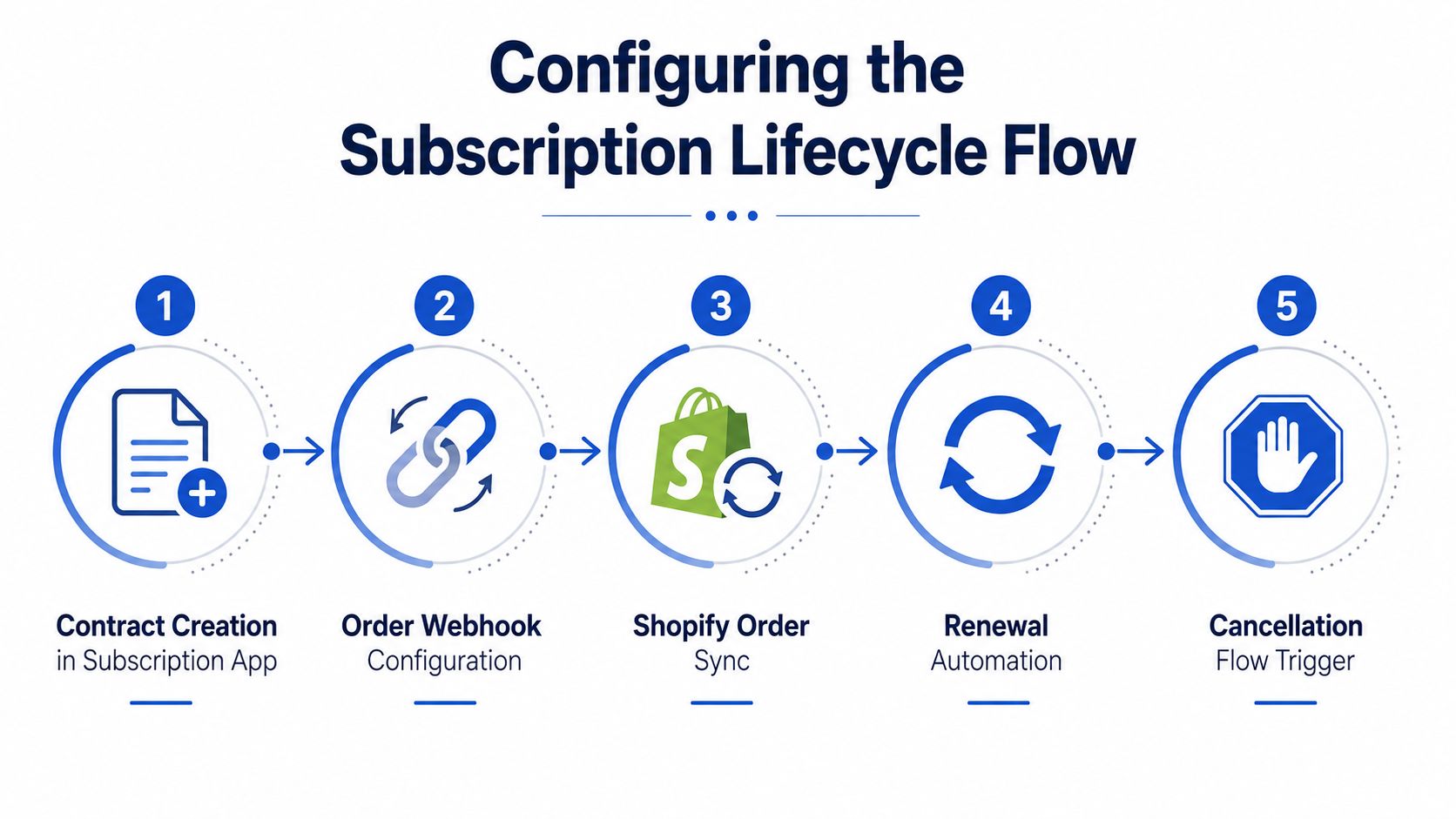
A subscription lifecycle should have one clear source of truth for each event. The selected app creates or manages the contract. Shopify records customers and orders. Webhooks connect the systems. Fulfilment and support tools consume the resulting state.
Start by creating the contract from the selected selling plan or app workflow. Store the plan identifier, contract identifier, customer identifier, payment reference, next billing date, and status in the systems that need them. Don't treat an order number as the subscription identity. A single contract produces multiple renewal orders, and support staff need to distinguish the ongoing relationship from one transaction.
Connect events without creating duplicates
Configure webhooks for contract creation, updates, skips, pauses, cancellations, payment failures, successful renewals, refunds, and fulfilment changes. Every handler should be idempotent. If Shopify or the app retries an event, the handler must recognise the existing event key or contract state and avoid creating a duplicate order, fulfilment, notification, or entitlement.
The renewal process needs a stock check before billing where the platform supports it, or an immediate exception path when it doesn't. Apply delivery cut-offs consistently. A customer who changes a product after the cut-off may need the next cycle rather than the current one. Record that decision in the contract timeline so support can explain it.
For a customer-friendly reference point, Trim's subscription management page demonstrates the kind of self-service expectation merchants should plan for, even if the final experience is built with another tool.
Build dunning as a recovery process
A failed charge shouldn't jump directly to cancellation. Configure retries, payment-method update prompts, and clear email or SMS notices. The sequence should tell the customer what failed, what action is available, and when the next attempt will occur. Keep the subscription status consistent across the app, Shopify, fulfilment, and marketing systems.
Review the store's payment processor integration before relying on any recovery workflow. Gateway tokenisation, direct debit timing, and card updater behaviour can change what the app can retry automatically.
Cancellation is the most important off-ramp. Surface skip next delivery, pause, change frequency, downgrade, and address editing before the final cancellation confirmation. Use customer-account UI extensions, the Subscription API, or app-provided Liquid blocks where appropriate. Capture a structured reason such as price, product fit, excess stock, delivery timing, payment difficulty, or service quality. Free-text feedback can add context, but it shouldn't replace usable categories.
The Real Cost of Running Subscriptions on Shopify in the UK
The subscription app is only one line in the budget. UK merchants need to model the Shopify plan, payment processing, third-party software, implementation, support, tax treatment, and any operational service that touches renewals.
Shopify's UK pricing page lists Basic at £25 monthly or £19 annually, Grow at £65 monthly or £49 annually, Advanced at £344 monthly or £259 annually, and Plus from £1,800 monthly. Those figures come from the UK Shopify pricing analysis, which also highlights why the £5 Starter plan should not be treated as a full storefront plan. It's intended for social selling.
A cost model for 500 active subscriptions
The table below deliberately avoids pretending that a single total applies to every merchant. App pricing, payment rates, contract terms, and VAT treatment vary, so the useful output is a complete cost model rather than a fabricated estimate.
| Cost line | Basic + native | Shopify + third-party app | Notes |
|---|---|---|---|
| Shopify plan | Basic list price, £25 monthly or £19 annually | Grow-level Shopify list price, £65 monthly or £49 annually | Confirm the selected billing cadence and current merchant quote |
| Subscription software | Shopify Subscriptions tooling | Recharge, Bold, Seal, Appstle, Sky Pilot, or another selected app | Check fixed fees, active-subscriber charges, usage tiers, and included features |
| Payment processing | Shopify Payments rate for the merchant's plan and payment method | Shopify Payments rate for the merchant's plan and payment method | Recurring orders can make small rate differences material over time |
| Third-party gateway fees | Only where the chosen payment method requires them | Gateway, direct debit, or alternative payment fees where applicable | Check whether the app supports the required recurring authorisation |
| Implementation | Theme, account, integration, and testing work | App configuration plus custom portal and integration work | Include migration and QA, not just installation |
| Operations | Support, fulfilment, dunning review, and reconciliation | Same, often with more platform administration | Assign ownership for failed renewals and exceptions |
| VAT and accounting | Confirm treatment for each software and service invoice | Confirm treatment for each software and service invoice | Don't assume every line has identical VAT treatment |
The break-even question is commercial: does the selected plan and app stack reduce the cost of acquiring, serving, and retaining a customer compared with the alternatives? A higher plan may improve payment economics or operational capability, but it doesn't automatically improve unit economics. Calculate fees against actual recurring order value, refund behaviour, gateway mix, subscriber support load, and the work required to keep contracts healthy.
The UK market's scale makes this exercise more important. By June 2026, the country had more than 5,700 Shopify Plus stores, up from about 1,000 in 2023, according to the same Shopify UK market report. Plus can be appropriate for complex operations, but the plan fee is only justified when the extra capability solves a real constraint.
Retention Tactics Worth Building Into the Storefront
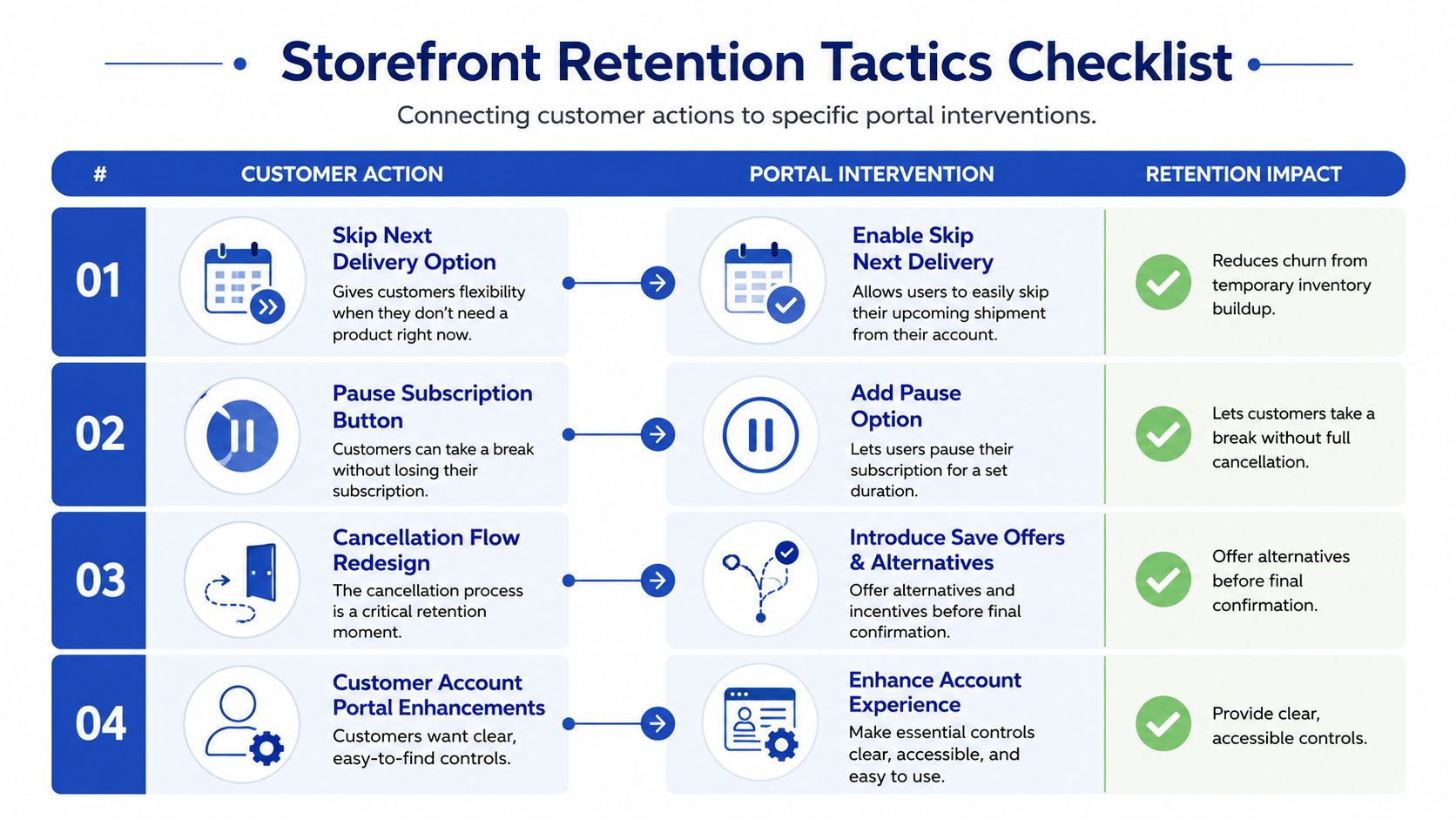
Retention starts in the customer account, not in a late win-back email. A subscriber who has too much product shouldn't need to cancel just to take a break. A customer travelling for a month shouldn't have to contact support to move a delivery. The portal should make the sensible action easier than the destructive one.
UK subscription demand is already substantial. Research cited by Whistl found that 81% of households were signed up to at least one subscription in 2021, with the market valued at £395 million in 2021 after 18.9% year-on-year growth, and forecast to reach £1.8 billion by 2025 in the subscription box research. The same research put average subscription duration at 9 months, which makes the period after the first order a core product-design concern rather than a marketing afterthought.
Make the portal absorb normal customer behaviour
Put these controls directly beside the next order and next charge:
- Skip next delivery: Useful when a customer has excess stock or a temporary change in need.
- Pause subscription: Preserves the relationship without forcing a full cancellation.
- Change frequency: Lets a customer move from a faster cycle to a slower one.
- Swap products: Helps curated or replenishment brands prevent flavour, format, or product fatigue.
- Change delivery date: Keeps timing aligned with the customer's routine and fulfilment cut-offs.
- Cancel with a reason: Gives the merchant actionable information without obstructing the customer.
Don't hide cancellation. A difficult cancellation path creates support work, payment disputes, and distrust. Offer alternatives first, explain them plainly, and confirm the final state immediately.
Turn events into useful interventions
Wire lifecycle events into Shopify Email, Klaviyo, or the chosen messaging platform:
- Before billing: Remind customers what will renew and give them time to edit the order.
- Payment failure: Explain the failed payment and provide a direct payment-method update route.
- Skipped delivery: Confirm the new date and avoid treating a skip as churn.
- Voluntary cancellation: Ask for a structured reason and offer a relevant alternative where appropriate.
- Post-cancellation win-back: Match the message to the reason, such as a slower cadence for excess stock or a product change for poor fit.
Read churn by cohort, plan, product, region, acquisition source, and cancellation reason. UK subscription behaviour isn't uniform. Research found 29.6% of UK shoppers were already signed up to at least one subscription box, 74.1% of subscription-box shoppers had more than one scheme, and 55.6% were in multiple schemes in the UK subscription box market report. Adoption also varied by age and region, so a portal or offer that works in London may not work equally well across the country.
Don't optimise the cancellation email before fixing the account action that caused the cancellation.
Pitfalls, Migrations, and What to Fix Before You Scale
The assumption that a subscription store becomes harder only because order volume rises is incomplete. Complexity rises when systems disagree about contract state. A webhook retry can create duplicate work if handlers lack idempotency. A variant can disappear from the catalogue while active contracts still reference it. A gateway change can leave customers with payment methods that the new billing path can't use.
Test the failure paths before customers find them
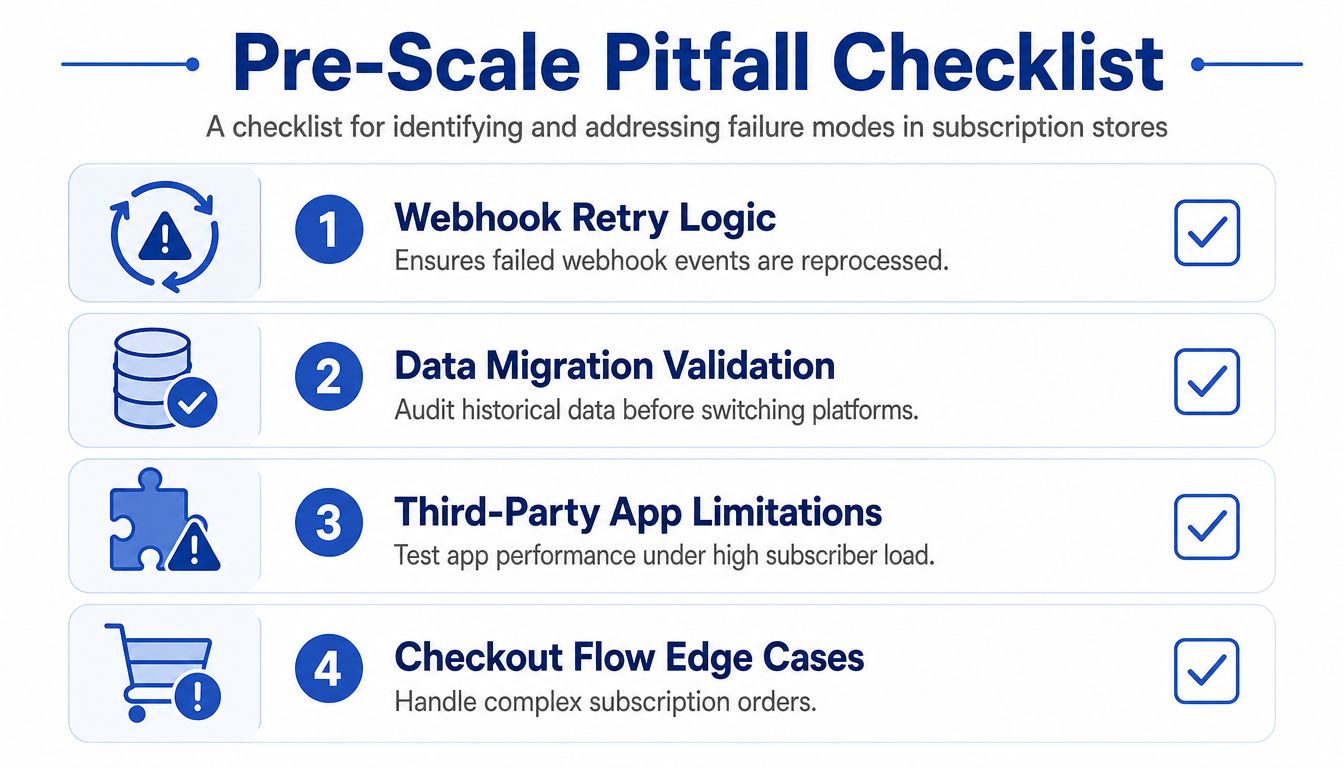
Run a pre-scale review against real scenarios:
- Webhook retry logic: Replay events and confirm that the store doesn't duplicate charges, orders, fulfilments, or notifications.
- Data migration validation: Compare customers, contracts, next billing dates, discounts, prepaid balances, and historical orders before switching platforms. The data migration validation guide provides a useful framework for checking records rather than trusting a completed import.
- App limitations: Test bundle rules, Shopify Functions discount behaviour, customer accounts, Shop Pay paths, and portal performance under realistic data.
- Checkout edge cases: Cover mixed carts, unavailable variants, address changes, currency changes, refunds, and renewals with changed payment details.
A migration from Recharge, Bold, or a custom Stripe integration needs more than a customer CSV. Historical orders rarely map cleanly to new contract records. Prepaid balances may need manual offsets, and customer account URLs often change, which can break email automation and saved links. Freeze the migration rules, export a complete source snapshot, map contracts to products and customers, and run reconciliation before enabling new renewals.
The common currency-switch failure needs a controlled sequence. First pause the affected renewal job if the platform could generate incorrect charges. Then confirm the contract currency, product price, discount, tax, and fulfilment values. Re-authenticate or update payment methods through the supported gateway flow, validate a single renewal in the target currency, reconcile the resulting order, and only then resume the remaining contracts. Don't force customers through checkout unless the payment provider requires new authorisation.
The government's UK subscriptions research, published in April 2023, and Citizens Advice reporting from March 2016, which found that over 2 million people in Great Britain had problems cancelling recurring payments, underline why renewal and cancellation controls deserve technical attention. The history of consumer difficulty makes clear cancellation paths and reliable payment management part of the product, not optional polish.
Shopify can support subscription services, but it won't decide the right contract model, recover every failed payment, reconcile every migration, or design a trustworthy cancellation flow for you. Those are implementation decisions. Treat the subscription as a connected operational system, and the platform can support a durable service rather than a fragile recurring-order shortcut.
Grumspot helps Shopify merchants design and implement subscription systems, including native Subscription API builds, Recharge and Bold integrations, custom billing logic, customer portals, migrations, and retention-focused account flows. Visit Grumspot to discuss the subscription architecture, payment recovery, and Shopify Plus work your UK store needs before the next scale problem reaches customers.
Let's build something together
If you like what you saw, let's jump on a quick call and discuss your project

Related posts
Check out some similar posts.