Marketplace Integration: A 2026 Guide
- marketplace integration
- Shopify Plus
- ecommerce automation
- API connectors
- channel strategy
Launched
August, 2026

Your Shopify store is stable, Amazon UK is producing regular orders, and the operations team has just added OnBuy and TikTok Shop. Within days, stock counts drift, a bundle keeps selling after its component is gone, and a promotion goes live at the wrong price on one channel. The operations lead spends the afternoon copying figures between systems instead of managing the business.
That's the point at which marketplace integration stops being an ecommerce feature and becomes an operating model. The right setup should protect available stock, keep listings commercially accurate, route orders into fulfilment, and give finance a trustworthy view of channel performance. The wrong setup moves the spreadsheet problem into a subscription dashboard.
The Multi-Channel Reality Most Brands Walk Into
The first warning sign is usually not a failed API call. It's an email from customer service asking why an item marked available on TikTok Shop can't be fulfilled from the warehouse.
A brand running Shopify, Amazon UK, eBay UK, OnBuy and TikTok Shop often starts with separate exports, app dashboards and channel-specific workarounds. One person updates prices on Amazon, another checks eBay orders, and the warehouse team relies on a late stock file. Temu may then add another catalogue, fulfilment and promotional workflow before anyone has agreed which system owns the product record.
The operational symptoms
You'll recognise the pattern quickly:
- Stock drift: Shopify shows one quantity, a marketplace shows another, and the warehouse has a third version after pending orders and returns are considered.
- Oversold SKUs: A fast-moving product sells on two channels during the gap between inventory updates.
- Listing inconsistency: Images, titles, variants, attributes and compliance information differ by marketplace.
- Pricing mistakes: A promotion is updated on one channel but not another, or marketplace fees make an apparently profitable price loss-making.
- Order duplication: An order is imported twice, or a cancellation fails to reach the fulfilment system.
- Manual customer service: Staff check multiple portals to find tracking, refund status or the original order source.
The operations lead becomes a human API. They remember which file is authoritative, which marketplace needs a manual acknowledgement, and which channel requires a different returns process. That knowledge is fragile, expensive and difficult to hand over.
Practical rule: If one person has to explain how inventory moves between channels, your integration is already under-engineered.
The immediate answer isn't another connector. First, document the current workflow in the same way you'd audit multi-channel inventory management. Record where stock originates, how quickly updates travel, who owns failed orders, and which events require human intervention.
Then make the desired outcome explicit. Your architecture should reduce overselling, shorten order handling, maintain channel-specific listings and preserve margin visibility. If it can't do those four jobs reliably, adding another marketplace will increase workload rather than reach.
What Marketplace Integration Actually Means
Marketplace integration is the continuous, two-way exchange of commercial and operational data between your ecommerce stack and sales channels. It isn't a one-off product upload. It's the nervous system that carries inventory, orders, listings, pricing and fulfilment events between Shopify, marketplaces, your ERP, warehouse and customer-service tools.
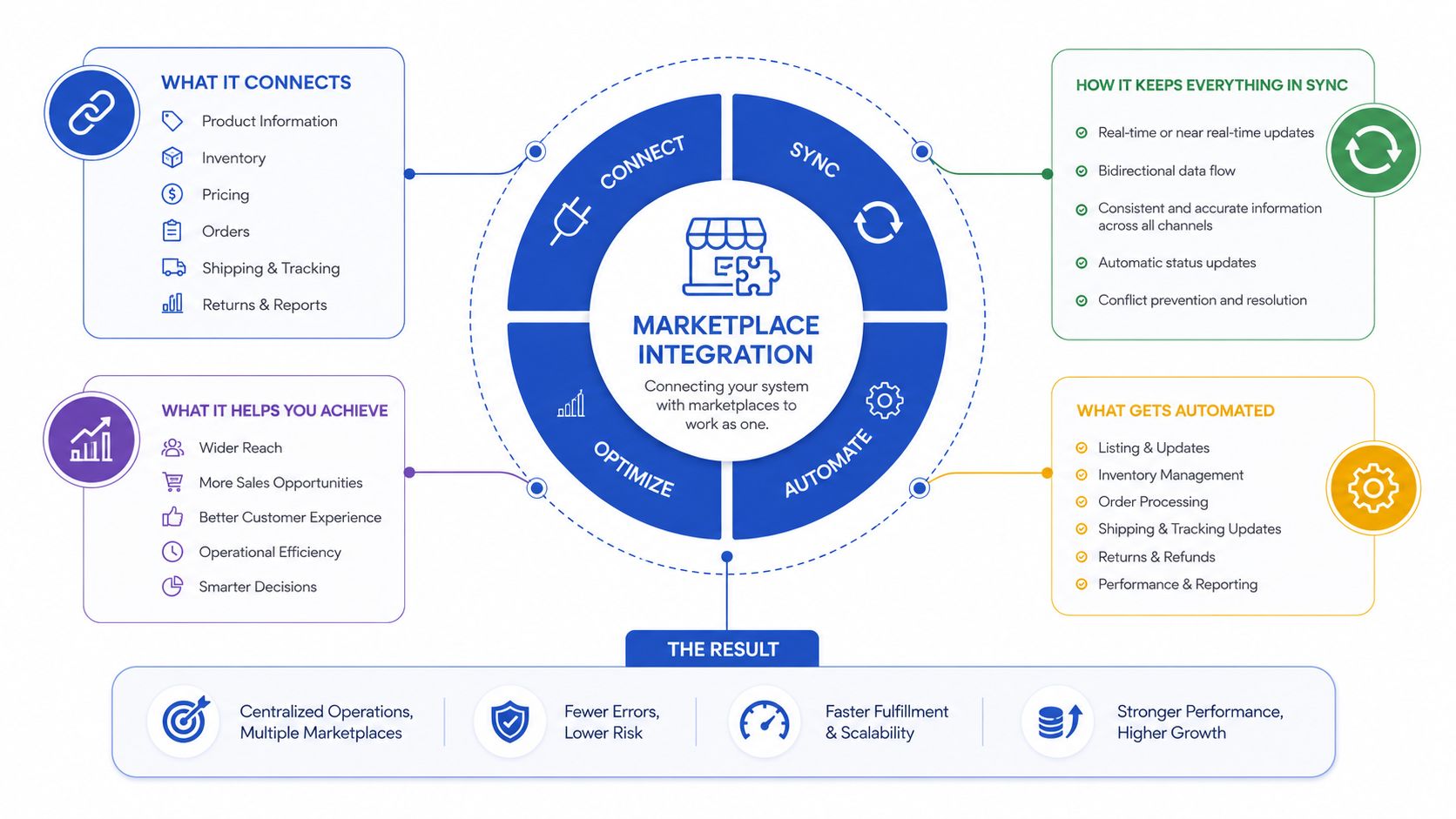
The five data flows that matter
Catalogue and listing data
Shopify may hold the core product identity, but Amazon UK, eBay UK, OnBuy, TikTok Shop and Temu can require different attributes, titles, images or category mappings. The integration should publish the right version to each channel without destroying the master record.Inventory data
Available stock must account for reservations, safety buffers, bundles and warehouse rules. A good design doesn't merely copy a number. It applies an allocation policy before exposing stock to another marketplace.Order data
Orders should enter the agreed commerce or order-management system with channel identifiers, line items, discounts, delivery details and tax information intact. This gives customer service one record to search and finance one transaction trail to reconcile.Price and promotion data
Channel prices need governance. A marketplace price may need to absorb commission, fulfilment, advertising and returns costs, while a social-commerce promotion may follow a different commercial calendar.Fulfilment and status data
Pick, pack, dispatch, tracking, cancellation, refund and return events must travel back to the marketplace. A shipment that exists in the warehouse but not on the sales channel still looks like a fulfilment failure to the customer.
The UK public sector offers a useful institutional example of what centralised marketplace infrastructure can achieve. By 1 October 2018, the Government Digital Service's Digital Marketplace had nearly 5,100 suppliers, with more than 92% being SMEs, and had routed over £4.3 billion in business since launch. The OECD account of the UK Digital Marketplace shows how standardised participation can aggregate supply and widen access. Retail brands face a different problem, but the principle carries across: centralise the repeatable mechanics while preserving channel-specific rules.
Integration also doesn't replace merchandising. Your team still needs strong storefront structure, content and brand presentation. For that part of the work, Trendlytic's storefront advice is a useful complement to the underlying data architecture.
The Four Technical Approaches Side by Side
There are four credible ways to connect Shopify with marketplaces. The choice depends less on the feature list and more on how much exception handling your team can own.
| Approach | Best for | Cost shape | Key risk |
|---|---|---|---|
| Direct API build | Brands with unusual workflows and capable engineering | High initial build, continuing maintenance | Your team owns every marketplace change and failure |
| Middleware platform | Multiple channels, ERP or warehouse complexity | Recurring platform cost plus implementation | Configuration can become difficult to govern |
| Connector app | Straightforward Shopify and marketplace flows | Lower entry cost, subscription and usage limits | Limited handling of bundles, exceptions and channel rules |
| Custom Built for Shopify app | A differentiated workflow that standard tools cannot model | Product development cost plus support | The business becomes responsible for a software product |
Direct API builds
A direct build gives you control over data ownership, retries, transformation logic and monitoring. It suits a merchant with a strong engineering team, complex bundling, unusual fulfilment rules or a clear need to own the intellectual property.
The trade-off is permanent maintenance. Marketplace APIs change, authentication flows evolve, rate limits apply, and individual channels behave differently during outages. A build that works in testing can still fail during a promotion if it doesn't queue events, retry safely and expose operational alerts.
Middleware platforms
Middleware is usually the practical choice once the channel portfolio includes more than simple order and stock synchronisation. It can map products, normalise orders, connect ERP and fulfilment systems, and give operations a place to inspect failed messages.
Treat it as an operational platform, not a magic pipe. Ask how it handles partial failures, duplicate events, backorders, returns, bundles and channel-specific pricing. A well-designed API-first ecommerce architecture keeps those decisions explicit instead of burying them inside undocumented rules.
Connector apps and custom apps
A connector app can be the right answer for a narrow scope, particularly when Shopify is the commercial master and the marketplace workflow is conventional. Buy it when the app handles your exact SKU, order, inventory and fulfilment path, not because its listing promises a long feature catalogue.
A custom Built for Shopify app makes sense when the workflow itself is strategically important. For example, you may need a proprietary allocation algorithm, a specialised bundle model or a controlled internal interface for merchandising. If the requirement is merely “sync Amazon orders”, building is usually an expensive way to recreate a commodity connector.
Your transport design also matters. Marketplace orders may trigger different carrier, warehouse and delivery rules, so the team should understand how a transport management system for UK hauliers fits into the order and fulfilment chain before selecting middleware.
Business Benefits and the Risks Nobody Mentions
The commercial case for integration is straightforward. A consistent data layer lets a brand add channels without rebuilding every downstream workflow, gives operations a common order view, and makes channel margin easier to analyse. It can also make international or cross-border workflows less dependent on manual document handling.
The UK retail environment makes that shift hard to ignore. GOV.UK cites Office for National Statistics data showing that online sales have tripled over the past 10 years and now account for nearly 30% of retail sales. A separate government market guide predicted online retail would reach 38.1% of total retail sales in 2025, while UK ecommerce sales increased by nearly 30% between 2024 and 2025. These figures are documented in the UK government guidance on online marketplaces and consumer journeys.
The hidden cost is exception handling
Independent research found that 78% of retailers said marketplace trading was challenging, 88% identified disparate processes as the main issue, and 83% still had more than 10 manual data processes in their marketplace technology stack. The same research found that 31% had 31 or more manual processes, as reported by Enterprise Times on marketplace integration and automation.
Those numbers describe operational drag, not a software preference. Every manual process creates a cost line:
- Reconciliation time: Staff compare marketplace, Shopify, ERP and payment records.
- Customer-service load: Agents investigate orders that should have synchronised automatically.
- Margin leakage: Incorrect prices, duplicated discounts or unallocated marketplace fees distort profitability.
- Inventory exposure: Overselling creates refunds, substitutions and marketplace performance issues.
- Maintenance debt: A connector change can orphan listings or alter field mappings without a clear owner.
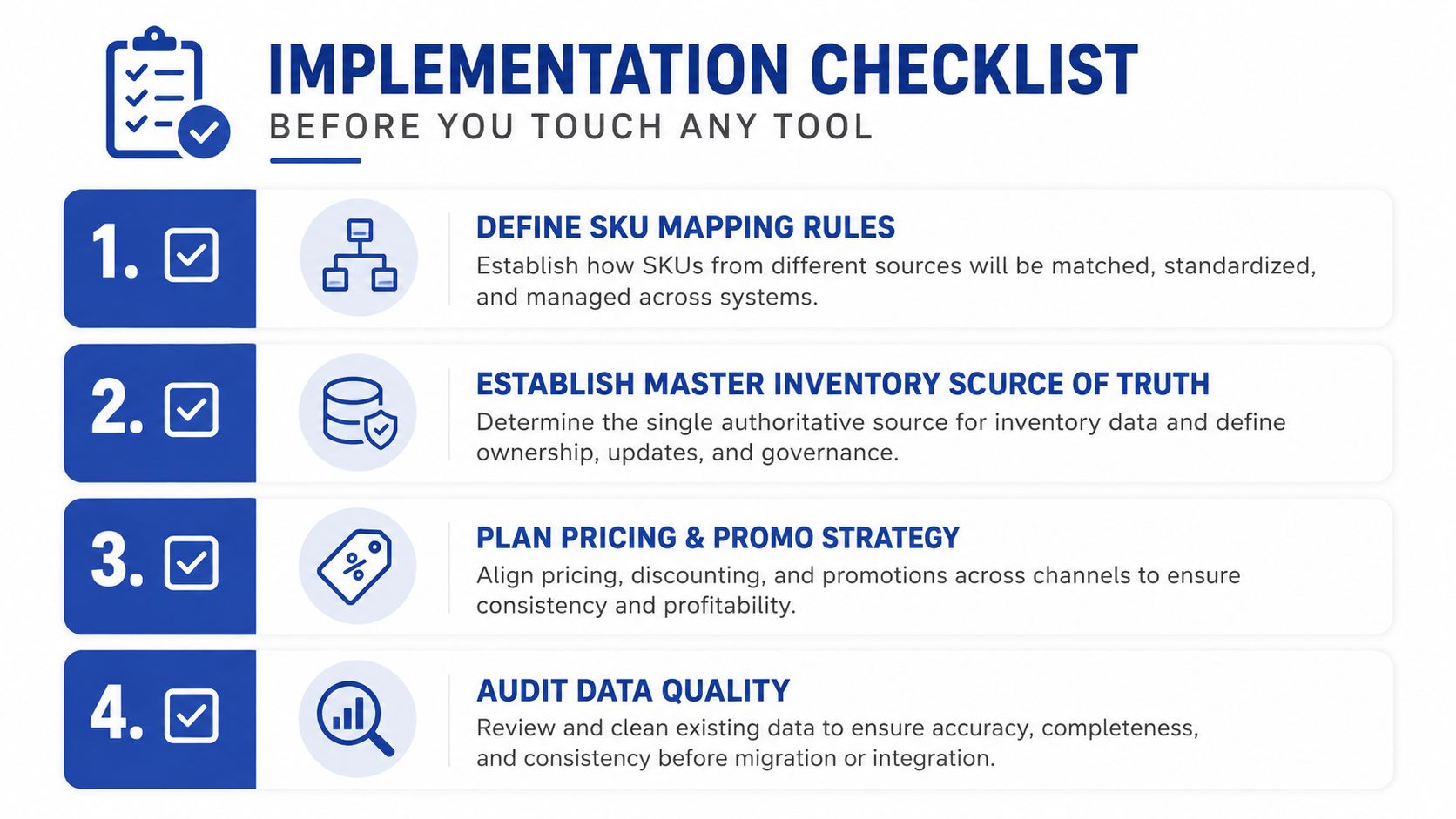
The UK Single Trade Window points towards the same systems principle. Its API design is intended to let traders and software providers connect supply-chain data into government systems, supporting data sharing and risk assessment across border agencies, as described in the OECD report on digital trade in the United Kingdom. For marketplace operations, connected order, customs and shipment events reduce the need to re-key the same transaction across disconnected systems.
The UK government estimates that full implementation of remaining digital trade facilitation measures could reduce manufacturing trade costs by 5.88% and services trade costs by 2.27%, according to its report on digitalisation of trade processes. Treat that as evidence of potential economic value from cleaner digital handoffs, not as a guaranteed return from a marketplace app.
Implementation Checklist Before You Touch Any Tool
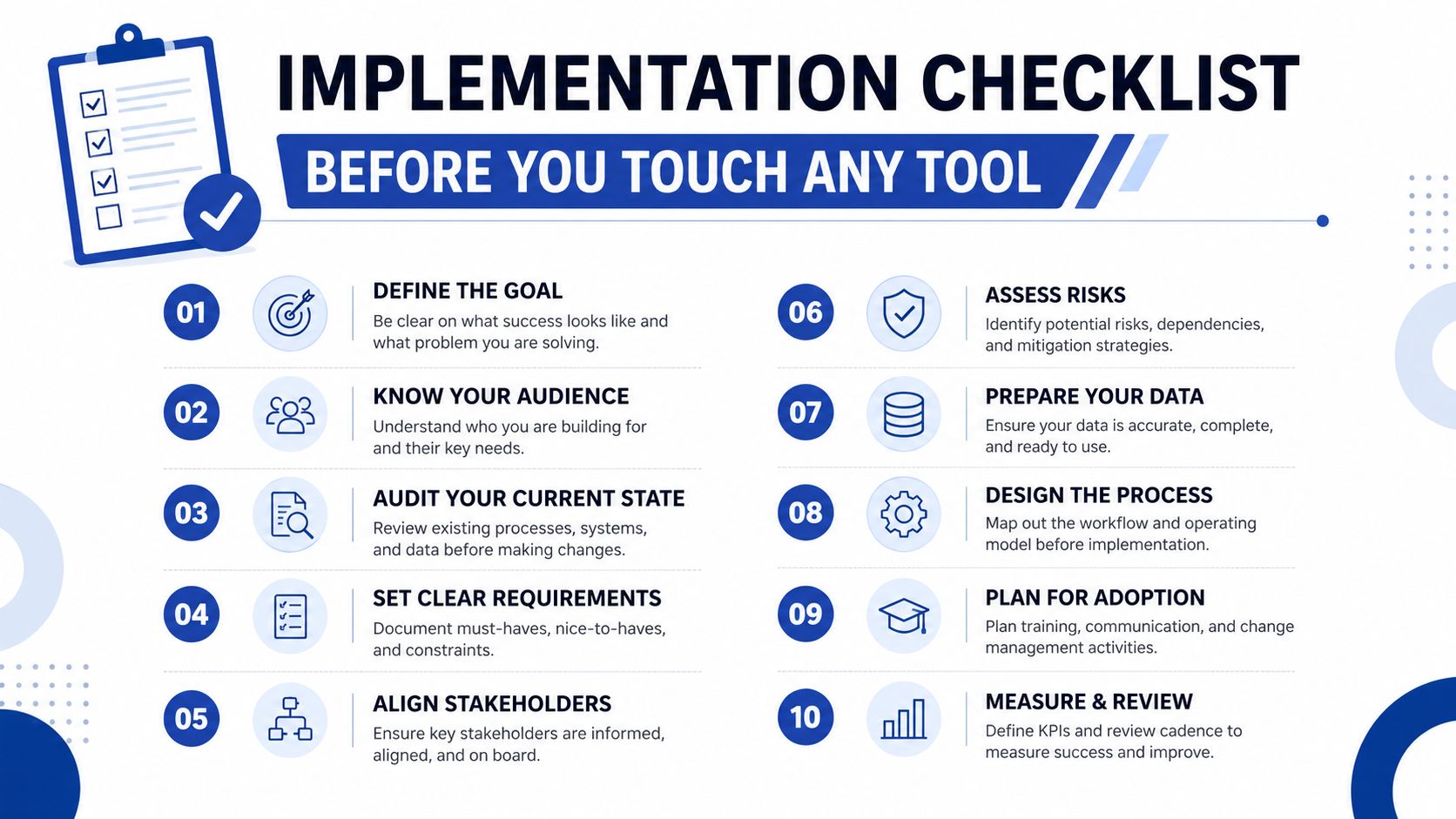
Software can't resolve unclear ownership or dirty product data. Before requesting demos, write down the rules that the integration must enforce.
Start with the product record
Define the SKU mapping before you connect anything. Decide whether the Shopify SKU, ERP code, barcode or a separate channel identifier is the canonical key. Include variants, bundles, multipacks, substitutions and discontinued products.
This prevents the most damaging class of integration error, where two systems treat the same item as different products or two different items as interchangeable. Test edge cases before testing a normal single-item order.
Choose one inventory authority
Name the system that owns available-to-sell stock. Shopify may own it for a simple operation, while an ERP, warehouse-management system or order-management platform may be more appropriate once reservations and multiple locations enter the picture.
Document the update direction and the safety buffer. A marketplace shouldn't receive stock merely because a warehouse record exists. It should receive the quantity your allocation policy says can safely be sold.
Govern price and promotion rules
Create a channel price book that accounts for commission, fulfilment, advertising and return exposure. Decide who approves promotions and whether marketplace discounts can stack with Shopify discounts.
Give each rule an owner and an expiry process. Temporary promotions become permanent margin problems when nobody records when they should end.
Route returns before orders
A return isn't just an order in reverse. It can involve marketplace policy, prepaid labels, warehouse inspection, refunds, exchanges, damaged stock and customer communication.
Map the full path for each channel. Decide where the return is authorised, where the refund is issued, and which system records the final disposition.
Assign a human owner to every flow
Inventory, catalogue, pricing, orders, fulfilment, refunds and reporting need named owners. The owner doesn't manually perform the flow. They monitor it, approve policy changes and respond when the automation fails.
Use the same discipline when reviewing Shopify ERP integration. A technically successful connection still fails operationally if nobody owns reconciliation, alert triage or release testing.
Before selecting a vendor, ask for a failure demonstration. Make the supplier show a duplicate order, an unavailable SKU, a rejected listing, a delayed carrier update and a marketplace outage. If the dashboard only demonstrates the happy path, you haven't seen the product you'll operate.
Real Scenarios and the ROI Signals to Watch
The right integration depends on the constraint that limits growth. A fashion brand, a homeware seller and a beauty business can all use Shopify Plus while needing completely different architectures.
A fashion brand adding TikTok Shop and OnBuy
The brand already sells through Shopify and Amazon UK. It wants TikTok Shop for discovery-led demand and OnBuy for additional UK reach, but its catalogue contains colour and size variants with uneven availability.
A connector app may be sufficient if Shopify remains the stock authority and the brand accepts standard listing rules. The team should watch sell-through rate by channel, cancellation reasons and the margin after channel fees, fulfilment and returns. The objective isn't to publish more products. It's to identify whether each marketplace moves the right stock at an acceptable contribution margin.
A homeware seller consolidating five marketplaces
This seller has accumulated separate connections over time. Orders arrive in different formats, stock is held across fulfilment locations, and finance spends too much time matching payouts to order records.
Middleware is the sensible choice because the main problem is orchestration. The leadership team should monitor hours saved per week in operations, failed-message volume, order reconciliation time and the frequency of manual stock corrections. A central layer earns its keep only when it reduces the number of exceptions people must investigate.
A beauty brand building a custom app
This brand has a Shopify 2.0 storefront, complex routines and bundles, and a merchandising team that needs channel-specific product logic. Off-the-shelf connectors can't model the required relationships cleanly, so the business considers a custom Built for Shopify app.
The ROI signal is average order value on bundles, but the team must also measure app maintenance effort and listing accuracy. A custom build pays back when it supports a differentiated commercial workflow. It doesn't pay back merely because the internal team dislikes an existing interface.
The common thread is measurement before implementation. Use the following video as a visual prompt for evaluating integration decisions alongside the commercial workflow, not as a substitute for mapping your own data.
The portfolio itself needs review. UK online marketplaces and peer-to-peer platforms reached £34.1 billion in GMV excluding VAT in 2025, representing just under a third of UK online retail spending, while UK ecommerce growth is forecast to peak at 6.2% in 2026 before slowing as the market matures, according to Mintel's UK online retailing marketplaces report. That makes channel selection a margin and maintenance decision. Amazon UK, eBay UK, OnBuy, TikTok Shop and Temu shouldn't all receive identical catalogue, pricing or fulfilment treatment.
When to Buy Versus Build on Shopify
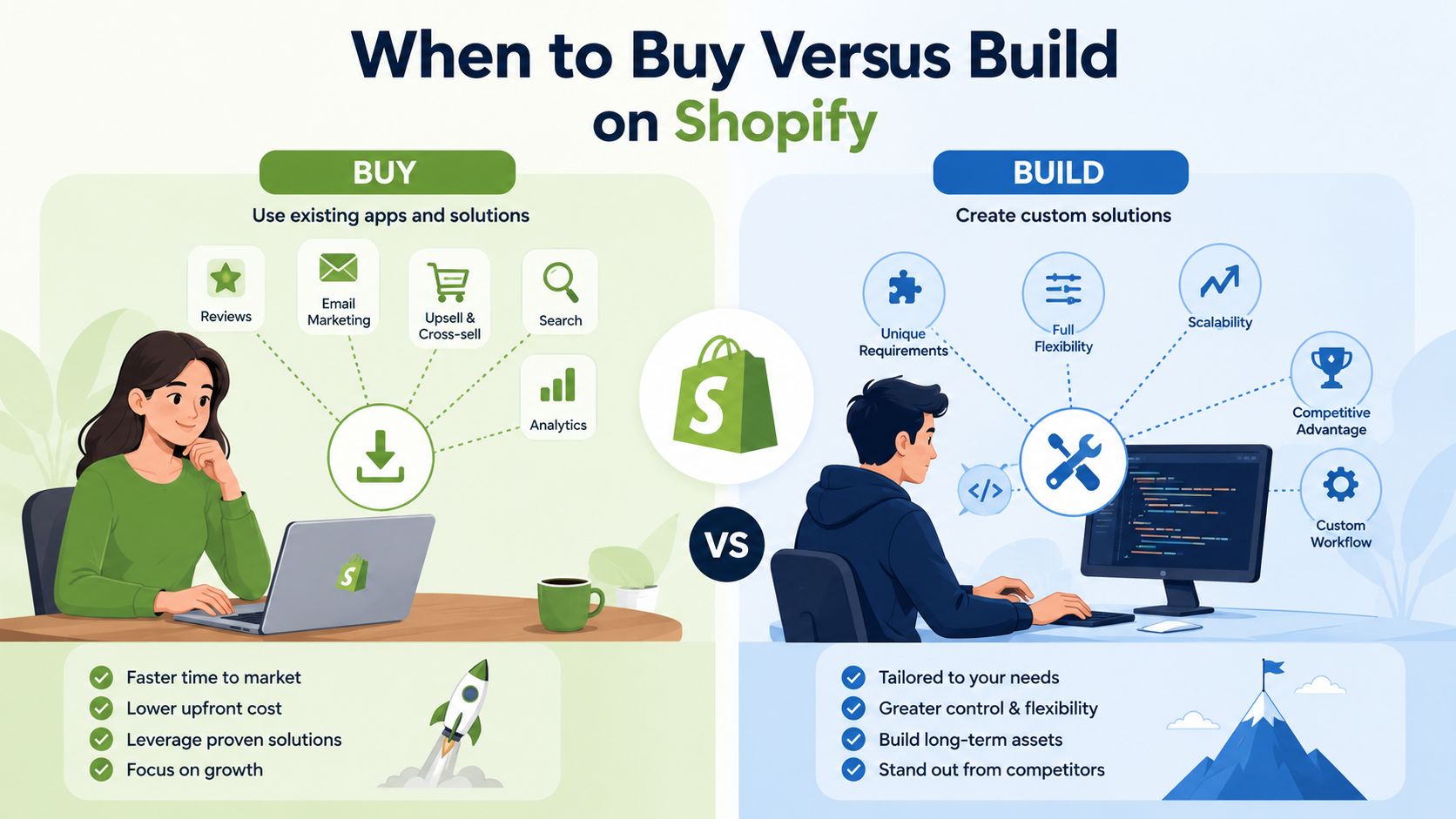
Buy an off-the-shelf connector when your requirements are conventional: Shopify owns the catalogue, one system owns inventory, marketplace orders follow predictable rules, and standard fulfilment statuses cover the workflow. Validate the actual edge cases before subscribing, especially bundles, returns, cancellations, multi-location stock and listing errors.
Choose middleware when several channels share ERP, warehouse or carrier dependencies. The recurring cost is justified when the platform gives operations one place to monitor messages, replay failures and manage mappings. Don't choose it just because it has the most integrations. Choose it because it removes the most manual exceptions from your specific operation.
Build a custom Built for Shopify app only when the workflow is commercially distinctive or no existing product can represent it safely. Keep the scope narrow, expose clear logs and alerts, and budget for API changes, testing and support. A custom app is a product you own, not a project you finish.
For migration, run the new path alongside the old one long enough to compare inventory, orders and fulfilment outcomes. Cut over by channel or product group, freeze catalogue changes during the switch, and keep a rollback route that doesn't create duplicate orders. Test a failed event before declaring success.
One-minute rule: Buy when the workflow is standard, use middleware when orchestration is the problem, and build only when the integration itself creates a defensible commercial advantage.
Grumspot connects Shopify with ERP, CRM and fulfilment systems, and can develop custom Shopify apps when standard marketplace connectors don't fit the operating model. If your channels are creating stock, order or maintenance problems, visit Grumspot to discuss the data flows, ownership rules and Shopify architecture that need fixing.
Let's build something together
If you like what you saw, let's jump on a quick call and discuss your project

Related posts
Check out some similar posts.

- shopify website examples
Explore 7 Shopify website examples and learn the UX, conversion features, and practical lessons merc...
Read more
- cro best practices
Apply cro best practices to Shopify stores with 10 actionable tactics for testing, product pages, ch...
Read more
- ecommerce subscription platform
Learn how an ecommerce subscription platform works, which models drive retention, and how to choose,...
Read more
- ecommerce replatforming agency
Choosing an ecommerce replatforming agency? Learn what they do, replatforming signs, costs, timeline...
Read more