Master Affiliate Program Management for Shopify Plus
- affiliate program management
- shopify plus
- ecommerce marketing
- affiliate recruitment
- performance marketing
Launched
July, 2026
Paid social is less forgiving than it was. Search is crowded. Email still matters, but it won't solve acquisition on its own. A lot of Shopify Plus teams hit the same wall: revenue targets keep rising while the list of efficient channels gets shorter.
That's usually when affiliate marketing gets revisited. Sometimes it's treated like a side channel for coupon sites. Sometimes it gets handed to whoever already owns influencer outreach. Both approaches usually underperform.
Good affiliate program management is closer to partner channel operations than campaign management. You're building a commercial system: commission logic, tracking, payouts, recruitment, compliance, onboarding, creative support, fraud controls, and ongoing optimisation. When that system is tight, affiliates stop being an afterthought and start acting like an external growth team that only gets paid when they produce results.
For Shopify Plus brands in the UK, the difference between a mediocre programme and a durable one usually comes down to execution. The basics are easy. The hard part is stitching together the right tech stack, recruiting the right partners, keeping attribution clean, and protecting margin while the programme scales.
Beyond Paid Ads The Case for Affiliate Marketing
A familiar pattern shows up in growth reviews. Paid acquisition still spends money every day, but efficiency is harder to defend. Creative fatigue arrives faster. Retargeting has limits. Prospecting costs rise. The brand needs a channel that expands reach without locking more budget into upfront media risk.
That's where affiliate marketing earns its place. The reason serious ecommerce teams keep coming back to it is simple: it's performance-led, partner-driven, and much more flexible than many brands assume.
It's not a niche channel
In the UK, 72% of e-commerce companies actively run affiliate programs as a core component of their digital strategy, and nearly 65% of affiliate marketers report that their managed programmes generate at least 20% of overall company revenue, according to New Media's affiliate marketing statistics roundup. That tells you two things. First, affiliate isn't a fringe tactic. Second, when managed properly, it can become a meaningful revenue line rather than a nice extra.
For Shopify Plus brands, that matters because scale changes the channel mix. Once a store has decent product-market fit, a repeatable fulfilment operation, and enough margin discipline, affiliate starts solving a different problem than ads. It opens access to creators, editorial publishers, loyalty partners, comparison sites, communities, and complementary brands that already have audience trust.
Practical rule: If you only think of affiliates as discount publishers, you'll build a low-quality programme and attract exactly the wrong partners.
Affiliate management is partner ecosystem management
The best-performing programmes don't recruit everyone. They build a partner mix on purpose.
A skincare brand might want creators who can demonstrate routines, editorial publishers who rank for ingredient queries, and a few trusted voucher partners with strict rules. A premium homewares merchant might prioritise interior design creators, gifting guides, and non-competing brand collaborations. The point isn't volume. The point is fit.
That shift in mindset changes how the programme gets run:
- Recruitment becomes selective rather than open-door.
- Commissioning becomes strategic rather than flat-rate.
- Creative support becomes ongoing rather than a one-off asset folder.
- Compliance becomes operational rather than something buried in terms and conditions.
Why Shopify Plus teams should care
Shopify Plus gives brands more room to operationalise this well. You can align promotions with product launches, segment landing pages by partner type, automate internal workflows, and connect affiliate activity to broader retention and merchandising decisions.
That's why affiliate programme management works best when ecommerce, CRM, merchandising, and finance all stay close to it. The channel sits across all four. Treat it like a side project and it drifts. Treat it like a revenue programme and it compounds.
Building Your Affiliate Program Blueprint
Most affiliate programmes don't struggle because they picked the wrong software. They struggle because nobody decided what the programme was supposed to do beyond “get more sales”.
That's too broad to manage well. A blueprint needs commercial intent, guardrails, and a payout structure that your margin can support.
Start with business goals, not platform settings
The industry is getting bigger and more competitive. The global affiliate marketing industry is projected to reach $36.9 billion by 2030, and brands typically invest between $20,000 and $50,000 annually in programme management. That investment is easier to justify because affiliate traffic converts at 1–3%, which outperforms display ads on average, according to Rewardful's affiliate marketing statistics.
Those numbers matter, but they shouldn't push you into rushing setup. They should push you into sharper planning.
A strong blueprint usually answers these questions:
- What is the primary job of the programme? New customer acquisition, content distribution, AOV support, product launch reach, or international market entry.
- Which partner types fit the brand? Content creators, review publishers, loyalty sites, ambassadors, niche communities, or complementary brands.
- What actions deserve payout? Completed purchase, approved order, subscription start, or something hybrid.
- Which orders should not be over-incentivised? Heavily discounted sales, low-margin products, or existing-customer orders if your goal is acquisition.
Define the partner persona before recruitment
A lot of weak programmes accept almost everyone, then wonder why sales quality is mixed. Define your ideal affiliate the same way you'd define an ideal customer segment.
For a Shopify Plus merchant, that usually includes:
- Audience relevance: Their audience overlaps with your target buyer.
- Commercial fit: Their content style can sell your product without forcing it.
- Brand safety: Their site, content, and social presence won't create downstream risk.
- Operational fit: They can follow promo rules, disclosures, and creative standards.
If you can't describe who the right affiliate is, your recruitment will default to whoever applies first.
Pick the commission model your margin can survive
Different models suit different catalogue structures, buying cycles, and partner types.
| Model | How It Works | Best For | Potential Downside |
|---|---|---|---|
| CPA | Affiliate earns a fixed amount per approved sale or action | Brands with stable economics and simple reporting needs | Can become blunt if product prices vary widely |
| RevShare | Affiliate earns a percentage of order value | Most ecommerce brands with varied baskets | Margin pressure if rates aren't adjusted by category or partner type |
| Hybrid | Combines a fixed payout with a percentage or incentive layer | Strategic partners or programmes balancing acquisition and volume | More complex to administer and explain |
| Tiered | Rate increases based on performance thresholds | Scaling programmes that want to reward top performers | Can erode profitability if thresholds are too generous |
A few practical trade-offs matter here.
Flat rates are easier to communicate, but they often ignore product mix. Revenue share aligns payout with basket value, but it can overpay on orders that would likely have happened anyway. Tiered models are powerful, but only after tracking is clean and partner quality is stable.
Don't finalise commissions in a vacuum. Run the maths against gross margin, discount policy, returns behaviour, and average basket composition first.
Put the operating rules in writing
Before launch, create a simple internal blueprint document that covers:
- Programme objective
- Approved partner categories
- Commission logic
- Exclusions and restricted products
- Promo code rules
- Brand bidding and trademark policy
- Payment approval process
- Creative refresh cadence
If that document doesn't exist, the programme usually gets rebuilt through Slack messages and exceptions. That's where inconsistency starts.
Choosing and Integrating Your Tech Stack on Shopify Plus
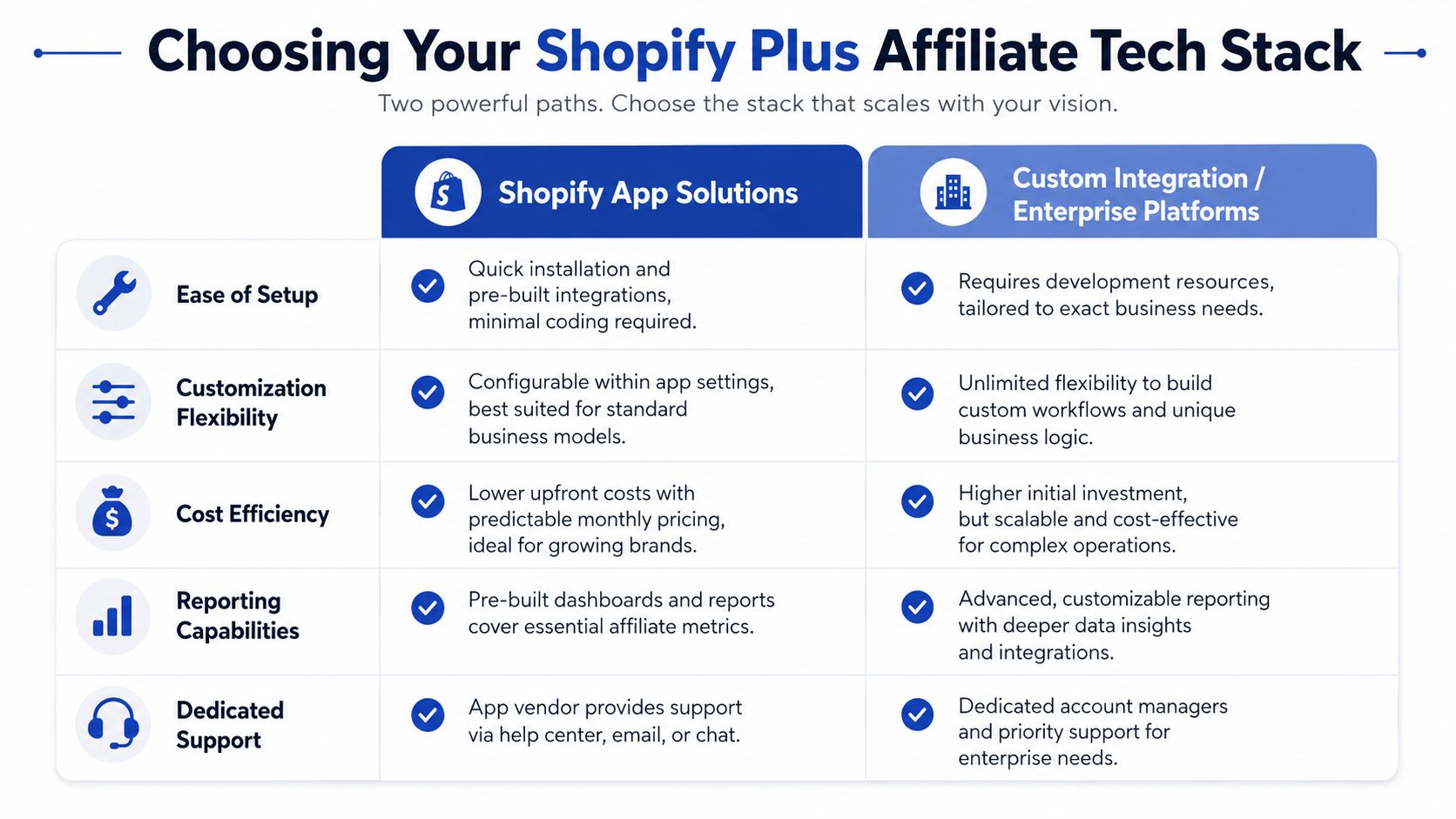
There are two main ways to run affiliate infrastructure on Shopify Plus. You either use a Shopify app or SaaS-led setup that gives you speed and control, or you plug into a larger affiliate network or enterprise platform that gives you broader partner access and more formal account infrastructure.
Neither route is automatically better. The right choice depends on whether your main bottleneck is recruitment, reporting depth, operational control, or internal resourcing.
Shopify app route versus network route
A Shopify app or standalone SaaS platform is usually the faster option. Tools in this category tend to be easier to install, easier to test, and easier to shape around your own workflows. They're often a strong fit when the brand already has a clear recruitment strategy and doesn't need a network to supply partner demand.
A network or enterprise platform usually makes more sense when the brand wants built-in publisher access, more mature payment infrastructure, and a formalised environment for larger affiliate relationships. The trade-off is that setup, governance, and reporting logic can be heavier.
A practical way to compare them:
- Choose app-led infrastructure if you want more direct control over partner experience, flexible experimentation, and tighter internal ownership.
- Choose network-led infrastructure if recruitment scale, established publisher relationships, and centralised partner administration matter more than maximum control.
What matters specifically on Shopify Plus
Shopify Plus changes the implementation conversation because affiliate tracking isn't the only concern. The programme needs to fit the rest of your ecommerce stack.
That usually means checking five things early:
Checkout and attribution compatibility
Tracking has to work cleanly with your checkout flow, promo code logic, and post-purchase processes.Automation opportunities
Shopify Flow can help automate internal notifications, approval steps, tagging, and exception handling. If affiliate operations still rely on manual chasing, the programme gets slower as it grows.International setup
If the brand sells across markets, multi-currency commission handling and country-specific offers matter. A platform that looks fine for one market can become awkward once international partner payouts start.Site performance impact
Too many scripts, tags, or app conflicts can slow storefront performance. That's not just a technical issue. It affects conversion quality from affiliate traffic.Data ownership and reporting flexibility
If you can't segment partner performance by product type, order quality, or customer type, optimisation gets shallow very quickly.
For brands doing broader systems work, this is usually part of the same conversation as Shopify third-party integration services, because affiliate tooling rarely sits alone. It touches analytics, finance, CRM, and sometimes ERP or fulfilment workflows as well.
A simple decision filter
Use this filter before choosing anything:
| Question | Lean app or SaaS | Lean network or enterprise |
|---|---|---|
| Do you already know how you'll recruit partners? | Yes | No |
| Do you need direct control over data and workflows? | Yes | Sometimes |
| Do you want access to an existing publisher base? | Less important | Very important |
| Will internal teams manage the programme hands-on? | Likely | Sometimes shared |
| Is customisation a major priority? | Usually | Depends on platform constraints |
The mistake isn't choosing one category over the other. The mistake is buying for launch convenience, then discovering six months later that the platform doesn't fit how your team operates.
Recruiting and Onboarding High-Value Affiliates
Most affiliate programmes don't fail because there are no partners available. They fail because the brand waits for applications instead of recruiting with intent.
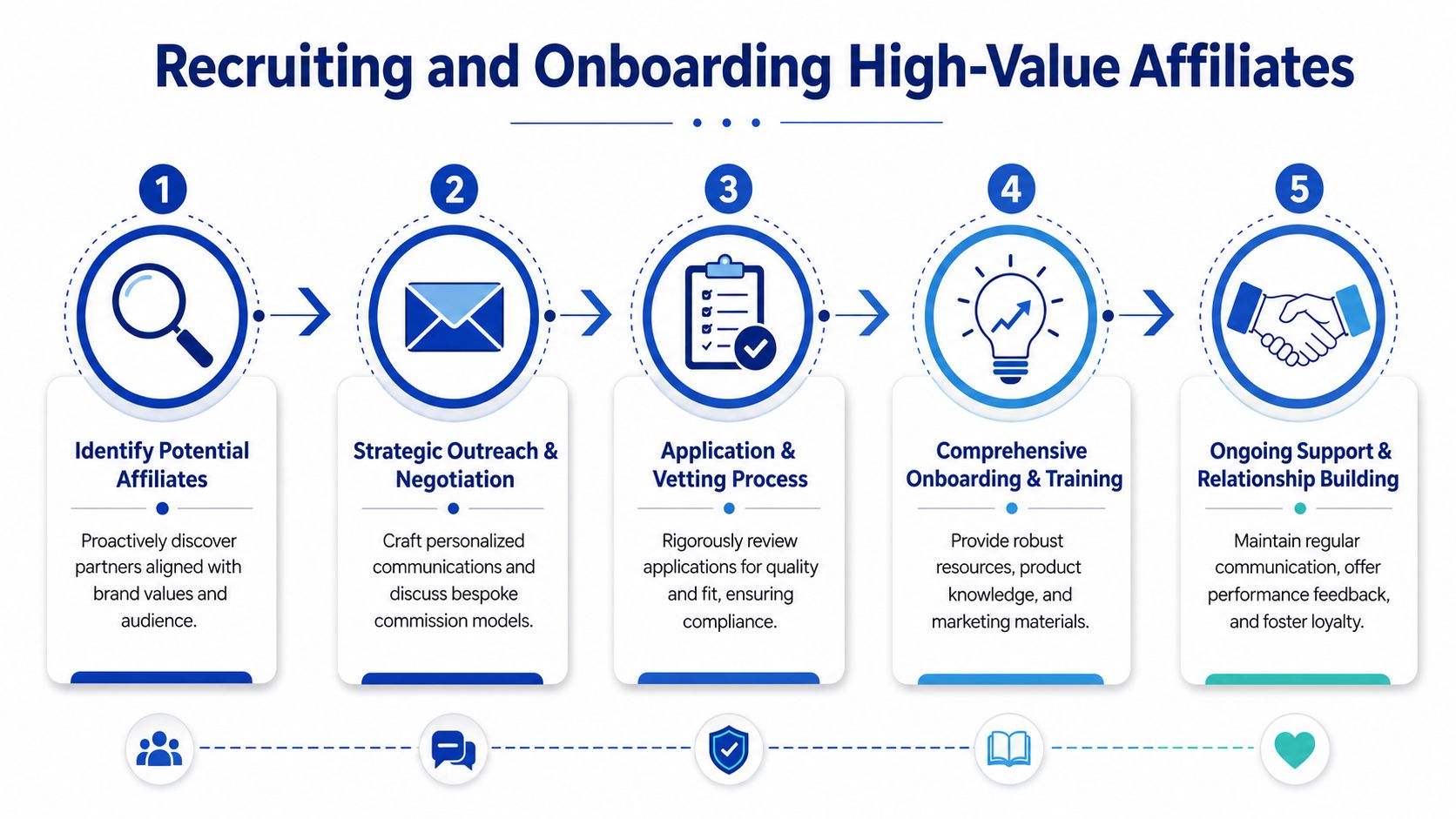
High-value affiliates usually don't appear by accident. You have to identify them, assess fit, and give them enough context to start promoting properly. That process should feel closer to business development than to opening a sign-up form and hoping for the best.
Where strong affiliates actually come from
The best recruits for a Shopify Plus brand are often hiding in plain sight.
Start with people and businesses that already speak to your buyer:
- Micro-influencers in niche verticals with strong audience trust and visible product use.
- Editorial creators and reviewers who publish buying guides, comparisons, tutorials, or use-case content.
- Complementary brands that sell to the same customer without competing directly.
- Existing customers with influence who already understand the product and can speak credibly.
- Community-led publishers such as niche newsletters, podcasts, and membership groups.
Segmentation is beneficial when your customer base contains clear behavioural or demographic clusters, allowing you to recruit partners around those groups instead of taking a one-size-fits-all approach. That's the same logic behind a disciplined customer segmentation strategy. Better segments lead to better partner targeting.
A lot of teams also need channel-specific expertise when affiliate expands beyond the website. If social commerce is part of the plan, this guide to managing TikTok Shop affiliate programs is useful because TikTok affiliate operations have very different creator workflows and content rhythms from a standard ecommerce affiliate setup.
Vet for trust, not just reach
Follower count is a weak filter on its own. Strong recruitment looks at context.
Review the partner's content quality, brand fit, promotional style, and whether they can drive the type of demand you want. A creator who can explain product value clearly may outperform a much larger account with weaker audience trust. A niche publisher with purchase-intent content can be more valuable than a broad lifestyle site that mentions everything and converts little.
A good affiliate doesn't just have traffic. They have a believable reason for their audience to act on a recommendation.
This short walkthrough is worth sharing with internal teams that are new to affiliate onboarding:
Make onboarding feel commercial, not administrative
A weak onboarding flow gives partners a link and leaves them alone. A stronger one gives them a reason to activate.
A practical welcome kit should include:
- A partner playbook with brand rules, claims guidance, prohibited promotions, and disclosure expectations.
- Creative assets sized for the channels they use, not a random folder of old banners.
- Product education focused on bestsellers, differentiation, objections, and audience-fit use cases.
- Named support contact so questions don't disappear into a generic inbox.
- Launch prompt such as a featured product, timely offer, or content angle to publish first.
The goal is to get the affiliate to first meaningful activity quickly, with the right message and minimal friction. Brands that onboard this way tend to attract better partners over time because the programme feels organised and worth prioritising.
Activating and Managing Your Partners for Growth
A lot of programmes look healthy on launch day. New sign-ups come in. Links are generated. A few early sales arrive. Then the channel stalls because nobody is managing momentum.
That usually happens in two ways. The first is silence. The second is payout friction.
According to Adobe's UK affiliate marketing guide, delayed payments and poor communication can lead to a 20–30% drop in affiliate engagement. The same source notes that programmes with dedicated managers who communicate effectively achieve 2.5x higher conversion rates and 40% higher customer lifetime value. Those figures line up with what operators see in practice. Partners prioritise the programmes that feel organised, responsive, and commercially useful.
What weak management looks like
A brand launches its programme and approves a batch of affiliates. For the first few weeks, there's energy. Then the affiliates stop hearing from anyone. Creative doesn't get updated. Promotions aren't shared early. Questions sit in support queues. Payments take too long to approve because finance and ecommerce never defined a workflow.
Nothing dramatic happens at first. The programme just loses priority in the affiliate's mind.
That's the part many internal teams miss. Affiliates compare your programme against every other one they're in. If your communication is inconsistent and your admin is unreliable, they won't complain much. They'll just promote someone else.
What good management actually involves
Strong affiliate programme management is repetitive in a good way. There's a rhythm to it.
A workable operating cadence often includes:
- Weekly partner updates with top products, promotional angles, trading moments, and any policy reminders.
- Fresh creative distribution tied to product launches, seasonal pushes, and platform-specific needs.
- Activation outreach to dormant affiliates with simple next actions rather than generic “checking in” messages.
- Fast issue handling when links break, promo codes fail, or content needs review.
- Predictable payment timing so partners trust the programme enough to keep investing effort.
Affiliates don't need constant noise. They need useful, timely communication they can act on.
Manage by partner type, not as one big list
A content creator needs a different kind of support than a loyalty site. A niche editorial partner needs product detail and angle ideas. A voucher partner may need strict promo code rules and fast validation. A complementary brand partner may need campaign planning around joint audiences.
That's why partner segmentation matters operationally as well as strategically. When all affiliates receive the same message, most of them get something irrelevant.
A simple internal split often works well:
| Partner type | What they usually need most |
|---|---|
| Content creators | Samples, use cases, fresh hooks, landing pages |
| Editorial and review sites | Product detail, comparison angles, commercial clarity |
| Voucher and loyalty partners | Accurate offers, clear restrictions, fast validation |
| Brand partners | Co-marketing planning, timelines, shared positioning |
When managers stay close to those differences, the programme feels curated. When they don't, activation falls and the channel starts to look weaker than it really is.
Advanced Optimisation and Scaling Playbooks
Once a programme is stable, the next risk is complacency. Many brands stop at “it's working” and never build the systems that turn affiliate into a major growth channel.
That leaves revenue on the table. It also leaves margin exposed, because a flat, under-managed programme rarely rewards the right partners in the right way.
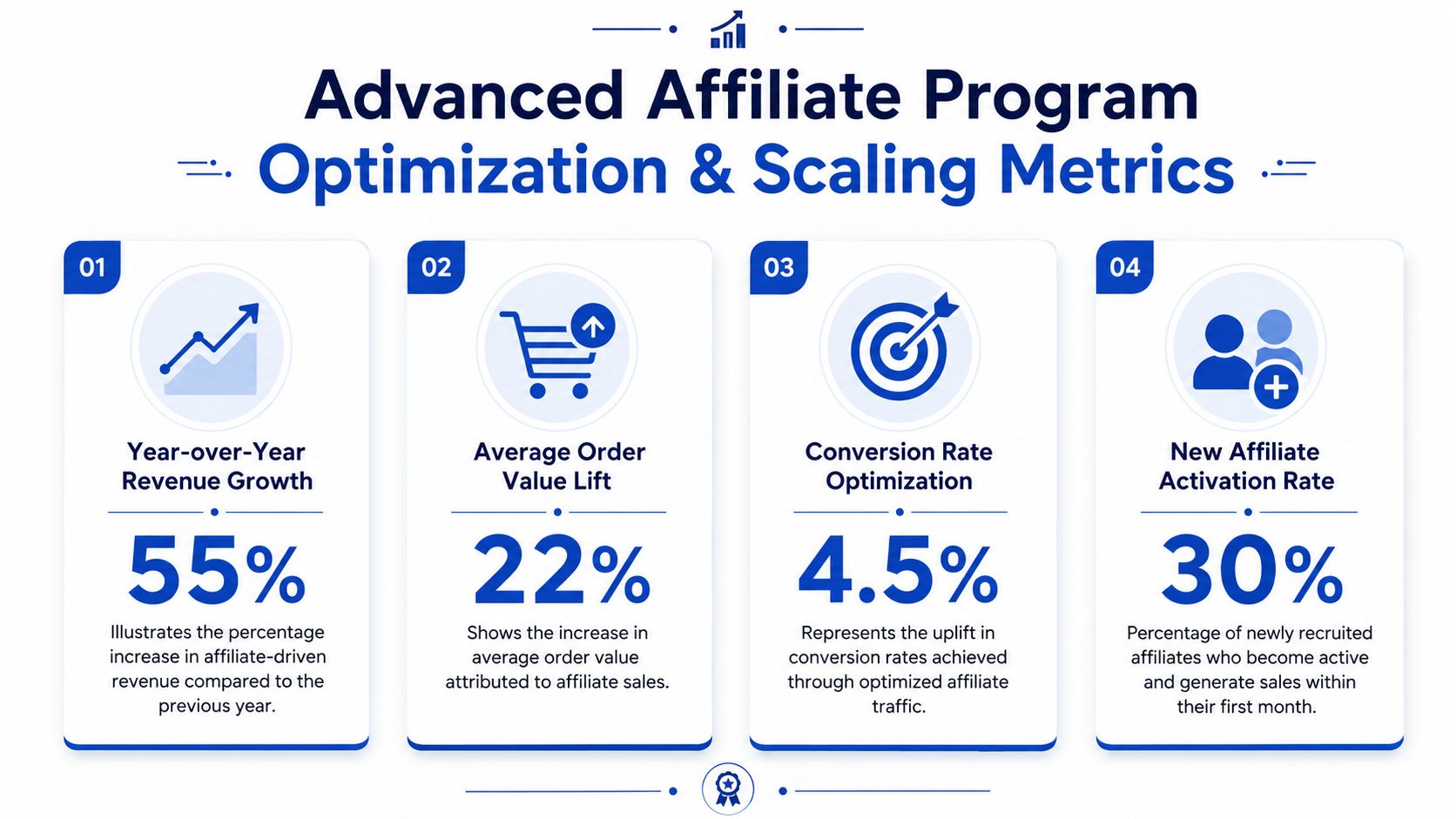
According to All Inclusive Marketing's guide to optimising affiliate programme management, a structured methodology that includes tiered commissions and A/B testing on cookie durations, typically 30–60 days in the UK, can lead to a 35–50% increase in revenue year over year in the UK market. That result doesn't come from one tweak. It comes from disciplined iteration.
Use commissions as a control system
Flat commissions are fine for launch. They're usually too blunt for scale.
A stronger model uses commission design to shape partner behaviour. Top-performing partners can access better rates. Strategic product categories can carry different incentives. Seasonal pushes can include time-bound bonuses. New affiliate activation can be supported with short-term ramps that encourage early promotion without becoming permanent margin leakage.
Three rules keep this sane:
Reward outcomes you want Don't pay the same for every type of sale if some orders are far more valuable than others.
Protect the economics first
Commission generosity doesn't fix poor partner quality or weak conversion paths.Keep the structure explainable
If affiliates can't understand how they earn more, the incentive won't change behaviour.
Test the traffic after the click
A lot of affiliate optimisation gets stuck at tracking and payout. That's too narrow.
The click is only the start. The brands that scale affiliate well test what happens after the partner sends traffic. That includes affiliate-specific landing pages, product collection pages specific to creator themes, and promo experiences that match the promise in the referring content.
Useful tests often include:
- Cookie duration experiments within commercially sensible ranges
- Landing page variants by partner type or campaign theme
- Offer framing such as bundle-first versus discount-first messaging
- Creative alignment between affiliate content and on-site merchandising
- Product set curation for audiences with distinct intent
For teams looking at broader AI support for merchandising, analysis, and content operations, WearView's e-commerce AI picks is a practical resource. Used properly, those tools can speed up testing workflows and asset production, but they still need human commercial judgement.
Track proof, not just clicks and sales
If you want affiliate to get more budget and internal support, report it like a serious channel.
A useful dashboard usually includes a mix of commercial and operational metrics:
- Revenue contribution by partner type
- New versus returning customer mix
- Average order value by affiliate segment
- Customer lifetime quality from affiliate-acquired cohorts
- Activation rate of newly recruited partners
- Time to first sale after onboarding
- Commission cost relative to approved revenue
The strongest affiliate managers don't just report output. They show which partner behaviours create profitable growth and which ones don't.
That's the difference between running a programme and scaling one.
Mitigating Fraud and Ensuring UK Legal Compliance
Many brands assume that if tracking is installed and sales are flowing, the programme is under control. It isn't.
Basic affiliate tracking tells you what got attributed. It doesn't reliably tell you whether the attribution was clean, whether the partner behaviour was compliant, or whether the programme is exposed to legal and reputational risk. For UK ecommerce teams, that gap matters more than most generic affiliate guides admit.
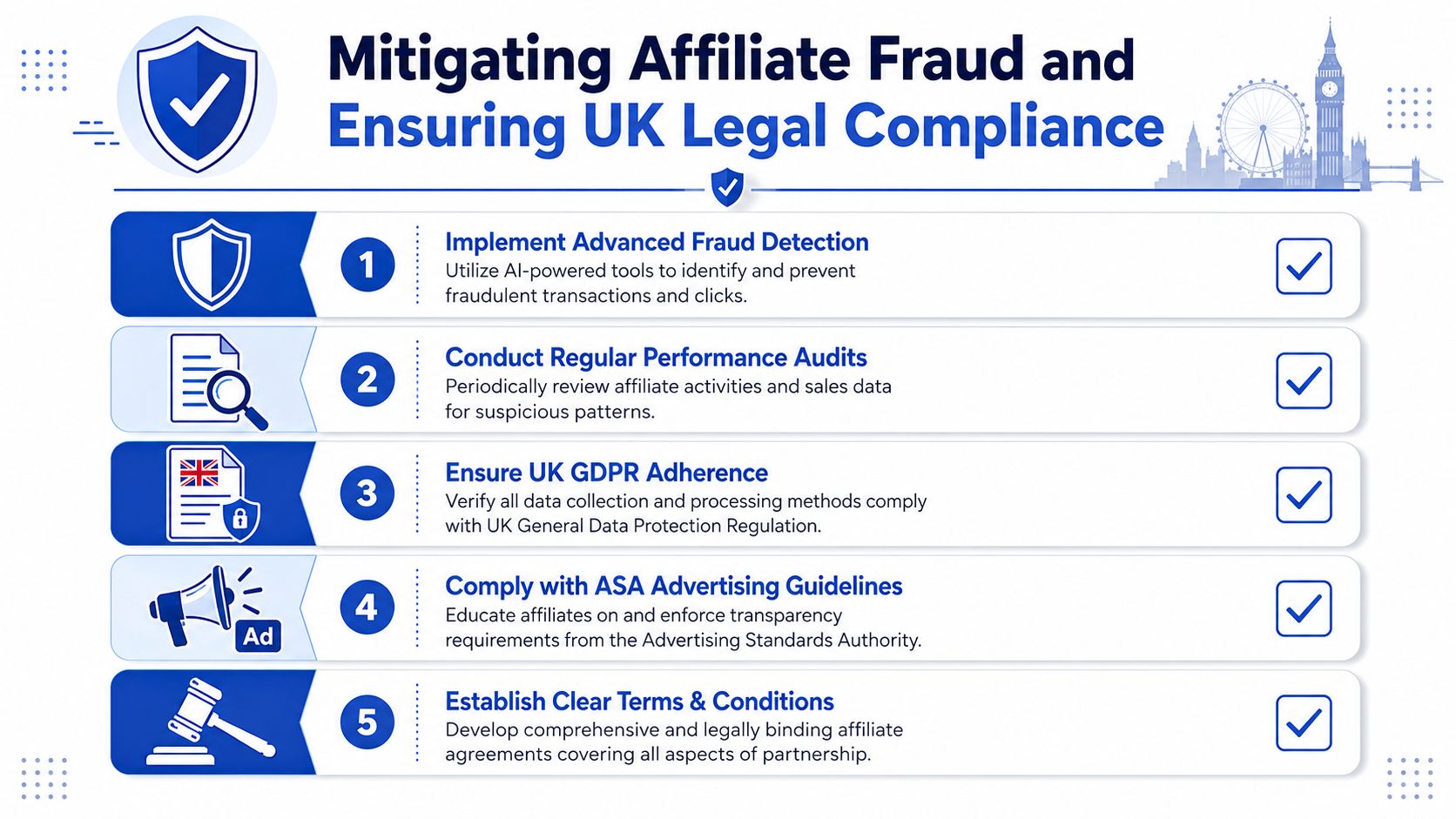
According to Acceleration Partners' UK affiliate marketing resource, 28% of UK merchants report losing up to £15,000 annually to affiliate fraud, while only 12% use automated fraud detection tools. The same source notes the added exposure around compliance with the UK's Financial Conduct Authority guidance on disclosure. That combination is the problem. Fraud risk and compliance risk often sit in the same operational blind spot.
What basic tracking misses
Affiliate fraud doesn't always look dramatic. Often it hides in patterns that teams don't review closely enough.
Common problem areas include:
- Voucher attribution abuse where low-value last-click behaviour captures credit it didn't really influence
- Brand bidding violations that push affiliates into paid search spaces they weren't allowed to occupy
- Questionable transaction patterns such as unusual order clustering, suspicious cancellations, or low-quality conversion behaviour
- Misleading promotional methods that create compliance and reputational issues even when attributed sales appear valid
- Weak disclosure practices that expose both brand and affiliate to scrutiny
In practice, clean affiliate programme management needs active policing. You can't outsource all of that responsibility to the network or platform.
A practical fraud and compliance framework
For UK Shopify Plus brands, the most reliable setup is a layered one.
First, tighten your programme terms.
Spell out prohibited traffic sources, brand bidding restrictions, disclosure requirements, voucher code rules, and consequences for non-compliance.
Second, review performance like an operator, not just a marketer.
Look for behavioural anomalies. Sudden shifts in conversion patterns, unusual affiliate concentration, and odd discount usage are operational signals, not just reporting quirks.
Third, use specialist tooling where needed.
Basic dashboards often won't catch nuanced abuse. Teams dealing with larger order volumes or mixed partner types should consider a more advanced fraud prevention approach for ecommerce, especially when affiliate overlaps with discounting, paid search, and promotional extensions.
Fourth, enforce disclosure rules consistently.
Affiliates need clear guidance on transparent ad labelling and approved promotional language. That matters broadly in the UK, and even more in regulated categories.
Fifth, document reviews and actions.
If a partner is warned, restricted, or removed, keep records. Compliance is much easier to defend when enforcement is documented.
A compliant programme isn't the one with the longest terms and conditions. It's the one that reviews behaviour, enforces standards, and acts quickly when something looks wrong.
Where UK-specific risk gets overlooked
UK teams often pay close attention to conversion reporting and not enough attention to disclosure and sector-specific rules.
For most brands, that means clear advertising disclosure standards. For brands in regulated sectors, the bar is higher. If the product touches financial services or another regulated area, affiliate messaging can't be treated casually. The partner may create the content, but the brand still carries risk if the programme allows weak controls.
That's why the mature approach is straightforward. Recruit carefully. Monitor actively. Automate where sensible. Review manually where judgement matters. And never assume that attributed revenue is the same thing as legitimate incremental value.
If your Shopify Plus team needs help building, fixing, or scaling affiliate infrastructure alongside the rest of your ecommerce stack, Grumspot can help. They design and develop high-performance Shopify experiences, handle complex integrations, and support growth teams that need sharper execution across conversion, tracking, and operational workflows.
Let's build something together
If you like what you saw, let's jump on a quick call and discuss your project

Related posts
Check out some similar posts.
- shopify store credit
Learn how to set up Shopify store credit with built-in tools or apps. Covers policy design, refund w...
Read more
- unified commerce platform
Learn how a unified commerce platform connects channels, ERPs, and CRMs to drive growth. Practical g...
Read more
- composable commerce platform
Learn what a composable commerce platform is, how it differs from monoliths, and how UK Shopify Plus...
Read more
- b2b ecommerce platform
Discover how a B2B ecommerce platform helps scaling brands streamline operations, boost sales, and g...
Read more