B2B Conversion Rate Optimization That Drives Revenue
- b2b cro
- b2b ecommerce
- shopify plus
- conversion rate optimization
- abm
Launched
July, 2026
You can have a dashboard full of green numbers and still feel the room go quiet when sales reviews pipeline. The form fills are coming in, the CTRs look tidy, and the board deck has charts. Then someone asks how many of those leads became real opportunities, and the answer is fuzzy enough to hurt.
That's the starting point for B2B conversion rate optimization. In B2B, a conversion is rarely the sale itself. It's a signal, and that signal only matters if it survives the handoff into CRM, sales qualification, and revenue. On a Shopify Plus B2B store, that might mean a quote request, a Net Terms application, a gated catalogue view, or a checkout flow for approved accounts. None of those deserve applause if they don't create usable pipeline.
Why B2B CRO Feels Different From Day One
Many B2B ecommerce teams open analytics, see a conversion rate that looks fine, and treat CRO like a page polish exercise. Then the pipeline review exposes the gap. The storefront may be collecting activity, but the qualified output has barely moved, and that is where the work changes.
The baseline matters here. In the UK, the average B2B ecommerce conversion rate is 1.8% according to VWO 2026 CRO statistics, and that is exactly why small gains matter so much. A move from 1.8% to 2.3% is a meaningful relative lift, but only if the extra conversions are the right ones. More form fills with weaker qualification just creates busier reporting.
The problem is the handoff
B2B buying does not happen in one sitting. One person explores, another reviews specs, procurement checks terms, finance asks questions, and sales often steps in before anything closes. Shopify's B2B guidance describes that reality well, with decisions that involve many stakeholders, longer cycles, and account-level signals rather than individual clicks (Shopify Enterprise B2B CRO guide).
A page-level win can still be a bad business outcome. A contact form might convert well while attracting students, competitors, or low-fit buyers. A quote builder might increase submissions but leave sales with messy handoffs. If the CRM stage quality is poor, the page metric is the wrong scoreboard.
Practical rule: if sales would rather not work the leads your CRO programme is creating, you are optimising the wrong conversion.
On Shopify Plus, that shows up quickly. A gated price list might drive curiosity but not accounts. A Net Terms flow might reduce friction for approved buyers but put casual traffic off. A custom quote journey can be the right move for complex buying, yet it still needs pipeline validation, not applause in a boardroom. That is the discipline here, count the actions that move accounts forward, not the ones that only fill the top of the funnel.
Build a Measurement Foundation Before You Test Anything
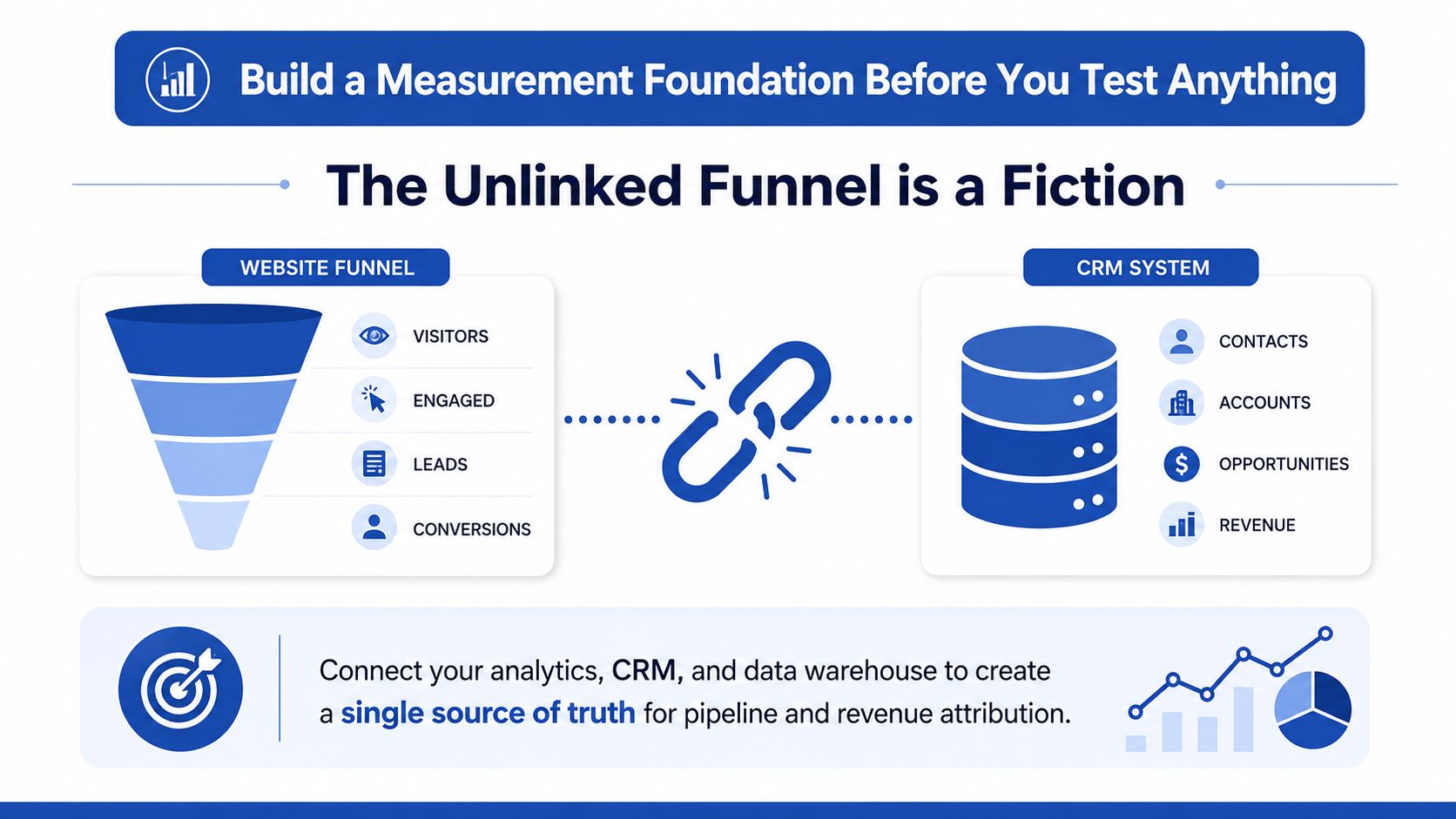
If your tracking can't survive the CRM, every test afterwards is theatre. Before changing a headline or rearranging a form, audit the full path from anonymous visit to revenue stage. That starts with a GA4 funnel audit, then segmentation by device, traffic source, and new versus returning visitors, then mapping the events to CRM lifecycle stages.
The cleanest way to do this is boring, and boring is good. Define the funnel, instrument each step, and decide what counts as a meaningful success before you launch a single experiment. A practical sequence is landing page view, CTA click, form start, form submit, thank-you page, CRM lead created, SQL, opportunity, and closed-won. The point is not to admire the funnel. The point is to make sure each step can be traced back to pipeline.
A useful field guide for that setup is this CRO audit step-by-step guide from Otter A/B, especially if your team keeps arguing about where the leaks are.
Make micro-conversions earn their place
Not every click deserves to be tracked as if it matters. Revenue-weighted micro-conversions do matter, though, because they let you see which behaviours predict later pipeline. If a pricing-page visit, a demo-booking click, or a Net Terms submission regularly precedes qualified opportunity creation, those events belong in your reporting model.
This is also where deduction and cleanup matter. Shopify records, CRM records, and marketing events need consistent IDs so one account doesn't look like three different people. UTM discipline matters too, because dirty source data makes channel comparisons useless. Low-quality form fills should be flagged, not hidden, so the experimentation queue favours buyer intent over raw volume.
Treat the CRM as part of the experiment
If the test wins on the website but loses in CRM, it didn't win. That means deduplication, lifecycle stage mapping, and lead-quality thresholds need to sit inside the programme, not as a nice-to-have afterthought. The hardest part is usually not the testing platform, it's getting sales, marketing, and RevOps to agree on the same definitions.
For a team that wants the workflow in more detail, Grumspot's customer journey mapping approach is a useful internal reference point because it forces the website journey to line up with downstream account movement.
The unlinked funnel is a fiction. If the website, CRM, and reporting layer disagree, the team will keep arguing about performance instead of improving it.
The discipline here is simple. Track what reaches revenue, not just what reaches the form. Then segment it, clean it, and use that as the base for every test that follows.
Map the Buyer Journey and Find the Highest-Value Friction
Common CRO roadmaps often start with the homepage because it's visible, but that's usually the wrong instinct. The page that deserves attention is the one closest to revenue and carrying the most friction, which is often a demo request, quote builder, contact flow, or account login page.
The stronger way to map B2B CRO is by stage, not by page. Anonymous research turns into known account behaviour, then approval, then order or contract progression, then reorder. Shopify Plus B2B work has to serve both the end user and the approval workflow behind the scenes, so buyer journey mapping matters more than page-by-page aesthetics.
| Page Type | Typical Conversion Rate | Top Quartile | Where to Focus |
|---|---|---|---|
| B2B SaaS website overall | 1.1% | Not stated in the verified data | Demo request, pricing, and contact flows |
| SaaS landing pages | 3.8% | 11.6% | Campaign landing pages tied to high-intent offers |
| Professional services landing pages | 6.1% | Not stated in the verified data | Contact, audit request, and consultation flows |
The table makes the prioritisation obvious. If you're running a Shopify Plus B2B site, homepage tweaks rarely beat work on the pages that already attract intent. Demo request pages, quote journeys, and account login pages usually carry more influence because they sit closer to sales-ready behaviour.
Prioritise by revenue impact, not visual prominence
A page with less traffic can still be the most valuable page in the business if it sits at the right point in the journey. I'd rather fix a quote flow with poor completion than spend a sprint polishing a hero banner. The first change can shift qualified pipeline, the second usually changes opinions in a meeting.
Mobile deserves a sharper lens too, because mobile influences more than 40% of B2B revenue according to the benchmark summary in the brief (Storylane benchmark summary). That does not mean every B2B buyer closes on a phone, it means mobile friction can damage a meaningful slice of the journey. Speed, form layout, and above-the-fold trust signals are not cosmetic issues.
For teams that want a practical way to structure the journey work, Grumspot's customer journey mapping approach is a useful reference because it ties the website journey to downstream account movement.
Use the journey map to choose your first ninety days
A practical priority stack looks like this, not because it is fashionable, but because it tends to expose the biggest leaks first.
- Demo request pages: These often carry the clearest intent, so even small reductions in friction can matter.
- Quote builders: Complex buying needs clarity, not more fields and more confusion.
- Contact flows: These are often where qualified leads get lost to unnecessary friction.
- Account login and reorder paths: Approved buyers should not have to fight the interface to repeat business.
The right test queue comes from the highest-value obstruction, not the prettiest page. Track what reaches revenue, not just what reaches the form. Then segment it, clean it, and use it as the base for every test that follows.
For the testing side of the programme, the hypothesis testing guide helps keep the work tied to evidence instead of opinions.
Turn Research Into Testable Hypotheses and Run Them Properly
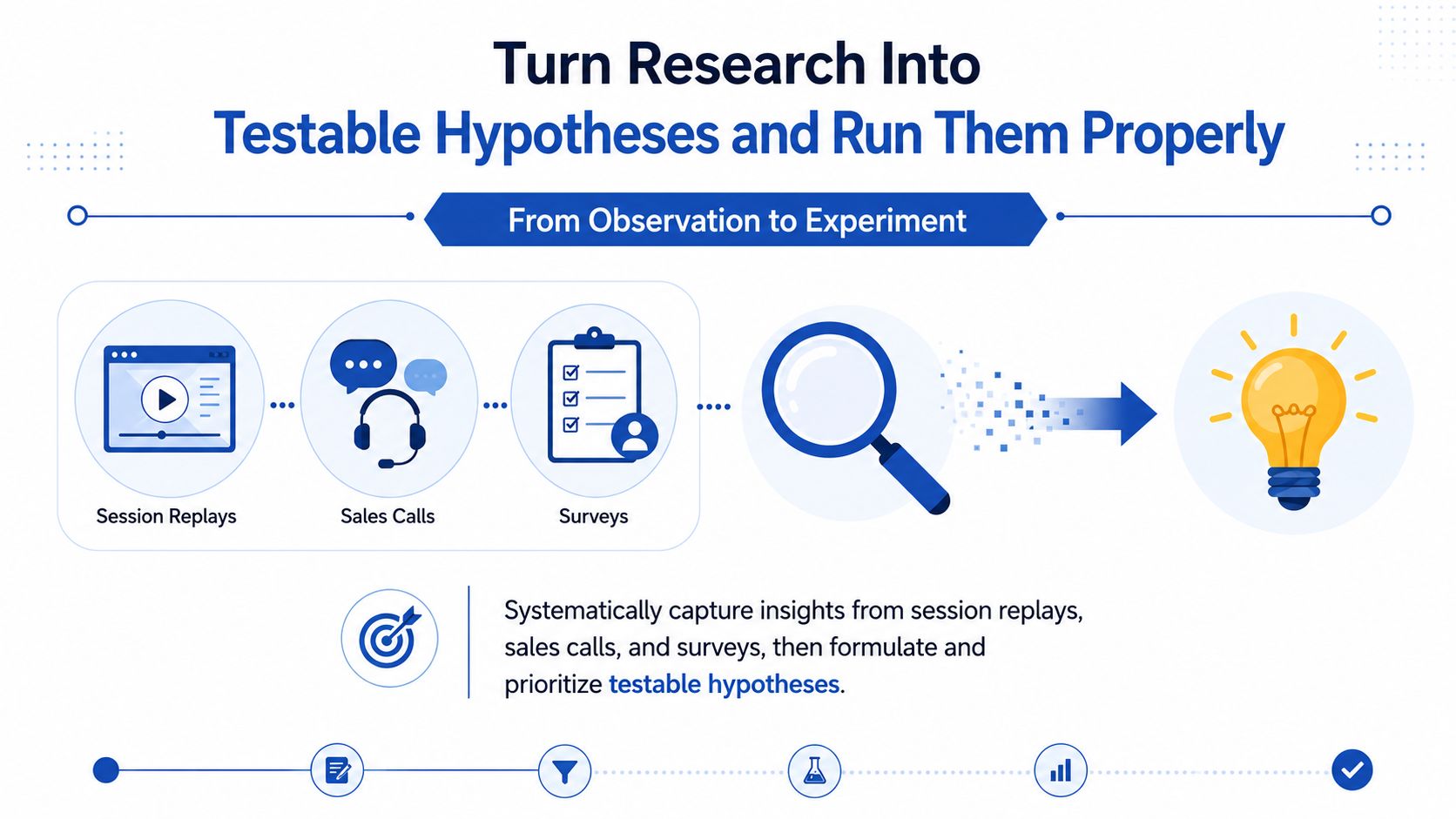
A backlog full of ideas is not a strategy, it is a wish list. Session replays, sales call notes, and exit surveys matter only when they turn into hypotheses you can test. Start with one observed friction point, one proposed mechanism, and one primary metric.
A good hypothesis is specific enough to be wrong. “The form is too long” is vague. “Removing the second phone field will increase form starts from high-intent mobile visitors because it lowers visible effort” is testable. You can argue about the idea, but you cannot hide from the outcome.
Build the test around the decision, not the idea
The strongest B2B experiments are usually single-variable tests. That keeps the result interpretable, which matters more than making the variant look clever. The team should also decide the minimum detectable effect before launch, because sample size and duration are not admin work, they are the difference between learning and guessing.
The practitioner guidance in the brief says that at a 3% baseline conversion rate and a 15% minimum detectable effect, you need roughly 10,000 visitors per variation, and tests should run for at least two full business weeks to capture weekday and weekend variance (Artisan Growth Strategies CRO guide). That is a useful reality check for teams that want conclusions by Friday. You do not get statistical truth on demand. For a tighter view of how significance decisions should be handled, this statistical significance testing guide is the right companion reference.
Decision rule: do not call a winner at 90% confidence when the downside of a false winner would pollute the pipeline for months.
The same source warns against peeking and early stopping, and that is not academic fussiness. If you keep checking the numbers and stopping when they look good, you will end up selecting noise. Use 95% confidence before declaring a winner, and pre-register the primary metric so everyone knows which outcome decides the test.
Use research inputs, then rank them
Session replays tell you where people hesitate. Sales calls tell you what objections keep repeating. Surveys tell you what is unclear. The backlog should then rank hypotheses by expected revenue impact, not by who shouted loudest in the planning meeting.
For teams that want a clean refresher on framing the experiment properly, SigOS's hypothesis testing guide is worth a read before anyone approves a launch. If the team cannot explain the null, the primary metric, and the stop rule, the test is not ready.
Here is a simple template that keeps teams honest.
- Hypothesis: what change will reduce friction?
- Mechanism: why should that change work for buyers?
- Primary metric: which conversion event decides success?
- Sample size: how much traffic is needed to avoid noise?
- Decision rule: what confidence threshold ends the debate?
If the hypothesis cannot survive that structure, it probably belongs in a research note, not an experiment queue.
Optimise UX, Forms, Pricing and Checkout for Real Buyers
This is the part that gets tactile. Buyers don't care that the wireframe is elegant if the form asks for nonsense, the pricing is hidden behind sales calls, or checkout treats a procurement buyer like a retail impulse shopper. B2B CRO earns its keep when the interface stops getting in the way.
Fix the form before you repaint the page
Long forms are often where teams bleed leads. The usual mistake is asking for too much too early, then dressing it up as qualification. A better move is to shorten the visible form, use progressive disclosure, and only ask for details that route the account.
Inline validation helps because buyers shouldn't have to guess what failed. Autosave matters on longer applications, because nobody enjoys retyping a company name and order reference after a timeout. Conditional fields also earn their place when they only appear for specific account types or buying motions.
Make the checkout feel built for B2B
Shopify Plus gives teams room to shape checkout and account flows in ways that standard retail setups can't. That's where Shopify Functions and custom checkout scripts become useful, because they let you suppress fields that frustrate approved buyers and add fields that B2B procurement expects. Think purchase order number, requested delivery date, and cost centre, not first-name theatre and marketing opt-ins.
Pricing clarity matters just as much. If the buyer needs approval, hiding tiered pricing or Net Terms until late in the process creates unnecessary friction. In B2B, trust signals such as customer logos, security badges, service-level clarity, and approval-safe language often do more work than decorative consumer-style banners.
If your buyer needs to explain the order internally, your page has to do part of that job for them.
This is also where Shopify Plus-specific execution pays off. A custom quote builder can fit one motion, while a B2B theme can support another, and a checkout extension can remove friction from the handoff. If the company sells through both self-serve and assisted flows, the page should make it obvious which path the buyer is in.
I've seen teams overcomplicate this and underdo the basics. Add the missing trust, remove the insulting fields, and make the pricing logic legible. That's usually a better use of a sprint than a full visual rebuild.
Layer ABM, Personalisation and Technical Performance
Personalisation only works when it earns attention. If the page is slow, vague, or irrelevant, swapping in a dynamic headline won't rescue it. The sensible hierarchy is simple. Target the right account, show the right offer, and make the page technically dependable.
Whitehat's summary of current B2B conversion optimisation points to AI-powered personalisation that can lift conversions by 20–30%, Core Web Vitals compliance that can create a 40–50% advantage over slower competitors, and Answer Engine Optimisation in an environment where 58.5% of searches end without a click (Whitehat conversion optimisation strategies). Those are useful directional signals, but they only matter if the buyer reaches the page and the page loads properly.
Start with relevance, then add intelligence
ABM and CRO should be partners, not separate departments. A personalised landing page for a target account, a dynamic CTA by industry, or a chatbot that routes enterprise intent can all help. But each one should be tied to a real buying behaviour, not a novelty.
If the personalisation just changes vocabulary, it's decoration. If it changes the offer, the proof, or the path through the experience, it has a shot at affecting conversion. That distinction matters because buyers notice relevance quickly and ignore gimmicks even faster.
The internal segmentation work belongs here too, and Grumspot's customer segmentation strategy is a useful companion reference when teams need to decide which segments deserve bespoke treatment. Segmentation without a conversion plan is just a list. Segmentation with a page strategy becomes a lever.
Protect the experience with speed and search
Technical performance is not separate from CRO, it is part of the offer. If demo requests stall, checkout feels laggy, or mobile interactions are sluggish, the buyer's intent decays. That's especially painful on high-intent pages, where the user already wants to act.
On-site search and content also matter more than teams like to admit. If buyers are landing from search and leaving without a click, the page needs to answer faster and more clearly. That doesn't mean stuffing more copy into the page. It means giving the buyer the proof, the route, and the answer with less friction.
For tactical lead qualification work tied to these motions, boost B2B conversions is a useful read because the conversion problem in B2B often begins with the wrong leads, not just the wrong interface. If the lead quality is weak, no amount of front-end polish will rescue the funnel.
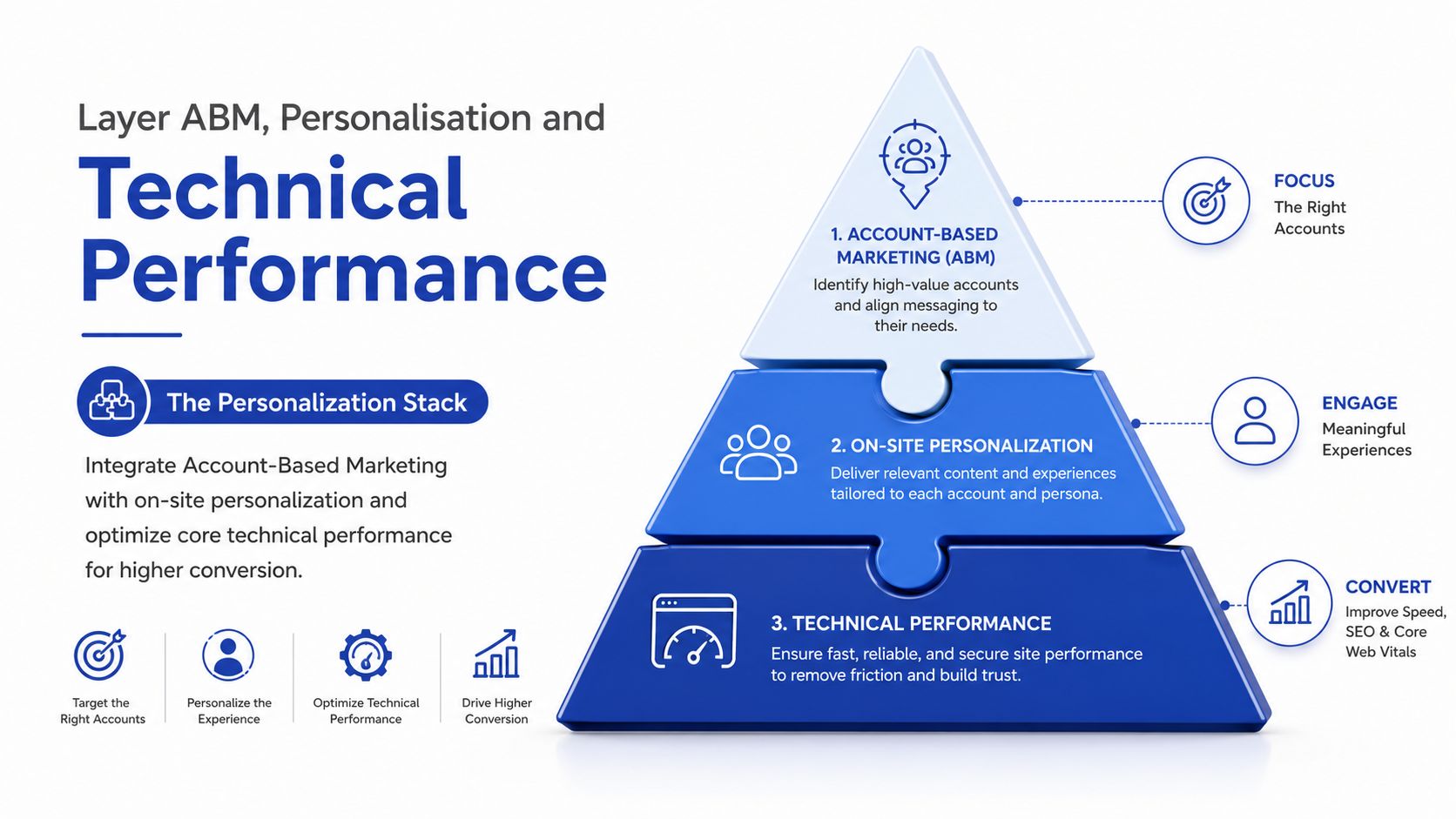
The order matters. First, decide who matters. Then show them something useful. Then make sure the page doesn't get in its own way.
Run the Programme, Align Stakeholders and Prove Pipeline Impact
A CRO programme dies when it becomes a private hobby of the marketing team. The work needs weekly rhythm, visible ownership, and a reporting model that sales and finance can trust. Otherwise the team ends up celebrating page metrics while the business asks for pipeline.
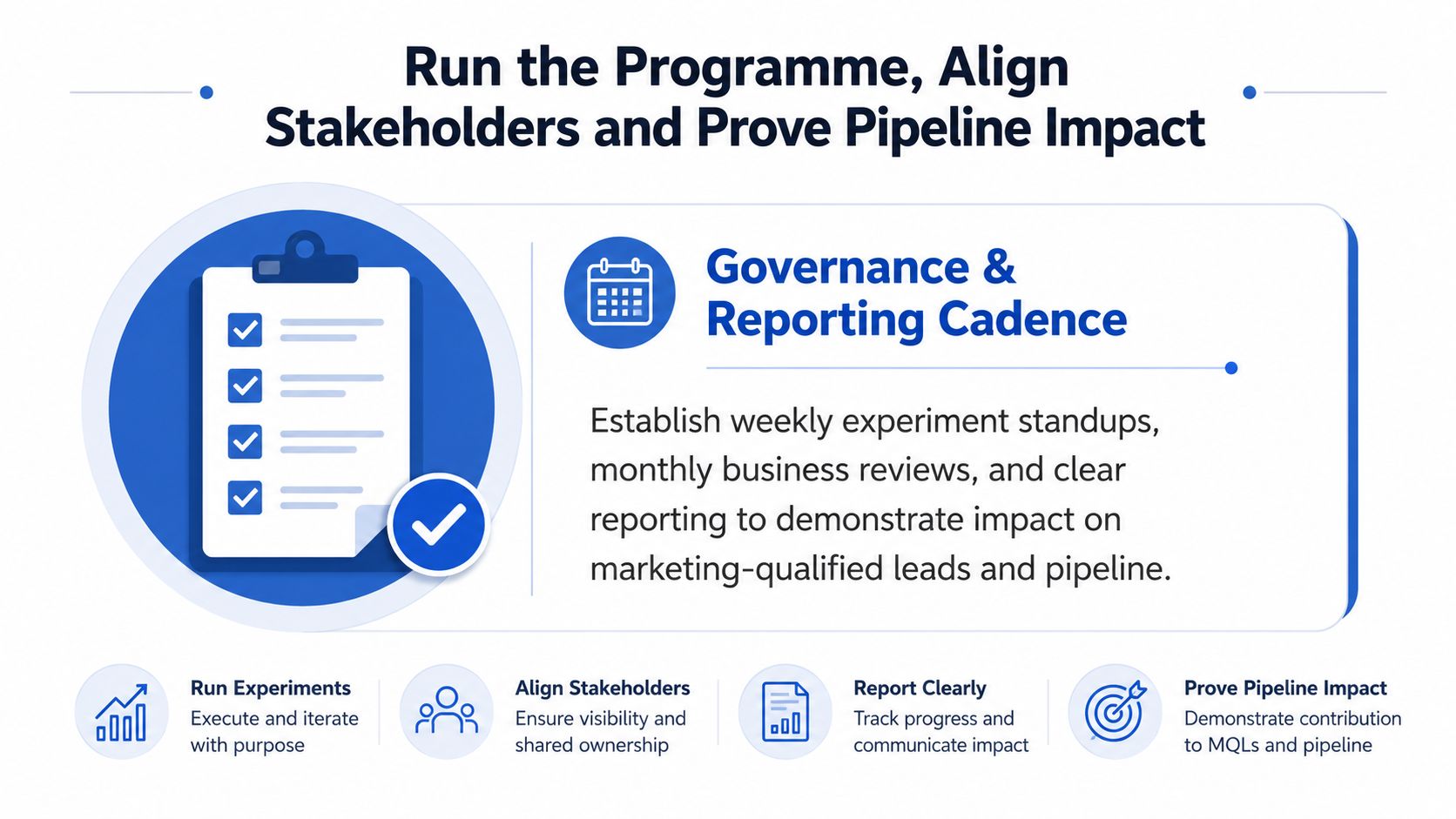
The operating cadence should be plain. Hold weekly experiment standups. Run monthly business reviews tied to pipeline, not just form fills. Keep a shared roadmap that marketing, sales, product, and the agency can all see. That structure prevents the usual drift where everyone agrees to “optimise conversion” but nobody agrees on what conversion means.
Give each stakeholder a reason to care
Sales cares about lead quality, speed to qualification, and whether the new flow makes follow-up easier. Product cares about implementation risk and whether the changes create debt. Marketing cares about acquisition efficiency and messaging consistency. RevOps cares about data integrity and attribution. If each group can't see its stake, the programme gets resistance instead of momentum.
The best ritual I've seen is the pre-mortem before launch. The team names everything that could go wrong, from tracking breakage to legal objections. Then the post-test readout is shorter than the debate that preceded it, because the decision rule was already agreed. That discipline keeps ego out of the room.
The governance layer should also include a clear scoreboard. Track the experiment, the expected funnel effect, and the downstream pipeline outcome. If a test lifts form fills but hurts SQL quality, it's not a win. If it improves account-quality engagement and shortens the path to opportunity, that's the sort of result worth rolling out.
Keep the programme alive after the first win
A winning test is not the finish line. It's the proof that the programme deserves another cycle. The trick is to avoid the common failure mode where one bad month freezes the budget and one good month causes overconfidence. Report the learning, not just the result.
Use a Monday-morning checklist that forces action. Pick one page. Set up one funnel. Write one hypothesis. Schedule one review. If that sounds small, good. B2B conversion rate optimization compounds when the team can repeat the basics without drama, and the basics are exactly what drive revenue over time.
If your team wants a Shopify Plus partner that can audit the funnel, build the variants, and connect the changes back to revenue rather than vanity metrics, start a conversation with Grumspot.
Let's build something together
If you like what you saw, let's jump on a quick call and discuss your project
Related posts
Check out some similar posts.
- shopify store credit
Learn how to set up Shopify store credit with built-in tools or apps. Covers policy design, refund w...
Read more
- unified commerce platform
Learn how a unified commerce platform connects channels, ERPs, and CRMs to drive growth. Practical g...
Read more
- composable commerce platform
Learn what a composable commerce platform is, how it differs from monoliths, and how UK Shopify Plus...
Read more
- b2b ecommerce platform
Discover how a B2B ecommerce platform helps scaling brands streamline operations, boost sales, and g...
Read more