7 Conversion Rate Optimization Case Studies for 2026
- conversion rate optimisation case studies
- cro examples
- ecommerce cro
- ab testing examples
- grumspot
Launched
June, 2026
Most brands only convert a small slice of the traffic they already pay for. The expensive part often isn't getting the click. It's failing to turn that click into action once the visitor lands. That's why the best conversion rate optimization case studies matter. They show where friction lived, what teams changed, and which tests moved revenue instead of vanity metrics.
A strong example comes from UK insurer Enhance Insurance, which increased landing page conversion rate to 18.69% and delivered a 138% uplift in conversion rate by adding more above-the-fold CTAs and refining the wording for a UK audience, according to this Lead Forensics case study roundup. That's the level of specificity worth studying.
This article breaks down seven sources of conversion rate optimization case studies using a practitioner's lens. For each one, I'm looking at the same things: the problem, the hypothesis, the test, and the result. If you also want ideas for traffic acquisition that pair well with post-click optimisation, you can learn from Proven SaaS ad examples.
1. Grumspot
Stores rarely lose conversions because of one dramatic mistake. More often, revenue slips through a stack of smaller issues. Weak product page hierarchy, slow theme execution, awkward bundle flows, and a checkout path that asks the customer to work too hard all add up.
That is why Grumspot stands out in this list. Their case studies and service model are built around execution, not just diagnosis. For Shopify and Shopify Plus brands, that matters. A strong CRO idea has limited value if the team cannot implement it cleanly inside the storefront, the theme, and the app stack.
Problem, hypothesis, test, results
The recurring problem in Grumspot work is straightforward. Traffic is already there, but the buying journey does not support purchase intent well enough. Shoppers hesitate at selection, miss cross-sell opportunities, or abandon because the path from interest to cart feels heavier than it should.
The hypothesis structure is practical and reproducible. Fix the point of friction closest to revenue. That might mean improving visual hierarchy on the PDP, reducing decision load in bundle creation, or rebuilding a blocked experience that the current theme cannot support. If the change makes choice easier and purchase flow clearer, conversion rate or average order value should improve.
One useful example is Grumspot's bundle creator work, which increased average order value for a client. The lesson is bigger than the feature itself. Bundling often sits in the merchandising bucket, but for many ecommerce stores it functions as CRO. It changes how customers buy, not just what they see.
Practical rule: If customers naturally buy complementary products together, test the bundle flow as part of conversion optimisation, not as a separate upsell project.
Where Grumspot fits best
Grumspot is a strong fit for merchants that need one team to diagnose friction and ship the fix. That usually means stores dealing with a mix of UX issues, Shopify 2.0 constraints, app conflicts, redesign requirements, or migration work. In those situations, splitting strategy, design, and development across separate vendors slows testing and weakens accountability.
Their operating model is also more usable than many agency setups. Brands can start with a focused project or continue with ongoing iteration. The team structure matters here too: senior Shopify developers, UX designers, and CRO specialists work in one engagement, with weekly strategy calls and regular progress updates.
A few details make the offer easier to evaluate:
- Fast onboarding: Projects typically begin within a few business days.
- Operational clarity: One-off builds suit targeted releases, while retainers support weekly testing and iteration.
- Technical range: Shopify development, migrations, app work, ERP and CRM integrations, and CRO sit under one team.
- Low-risk entry point: A free UX audit helps identify whether the problem is messaging, flow, or implementation.
The trade-off is clear. Pricing is custom, so buyers need a conversation before they can compare scope against budget, and availability may tighten during busy periods. Still, for Shopify brands that want both strategic diagnosis and implementation, Grumspot provides a useful benchmark for what conversion rate optimization looks like in a practical ecommerce workflow.
2. Conversion Rate Experts
Some CRO firms publish glossy outcomes. Conversion Rate Experts usually publishes the logic behind the outcome. That's why practitioners still read them. Their case studies tend to show the research path, the message changes, the test rationale, and the commercial impact in more detail than most agency write-ups.
That makes CRE useful when you don't just want ideas. You want to see how an experienced team moved from evidence to hypothesis.
Problem, hypothesis, test, results
The underlying problem CRE materials often address is not “the button colour is wrong”. It's broader. The page doesn't answer the buyer's objections, the offer isn't framed in the right order, or the funnel asks for commitment before trust exists. That's a more valuable lens than surface-level UI commentary.
The hypothesis structure is usually message-led. If the page clarifies the value proposition, aligns proof with buyer anxiety, and reduces ambiguity at the commitment point, conversion should improve. That sounds obvious, but in practice many teams skip the diagnosis and jump straight to layout edits.
The test style is where CRE earns its reputation. They tend to connect customer research, analytics, and validation instead of treating experimentation as random iteration. If you're vetting outside support, this is also a good benchmark for what a serious conversion optimisation agency process should look like.
Good CRO case studies don't just show a winning page. They show why the original page lost.
Real trade-offs
CRE's main advantage is rigour. Their main drawback is that the library is curated rather than huge, and some older examples reflect older tooling or page conventions. That doesn't make the lessons obsolete, but it does mean you need to translate the principles into a modern stack.
If you're after depth over volume, Conversion Rate Experts is one of the better places to study how strong experimentation programmes are reasoned through.
3. Conversion
Conversion has strong UK relevance, which matters more than many listicles admit. Consumer expectations, device behaviour, shipping norms, and trust patterns differ by market. A case study from a UK-heavy agency is often easier to adapt than one built around a very different buying context.
Their material is particularly useful for brands that need more than one test. It reflects programme thinking, not just isolated wins.
Problem, hypothesis, test, results
A good example of the kinds of patterns UK teams should pay attention to is shipping transparency. In a UK-focused audit, making shipping details visible from the first checkout step increased purchases by 54.19% among UK shoppers, and the same source notes that hidden shipping fees drive abandonment for many UK consumers, according to this Sitetuners CRO case study roundup.
That's the kind of issue Conversion's body of work tends to align with. The problem isn't always dramatic. Sometimes the loss comes from uncertainty introduced too late in the journey. The hypothesis is then behavioural, not decorative. If visitors understand total cost, delivery expectations, or next-step commitment earlier, more of them continue.
What I like about Conversion's case study style is that the UX changes usually tie back to a research trail. The visual updates aren't presented as taste. They're framed as responses to identifiable friction.
Best use case
Choose Conversion when you want examples of experimentation programmes that connect research, prioritisation, design, build, and analysis. The limitation is that some stories emphasise outcomes more than test mechanics, so you may not always get the granular implementation detail a hands-on team wants.
Still, for UK ecommerce and subscription brands, it's a strong reference point for end-to-end optimisation thinking.
4. VWO Success Stories
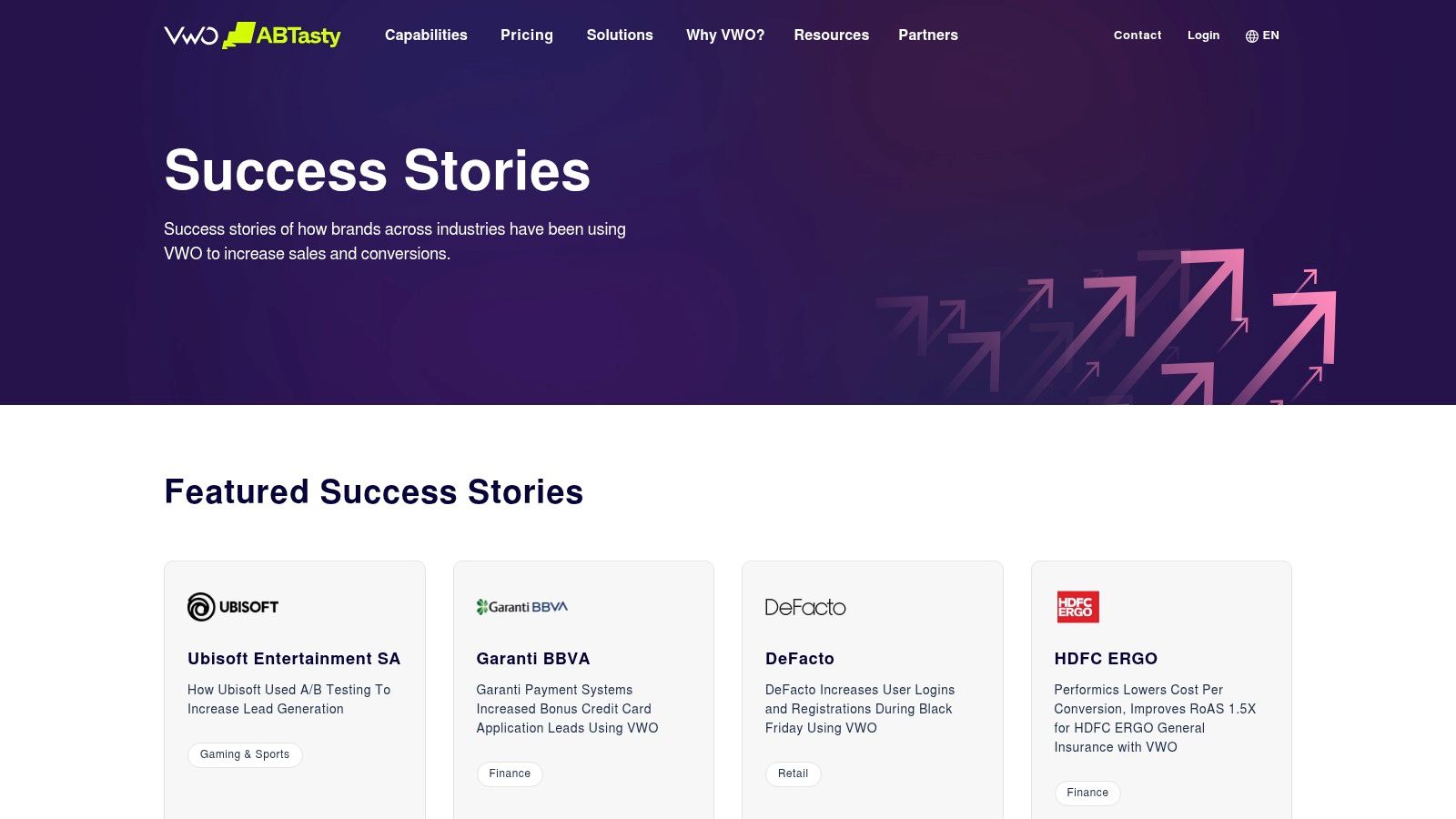
If your goal is idea mining, VWO's success story library is one of the most practical places to spend time. It's broad, searchable, and often specific enough to adapt quickly on Shopify, custom ecommerce stacks, or lead gen sites.
You use this to test concepts for product pages, cart friction, cross-sell modules, form flows, and CTA placement.
Problem, hypothesis, test, results
One standout case in the VWO library involved Flos USA. After a redesigned cross-sell layout, the brand saw a 125% increase in checkout conversion rates, a 24.18% increase in purchases, a 16.21% boost in revenue, and an 18X return on investment, according to VWO's case study collection.
The mechanics matter. The winning approach centred on cross-sell layout, CTA placement, and urgency on product pages. That's useful because it shows how often “big results” come from small structural changes near an existing buying decision, not from homepage reinvention.
For teams running Shopify, this is also the right moment to think about tooling discipline. A test only helps if the variant is implemented cleanly, tracked correctly, and measured against the right segment. If you're planning that stack, Grumspot's guide to Shopify A/B testing services is a helpful technical companion.
Field note: Test the placement and context of offers before you test more aggressive discounting. Layout fixes are often cheaper to maintain than margin erosion.
Trade-offs
VWO's strength is volume and tactical variety. Its weakness is the usual vendor bias. Many examples reflect the VWO workflow and naturally frame the platform as central to success. That doesn't invalidate the lessons, but it should keep you analytical.
For tactical inspiration with enough detail to build a testing backlog, VWO Success Stories is hard to beat.
5. Optimizely Customer Stories and Experimentation Playbooks
Optimizely sits higher up the maturity curve. Its customer stories are less about one page fix and more about how organisations build experimentation into operations, analytics, governance, and product delivery.
That makes it more useful for larger teams than for a small merchant looking for a fast homepage win.
What the case studies teach
The recurring problem in Optimizely-style environments is organisational. Teams have enough traffic and enough opportunity, but they lack a repeatable way to prioritise tests, ship variants, and learn across departments. The bottleneck is process.
The hypothesis is then programme-level. If the company creates a clear experimentation framework, aligns stakeholders around shared KPIs, and reduces the friction involved in launching tests, better conversion outcomes follow over time. That's less glamorous than a single-page uplift headline, but it's closer to how mature CRO works.
Their downloadable playbooks are useful because they speak to governance, analytics integrations, and operating cadence. Those topics don't get enough attention in lighter conversion rate optimization case studies.
Where it falls short
For smaller teams, Optimizely customer stories can feel a bit distant. The platform and programme model suit organisations with traffic, development resources, and internal buy-in. Pricing is enterprise and quote-based, which also narrows fit.
If you're building a culture of testing across multiple teams, though, Optimizely's library is one of the better strategic references available.
6. AB Tasty Customers and Case Studies
AB Tasty is especially useful for UK and European teams that need experimentation examples grounded in regional privacy realities and personalisation constraints. Their case studies often sit at the intersection of CRO and experience tailoring, which is where many mid-market brands eventually need to go.
This makes AB Tasty more interesting than a pure split-testing archive.
Problem, hypothesis, test, results
The strongest pattern in AB Tasty materials is segmentation. A generic journey underperforms because not every visitor needs the same prompt, message, badge, or product recommendation. The problem isn't only friction. It's mismatch.
The hypothesis is that more finely tuned content and interactions increase relevance at the decision point. That might mean urgency badges, recommendation modules, adjusted messaging for new versus returning users, or cleaner form flows.
This is also where teams need discipline. Personalisation can become noise if the segmentation logic is weak or impossible to maintain. AB Tasty's examples are useful because they often show the intervention in context, not just the end result.
The best personalisation doesn't announce itself. It simply removes one unnecessary decision for the visitor.
Practical fit
AB Tasty is a good resource for brands that want to combine testing and personalisation without jumping straight into a heavyweight enterprise stack. The downside is access friction. Some materials are gated, and pricing isn't public.
Still, if your CRO backlog increasingly includes audience-specific experiences rather than universal page changes, AB Tasty is worth studying.
7. Dynamic Yield by Mastercard Case Studies
Dynamic Yield is where conventional CRO starts blending into mature personalisation and merchandising. The case studies usually focus on recommendation logic, messaging placement, and segmentation depth. For larger catalogues and more complex customer journeys, that's often where the next gains sit.
This repository is less about “change the headline” and more about “serve the right nudge to the right segment in the right slot”.
Problem, hypothesis, test, results
A useful adjacent lesson here comes from a UK-based Shopify store that increased conversion rate by 34% after a data-led audit fixed checkout leaks, enabled Shop Pay, and added a dynamic shipping bar tied to the free-shipping threshold. The same implementation also lifted average order value by 18%, according to this UK Shopify CRO guide.
That matters because it mirrors the logic behind many Dynamic Yield-style interventions. The problem is rarely just traffic quality. It's that the site doesn't guide momentum well enough. The hypothesis is that context-aware prompts, clearer incentives, and reduced effort increase progression and basket value.
Dynamic Yield's best case studies usually include segmentation logic and placement strategy. That's valuable. It lets experienced teams assess whether the tactic is transferable or too dependent on enterprise data layers.
Fit and caution
Dynamic Yield case studies are best for mid-market and enterprise operators with enough traffic, catalogue depth, and implementation support to benefit from advanced personalisation. Smaller merchants can still learn from the principles, but not every pattern is lightweight to deploy.
Use this library when your biggest gains no longer come from fixing obvious UX friction and instead come from orchestrating relevance across the journey.
Comparison of 7 Conversion Rate Optimization Case Studies
| Service | Implementation Complexity 🔄 | Resource Requirements ⚡ | Expected Outcomes 📊⭐ | Ideal Use Cases 💡 | Key Advantages ⭐ |
|---|---|---|---|---|---|
| Grumspot | Medium–High: bespoke themes, migrations, ERP/CRM integrations | Agency engagement or retainer; senior devs, UX/CRO specialists | 📊 Conversion-led revenue lifts (case example: +61% AOV); predictable deliverables | Rapid Shopify Plus rebuilds, fast migrations, conversion-first initiatives | Fast turnaround, conversion-first UX, end-to-end Shopify expertise |
| Conversion Rate Experts (CRE) | Medium: deep research and rigorous experiment design | Consultancy time for audits and test programs; reading case studies for learnings | 📊 Methodical, revenue-focused case studies useful for benchmarking | Teams wanting transparent, numbers-driven experiment blueprints | Rigour and methodological transparency in CRO reporting |
| Conversion (conversion.com) | Medium–High: end-to-end experimentation program setup | Dedicated practitioner team; program design and delivery capacity | 📊 Program-level ROI claims (example: reported 18× ROI) and UX-linked lifts | Organisations building sustained experimentation operating models | Strong end-to-end experimentation capability and practitioner depth |
| VWO (Success Stories) | Low–Medium: tactical A/B test recipes and screenshots | Tool subscription or use of examples; in-house test execution capability | 📊 Practical, replicable uplifts and many quick-win ideas | Teams seeking tactical test ideas and step-by-step examples | Large searchable library, tactical details and public pricing |
| Optimizely (Customer Stories) | High: enterprise-grade scaling and governance work | Enterprise platform, analytics integrations, governance resources | 📊 Scalable test-and-learn culture tied to business KPIs | Enterprises scaling experimentation across product and marketing | Comprehensive playbooks, multi-format resources for program scale |
| AB Tasty (Customers) | Medium: mix of client- and server-side testing with localisation | Tooling plus IT for server-side; attention to EU/UK privacy | 📊 Regionally relevant CRO + personalisation examples with measured uplifts | European/UK teams wanting localised personalisation and CRO tactics | European footprint, downloadable PDF case studies with tactics |
| Dynamic Yield (by Mastercard) | High: advanced personalisation and segmentation implementations | Enterprise resources, server-side capabilities, segmentation data | 📊 Personalisation-driven AOV and revenue-per-user uplifts; segmentation details | Mid-market to enterprise focusing on recommendations and targeting | Mature personalisation programs with concrete segmentation logic |
From Insight to Impact: Your CRO Action Plan
Teams that treat conversion rate optimization case studies like swipe files usually get weak results. They copy the surface tactic, skip the diagnosis, and miss the reason the change worked in the first place. The result is familiar: urgency banners nobody trusts, oversized CTAs with no context, and redesigns that improve aesthetics more than revenue.
The useful pattern across these examples is a working framework you can reuse: Problem, Hypothesis, Test, Results. That structure matters more than the page layout or button color in any individual win. It forces a team to define what is broken, why it is happening, what single change should address it, and which commercial metric will confirm the outcome.
Across the case studies in this roundup, the strongest gains tended to come from four types of intervention:
- Reducing uncertainty: clearer shipping details, return policies, pricing context, and next steps
- Improving visibility: stronger CTA placement, better product discovery, and cleaner information hierarchy
- Removing effort: shorter forms, fewer checkout steps, and easier product selection
- Increasing relevance: tighter segmentation, smarter cross-sells, and more context-specific messaging
One practical trade-off shows up often. Broad redesigns create more visual momentum internally, but focused tests are easier to learn from and easier to scale. If a team needs cleaner insight, test one meaningful variable at a time. If the funnel is clearly broken at multiple points, bundle only the changes tied to the same hypothesis and measure downstream revenue impact carefully.
CRO also starts before the visit. According to Discovered Labs' analysis of upstream conversion dynamics, AI-driven vendor research is shaping who arrives with intent in the first place. For B2B teams, that means on-page optimization and pre-visit discoverability now influence the same conversion path.
Start where friction sits closest to revenue.
For ecommerce, that usually means product page clarity, cart transparency, or checkout speed. For lead generation, the pressure points are often offer framing, form length, proof, and CTA prominence. Pick one high-friction step, write the hypothesis in plain language, ship the test fast, and record the result in a format the whole team can reuse.
That last step gets ignored too often. Internal case studies become operating assets when they document the full chain from problem to result, including what did not work, what engineering effort was required, and whether the lift held over time. That is how teams stop debating preference and start building a testing program with memory.
If you want outside support while building that process, it's worth comparing specialist providers with broader service offers such as Digital Skyrocket's CRO services. The right partner should contribute more than redesign recommendations. They should bring prioritization, testing discipline, implementation support, and a clear line between site changes and business outcomes.
Grumspot is a strong fit for teams that need diagnosis and execution in the same engagement. Their model is especially useful for Shopify brands that have moved past obvious quick wins and now need design, development, testing support, migrations, and custom app work coordinated by one team.
Let's build something together
If you like what you saw, let's jump on a quick call and discuss your project
Related posts
Check out some similar posts.

- how to improve conversion rate optimization
Learn how to improve conversion rate optimization with our CRO framework for Shopify. Diagnose probl...
Read more
- conversion rate optimisation ux
Learn our conversion rate optimization ux playbook. Transform your ecommerce store with expert strat...
Read more
- shopify accessibility audit
Learn how to conduct a Shopify accessibility audit. Our guide covers WCAG compliance, legal risks, a...
Read more
- shopify conversion rate optimization
Unlock growth with our 2026 Shopify conversion rate optimization playbook. Learn data-driven strateg...
Read more