Customer Review Management: Shopify UK Playbook
- customer review management
- shopify reviews
- ecommerce reviews
- review strategy uk
- shopify cro
Launched
June, 2026
You're probably already doing some version of review management. A review app is installed. A few emails go out after purchase. Someone on the team replies to the worst complaints when they notice them. The problem is that this setup looks active from the inside and feels inconsistent from the customer's side.
That gap matters more on Shopify than many merchants realise. Reviews don't sit in one neat box called “social proof”. They affect product page confidence, post-purchase retention, email segmentation, search visibility, customer service load, and whether a new visitor trusts you enough to buy at full price.
For UK Shopify brands, customer review management also comes with two extra layers of complexity. First, trust is fragile. Second, automation has to be built around UK compliance, not bolted on afterwards. If your review requests fire too early, your response process is patchy, or your data handling is vague, you're not just missing feedback. You're weakening conversion at multiple points in the funnel.
The Foundation of Trust Why Reviews Matter More Than Ever
Most merchants don't have a review problem. They have a systems problem.
Reviews get treated as an app feature instead of a commercial function. That leads to familiar symptoms. Product pages have a handful of old reviews. Google and Trustpilot have different response standards. Negative feedback lands in a support inbox and never makes it back into merchandising, fulfilment, or CRO decisions.
In the UK, that's expensive. According to the Office for National Statistics, 96% of UK consumers read reviews before purchasing, and 72% abandon transactions if no reviews exist. Those figures sit inside a UK-specific review workflow benchmark that also stresses timing, personalisation, moderation, and automation discipline. The underlying issue isn't whether reviews matter. It's whether your store has a dependable way to generate, surface, and act on them.
Reviews are trust infrastructure
When I audit Shopify stores, I don't look at reviews as a reputation layer. I look at them as trust infrastructure.
A strong review system does four jobs at once:
- Reduces purchase hesitation by giving shoppers proof from people who've already bought
- Improves merchandising decisions because patterns in feedback expose product or fulfilment issues fast
- Supports CRM segmentation by separating delighted customers from frustrated ones
- Creates reusable content for PDPs, email, paid social, landing pages, and support macros
That's why customer review management belongs in the same conversation as conversion rate optimisation and lifecycle marketing.
Reviews work best when they aren't isolated inside a widget. They need to feed your storefront, your CRM, and your support process.
UK pressure changes the way merchants evaluate review systems
Many UK brands are trying to protect margin while still improving conversion. That changes how review management gets funded internally. If you're comparing software, service overhead, and automation effort, you need to look beyond “more reviews” and ask whether the process reduces support friction, protects trust, and helps you convert traffic you're already paying for.
That commercial mindset is similar to how merchants assess channel economics elsewhere in the stack. If you've ever worked through marketplace cash flow questions, this guide on understanding Amazon Monthly Payments is a useful example of the kind of operational detail that affects real trading decisions. Review operations deserve the same level of scrutiny.
Building Your Review Collection Engine
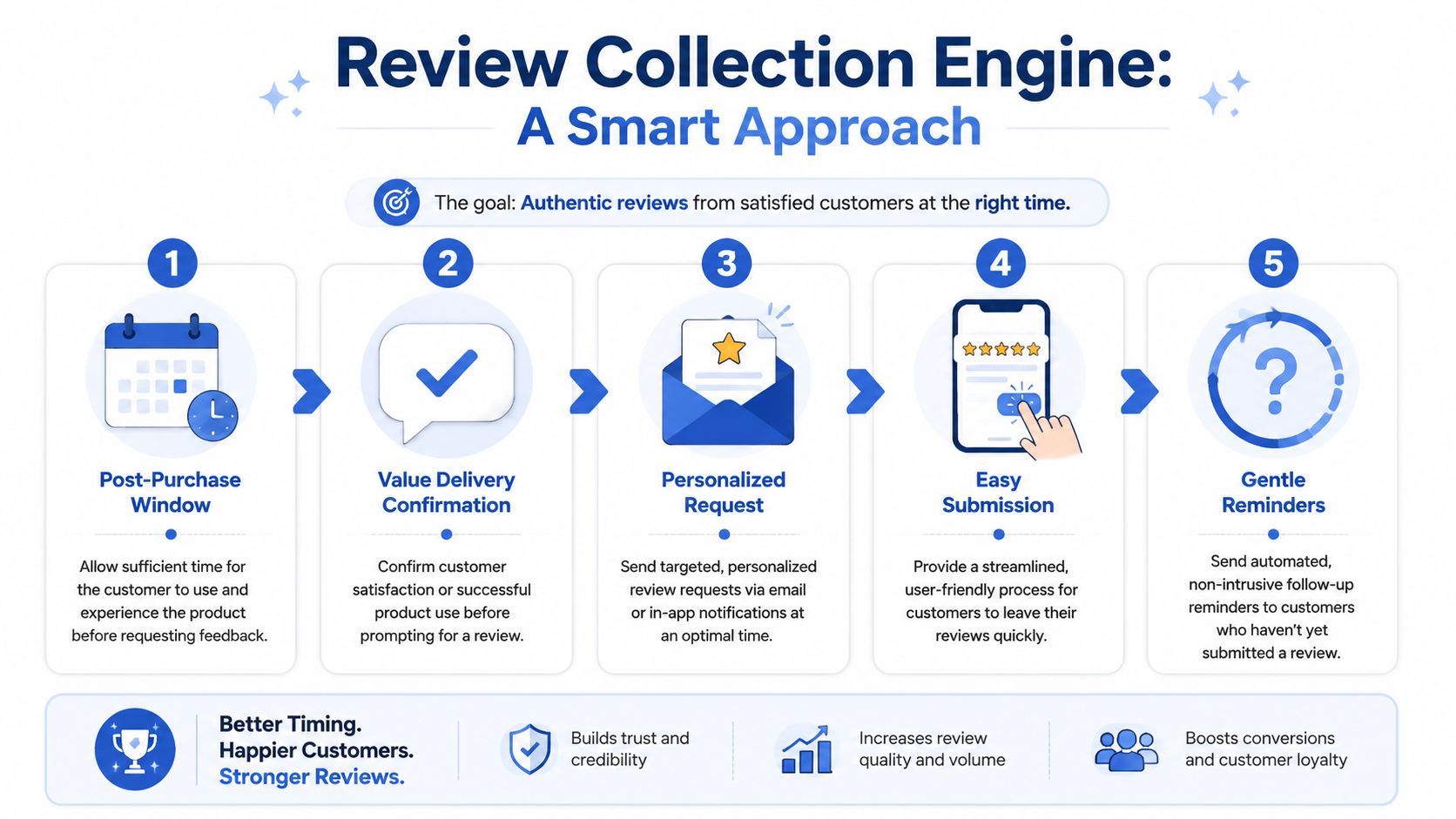
A review engine fails for one of three reasons. It asks too early, sounds generic, or makes leaving feedback harder than it should be.
The fix isn't complicated, but it does require discipline in setup.
According to UK government-commissioned data from the Office for National Statistics, 96% of UK consumers read reviews before purchasing. A methodology that triggers automated review requests 48 to 72 hours post-delivery reduces request-to-feedback latency by 34%, and UK brands using these workflows achieve 2.3x higher review volume than manual follow-ups.
Get the timing right first
The biggest mistake is firing the request immediately after purchase. The customer hasn't received the item, hasn't used it, and has no meaningful opinion yet.
The UK benchmark is clear on this. Trigger the request 48 to 72 hours after confirmed delivery, not after order confirmation. That gives the customer enough time to form an actual view while the purchase still feels recent.
The same benchmark also notes that requesting too early leads to 41% lower response rates. Timing isn't a small optimisation. It's the base layer.
A practical Shopify Plus setup usually looks like this:
- Delivery event captured through Shopify, your 3PL, or a shipping app webhook.
- Delay window applied based on product type. Apparel may need less time than skincare, supplements, or homeware.
- Review request sent by email or SMS with a direct path to leave feedback.
- Reminder sent selectively only to non-responders, without nagging people who already replied.
Personalisation beats templates
Generic review requests underperform because they look automated in the wrong way. Customers can tell when the message was written for nobody.
The UK benchmark warns that using generic templates instead of personalised messages cuts UK engagement by 28%. The simplest fix is also the most effective. Reference the customer's first name and the exact product purchased.
Here's the difference in practice:
| Message type | What it sounds like | Likely outcome |
|---|---|---|
| Generic | “Please review your recent order” | Easy to ignore |
| Personalised | “Hi Sarah, how's your new merino base layer fitting so far?” | Feels relevant |
| Platform-led | “Share your experience on Google or Trustpilot” | Better for off-site proof |
The strongest flows also use embedded shareable links to the destination that matters most. For many UK brands, that means a blend of on-site product reviews plus external platform signals on Google and Trustpilot.
Choose apps that fit your stack, not just your widget
For Shopify stores, the common shortlist usually includes Judge.me, Loox, and Yotpo. Each can work, but the right choice depends on what you need the review system to do beyond collection.
Use this filter:
- If you want lightweight speed: Judge.me is often easier to launch and maintain.
- If visual UGC matters heavily: Loox can be useful for photo-led review capture.
- If reviews need to plug into a broader retention stack: Yotpo is stronger when tied into SMS, loyalty, and lifecycle tooling.
For Shopify Plus, the app should also meet the technical bar set out in the UK benchmark: Built for Shopify standards, API v2.0 support, real-time webhook callbacks for review ingestion, and GDPR-compliant handling of UK customer consent.
Practical rule: Don't pick a review app based on widget aesthetics alone. Pick the one that can pass review data cleanly into your CRM and support workflows.
Build for momentum, not one-off bursts
A healthy review engine doesn't chase occasional spikes. It creates a steady flow of fresh, usable feedback.
That means:
- Segmenting by product type so the request delay matches actual usage time
- Routing high-intent customers to the platform you most need to strengthen
- Keeping the form friction low on mobile
- Moderating submissions so spam doesn't poison trust later
The same UK benchmark notes that failing to moderate spam or inappropriate content causes 19% of UK shoppers to distrust the brand. Collection and moderation are part of the same engine. If you treat them separately, quality drops fast.
Moderating and Responding Like a Pro
Collection gets you volume. Response quality is what turns that volume into trust.
Many brands still handle incoming reviews in a way that's half support queue, half panic. The result is inconsistent tone, delayed responses, and a public record that makes the business look less organised than it really is.
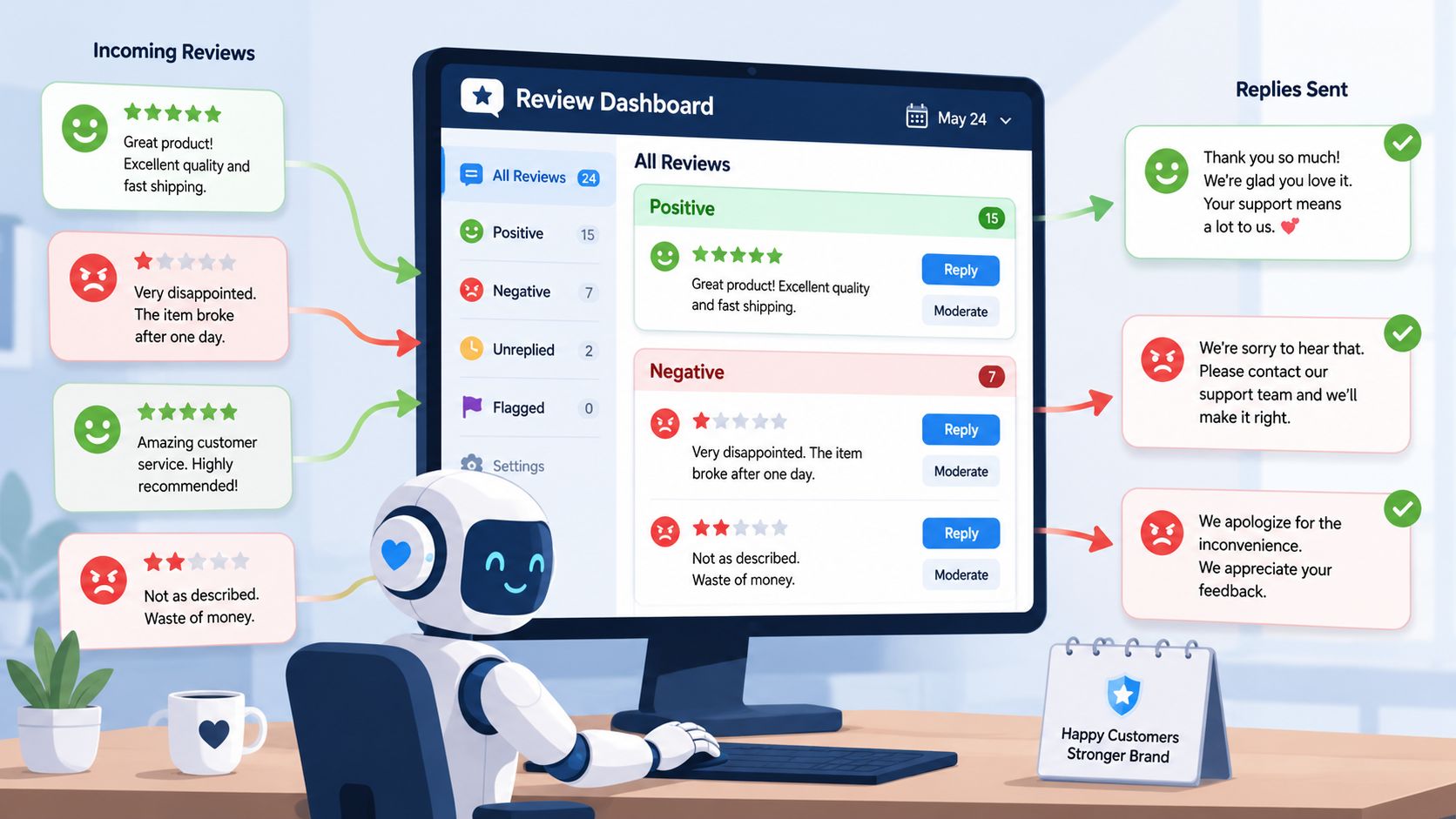
A 2025 UK Retail Innovation Council study found that 94% of UK shoppers say a negative review damages brand trust, but 94% also expect a response to reviews within 48 hours. Ignoring negative feedback can lead to 27% higher churn in UK markets.
Moderate with automation, approve with judgement
You should absolutely use AI-driven spam filtering. You should not let automation decide every edge case without oversight.
A workable moderation stack usually includes:
- Spam and abuse filtering for obvious junk, duplicates, or policy-breaking submissions
- Sentiment tagging into positive, negative, and neutral
- Issue categorisation such as fulfilment, product quality, fit, damaged goods, or support delay
- Escalation rules for legal risk, safety concerns, or repeat complaints
For stores handling larger order volume, it helps to connect review handling with broader service workflows. If you're tightening the handoff between automation and human support, this guide on customer service automation is useful for thinking through routing, triage, and escalation design.
Response standards that actually work
The fastest way to weaken a review profile is to sound copied and insincere. The second fastest is to go silent when the review is negative.
Use a framework instead.
Positive reviews
Thank the customer, mention the product, and reinforce the benefit they highlighted.
Example:
Thanks, Hannah. Glad the waterproof changing robe kept up during school-run mornings and weekend matches. We appreciate you taking the time to share it.
This works because it sounds like a person read the review.
Three-star reviews
Three-star feedback is often the most useful because it usually contains a fixable point. Don't treat it as a negative review with defensive language. Treat it as product intelligence.
Example:
Thanks for the honest feedback, Tom. We're pleased the fabric felt premium, but we take your note on sizing seriously. We've shared this with our product team and our support team can help if you'd like to swap for a better fit.
Negative reviews
Stay factual. Acknowledge the issue. State the next step. Move the resolution into a private channel without hiding from the public thread.
Example:
Sorry you received the order later than expected, Priya. That's not the standard we aim for. We've asked our support team to review the shipment and contact you directly so we can sort this properly.
Speed matters, but consistency matters more
If you answer Google reviews within a day but leave Trustpilot untouched for a week, customers read that inconsistency as a sign that your process is reactive.
What good teams do instead:
- Set one SLA across all review platforms
- Use brand-approved templates as drafts, not final copy
- Assign ownership clearly between CX, marketing, and operations
- Review unresolved public complaints daily
A later-stage team can also use reviews to identify system failures before they spread. If the same complaint keeps appearing, the review team shouldn't just reply. They should push the issue back to fulfilment, product, or merchandising.
A useful walkthrough on handling responses at scale sits below.
Showcasing Reviews for Maximum CRO and SEO Impact
A lot of stores collect good reviews and then bury them in a tab halfway down the product page. That wastes the asset.
Reviews should be displayed where they reduce hesitation. On Shopify, that usually means they need to appear before the customer has to make a commitment, not after.
Put reviews where buying decisions happen
The highest-impact placements are usually straightforward:
- Product pages near the title, price, and add-to-cart area
- Lower on the PDP with fuller review content, filters, and photo submissions
- Collection pages with star summaries that help customers compare options
- Homepage and landing pages with selected proof tied to category claims
- A dedicated reviews page for brand-level credibility and deeper browsing
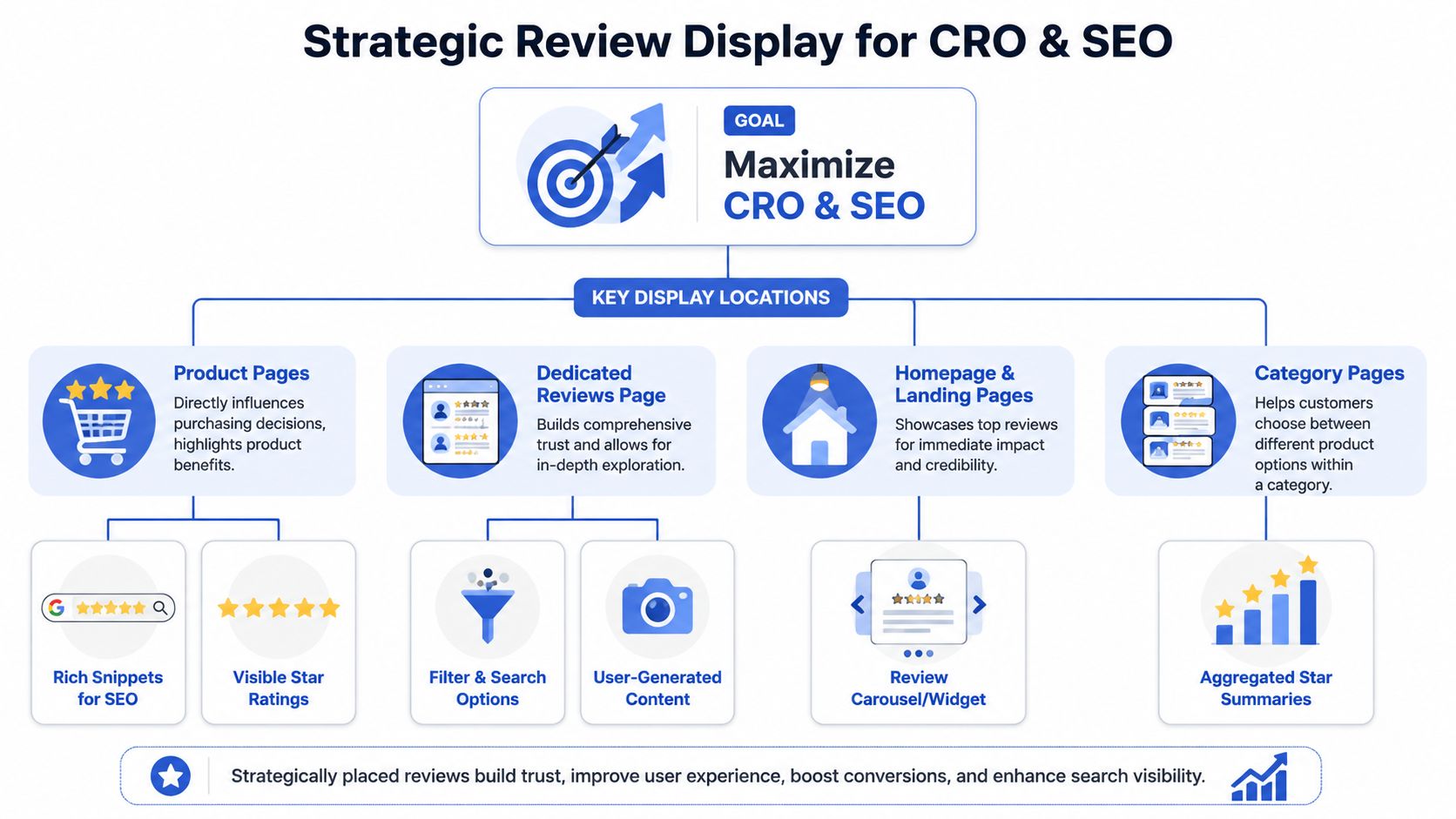
Placement should match buying intent. A customer on a category page wants quick confidence signals. A customer on a PDP wants detail. A customer on a landing page wants proof that the brand delivers on its promise.
Treat review content as UX, not decoration
The best-performing review modules do a few simple things well:
| Placement | What to show | Why it works |
|---|---|---|
| PDP header zone | Star summary and review count | Adds immediate credibility |
| Mid-PDP | Highlighted quotes by theme | Reinforces buying triggers |
| Full review block | Filters by fit, use case, or concern | Helps customers self-qualify |
| Category cards | Aggregated stars | Speeds comparison |
What doesn't work is stuffing every review into one undifferentiated list. Customers don't read review walls. They scan for relevance.
The SEO side is technical, not just visual
If your review app isn't outputting structured data properly, you're leaving value on the table. Product reviews should support AggregateRating schema where appropriate, and your implementation needs to align with how Shopify renders product data in your theme.
Many stores fall short when the review widget is visible, but the structured data is broken, duplicated, or missing after theme customisation. If you're checking how review markup fits into a broader theme setup, this guide on Shopify structured data setup is a practical reference.
The storefront version of a review and the machine-readable version need to match. If they don't, you create confusion for both users and search engines.
Repurpose the best feedback beyond the storefront
Your strongest reviews shouldn't stay trapped on product pages.
Use them in:
- Email campaigns that reinforce category value
- Paid social creative where customer wording often beats brand copy
- Landing pages aligned to specific objections
- Support macros that reflect real usage outcomes
- Wholesale or retail decks when buyers need external validation
The key is selection. Don't just pick the most flattering quote. Pick the review that removes a real objection.
Automation Workflows and UK Compliance
Once review collection and response are working, the next step is to wire reviews into the rest of the ecommerce stack. That's where review management stops being a reputation task and starts acting like an operational system.
In practice, this means your review platform should talk to Klaviyo, HubSpot, your support desk, and any reporting layer you rely on for CX or CRO decisions.
Build flows around customer state
A review is a signal. The mistake is treating every signal the same way.
Useful post-review automations often include:
Positive review flow
Add the customer to a segment for advocacy, UGC requests, or early access campaigns.Neutral review flow
Trigger a check-in that asks a more specific follow-up question, especially if the issue sounds fixable.Negative review flow
Open a support task, alert the CX owner, and suppress promotional sends until the issue is resolved.Theme-based alerting
If similar complaints cluster around one SKU, shipping method, or bundle, route that pattern to operations or merchandising.
The UK review benchmark also points to the value of integrating reviews into post-purchase CRM workflows with real-time sentiment analysis. That setup enables faster action because the review doesn't sit in a silo waiting for someone to spot it.
Compliance has to be designed in
UK merchants must be more careful than many generic guides suggest.
The UK's 2025 Digital Services Act introduced stricter rules on algorithmic transparency. A 2025 study by the UK Information Commissioner's Office revealed that 41% of UK-based Shopify stores inadvertently risk GDPR violations by auto-collecting review data without explicit, granular consent.
That changes how you should build automated review solicitation.
A practical compliance standard looks like this:
- Ask for clear consent to receive review requests. Don't bury it inside broad marketing permission.
- Keep consent granular so customers can agree to service messaging without being bundled into unrelated promotional use.
- Be transparent about automation if AI helps draft or personalise messages.
- Store only what you need for the review workflow and define retention rules inside the app and CRM.
- Maintain platform sync carefully across Google, Trustpilot, and on-site reviews so deleted or corrected records don't create mismatch.
A simple UK-safe review request pattern
Use language that is plain, specific, and limited in scope.
For example:
We'd like to send a follow-up message after your order is delivered to ask for feedback on your purchase. You can choose email, SMS, both, or neither.
That works better than vague consent language because it tells the customer what will happen, when, and through which channel.
For Shopify Plus builds, I'd also insist on the technical basics already noted in the UK benchmark. The app should support GDPR-compliant data retention, real-time webhook ingestion, and multi-platform response sync where relevant. If the app can't handle that cleanly, it shouldn't sit at the centre of your customer review management process.
Measuring Success The KPIs That Drive Growth
The weakest review programmes report activity. The stronger ones report business impact.
That distinction matters because a long list of reviews can still hide bad timing, poor response discipline, weak product coverage, or unresolved operational issues. If your dashboard only shows review count and average star rating, you're missing most of the commercial picture.
A 2024 survey by the UK Retail Association found that 68% of UK-based Shopify stores lack a formalised ROI model for review management, despite 74% of consumers in the UK stating they trust brands with active review engagement.
Start with a simple scorecard
You don't need a massive BI project to measure customer review management properly. Start with a weekly scorecard that combines volume, trust, and action metrics.
Track at least these:
- Review volume by product so you can spot SKUs with weak proof coverage
- Average rating trend by collection, not just storewide
- Response time across each platform
- Sentiment themes such as sizing, delivery, packaging, durability, or support
- Conversion difference between pages with strong review presence and pages with weak or missing proof
If your support team is involved in review handling, it's also worth looking at operational service metrics in parallel. This piece on improving CSAT and FCR is useful because it shows how customer-facing performance can be measured beyond simple volume reporting.
Build an ROI model around avoided friction and gained trust
A workable ROI model usually has three layers.
| Layer | What to measure | Why it matters |
|---|---|---|
| Acquisition | Review coverage on key products and high-intent pages | More trust where buying decisions happen |
| Conversion | Sales performance on pages with stronger review display | Shows whether proof is reducing hesitation |
| Operations | Repeated complaint themes and response discipline | Links review activity to service and fulfilment fixes |
Often, teams overcomplicate this aspect. You don't need to attribute every pound of revenue to one review. You need to show that stronger review coverage and faster issue handling contribute to better commercial outcomes and fewer recurring customer problems.
Run a weekly review audit
A weekly audit is usually more valuable than a monthly summary because it catches repeat issues while they're still fixable.
A practical audit includes:
Top positive themes
What customers praise consistently. Use this in merchandising and copy.Top friction themes
What keeps appearing in complaints or neutral reviews. Feed this back to operations.Products with weak review density
These often need a stronger solicitation flow or better post-delivery timing.Platforms with response lag
Trust drops when response standards differ by channel.Resolved complaints worth learning from
These often reveal process fixes that reduce future support load.
For broader guidance on how customer perception data should be measured alongside service and retention metrics, this reference on customer satisfaction measurement is worth bookmarking.
Customer review management pays off twice. First in conversion, then again when you use feedback to remove the root causes of future complaints.
If you're doing this well, the review team won't just publish polite replies. They'll influence product pages, lifecycle messaging, fulfilment standards, and service workflows. That's when reviews stop being a marketing asset and start becoming a growth system.
If your Shopify store needs that kind of joined-up execution, Grumspot is built for it. They help brands fix broken review flows, tighten CRO across product pages, connect apps and CRM properly, and build Shopify experiences that convert without adding operational mess.
Let's build something together
If you like what you saw, let's jump on a quick call and discuss your project
Related posts
Check out some similar posts.

- ecommerce ab testing
Master ecommerce AB testing with a revenue-first playbook. Learn to build hypotheses, calculate samp...
Read more
- conversion rate optimisation australia
Boost sales in 2026 with our definitive guide to conversion rate optimisation australia. Learn local...
Read more
- website conversion rate optimisation
Master website conversion rate optimisation with our 2026 e-commerce playbook. Audit, test, measure,...
Read more
- customer journey mapping
Master customer journey mapping for your Shopify store. Research touchpoints, use insights for CRO &...
Read more