Zero Party Data for Ecommerce: A Practical UK Guide
- zero party data
- ecommerce personalisation
- Shopify CRO
- UK GDPR marketing
- first party data
Launched
October, 2026
A Shopify founder in Manchester opens Meta Ads Manager and sees another week of unreliable attribution. The numbers no longer tell a clean story, the email team wants another broad send, and the product team is still guessing which customers actually want which products. Behavioural signals remain useful, but they're increasingly difficult to interpret and harder to control.
That's why zero party data has moved from an interesting marketing idea to a practical ecommerce architecture decision. Preference centres, product finders and post-purchase surveys can give a merchant something ad platforms and analytics tools can't: a customer's stated preference, collected with a clear value exchange and connected to an experience the store can change. The challenge is making that system useful without creating a new consent, profiling or retention problem.
The Moment Declared Data Started Mattering Again
The founder doesn't need another dashboard. They need to know whether a shopper is looking for a sensitive-skin routine, a particular fit, a gift for someone else or just fewer promotional emails. A page view can suggest intent, but it can't confirm it. A declared preference can.
Privacy changes have made this distinction more important. Third-party tracking is less dependable, platform attribution is patchier, and customers are more conscious of how brands use their information. The UK evidence reflects that tension. A 2024 survey of 1,885 nationally representative consumers found that 66% were concerned about data privacy when interacting with brands online, while 50% said they'd be more likely to trust brands that collect zero-party data. The survey findings published by New Digital Age also show that consumers favour explicit collection methods, including surveys and online forms.
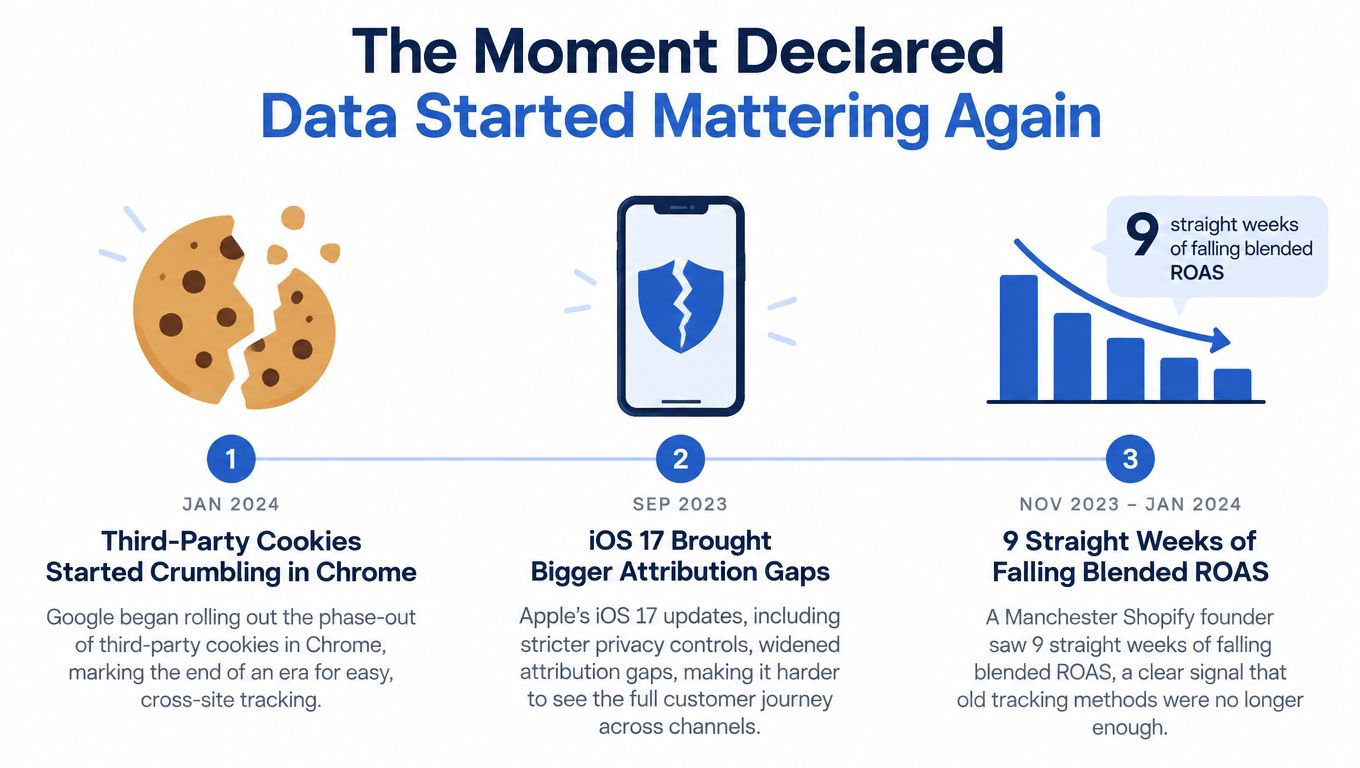
The operational shift
A preference centre isn't valuable because it adds more fields to a CRM. It's valuable when a customer selects “fragrance-free”, and the store uses that answer to change product recommendations, email content and merchandising rules. A quiz isn't valuable because it has a polished interface. It earns its place when the result helps a shopper choose confidently and gives the merchant a reliable segmentation signal.
The strongest programmes treat declared information as a counterweight to attribution loss, not a replacement for first-party behavioural data. Browsing history can still show what someone considered. Purchase history can still show what they bought. Zero-party data adds the reason, preference or intended use that those systems can only infer.
Practical rule: Ask only for information that will visibly improve the customer's next interaction with the store.
That rule keeps the programme commercially focused. It also reduces compliance risk, because every field has a defined purpose rather than being collected “just in case”. The decisions that follow are practical ones: what counts as zero party data, which Shopify capture formats earn their friction, how lawful basis is documented, and how the data should travel from Shopify into activation tools.
What Zero Party Data Actually Is
Zero-party data is information a customer intentionally and proactively shares with a brand. A customer choosing their preferred product category in an account profile is declaring a preference. A shopper answering questions in a product finder is declaring a use case. A customer selecting contact frequency in an email preference centre is declaring how the relationship should work.
The distinction matters because collection mechanics affect how much confidence a team should place in a field. A behavioural platform may record that someone repeatedly viewed moisturiser products. A quiz answer can tell you that the customer is shopping for dry skin. Both signals can help, but they aren't equivalent.
| Data type | Source | How it is collected | Typical accuracy |
|---|---|---|---|
| Zero party data | The customer | Preference centres, quizzes, surveys, forms and declared profile choices | High for the specific answer given |
| First-party data | The brand's owned channels | Browsing, purchases, account activity, support history and on-site events | Useful, but often inferred |
| Second-party data | Another organisation | A partner shares data originally collected through its own channels | Depends on the partner's collection and matching |
| Third-party data | An external data provider | Data is acquired or combined outside the brand's direct relationship | Variable and difficult for the merchant to validate |
A customer's email address can be zero party data when they intentionally provide it, while browsing activity is generally first-party data because the store records it through an owned channel. The same customer profile can contain both. That's why teams shouldn't label the entire Shopify customer record “zero party” just because some fields were volunteered.
The distinction also changes the implementation. Declared answers need a field definition, a purpose, an explanation at collection and a way to update or withdraw them. Behavioural events need an event schema and a retention approach. For a practical grounding in how owned-channel collection fits into ecommerce growth, Grumspot's guide to first-party data collection provides a useful companion perspective.
On Shopify, the important question isn't whether a field sounds like a preference. It's whether the store knows who supplied it, what they were told, where it's stored and which activation rule is allowed to use it.
Why Declared Data Beats Inferred Signals
A customer viewing a product is not the same as a customer wanting it. The click could come from a search result, a comparison habit, or simple curiosity. Even repeat purchase only tells you that something worked before, not whether price, colour, fit, or convenience drove the decision.
Declared data reduces that ambiguity. A shopper who chooses “office wear”, “wide fit”, or “low fragrance” has given the merchandising and lifecycle team something they can use. Those answers can change, and they should be editable, but they are still stronger than a model guessing intent from behaviour alone.
The trust case matters because explicit collection is easier to defend than hidden inference. The New Digital Age survey of UK consumers found that 50.0% preferred surveys as a way for brands to capture data, while 48% preferred interactive surveys and 36.8% liked online forms. That does not mean brands should ask more questions. It means customers will accept declared data when the purpose is obvious and the exchange feels fair.
Quality changes the activation layer
A small set of clear preferences can outperform a much larger pile of fuzzy events. A skincare store is a good example. “Viewed cleanser” is a weak signal. “I'm buying for dry skin and prefer fragrance-free products” can shape the product finder, the recommendation block, and the follow-up email without forcing a guess.
Completion rates still matter, and they are usually the trade-off teams underestimate. Product finders tend to work better when they appear at the point of choice, while post-purchase surveys often get more honest feedback after the customer has used the product. The point is not to chase every answer. It is to collect the answers that can change what the store does next.
Good architecture treats declared data as a controlled input, not a catch-all profile field. It needs clear purposes, clean field definitions, and rules for where each answer can be used in Shopify, a CDP, or a personalisation engine.
Use declared fields to make decisions such as:
- Segmentation: Separate customers by stated use case or category interest, rather than only by recent clicks.
- Recommendation: Match products to an answer the shopper has confirmed.
- Content relevance: Adjust product copy, educational content, or email themes to reflect the customer's stated context.
- Merchandising: Prioritise a relevant product family without building a separate storefront.
The commercial test is simple. If the answer does not change a recommendation, message, service interaction, or merchandising rule, it should stay out of the first version of the programme.
Collection Formats That Work on Shopify
Shopify stores need a capture format that matches the customer's immediate task. A preference centre suits shoppers who want control over the relationship. A product finder helps when the catalogue is difficult to browse. A post-purchase survey fits the point at which the customer has enough experience to give useful feedback.
| Format | Friction | Data value | Best-fit catalogue |
|---|---|---|---|
| Account preference centre | Low to moderate | Durable category, size, contact and content preferences | Broad catalogues with repeat purchase or strong lifecycle marketing |
| Two-question product finder | Low | Immediate intent and recommendation context | Catalogues where shoppers need help choosing |
| Longer product quiz | Moderate to high | Rich product suitability and use-case signals | Skincare, supplements, apparel and other considered purchases |
| Post-purchase micro-survey | Low after purchase | Product experience, future needs and service preferences | Brands with repeat purchase or meaningful product usage |
| Contest or sample opt-in | Moderate | Interest and acquisition context | Brands with a clear incentive and a tightly defined audience |
A preference centre provides a durable base for declared data. Ask for category interests, size or fit, sustainability topics, and contact frequency in the account area or email profile. Store fields in Shopify customer metafields when they belong on the customer record. Send them to a CDP or Klaviyo profile properties when segmentation and lifecycle activity depend on them. Define the field name, allowed values, purpose, and destination before adding it to the form.
A product finder should earn the time it requests. Place a short flow on a collection page, landing page, or quiz entry point, then return a result that helps the shopper choose. A longer quiz can collect richer suitability and use-case information, though every extra question increases abandonment. The result should explain why the products fit, apply relevant filters, offer usage guidance, and give the shopper a clear next action.
Collection principle: The reward for answering should be a better decision, not merely a discount code.
Post-purchase surveys capture feedback after a real product experience. Keep the opening interaction narrow. Ask what the customer bought the product for, whether the fit or format worked, and what they might need next. Map each answer to order metadata or a customer profile only after defining its downstream use in Shopify, the CDP, or the personalisation engine.
Contest and sample forms can attract new visitors, yet their answers often provide shallow signals. Keep the participation mechanic separate from marketing consent, record the source and purpose of the submission, and avoid treating an incentive response as a broad customer profile. UK GDPR and the Data (Use and Access) Act 2025 make that purpose-led structure part of the data architecture, not a later clean-up task.
The Compliance Trap Most Brands Miss
Volunteering an answer doesn't remove its legal status. Zero party data is still personal data when it relates to an identifiable individual, and the store still needs a documented lawful basis, a defined purpose, transparent notices, data minimisation and an appropriate retention approach.
For many UK SME ecommerce use cases, the likely lawful basis is consent or legitimate interests, but the correct basis depends on the processing. Consent must be freely given, specific, informed and unambiguous. Pre-ticked boxes and bundled consent aren't valid under the ICO standard described in this UK GDPR personalisation guidance.
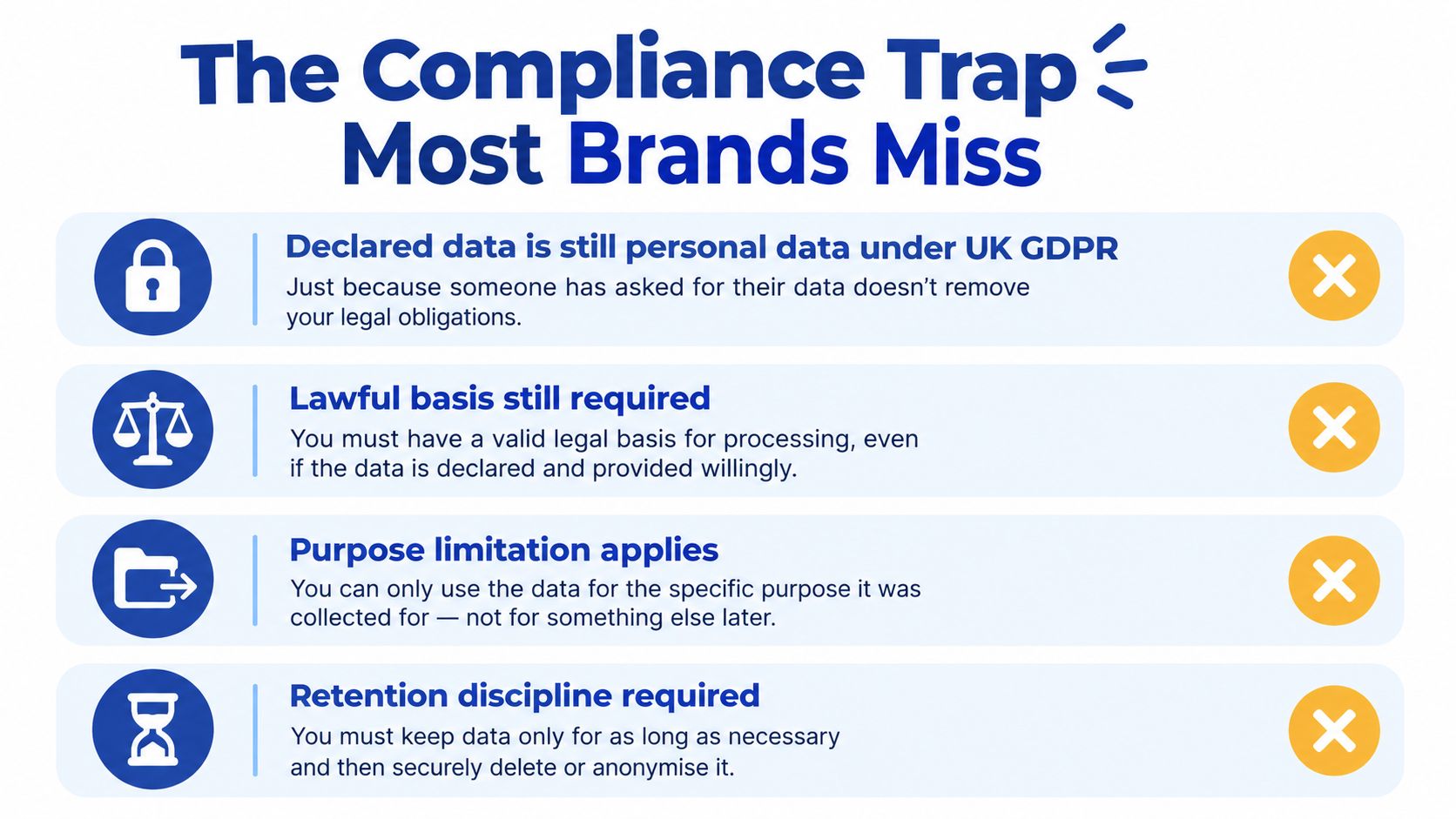
Four failure points
Marketing consent attached to purchase: A checkout transaction and a marketing subscription are different decisions. Keep the purposes separate and make the choice clear.
A quiz described as analytics: If answers are used to categorise people, personalise content or influence automated recommendations, the processing needs to be assessed as profiling rather than hidden behind a generic analytics label.
Sensitive inferences: A style or product quiz can reveal more than the team intended. Answers may expose health, size, financial circumstances, religion or family status. Don't collect or activate those attributes without understanding the additional risk.
Permanent storage: A preference shouldn't remain on a customer record forever just because the database allows it. Set retention rules that match the original purpose, and provide a practical way to change or erase the answer.
The Data (Use and Access) Act 2025 adds another reason to keep governance current. UK commentary describes the legal framework as unsettled in 2026, with guidance under review and direct-marketing guidance updated during 2026. The UK commentary on zero-party data governance and Shopify personalisation highlights the practical gap: brands need to classify, store and segment answers without treating “voluntary” as synonymous with “low risk”.
A preference centre with poor purpose wording is still a compliance exposure. The interface may look polished, but the underlying Article 6 basis, consent record, access controls and withdrawal path must stand up independently. Teams working through the wider operational detail can use this Shopify GDPR compliance checklist for expansion into the EU as a related governance reference.
Plugging Zero Party Data Into Your Stack
A customer selects “fragrance-free” in a Shopify quiz, then expects the next product recommendation and email to reflect that choice. If the answer stays in the quiz app, the experience breaks. A workable setup carries the declared preference from collection through storage, activation and review, with each handoff documented.
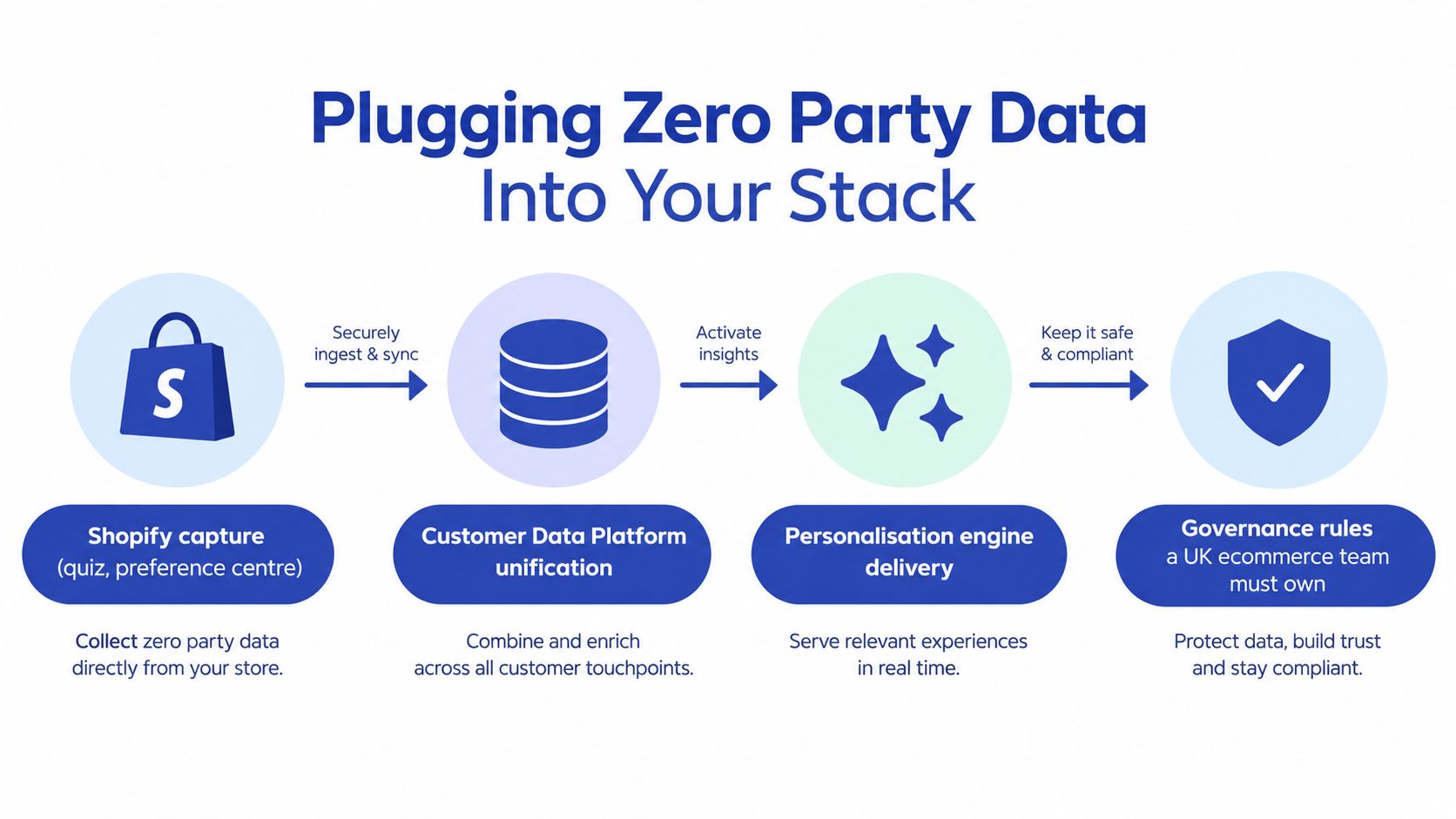
The architecture has four layers. Shopify captures the answer, a CDP or CRM unifies the customer record, an activation tool uses the preference, and governance limits what each system can do.
Start with the collection layer. A quiz app, preference centre or custom Shopify extension can capture the response. Store durable attributes as metafields where practical. Keep tags for simple operational grouping. A field such as preferred_category is easier to inspect and update than several loosely named tags interpreted differently by marketing, merchandising and customer service.
The CDP or CRM then receives the event and profile update. This might involve Segment, Shopify's customer data capabilities or another connected system. Platform choice matters less than the schema. Define the field name, accepted values, collection timestamp, stated purpose, consent status where relevant and source touchpoint before sending the first record downstream. Teams reviewing the connection between Shopify records and connected platforms can use this ecommerce CRM integration guide as a practical reference.
Make every field purpose-bound
Activation tools may include Klaviyo, Nosto, Rebuy, a searchandising layer or a custom personalisation service. Tie each declared preference to a defined action, such as showing fragrance-free products in recommendation slot A or sending category education to customers who selected running.
Include these controls in the implementation brief:
- Versioned consent records: Record what the customer agreed to, when they agreed and which notice they saw.
- Audit trails: Log changes to preference values and the systems that received them.
- Purpose-bound fields: Do not reuse a product-fit answer for unrelated advertising or data sharing without assessing the new purpose.
- Retention windows: Remove or review data when the original use no longer applies.
- Withdrawal paths: Let customers change or erase preferences from the same account or preference surface that collected them.
A marketing automation agency can support event design, consent-aware synchronisation and lifecycle activation when the in-house team has the strategy but lacks integration capacity. Assign an owner for each field and test the full path, from quiz submission to Shopify record, CDP profile, personalisation rule and customer-facing message.
The stack earns its complexity only when the declared signal changes a real experience. If the answer remains in a CDP without affecting merchandising, content, service or messaging, the store is collecting data without a clear operational return.
Here's a practical walkthrough of the technical flow:
Turning Declared Preferences Into CRO Wins
A declared preference earns its place when it changes the customer's next decision. On a Shopify store, that usually means making a product page, collection, homepage or lifecycle message more relevant without making the experience feel personally intrusive.
Start with the product page. Use the customer's stated context to change the explanation, not merely the product order. A shopper who selects sensitive skin should see relevant ingredients, usage guidance and product imagery. Someone who chooses a particular fit preference should see sizing information and reviews that address that concern. Keep the default page useful for shoppers without a profile. Personalisation should improve the baseline experience, not make it dependent on a quiz answer.
Collection merchandising can apply the same rule. If a shopper declares a comfort-first use case, prioritise products suited to that context while keeping credible alternatives visible. The merchandising team should be able to inspect the rule, understand which declared field activates it and adjust it without asking an engineer to decode a hidden model. Relevance becomes manipulation when every answer forces a narrow product set.
| Surface | Declared signal used | Expected CRO effect |
|---|---|---|
| Product detail page | Fit, skin type, use case or product concern | More relevant proof, clearer suitability and stronger purchase confidence |
| Collection page | Category interest, activity or stated priority | Better product order and less search effort |
| Email and SMS | Quiz result, contact preference or replenishment intent | More relevant sends and less promotional fatigue |
| Homepage | Declared category or shopping mission | Faster route to the right collection or guide |
| Post-purchase journey | Intended use and future need | More useful education, support and cross-sell timing |
Email teams often begin with a broadcast list because it is simple to run. Declared preferences create a more useful brief for segmentation and content. A customer interested in trail running should receive different editorial guidance from someone shopping for everyday walking shoes. Contact-frequency choices can also reduce unwanted promotional pressure, provided the preference is honoured consistently across the sending tools and the customer account.
Keep the commercial rule separate from the consent decision. A product-fit answer can shape merchandising, while a contact preference controls messaging. The Shopify customer record, CDP and personalisation engine should not treat those fields as interchangeable. That separation protects the experience and makes the activation logic easier to review under UK GDPR and the Data (Use and Access) Act 2025.
The CRO mechanism is clear: declared intent increases relevance, and relevance reduces decision effort. A preference will not improve every conversion event. Some answers are more valuable for retention, customer support or product development than for an immediate sale.
Merchandising test: For each declared field, name the exact product rule, message variation or service action it enables. If nobody can name one, do not collect the field.
Measure the path from answer to meaningful action. Depending on the programme, that may be a recommendation click, add to basket, completed purchase, preference update or lower unsubscribe activity. Compare the result with the store's existing experience, and check whether the rule creates unwanted effects such as fewer product options being viewed or more support questions. Quiz completion alone is a weak success measure. A smaller flow that helps customers choose with confidence can outperform a popular quiz with no activation behind it.
A 30 Day Plan for Your First Zero Party Programme
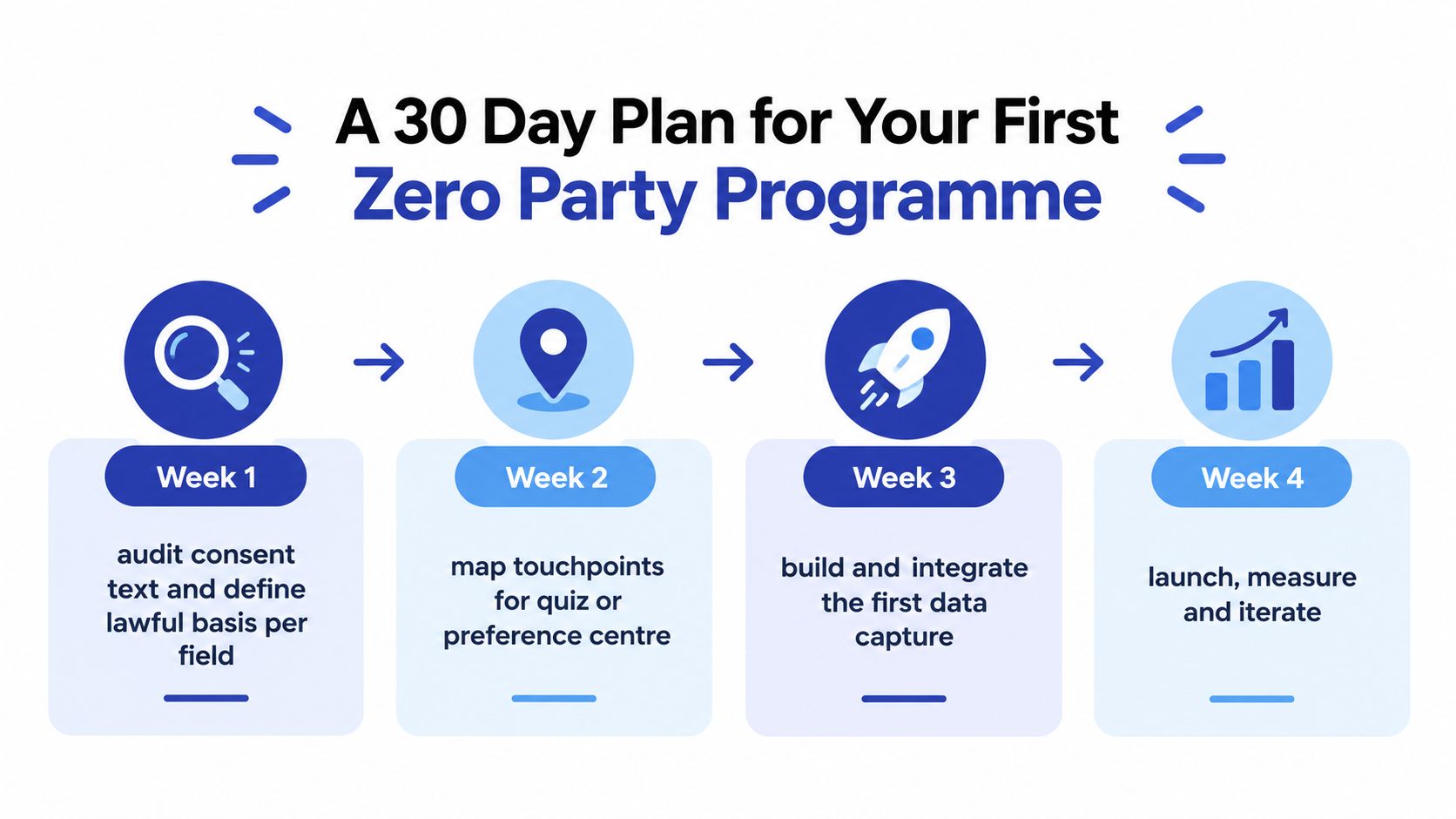
Start with one customer decision and one useful destination. A product finder for a hero collection usually gives merchandising a clearer activation path than a broad profile survey.
- Week one: Review consent wording, document the lawful basis for each field, and choose a touchpoint that does not interrupt checkout.
- Week two: Design one high-intent flow. Define its output schema, accepted values, retention setting, and activation rule.
- Week three: Build the capture, write the answer to Shopify, pass it to the CDP, and connect one personalisation use case.
- Week four: Test the path from answer to purchase or service outcome. Review opt-outs, complaints, data quality, access controls, and deletion handling under UK GDPR and the Data (Use and Access) Act 2025.
Ship one flow before adding another. Confirm that the Shopify record, CDP and personalisation engine pass the same values, then measure a defined commercial or customer-experience result. Quiz completion alone is not enough.
Grumspot helps Shopify and Shopify Plus teams build preference-led storefronts and integrations with CRMs, fulfilment systems and custom tools. Visit Grumspot to discuss the capture flow and data plumbing.
Let's build something together
If you like what you saw, let's jump on a quick call and discuss your project
Related posts
Check out some similar posts.
- black friday campaigns
Compare 7 tools for planning Black Friday campaigns on Shopify, covering email, SMS, personalisation...
Read more
- shopify website examples
Explore 7 Shopify website examples and learn the UX, conversion features, and practical lessons merc...
Read more
- cro best practices
Apply cro best practices to Shopify stores with 10 actionable tactics for testing, product pages, ch...
Read more
- social proof widgets
Learn how social proof widgets boost Shopify conversions. Discover types, placement strategies, perf...
Read more