Headless Commerce Agency: The 2026 Guide
- headless commerce agency
- headless ecommerce
- Shopify Plus agency
- ecommerce architecture
- headless migration
Launched
October, 2026

The most popular advice about headless commerce is also the least useful: that every ambitious Shopify Plus brand should decouple its storefront. That isn't a strategy. It's a technical preference presented as commercial advice.
A headless build can give a DTC brand more control over experience design, content delivery and channel expansion. It can also create more services to monitor, more releases to govern, more integrations to test and more people responsible for keeping SEO and trading operations intact. The right question isn't whether a modern framework can produce a faster storefront. It's whether your organisation can operate the architecture after launch.
That distinction matters in the UK, where ecommerce is already a substantial digital market. One UK agency source places the market at more than £265 billion, while the Office for National Statistics figure cited by the same source puts online retail at 29.4% of all UK retail sales in June 2026. Those conditions create a strong commercial case for better digital experiences, but they don't make headless the automatic answer. (UK ecommerce market context)
What Headless Commerce Actually Involves in 2026
Headless commerce separates the customer-facing storefront from the commerce backend. Shopify can still manage products, checkout, orders and much of the operating machinery, while a separately developed frontend controls the experience before checkout. The technical separation is straightforward. The ownership it creates is not.
A traditional Shopify theme keeps the platform, theme layer, app ecosystem and publishing workflow relatively close together. A headless stack adds boundaries between the browser, frontend hosting, APIs, commerce services, content systems, analytics and third-party integrations. Each boundary can support flexibility, but each also adds monitoring, testing and failure points.
Practical rule: If the business case only says “we want a more modern frontend”, the case for headless probably isn't mature enough.
The strongest UK-focused guidance treats headless as an operating-model decision rather than a frontend rebuild. The case is stronger when a brand needs a storefront experience that can materially improve conversion or average order value, several regional or channel frontends sharing commerce logic, and an internal team able to manage observability, release governance and additional API, hosting, edge and frontend services. (UK headless strategy guidance)
What decoupling gives you
A decoupled storefront lets product and design teams work beyond Liquid theme conventions. They can create richer editorial commerce pages, build a more personalized buying journey, serve regional experiences from shared commerce data, or connect the storefront with an application and other customer touchpoints.
The frontend does not become faster by default. The agency must decide how data is requested, what can be cached, how important content is rendered, and what happens when an upstream service responds slowly. A polished React or Next.js build can still perform poorly if it makes too many client-side requests or waits for unnecessary integrations before rendering.
The larger change is organisational. After launch, the brand must assign clear owners, not assume the agency will absorb every operational responsibility:
- Release governance, including branch strategy, approval rules, rollback procedures and environment parity.
- Observability, including frontend errors, API latency, failed requests, hosting health and checkout handoffs.
- Search governance, including metadata, structured data, canonicals, redirects and indexation controls.
- Experimentation, including test design, analytics integrity, audience targeting and deployment ownership.
- Trading continuity, including promotions, product launches, regional changes and urgent content updates.
- Cross-border compliance, including the regional rules and storefront behaviours that affect international trading.
A headless commerce agency should therefore be assessed as an engineering and operating partner, not only as a team that can build a fashionable frontend. Shopify Plus may remain the commerce engine, but the brand owns the consequences of the separation. If only the original developers understand the stack, the business has acquired dependency rather than durable flexibility.
Headless Architecture Versus Traditional Shopify Plus
Shopify Plus Liquid themes remain the sensible choice for many scaling brands. They support rapid merchandising, familiar content workflows and a tightly integrated storefront model. A well-designed theme can deliver a polished experience without asking the business to operate separate frontend infrastructure, deployment pipelines and API contracts.
Headless becomes more compelling when the commercial requirement cannot be met cleanly within that model. Examples include a highly bespoke product discovery journey, several regional storefronts with shared commerce logic, or experiences that need to serve channels beyond the main website. The trigger should come from customer and trading requirements, not from a developer's preference for a particular framework.
A useful distinction is that Shopify Plus can still be the commerce engine in both models. The architectural decision concerns how much of the customer experience sits outside Shopify's native theme layer and how much responsibility the brand accepts for maintaining that separation.
Architecture Decision Matrix
| Business Requirement | Traditional Shopify Plus | Headless Commerce |
|---|---|---|
| Fast launch with a conventional catalogue and buying journey | Usually the stronger fit. A Liquid theme keeps implementation and publishing closer to the platform. | Often unnecessary. The extra architecture may delay launch without solving a material business problem. |
| Bespoke merchandising or editorial interaction | Suitable when the experience can be delivered through theme development and carefully selected apps. | Appropriate when the experience needs deeper control over rendering, content composition or interaction design. |
| Several regional storefronts | Can work when markets share a broadly similar storefront and operating process. | More suitable when regional frontends need shared commerce services but different experiences and content rules. |
| Mobile app or other connected channels | A theme remains focused on the web storefront. | A shared API-led commerce model can support multiple customer-facing channels, provided the team can govern them. |
| Frequent content and promotion changes by trading teams | Usually simpler for internal teams to manage. | Requires clear CMS permissions, publishing workflows, preview environments and deployment responsibilities. |
| Limited engineering capacity | Lower operational burden and easier access to Shopify specialists. | Risky unless an agency provides dependable support and the brand develops internal ownership. |
| Performance improvement | Theme optimisation, image handling, app reduction and template discipline may be enough. | Can provide more control over rendering and delivery, but only with strong frontend, API and hosting practice. |
| Need to protect launch speed and margin | Usually the safer commercial decision. | Justified only when the expected commercial value outweighs the added delivery and operating cost. |
The important comparison isn't “old technology versus new technology”. It's contained complexity versus distributed complexity. A Liquid theme constrains some forms of experience design, but it also keeps more responsibilities in one platform. Headless removes constraints from the frontend while moving responsibility to the brand, its agency and its hosting and integration stack.
Teams considering the change should document the requirements first, then test whether a theme, app extension or focused customisation can satisfy them. An API-first approach can help clarify the separation between commerce capabilities and customer experience, but the architecture still needs to serve a specific operating model. This API-first ecommerce architecture guide is useful background when stakeholders need to understand that distinction.
Headless is justified by a business capability you can't deliver efficiently in the existing model, not by the fact that your current theme feels visually dated.
Core Services Delivered by a Headless Commerce Agency
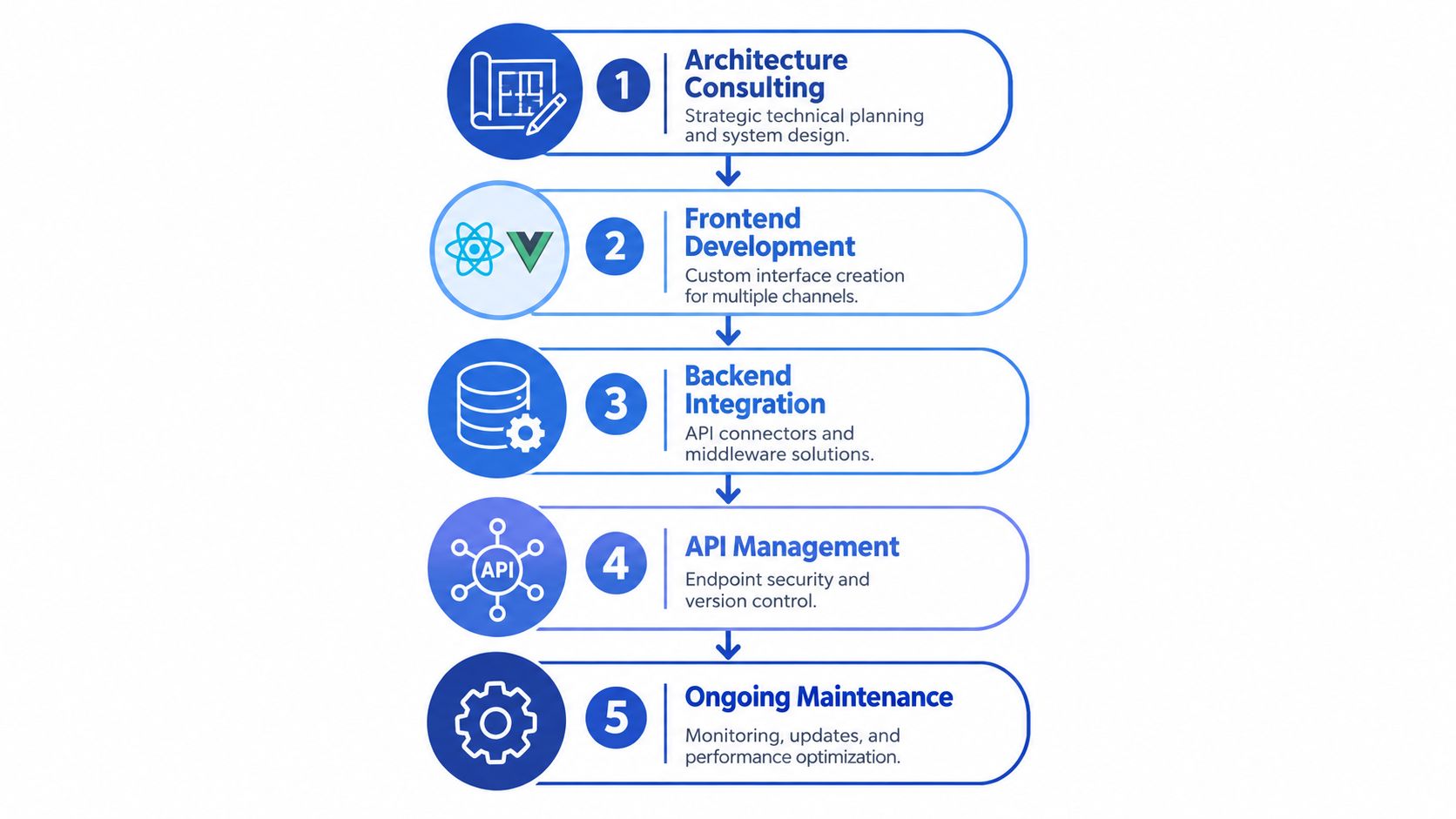
A specialist headless commerce agency should do considerably more than write React components. The storefront is only one layer of the system. The agency must define how the layers exchange data, how teams publish changes, and how the organisation responds when a service fails.
Architecture before implementation
The first deliverable should be a system design, not a page mock-up. It should identify Shopify's role, the CMS model, frontend hosting, caching strategy, search and analytics requirements, ERP and fulfilment dependencies, and the way content and commerce data will be requested.
The agency should also record failure behaviour. What happens if product availability is slow? Which elements can render without a recommendation service? How does the site behave when a campaign landing page has unpublished data? These decisions protect the buying journey from the assumption that every API will always respond perfectly.
Frontend engineering with commercial constraints
React, Vue, Hydrogen or Next.js can all support a capable storefront. The tool matters less than the implementation discipline around rendering, images, navigation, state management, accessibility and progressive enhancement.
A strong build gives content and merchandising teams useful control without turning every update into a developer ticket. It also makes the important customer paths easy to test, including search, collection discovery, product selection, cart updates, account flows and the transition into Shopify checkout.
API contracts and middleware
The API layer needs explicit contracts. The team should define data shapes, authentication boundaries, error handling, caching rules, versioning and ownership for each connection. Middleware may be necessary when Shopify data needs to be combined with a PIM, ERP, CRM, subscription service, warehouse system or bespoke fulfilment process.
Superficial frontend agencies tend to expose their limits here. A visually polished storefront can still become fragile if each page makes uncontrolled requests to several systems, if one vendor's schema change breaks the experience, or if nobody owns the mapping between catalogue, inventory and customer data.
Delivery, monitoring and maintenance
The agency must configure deployment environments, automated testing, logging, alerting and performance monitoring. It should explain which team receives an alert, how incidents are escalated, and how a release is rolled back when a promotion or product launch exposes a defect.
A useful request for proposal should ask for four artefacts:
- A system diagram showing every major service and data path.
- An ownership matrix covering code, content, SEO, analytics, integrations and incidents.
- A release plan covering testing, approvals, deployment and rollback.
- A maintenance proposal covering monitoring, security updates, support and continuous optimisation.
Marketing leadership may also need a broader partner for acquisition, lifecycle activity and commercial measurement. In that context, a resource such as top ecommerce marketing agency AdManage.ai can help separate storefront engineering from the wider marketing operation. The distinction matters because a headless agency shouldn't imply that frontend delivery alone constitutes a complete growth programme.
Project Costs and Realistic Timelines
Headless projects cost more than a standard theme customisation because the agency is delivering an operating system for the storefront, not just a visual layer. The scope usually includes architecture, frontend development, API and middleware work, content modelling, integrations, environments, testing, migration support and post-launch monitoring.
A Birmingham headless ecommerce agency gives a UK benchmark of £20,000 to £80,000+, with the final figure influenced by catalogue size, design complexity, integrations and channel requirements. (UK headless build pricing benchmark) That range should be treated as a starting point for scoping, not as a fixed quote for every Shopify Plus migration.
The variables behind the estimate
Catalogue complexity affects more than the number of product templates. The agency needs to understand variants, bundles, subscriptions, markets, availability rules, merchandising, search behaviour and content relationships. A small catalogue with difficult purchasing logic can be more demanding than a larger catalogue with a straightforward path to checkout.
Design complexity also has a technical cost. Bespoke animation, interactive product discovery, dynamic editorial modules and unusual navigation patterns require more design-system work, testing and performance discipline. The agency should price the behaviour, not just the number of screens in a design file.
Integrations create another layer of uncertainty. ERP, CRM, fulfilment, reviews, search, loyalty, subscriptions and personalisation tools all introduce contracts that need testing and monitoring. A discovery phase should identify whether data is requested in real time, synchronised on a schedule or transformed by middleware.
Budgeting around value
UK guidance on headless strategy notes that the model usually implies a 12 to 18-month ROI horizon, rather than immediate cost savings. (Headless ROI guidance for UK brands) That changes the business case. The finance team shouldn't expect the architecture to pay for itself just because the new frontend launches quickly.
The commercial model should connect investment to measurable opportunities, such as improved mobile experience, stronger merchandising, better international reuse, more efficient experimentation or reduced friction in a high-value journey. Those outcomes need owners and measurement plans before development starts.
A sensible delivery plan separates discovery and architecture from implementation, migration and optimisation. The exact calendar depends on scope and team availability, but the governance should be explicit: who signs off the design system, who validates integrations, who approves redirects, who owns content migration and who handles defects after release. Teams can use a structured project timeline management framework to make those dependencies visible rather than treating the launch date as the only milestone.
Measuring Success Through Performance and Revenue KPIs
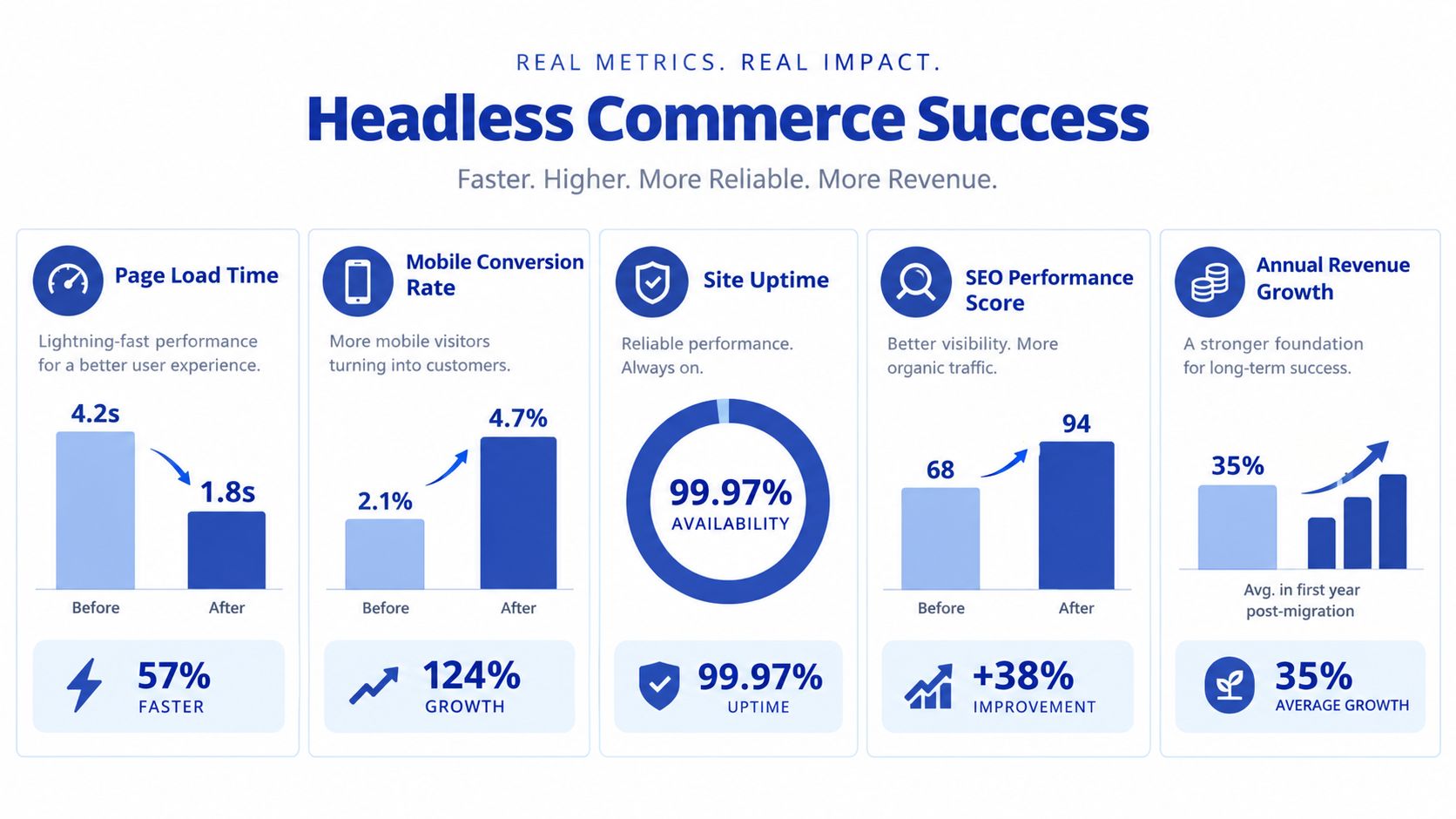
A headless launch can look successful while commercial performance stays flat. Measurement must connect technical behaviour with revenue, search visibility and customer journeys. “The site feels faster” is not enough for a board review, and a high Lighthouse score does not prove that customers can find products, complete checkout or receive the right regional experience.
Capture baseline performance for priority templates and journeys before development starts. After launch, compare like-for-like conditions across rendering speed, interaction responsiveness, mobile journey completion, search usage, product discovery, add-to-cart behaviour, checkout progression, conversion rate, average transaction revenue and revenue by market. Assign ownership for SEO, experimentation and cross-border reporting before the first release, because those responsibilities do not disappear when the frontend is live.
A UK case example involving White Stuff reported 85% faster overall load times, doubled mobile speed, a 37% conversion-rate increase and a 26% lift in average transaction revenue after a headless implementation. (White Stuff headless commerce case example) Those results belong to that specific implementation and shouldn't be treated as a forecast for every brand.
Why the technical change can affect revenue
Decoupling lets a team improve rendering and mobile delivery without rebuilding the underlying commerce logic. That can help when the existing storefront carries unnecessary scripts, hides important content behind client-side requests or makes controlled experimentation difficult.
The commercial result depends on the complete delivery chain. API design, frontend tuning, caching, image handling, hosting configuration, analytics accuracy and deployment discipline all affect performance. A faster product page will not improve revenue if availability data is incomplete, tracking is broken or the checkout path creates friction.
Use the case example to test causality, not to set a forecast. If mobile conversion improves, compare device groups, markets, landing-page types and traffic sources. If average transaction revenue rises, check whether merchandising, pricing, promotions or assortment changes contributed. Cross-border teams should also verify that currency, tax, delivery, consent and regional content are measured correctly.
A practical KPI set should include:
- Experience health, covering page rendering, interaction responsiveness, frontend errors and API failures.
- Search visibility, covering indexation, crawl issues, templates, structured data and organic landing performance.
- Journey quality, covering internal search, collection engagement, product interaction, cart creation and checkout progression.
- Commercial output, covering conversion, average transaction revenue, repeat purchasing and revenue by market.
- Operational reliability, covering deployment incidents, failed integrations, content publishing errors and time to recovery.
For teams building the measurement layer, this guide to Core Web Vitals optimisation provides implementation context. The reporting model should reflect the brand's commercial priorities, SEO ownership and testing roadmap rather than chase a single score.
Evaluating Agencies for Post-Launch Governance
The most important question for an agency isn't “Can you launch the frontend?” It's “Who will own the system on the next trading day?”
Headless creates a permanent division of responsibilities. Developers may own deployments, marketers may own campaigns, SEO specialists may own indexation and templates, and trading teams may own promotions and availability. If those boundaries aren't written down, urgent work gets delayed while each team assumes another team is responsible.
UK-specific coverage highlights the continuing difficulty of site speed, user experience and cross-border trading complexity, while also pointing to the need for technically clean pages. (UK ecommerce and digital performance commentary) The practical risk is not only a slow page. It's an international storefront with inconsistent metadata, incorrect regional content, broken redirects or analytics that no longer distinguishes markets correctly.
Questions that expose the operating model
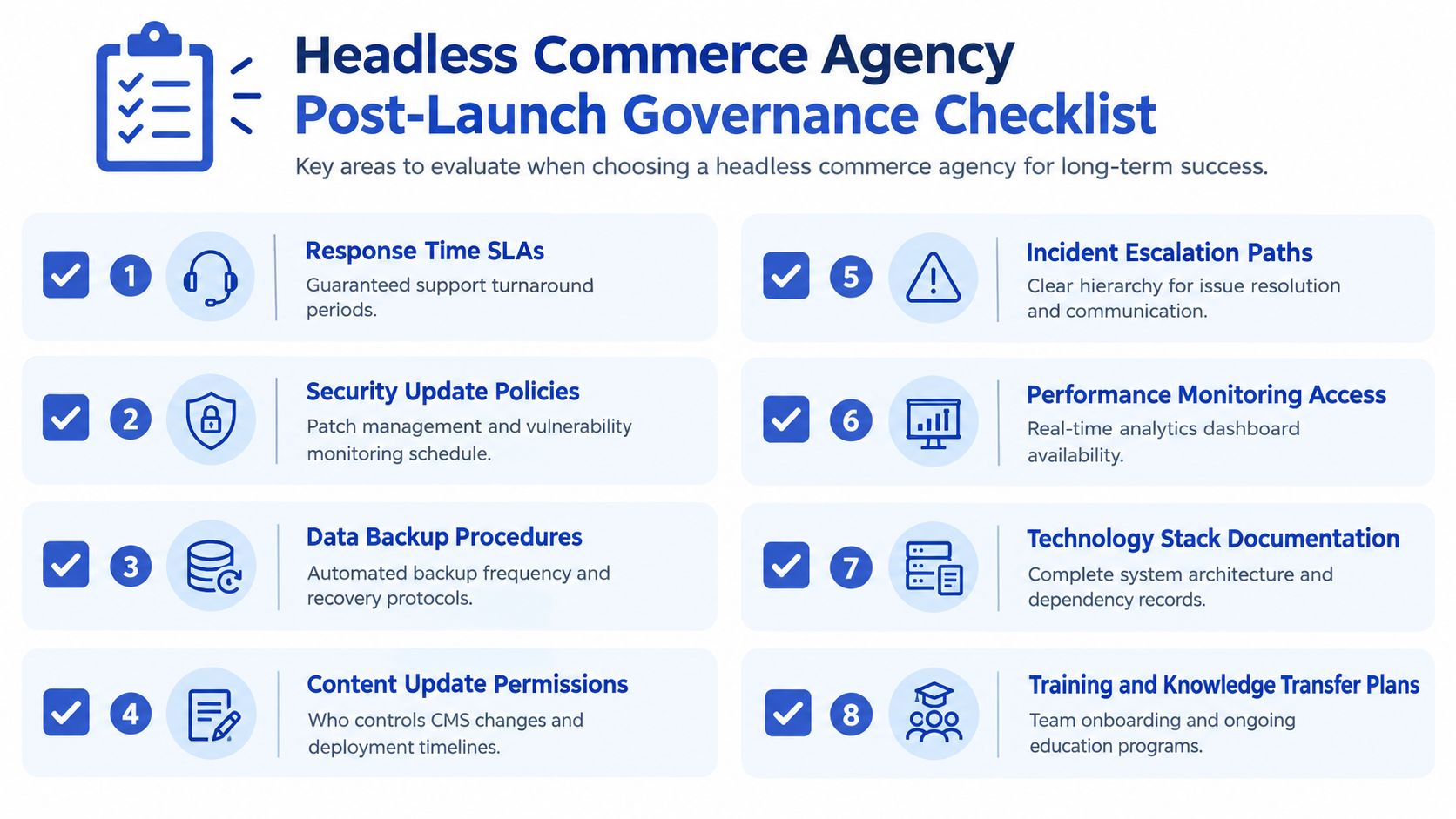
Ask the agency to explain how it handles the following areas, using your own launch and trading scenarios rather than generic assurances.
- SEO changes: Who updates canonicals, schema, metadata, internal links and XML sitemaps? Can the SEO team make safe changes without waiting for a full frontend release?
- Redirect governance: How are legacy URLs mapped, reviewed and monitored? Who responds when a product, collection or market URL changes?
- Experimentation: Which team creates tests, implements variants, validates event tracking and decides whether a winning experience becomes permanent?
- Analytics deployment: Where are events defined? Who checks consent behaviour, data quality, attribution and parity between the old and new storefront?
- Internationalisation: Who manages regional content, currency display, tax treatment, delivery messaging, hreflang logic and market-specific promotions across UK and EU trading setups?
- Content publishing: Can editors preview and schedule content? Which changes require a code deployment, and what is the fallback when an urgent campaign needs to go live?
- Incident response: What qualifies as a critical incident? Who is contacted first, how is the issue escalated, and how does the team communicate during recovery?
- Knowledge transfer: What documentation, training and repository access will the brand receive? Can an internal developer safely make a change without reverse-engineering the stack?
Put ownership into the contract
A support retainer should specify response expectations, monitoring access, release responsibilities, security maintenance, testing standards and the boundaries between agency and client. It should also state what happens when the brand adds a market, changes a fulfilment provider or introduces a new subscription or loyalty service.
The agency should demonstrate its monitoring approach before signing. Ask to see how it detects broken routes, failed API calls, rendering errors, slow templates and analytics anomalies. The answer should involve real alerting and triage, not a monthly report that arrives after customers have already encountered the defect.
The handover is not a meeting. It's a transfer of operational capability, documentation and decision rights.
SEO deserves particular scrutiny because headless teams can focus on rendering while overlooking discoverability. The agency must understand server-side rendering, metadata controls, structured data, canonicals, pagination, redirects, faceted navigation and content deployment. It should also explain how those controls behave when a brand trades across multiple regional storefronts.
Finally, test the relationship before committing to a large build. Request a technical discovery exercise, ask for a written ownership map and challenge the team with a hypothetical incident involving a promotion, a broken API and a market-specific SEO change. The quality of the answer will tell you more than a gallery of frontend screenshots.
Building a High-Velocity Revenue Engine
The right headless commerce agency doesn't sell a framework as a growth strategy. It helps a brand decide where decoupling creates commercial value, where Shopify Plus should remain the source of truth, and how the organisation will operate every service after launch.
That partner combines architecture with conversion-focused UX, disciplined analytics, SEO governance and practical release management. It can work with internal developers, trading teams and marketing specialists without hiding important knowledge behind an agency ticketing system. It also knows when a well-built Shopify Plus theme is the better answer.
For a scaling DTC brand, the outcome should be more than a fast initial frontend. It should be a storefront that teams can change safely, measure accurately and localise responsibly. The architecture earns its keep when it supports better customer journeys without creating an unmanaged operational burden.
A useful final test is simple. Can your team explain who owns the next SEO change, experiment, market launch, API incident and content deployment? If the answer is unclear, delay the build until the operating model is clearer.
Grumspot offers Shopify Plus design and development, headless storefront work, internationalisation, deep ERP, CRM and fulfilment integrations, plus ongoing UX and CRO support. If you need to assess whether headless fits your commercial and operational model, visit Grumspot to discuss the architecture, governance and delivery requirements with its team.
Let's build something together
If you like what you saw, let's jump on a quick call and discuss your project
Related posts
Check out some similar posts.
- composable commerce platform
Learn what a composable commerce platform is, how it differs from monoliths, and how UK Shopify Plus...
Read more
- best web design agency london
Searching for the best web design agency London has? Our 2026 guide reviews 7 top agencies for ecomm...
Read more
- headless shopify plus
Master your headless Shopify Plus implementation with our 2026 guide. Expert tips on building high-p...
Read more
- composable commerce Shopify Plus
Unlock growth with composable commerce Shopify Plus. Learn architecture patterns and migration steps...
Read more