Shopify Store Credit: Complete Setup & Workflow Guide
- shopify store credit
- store credit guide
- shopify refunds
- ecommerce credits
- shopify plus
Launched
October, 2026

A customer returns a faulty product. Your support agent wants to resolve the complaint quickly, keep the value inside the business, and give the customer a reason to shop again. Store credit seems like the obvious answer, until the return reason, payment method, customer account, VAT treatment and refund deadline all have to line up.
That's where many Shopify store-credit programmes become difficult. The customer-facing balance may look simple, but behind it sits a liability, a returns decision, a payment reconciliation process and a set of consumer-protection obligations. A programme that increases repeat purchasing can still create chargebacks, accounting errors and customer complaints if the rules aren't clear.
What Store Credit Really Means for Your Shopify Store
A Shopify store-credit programme can look like a retention feature in the admin. Operationally, it is a promise to provide value later. That promise affects customer service, finance, returns, tax treatment and reconciliation, so the definition needs to be agreed before anyone configures automations.
Shopify store credit is monetary value assigned to a customer account for a future purchase. Discount codes change the price of an order. Gift cards usually carry value through a code that can be transferred or shared, while account-based credit is tied to a specific customer record.
A clear store credit definition gives customer-service, finance and ecommerce teams a shared starting point. Without that agreement, “credit” can mean a refund alternative, a goodwill payment, a loyalty reward or a promotional incentive. Those uses have different approval rules, accounting treatment and customer communications.
The first operating rule is straightforward:
Practical rule: Treat every issued balance as a controlled liability until the customer redeems it, the balance expires under valid terms, or finance confirms another appropriate treatment.
Issuing credit records an obligation to provide value later. It does not create new revenue. Someone must own that obligation, and the system must retain the transaction history needed to explain every balance. Tracking only the original order leaves unanswered questions: Was the credit partly redeemed? Was it refunded again? Was it manually adjusted? Did an account change leave value attached to the wrong customer?

Decide why the credit exists
Classify the reason for issuance before creating an automation:
- Refund alternative: Offered only where the customer can lawfully choose it instead of money.
- Goodwill credit: Issued to resolve a service failure, delayed delivery or complaint.
- Exchange credit: Used to support a product change when the customer accepts the proposed resolution.
- Reward credit: Earned through a loyalty, referral or promotional programme.
- Compensation: Recorded separately from sales-related refunds so finance can report it correctly.
That classification should pass into the ledger, accounting code, customer message and approval route. It also gives support agents a consistent basis for deciding how to handle a return.
For most online, mail-order and telephone purchases, UK consumers generally have 14 days after receiving goods to notify the retailer that they want to cancel, followed by another 14 days to return them. The retailer generally has to refund within 14 days of receiving the goods, or evidence that they were sent back, as explained in this UK ecommerce consumer-rights guide. Store credit cannot replace a legally required monetary refund just because the merchant wants to retain the cash.
Expiry and breakage assumptions also need scrutiny. Fairer Finance has warned about consumer losses from gift cards and vouchers that are lost, expire or are not honoured. That is a reason to document valid expiry terms, customer notices and finance treatment rather than treating unused balances as an automatic profit opportunity.
A sound implementation asks four questions: why is the customer receiving value, is cash legally owed, has the customer accepted credit, and which system will prove what happened later? If those answers are unclear, the programme is not ready for automation.
Built-In Tools vs Dedicated Store Credit Apps
The right implementation depends on whether credit is an occasional service tool or a core part of the retention model. Shopify's native customer-account credit and gift-card functionality can cover straightforward use cases, while a dedicated application may be necessary when return routing, rules and reporting become more involved.
Native gift cards suit gifting because the recipient can use a code without being the original purchaser. Account-based store credit is more appropriate for customer-specific refunds, goodwill adjustments and rewards. Shopify's own guidance describes store credit as a balance that can be issued through the admin or POS and tracked against the customer profile, but native functionality shouldn't be mistaken for a complete programme-management layer. See the Shopify guide to issuing and tracking store credit for the platform's current account and redemption model.
Manual credit can work for a support team handling a modest number of cases. An agent reviews the order, obtains approval, adjusts the customer balance and records the reason in the ticket. The weakness appears when the business needs consistent conditional logic. Manual processes tend to drift, especially when different agents apply different expiry dates, approval standards or refund decisions.
Store Credit Implementation Options Comparison
| Option | Best For | Automation Level | Complexity |
|---|---|---|---|
| Native Shopify gift cards | Gifting, campaigns and transferable value | Low to moderate | Low |
| Native customer-account credit | Occasional goodwill adjustments and simple refund alternatives | Low | Low |
| Shopify Flow with manual approval | Controlled internal rules and support-led issuance | Moderate | Moderate |
| Dedicated store-credit app | Rewards, conditional issuance, account displays and redemption rules | High | Moderate to high |
| Custom integration | Complex returns, ERP journals, multi-market or bespoke liability controls | Very high | High |
Apps such as Gifting Rewards, Returnly and Refundo can be evaluated when the native workflow doesn't provide enough control. The important question isn't whether an app advertises “store credit”. Check whether it uses Shopify's customer balance, maintains its own wallet, or converts value into discount codes. Those models affect migration, refunds, reporting and the customer's checkout experience.
A polished credit widget won't fix an unclear liability model. Choose the system that your finance and support teams can audit, not just the one that makes issuance look fastest.
Test the full path before selecting a vendor. Review customer-account compatibility, POS requirements, return-portal integrations, partial redemption, mixed tender, cancellation handling, expiry messaging and export capability. If the app can't explain where every balance movement is recorded, it's not ready for a high-volume Shopify Plus operation.
For teams building or extending a public-facing integration, the technical requirements differ from a quick private automation. Shopify's public app development guidance is useful context when you need a scalable app that respects platform permissions, installation flows and maintainability.
Setting Up Your Store Credit System
Start with the ledger, not the app interface. Decide what finance needs to see for every movement: customer, order, issue reason, currency, amount, date, expiry status, redemption order, refund relationship and staff member or automation responsible.
The application should make those records accessible, but don't assume the app's dashboard is your accounting system. Export the relevant data and define how it will reconcile with Shopify orders, refunds, payment-provider reports, payouts and the finance platform.
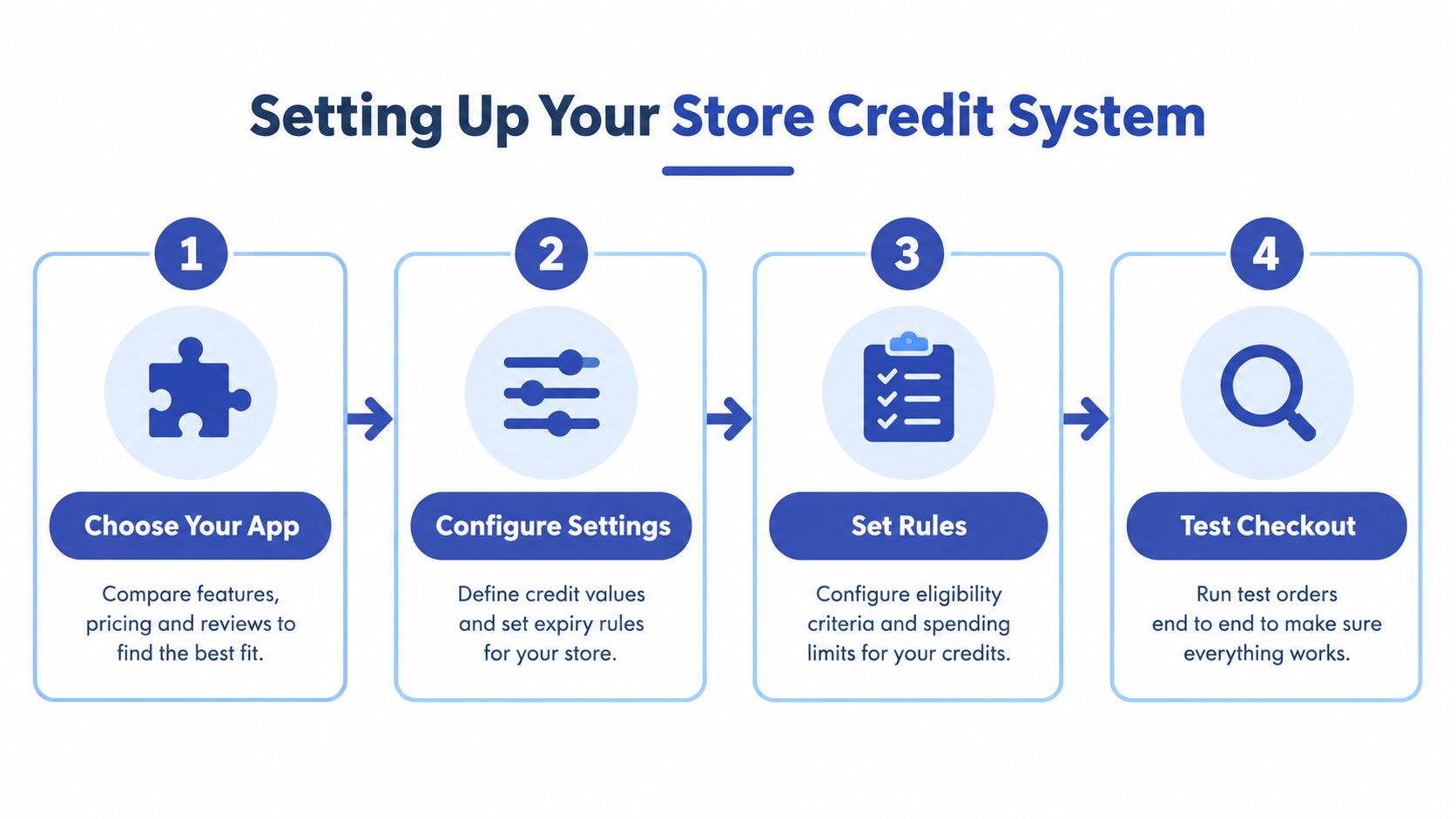
Select the implementation against real scenarios
Ask each shortlisted app to demonstrate the workflows your store needs:
- Issue after a returned order. The system should preserve the return reason and original order reference.
- Redeem across multiple orders. Confirm whether the balance reduces correctly and remains visible.
- Use partial value. Establish whether the customer can spend part of the balance or whether the platform applies it differently.
- Combine credit with a card payment. Check the checkout, order and payment exports.
- Cancel or edit the order. Verify whether the credit is restored, reissued or requires a controlled manual action.
- Process a refund after credit redemption. Make sure the resulting liability and payment records don't duplicate value.
- Change the customer account. Test deletion, merging, guest conversion and account takeover controls.
A demo that only shows a full-value checkout proves very little. The failure points usually appear in partial redemption, mixed tender, cancelled orders and refunds after the original balance has already changed.
Configure customer and staff controls
Make the balance visible in My Account, in relevant order communications and at checkout. Customers shouldn't have to contact support to discover that value exists. Tell them whether credit is account-bound, where it can be used, whether it can be combined with other payment methods and what happens if an order is cancelled.
Set expiry only after legal and commercial review. Your terms should explain the expiry event, the time zone used by the system, reminders, exceptions and the customer's route to support. A default should never be copied from an app's settings without checking the product category, promotion type and markets in which you sell.
Use manual approval for higher-value adjustments, without relying on an arbitrary threshold that agents interpret differently. The approval record should capture the reason, evidence, approver and final outcome. Shopify Flow can route events to support or finance, but it shouldn't on its own decide that every return becomes credit.
UK digital stored value is already a mainstream customer behaviour. In H1 2024, digital gift-card sales grew 17.1% year over year and represented more than 50% of the market for the first time, according to the Gift Card & Voucher Association market data. That supports a clear UX investment, but it doesn't remove the need for controls.
Finish with end-to-end test orders in a non-production environment where possible. Have support, finance and ecommerce each approve the result. If the customer sees one balance while finance sees another, pause the launch until the ownership and reconciliation rules are fixed.
Return and Refund Workflows with Store Credit
A customer returns a faulty item, a support agent selects “refund to credit” because the option is available, and the finance team later finds no evidence that the customer accepted it. The immediate case appears closed, but the business may now owe a monetary refund and carry an unexplained credit balance.
Treat store credit as a liability throughout the workflow. It is value owed to a customer, not revenue earned when an agent issues it. The route should begin with the return reason and legal status, then determine whether credit is permitted, accepted or unsuitable. A faulty, misdescribed or unfit product can trigger statutory remedies. A cancellation request, an exchange and goodwill credit after a service problem require different decisions.
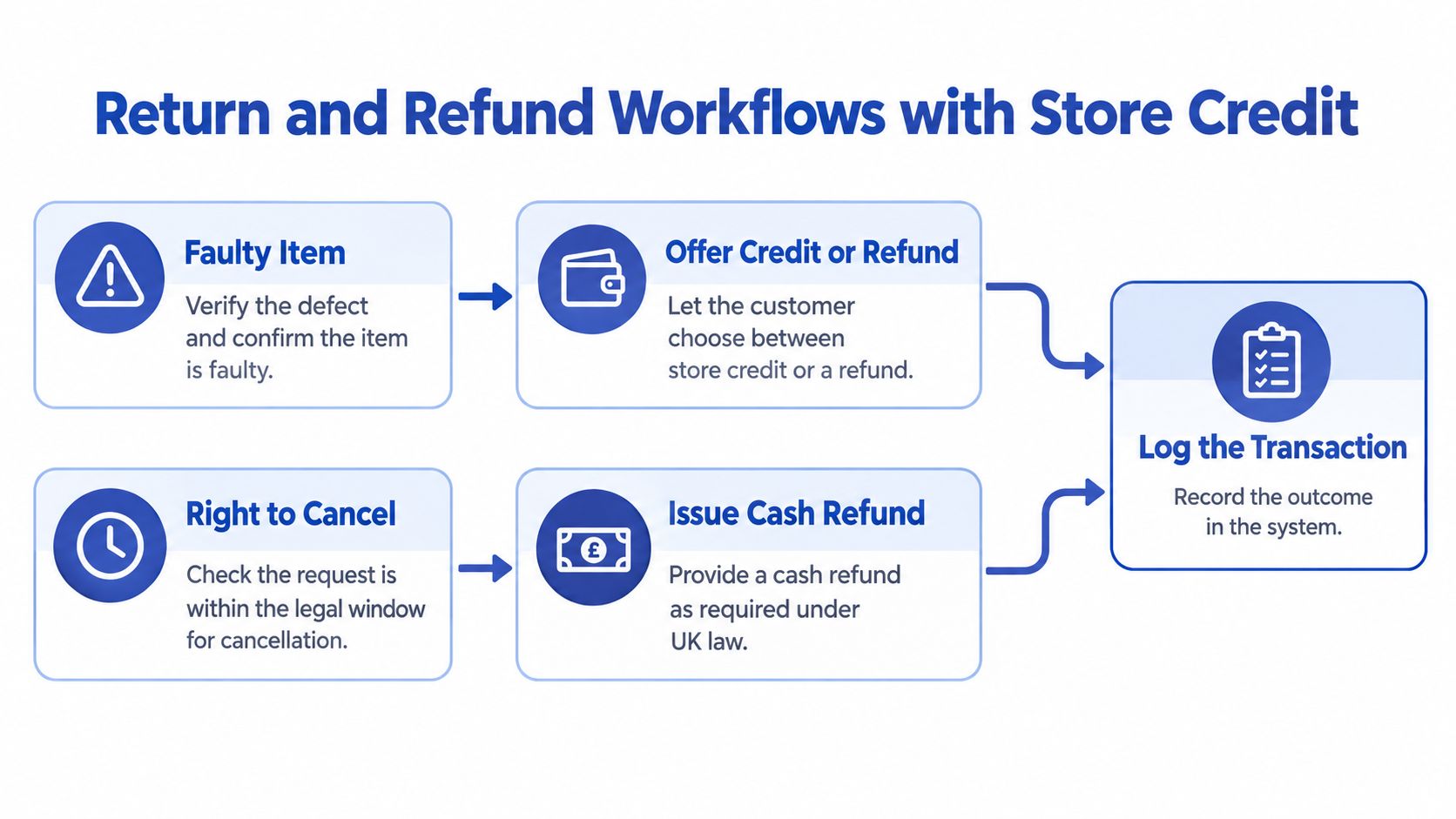
Route each return deliberately
For a faulty item, verify the reported defect and show the available remedies clearly. Depending on the facts, the customer may accept a repair, replacement, exchange, credit or refund. A credit offer should never conceal a restriction on the customer's refund rights.
Use the cancellation window introduced earlier as a routing flag for the cash-refund path. Record the customer's notification date, the return date and the date the goods were received in the audit trail. Credit may be offered as an alternative only where the customer can lawfully choose it and the acceptance is recorded.
For a change-of-mind return outside a statutory cancellation route, apply the published returns policy. Show eligible customers the available exchange or credit option and capture their selection before issuing value. A returnless refund can make sense for low-value or difficult-to-recover products. Reddog Consulting Group explains returnless refunds, including the terminology teams can use when assessing that decision.
Build the rules into the workflow
Use the return reason, original sales channel, product type, fulfilment status and customer selection as routing inputs. A practical sequence is:
- Cancellation request: Flag the case for the cash-refund route and retain notification, return and receipt dates.
- Fault report: Require defect evidence or an approved remedy before issuing a refund or credit.
- Change of mind: Apply the published policy and issue credit only where the customer is eligible and agrees.
- Mixed tender: Separate the original-payment refund from the credit component, then confirm how shipping, fees and discounts are handled.
- International order: Refer cases for tax and local consumer-rights review when currency, VAT or jurisdiction changes the outcome.
Each decision needs an audit trail. Record the reason, dates, original tender, refund amount, credit amount, customer acceptance, approver and final outcome. Store the issued credit against the order and customer record, then reconcile redemptions, cancellations and reversals against the ledger. An apparently small mismatch can leave support promising value that finance cannot verify.
Shopify Flow can send notifications and route approvals, but it should not decide that every return becomes credit. Ambiguous cases need a human review queue, particularly where the customer's message, agent selection and payment record disagree.
Teams operating across online stores, POS, subscriptions and marketplaces should document how each channel handles returns and balances. A structured ecommerce returns-management process keeps the return reason, approval and financial outcome connected when several systems touch one order.
Digital e-gift cards require separate checks because immediate delivery and cancellation rights can interact. The buyer may need to give clear consent to immediate supply and acknowledge the effect on cancellation rights. Use different wording and automation for a customer-specific refund credit and a gift purchased for another person.
Using Store Credit for Conversion Optimisation
Store credit can support conversion, but only when customers understand the balance and can use it without friction. The strongest programmes don't depend on customers forgetting value. They make the balance visible, explain where it applies and create a relevant reason to return.
Start with the customer experience. Show available credit in the account area, confirmation emails and selected lifecycle messages. At checkout, make the payment option recognisable and explain what happens if the balance doesn't cover the full basket. Customers should know whether they can combine credit with a card, whether discounts apply first and what happens to unused value after a cancellation.
Optimise for useful redemption
A credit balance becomes a retention mechanism when it leads to a purchase that makes sense for the customer and the margin profile of the business. It becomes a breakage trap when the merchant hides the balance, adds confusing restrictions or sends reminders that feel like pressure.
Useful tactics include:
- Post-return messaging: Confirm the amount, reason, account location and next action in the same message.
- Balance-led merchandising: Recommend products that are relevant to the customer's previous purchase, not just the highest-margin items.
- Expiry reminders: Send clear, timely notices that state the date and the terms without implying that the customer has lost value before the valid expiry.
- Threshold incentives: If you offer an extra reward for reaching a basket condition, record the promotional credit separately from a refund alternative.
- Support visibility: Give agents a transaction timeline so they can answer balance questions without asking the customer to repeat the full history.
Don't measure success only through issued credit or outstanding balances. A rising liability can mean customers are returning, or it can mean the programme creates dormant value that support eventually has to resolve.
Track cohorts by issued value, redeemed value, outstanding value, expiry value, support contacts, fraud rate and incremental repeat-purchase revenue. Reconcile those measures to orders and payouts regularly. The finance view should show whether credit is being redeemed profitably, while the customer view should show whether the programme is easy to understand.
A strong credit programme optimises profitable redemption, not maximum issuance.
Conversion work also needs guardrails. Test whether credit can be applied to discounted products, subscriptions, shipping, bundles, pre-orders and mixed-VAT baskets. Then document the intended behaviour so merchandising, support and finance don't optimise against different definitions of a successful redemption.
For broader testing principles covering account UX, checkout friction, messaging and experiment design, use these CRO best practices for ecommerce teams. The same discipline applies here. Change one part of the journey, observe the financial and customer-service effect, then retain only the behaviour that improves the whole operation.
When Cash Refund Outperforms Store Credit
Store credit doesn't automatically produce a better customer relationship. A customer who receives money promptly may trust the brand more than one who is pushed into another purchase, especially after a faulty product or a frustrating delivery.

The clearest case for cash is a legally required refund. The same applies when the customer has expressly asked for money, when the product failure has damaged confidence, or when the store's account and redemption experience is unreliable. Retention built on constrained choice is fragile. It can increase complaints and payment disputes instead of future orders.
Consider the hidden cost
Credit programmes require more than an issuance button. They need liability reporting, approval controls, account-security measures, expiry governance and reconciliation across Shopify, gateways, ERP systems and customer-service tools. If the original payment provider retains a fee after a refund, finance must understand how that cost is recorded rather than assuming the order and payout reports will align automatically.
Outstanding balances also create customer-protection exposure if a retailer fails. Fairer Finance's UK benchmark shows why customers need clear terms, visible balances, an accessible recovery route and honest communication about the value they hold. Don't treat unused balances as immediate margin merely because the customer hasn't redeemed them.
For a UK merchant, Shopify states that the merchant remains responsible for correct tax charging, filing and remittance rather than Shopify filing on the merchant's behalf. The Shopify UK tax guidance should be reviewed alongside advice from an accountant, particularly where credit is used across products with different VAT treatment, currencies or markets.
The operating rule is simple: offer store credit as an option, never as a default substitute for a legally required refund. Give agents a decision tree, give customers clear choices and give finance a ledger that ties every movement to an order and reason.
A short training video can help support teams understand the difference between returnless refunds, exchanges and credit before they work in the live workflow.
Before launch, appoint one owner for the liability ledger and one owner for customer-facing policy. Then test issuance after a return, redemption across orders, partial and mixed-tender payments, cancelled orders, account changes, fraud scenarios and payment-provider failure. If your team can't explain the balance from issue to final settlement, the programme isn't ready to scale.
Grumspot helps Shopify and Shopify Plus brands design and implement store-credit workflows that connect customer accounts, returns, checkout, finance and CRO without sacrificing compliance. Visit Grumspot to discuss a practical store-credit build, audit or integration plan for your store.
Let's build something together
If you like what you saw, let's jump on a quick call and discuss your project

Related posts
Check out some similar posts.

- unified commerce platform
Learn how a unified commerce platform connects channels, ERPs, and CRMs to drive growth. Practical g...
Read more
- composable commerce platform
Learn what a composable commerce platform is, how it differs from monoliths, and how UK Shopify Plus...
Read more
- b2b ecommerce platform
Discover how a B2B ecommerce platform helps scaling brands streamline operations, boost sales, and g...
Read more
- shopify subscription theme
Choose and implement the right Shopify subscription theme for your UK store. Covers OS 2.0, app inte...
Read more