Unified Commerce Platform: How It Works for Shopify Brands
- unified commerce platform
- shopify plus
- ecommerce integration
- omnichannel retail
- commerce technology
Launched
October, 2026

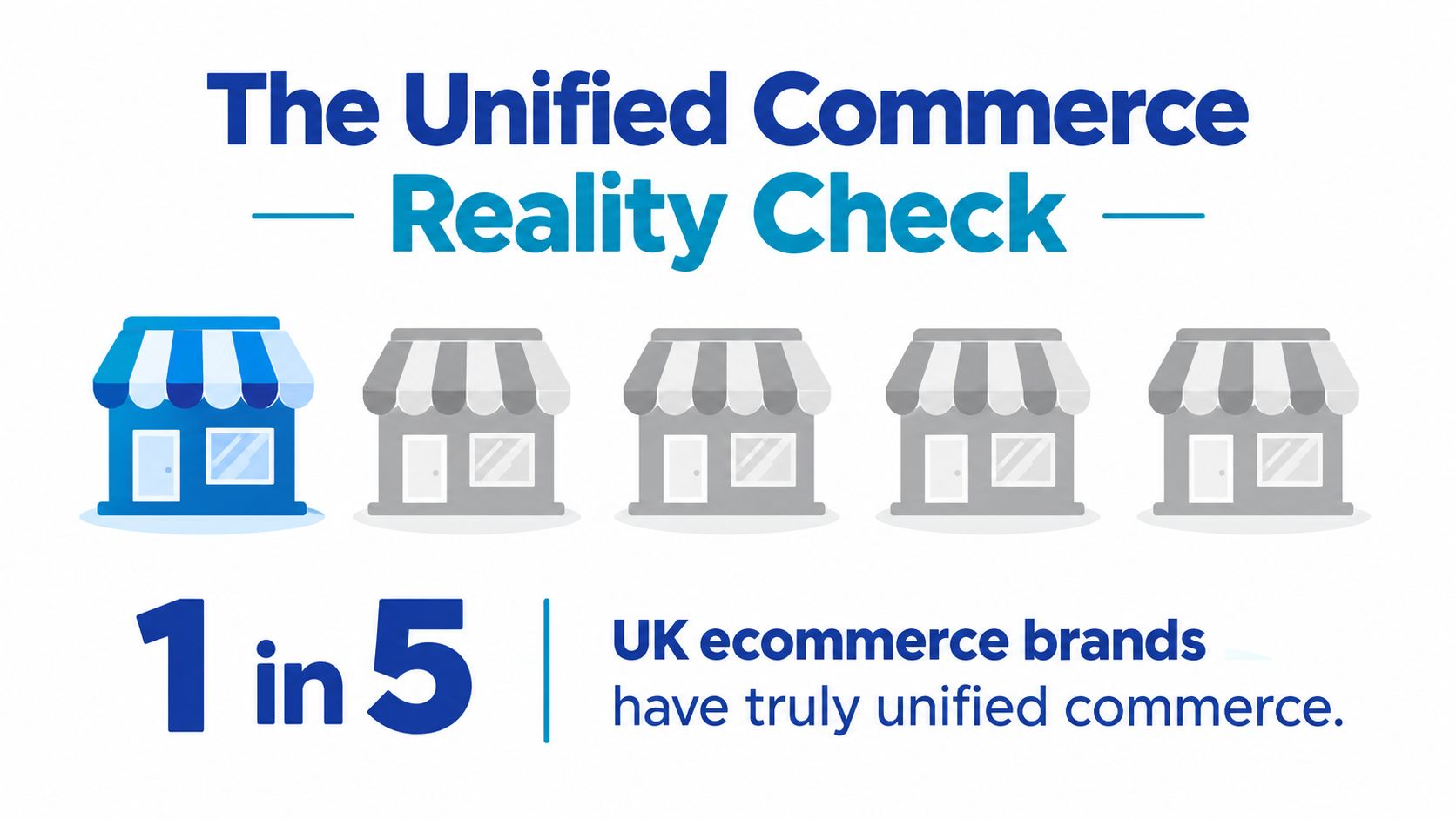
In the UK, only 1 in 5 retailers felt they were delivering a genuinely unified experience, while 86% said customer expectations were moving faster than their digital capabilities. That gap is why a unified commerce platform is not just another commerce stack choice; it's an execution problem that decides whether your channels work together or just look connected on the surface.
A Shopify brand can sell on website, marketplace, and store and still miss the point. Unified commerce is about one operational truth across items, prices, promotions, orders, payments, and customer activity, so the business can act in real time instead of reconciling systems after the fact.
The Unified Commerce Reality Check
Only 1 in 5 retailers said they were delivering a genuinely unified experience, while 86% reported that customer expectations were moving faster than their digital capabilities. Retail Economics also found that 4 in 10 decision-makers blamed disconnected internal teams and slow decisions for the barrier to unified commerce. Retail Economics' 2026 unified commerce report
Channels are not the same as unity
A Shopify brand can sell through its website, Amazon, TikTok, and a physical store while running each channel as a separate operation. Pricing may be maintained in different systems, inventory can fall out of sync, and customer service may lack the complete order history. Customers then experience separate fragments, even when the storefronts appear connected.
The practical test is whether a product, price, or fulfilment change propagates across the relevant channels without manual re-entry. If staff must export spreadsheets, check another system, or reconcile records before acting, the business has channel presence rather than unified commerce.
Practical rule: if a team member has to reconcile data before making a decision, the stack is not unified yet.
Tagada's unified commerce approach is a useful benchmark because it treats unified commerce as an operating model, not a shopping list of software. That distinction matters for Shopify brands. Adding another app can extend coverage while creating another handoff, exception, and source of truth to maintain.
Why the execution gap costs more than the platform decision
The same Retail Economics report identified composable commerce as a preferred approach for speed, flexibility, and cost efficiency, with digitally mature businesses more likely to have a fully modular stack, reaching 70% within that group. The useful lesson is not that every brand needs the same architecture. Platform choice creates options, but integration maturity determines whether those options work together.
For a Shopify Plus brand, a well-built theme and broad channel strategy cannot compensate for separate processes across operations, marketing, support, and fulfilment. The true cost appears in delayed decisions, manual reconciliation, stock discrepancies, inconsistent promotions, and service teams working from incomplete context.
Unified commerce begins when those handoffs become system-driven. The priority is therefore to map where data changes hands, identify which team owns each decision, and fix the highest-cost breaks before replacing the platform.
Unified Commerce vs Omnichannel and OMS
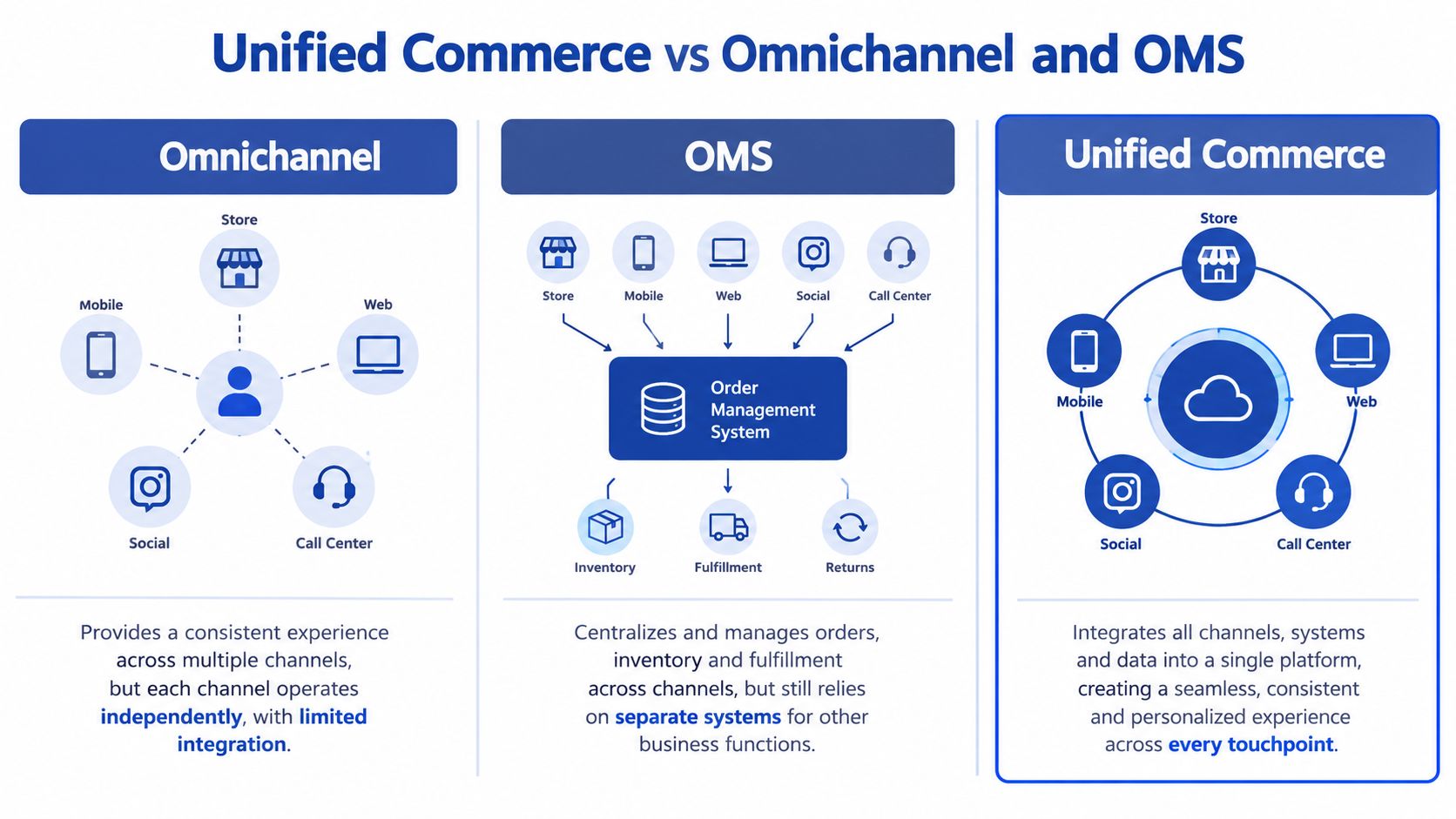
Omnichannel, OMS, and unified commerce get blurred together because they all sit near the customer journey. They solve different problems. Omnichannel helps you sell in more places, an OMS helps you route and fulfil orders, and a unified commerce platform tries to make the whole stack behave like one system.
The cleanest boundary is this, omnichannel is about presence, OMS is about order flow, and unified commerce is about operational truth. If store staff can't see online purchases, promotions differ by channel, or pricing rules are patched together in multiple systems, you're not unified even if the customer-facing experience feels smooth.
What each layer actually does
A unified commerce platform in the UK is typically built as a composable stack that federates items, prices, promotions, orders, payments, and related transaction data into a single operational layer. That's what enables real-time inventory visibility and consistent pricing across stores, warehouses, and digital channels, and it supports service flows like click-and-collect, dynamic promotion management, and fulfilment orchestration. Flooid UK
By contrast, an OMS can route an order from one warehouse to another, but it doesn't automatically unify product logic, customer identity, or commercial rules. A PIM can keep product content tidy, but it sits outside transactional flow, so it won't solve order state, payment state, or live stock visibility on its own.
For a practical Shopify diagnosis, use three checks:
- Channel presence: do you sell in more than one place?
- Data connectivity: do the systems exchange current data without manual exports?
- Operational control: can the business make one change and trust it across the whole journey?
If the first is yes and the last two are shaky, the stack is still fragmented.
A useful content and operating model reference
For teams thinking about governance as well as commerce architecture, WebinOne's omnichannel content governance guide is a helpful companion resource. It's especially relevant when product, content, and channel ownership are split across separate teams.
The point is not that OMS or PIM are bad. It's that they're components, while unified commerce is the operating model that decides how those components work together.
Grumspot's omnichannel ecommerce strategy is a useful internal reference if you're trying to map the transition from channel sprawl to coordinated execution.
Core Architecture and Key Features
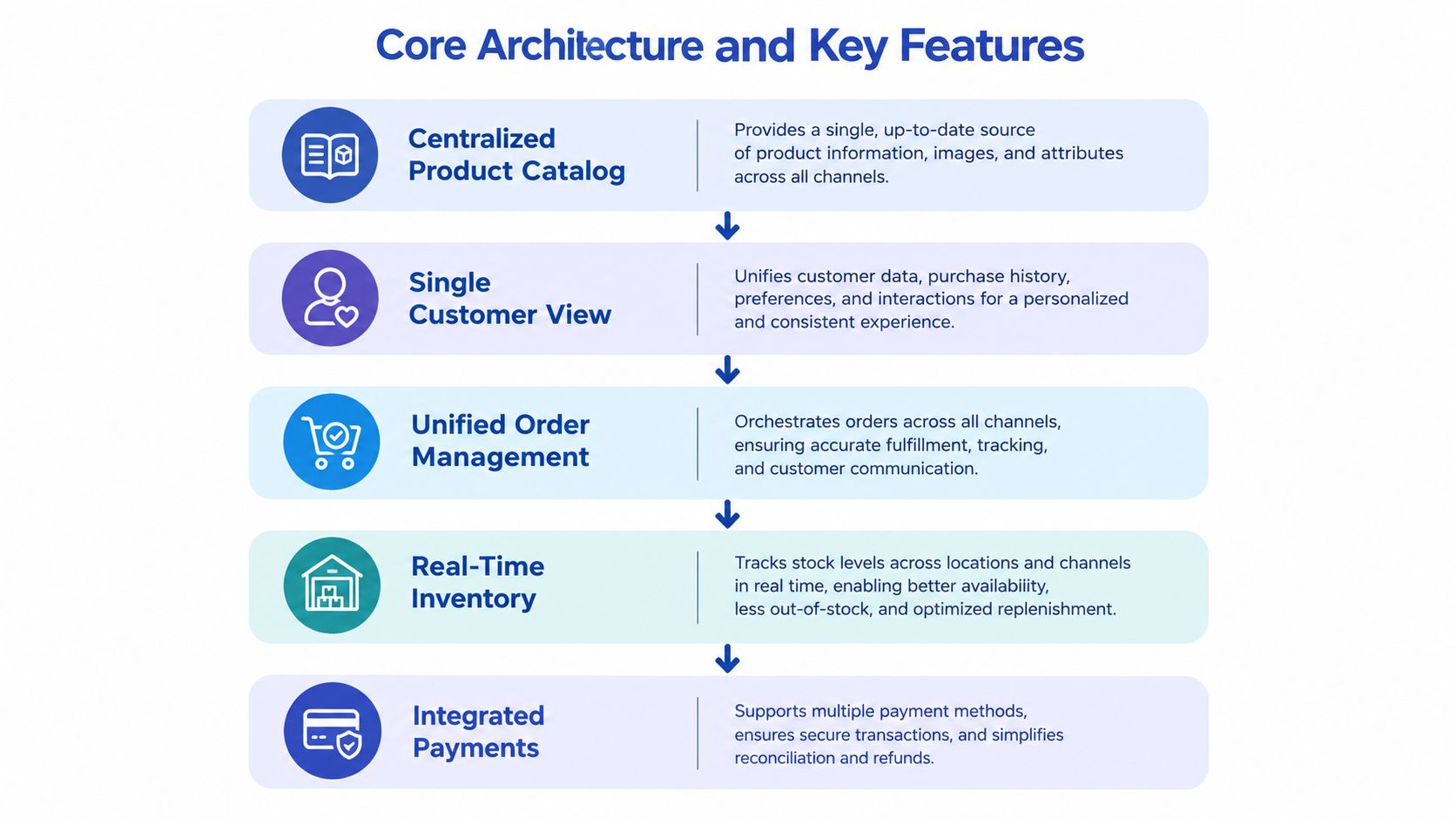
A unified commerce platform only works when the underlying layers are designed to share one truth. For Shopify Plus brands, the important question isn't whether you can add more apps, it's whether product, customer, order, inventory, and payment data stay consistent when the business scales or the promo calendar gets messy.
The five layers that need to line up
Centralised product catalog is the starting point. If product data lives in separate systems, bundle logic, variants, and channel-specific overrides become a maintenance task rather than a commercial decision. On Shopify, that usually means treating the catalogue as a controlled source of truth and pushing only approved data to channels.
Single customer view comes next. A store associate, support agent, and email marketer all need the same purchase context, otherwise the brand repeats itself to the customer and loses history in the process. Customer profiles, consent, and interaction history matter more than another segmented dashboard in this context.
Unified order management handles the full order lifecycle. It's not just routing, it's the rules behind split shipments, fulfilment priority, cancellations, and exchanges. If that logic sits in separate tools, every exception becomes a manual ticket.
Real-time inventory is the part that stops overselling and stock blind spots. If one warehouse says yes and another system says maybe, the customer gets the wrong promise. The inventory layer has to be trusted enough to drive storefront logic, fulfilment logic, and service responses.
Integrated payments closes the loop. Payment state, refund state, and transaction state need to match order state, or finance and CX teams end up reconciling the same event twice.
The architecture has to support operations, not just reporting. If the data only becomes useful after export, it's already too late for live commerce decisions.
How Shopify apps fit without breaking the model
Shopify apps can absolutely play a role, but they should reinforce the operating model rather than become the model. A bundle builder, subscription app, or loyalty layer works best when it reads from clean product and inventory rules instead of maintaining its own shadow logic. That's where architecture beats app count.
A practical example is bundle creation. If product data, pricing rules, and inventory are unified, the business can present bundles without creating stock conflicts or pricing inconsistencies. If they aren't, every bundle becomes a workaround.
For teams that want a deeper technical pattern, Grumspot's API-first ecommerce architecture guide is a sensible reference point. It aligns well with Shopify Plus builds that need flexibility without turning the stack into a tangle of one-off integrations.
The Financial Case for Unified Commerce
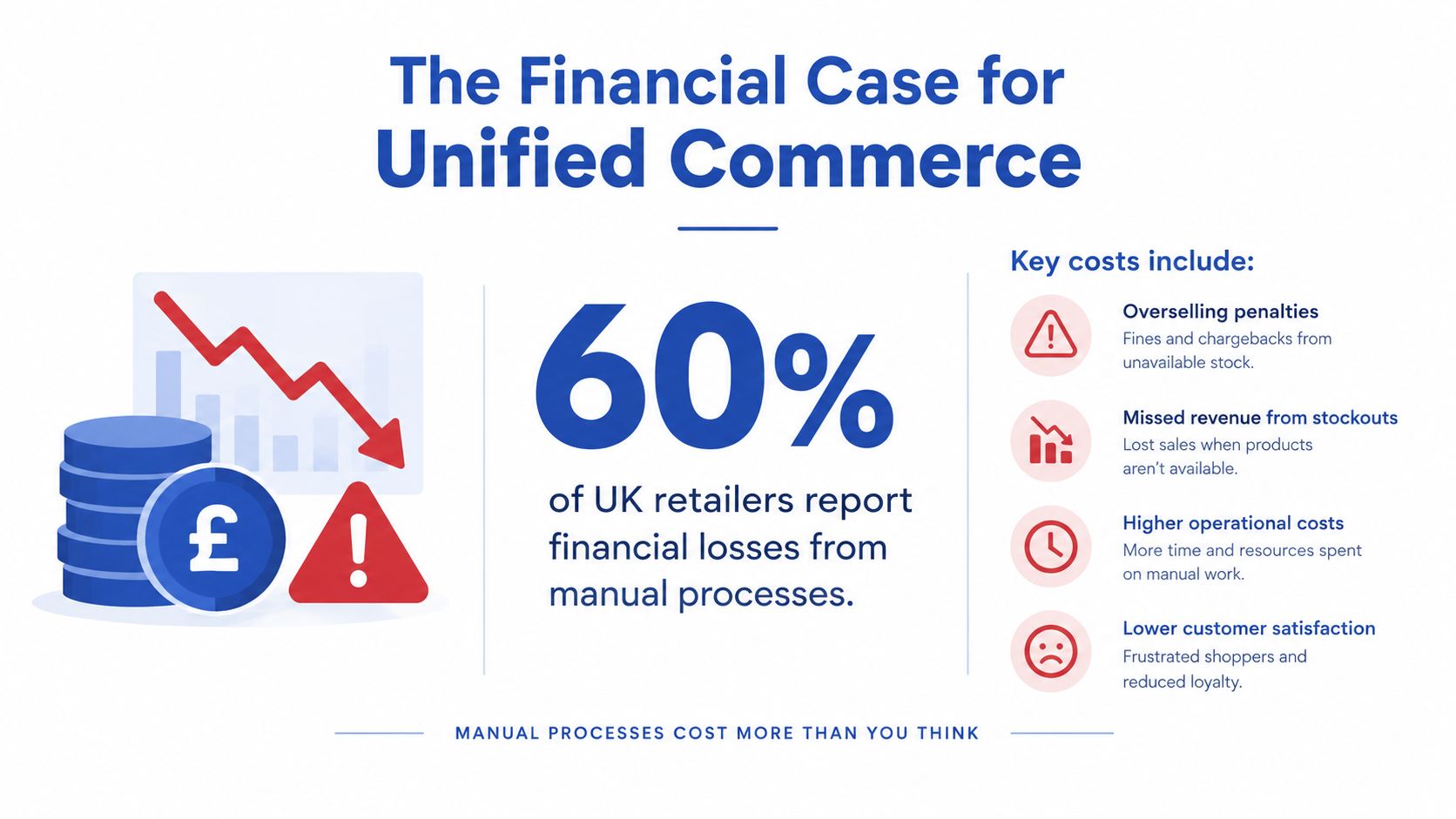
Disconnected systems don't just annoy teams, they drain cash. A UK retail integration survey in 2025/26 found that 60% of retailers reported financial losses from disconnected systems, 48% lost more than £50,000 a year, 14% lost more than £500,000, and 1 in 10 lost over £1 million annually. The survey covered 200 UK retail managers and leaders with technology decision-making authority, so this wasn't a casual sample. Patchworks and The Retail Bulletin coverage
The cost shows up in the boring places first
The biggest losses usually don't start with a dramatic outage. They show up as manual reconciliations, missed stock moves, duplicate work, failed promo logic, and customer service time spent untangling order state. During peak trading periods such as Black Friday, those cracks widen because more exceptions hit the same weak processes at once.
Only 27% of the surveyed retailers described their commerce stack as fully connected and scalable. Nearly a third were still fragmented, while another large segment was stuck in a reactive phase. That matters because a reactive stack can survive normal demand, then start costing real money when order volumes, returns, or campaign changes spike.
How to frame the business case for finance
A useful internal calculation is to separate recurring friction from event-driven loss. Recurring friction includes staff time, support overhead, and maintenance across systems. Event-driven loss includes overselling, delayed fulfilment, promo mistakes, and the revenue lost when a customer drops after a bad experience.
Finance teams usually respond better to operational risk than abstract transformation language. So instead of saying the business needs a unified commerce platform, show how many handoffs fail, how often teams reconcile the same data, and where manual fixes create avoidable cost.
If a process needs human reconciliation every time sales volume rises, it's not resilient, it's just tolerated.
The commercial argument is straightforward. Unified commerce is not only about better customer experience, it's about removing the recurring expense of systems that don't agree with each other.
Integration Patterns and Use Cases
The most practical unified commerce setups connect three things well, ERP, CRM, and fulfilment. ERP keeps inventory, purchasing, and financial data grounded. CRM gives the business customer context. Fulfilment systems decide where the order should go and what promises can be kept.
The UK case for this is obvious. One retail research sample found 64.0% of retailers offered click-and-collect, 42.7% had basic active inventory visibility, and 91.3% had an active ecommerce business. That means channel presence is no longer the issue. The issue is synchronising data and operational control across legacy and online systems. Tecsys UK omni research PDF
Where integrations usually pay off
Click-and-collect only works cleanly when stock, reservations, and fulfilment status are aligned. If the online store shows an item as available while the store floor has already sold it, the customer is the one who pays for the mismatch. The same pattern appears in ship-from-store, where the business needs current location-level stock and a fulfilment rule set that knows which node should pick the order.
Dynamic promotion management is another good test. If a promotion is created in one tool but isn't reflected in order logic or customer service tools, you end up with refunds, disputes, and manual overrides. A unified layer reduces that gap because the promotion is part of the same transaction model, not a separate campaign object floating above it.
Store associates also benefit when customer history is visible at the point of service. If a shopper comes in with an online return, a loyalty issue, or a repeat purchase question, staff should not have to search three systems to find the answer.
Grumspot's ecommerce ERP integration guide is useful for brands planning the plumbing work behind these scenarios, especially when ERP and Shopify need to share product, stock, or fulfilment data.
What tends to go wrong
The failure pattern is usually the same. A business launches a new sales channel, adds a tool to fix one symptom, then discovers the new tool has its own data model and exception handling. That creates more maintenance than the original problem.
A tighter approach is to define the master system for each data type, then decide where each event gets written, read, and validated. That's what keeps unified commerce from becoming “integrated chaos.”
Implementation Readiness and Migration Guidance
Buying a platform is the easy part. Running the migration without breaking operations is where brands get exposed. UK evidence suggests the key gap is not just platform selection, but execution maturity across modular architecture, centralised analytics, and AI deployment. In a 2025 UK survey of 100 retail and DTC brands, only 28% reported a fully modular stack, 42% of omnichannel retailers had fully deployed AI personalisation, and 58% of retailers with centralised data capabilities said they made faster decisions. PMC Commerce's UK survey write-up
Readiness beats ambition
If you're on Shopify Plus, the first question isn't whether you can migrate from Magento, WooCommerce, or a custom build. It's whether your current data structures and team processes can survive the move. Legacy catalog logic, brittle discount rules, and poorly documented fulfilment exceptions tend to surface late, which is exactly when migration risk gets expensive.
The readiness check should cover four areas. Data architecture, because product and order data need clean ownership. Team structure, because siloed teams slow every release. Process documentation, because undocumented exceptions always return during go-live. Stack modularity, because a tightly coupled system is harder to unwind and harder to extend.
How to judge whether migration is worth it
A move to Shopify or Shopify Plus makes sense when the current stack is blocking commercial execution more than supporting it. If new channels, subscriptions, bundles, or international expansion keep colliding with integration debt, the business is already paying for complexity, just in a hidden way. If the team can't explain where truth lives for price, stock, or customer state, that's a migration warning sign.
Grumspot's migration and build work fits naturally here because it combines storefront development with ERP, CRM, and fulfilment integrations. The practical value of that kind of service is not the platform itself, it's the ability to move data and logic without losing the operating model that the business depends on.
A migration should reduce exception handling, not move it to a new admin panel.
The brands that do this well plan for integration testing, content parity, and staff training before the cutover. The ones that struggle treat go-live as a finish line rather than the start of operational stabilisation.
Success Metrics and Continuous Improvement
A unified commerce platform earns its place by making the business faster, cleaner, and cheaper to run while protecting customer trust. The clearest evidence appears in daily work: fewer reconciliations, fewer manual corrections, and more time for teams to improve the customer experience.
Start with operational measures. Track order cycle time, stock accuracy, cancellation rate, and exception volume to see whether storefront, POS, fulfilment, and finance are working from the same facts. Customer measures should cover repeat purchase behaviour, service resolution quality, and channel consistency. Financial measures then show whether maintenance effort is falling and whether peak trading creates fewer expensive fixes.
What a healthy trend looks like
Improvement usually happens in stages. Operations move from reactive firefighting to partial coordination, then to a model where teams can resolve issues without checking several systems. A useful signal is not the disappearance of every problem. It is the same problem stopping at one point instead of returning across three systems.
Set one exception-reduction target at a time. For example, a Shopify brand could reduce inventory-latency cancellations from 2.1% to below 0.5% in 60 days by making the inventory service the single source of truth for the storefront and POS. The target connects a technical change to a commercial outcome, and it gives the team a clear test for whether the integration is working.
A central dashboard helps only when it links operational events to business results. A cancellation spike may expose inventory latency. A conversion drop may indicate a promotion mismatch. More support tickets may show that order context is missing. Monitoring should make those relationships visible quickly enough for the team to act.
Keep the stack modular enough to improve
As noted earlier, Retail Economics found that digitally mature businesses were more likely to use a fully modular stack. The practical lesson for Shopify brands is to preserve clear ownership between commerce, inventory, customer, and fulfilment services rather than making every improvement depend on a full-system rewrite. Retail Economics' 2026 unified commerce report
Unified commerce is an operating discipline, not a launch milestone. Review the data regularly, remove one recurring exception at a time, and tighten the links between commerce, operations, and finance.
Grumspot supports Shopify and Shopify Plus projects through storefront builds, technical audits, and integrations with ERP, CRM, and fulfilment systems. Visit Grumspot to assess how that work could fit a unified commerce setup.
Let's build something together
If you like what you saw, let's jump on a quick call and discuss your project

Related posts
Check out some similar posts.
- shopify store credit
Learn how to set up Shopify store credit with built-in tools or apps. Covers policy design, refund w...
Read more
- composable commerce platform
Learn what a composable commerce platform is, how it differs from monoliths, and how UK Shopify Plus...
Read more
- b2b ecommerce platform
Discover how a B2B ecommerce platform helps scaling brands streamline operations, boost sales, and g...
Read more
- shopify subscription theme
Choose and implement the right Shopify subscription theme for your UK store. Covers OS 2.0, app inte...
Read more