Benefits of Conversion Rate Optimization
- conversion rate optimisation
- CRO benefits
- ecommerce conversion
- revenue growth
- UX improvement
Launched
September, 2026
Great Britain's average ecommerce conversion rate reached 3.4% in April 2026, but the median site converted at only 2.35%, according to UK ecommerce conversion benchmarks for 2026. That gap matters because it shows why conversion rate optimisation isn't a cosmetic exercise. Many UK stores can create more revenue from the visitors they already attract, particularly on the device, category, or checkout step where performance is weakest.
I've audited enough Shopify stores to know that the biggest opportunities rarely come from changing a button colour. They come from removing uncertainty around delivery, fixing awkward mobile interactions, clarifying product value, and making checkout feel safe and predictable. The benefits of conversion rate optimization are commercial, but the work starts with understanding where shoppers hesitate.
Why Conversion Rate Optimisation Matters More Than Ever
A sitewide conversion rate can hide serious underperformance. The 2.35% median in Great Britain sits well below the reported 3.4% average, which suggests that a smaller group of high-performing stores pulls the average upwards while many merchants remain below it. Category context matters too. Grocery converted at 11.1%, while furniture converted at about 7.1% in the same benchmark set, demonstrating why sector comparisons are more useful than a generic target. (Behaviour Digital)
The practical implication is straightforward. If your store attracts qualified traffic but loses buyers through unclear product information, slow mobile pages, or an inconvenient checkout, buying more traffic magnifies the leak. CRO improves the efficiency of acquisition, organic visibility, email traffic, and returning visitors at the same time.
Traffic growth versus traffic efficiency
UK conversion performance also moves noticeably over time. One Great Britain benchmark recorded online conversion falling from 2.18% in Q4 2023 to 1.94% in Q4 2024, while another UK dataset reported a market average of 1.51% in January 2026, down from 1.75% a year earlier. (Grumspot's UK CRO analysis)
Those figures don't provide a universal target. They show why a static “average conversion rate” isn't enough for decision-making. A store needs to understand its own traffic mix, product margins, device split, and customer intent before deciding whether acquisition or optimisation deserves the next budget allocation.
Practical rule: Fix the weakest commercially important step before increasing the volume entering it.
Checkout is often the clearest revenue leak
Checkout friction deserves priority because it affects visitors who have already shown strong intent. A Leeds Beckett and Retail Institute study reported that around 74% of UK baskets created in Q4 2024 didn't convert. Mobile basket abandonment was 76%, compared with 67% on desktop, and recovery rates were below 5% in 2023. (UK abandoned basket data)
Forced account creation, unexpected delivery costs, distracting discount fields, and slow payment steps can all turn purchase intent into lost revenue. CRO gives teams a method for identifying which friction matters, testing a focused response, and measuring whether more customers complete the journey.
What Conversion Rate Optimisation Actually Is
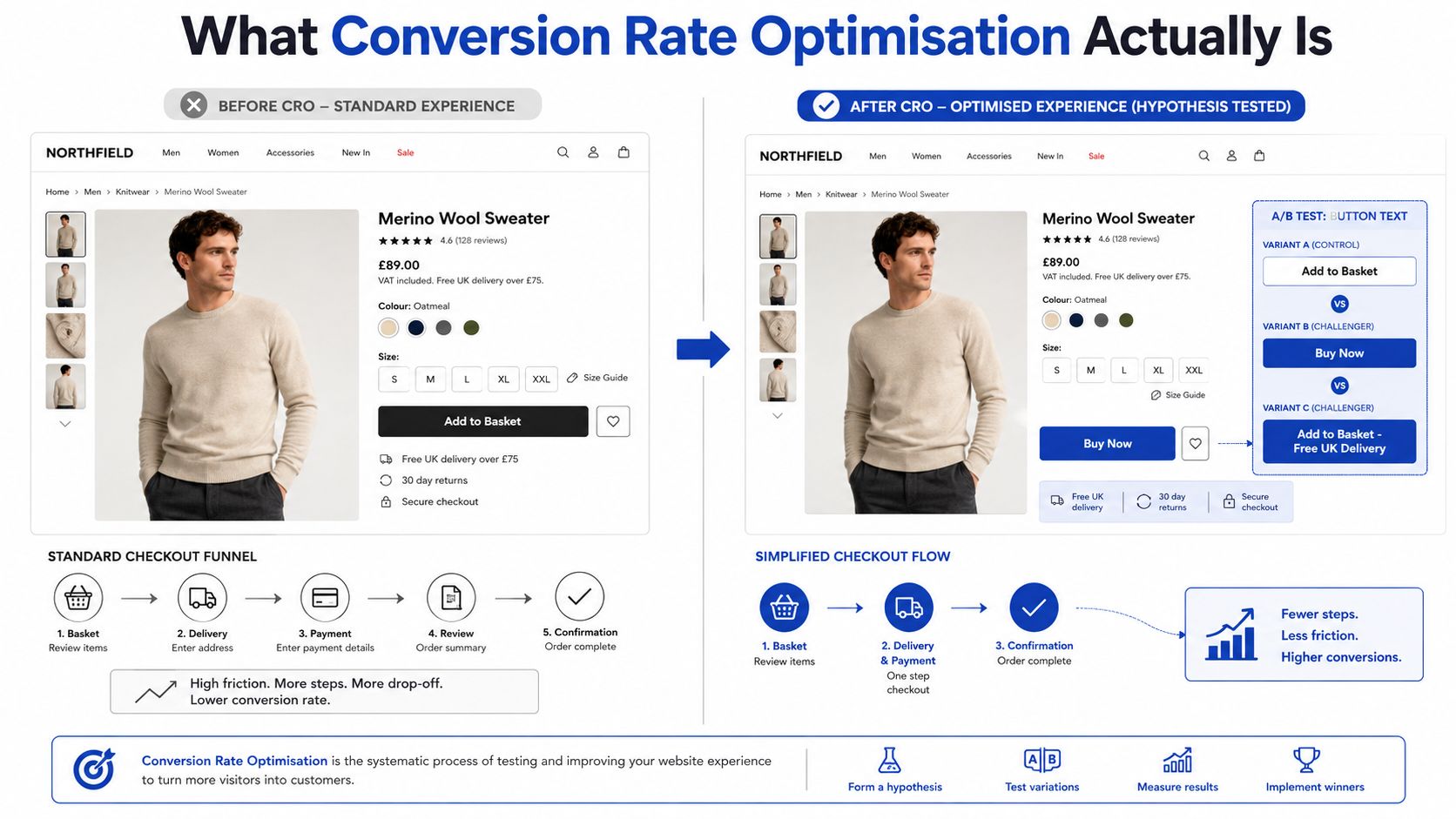
Conversion rate optimisation is a structured process for increasing the proportion of visitors who complete a valuable action, usually a purchase. It combines behavioural research, analytics, customer feedback, UX review, and controlled experimentation to identify why people hesitate and what change might help them progress.
A useful CRO hypothesis is specific. “Improve the homepage” isn't a hypothesis. “Mobile shoppers don't see delivery reassurance before selecting a variant, so moving a concise delivery promise closer to the purchase controls should reduce hesitation” is testable. The second statement identifies an audience, a problem, an intervention, and an expected behaviour.
CRO covers the whole buying journey
A Shopify CRO programme can include:
- Landing pages: Match the page message to the advert, search query, email, or referral that brought the visitor.
- Collection pages: Improve filtering, sorting, merchandising, and category explanations so shoppers can narrow choices confidently.
- Product pages: Resolve questions about fit, materials, compatibility, delivery, returns, stock, and payment before the buyer reaches the cart.
- Cart and checkout: Remove unnecessary fields, clarify costs, support guest checkout, and make payment options easy to understand.
- Post-purchase flows: Use confirmation, education, and relevant recommendations to support retention and future value.
CRO isn't a redesign project with a launch date. It isn't copying a competitor because their product page looks cleaner, and it isn't running random tests until one produces a favourable result. A redesign may be necessary when the underlying experience is structurally weak, but a mature programme still needs research and measurement.
The working cycle
Teams normally begin by reviewing analytics, session recordings, heatmaps, customer service questions, search behaviour, and checkout progression. They then prioritise the problems most likely to affect revenue, write a hypothesis, implement one controlled change, and compare the result against a suitable baseline.
The discipline matters more than the visual novelty. A small change that resolves a genuine objection can outperform a dramatic page refresh that reflects internal taste.
The Core Benefits of Conversion Rate Optimisation
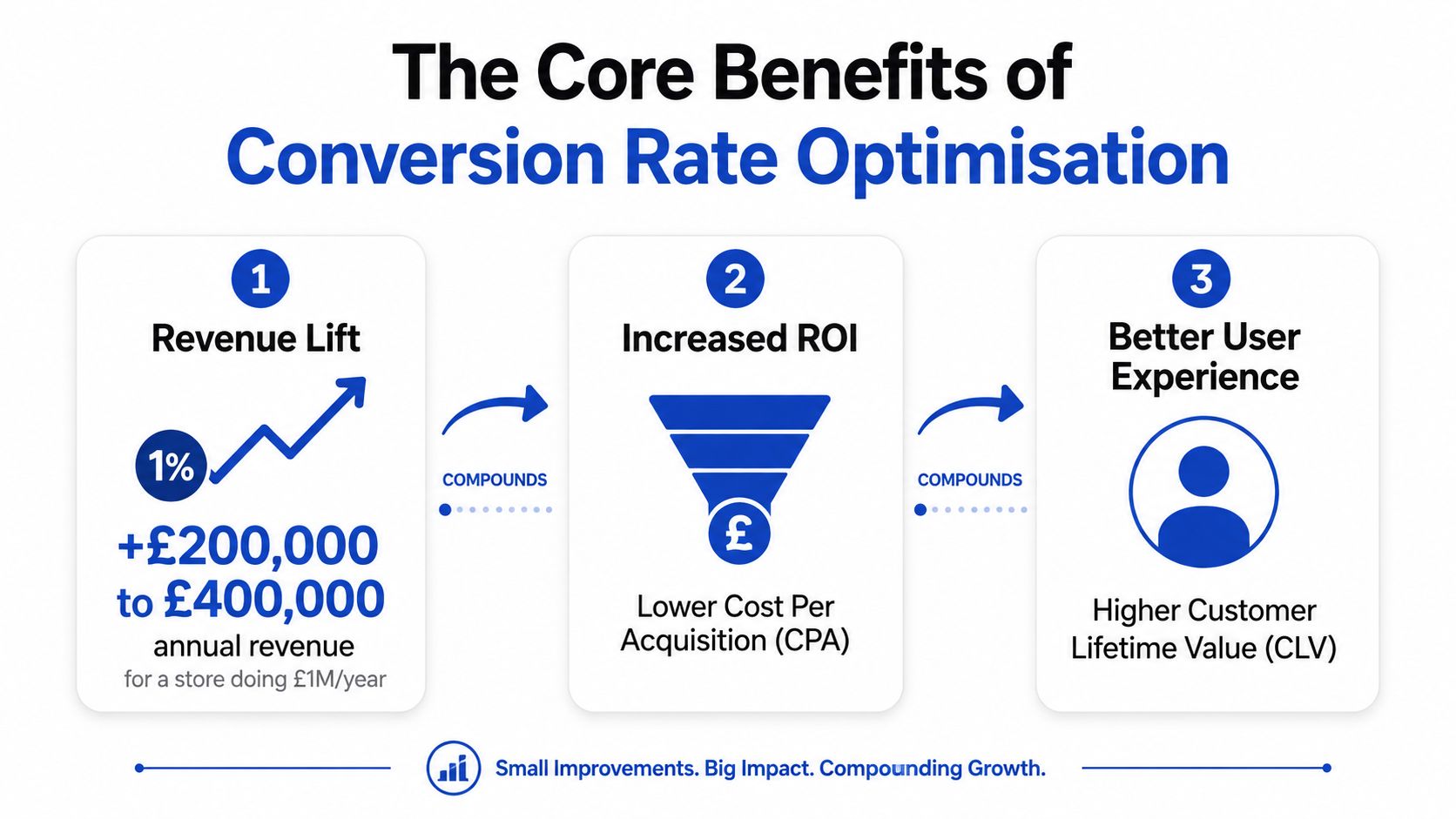
The most obvious benefit is more revenue from existing demand. When a higher proportion of qualified visitors purchase, the store earns more without needing to increase sessions first. That distinction is important for merchants managing paid acquisition costs, inventory constraints, fulfilment capacity, and contribution margin.
The financial effect is easiest to understand through a simple model. If a store has already paid to attract a visitor, improving the chance that the visitor buys increases the value of that acquisition spend. The store doesn't need a new audience for every revenue gain. It needs fewer valuable sessions to go to waste.
Better acquisition economics
CRO can improve paid media efficiency because more of the resulting traffic completes the purchase journey. If the media cost stays constant while the number of customers rises, the effective cost per customer falls. That can improve return on ad spend without asking the media team to find cheaper clicks.
This is why I'm cautious when a store immediately responds to weak revenue by increasing Google Shopping or Meta spend. If product-page visitors struggle to understand delivery, availability, returns, or product suitability, more traffic creates more expensive evidence of the same problem.
A more resilient sequence is:
- Confirm that the traffic is commercially relevant.
- Identify the largest drop-off by device and funnel stage.
- Remove the clearest friction or objection.
- Measure revenue per session, not just button engagement.
- Increase acquisition only after the landing and purchase experience can handle it.
A clearer and more usable customer experience
Research methods such as session recordings, heatmaps, on-site surveys, and customer interviews reveal problems that standard analytics can't explain. Analytics may show that mobile product pages underperform. Recordings can show that shoppers repeatedly open accordions, struggle with variant selectors, or scroll past delivery information without finding an answer.
Those findings improve the experience for people who don't convert and for customers who eventually do. Clearer navigation, readable product information, accessible controls, and predictable checkout behaviour reduce the effort required from every visitor.
The trade-off is that some “conversion” changes can damage trust. Aggressive pop-ups, artificial urgency, hidden costs, and over-personalised recommendations may create short-term interaction while harming customer satisfaction or return behaviour. Guardrails matter.
Stronger customer value after the first order
CRO shouldn't end at the thank-you page. Post-purchase education, replenishment reminders, relevant cross-sells, and clearer account experiences can increase the value of a customer relationship. The right approach depends on the product. A replenishable skincare item calls for a different follow-up from a high-consideration furniture purchase.
The same research discipline applies after purchase. Review which recommendations are relevant, which emails create support tickets, and whether additional offers help the customer rather than interrupting them. A higher initial conversion rate is useful, but a profitable customer relationship is the broader commercial objective.
Faster decisions and stronger internal knowledge
A repeatable CRO programme gives merchandising, marketing, design, development, and customer service teams a shared way to make decisions. Instead of debating whether a page feels premium, they can investigate which information shoppers need and whether a change improves the business metric that matters.
That knowledge compounds. A test on delivery messaging may inform paid advertising, email content, product naming, and customer service scripts. A finding about mobile navigation may influence the design of a new collection page. CRO becomes valuable not only because individual experiments can win, but because the organisation learns how its customers make decisions.
International expansion adds another layer. UK stores entering European or US markets may need different delivery language, payment expectations, returns reassurance, tax communication, and trust cues. CRO helps teams adapt those elements to local behaviour rather than assuming one storefront experience will work equally well everywhere.
Where the Biggest Gains Come From by Device and Sector
Conversion rate isn't one number. It's a collection of outcomes produced by different devices, categories, traffic sources, and customer intentions.
A mobile visitor comparing a £20 cosmetic product behaves differently from a desktop visitor researching a large furniture purchase. Treating both journeys as one sitewide average makes prioritisation harder and can lead teams towards generic changes that help nobody materially.
Start with the weakest valuable segment
UK benchmark data shows a broad sector spread, from 0.53% in electrical and commercial equipment to 4.82% in arts and crafts in January 2026. The same source reported the UK market average at 1.51%, down from 1.75% a year earlier. (UK ecommerce sector benchmarks)
That spread changes the question a CRO specialist should ask. Don't start with “How do we raise the sitewide rate?” Start with “Which segment has enough qualified demand and enough friction to justify attention?”
For some stores, mobile checkout is the answer. For others, the product page on desktop is the bottleneck because customers need technical comparison, sizing guidance, or delivery confidence. In furniture, buyers may need room dimensions, material details, assembly information, and realistic delivery expectations. In beauty, the priority may be shade selection, routine guidance, ingredient clarity, or bundle relevance.
Use benchmarks as context, not targets
IRP Commerce data illustrates why category and time period matter. Its UK benchmark coverage reports broad category differences, including approximately 1.2% to 1.5% for home and furniture and 4.9% to 6.2% for food and beverage, while another July comparison showed the market average moving from 1.94% to 2.26% year over year. (IRP Commerce market data)
A benchmark can flag an anomaly, but it can't diagnose the cause. Compare device, category, landing page, new versus returning visitor, and traffic source. Then connect the weakest segment to a user problem you can investigate.
A sitewide average is a reporting number. The opportunity usually sits inside a specific journey.
Review mobile-to-desktop performance carefully. UK-focused benchmark guidance identifies mobile below 40% of desktop conversion as a warning sign, with 40% to 55% described as a normal range. (IRP Commerce device guidance) Treat that as a diagnostic prompt, not a promise of what your store should achieve.
For a broader B2B perspective, this guide to B2B conversion rate optimisation is useful because it highlights how buying complexity changes the evidence and reassurance a page needs.
How to Measure and Prove CRO Impact
CRO earns credibility when the measurement model reflects commercial reality. The primary metric should normally be purchase conversion rate or revenue per session, depending on whether order value varies significantly between experiences.
Supporting metrics explain movement, but they shouldn't replace the business outcome:
- Add-to-basket rate: Indicates whether product-page intent is increasing.
- Checkout completion: Shows whether cart and payment friction has changed.
- Average order value: Helps detect whether a conversion gain comes with weaker basket quality.
- Revenue per session: Connects order frequency and order value to the traffic being evaluated.
Guardrail metrics protect the business from false wins. Monitor performance, refunds, returns, customer service contacts, satisfaction feedback, and page speed where relevant. A test that increases completed purchases but causes more support issues or poor-quality orders may not be commercially positive.
Build tests around decisions
Before launching an A/B test, record the hypothesis, primary metric, audience, implementation details, and decision rule. Don't change the primary metric after seeing the result. Don't stop a test because one variation looks promising in the first few days, and don't declare a winner when the sample is too small to support a reliable conclusion.
Exact sample requirements depend on baseline conversion, traffic volume, allocation, minimum detectable effect, and the number of segments being analysed. Smaller UK stores may need longer test periods or larger, more meaningful changes. If a store can't generate enough observations for a clean test, structured before-and-after analysis, usability research, and staged implementation may be more appropriate than pretending a weak experiment is conclusive.
Watch for Simpson's paradox when aggregate results conflict with device or source-level results. A variation may appear positive overall because its traffic mix changed, while mobile performance declined. Novelty effects can also inflate early engagement, and micro-conversions such as clicks or email sign-ups may not translate into profitable orders.
For additional context on measuring conversion behaviour across advertorial and listicle journeys, Landra's guide to advertorial conversions offers a useful complementary resource.
Present ROI in a way finance can challenge
A practical CRO ROI calculation is:
Incremental gross profit from the measured improvement, plus the value of retained performance over the reporting period, minus testing software, implementation, research, and internal time, divided by total programme cost.
Use revenue per session and margin rather than revenue alone where possible. Attribute the uplift conservatively, document assumptions, separate permanent changes from temporary test exposure, and show how the result behaves across mobile, desktop, category, and acquisition source. Stakeholders trust CRO more when the dashboard exposes uncertainty instead of hiding it.
Real CRO Wins and What Made Them Work
The requested examples in this section aren't supported by the verified data provided, so they shouldn't be presented as real UK case studies or attributed outcomes. Inventing a retailer, test duration, conversion lift, or revenue result would make the article less useful, not more authoritative.
What can be stated confidently is the pattern behind credible CRO wins. A fashion store may discover through recordings and device reports that mobile shoppers lose access to the purchase control while reviewing product information. A sticky add-to-basket control could be a sensible hypothesis, but its impact must be measured against purchase and revenue metrics, not assumed from clicks.
A homeware merchant might find that customers reach checkout but hesitate when delivery timing or returns information is unclear. Moving reassurance closer to the decision point may address the objection, yet the team still needs to check whether completed orders, margin, and support contacts improve together.
A health and beauty brand may identify relevant product relationships from its own purchase data. A cross-sell module can then be tested for basket value and completed orders, while monitoring whether irrelevant recommendations distract shoppers or create confusion.
What separates evidence from anecdotes
A credible experiment record includes:
- Observed problem: The data or research shows where customers struggle.
- Specific hypothesis: The team explains why a change should help.
- Controlled implementation: The test isolates the meaningful variation.
- Predefined measurement: Primary, supporting, and guardrail metrics are agreed beforehand.
- Segment review: Device, category, and traffic source results are checked separately.
- Decision log: The team records what changed, what was learned, and what happens next.
The CRO case studies collection can provide further reading on how practitioners frame experiments and outcomes. Use any case study as a source of hypotheses, not as a guarantee that the same treatment will work on your store.
Getting Started with Your First CRO Programme
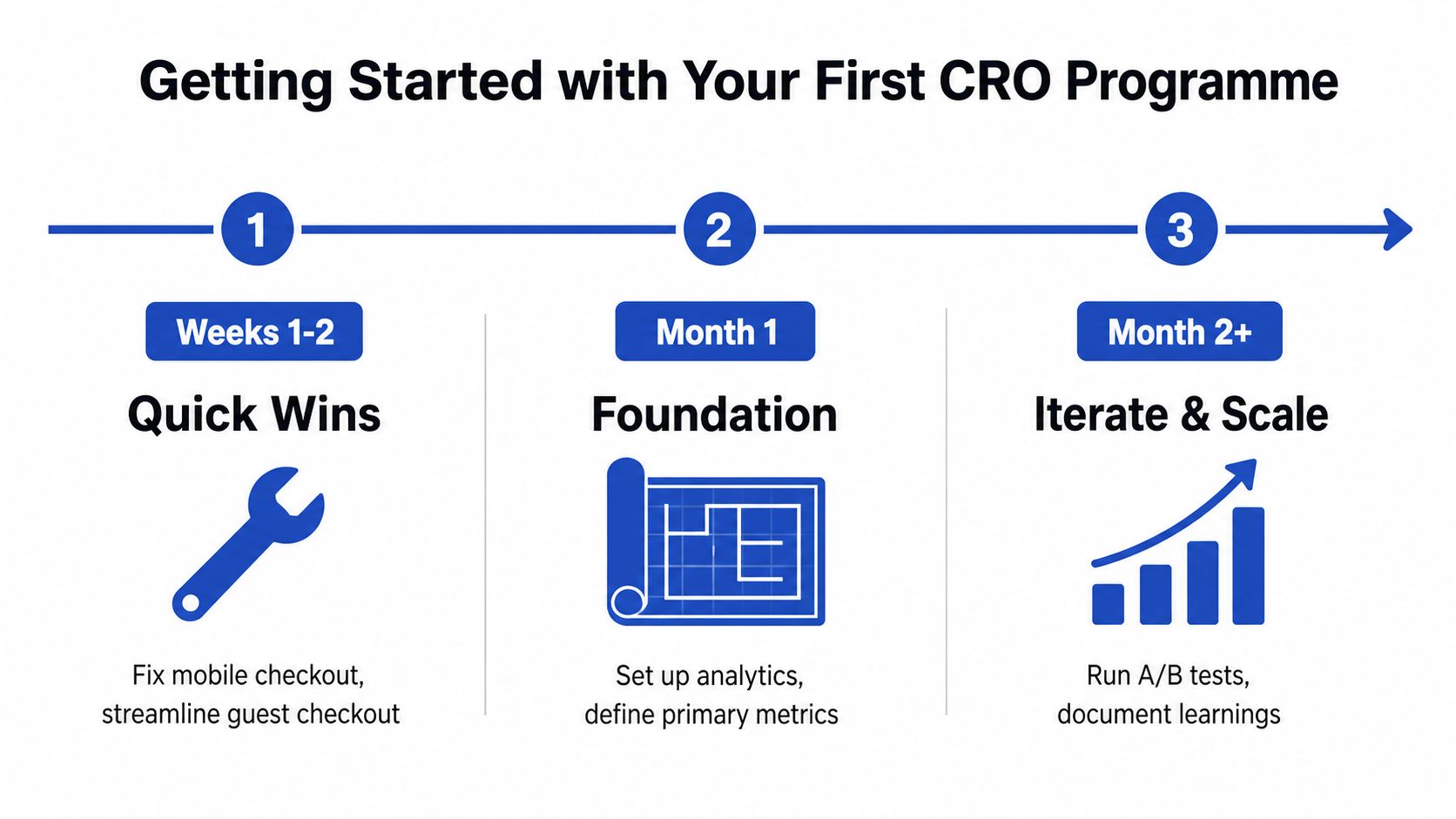
Start with diagnosis, not a redesign. During the first audit, review analytics by device and category, inspect mobile and desktop checkout paths, watch session recordings, examine heatmaps, and collect customer questions from support teams. Look for broken interactions, unclear delivery promises, missing returns information, hard-to-use selectors, and distractions that appear at the point of purchase.
Fix obvious friction before testing ambition
The first phase should focus on issues that are both visible and commercially close to the transaction:
- Mobile checkout: Complete the journey on real devices and resolve layout, payment, validation, and navigation problems.
- Guest purchase: Don't force account creation before the customer has a reason to return.
- Product-page confidence: Make delivery, returns, reviews, stock, sizing, compatibility, and payment information easy to find.
- Cart clarity: Show the true order total and delivery expectations before the customer reaches the final payment step.
Create a prioritised backlog using Potential, Impact, and Ease, but don't let a scoring framework override judgement. A technically easy change with little traffic may matter less than a difficult mobile checkout fix affecting a large share of qualified sessions.
Build a manageable operating rhythm
A minimum viable stack includes reliable analytics, heatmaps, session recordings, customer feedback collection, and an A/B testing tool where traffic supports controlled experimentation. Teams assessing automation or research support can also consult this comparison of AI marketing tools, but AI should accelerate analysis rather than replace commercial judgement or customer validation.
Allow the audit and hypothesis-generation stage enough time to produce useful questions. Testing cycles should run long enough to capture normal traffic variation and should not be stopped merely because an early result looks favourable. If traffic is limited, prioritise larger experience changes, qualitative research, and careful segmented analysis over a stream of underpowered button tests.
Document every test in a shared repository. Include the original problem, screenshots, audience, primary metric, result, decision, and follow-up question. That record turns isolated experiments into institutional knowledge.
For a practical implementation framework, use this guide on how to improve conversion rate optimisation alongside your analytics and research process.
Grumspot provides Shopify Plus design and development, UX reviews, technical audits, and data-driven CRO support for stores that need help identifying and implementing conversion improvements across product pages, navigation, cart, and checkout. Visit Grumspot to discuss an audit-led CRO programme focused on your store's weakest device and sector journeys, rather than a generic sitewide redesign.
Let's build something together
If you like what you saw, let's jump on a quick call and discuss your project
Related posts
Check out some similar posts.
- ecommerce ab testing
Master ecommerce AB testing with a revenue-first playbook. Learn to build hypotheses, calculate samp...
Read more
- ecommerce ui ux design
Learn ecommerce UI UX design principles that lift conversion, from information architecture to acces...
Read more
- conversion rate optimisation
Looking for a conversion rate optimization consultant? This 2026 guide covers their role, process, K...
Read more
- reduce Shopify cart abandonment
Diagnose & reduce Shopify cart abandonment with our 2026 playbook. Get actionable strategies for UI,...
Read more