Ecommerce AB Testing Playbook for UK Brands
- ecommerce ab testing
- shopify cro
- conversion rate optimisation
- uk ecommerce
- ab testing strategy
Launched
September, 2026
Only 17.4% of 2,408 UK-focused ecommerce A/B tests produced a statistically significant winning variant, while 74.2% were inconclusive or showed no detectable difference, according to Otter AB's analysis of ecommerce testing. That finding should change how Shopify and Shopify Plus teams define success. A test programme isn't a slot machine for conversion-rate wins. It's a disciplined way to reduce commercial risk, learn how customers behave, and improve profit without assuming every idea deserves a rollout.
UK ecommerce also gives brands a strong reason to test properly. Great Britain's average ecommerce conversion rate reached 3.4% in April 2026, while the median site converted at 2.35%, according to UK conversion-rate benchmark data. Other UK datasets reported an average online conversion rate of 1.93% in May 2026 and an IRP Commerce figure of 2.03% in June 2026, up from 1.85% in June 2025, so performance varies sharply by dataset, category, device mix, and measurement method.
For a UK brand, the commercial question isn't just, “Which version converts more?” It's, “Which version creates more profitable customer orders, and can we trust the data behind that decision?”
The Reality of Ecommerce Experimentation
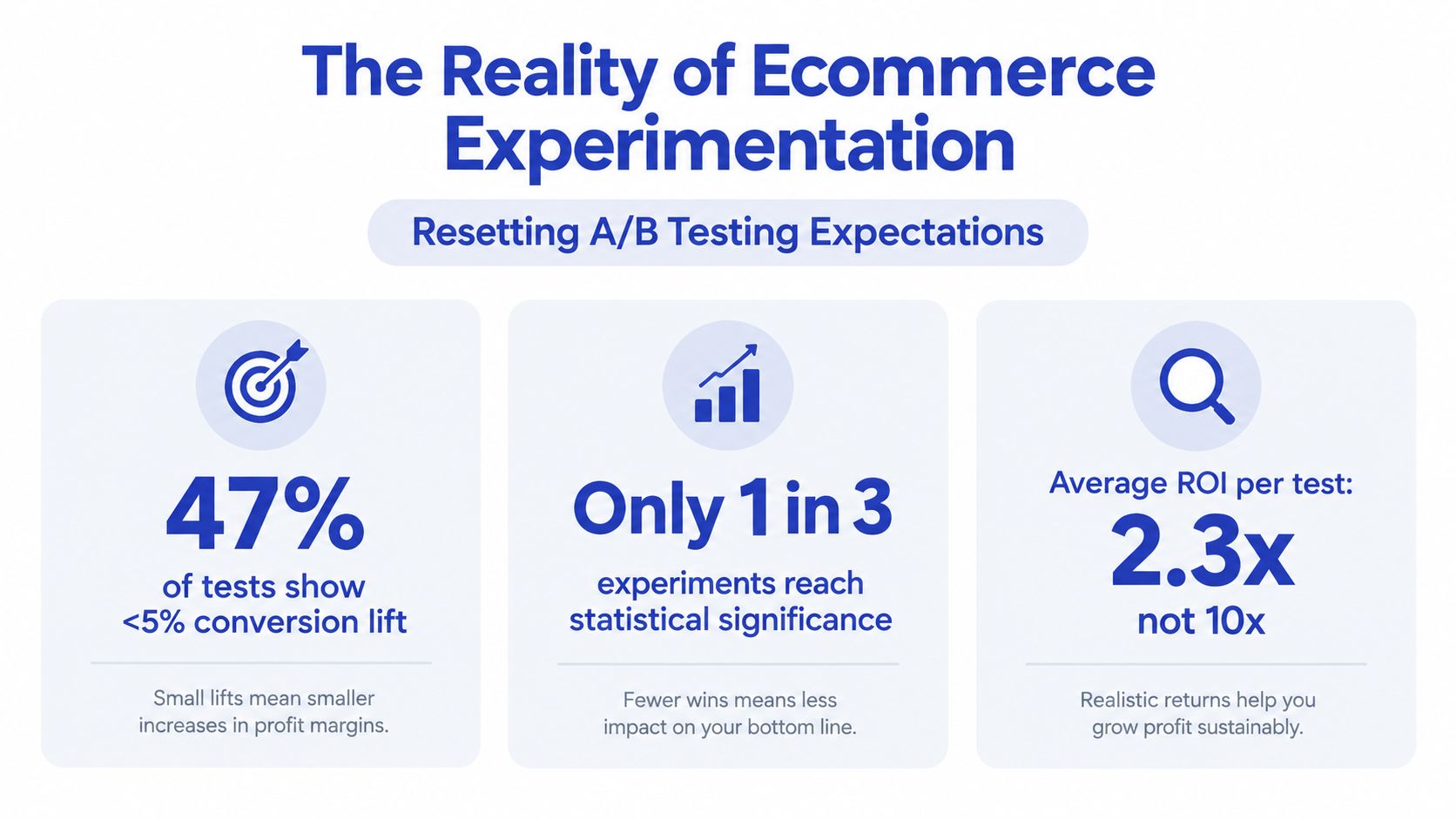
Only 17.4% of 2,408 UK-focused ecommerce A/B tests produced a statistically significant winning variant, while 74.2% were inconclusive or showed no detectable difference, according to Otter AB. Button colours, rewritten headlines, new product imagery, and full-page redesigns can look convincing before launch, yet most ideas do not create enough measurable movement to justify deployment.
That failure rate is a planning constraint, not a reason to abandon experimentation. Customer behaviour is noisy, and plausible ideas often have limited commercial impact. A test may fail because the change does not address a meaningful problem, traffic is too limited, the effect is smaller than the store can detect reliably, or implementation creates friction elsewhere in the journey.
Treat tests as a portfolio
A mature Shopify Plus team does not judge experimentation by its count of winning variants. It judges whether tests produce reliable decisions while protecting the existing revenue stream and profit margin. Prioritise low-risk experiments on high-traffic journeys, such as product pages, baskets, and checkout, rather than placing the store behind one major redesign.
A balanced portfolio can include:
- Friction removal: clarify delivery information, improve variant selection, or make checkout requirements easier to understand.
- Value communication: test the placement and presentation of benefits, guarantees, reviews, and product education near the purchase decision.
- Commercial mechanics: examine shipping thresholds, bundles, payment options, or promotions with margin guardrails in place.
- Experience improvements: assess navigation, imagery, filtering, and mobile layouts where observed behaviour indicates uncertainty.
The primary conversion metric should not decide a rollout alone. Pair it with guardrails such as revenue per visitor, average order value, refund rate, cancellation rate, and contribution margin where the data is available. A variant that lifts orders but attracts lower-value purchases or increases refunds may reduce profit.
A failed test still has value when the team records what it tested, why it expected a change, and what evidence would justify deployment. An inconclusive result can prevent an expensive implementation based only on internal preference.
Practical rule: A variant losing does not make a test useless. A test fails when its result cannot support a reliable decision.
UK brands can strengthen pre-test research by reviewing customer behaviour, competitor offers, and marketplace patterns. A marketplace scraping benchmark can show how products, pricing, and merchandising appear in a competitive environment. Use those observations to form hypotheses, not to copy another storefront.
Building Hypotheses That Protect Profit Margins
“Make the product page cleaner” isn't a hypothesis. It's a design preference with no defined customer behaviour, commercial outcome, or decision rule. A useful hypothesis connects an observed problem to a specific intervention and a measurable result.
Start with the evidence available in your Shopify stack. Review search exits, product-page engagement, add-to-basket behaviour, checkout progression, customer-service transcripts, returns reasons, and session recordings. Don't assume the most visible element is the biggest constraint. A prominent call-to-action may be performing adequately while unclear delivery timing creates hesitation lower on the page.
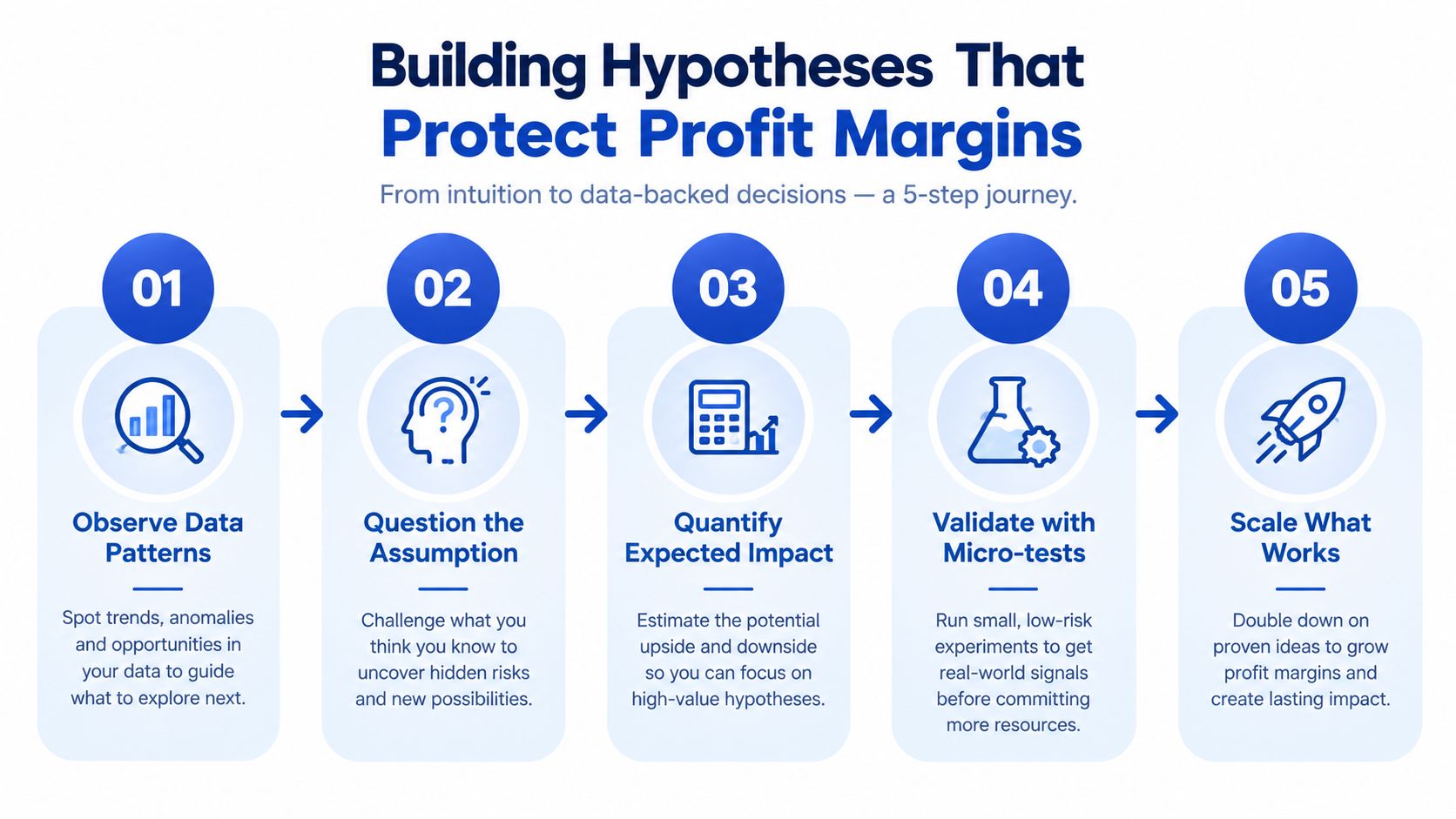
Turn observations into testable statements
Use a simple structure:
Because we observe [customer problem], changing [specific element] should cause [behavioural change], measured by [primary KPI], without worsening [guardrail].
For example, if mobile shoppers reach the delivery section but don't continue, test a clearer delivery message near the purchase controls. The expected behaviour might be stronger add-to-basket progression. The commercial protection could include revenue per visitor, refund rate, and delivery-cost exposure.
The wording matters because it forces the team to separate what it knows from what it expects. “Customers don't trust us” is an assumption. “Customers repeatedly open delivery information before leaving the product page” is an observation that can support a more precise test.
Prioritise by value and effort
A backlog should reflect commercial opportunity, not the loudest stakeholder. Rank ideas using four questions:
- How close is the issue to revenue? Product pages, baskets, and checkout usually deserve more attention than low-intent informational pages.
- How many customers encounter it? A modest improvement on a heavily visited journey may matter more than a dramatic improvement on a niche page.
- What would the change cost to implement and reverse? Prefer reversible front-end changes while the hypothesis is uncertain.
- What could go wrong commercially? A stronger purchase prompt might increase low-quality orders, discount dependency, returns, or costly deliveries.
The opportunity prioritisation matrix can help organise this backlog, provided the scoring includes margin impact rather than conversion potential alone. A test that requires complex Shopify Plus logic, fulfilment changes, or market-specific pricing needs a higher evidence threshold than a contained content change.
Keep the experiment interpretable
Change one major variable at a time where possible. If the variant changes the hero image, product copy, trust badges, delivery message, and button placement together, a positive result won't tell you which intervention created it. Bundled tests can be appropriate when the hypothesis concerns an entire experience, but the team should document that it is testing a package, not isolating a single cause.
Define the primary KPI and guardrails before launch. Decide what happens if the variant raises add-to-basket activity but lowers completed orders, increases refunds, or exposes the business to more expensive delivery options. That decision belongs in the test plan, not in a meeting after the result appears.
Calculating Sample Size and Test Duration
A favourable result after a short traffic burst is usually fragile. Limited volume, changing acquisition sources, and different weekday and weekend behaviour can all shift the apparent winner. Ending the test when a dashboard first shows a lead converts random variation into a costly deployment decision.
Plan sample size around the baseline conversion rate, minimum detectable effect, confidence level, and variant allocation. Lower baselines and smaller target improvements require more users. UK guidance illustrates the scale: detecting a 10% relative lift on a 3% conversion rate requires about 52,000 users per variant, or more than 100,000 total exposures (Klaviyo's UK CRO guidance).
That figure is not a target for every Shopify Plus store. It is a feasibility check before design, development, and merchandising time are committed. If the required sample exceeds realistic traffic, change the test design or choose a higher-volume event. Do not claim that a few days of data can answer a question the store cannot support.
Choose an effect you can act on
Set the minimum detectable effect against the commercial decision. A small uplift may not repay development effort, operational risk, or rollout work. A checkout change with material implications for margin, returns, or fulfilment may warrant investigation even when its detectable threshold demands more traffic.
Use a clean, store-specific baseline rather than copying a market benchmark into the calculator. Pull Shopify order and session data for the last 28 days, exclude internal and bot traffic, check that the conversion definition is consistent, then use that figure for planning. According to that same guidance, reported session conversion was 2.03% in June 2026, compared with 1.85% in June 2025. The Grumspot CRO benchmark discussion also shows why external averages can differ from one another. Treat them as context, not as your store's starting point.
Your guardrails belong in the calculation plan too. Monitor completed orders, contribution margin, average order value, refunds, discount use, and delivery cost alongside the primary conversion event. A variant that raises conversion while attracting less profitable orders is not a commercial win.
Set the stopping rule before launch
Record the planned sample, test duration, primary metric, significance threshold, and exclusion rules before exposure begins. The duration should cover the normal purchasing cycle and meaningful traffic variation. Do not stop when the variant takes a temporary lead or restart after an inconvenient early result.
Use the statistical significance testing guide to define a consistent decision process. Have someone who was not responsible for the original idea review the outcome, especially when the primary metric improves but a guardrail moves negatively.
Low-volume stores can test higher-funnel events, address larger friction points, or use qualitative research to remove weak ideas before a formal split test. These options do not replace statistical discipline. They make limited traffic more useful while protecting profit from overconfident rollouts.
Navigating UK Privacy and Tracking Constraints
Consent isn't a compliance footnote that can be checked after the experiment. It affects who enters the measurement system, which events are recorded, and whether the two variants remain comparable. UK ecommerce teams need to account for GDPR and PECR when designing experimentation and analytics, particularly where tracking depends on explicit consent.
If a meaningful subset of visitors declines analytics or marketing cookies, the measured audience may differ from the total audience. That can bias results towards users who consent, interact differently, use a particular device, or arrive through a specific channel. A variant can appear profitable because the measurement layer sees only a partial slice of its commercial impact.

Audit consent before trusting the result
Map the full path from consent banner to experiment assignment and purchase event. Confirm what happens when a visitor accepts analytics, rejects it, changes their preference, or returns with a different consent state. The test tool must not assign users in a way that creates inconsistent exposure or breaks variant persistence.
Check these points before launch:
- Assignment integrity: Each eligible visitor should receive the intended variant consistently under the tool's rules.
- Consent behaviour: Document which events are available before and after consent, and avoid treating missing events as zero-value behaviour.
- Device parity: Compare mobile and desktop event firing, page-load timing, variant visibility, and checkout hand-off.
- Revenue capture: Confirm that orders, refunds, discounts, taxes, and shipping values are passed into the reporting layer correctly.
- Exclusions: Remove internal traffic, QA sessions, bots, and other records that could distort allocation or outcomes.
First-party measurement can improve continuity, but it doesn't remove the need for a lawful basis or clear consent management. A practical first-party data collection framework can help teams design owned data flows without treating privacy controls as an obstacle to bypass.
Treat missing data as a test risk
A consent-limited dataset isn't automatically useless. It becomes dangerous when the team assumes it represents every shopper. Record consent rates and measurement coverage alongside the test results, then investigate whether coverage differs by device, acquisition source, geography, or variant.
UK CRO guidance also highlights the risk of incomplete tracking and weak page speed. A 2026 benchmark cited in the supplied research reports a median conversion rate of 4.1% across 3,328 UK sites, while contrasting relatively strong tracking with weak page speed in the UK market (Grumspot's Shopify A/B testing guidance). Use that benchmark as context, not as a target. Your first responsibility is to establish whether your own tracking describes the whole journey accurately enough to support a deployment decision.
Analysing Results Beyond the Primary Metric
Conversion rate answers one question, and often not the most important one. A variant can produce more completed orders while reducing basket value, increasing refunds, encouraging costly delivery choices, or attracting customers whose orders carry weak margins. Shopify Plus brands with complex shipping, tax, discount, subscription, and payment logic need a broader result review.
Set the primary metric according to the immediate customer action, but pair it with guardrails that represent commercial health. Revenue per visitor is often more informative than conversion rate because it captures both order frequency and order value. Contribution margin per visitor goes further by accounting for product economics, discounts, payment costs, delivery exposure, and other variable costs available to the business.
| Primary Metric | Guardrail Metric | Why It Matters |
|---|---|---|
| Conversion rate | Revenue per visitor | A higher order rate may not create more value if baskets become smaller. |
| Add-to-basket rate | Checkout completion rate | More baskets aren't useful if the change creates friction later. |
| Completed orders | Contribution margin per visitor | Revenue can rise while discounts, fulfilment, or payment costs erode profit. |
| Average order value | Refund and cancellation rate | Larger orders may contain products customers don't keep. |
| Free-shipping uptake | Delivery-cost exposure | A conversion gain can become expensive if more orders qualify for costly fulfilment. |
| Payment-option usage | Payment failure rate | A new payment path should support successful collection, not just clicks. |
Identify false winners
Suppose a prominent promotion increases conversion rate by attracting price-sensitive orders. If the promotion also reduces margin or shifts customers towards products with expensive delivery requirements, the primary metric is telling only part of the story. The correct decision may be to reject the variant, narrow its eligibility, or redesign the offer rather than roll it out universally.
The same logic applies to checkout simplification. Removing information can reduce visible friction and increase progression, but it might also create poorly informed purchases that later result in returns or support contacts. A product-page variant that increases add-to-basket activity but doesn't improve completed orders has created a behavioural signal, not a commercial win.
Read the result by segment and timing
Review mobile and desktop separately, then compare acquisition channels, new and returning customers, product categories, delivery regions, and relevant customer types. Segmentation should support a pre-planned question, not become a fishing exercise for a favourable subgroup. If a segment appears to respond differently, validate the finding before creating a permanent experience.
Check the full customer path from exposure to order, refund, cancellation, and fulfilment where the data is available. A result that looks strong in the first reporting window may weaken once delayed outcomes arrive. The deployment decision should reflect the time horizon of the cost or benefit you're trying to protect.
A conversion-rate winner is only a commercial winner when the additional orders improve the economics of the business.
Scaling Your Experimentation Programme
A sustainable programme needs operating discipline more than a long list of test ideas. Create one central hypothesis library with the observation, proposed change, target audience, primary metric, guardrails, implementation owner, sample-size plan, and final decision. This record stops teams from repeating old tests and turns inconclusive results into reusable knowledge.
Set a regular review cadence with ecommerce, trading, UX, development, analytics, and fulfilment represented where the test affects their work. Each review should answer three questions: what did we learn, what decision follows, and what new evidence should shape the next hypothesis? Don't reward teams only for positive results. A well-designed test that prevents a risky rollout protects the business.
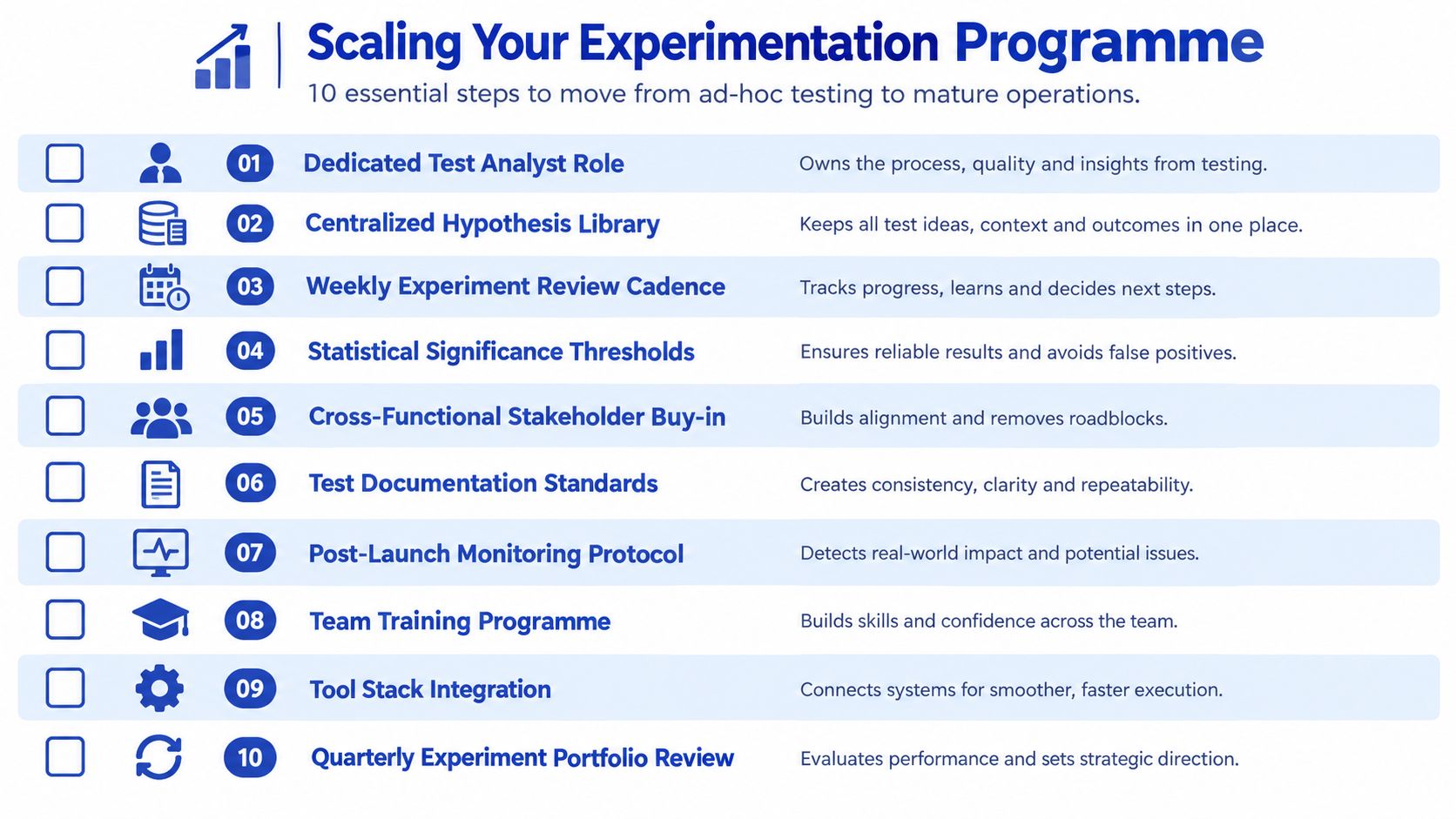
Build the system around decisions
A Shopify Plus programme should connect experimentation with the wider trading calendar, product roadmap, merchandising plan, and technical release process. Keep tests isolated from simultaneous changes where possible, document dependencies, and maintain a rollback path for every production variant.
A practical operating model includes:
- A named owner: One person is accountable for the hypothesis, launch checks, analysis, and recommendation.
- A measurement contract: Analytics and engineering agree how assignment, consent, orders, refunds, margin inputs, and exclusions are recorded.
- A release protocol: The team defines exposure limits, QA checks, monitoring windows, and rollback conditions before customers see the variant.
- A learning archive: Results include the original assumption, evidence, statistical interpretation, segment findings, and commercial decision.
- A portfolio review: Leaders assess whether the backlog is balanced across acquisition landing pages, product discovery, basket, checkout, retention, and margin protection.
Tools can support different parts of this workflow, from experimentation platforms and analytics suites to session-recording products and bespoke Shopify implementations. Grumspot offers Shopify Plus design, development, audits, and CRO support, including A/B testing through its in-house ABsolutely app, so teams can evaluate whether its delivery model fits their storefront and measurement requirements.
The strongest programme won't promise constant uplift. It will make fewer speculative changes, reject misleading wins, preserve profitable customer behaviour, and compound reliable learning across the store.
If your Shopify or Shopify Plus store needs a profit-focused experimentation process, Grumspot can help audit the customer journey, define guardrails, and implement controlled CRO tests. Contact the team to turn your next test idea into a measured commercial decision, not a guess.
Let's build something together
If you like what you saw, let's jump on a quick call and discuss your project

Related posts
Check out some similar posts.
- conversion rate optimisation
Benefits of conversion rate optimization. Discover the real benefits of conversion rate optimisation...
Read more
- ecommerce development uk
Your complete guide to ecommerce development UK. Learn to plan, hire an agency, choose a tech stack ...
Read more
- fraud prevention ecommerce
Secure your UK store with this fraud prevention ecommerce guide. Detect threats, manage chargebacks,...
Read more
- conversion rate optimisation australia
Boost sales in 2026 with our definitive guide to conversion rate optimisation australia. Learn local...
Read more