Shopify Domain Price: UK Costs and Total Ownership
- shopify domain price
- domain renewal
- vat costs
- domain transfer
- uk domains
Launched
October, 2026
You've found a domain that appears to cost almost nothing, connected it to Shopify, and moved on to the launch checklist. Then the renewal notice arrives. The introductory price has disappeared, VAT is displayed differently from the registrar's advert, and the domain is now a recurring operating expense that supports your storefront, email, redirects, and search visibility.
That's why the Shopify domain price shouldn't be judged by the first payment alone. For a UK merchant, the useful question is what the domain will cost over several years, who controls it, how renewal is handled, and whether a lower invoice creates extra technical administration. A domain can remain with an external registrar while its DNS points to Shopify, but that flexibility also creates ownership and renewal responsibilities.
Registration Versus Renewal: The Two Prices That Matter
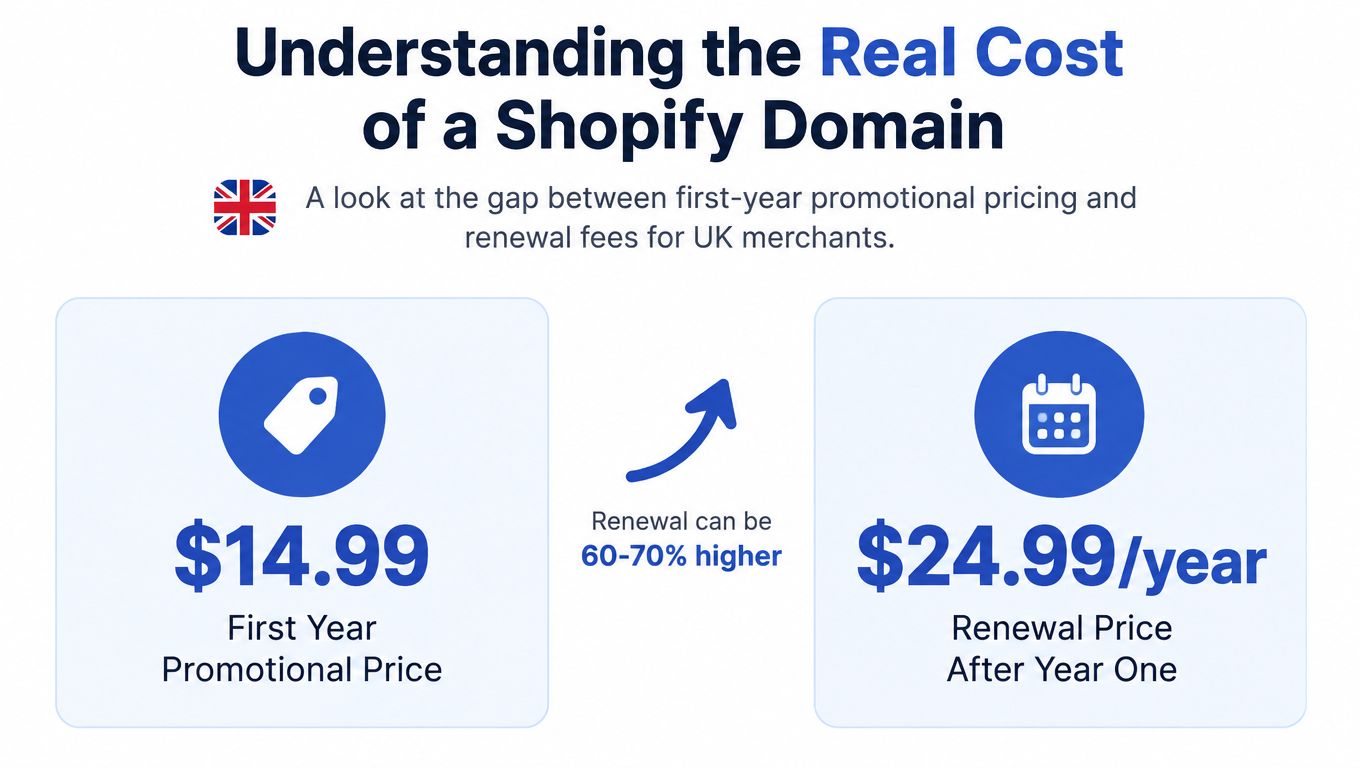
A domain that looks inexpensive at checkout can become a larger operating cost once its introductory term ends. UK registrar examples place .co.uk registration between approximately £1 and £12.83 before VAT, while renewals commonly range from about £10 to £15 before VAT, depending on the provider and promotion. A £12.83 before VAT renewal becomes £15.40 including VAT at the UK's 20% VAT rate, as outlined in this UK .co.uk domain cost guide.
Registration and renewal are separate commercial events. Registration is often discounted to attract a new customer. Renewal is the recurring charge that keeps the address active after that promotion ends. For a Shopify merchant, the renewal figure belongs in the operating budget, not the headline first-year price.
Read the checkout total
Record these details before purchase:
- Registration price: Confirm whether the displayed amount applies only to the first term.
- Renewal price: Find the recurring amount in the provider's pricing or checkout information.
- VAT treatment: Establish whether the advertised price includes VAT.
- Auto-renewal terms: Check the renewal date, payment method, and account responsible for the charge.
OVHcloud illustrates the same pricing distinction. Its .co.uk registration is listed at £4.50 excluding VAT, or £5.40 including VAT, while renewal is £8.99 excluding VAT, or £10.79 including VAT, according to its UK domain pricing page. The amount charged at renewal is the figure that affects a live Shopify store.
A portfolio makes the difference more visible. Ten domains renewing at £15.40 each would cost approximately £154 per year including VAT, before premium-domain fees, privacy services, email, or hosting-related charges. Defensive domains, regional variants, and legacy redirects belong in the same infrastructure budget as apps and platform services.
Practical rule: Treat the first year as an acquisition cost and every later year as operating expenditure.
For broader context on platform commitments, compare this calculation with Grumspot's Shopify pricing guide. The domain fee may be modest beside other ecommerce costs, but its renewal and ownership arrangements still affect the store's three-year cost and operational resilience.
How Shopify Domain Pricing Works
Shopify does not use one universal UK domain fee. The price depends on the selected Top-Level Domain, or TLD, and on whether Shopify classifies the name as premium. Shopify says domains typically start at around US$9 per year, roughly £7 to £8 at current rates, and are sold in one-year terms with auto-renewal enabled by default, while eligible domains include WHOIS privacy protection, according to its domain pricing guidance.
That starting figure is only a reference point, not a quote for a specific .co.uk domain. A country-code extension, another TLD, or a premium classification can change the amount shown in Shopify admin. Search for the exact domain and extension, then record the annual price displayed at checkout. For UK budgeting, confirm the currency and VAT treatment before treating that figure as the store's actual cost.
What the Shopify purchase includes
Buying the domain through Shopify keeps registration beside the storefront instead of placing it in a separate registrar account. For eligible domains, WHOIS privacy protection is included without a separate privacy charge. That can reduce total ownership cost where an external registrar charges for privacy as an add-on.
The practical benefit extends beyond the registration fee. Centralised billing reduces the risk of a renewal invoice reaching a former agency contact or an unused finance inbox. Shopify-managed settings can also make the connection between the store and its primary web address easier for a small team to maintain.
Convenience does not remove the need for checks. A generic starting price does not confirm whether a UK checkout will show GBP, how VAT will be handled in the billing setup, or whether the chosen name has a premium classification. Verify those details for the exact domain before purchase, then include the renewal charge in the store's longer-term budget.
| Pricing question | What to verify |
|---|---|
| Extension | Is the name .co.uk or another TLD with separate pricing? |
| Term | Is the registration sold for one year? |
| Renewal | What will Shopify charge after the first term? |
| Privacy | Is WHOIS protection included for the selected domain? |
| Premium status | Has Shopify categorised the name as premium? |
A Shopify-managed domain suits teams that value fewer systems and a simpler handover. An external registrar may suit a brand with a larger domain portfolio, specialist DNS requirements, or procurement rules that keep domain assets separate from the commerce platform. The right choice depends on the full operating cost and the team's ability to manage renewals, access, and changes over several years.
Comparing Shopify Versus Third-Party Registrars
The choice isn't Shopify versus a cheap registrar. It's a comparison between managed convenience, recurring price, billing control, and operational responsibility.
For a UK .co.uk domain, Nominet's registry economics explain why retail prices vary. Nominet states that direct registration by a non-member costs £80 plus VAT for a two-year .uk registration, while member registrars receive preferential rates. At the UK's 20% VAT rate, that amount becomes £96 for two years, equivalent to £48 per year before any retailer, DNS, support, or platform margin, according to the Nominet fee schedule.
That registry figure isn't a Shopify quote. It's a reminder that a headline retail promotion shouldn't be compared with a registry fee as though they're identical products. A registrar adds its own pricing, service model, support, and billing structure.
Side-by-side decision factors
| Factor | Shopify-managed domain | Third-party registrar |
|---|---|---|
| Store connection | Designed for connection within Shopify admin | Requires the merchant or technical team to manage the connection |
| Billing | Consolidated with the Shopify environment | Separate registrar account and invoice |
| Privacy | Included for eligible domains | May be included or charged separately |
| Price visibility | Exact amount must be checked for the selected TLD | Promotions and VAT presentation vary by provider |
| Portfolio control | Convenient for a small, Shopify-centred setup | Useful for multi-platform or multi-brand portfolios |
| Migration flexibility | Can be transferred or managed within Shopify | Can remain independent while pointing to Shopify |
The external route can work well. A merchant may retain a domain at an existing registrar and connect it to Shopify without moving registration. That arrangement can preserve a familiar account, keep several brands together, or allow the business to change storefront platforms later without changing its registrar.
The trade-off is divided responsibility. Shopify handles the storefront, while the registrar controls the domain account, renewal, and domain-level settings. If the agency owns the registrar login, or if nobody records the renewal date, a cheap annual fee can create a serious continuity risk.
The lowest invoice is only a saving if the business can still identify the account, pay the renewal, and recover access when the team changes.
Choose Shopify when simplicity and central administration matter more than fine-grained portfolio management. Choose an external registrar when the organisation already has strong ownership controls and someone is explicitly responsible for domain operations. In either case, register the domain to the merchant entity, not the implementation partner.
The Three-Year Total Cost Perspective
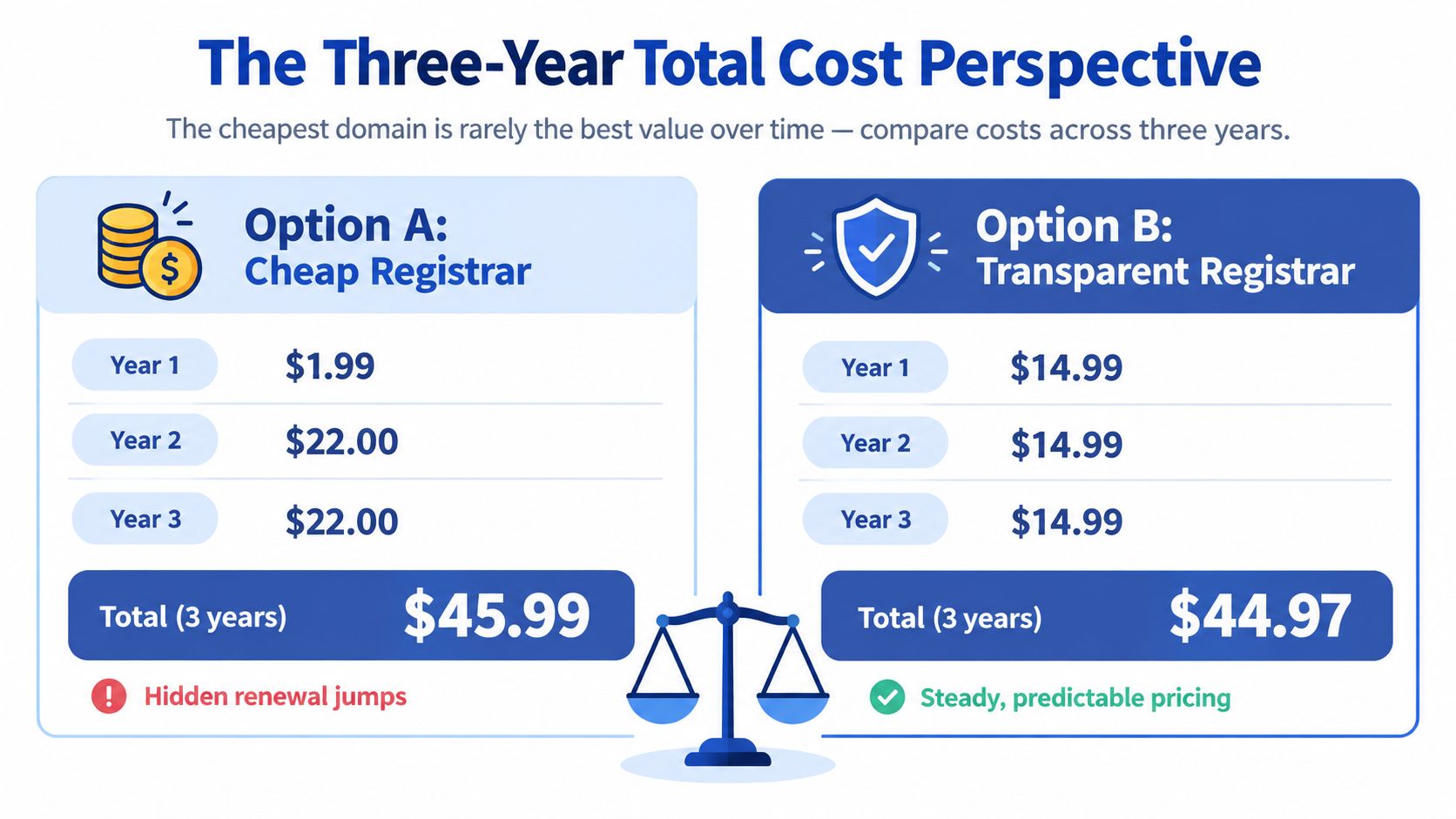
A first-year promotion can make a domain look cheap while hiding the cost that matters to a trading business. UK examples show promotional .co.uk offers from £0.01 to £4.00, while renewal pricing can rise to approximately £10 to £27.59 including VAT, depending on the registrar, as discussed in this UK domain cost analysis.
A three-year model exposes the difference. Add the first registration charge, the next two renewal charges, VAT treatment, any transfer fee, privacy charge, and the administrative effort required to keep the account secure. Don't assume that a low opening price says anything about years two and three.
Build a simple ownership model
Use a spreadsheet with one row per domain and these columns:
- First term: Enter the actual registration amount shown at checkout.
- Second term: Enter the published renewal price, including VAT where applicable.
- Third term: Use the same renewal price only if the registrar confirms that it remains applicable.
- Extras: Add privacy, email, premium services, or transfer charges that the business needs.
- Responsibility: Name the person or team that owns renewal and account recovery.
A provider offering a stable annual charge may produce a similar three-year total to a cheaper promotional provider. The value may then come from predictable budgeting and fewer renewal surprises, not from the lowest first invoice.
The operational side is just as important. Shopify-managed domains can reduce manual coordination because the merchant works within the Shopify environment. An external domain can still perform perfectly, but the team must maintain the registrar relationship separately, confirm that the domain remains connected, and renew it even if the Shopify subscription or agency relationship changes.
The visual above is useful as a reminder of the calculation, but its example values are not a UK quotation for your domain. Use the live checkout and renewal terms for the actual name, extension, and provider.
For broader project planning, Grumspot's guide to Shopify website design cost provides useful context. Domain ownership belongs in the same launch plan as theme work, redirects, analytics, email, and release management.
The best choice depends on the merchant's tolerance for administration. A low-cost external domain may suit a technically capable team with a central registrar account. A Shopify-managed domain may be preferable for a lean team that values fewer renewal paths and a simpler operational handover.
Managing VAT and Renewal Confusion
UK domain comparisons often fail because providers don't display VAT in the same way. One registrar may show a .co.uk renewal at £9.95 excluding VAT, or £11.94 including VAT, while another may show £12.83 before VAT, or £15.40 after applying the UK's 20% VAT rate, according to the UK .co.uk pricing examples.
The distinction affects both cash planning and accounting. A VAT-registered business may treat eligible VAT differently in its accounts, but the payment provider still takes the full checkout amount. Your purchasing process should record the cash total first, then separately identify the VAT element for finance review. For broader European context, Chern & Co's RegisterCompany.ie VAT guide is a useful reference when teams compare tax treatment across markets.
Audit the price before purchase
Use this short process for every important domain:
- Search the exact name: Don't use a generic extension estimate.
- Open the renewal terms: Confirm the recurring fee, not only the registration offer.
- Reach the final checkout: Record the amount including VAT and any selected extras.
- Save the evidence: Keep the invoice, confirmation email, and renewal date in the company's records.
- Assign responsibility: Put one named owner on the renewal and recovery process.
The renewal calendar should live outside the registrar's inbox. Add the date to the company calendar, finance workflow, and password-management notes, then review the payment method before the charge is due. This matters during agency changes, staff departures, and platform migrations, when automated notices can still go to an account nobody monitors.
Finance check: Compare providers on the amount that leaves the bank account, then document the VAT treatment separately.
A domain expiry can affect the storefront address, branded email, redirects, and other services that depend on continuous ownership. The registrar account may remain active while the domain itself stops resolving, so a Shopify subscription alone doesn't protect the business from missed external renewal.
Your platform budget should also remain separate from domain planning. The Shopify subscription plans guide can help structure recurring platform costs, while the domain register should track registrar-specific fees and dates. Treating both as one vague monthly technology cost makes it harder to find the source of a surprise charge.
Protecting Your Domain Ownership and Assets
Price matters less than control if the domain supports your primary storefront and customer email. The merchant's legal entity should appear as the registrant, and the company should control the registrar account, recovery email, payment method, and multi-factor authentication.
Check these details before a migration:
- Registrant identity: Confirm the business, not an agency or freelancer, is recorded as the owner.
- Account access: Test a current company login and recovery route.
- Renewal control: Verify auto-renewal, payment details, and the next renewal date.
- Service inventory: Record every domain, redirect, email dependency, and regional variant.
- Handover evidence: Store invoices and ownership records where the operations team can retrieve them.
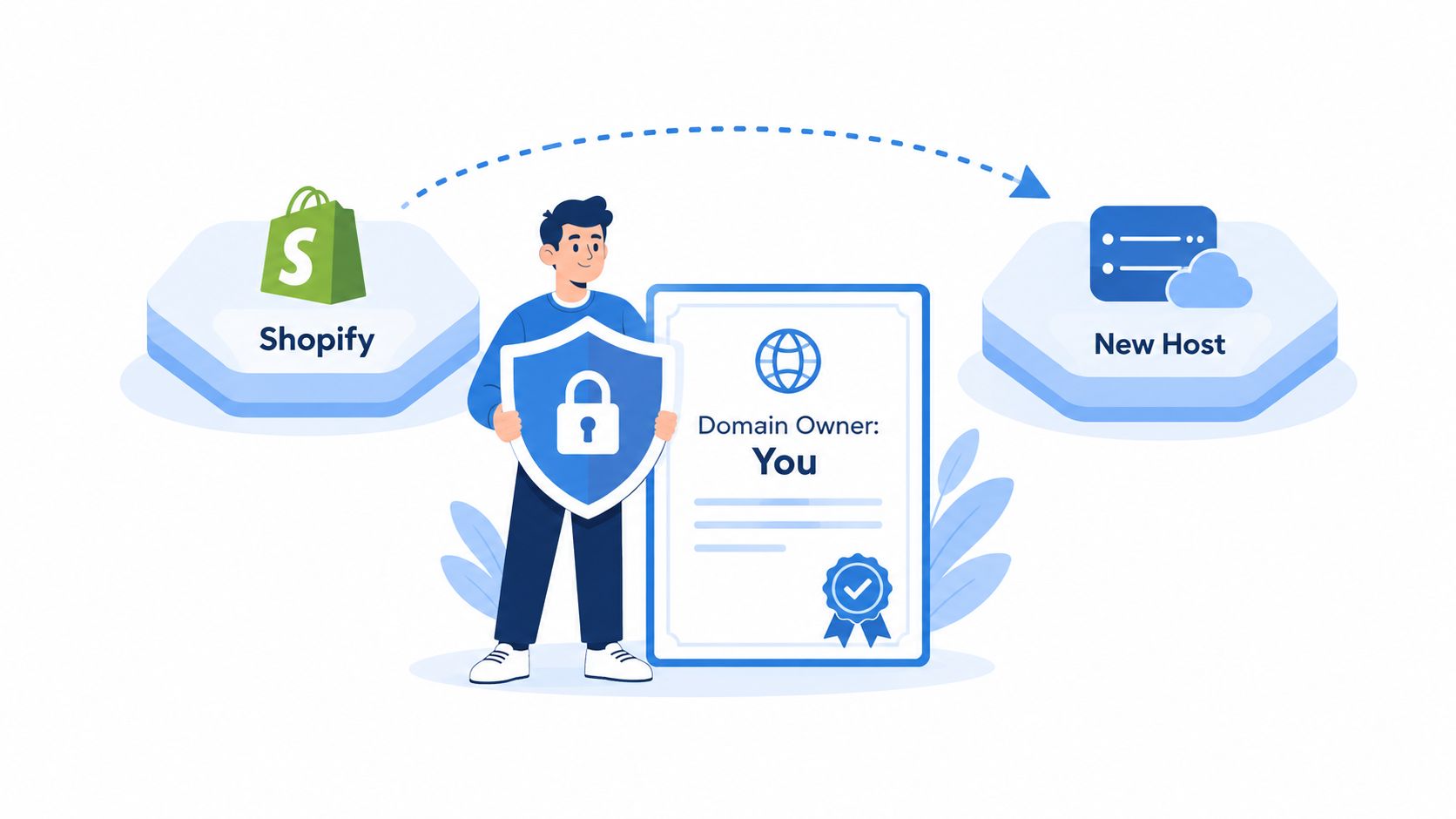
A migration from Magento, WooCommerce, or a custom storefront to Shopify doesn't automatically require a registrar transfer. The domain can remain with its existing provider while the technical team changes the storefront connection. That separation is useful, but only if the merchant knows who controls the account and has documented the change process.
Small businesses that lack internal technical coverage may also find 1stNet AI's small business website help useful when organising website ownership and support responsibilities. The same principle applies to larger DTC teams: make access part of the delivery checklist, not an informal promise from a development partner.
The right Shopify domain price is the one that fits the three-year budget and leaves the merchant with uninterrupted control. Review the exact renewal total, VAT treatment, and account ownership before launch, then repeat that review whenever the store, agency, or finance team changes.
Grumspot helps Shopify and Shopify Plus brands plan migrations, audit storefront infrastructure, and protect the operational details that support growth, including domain ownership and continuity. Visit Grumspot to discuss a domain-aware Shopify build, migration, or technical audit with a team that can connect the commercial and implementation decisions.
Let's build something together
If you like what you saw, let's jump on a quick call and discuss your project

Related posts
Check out some similar posts.