ABsolutely: The Complete A/B Testing Suite for Shopify
- Shopify
- Shopify Public App
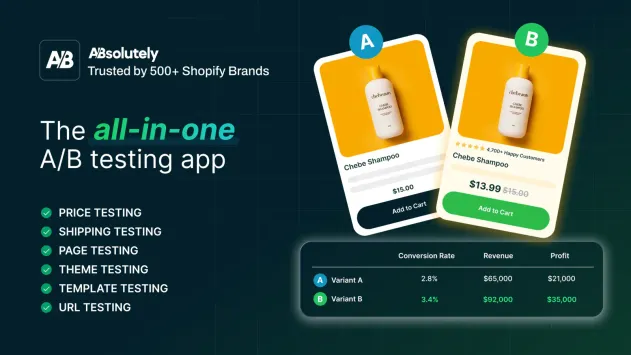
The Shopify ecosystem has no shortage of apps that promise conversion optimization. Most of them do one thing: swap a headline or change a button color and call it a day. The moment a merchant wants to test something that actually moves the needle (a pricing strategy, a shipping threshold, an entirely different theme), they're left stitching together multiple tools, writing custom code, or simply guessing and hoping.
ABsolutely was built to close that gap. It is a single A/B testing platform that handles five distinct experiment types (price, shipping rate, redirect, template, and theme), each sharing a common foundation of multi-variant traffic splitting, granular audience targeting, and statistically rigorous analytics. The result is a tool that covers the full spectrum of storefront experimentation, from a single product's price point to an entire site redesign, without requiring merchants to touch a line of code.
Part 1: The Architecture of Experimentation
Before any individual test type matters, the system beneath it has to be sound. Every experiment in ABsolutely, regardless of whether it tests prices, shipping rates, or themes, runs on the same core engine. Understanding that engine explains why the platform can support such diverse test types without compromising reliability.
Deterministic Traffic Splitting
When a visitor first arrives at a store running ABsolutely, the extension generates a unique fingerprint that persists across sessions. This fingerprint is then used to deterministically assign the visitor to one of the test's defined groups. Consistently, every time, on every page.
The critical property here is determinism. The same visitor always lands in the same group for a given test. There's no randomness on each page load, no flickering between experiences, no risk of a visitor seeing one price on a product page and a different one at checkout. The assignment is sticky by design, and it happens instantly. No waiting, no loading screens, no degraded experience.
Each test supports up to five groups: a control plus four variants, each with independently configurable traffic allocation. A merchant might run a simple 50/50 split, or allocate 70% to the control and 10% each to three experimental variants. The distribution scales accurately regardless of traffic volume.
Audience Targeting
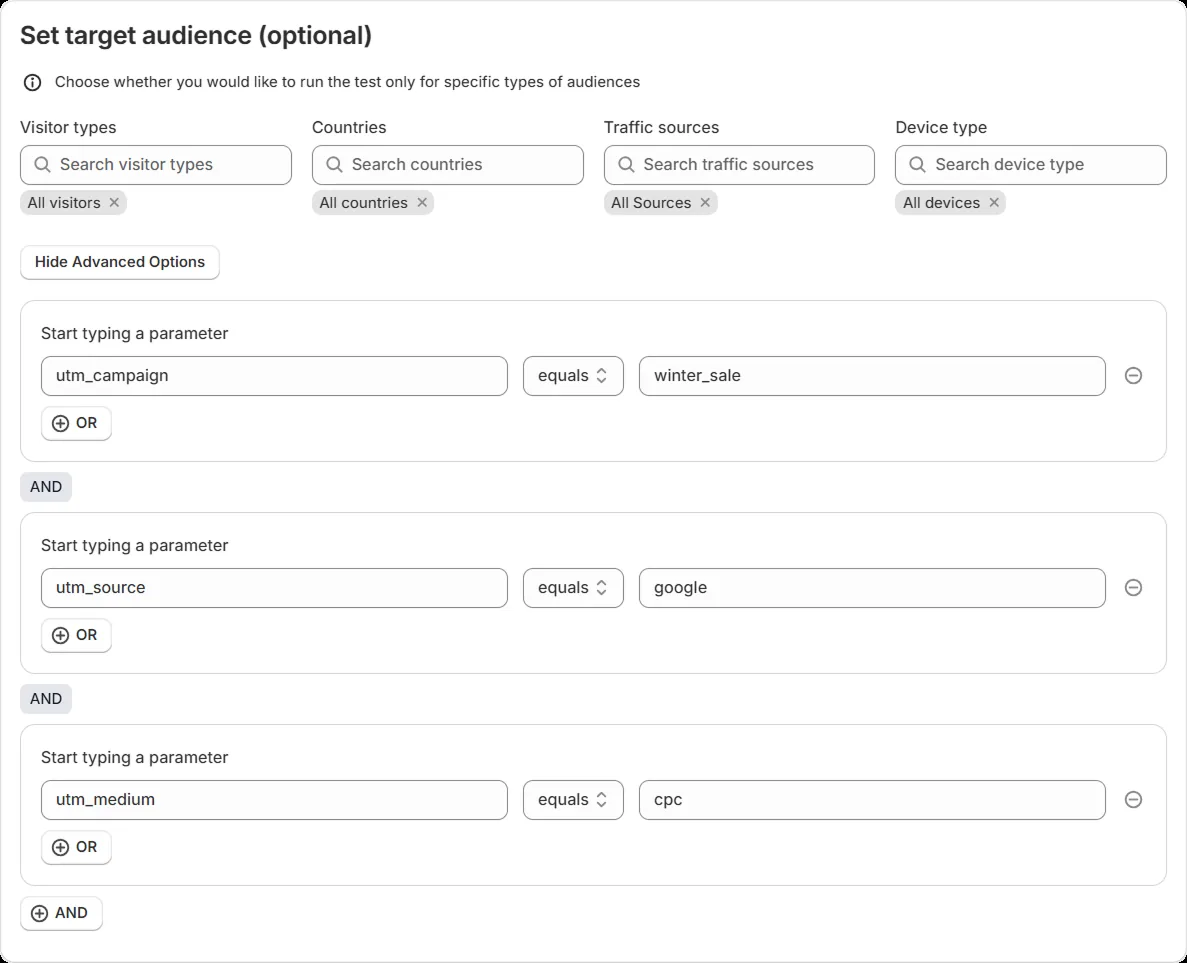
Not every experiment should run on every visitor. ABsolutely's targeting engine filters tests before group assignment even occurs, using four primary dimensions: visitor type (new or returning), geographic location (by country), device type (desktop or mobile), and traffic source, covering direct visits, email, referral, organic and paid social, organic and paid search, SMS, and specific platforms like Google, Facebook, Instagram, TikTok, Twitter, and YouTube.
Beyond these built-in dimensions, an advanced rules system supports custom parameter matching with multiple operators (equals, not equals, contains, and does not contain) combined using AND/OR logic. Merchants can construct precise audience segments without writing a single line of code. A test could target only returning visitors from the United States who arrived through a specific Google Ads campaign, and the system handles all the matching automatically.
Part 2: Price Testing
Pricing is the highest-leverage variable in e-commerce. A product priced at $49.99 might sell well, but a merchant has no way of knowing whether $54.99 would increase revenue per visitor or whether a higher compare-at price would create enough urgency to lift conversion rate. Most merchants set a price once, based on margin calculations and competitor research, and never revisit it. The cost of that inertia is invisible. It shows up as revenue that was never captured.
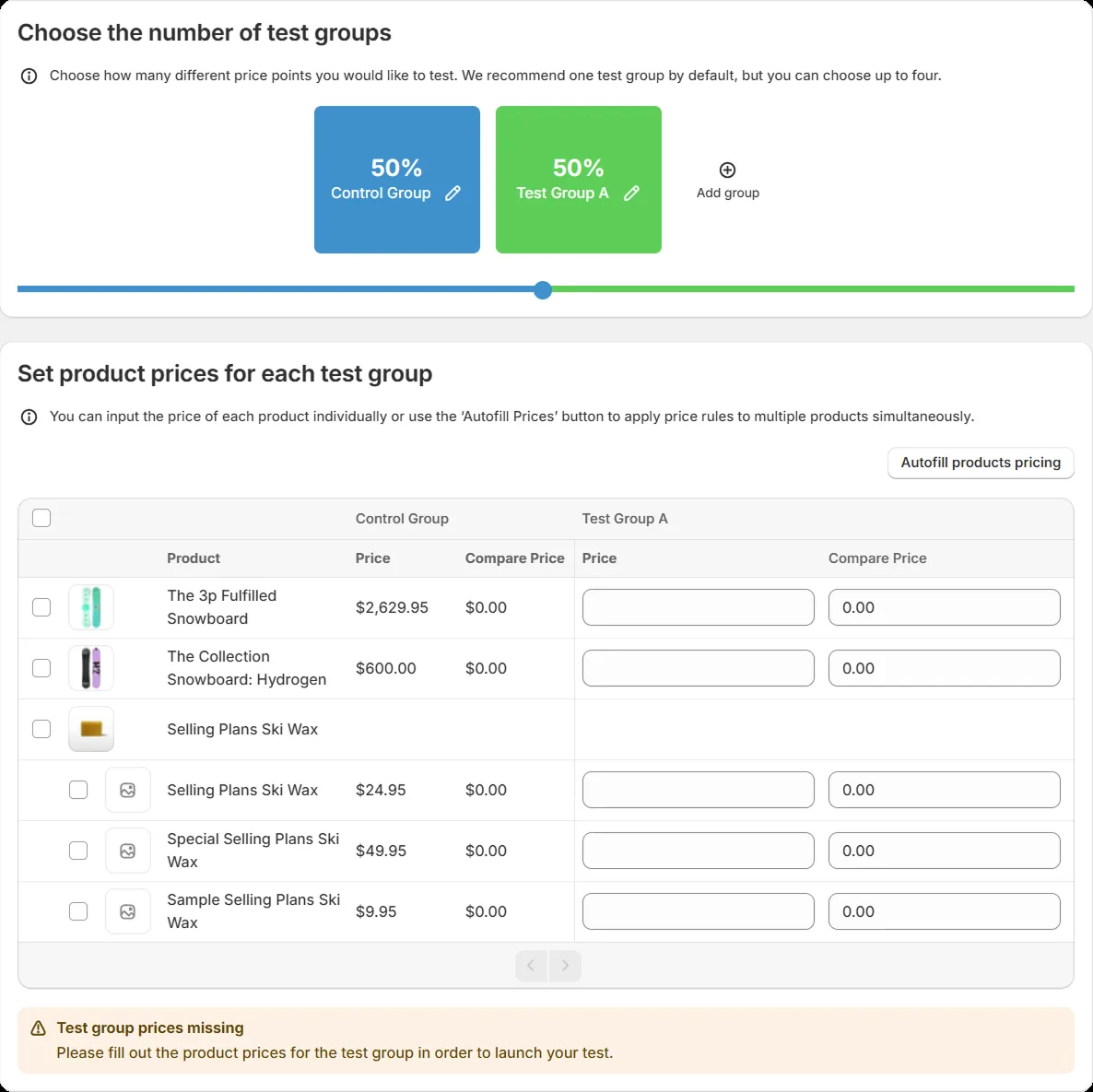
ABsolutely's price testing module operates at the variant level. Merchants select products, and for every variant of every product, they define a specific price and compare-at (strikethrough) price for each test group. This is not a percentage adjustment or a blanket discount. It's precise, per-variant, per-group pricing that reflects how Shopify actually structures product data. The control group always retains the store's original pricing, serving as the baseline against which all variants are measured.
On the storefront, price replacement happens seamlessly. When a visitor loads a page, the extension identifies every price element (the main price, compare-at price, savings amounts, percentages, and installment pricing), determines the visitor's assigned group, and displays the group-specific values. Currency formatting is preserved automatically, so prices render correctly whether the store uses "$54.99" or "€54,99" formatting.
Critically, the underlying product data in Shopify is never modified. Price changes exist only in the visitor's experience, not in the catalog. If a test is paused or stopped, the original prices return immediately. There's no cleanup, no rollback scripts, no risk of a failed experiment corrupting the product catalog.
Part 3: Shipping Rate Testing
Shipping cost is the single most cited reason for cart abandonment. Baymard Institute's research consistently shows that unexpected costs, primarily shipping, account for roughly 48% of abandonment decisions, contributing to an average cart abandonment rate above 70%. The challenge for merchants is that shipping strategy isn't binary. Free shipping isn't always the answer; sometimes a lower threshold, a reduced flat rate, or zone-specific pricing outperforms blanket free shipping on both conversion and margin.
ABsolutely hooks directly into Shopify's checkout flow to serve different shipping rates to different test groups. When a customer reaches the shipping step, the system identifies the customer's assigned group, matches the destination against configured shipping zones, evaluates any weight-based or price-based conditions, and returns the appropriate rates. All transparently, within the normal checkout experience.
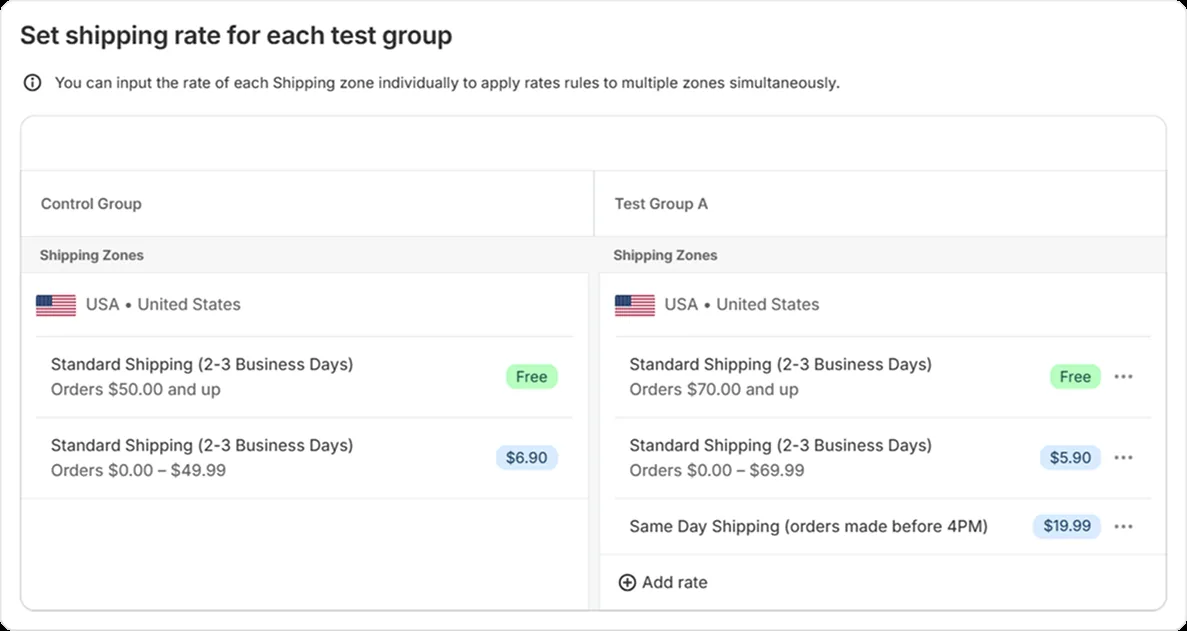
The shipping test editor was deliberately designed to mirror Shopify's native shipping rate management interface. Merchants configure zones with countries and provinces, create rates with names, descriptions, and amounts, and optionally attach conditions: minimum and maximum order weights (in grams, kilograms, ounces, or pounds) or minimum and maximum order totals. The structure is hierarchical: profiles contain zones, zones contain rates, and rates contain conditions. The familiarity is intentional. A merchant who knows how to configure shipping in Shopify already knows how to set up a shipping experiment in ABsolutely.
Each test group receives its own set of rates within the same zone structure. The control group's rates can mirror Shopify's existing configuration, while variant groups test alternatives: free shipping against a $5.99 flat rate, or a $50 free-shipping threshold against a $75 one. Every rate served is tracked back to its specific test group, ensuring analytics attribution is precise down to the zone and rate level.
Part 4: Redirect Testing
Traffic arrives at a store from dozens of sources (paid ads, organic search, social media, email campaigns), and the assumption that every visitor should land on the same page is rarely optimal. A product page might convert better than a collection page for ad traffic. A dedicated landing page might outperform both. Without controlled experimentation, merchants default to whichever page they built first and never validate whether it's actually the best destination.
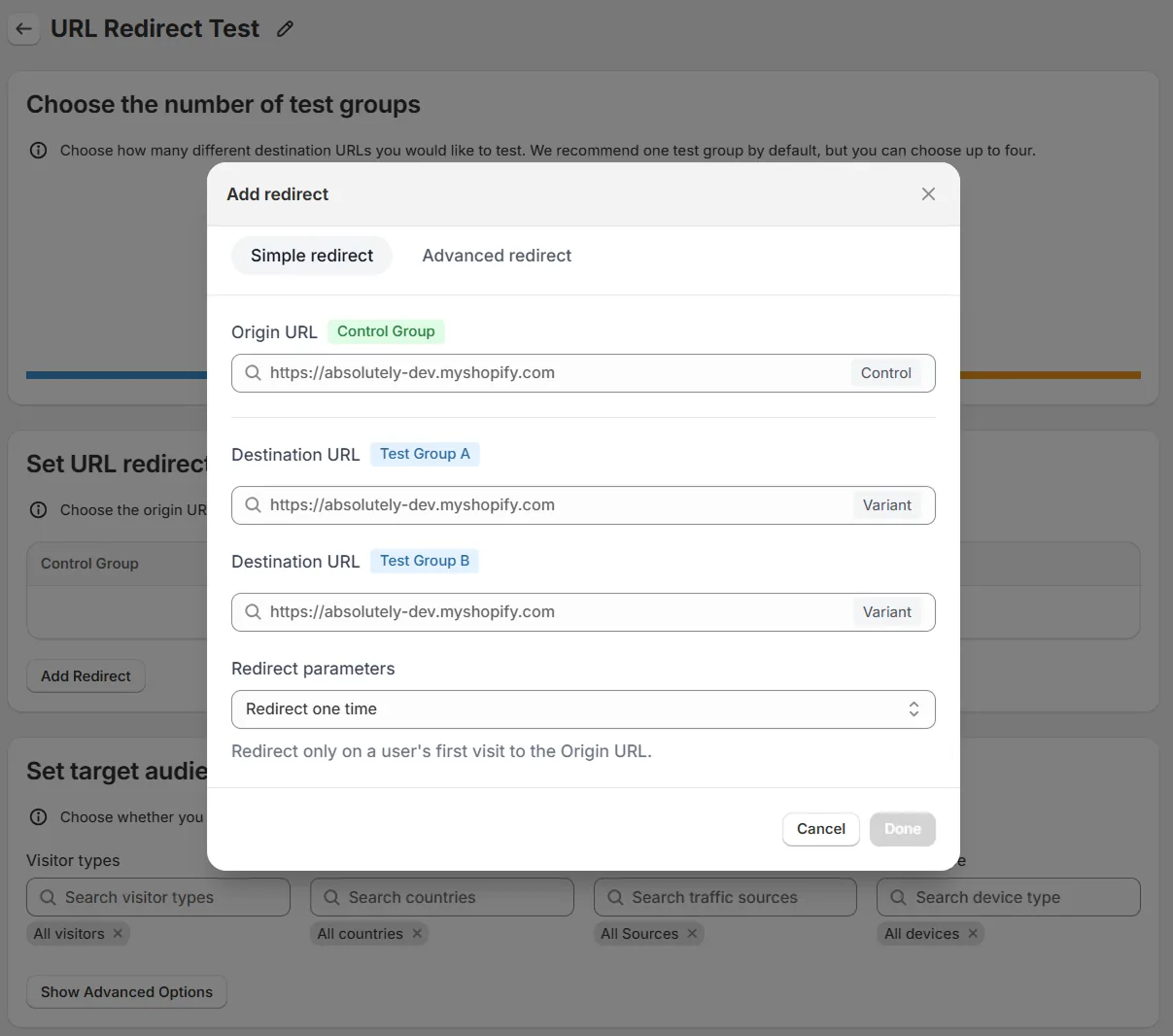
ABsolutely's redirect testing system works through URL matching rules. Each rule defines an origin (the URL pattern that triggers the redirect) and a set of destinations, one per test group. The matching engine supports four modes: exact match, contains, ends with, and full regex, covering everything from simple page-to-page redirects to complex pattern-based routing for merchants with sophisticated URL structures. Edge cases are handled gracefully; an invalid pattern simply won't match, rather than breaking the visitor's experience.
Two redirect strategies are available. In full URL mode, the visitor is sent to an entirely different destination, with query parameters from the original URL automatically appended, preserving UTM tags, tracking parameters, and any other data encoded in the URL. In replace matching mode, only a specific segment of the URL is swapped, leaving the rest of the structure intact. This is particularly useful for testing across parallel page structures, like swapping a collection slug, for instance, while preserving product paths and filters.
Frequency control adds another layer of precision. A redirect can fire every time the visitor encounters the matching URL, or only once per session, preventing returning visitors from being redirected repeatedly and avoiding the disorienting experience of landing on unexpected pages after their first visit. Multiple rules can coexist within a single test, each with independent origins, matching modes, and destinations, evaluated in order, with the first match winning.
Part 5: Testing the Storefront Itself
The first four test types target specific conversion levers: pricing, shipping, and traffic routing. Template and theme testing go further, addressing the storefront experience as a whole. Together, they cover the full spectrum of visual and structural experimentation, from swapping a single page layout to replacing the entire store design.
Template Testing
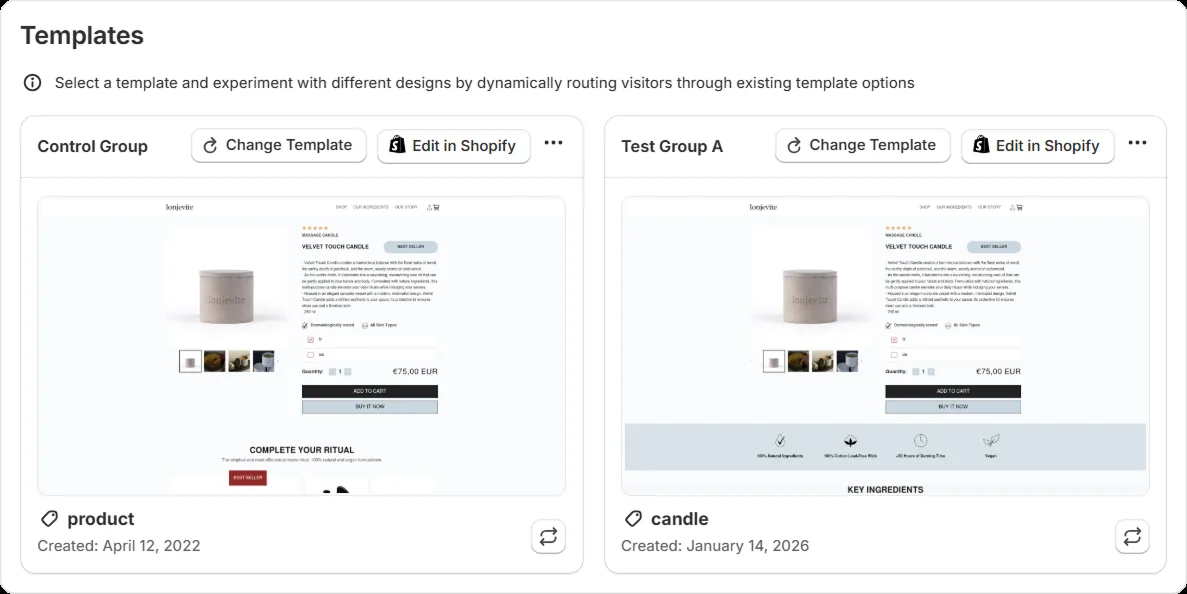
Shopify themes support alternate templates, different layouts assigned to the same resource type (product pages, collection pages, landing pages). ABsolutely's template testing module leverages this by assigning different templates to each test group. The system detects which template the visitor should see based on their group assignment and seamlessly loads the correct version, using Shopify's own template-serving mechanism rather than client-side workarounds.
From the visitor's perspective, the page simply loads with a different layout. There's no flash of content, no visible switching. Shopify serves the correct template natively. This makes template testing particularly clean: the merchant creates alternate templates in their theme editor (a workflow they already know), assigns them to test groups in ABsolutely, and the system handles the rest.
Theme Testing
A theme redesign is one of the most consequential decisions a Shopify merchant can make, and one of the riskiest. Months of design work, developer hours, and brand deliberation go into a new theme, and the standard approach is to launch it all at once and hope the conversion rate holds. Too often, it doesn't, and the scramble to revert begins.
Theme testing eliminates that risk entirely. ABsolutely splits traffic between the store's current live theme and one or more alternate published themes. The system detects which theme the visitor is seeing, compares it against their assigned group, and seamlessly loads the correct theme if they don't match, using Shopify's own theme-serving infrastructure. The switching logic includes safeguards against infinite loops and edge cases, ensuring the experience is always stable.
Only one theme test runs at a time. This is a deliberate constraint. Theme switching affects the entire storefront, so overlapping experiments would produce meaningless data. There's also a technical reality: templates are per-theme. A template that exists in one theme may not exist in another, and if a visitor lands on a missing template, Shopify falls back to a default layout that almost certainly breaks the intended experience. Restricting theme tests to one at a time eliminates that risk entirely. Every theme in the test must have ABsolutely's app embed enabled, ensuring the tracking and analytics scripts are present regardless of which theme the visitor sees. The result is a controlled, measurable comparison between design directions, with hard data on conversion rate, revenue, and profit per theme, available before any permanent switch is made.

Part 6: The Analytics Engine
An A/B test without rigorous analytics is just a coin flip with extra steps. ABsolutely's analytics system was designed around a core principle: merchants shouldn't need a statistics degree to interpret results, but the mathematical rigor behind those results must be real.
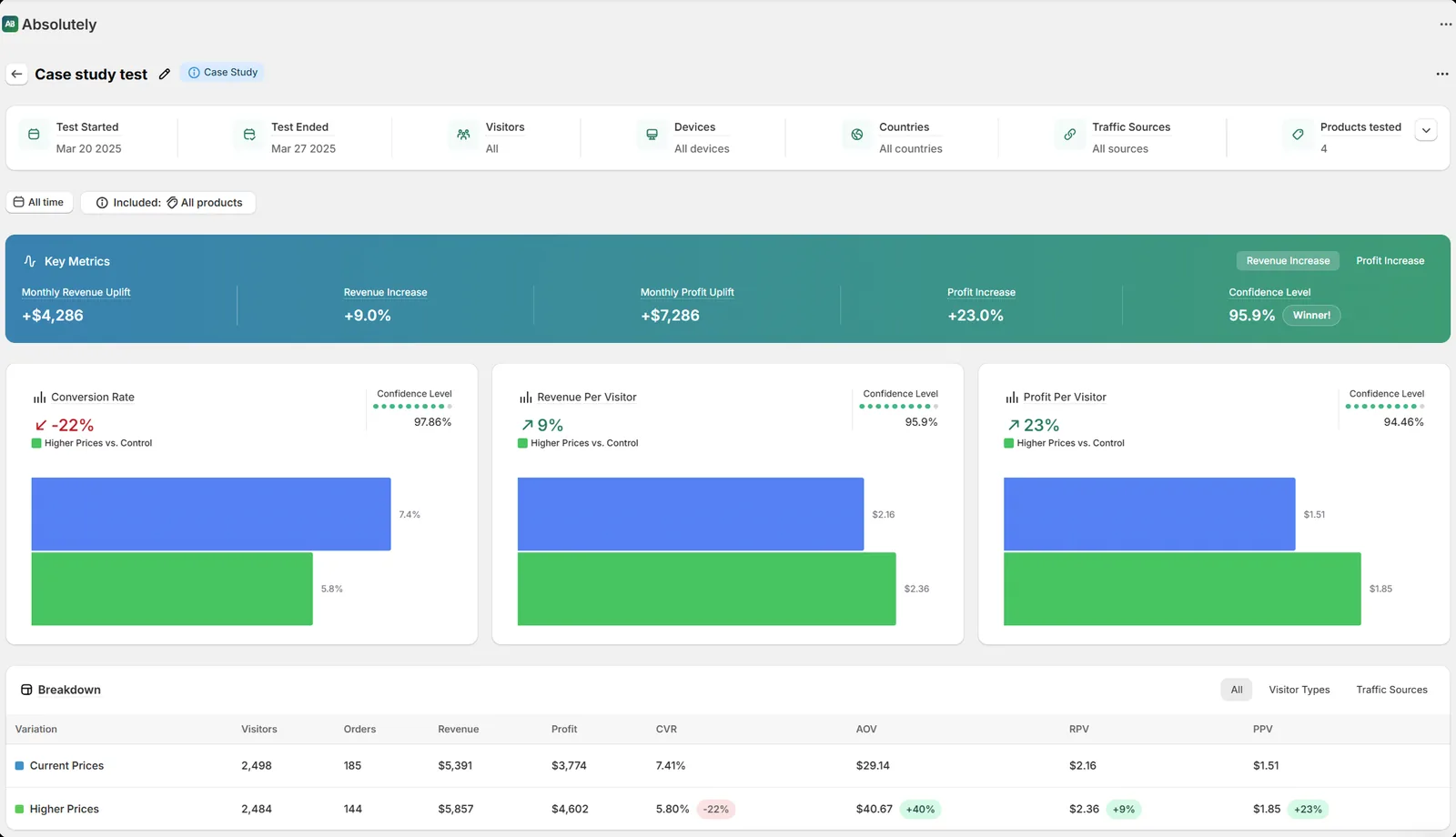
Every test tracks visitors, orders, revenue, and conversion rate per group. When a merchant has entered their cost of goods, the system also calculates profit impact, the actual margin difference between groups, not just top-line revenue. This distinction matters: a price increase might lift revenue but reduce unit volume enough to hurt profit, and without COGS data, that loss is invisible.
Statistical significance is calculated using a non-parametric method chosen specifically because e-commerce revenue data is rarely normally distributed. Standard approaches that assume bell-curve distributions would produce misleading confidence levels. The system reports confidence as a percentage and flags significance at the 95% threshold. Importantly, it enforces minimum data requirements before even attempting significance calculations, preventing merchants from making decisions based on insufficient sample sizes. Until the data is ready, the dashboard says so clearly.
The test lifecycle supports the full experimentation workflow. Tests begin as drafts, where all configuration happens without affecting the live store. Publishing transitions them to running, recording a start timestamp and activating the storefront integration. Running tests can be stopped (recording an end timestamp and deactivating the integration) or archived for long-term records. For shipping tests, stopping a test triggers automatic restoration of control group rates in Shopify, ensuring the store's shipping configuration returns to its pre-test state without manual intervention.
One Platform, Every Experiment
ABsolutely represents a deliberate bet: that Shopify merchants deserve the same caliber of experimentation tooling that enterprise platforms provide, without the enterprise complexity or price tag. Five test types, each engineered for a specific conversion lever. A shared architecture of deterministic traffic splitting, granular audience targeting, and statistically rigorous analysis. And a design philosophy that treats the merchant's existing Shopify knowledge as a starting point rather than something to replace.
From a single product's price point to an entire storefront redesign, every decision a merchant makes about their store can be validated with data before it becomes permanent. That's what ABsolutely was built to do.
Want this kind of work on your store?
Send us the URL and what is slowing it down. We look at the store before we reply.