SelfServe: the order editing app that turned support tickets into $55,171 of upsells
- Our own app
- Order editing
- Post-purchase upsells
A Shopify app we designed, built and run. Customers fix sizes, addresses and cancellations on the order status page they already visit, and a post-purchase upsell turns the edit into revenue.
- $55,171
- additional revenue at Grooby Shop, in under three months from install
- 2,407
- upsell conversions across 2,303 orders at Grooby Shop
- 91
- support tickets that never had to be opened at Naked Cashmere
- 30+
- public reviews on the Shopify App Store
- Product
- SelfServe, our own app
- Platform
- Shopify App Store
- The work
- Designed, built and run by us
- Status
- Built for Shopify
What SelfServe is
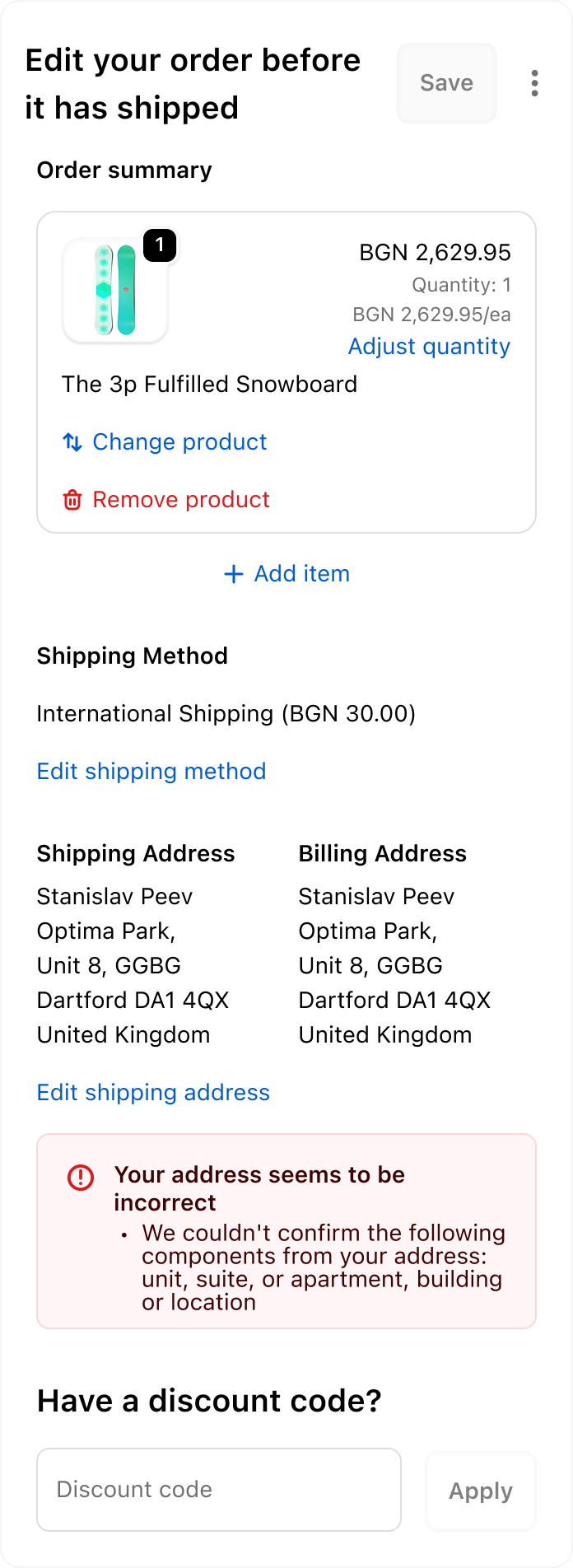
SelfServe is a Shopify app we designed, built and run under our ServeApps label. It lets a customer change their own order after checkout, from the order status page they already visit: swap a size, fix an address, add a forgotten item, or cancel. Every one of those used to be a support email. With SelfServe it is a few taps.
The problem we built it for
Every merchant we had worked with had the same queue: “wrong size”, “can I add one more”, “I put the old address”. Each message costs ten to fifteen minutes of someone's time, delays fulfilment, and the customer who wanted to spend more usually gives up because emailing support is a chore. Shopify's native order editing lives in the admin, so only staff can use it. We wanted the customer to use it.
- Every size, address and quantity change is a support email
- Ten to fifteen minutes of staff time per message
- Fulfilment waits on the reply
- Order editing lives in the admin, so only staff can use it
- The customer changes the order themselves, from the order status page
- A few taps, no email
- Price differences charged or refunded through Shopify
- The edit shows a one-tap upsell
What we built
Self-service editing on the order status page
Products, variants, quantities, shipping address and contact details, all editable by the customer. Price differences are handled through Shopify: an upgrade is charged, a downgrade refunded, with nothing for the merchant to reconcile by hand.
Rule-based editing windows
A plain time limit for most stores, or a condition builder for the ones with real constraints: allow edits until the order is tagged for the warehouse, block them for subscription products, require approval for cancellations above a value. The merchant decides exactly when a change is allowed.

Post-purchase upsells inside the edit
When a customer opens the order to change it, SelfServe shows a product recommendation with an optional discount and a one-tap add. There is no second checkout. This is the part merchants install it for.
- 01The customer opens the orderFrom the order status page, to change something.
- 02SelfServe shows a recommendationA product the merchant picks, with an optional discount.
- 03One tap adds itNo second checkout. The order is updated in place.

Automated tagging, notifications and Klaviyo
Every customer change applies the tags the merchant defines, so Shopify Flow, packing slips and fulfilment routing react to it. Real-time notifications tell the team the moment an order changes, and the Klaviyo integration keeps the edit emails on brand.
What merchants saw
- Grooby Shop: $55,171 in additional revenue in under three months from install2,407 upsell conversions across 2,303 orders. Figures as of June 16, 2026.
- emma&noah: 2,234 upsell conversions and $3,991 in additional revenuePlus 118 self-service order edits.
- F3 Gear Store: 102 order changes handled without a single support emailRoughly 17 hours saved.
- Naked Cashmere: 91 support tickets that never had to be openedWith the brand experience intact.
SelfServe has 30+ public reviews on the Shopify App Store. The one we hear most often is some version of “the team set it up with me on a call and the first upsells came in within days”.
See it move
How it is built
A Remix app on Shopify's App Bridge and Polaris, a checkout and order-status UI extension for the customer side, Shopify Functions for the pricing rules, webhooks for every order event, and the billing API for plans that scale with order volume. The same stack we use when we build a private app for a client.
- Remix
- App Bridge
- Polaris
- Checkout UI extension
- Order status UI extension
- Shopify Functions
- Webhooks
- Billing API
- Shopify Flow
- Klaviyo
Want this kind of work on your store?
Send us the URL and what is slowing it down. We look at the store before we reply.