Local Search Optimization: A Practical UK Playbook
- local search optimization
- local SEO
- Google Business Profile
- NAP consistency
- local citations
Launched
August, 2026

A shopper is standing outside your nearest branch, phone in hand, searching for the service you already offer. They're not reading your homepage first, and they're not browsing a directory page from three years ago. They're choosing between the businesses that show up cleanly in Google Maps, on the local pack, and in the handful of profiles that look alive, accurate, and easy to trust.
That's why local search optimization has become a revenue task, not a vanity project. Google's own business guidance is built around Google Business Profile, the free tool that shapes how a company appears in Google Search and Maps, and that shift has replaced the old directory-led model of local discovery for most buyers. Google's UK-facing support materials focus on practical actions like updating opening hours, photos, services, and reviews, because those details change how people behave before they ever reach your site. In local search, accuracy is no longer housekeeping, it's part of the sales process. The historical milestone is simple, the Google Maps and Business Profile ecosystem became the default discovery layer for mobile users, so the business with the clearest listing often gets the call, the visit, or the booking.
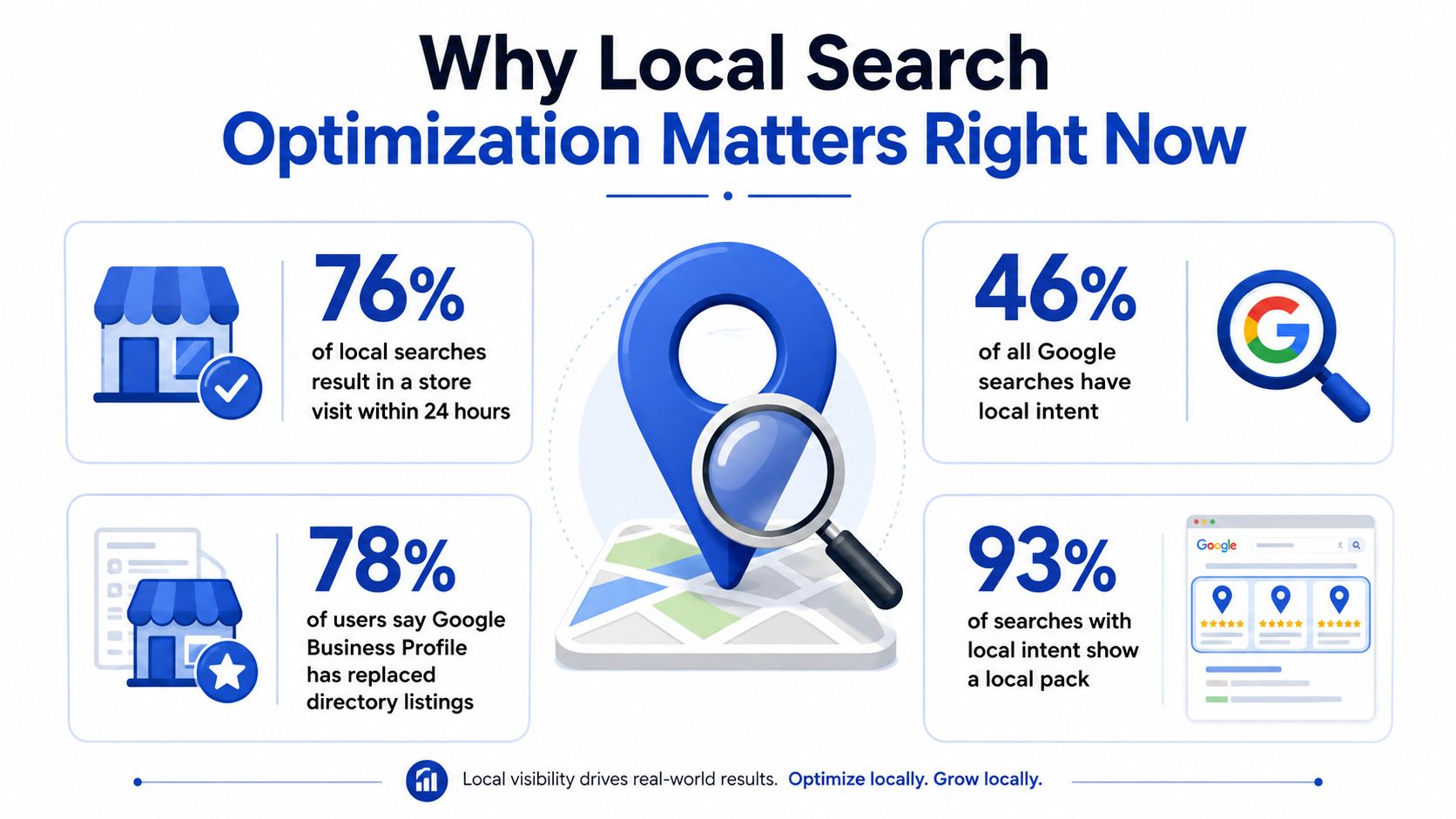
The consumer behaviour behind that shift is hard to ignore. Independent local-seo data says 46% of Google searches have local intent and 88% of consumers who do a local search on their smartphone visit or call a store within a day according to the local search statistics overview. Another recent data set says 21% of consumers search for a local business every day, 28% of local searches result in a purchase within 24 hours, and 72% of consumers who search locally visit a store within five miles in this 2026 local SEO roundup. For a UK retailer or service brand, that's the whole point. Local search is close to the moment of action, which is why a listing, a review, or a wrong phone number can change revenue today, not next quarter.
If reputation is already wobbling, a practical place to start is this guide on 5 easy ways to fix your reputation, because local visibility and public trust tend to rise or fall together.
Why Local Search Optimization Matters Right Now
A customer standing outside your shop is not reading your brand story. They are checking whether the hours are right, whether the phone number works, whether the map pin is accurate, and whether the listing still looks current enough to trust. That is why local search wins budget when demand is immediate, because it affects the decision at the exact point of action.
The shift from directories to managed profiles
Older local discovery depended on static listings, directory pages, and scattered references that were hard to update. The modern setup centres on a managed profile that Google can surface in Maps and local results, so the business controls the facts users see at the point of decision. That is a major operational change, because stale information now creates missed calls, missed visits, and avoidable friction.
Google's own support materials for Business Profile stress the fields that affect customer behaviour, opening hours, photos, services, and reviews. That emphasis is deliberate. Those inputs shape whether a searcher sees a business as active, nearby, and worth choosing. In practice, local search optimisation behaves more like merchandising than traditional content marketing.
Practical rule: if a branch looks incomplete in Maps, assume it is leaking demand even before you see the ranking data.
The commercial value of local search is also about timing. When someone searches for a service nearby, they are often close to the decision point already, so a strong profile can be the difference between a same-day call and a lost lead. For UK retailers and service brands, local search should sit inside the conversion path, not as a separate channel on the side.
What the behaviour data really means
The numbers in the local-seo research make the point clearly. 46% of Google searches have local intent and 88% of smartphone local searchers visit or call within a day as reported in the local search statistics overview. In the same research set, 28% of local searches result in a purchase within 24 hours and 72% of consumers who search locally visit a store within five miles in the 2026 data points article. That combination shows local search is not a slow-burn awareness channel.
It also explains why generic traffic thinking fails in local marketing. A branch does not need every query, it needs the queries that match its service area, its opening hours, and its immediate competitive environment. When that match is strong, search becomes a short route from intent to action. When it is weak, the competitor with a cleaner profile wins the lead without much effort.
If reputation is already wobbling, a practical place to start is this guide on 5 easy ways to fix your reputation, because local visibility and public trust tend to rise or fall together.
Setting Up and Optimising Google Business Profile
A lot of local SEO work goes wrong before optimisation even starts. The profile is claimed under the wrong trading name, the business is marked as a service-area company when it has a storefront, or the same branch exists twice in different forms and Google can't tell which one is real. Fix those basics first, because every later improvement sits on top of them.
Treat the profile like the canonical record
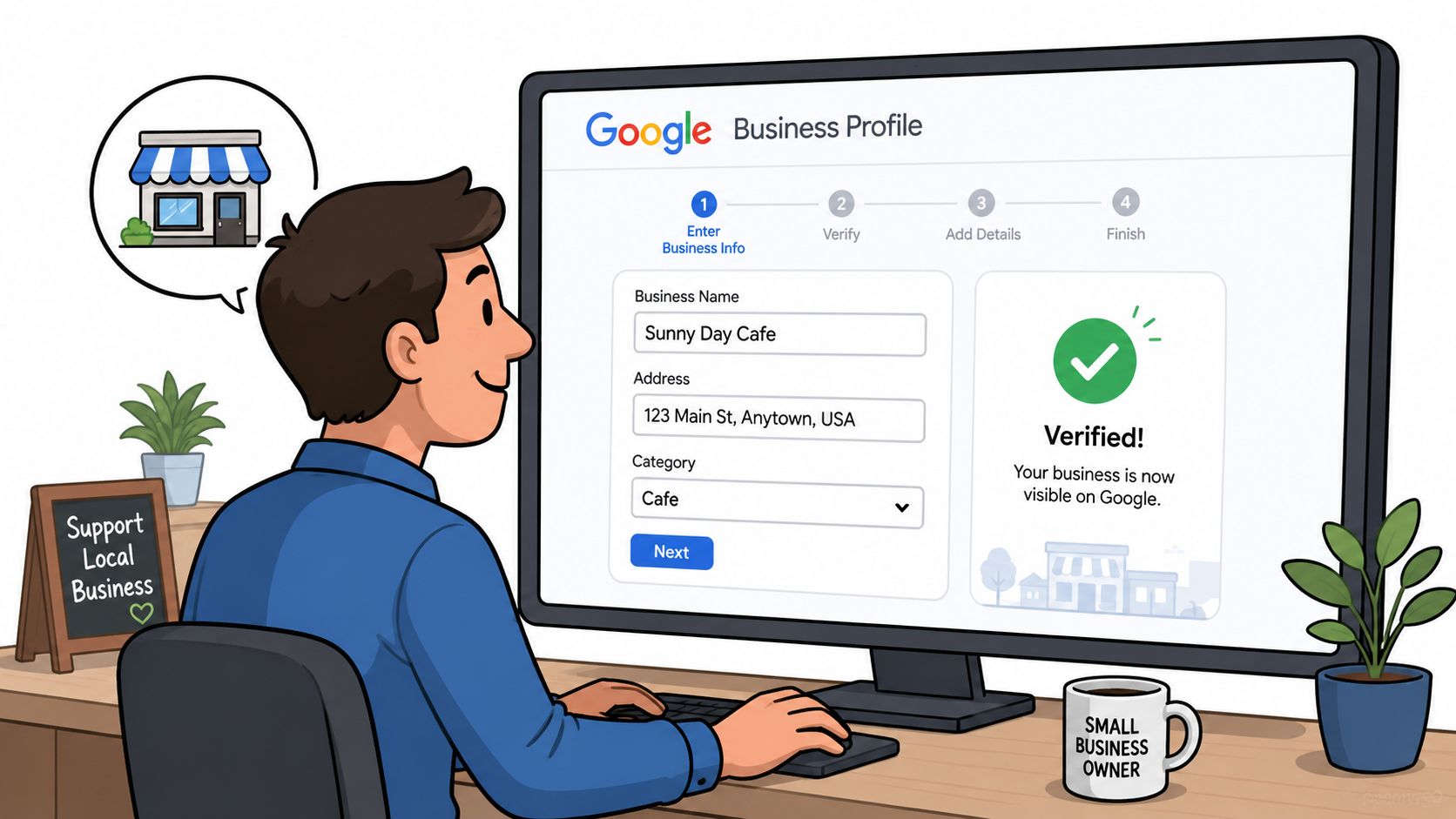
Local Falcon's guidance frames the right workflow well, start with Google Business Profile as the canonical entity, then audit citations for NAP variants, then correct the errors across the wider web in its local SEO knowledge base. That sequence matters because Google has to reconcile the profile with everything else it can find. If the profile says one thing and directories say another, you're forcing the system to guess.
The fields that deserve the most care are the ones users see and act on. Complete the business category carefully, then add services, attributes, hours, description, photos, and location details that match the branch. For a multi-branch brand, each profile needs branch-specific accuracy, not a duplicated national template with a different postcode dropped in.
Keep the profile boringly accurate. In local search, boring beats clever.
Google's SEO Starter Guide also reinforces the broader technical discipline around search visibility, especially monitoring in Search Console and canonicalisation, which becomes relevant once branch pages and profile URLs start competing with each other in Google's SEO Starter Guide. That's a key point often overlooked. GBP isn't isolated from the website, it's part of the same entity system.
Avoid the UK-specific traps
The two errors I see most often in UK programmes are trading-name mismatch and service-area confusion. If the legal entity differs from the storefront name, the public-facing name still needs to align with how the business is known in market. If the business serves customers at a physical location, don't hide that behind a service-area setup just because it feels tidy.
Branches also need separate thinking. A head office page can't do the job of a location listing, and a location listing can't compensate for a weak or missing location page on the site. If one branch is underperforming, fix that branch's profile, its photos, its hours, and its review flow rather than cloning the best branch and hoping the problem disappears.
For contractor-style or service-area setups, this guide to setting up GBP for contractors is a useful companion because it handles the practical differences between storefront and field-service businesses.
Running a NAP and Citation Audit
A branch can look healthy in GBP and still send mixed signals everywhere else. The usual failure is simple: one address in the profile, another on old directories, a recycled phone number on a handful of citations, and a moved location that still shows up under the old postcode. The job is to turn that spread of records into one clear business identity that search engines and customers can trust.
Build the canonical record first
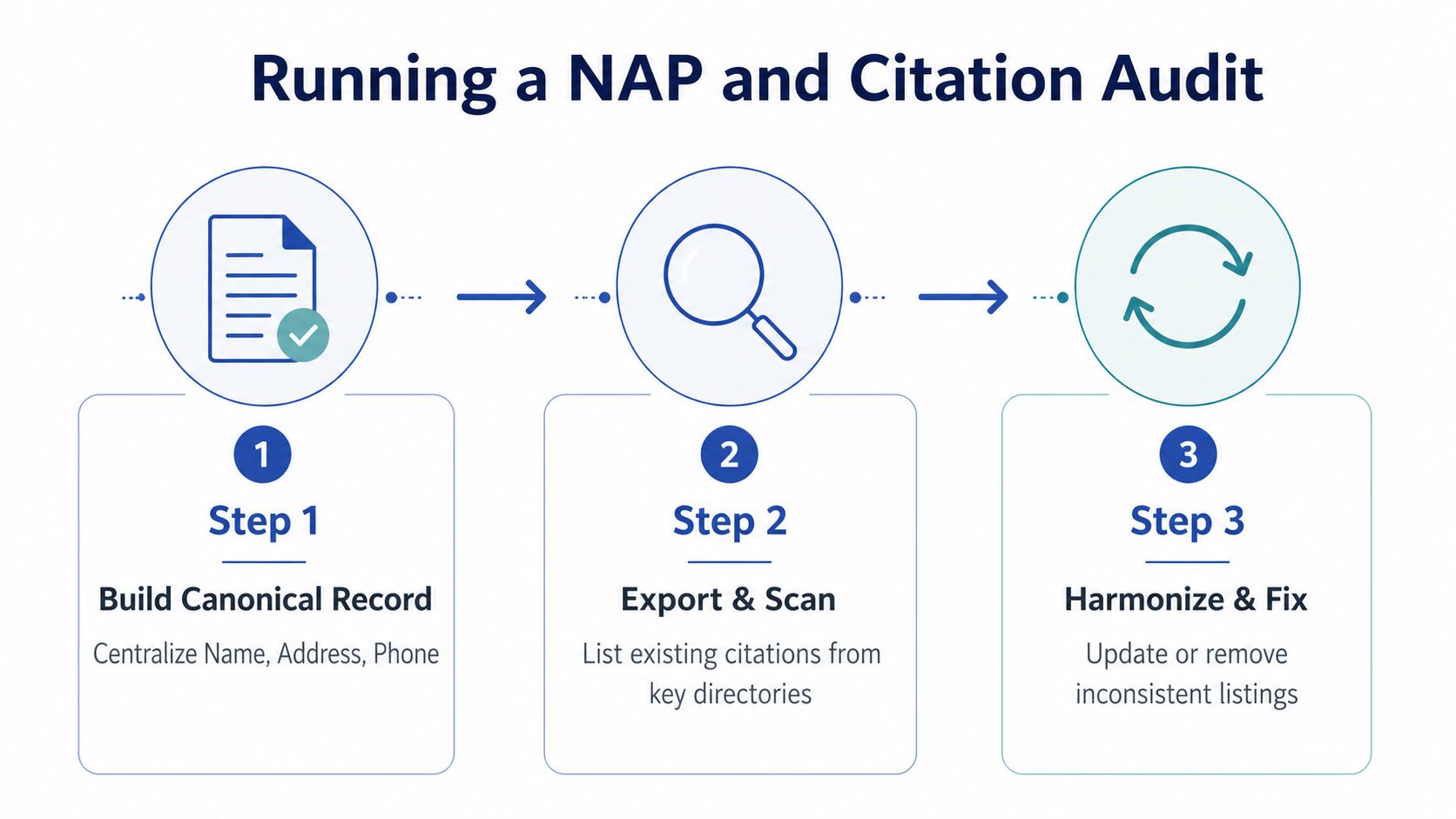
Start with one internal source of truth for the exact business name, address, phone number, opening hours, website URL, and any branch-level notes that affect what customers see. From there, export what you can from citation tools, add manual searches, and look for name variants, address abbreviations, duplicates, and old locations. The point is not to make every listing perfect on the first pass. The point is to identify the records most likely to confuse Google and customers, then fix them in the right order.
Prioritisation matters. Fix the highest-trust, highest-reach listings first, usually the major aggregators and the directories that feed other sites, then the niche platforms that matter in your sector, then the lower-value citations that are less likely to change visibility. A bad address in one upstream source often gets copied into other listings, so cleaning the source beats chasing symptoms. If you need a structured way to review the wider audit process, this SEO audit guide maps well to the same approach, find the mismatch, rank it by impact, and close the loop.
A quarterly cadence works for most brands that are stable. Fast-changing businesses need faster checks. New branches, closures, relocations, and phone number changes deserve immediate attention, because stale citations are easy to create and painful to unwind later.
Deal with duplicates and ghost branches
Duplicate listings split reviews, split engagement, and make a branch look less established than it is. Ghost listings create a different problem, because the business exists offline but is effectively missing in Maps. Search Engine Journal covers this failure mode in its multi-location local SEO article, especially where branches differ by postcode or catchment in its multi-location local SEO article.
The fix is operational discipline, not guesswork. Confirm which record should survive, document the canonical details, request removals where needed, and keep a change log so the same mistake does not reappear later. For a practical reference on source quality and consistency, these local citation building tips from Netco Design LLC are useful when you are deciding which listings to keep, which ones to clean up, and which ones are not worth the effort.
On-Page and Technical Local Optimization
A strong profile can still underperform if the website doesn't back it up. Google has to see the same business, the same location, and the same service promise across both surfaces, otherwise the entity signal gets muddy. That's where on-page local optimisation earns its place.
Match keywords to real local demand
Local keyword research should start with actual service and area combinations customers use, not with a list of places you'd like to rank in. The useful queries are usually the ones that combine the service, the location, and the commercial intent, which is why branch pages and service pages need to reflect how people search in that market. If the query pattern is different by neighbourhood or city, the page copy should reflect that difference.
Location pages need real value, not templated fluff. A page that only swaps out the town name and postcode won't help much, because it doesn't give Google or users a reason to treat the branch as distinct. Better pages include branch-specific opening hours, staff or service notes, parking or access details, local proof points, and content that answers the questions people ask before they visit.
If a location page could belong to any branch, it probably won't rank well for any branch.
The internal linking structure matters too. The homepage should point to the branch pages, the branch pages should point to relevant services, and the site should make it easy for Google to understand which page corresponds to which physical location. That's also where a clean URL structure and consistent canonical tags save you from unnecessary duplication.
Make the site easy to parse
LocalBusiness schema helps search engines interpret the business entity, its hours, its address, and its service type. It won't rescue a weak listing, but it does make the site easier to understand when the rest of the local stack is already in good shape. For broader structured-data context, this schema markup guide for ecommerce is a useful reminder that clean markup supports entity clarity across the site.
Technical basics still matter more than many acknowledge. Mobile performance is critical because local search behaviour skews heavily toward phones, and slow branch pages or broken mobile layouts suppress engagement. Clean canonicalisation matters too, especially when multiple pages cover similar services in similar places.
Avoid thin pages, soft 404s, and duplicate branch content that creates more confusion than value. The same goes for hidden service pages that only exist to catch keywords but never help a customer decide. If the page doesn't make the location or service easier to choose, it's probably not pulling its weight.
Earning and Managing Reviews at Scale
Reviews do more than decorate a listing. They shape trust, they reinforce relevance, and they give Google and users more evidence that a branch is active and credible. In local search, that combination is hard to replace.
Build the ask into the customer journey
The best review requests happen at the point of satisfaction. That can be immediately after a resolved issue, right after a purchase, or once the customer has had time to confirm the result. Email follow-up, receipt links, and QR codes at the till are all useful because they fit into normal operations instead of creating a separate campaign the team forgets to run.
What doesn't work well is a one-off burst of review requests with no follow-through. You need a repeatable process that front-of-house staff, service teams, or account managers can use without extra debate. The more consistently the ask appears, the easier it is to build steady review velocity.
Reply like a local business, not a robot
Responses matter because they show customers you're paying attention, and they also reinforce the service language around a branch. A reply that mentions the location, the service, and the specific issue is more helpful than a generic thank-you, especially when future search surfaces read that text as part of the business profile.
Negative reviews need a calm response and a fix where possible. Don't argue in public, don't paste a template, and don't write a defensive wall of text. The best replies acknowledge the issue, confirm next steps, and keep the tone grounded in the local branch the customer dealt with.
For a deeper operational view of response workflows, this customer review management guide is relevant because review handling is a process, not a reaction.
Reviews are also becoming more important in AI-assisted local surfaces, because structured listing data and review language help machines understand what the business does and who it serves. That makes the wording around services and locations more valuable than old keyword stuffing ever was. The strongest review programmes don't chase volume alone, they build a pattern of trustworthy, relevant language that matches the branch reality.
Local Link Building and Branch Prioritisation
A branch with strong demand in a crowded catchment needs a different plan from a site that serves a calmer area with limited direct competition. Local link building only works when the effort matches the branch, the market, and the gaps already holding it back. In practice, that means treating prioritisation as an operating decision, not a content exercise.
Put effort where the branch can win
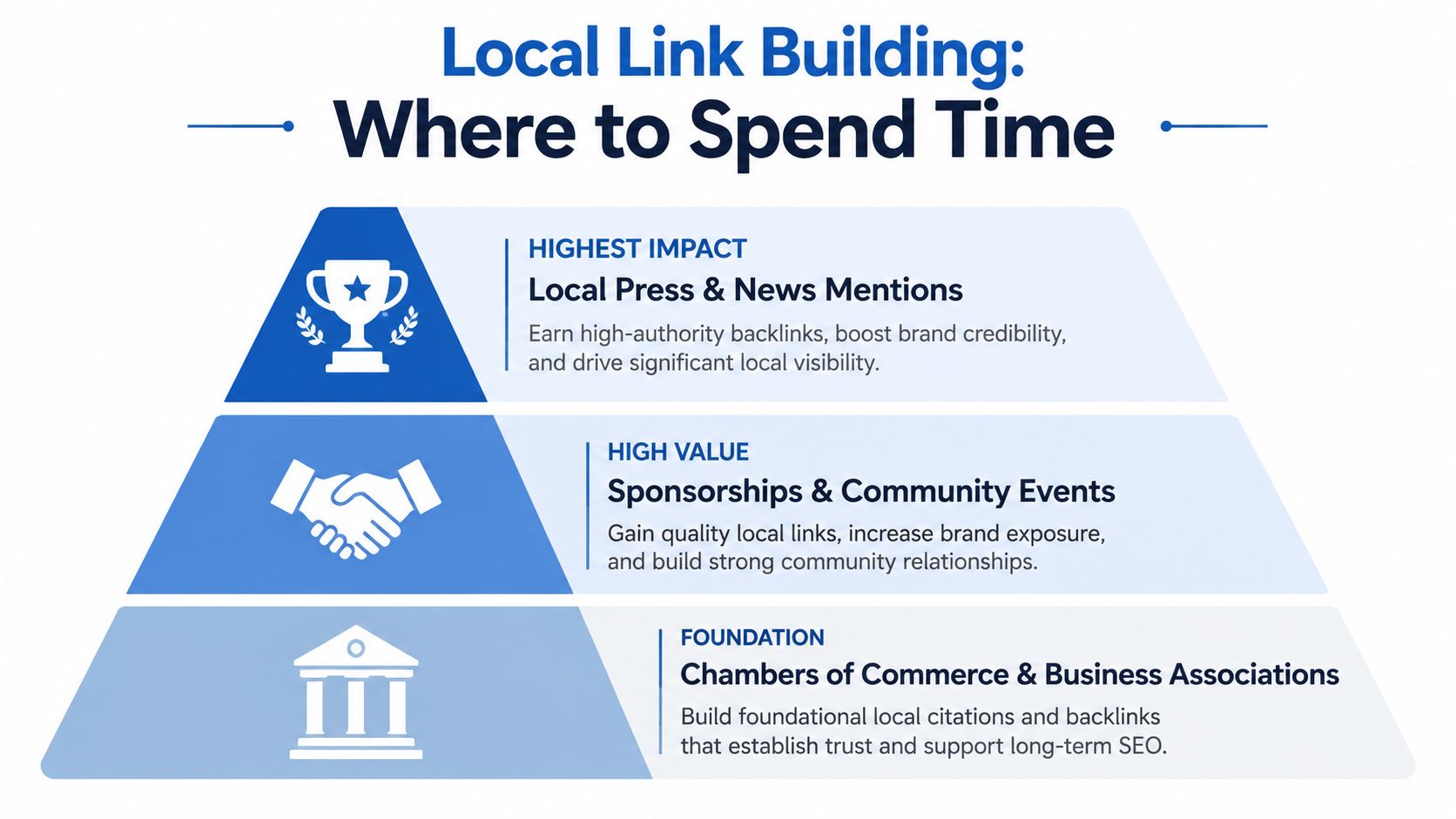
The links that usually move local search are tied to real places and real relationships, local press, community sponsorships, chambers of commerce, supplier pages, partner references, and niche industry directories. They tell search engines that the branch has a real role in that market, not just a page that mentions the town name. That local context matters more than chasing broad authority links that have no bearing on the area you serve.
For multi-location brands, the useful question is which branch should get the next round of time and budget. I would rank branches by revenue potential, competitive intensity, and current underperformance, then assign content and outreach effort from there. A weak branch with strong upside often deserves more work than a stable branch that is already holding its map visibility.
Don't ignore the invisible branches
Ghost branches create a real operational headache. The business is trading, the team is active, but Maps visibility stays thin because the profile is incomplete, inconsistent, or duplicated. That issue is common in multi-location programmes, and it becomes harder to spot once branch data starts drifting across systems and directories.
The fix starts with triage. Deal first with the listing that is clearly broken, then clean up the citation layer and review flow for the branches that matter most commercially, then build the local relationships that earn the best links. That order keeps the team out of low-yield busywork and stops the highest-value branch from being left with half-finished local signals.
AI-driven local surfaces raise the stakes again. If the citation ecosystem is messy, the machine-readable picture of the business becomes less reliable, which weakens the branch profile in the places that now summarise local intent. A consistent set of links, listings, and local references gives each branch a cleaner identity to work from, and that is often what separates a branch that gets surfaced from one that stays buried.
Measuring Local Search Performance and Next Steps
A lot of local SEO reporting gets stuck on vanity rankings. A branch can move from position eight to position four and still fail to generate calls if the profile is incomplete, the page is slow, or the listing looks stale. The better report shows whether the business is getting chosen.
Track the signals that map to revenue
GBP Insights gives you the basic behavioural picture, while Search Console shows how the website is being discovered and clicked. For multi-location brands, dedicated local rank trackers are worth the money when they let you measure map pack visibility by postcode or neighbourhood instead of at company level. That local granularity is what turns performance into a real management tool.
A useful monthly report should include calls, direction requests, store visits where available, review volume and response coverage, plus movement in the local pack for the branch's core queries. That gives you enough detail to see whether the profile, the website, or the citation layer is doing the job. It also helps you spot which branches need intervention before the decline becomes obvious to customers.
Make hygiene a permanent job
The biggest mistake is treating local search optimisation like a one-time cleanup. It isn't. Profiles drift, citations decay, reviews slow down, and branch information changes as the business grows or restructures.
AI-driven local surfaces make that maintenance even more important, because listing consistency, third-party citations, and review language all feed machine-readable signals about relevance and prominence. The operating model is simple, keep the data clean, keep the profile complete, and keep the branches that matter most under active management. That's how local visibility stays defensible instead of slipping back into clutter.
If you need a team that can turn messy branch data, weak location pages, and underperforming local profiles into a cleaner search presence, visit Grumspot. They work on technical SEO, conversion-focused site improvements, and the kind of audits that expose where local visibility is leaking. If your branches are losing visibility to better-organised competitors, they can help you fix the underlying structure, not just the symptoms.
Let's build something together
If you like what you saw, let's jump on a quick call and discuss your project

Related posts
Check out some similar posts.