Localization vs Internationalization for Shopify Growth
- localization vs internationalization
- Shopify internationalization
- ecommerce localization
- Shopify Plus global
- international SEO
Launched
September, 2026
A Shopify brand gets its first international orders, then discovers that “selling abroad” means more than adding a country selector. Product pages need another language, prices need to feel local, checkout needs the right payment and tax logic, and the theme must survive longer or shorter translated strings. Meanwhile, the SEO team is asking whether the new market should use separate URLs, and engineering is wondering which app will become the next integration bottleneck.
That's where the localization vs internationalization debate becomes a revenue decision. Internationalization gives your Shopify or Shopify Plus store the technical capability to serve multiple markets. Localization adapts that capability into an experience buyers trust in one specific market.
The order matters. Localize before the platform can reliably handle multiple locales and you'll create duplicated logic, fragile imports and expensive rework. Internationalize without adapting the customer experience and you may launch a technically elegant storefront that still feels foreign at checkout.
The UK makes the stakes unusually clear. E-commerce represented 27% of total retail in 2025 and 2026 in Landmark Global's UK factsheet, while the Office for National Statistics reported internet sales at about 28% of total retail in September 2025. The same factsheet reports that 31% of UK online shoppers buy from overseas, and 32% of those cross-border shoppers do so at least once a month. Those buyers already understand international shopping. They also have plenty of reasons to abandon a store that presents the wrong language, currency, delivery expectations or payment experience. (Landmark Global's UK e-commerce factsheet)
This guide gives Shopify teams a practical way to decide what to build first, what to localize and where compliance or data flows can derail expansion. It focuses on the work that affects engineering capacity, search visibility, customer confidence and conversion, rather than treating the distinction as a terminology exercise.
Why This Distinction Decides Global Growth
A merchant preparing to enter a second market often starts with the visible work. The team translates the homepage, duplicates a few product descriptions and turns on a new currency. The launch looks complete until a customer sees an untranslated cart error, a shipping estimate that doesn't match the destination or an address form that can't handle local formatting.
That failure usually isn't a translation problem. It's an internationalization gap showing up through a localization task. The store may have strings hardcoded into theme sections, apps that ignore the selected locale or feeds that pass inconsistent product and price data. Marketing owns the symptoms, but engineering owns the underlying structure.
The UK is a useful test case because online shopping is already mainstream. The International Trade Administration said UK retail e-commerce sales were expected to reach a new high in 2025, representing 38.1% of total UK retail sales, and projected e-commerce revenue to reach $185.97 billion by 2029, with annual average growth of 7.01%. Landmark Global estimated about 59 million online shoppers in the UK in 2025. (International Trade Administration's UK e-commerce guide)
For a Shopify Plus merchant, that creates two separate decisions:
| Decision | The question it answers | Typical owner |
|---|---|---|
| Internationalization | Can the platform support additional markets without rewriting its core systems? | Engineering, architecture and operations |
| Localization | Does this market receive an experience that feels relevant and trustworthy? | Ecommerce, marketing, merchandising and local specialists |
| Translation | Are the words accurate and appropriate in the target language? | Translators, content teams and reviewers |
| Market operations | Can the business fulfil, tax, support and report on orders correctly? | Finance, logistics, customer service and compliance |
The common mistake is treating these as a single launch checklist. A translated product page can't compensate for broken currency routing. A well-structured Shopify Markets setup can't compensate for a checkout that ignores local expectations.
The practical distinction: internationalization is the platform capability that lets you expand, while localization is the market-specific work that helps that capability produce revenue.
The rest of the decision follows from that split. If you're testing one market with a simple catalogue, you may localize a narrow customer journey while keeping the broader architecture modest. If you're building a multi-market operating model, you need the foundation before every new market becomes a custom project.
What Internationalization and Localization Really Mean
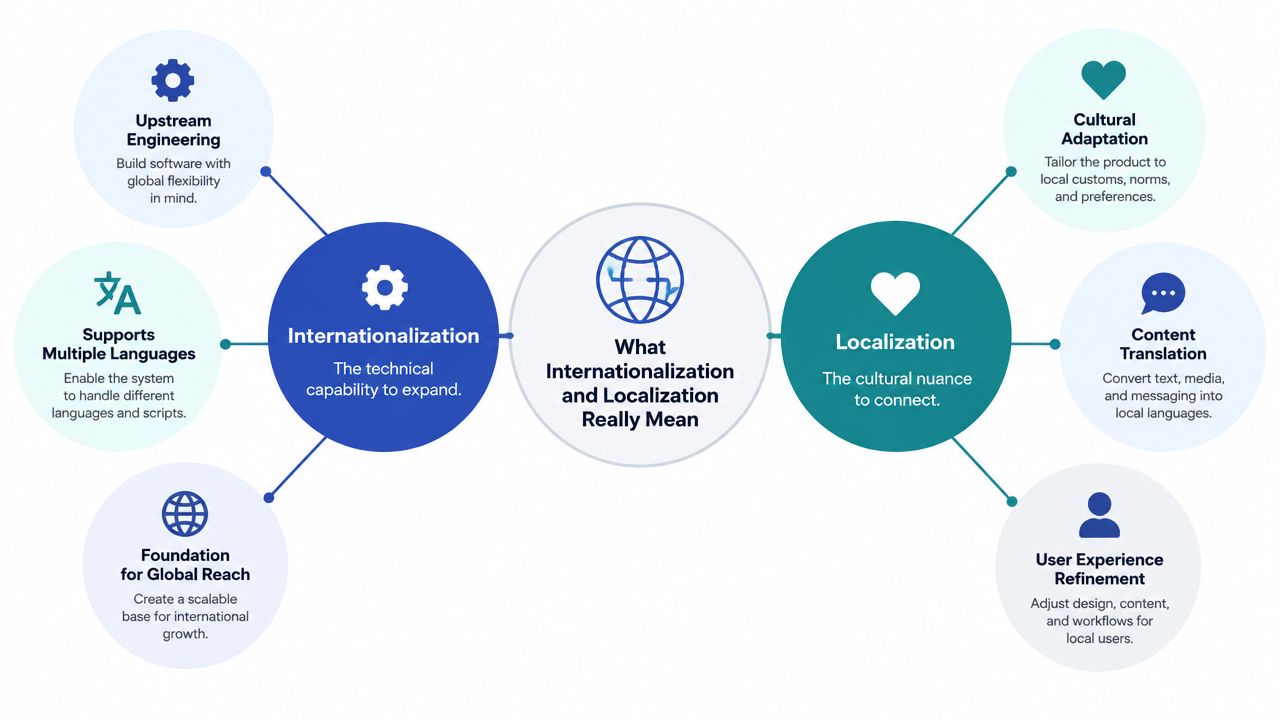
Internationalization is the upstream engineering work that prepares a store to support multiple locales. It covers the systems and conventions that let a Shopify or Shopify Plus implementation handle different languages, currencies, markets, formats, integrations and data flows without embedding one country's assumptions everywhere.
Localization is the market-specific adaptation layered on top. It changes the experience for a defined audience, including language, pricing presentation, imagery, product claims, delivery information, payment options, customer support and checkout expectations.
Translation sits inside localization, but it isn't the whole discipline. Replacing English words with words from another language leaves dates, address fields, tax messages, product attributes and promotional logic untouched. Buyers may understand the copy while still recognising that the store wasn't designed for them.
The foundation layer
On Shopify, internationalization can involve configuring Markets, separating locale content from theme logic, standardising market and language identifiers, and checking that apps, feeds, analytics and fulfilment systems pass those identifiers consistently. A custom app should retrieve translated strings and locale-aware values rather than assume one language, one price format or one address structure.
GOV.UK's language-support guidance illustrates the engineering reality. Adding a language requires an IETF-compatible language tag, translated locale files, and updates to application configuration and schema files before development can proceed. The process also includes importing translated CSV files, generating locale files and updating downstream publishing components so the language system stays consistent. (GOV.UK guidance on adding support for a new language)
That same principle applies to a Shopify ecosystem. You want a stable structure for translations, a controlled import workflow and a clear owner for every locale. Otherwise, each new market creates a new set of theme edits and app exceptions.
The experience layer
Localization starts with the buyer's context. A British customer may need familiar delivery language and VAT treatment. A customer in another market may expect different payment methods, address fields, sizing conventions or customer service hours. The correct choice depends on the market and product, so localization needs input from merchandising, operations and local reviewers, not only a translation vendor.
A useful test is simple: could a customer complete the purchase without mentally converting the experience? If they must convert the price, interpret unfamiliar delivery terms or wonder whether the returns policy applies to them, the store is only partially localized.
Detailed Comparison Across Purpose Timing and Ownership
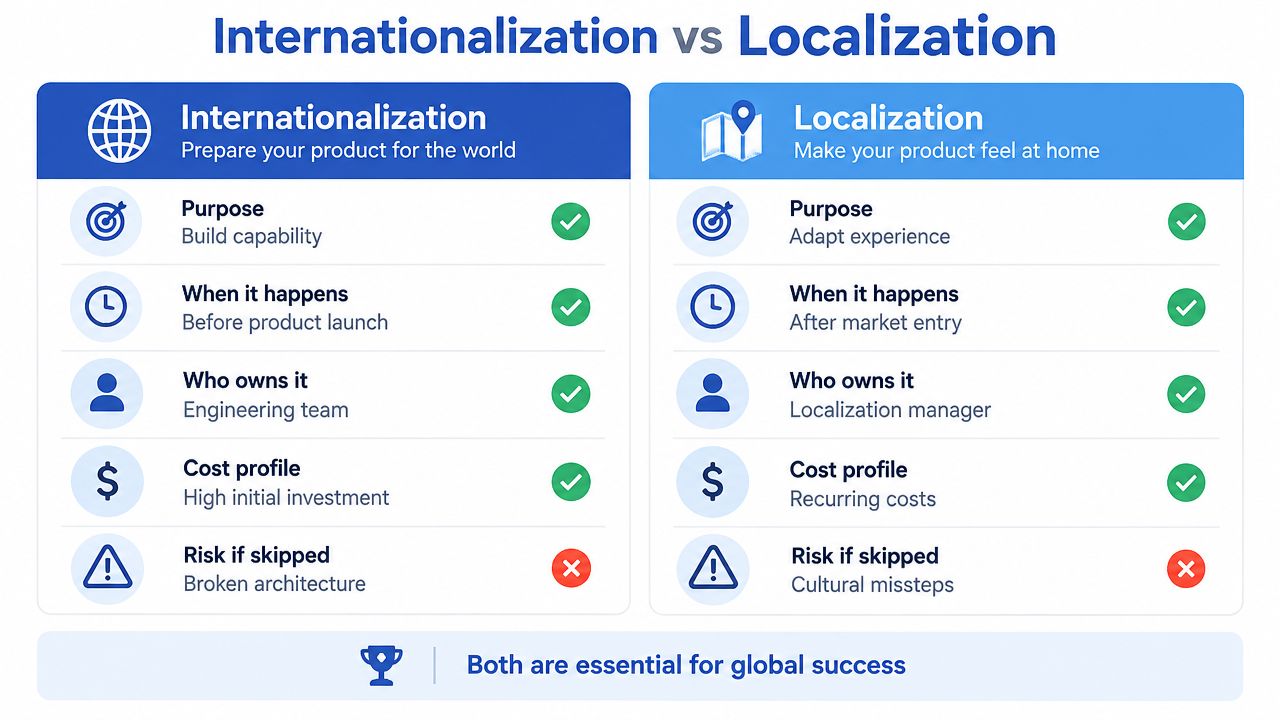
The cleanest way to separate the two is to compare the work against the decisions a Shopify team has to make. Internationalization changes how the platform is built. Localization changes how a market experiences that platform.
Purpose and timing
Internationalization should happen before expansion creates a long list of market exceptions. It externalises strings, supports locale-aware formatting, creates reliable market routing and gives integrations a consistent model to follow.
Localization happens as you enter or grow within a particular market. The team decides which products to feature, how to describe them, which content needs cultural adaptation and which commercial details must change.
| Criterion | Internationalization | Localization |
|---|---|---|
| Primary purpose | Build the capability to support markets | Adapt the experience for a market |
| Typical timing | Before broad multi-market rollout | Before and during a specific market launch |
| Core owners | Engineering, architecture and platform operations | Ecommerce, marketing, merchandising and local reviewers |
| Cost profile | Concentrated investment in structure and integration | Recurring market work across content, QA and operations |
| Risk if skipped | Hardcoded logic, inconsistent data and technical debt | Low trust, weak relevance and checkout friction |
Ownership and trade-offs
Engineering shouldn't be asked to decide local tone of voice, product positioning or culturally appropriate imagery. Equally, marketing shouldn't be expected to solve an app that renders English strings after the customer changes locale.
The best operating model gives each team a clear boundary. Engineering owns the reusable capability. Ecommerce and market teams own the customer-facing adaptation. Finance, legal, logistics and customer support join the launch before the storefront is considered ready.
Build the structure once where possible. Adapt the customer experience deliberately for every market.
Cost is where merchants often make the wrong short-term choice. Postponing internationalization can appear cheaper while the store serves one market, but the eventual retrofit touches themes, apps, checkout extensions, product data, analytics and operational systems. Localizing too broadly before validating demand can create unnecessary content and support overhead.
A focused launch can therefore use a narrow market scope, but it should still follow reusable conventions. A translation management process, stable locale identifiers and a documented QA checklist reduce localization risk without forcing the merchant to build every possible market up front. Teams that need a deeper distinction between language conversion and market adaptation can use this practical resource to reduce localization risk.
How Each Approach Impacts UX SEO and Operations
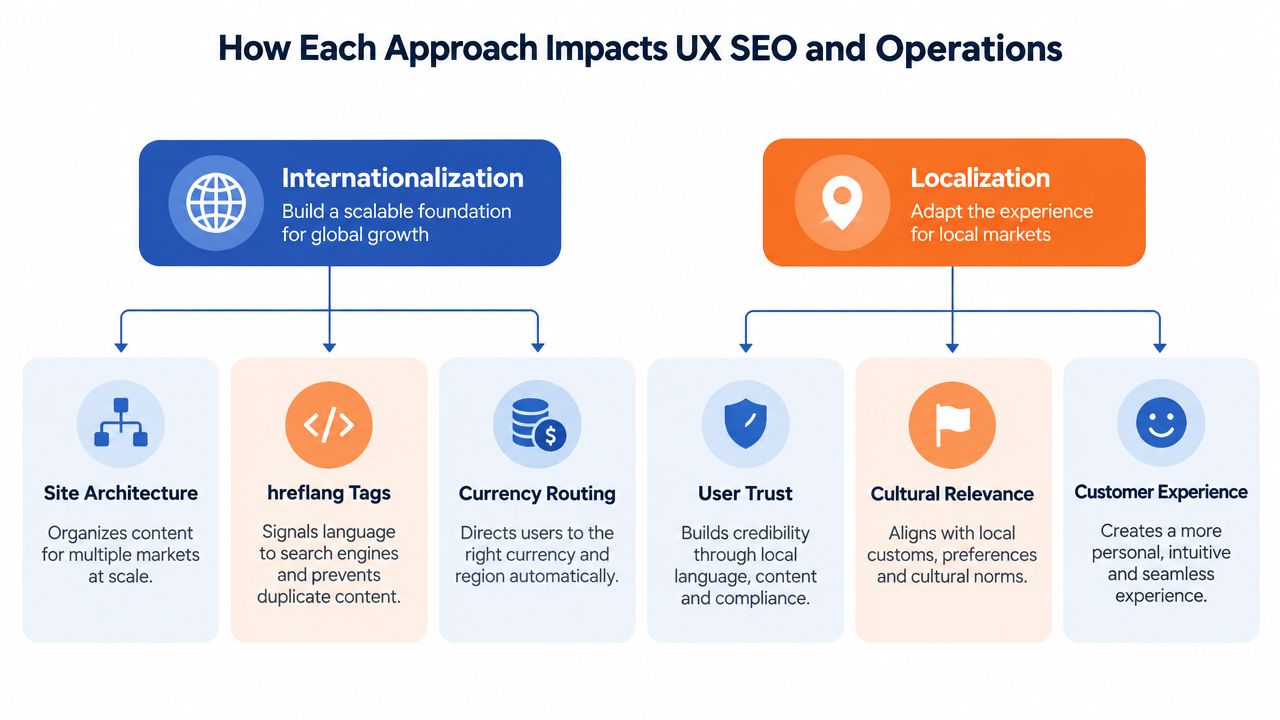
Internationalization affects what the store can reliably render and process. Localization affects whether the result makes sense to the customer. Both shape the buying journey, but they create different classes of failure.
At the architecture level, internationalization supports market routing, language selection, locale-aware formatting and maintainable content structures. It also gives SEO teams a dependable basis for language and regional URL strategies, metadata, canonical handling and hreflang implementation. Search engines can only interpret market relationships correctly when the site exposes consistent signals and serves the intended content at the intended URL.
Localization then determines whether the landing page earns the click and whether the product page supports the sale. Local language needs to sound natural, product benefits need to reflect market priorities and pricing must be clear. A page can be technically indexable and still underperform because its copy, imagery or delivery promise feels imported.
Accessibility is part of localisation quality
GOV.UK's translation guidance warns against placing translated text on the same page as English because mixed-language rendering can create problems for assistive technologies such as screen readers. Its public-sector pages appear in more than 60 languages alongside English and Welsh, demonstrating that scale requires publishing rules, metadata discipline and separate-language rendering, not just translated paragraphs. (GOV.UK guidance on planning and managing translations)
For ecommerce, this means QA should check more than visual appearance. Test language selectors, page titles, alt text, structured data, error messages, focus order and screen-reader output. Check the cart and checkout separately, because apps and extensions often bypass the theme's translation workflow.
Operations add another layer. Locale files need owners, translation updates need version control and product data needs a reliable source of truth. Customer service macros, transactional emails, return instructions and fulfilment notifications must align with the same market rules as the storefront.
Measurement must follow the market
A UK store expanding abroad shouldn't evaluate every market through one blended conversion rate. Segment reports by market, language, currency and traffic source, then connect changes in landing pages, product information and checkout behaviour to commercial outcomes. Teams that need a more complete operating model can review how to track campaigns abroad, particularly where attribution and market reporting span different campaigns and destinations.
For technical SEO implementation, use the ecommerce SEO best practices resource as an internal reference. The priority is consistency: each locale should expose the right content, metadata and market signals without creating duplicate or contradictory versions.
Implementation Steps for Shopify and Shopify Plus Stores
A reliable Shopify expansion starts with the platform, not the translation spreadsheet. The sequence below keeps reusable engineering work ahead of market-specific adaptation.
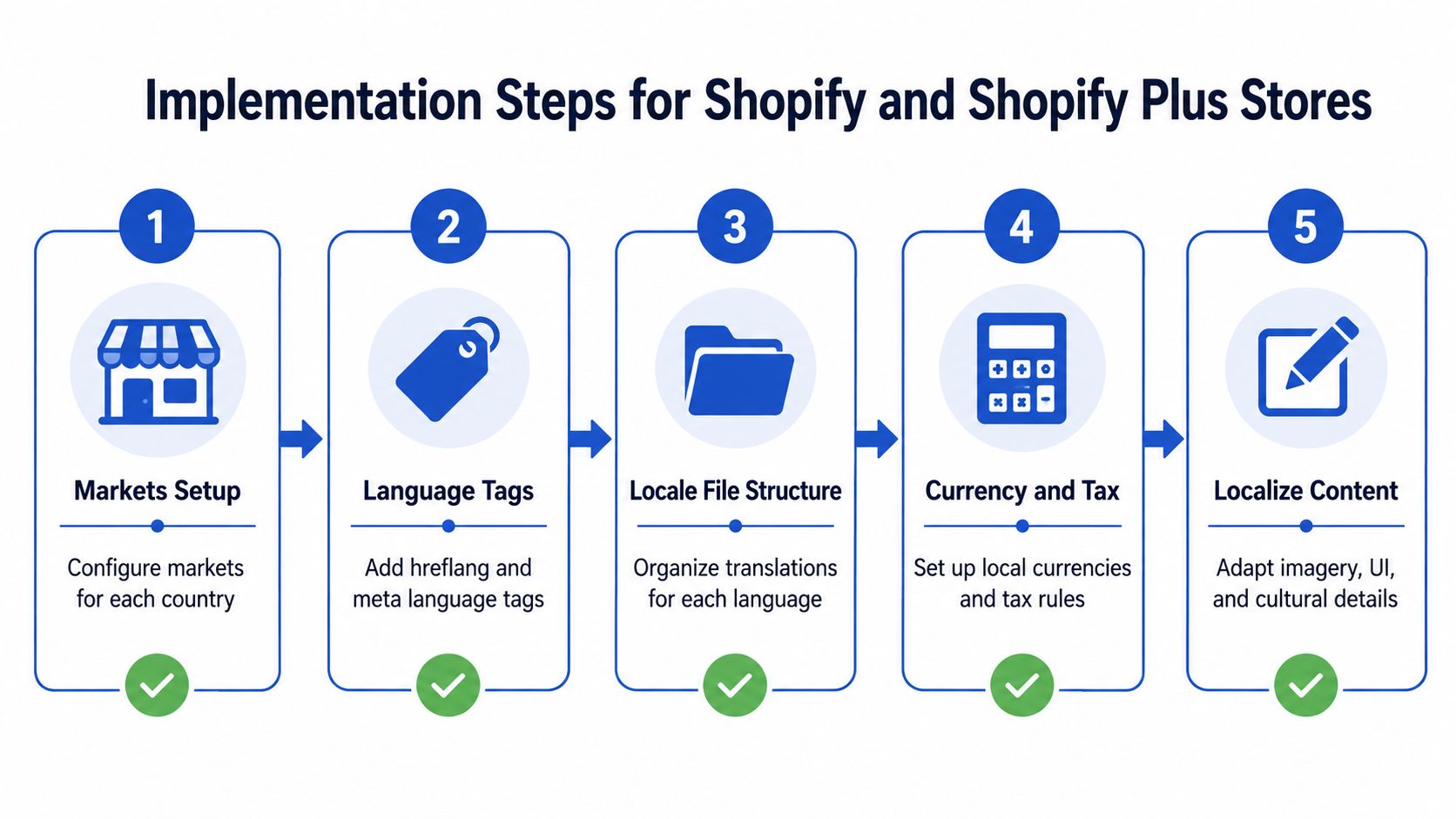
Start with the market model
Configure Shopify Markets. Define the countries or regions you intend to serve, assign domains or subfolders where appropriate, and document which products, currencies, shipping methods and payment options apply to each market. Don't create market entries without deciding who owns their commercial rules.
Standardise language identifiers. Use consistent locale and language tags across Shopify, translation tooling, custom apps, product feeds and analytics. GOV.UK's implementation guidance is a useful reminder that language support depends on correct identifiers and coordinated configuration, not only on translated text.
Create a controlled locale structure. Keep theme strings, product content, navigation, emails and app copy in predictable locations. Establish an import and review workflow before the catalogue expands. If an app can't respect the active locale or market, test a replacement before launch rather than hiding the problem in manual QA.
Then localize the customer journey
Set currency, tax and pricing rules. Decide how prices display, which tax information customers see, how rounding works and which systems receive the market value. Keep pricing decisions connected to margin and fulfilment, not only to the storefront selector. The internal guide to an international pricing strategy can help teams document those choices.
Adapt content and checkout. Translate product information with market context, review imagery and claims, configure local delivery language, and support relevant payment methods. Check account pages, returns, order emails, subscription flows and customer service content alongside the product page.
Custom apps, ERP connections and fulfilment systems should enter the plan early. They may need market identifiers, local tax values, translated statuses or different shipping services. Product feeds also deserve attention. Consistent titles, attributes and descriptions help merchants maintain catalogue quality across channels, while structured product data supports optimizing product pages for AI search without separating discoverability from the underlying content model.
Before opening a market to paid traffic, run a complete test order. Change language, change market, add a product, apply a discount, select delivery, pay, trigger fulfilment and inspect the customer email. Then test a refund and a support handoff. A launch is ready when the whole transaction works, not when the homepage translation is approved.
Real World Use Cases and When to Prioritize Each
Different merchants need different sequencing. The right answer depends on how many markets are planned, how much of the current stack assumes one locale and where the business expects revenue to come from.
One new market for a focused DTC test
A small DTC brand entering one market can start with a narrow localization pilot. Keep the catalogue focused, translate the pages that support the intended journey and validate pricing, delivery, returns and payment expectations before expanding the content footprint.
That doesn't justify hardcoding the market into the theme. Use reusable locale structures, stable product identifiers and documented rules from the beginning. The brand gets a faster test without turning the test into permanent technical debt.
A Shopify Plus brand entering several markets
A Plus merchant entering several European markets should internationalize first. Shared components, app compatibility, market routing, analytics and product data need a common foundation before teams create market variations.
Localization then happens in waves. Prioritise the markets with the clearest fulfilment capability and strongest commercial case, rather than translating every page simultaneously. This approach concentrates local review and QA where they can influence the launch, while engineering keeps the platform model reusable.
A catalogue business with complex compliance
Marketplace-style catalogues and businesses with regulated products often face operational constraints that outweigh language work. Product eligibility, tax treatment, data handling, consent, returns and fulfilment may determine whether a market can launch at all.
The UK Business Data Survey 2026 found that 10% of businesses handling digitised data transferred data internationally, rising to 27% among businesses trading outside the UK. It also found that 3% encountered issues due to data localisation rules in the receiving country. (UK Business Data Survey 2026 reference)
Those findings reinforce a point many localization guides miss. Data localization is not the same as translating content. Before committing to a market, map where customer, order, payment and marketing data is stored and processed, which vendors receive it and which retention or transfer requirements apply.
For Shopify teams expanding into the EU, use a concrete compliance checklist alongside the storefront plan, such as this guide to GDPR compliance for Shopify stores expanding into the EU in 2026. Legal review should happen before development locks the architecture, because changing consent, data and integration flows late can affect the entire checkout and CRM setup.
Choosing the Right Path for Your Store and Next Steps
There isn't one universal answer to localization vs internationalization. Use three signals: the number of markets you expect to support, where revenue concentration sits and how much technical debt the current store already carries.
| Merchant situation | Recommended priority | Why this order works | First action |
|---|---|---|---|
| One market, one pilot destination, simple stack | Localization pilot with basic internationalization discipline | Tests demand while avoiding market-specific hardcoding | Audit strings, currency, checkout and fulfilment for the pilot |
| Several planned markets, shared catalogue and multiple integrations | Internationalization first, then staged localization | Creates reusable rules before market variations multiply | Map Markets, locales, apps, feeds, tax and operational data flows |
| Existing store with brittle theme or app logic | Technical remediation first, then localization | Prevents translated content from exposing deeper platform failures | Run a Shopify architecture, app and checkout audit |
| Compliance-heavy catalogue or cross-border data flow | Internationalization and compliance together | Legal and operational constraints can block expansion independently of language | Map data processors, consent, tax, fulfilment and market eligibility |
Start with an inventory of every customer-facing string and every system that touches an order. Then choose one pilot market, define its localization acceptance criteria and test a complete purchase journey from landing page through refund. Track market-level conversion, search visibility, support issues and checkout failures instead of relying on blended store averages.
Bring in a Shopify Plus partner when the work crosses theme architecture, custom apps, ERP or fulfilment integrations, multi-market SEO and compliance. Grumspot provides Shopify design and development support across internationalization, localized storefront work, migrations, integrations and conversion-focused audits. Visit Grumspot to discuss your current store architecture, pilot market and expansion sequence.
Grumspot can audit your Shopify or Shopify Plus foundation, configure a scalable multi-market setup and localize the customer journey around the markets you're targeting. Visit Grumspot to turn your expansion plan into a tested storefront, clean integrations and a clearer path to international revenue.
Let's build something together
If you like what you saw, let's jump on a quick call and discuss your project

Related posts
Check out some similar posts.